226
Zero-shot transfer for implicit discourse relation classification
Murathan Kurfalı Department of Linguistics
Stockholm University
Robert ¨Ostling Department of Linguistics
Stockholm University [email protected]
Abstract
Automatically classifying the relation between sentences in a discourse is a challenging task, in particular when there is no overt expression of the relation. It becomes even more chal-lenging by the fact that annotated training data exists only for a small number of languages, such as English and Chinese. We present a new system using zero-shot transfer learning for implicit discourse relation classification, where the only resource used for the target lan-guage is unannotated parallel text. This system is evaluated on the discourse-annotated TED-MDB parallel corpus, where it obtains good results for all seven languages using only En-glish training data.
1 Introduction
The difference between a set of randomly se-lected sentences and a discourse lies in coherence. Among other attempts at defining the elusive na-ture of coherence, one way is to look at the mean-ing conveyed between the adjacent pair of sen-tences. In the current study, we follow the Penn Discourse Treebank (PDTB) framework which re-gards abstract objects (Asher, 2012) as the units of discourse and views the text as a collection of discourse level predicates, each taking two argu-ments. Such predicates, called discourse connec-tives, may (Ex. 1) or may not (Ex. 2) be repre-sented in the surface form:
1. Because the drought reduced U.S. stock-piles, they have more than enough storage space for their new crop, and that permits them to wait for prices to rise.
2. But a few funds have taken other defensive steps. Some have raised their cash positions to record levels. Implicit = BECAUSEHigh cash positions help buffer a fund when the market falls.
whereitalicsrepresents the first andboldfacethe second argument to the underlined discourse con-nective. The discourse relations which lack an overt discourse connective (Ex. 2) are referred as implicit discourse relations and are shown to be the most challenging part of the discourse parsing (e.g.Pitler et al.,2009).
In this paper, we perform implicit discourse re-lation classification using three recent data sets an-notated according to the same guidelines: Penn Discourse Treebank (PDTB) 3.0, the Turkish Dis-course Bank (TDB), and the multilingual TED-MDB. To the best of our knowledge, multilingual training and zero-shot transfer has not previously been investigated for this problem. The results suggest that an implicit discourse relation classi-fier can transfer well across dissimilar languages, and that pooling training data from unrelated lan-guages (English and Turkish) leads to significantly better performance for all languages.
2 Related Work
Implicit discourse relation recognition is often handled as a classification task, where earlier stud-ies focused on using linguistically rich features (Pitler et al., 2009; Zhou et al., 2010; Park and Cardie,2012;Rutherford and Xue,2014).
Recently, neural network approaches have be-come popular. Ji and Eisenstein (2015) use two RNNs on the syntactic trees of the arguments whereasZhang et al.(2015) use a CNN to perform discourse parsing in a multi-task setting where they consider both explicit and implicit discourse relations.
Rutherford and Xue(2016) use a simple yet ro-bust feedforward network and achieves the highest performance on the out-of-domain blind test in the CoNLL 2016 shared task (Xue et al.,2016).
attention-based neural network model whereas Bai and Zhao (2018) focus on the representation of the sentence pair and take different levels of text, from character to sentence pair, into account to achieve a richer representation.
Dai and Huang (2018) adopt a similiar ap-proach and represent discourse units by consid-ering a wider paragraph-level context. The dis-course unit representations are created by a Bi-LSTM which takes a sequence of discourse rela-tions in a paragraph which enables capturing the inter-dependencies between discourse relations as well.
3 Data
We use four different data sets: the Penn Discourse Treebank (PDTB) version 2.0 (Prasad et al.,2008) and version 3.0 (Prasad et al.,2018), as well as the TED Multilingual Discourse Bank (TED-MDB,
Zeyrek et al. 2018) and the Turkish Discourse Bank (TDB,Zeyrek and Kurfalı 2017).
The PDTB is built upon the 1 million word Wall Street Journal corpus and is the largest avail-able resource for discourse relations. Most related work uses PDTB 2.0, so we include this for com-paring our baseline to previous work.
The recently released PDTB 3.0 adopts a new annotation schema as well as an updated sense hi-erarchy. PDTB 3.0 includes the annotations of PDTB 2.0 updated according to the new annota-tion schema, as well as about 13 thousand new an-notations, of which about 5K are implicit relations (Prasad et al., 2018). The distribution of the top level senses of the implicit discourse relations in both PDTB versions is provided in Table1.
TED-MDB (Zeyrek et al.,2018) is the first par-allel corpus annotated for discourse relations. It closely follows the PDTB 3.0 framework and in-cludes the manual annotations of six TED talks in seven languages (English, Turkish, European Por-tuguese, Polish, German, Russian) aiming to allow crosslingual comparison of discourse relations1. It
has recently also been updated with Lithuanian (Oleskeviciene et al.,2019).
Despite the high number of languages covered by TED-MDB, the amount of annotated text per language is limited (see Table2). Therefore, in the current study, we limit ourselves with the top level senses, namely Expansion, Contingency,
Compar-1The TED-MDB annotations are available at: https://github.com/MurathanKurfali/Ted-MDB-Annotations
ison and Temporal. We only use TED-MDB for evaluation.
Among the TED-MDB languages other than English, only Turkish has another corpus an-notated with PDTB 3.0 discourse annotations, namely the Turkish Discourse Bank (TDB). TDB is a multi-genre corpus of 40 000 words, consider-ably less than the PDTB (see Table2), but it pro-vides the only directly comparable baseline to as-sess the performance of zero-shot learning.
PDTB2 PDTB3
Sense Train Dev Test Train Dev Test Comp. 1894 401 146 1828 404 153 Cont. 3281 628 276 5872 1159 527 Exp. 6792 1253 556 7939 1466 643 Temp. 665 93 68 1413 230 148
Table 1: Distribution of top level senses of the im-plicit discourse relations in PDTB 2.0 and PDTB 3.0 training, development and test sets: comp(arison), cont(ingency), exp(ansion), temp(oral).
4 Model
The main purpose of this study is to assess the per-formance of transfer learning on the implicit dis-course relation classification task. To this end, we use a simple feedforward network fed with mul-tilingual sentence embeddings following the find-ing of (Rutherford et al.,2017) which shows that simple discourse models with feedforward layers perform on par or better than those of with sur-face features or recurrent and convolutional archi-tectures.
We follow the model of (Rutherford and Xue,
2016) due to its simplicity and robust nature even in the multilingual setting with different argument and discourse relation representations. We repre-sent the arguments of the discourse relation via pre-trained LASER model (Artetxe and Schwenk,
2018). LASER is chosen as it is the current state-of-the-art model on several Natural Language In-ference (NLI) transfer learning tasks, a sentence relation classification problem similar to discourse relation classification.
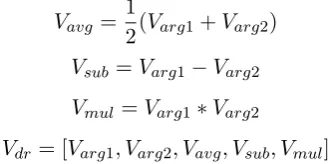
Given the argument vectors, Varg1 and Varg2,
Language Comparison Contingency Expansion Temporal Total English 20 (10.31%) 52 (26.80%) 107 (55.15%) 15 (7.73%) 194 (100%) German 13 (6.07%) 41 (19.16%) 148 (69.16%) 12 (5.61%) 214 (100%) Lithuanian 26 (10.57%) 53 (21.54%) 154 (62.60%) 13 (5.28%) 246 (100%) Polish 19 (9.74%) 28 (14.36%) 130 (66.67%) 18 (9.23%) 195 (100%) Portuguese 23 (9.06%) 47 (18.50%) 169 (66.54%) 15 (5.91%) 254 (100%) Russian 16 (7.24%) 31 (14.03%) 169 (76.47%) 5 (2.26%) 221 (100%) Turkish 20 (9.90%) 29 (14.36%) 140 (69.31%) 13 (6.44%) 202 (100%) TDB (training) 71 (10.94%) 142 (21.88%) 363 (55.93%) 73 (11.25%) 649 (100%) TDB (dev) 11 (9.82%) 31 (27.68%) 49 (43.75%) 21 (18.75%) 112 (100%)
Table 2: Distribution of top level senses of the implicit discourse relations in the TED-MDB and TDB corpora. The numbers within the parenthesis indicate the ratio. Since there is no official training/dev split for TDB, we arbitrarily chose two sections with different genres for the development set.
Vavg = 1
2(Varg1+Varg2) Vsub=Varg1−Varg2
Vmul =Varg1∗Varg2
Vdr = [Varg1, Varg2, Vavg, Vsub, Vmul]
The resulting vector is further fed into a hidden layer ht with d hidden units2 to achieve a more abstract representation of the relation and finally the outputois calculated using the sigmoid func-tion. This model is also essentially the same as was used byArtetxe and Schwenk(2018) for NLI transfer learning.
5 Experiments
We formulate the implicit relation classification as four ”one vs other” binary classification task. We follow the conventional setting of the first study (Pitler et al., 2009) and split the PDTB 2.0 into training (sections 2-20), development (sections 0-1 and 23-24) and test sets (sections 20-1-22) to have directly comparable results with the previous work. However, following the PDTB’s original distinction but unlike some previous work, we dis-tinguish Entity-based relations from implicit rela-tions. Each classifier is trained on an equal number of positive and negative instances where the nega-tive instances are randomly selected in each epoch to have a better representation of the data during the training. This model is evaluated on the PDTB 2.0 test set to confirm whether our model performs adequatly on same-language, same-domain data. These results are directly comparable to previous work.
2We use d=100 in the experiments
As TED-MDB is annotated according to the PDTB 3.0 framework, we train separate classifiers on PDTB 3.0 following the same convention as above. We test the trained models on all the im-plicit discourse relations in the TED-MDB corpus. The PDTB framework allows annotations to be labelled with more than one label. In such cases we only keep the first label, in line with previ-ous studies (among othersJi and Eisenstein,2015;
Rutherford et al.,2017).
The argument vectors are kept fixed during the training, and we do not update the parameters of the LASER model. We use cross-entropy loss, and AdaGrad as the optimizer. We evaluate using the model which achieved the highest F-score on the development set. As for the regularization, we use a dropout layer between the input and the hidden layer with a dropout probability of 0.3. All models are run 100 times to estimate the variance due to random initialization and stochastic training. All the models are implemented in PyTorch3.
6 Results and Discussion
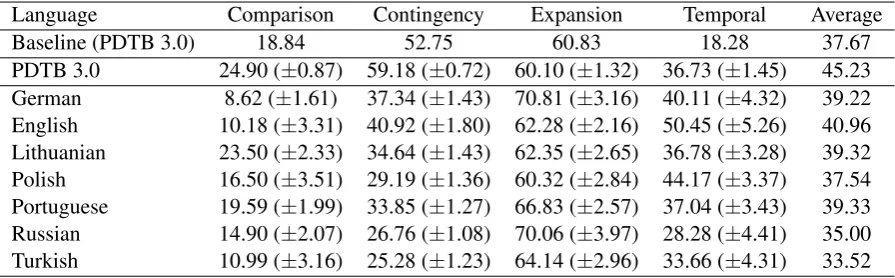
Table 3 shows the same-language, same-domain performance of our system, in comparison to pre-vious work. All figures refer to PDTB 2.0 test set F-score, when trained on the PDBT 2.0 training set, and are directly comparable. While our model does not achieve state-of-the-art performance in this setting, this experiment shows that it performs adequately for English, and provides a reasonable baseline for the zero-shot experiments presented in Tables4and5. We also include a naive baseline system which always predictsTRUEand is evalu-ated on the respective (PDTB 2.0 or PDTB 3.0)
Comparison Contingency Expansion Temporal
(Pitler et al.,2009) 21.96 47.13 - 16.76
(Zhou et al.,2010) 31.79 47.16 70.11 20.30 (Park and Cardie,2012) 31.32 49.82 - 26.57 (Rutherford and Xue,2014) 39.70 54.42 70.23 28.69 (Zhang et al.,2015) 33.22 52.04 69.59 30.54 (Ji and Eisenstein,2015) 35.93 52.78 - 27.63 (Lan et al.,2017) 40.73 58.96 72.47 38.50 (Bai and Zhao,2018) 47.85 54.47 70.60 36.87 (Dai and Huang,2018) 46.79 57.09 70.41 45.61
Baseline 24.49 41.75 69.41 12.20
[image:4.595.84.515.62.228.2]Our system 28.19 (±0.83) 50.63 (±1.00) 64.07 (±1.90) 29.22 (±2.53)
Table 3: Comparison of the F scores (%) of binary classifiers on PDTB 2.0 test set. Left out scores refer to the results where EntRel relations are also considered to be Expansion.
Language Comparison Contingency Expansion Temporal Average
Baseline (PDTB 3.0) 18.84 52.75 60.83 18.28 37.67
PDTB 3.0 24.90 (±0.87) 59.18 (±0.72) 60.10 (±1.32) 36.73 (±1.45) 45.23 German 8.62 (±1.61) 37.34 (±1.43) 70.81 (±3.16) 40.11 (±4.32) 39.22 English 10.18 (±3.31) 40.92 (±1.80) 62.28 (±2.16) 50.45 (±5.26) 40.96 Lithuanian 23.50 (±2.33) 34.64 (±1.43) 62.35 (±2.65) 36.78 (±3.28) 39.32 Polish 16.50 (±3.51) 29.19 (±1.36) 60.32 (±2.84) 44.17 (±3.37) 37.54 Portuguese 19.59 (±1.99) 33.85 (±1.27) 66.83 (±2.57) 37.04 (±3.43) 39.33 Russian 14.90 (±2.07) 26.76 (±1.08) 70.06 (±3.97) 28.28 (±4.41) 35.00 Turkish 10.99 (±3.16) 25.28 (±1.23) 64.14 (±2.96) 33.66 (±4.31) 33.52
Table 4: F scores (%) when the model is trained only on PDTB 3.0. In the table, PDTB 3.0 refers to the test set of the PDTB 3.0 corpus. The remaining rows refer to evaluations using TED-MDB.
test set in our comparisons.
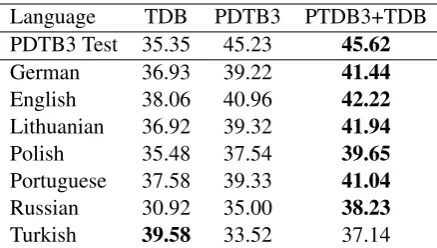
In all zero-shot experiments, evaluation is per-formed on the available test data with PDTB 3.0 annotations: TED-MDB, and the PDTB 3.0 test set itself. Results in Table 4use PDTB 3.0 only for training, whereas Table 5 presents the effect of having additional training data from Turkish (a language unrelated to English). Pooling training data from different languages is possible since our model is language-agnostic.
In all zero-shot experiments, we see similar levels of performance across all the evaluated languages in TED-MDB. While not completely comparable numerically since annotations differ slightly between languages, this evaluation set consists of parallel sentences annotated according to the same guidelines. The similarity in scores between the training language(s)—English and/or Turkish—and the remaining languages indicates that little accuracy is lost during transfer.
Comparing the performances with and without additional Turkish data, TDB, reveals that adding
a small amount (relative to the size of PDTB 3.0) of Turkish training data improves the F-scores by a statistically significant amount4for not only Turk-ish, but for all the languages in TED-MDB Ta-ble5.
7 Conclusion
In the current paper we have presented the (to the best of our knowledge) first study of zero-shot learning in the implicit discourse relation classifi-cation task. Our method does not require any dis-course level annotation for the target languages, yet still achieves good performance even for those languages where no training data is available. The performance is further increased by pooling train-ing data from multiple languages. Ustrain-ing our pub-lished code5 and publicly available resources it can used for implicit discourse classification in
4
On a sense-wise analysis, we observe that the main in-crease is in the Expansion relations; however, there is no de-crease in any of the other senses.
[image:4.595.75.523.272.411.2]Language TDB PDTB3 PTDB3+TDB PDTB3 Test 35.35 45.23 45.62
German 36.93 39.22 41.44
English 38.06 40.96 42.22
Lithuanian 36.92 39.32 41.94
Polish 35.48 37.54 39.65
Portuguese 37.58 39.33 41.04
Russian 30.92 35.00 38.23
[image:5.595.73.292.61.185.2]Turkish 39.58 33.52 37.14
Table 5: Comparison of average F-scores (%) when the model is trained on different training sets. Bold means significantly higher F-score than the second highest column (p <0.001, Mann-Whitney U test).
nearly a hundred languages.
Acknowledgments
We would like to thank Bonnie Webber for her help in obtaining PDTB 3.0 and Mats Wir´en for his useful comments.
References
Mikel Artetxe and Holger Schwenk. 2018. Mas-sively multilingual sentence embeddings for zero-shot cross-lingual transfer and beyond. arXiv preprint arXiv:1812.10464.
Nicholas Asher. 2012. Reference to abstract objects in discourse, volume 50. Springer Science & Business Media.
Hongxiao Bai and Hai Zhao. 2018. Deep enhanced representation for implicit discourse relation recog-nition.arXiv preprint arXiv:1807.05154.
Zeyu Dai and Ruihong Huang. 2018. Improving im-plicit discourse relation classification by modeling inter-dependencies of discourse units in a paragraph. arXiv preprint arXiv:1804.05918.
Yangfeng Ji and Jacob Eisenstein. 2015. One vector is not enough: Entity-augmented distributed semantics for discourse relations. Transactions of the Associa-tion for ComputaAssocia-tional Linguistics, 3:329–344.
Man Lan, Jianxiang Wang, Yuanbin Wu, Zheng-Yu Niu, and Haifeng Wang. 2017. Multi-task attention-based neural networks for implicit discourse rela-tionship representation and identification. In Pro-ceedings of the 2017 Conference on Empirical Meth-ods in Natural Language Processing, pages 1299– 1308.
Allen Nie, Erin D Bennett, and Noah D Goodman. 2017. Dissent: Sentence representation learning from explicit discourse relations. arXiv preprint arXiv:1710.04334.
Giedre Valunaite Oleskeviciene, Deniz Zeyrek, Vik-torija Mazeikiene, and Murathan Kurfalı. 2019. Ob-servations on the annotation of discourse relational devices in ted talk transcripts in lithuanian. Pro-ceedings of the workshop on annotation in digital humanities co-located with ESSLLI 2018, pages 53– 58.
Joonsuk Park and Claire Cardie. 2012. Improving im-plicit discourse relation recognition through feature set optimization. InProceedings of the 13th Annual Meeting of the Special Interest Group on Discourse and Dialogue, pages 108–112. Association for Com-putational Linguistics.
Emily Pitler, Annie Louis, and Ani Nenkova. 2009. Automatic sense prediction for implicit discourse re-lations in text. InProceedings of the Joint Confer-ence of the 47th Annual Meeting of the ACL and the 4th International Joint Conference on Natural Lan-guage Processing of the AFNLP: Volume 2-Volume 2, pages 683–691. Association for Computational Linguistics.
Rashmi Prasad, Nikhil Dinesh, Alan Lee, Eleni Milt-sakaki, Livio Robaldo, Aravind K Joshi, and Bon-nie L Webber. 2008. The penn discourse treebank 2.0. InLREC. Citeseer.
Rashmi Prasad, Bonnie Webber, and Alan Lee. 2018. Discourse annotation in the pdtb: The next genera-tion. InProceedings 14th Joint ACL-ISO Workshop on Interoperable Semantic Annotation, pages 87–97.
Attapol Rutherford, Vera Demberg, and Nianwen Xue. 2017. A systematic study of neural discourse mod-els for implicit discourse relation. InProceedings of the 15th Conference of the European Chapter of the Association for Computational Linguistics: Volume 1, Long Papers, pages 281–291.
Attapol Rutherford and Nianwen Xue. 2014. Discover-ing implicit discourse relations through brown clus-ter pair representation and coreference patclus-terns. In Proceedings of the 14th Conference of the European Chapter of the Association for Computational Lin-guistics, pages 645–654.
Attapol Rutherford and Nianwen Xue. 2016. Robust non-explicit neural discourse parser in english and chinese. Proceedings of the CoNLL-16 shared task, pages 55–59.
Nianwen Xue, Hwee Tou Ng, Sameer Pradhan, At-tapol Rutherford, Bonnie Webber, Chuan Wang, and Hongmin Wang. 2016. Conll 2016 shared task on multilingual shallow discourse parsing. Proceed-ings of the CoNLL-16 shared task, pages 1–19.
Deniz Zeyrek, Am´alia Mendes, Yulia Grishina, Mu-rathan Kurfalı, Samuel Gibbon, and Maciej Ogrod-niczuk. 2018. Ted multilingual discourse bank (ted-mdb): a parallel corpus annotated in the pdtb style. Language Resources and Evaluation, pages 1–27.
Biao Zhang, Jinsong Su, Deyi Xiong, Yaojie Lu, Hong Duan, and Junfeng Yao. 2015. Shallow convolu-tional neural network for implicit discourse relation recognition. InProceedings of the 2015 Conference on Empirical Methods in Natural Language Pro-cessing, pages 2230–2235.