May I Check Again? — A simple but efficient way to generate and use
contextual dictionaries for Named Entity Recognition. Application to
French Legal Texts.
Valentin BarriereCour de Cassation Palais de Justice 5 quai de l’horloge
75001 PARIS
Amaury Fouret Cour de Cassation
Palais de Justice 5 quai de l’horloge
75001 PARIS
Abstract
In this paper we present a new method to learn a model robust to typos for a Named Entity Recognition task. Our im-provement over existing methods helps the model to take into account the context of the sentence inside a court decision in or-der to recognize an entity with a typo. We used state-of-the-art models and en-riched the last layer of the neural network with high-level information linked with the potential of the word to be a certain type of entity. More precisely, we utilized the similarities between the word and the potential entity candidates in the tagged sentence context. The experiments on a dataset of French court decisions show a reduction of the relative F1-score error of 32%, upgrading the score obtained with the most competitive fine-tuned state-of-the-art system from 94.85% to 96.52%.
1 Introduction
Automatic Named Entity Recognition (NER) is a task that has been tackled and tackled over the years, because of the multitude of possible appli-cations that flow from it. It can be useful for en-tity information extraction (Ferr´e et al., 2018), for the creation of Knowledge Bases like DBPedia or for purposes of pseudonymisation (identification and replacement) in sensitive documents from the medical or the legal domain (Neamatullah et al., 2008).
In our application, the French Courts of Justice release 3800k court decisions each year. The size of this number makes the manual de-identification of each court decision helpless. Hence it is manda-tory to use natural language processing NER tools to automatize the operation.
The domain of NER has considerably evolved in the last several years. The NER models can be
rule-based systems using expert knowledge (Nea-matullah et al., 2008), hybrid models using lin-guistics and domain specific cues as features of a learning method (Sutton and McCallum, 2011; Bodnari et al., 2013) or end-to-end deep learning models using distributed learned representations of words and characters (Peters et al., 2018; Lam-ple et al., 2016).
Each method has its own advantages and draw-backs. The rule-based ones allow high precision but are nonetheless domain-specific, nor robust to noisy data and costly to design. Hybrid meth-ods combine the robustness and the high accuracy of Machine Learning algorithms with the fine-grained information of external dictionaries or lin-guistic rules (Cohen and Sarawagi, 2004; Barriere, 2017). The deep learning approaches that achieve high performances relying on a big amount of training data are the most efficient nowadays (De-vlin et al., 2018).
Nevertheless, even the most efficient systems struggle to manage with some kind of noise: the typos and misspelling (Kukich, 1992) are com-mon in real-world tasks, up to 15% of the search queries (Cucerzan and Brill, 2004), and lower the performances of the NER systems (Lai et al., 2015).
Neverthe-less, this method can also be used with a simple NER system like Conditional Random Fields, and it shows interesting results although not state-of-the-art.
The use of language-specific knowledge-source, dictionaries or gazetteers is very common for this type of task. Neelakantan and Collins (2015) also proposed to learn dictionaries of en-tities for NER and we distinguish our work from theirs by several points. Our method does not aim to create a dictionary of entities but instead use the entities detected in the context of each sentence in order to enhance the NER model.
Finally, we also worked on the language model embeddings in order to adapt the language models and embeddings from general domain to the legal domain. For that, we refined the BiLM Flair em-beddings (Akbik et al., 2018) and trained the Fas-text embeddings (Grave et al., 2018) on a dataset of 660,000 court decisions in order to adapt the language models and embeddings from general domain to the legal domain.
2 Sequence Labeling models
The method we are presenting :
1. Learn a Vanilla model for NER
2. For each sentence, create a list of potential entities using a context window
3. Create a vector of similarity values for each word between the word and each type of en-tities
4. Use this vector as a new feature in the last layer of the new NER neural network
As Vanilla sequence tagger model, we chose to use the work of Akbik et al. (2018) which obtained state-of-the-art results for NER, part-of-speech-tagging and chunking. This method is not spe-cific to the use of deep learning, though adding high-level information on the last layer is perfectly adapted to our problem, but can apply to any se-quence tagger model.
In order to verify this hypothesis, we also used MICA with a basic NER model composed of a Conditional Random Fields using hand-crafted features as input (Peng and Koborov, 2014).
2.1 Vanilla Model
The Vanilla model consists of a Bidirectional Long Short Term Memory coupled with a Condi-tional Random Field output layer (BLSTM-CRF)
(Huang et al., 2015) at the word level. The input of the BLSTM-CRF is a global vector composed of the concatenation of three different embedding vectors (see Equation 1).
Vector Stacking This global vector counts a contextualized word embedding vector obtained with a Bidirectional character-level Language Model and a word embedding vector learned inde-pendently of the NER task, and a character-level word embeddings learned jointly with the NER task, as shown below:
wi=
wF astT exti wCharBiLMi
wChari
(1)
where wCharBiLMi is the precomputed Bidirec-tional character-level Language Model from Ak-bik et al. (2018), wF astT exti is the precomputed FastText from Grave et al. (2018) andwChari the character-level word embedding learned during the task (Ma and Hovy, 2016).
BLSTM-CRF For each word, we’ll obtain as output of the BLSTM a vector ri (see Equation
2 whererfi andrbi are respectively the forward and backward output states).
ri =
rfi rbi
(2)
The sequence ofri vectors is used as
observa-tions for the CRF (Lafferty et al., 2001).
More details on the model can be found in (Ak-bik et al., 2018).
2.2 MICA
Vanilla model Once the training of the Vanilla NER model over, we create a new model with the same architecture and initialize its weights with the ones of the trained Vanilla except for the CRF last layer.
Similarity Vector For every sentence sent the new model sees, the Vanilla model sees a bunch of sentences from its neighborhood and create a dic-tionary of local entity candidatesDsent(see
Dsent=
PER: [c1PER, ..., cLPERPER]
PRO: [c1PRO, ..., cLPRO
PRO] LOC: [c1LOC, ..., cLLOC
LOC] DATE: [c1DATE, ..., cLDATEDATE]
(3)
We can create for each word wi ∈ senta
vec-tor si containing the potentiality of a word being
an entity of each type, computing similarity with the Damerau-Levenshtein distance dL (Damerau,
1964; Levenshtein, 1966), and the longest com-mon stringLCS. The Damerau-Levenshtein dis-tance is a derivative of the Levenshtein one known to be useful for misspellings detection. For each entity type, we compute the Damerau-Levenshtein similarity between the wordwiand the entity
can-didates, and take the maximum value. We also used a similarity based on the longest common string between the word and the most similar en-tity candidatec∗ENT.
si=
max
l (Lev(wi, c l
PER)) + LCS(wi, c∗PER)
max
l (Lev(wi, c l
PRO)) + LCS(wi, c∗PRO)
max
l (Lev(wi, c l
LOC)) + LCS(wi, c∗LOC)
max
l (Lev(wi, c l
DATE)) + LCS(wi, c∗DATE)
(4)
Enriched CRF Then we stack the vector si to
the previous ri vector which is the input of the
CRF (see Equation 5).
renhancedi =
rfi rb i
si
(5)
2.3 Simple CRF
The MICA method does not necessarily need to be used with a neural network although it is ap-propriate, so we also experimented MICA with a simple NER model. We tested it using a simple baseline model: a Conditional Random Fields us-ing classical hand-crafted features as input. We used all the features of the CONLL 2002 NER Tu-torial of Peng and Koborov (2014) except the parts of speech that are not given in our dataset.
The configuration stays the same, with the handcrafted features vector ri concatenated with
the similarity vectorsias input of the CRF.
3 Experiments
We tested three kind of models, that were all build upon a state-of-the-art performing system for Named Entity Recognition (Akbik et al., 2018) that we call Vanilla for reasons of simplicity. The Vanilla model is a BiLSTM-CRF taking as input different kinds of embeddings learned on general text data. We compared the Vanilla model with a model using embeddings that were fine-tuned or learned on legal text from the same domain that the text in our NER dataset. Eventually, we com-pare those baseline models to our models with the CRF layer enhanced with high-level similarity in-formation.
All the models were compared on the same dataset, with the same split between the train, val-idation and test datasets. Each set constitutes re-spectively approximately 80%, 10% and 10% of the full dataset.
All the models have been implemented using Pytorch (Paszke et al., 2017) and based on the Flair toolbox (Akbik et al., 2018). The sim-ple CRF had been imsim-plemented using pycrfsuite (Peng and Koborov, 2014).
3.1 Dataset
Our dataset is composed of 94 of real court deci-sions for a total of 11,209 sentences and 276,705 tokens. It has been manually annotated by a unique law expert regarding the following 4 types of entities:
1. PER: first and last name of the individuals,
2. PRO: first and last name of the court mem-bers and attorneys,
3. LOC: addresses concerning birthplaces and residences,
4. DATE: dates of birth.
Following the protocol of CONLL-2003 (Tjong et al., 2003), the dataset has been annotated with the BIO scheme (Ramshaw and Marcus, 1995) and separated into a train, a development and a test dataset. The statistics of the subdivided sets are shown in Table 1.
Examples of decision after anonymization of the PER, LOC and DATE classes can be found on the Internet website of L´egifrance.
Dataset Train Dev Test Total
# of cases 57 20 17 94
# of sentences 6,989 1,963 2,257 11,209 # of tokens 173,448 42,964 60,293 276,705
Ent
PER 1799 447 629 2875
LOC 468 115 139 722
PRO 750 215 243 1208
[image:4.595.68.289.62.160.2]DATE 57 9 18 84
Table 1: Description of the dataset of French court decisions with the associated entities
in law), there is no validation of the expert’s anno-tations with an inter-agreement score.
Finally, it is important to note that it is a clas-sical NER problem with four classes, nevertheless only the PER, LOC and DATE classes are useful for the de-identification problem.
3.2 Results
Regarding the metrics, we use the ratio of the true positives over the sums of the: true positives and false positives (precision), true positives and false negatives (recall), true positives and false positives and negatives (accuracy). The F1 is the weighted harmonic mean of the precision and the recall.
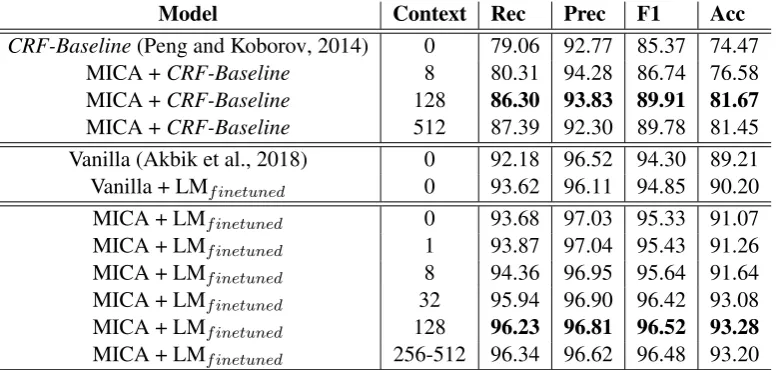
Table 2 reports the models’ performances. First of all, our MICA enhanced CRF models obtain the best performances compared to their respec-tive baselines.
Regarding theCRF-Baseline, the results are still far from a state-of-the-art system like the Vanilla model of (Akbik et al., 2018). Nevertheless we can see that the MICA method is improving the results, even when applied on a CRF-Baseline. We can note that for both theCRF-Baseline and the BLSTM-CRF, when the context window is too wide, the precision of the system is dropping. For a window wider than 128, the gain in recall is not sufficient anymore to counter drop of precision in order to keep a high F1.
The Vanilla model of (Akbik et al., 2018) ob-tains the poorest performances, but we can notice that using embeddings learned on legal domain rather than general domain helps significantly the system.
Regarding our proposed models, we can notice difference of performances regarding the size of the context used to create the dictionary of entity candidates (see Equation 3). The best model is obtained with a context size of 128.
High Recall In the case of de-identification, we need our systems to reach a high recall in order to remove any sensible information. As a matter of fact, our best model allows a reduction of the relative recall error of 40,90% compared with the fine-tuned Vanilla model.
3.3 Analysis
When analyzing our models, we witnessed several cases in which the systems we proposed improved the results over classical methods. To be more pre-cise, we present in the subsequent few prediction divergences between the model using a context of size 0 and our best model.
Typos Obviously, our system allows to detect the entities with typos, as shown by the results highlighted in Table 2. We noticed some relevant examples of missing spaces like the one below that were not detected by the model using no context:
Whereas [MS.LAVERGNE]P ERdoes not justify
her situation ...
Register We noticed that when the register changes, the system can make mistakes. Espe-cially when it happens that the entities to detect are children, they just use the first name to describe them, which is pretty uncommon for this kind of formal text. Our system can detect the name when it is presented for the first time in the text since there is the formality helping the system to detect the entity (Example 1), but struggle to detect the entity when it is in a long sentence without con-text (Example 2) :
(1)[J´er´emy]P ER, born on February 19th, 1990.
(2)She states that [J´er´emy]P ERand [L´eo]P ER
have expressed the will to ....
One drawback of this method is that if the first model is predicting a false positive, it is likely that the new model will also predict that false positive. Nevertheless, the results do not show that behav-ior and the rate of false positive is stable. An-other drawback of our system is its inefficiency against the same words that were detected by the first models as different types of entities.
4 Conclusion and Future Works
sen-Model Context Rec Prec F1 Acc
CRF-Baseline(Peng and Koborov, 2014) 0 79.06 92.77 85.37 74.47
MICA +CRF-Baseline 8 80.31 94.28 86.74 76.58
MICA +CRF-Baseline 128 86.30 93.83 89.91 81.67
MICA +CRF-Baseline 512 87.39 92.30 89.78 81.45
Vanilla (Akbik et al., 2018) 0 92.18 96.52 94.30 89.21
Vanilla + LMf inetuned 0 93.62 96.11 94.85 90.20
MICA + LMf inetuned 0 93.68 97.03 95.33 91.07
MICA + LMf inetuned 1 93.87 97.04 95.43 91.26
MICA + LMf inetuned 8 94.36 96.95 95.64 91.64
MICA + LMf inetuned 32 95.94 96.90 96.42 93.08
MICA + LMf inetuned 128 96.23 96.81 96.52 93.28
[image:5.595.111.500.62.247.2]MICA + LMf inetuned 256-512 96.34 96.62 96.48 93.20
Table 2: Results with the different models on the test dataset. The Context is in number of sentences.
tence, It uses context elements in order to create a dictionary of entity candidates. This dictionary allows to compute a value corresponding to the potentiality of a word to be an entity of a certain type using the Damerau-Levenshtein distance and the longest common string distance to calculate a similarity coefficient. We tested our model on a dataset of French court decisions. Our results show a diminution of the relative recall error of more than 40% compared to a fine-tuned state-of-the-art system while also slightly augmenting the precision.
We have in mind several improvements of our system, regarding the creation of the entities dic-tionary, the similarity function and the embed-dings used.
A possible improvement of our system to ob-tain a more accurate dictionary of entity candi-dates could be to use the full document instead of a document-blind context window to create the dic-tionary of the entity candidates. We can see that a window size larger than 128 reduces the perfor-mance.
Regarding the similarity function, it could be in-teresting to use the word embeddings generated by the character embeddings neural network with a cosine similarity. This would be an improvement over using only string-based similarities and take advantage of the robustness to noise of the charac-ter embeddings.
Recently, (Edizel et al., 2019) proposed a new method to upgrade the Fastext embeddings in or-der to make them robust to misspelled words. It could be interesting to improve our system by re-placing the classical Fastext embeddings into the
vector of stacked embeddings with the ones of (Edizel et al., 2019). We leave this improvement for future work.
Finally, since our system is domain-agnostic and language-agnostic we strongly want to com-pare it on other classical open-domain NER datasets with different languages (Tjong et al., 2003).
Acknowledgments
We would like to thank Pavel Soriano and C´edric Malherbe for the insighful discussions and help-ful comments. The authors of this work have been funded by the EIG program of the State in the con-text of the OpenJustice project.
References
Alan Akbik, Duncan Blythe, and Roland Vollgraf. 2018. Contextual String Embeddings for Sequence Labeling.
Valentin Barriere. 2017. Hybrid Models for Opinion Analysis in Speech Interactions. In ICMI, pages 647–651.
Andreea Bodnari, Louise Del´eger, Thomas Lavergne, Aur´elie N´ev´eol, and Pierre Zweigenbaum. 2013. A supervised naentity extraction system for med-ical text. CEUR Workshop Proceedings, 1179:1–8.
William W. Cohen and Sunita Sarawagi. 2004. Ex-ploiting dictionaries in named entity extraction. page 89.
Fred J. Damerau. 1964. A technique for computer de-tection and correction of spelling errors. Communi-cations of the ACM, 7(3):171–176.
Jacob Devlin, Ming-wei Chang, Kenton Lee, and Kristina Toutanova. 2018. BERT: Pre-training of Deep Bidirectional Transformers for Language Un-derstanding.
Bora Edizel, Aleksandra Piktus, Piotr Bojanowski, Rui Ferreira, Edouard Grave, and Fabrizio Silvestri. 2019. Misspelling Oblivious Word Embeddings.
Arnaud Ferr´e, Louise Del´eger, Pierre Zweigenbaum, and Claire N´edellec. 2018. Combining rule-based and embedding-based approaches to normalize tex-tual entities with an ontology. 11th edition of Language Resources and Evaluation Conference, LREC’18, pages 3443–3447.
Edouard Grave, Piotr Bojanowski, Prakhar Gupta, Ar-mand Joulin, and Tomas Mikolov. 2018. Learning Word Vectors for 157 Languages. pages 1–5.
Zhiheng Huang, Wei Xu, and Kai Yu. 2015. Bidirec-tional LSTM-CRF Models for Sequence Tagging.
Karen Kukich. 1992. Technique for automatically cor-recting words in text. ACM Computing Surveys, 24(4):377–439.
John D Lafferty, Andrew McCallum, and Fernando C N Pereira. 2001. Conditional Random Fields: Probabilistic Models for Segmenting and Labeling Sequence Data. Proceedings of the Eighteenth In-ternational Conference on Machine Learning, pages 282–289.
Kenneth Lai, Maxim Topaz, Foster Goss, and Li Zhou. 2015. Automated misspelling detection and correc-tion in clinical free-text records. Journal of Biomed-ical Informatics.
Guillaume Lample, Miguel Ballesteros, Sandeep Sub-ramanian, Kazuya Kawakami, and Chris Dyer. 2016. Neural Architectures for Named Entity Recognition.
Vladimir I. Levenshtein. 1966. Binary codes capable of correcting deletions, insertions, and reversals. So-viet Physics Doklady.
Xuezhe Ma and Eduard Hovy. 2016. End-to-end Se-quence Labeling via Bi-directional LSTM-CNNs-CRF. InACL.
Ishna Neamatullah, Margaret M. Douglass, Li Wei H. Lehman, Andrew Reisner, Mauricio Villarroel, William J. Long, Peter Szolovits, George B. Moody, Roger G. Mark, and Gari D. Clifford. 2008. Auto-mated de-identification of free-text medical records.
BMC Medical Informatics and Decision Making, 8(September 2014).
Arvind Neelakantan and Michael Collins. 2015. Learning Dictionaries for Named Entity Recogni-tion using Minimal Supervision. In EACL, pages 452–461.
Adam Paszke, Sam Gross, Soumith Chintala, and G Chanan. 2017. Pytorch: Tensors and dynamic neural networks in python with strong gpu accelera-tion.
Terry Peng and Mikhail Koborov. 2014. Pycrfsuite.
Matthew E. Peters, Mark Neumann, Luke Zettlemoyer, and Wen-tau Yih. 2018. Dissecting Contextual Word Embeddings: Architecture and Representa-tion. pages 1499–1509.
Lance Ramshaw and Mitchell Marcus. 1995. Text Chunking Using Transformation-Based Learning. InACL Workshop on Very Large Corpora.
Victor Sanh, Thomas Wolf, and Sebastian Ruder. 2019. A Hierarchical Multi-task Approach for Learning Embeddings from Semantic Tasks. InAAAI Con-ference on Artificial Intelligence (AAAI-19).
Charles Sutton and Andrew McCallum. 2011. An In-troduction to Conditional Random Fields. Machine Learning, 4(4):267–373.