331
From Explainability to Explanation: Using a Dialogue
Setting to Elicit Annotations with Justifications
Nazia Attari
Research Institute for Cognition and Robotics Bielefeld University, Germany
[email protected] David Schlangen Computational Linguistics University of Potsdam, Germany
Martin Heckmann Honda Research Institute Europe
Germany
Abstract
Despite recent attempts in the field of explain-able AI to go beyond black box prediction models, typically already the training data for supervised machine learning is collected in a manner that treats the annotator as a “black box”, the internal workings of which remains unobserved. We present an annotation method where a task is given to a pair of annotators who collaborate on finding the best response. With this we want to shed light on the ques-tions if the collaboration increases the qual-ity of the responses and if this “thinking to-gether” provides useful information in itself, as it at least partially reveals their reasoning steps. Furthermore, we expect that this setting puts the focus onexplanation as a linguistic act, vs.explainability as a property of mod-els. In a crowd-sourcing experiment, we inves-tigated three different annotation tasks, each in a collaborative dialogical (two annotators) and monological (one annotator) setting. Our re-sults indicate that our experiment elicits col-laboration and that this colcol-laboration increases the response accuracy. We see large differ-ences in the annotators’ behavior depending on the task. Similarly, we also observe that the dialog patterns emerging from the collabo-ration vary significantly with the task.
1 Introduction
Imagine asking a friend whether you can borrow their car for the afternoon, and the only reply you get is “no”. You would presumably perceive this as somewhat brusque, and Conversation Analy-sis would back you up there: This kind of dis-preferred reply typically needs more work, often being initiated with a filled pause, and being aug-mented with a reason for the refusal (Schegloff,
2007;Levinson,1983). Now imagine you are ask-ing a car rental place, via their website, whether you can rent a car for the afternoon, and again all
you get as a reply is a “no”. You would still not be pleased, but the difference here would be that while your friend may have been unwillingto tell you their reasons, the car rental company, having used a complex statistical model that judged you untrustworthy, based on various kinds of informa-tion it has about you, would be unableto state rea-sons (other than a vacuous one like “your score is too low”).
The field of explainable AI has set itself as a goal to open up the blackbox of current predic-tion models in order to make their decisions more transparent and also identifying problems con-cerning the core issues in AI safety. (See (Gilpin et al.,2018;Doshi-Velez and Kim,2017;Ribeiro et al., 2016; Lundberg and Lee, 2017; Amodei et al.,2016) for recent overviews.) The focus there typically is on providing explanations of decisions in terms of examples or secondary models (e.g. (Kim et al.,2018;Letham et al.,2015;Yuan et al.,
2019;Zhang et al.,2019)), where the resulting ex-planations are understandable at best to experts. In contrast, our interest is in learning to provide ver-bal explanations, accessible also to novice users. As a first step, we are interested in methods for eliciting data that can be used for this. In this pa-per, we present an annotation scheme where a pair of annotators works in collaboration to find the best response to a question. Our hypothesis is that a) this leads to better quality responses compared to non-collaborative annotation, as the annotators can actively acknowledge/correct/help their part-ners, b) the resulting discussions give access to the collaborative thinking directions that lead to the fi-nal response, and c) puts the focus onexplanation
setting, analyze to what extent the task triggered discussions in the dialog setting and quantify dia-log patterns emerging in the interaction of the an-notators.
2 The Annotation Game
We formalise the annotation task as a game with the following structure. The annotation problem is posed by a special participant in the game, which we callNature(N). N poses a questionQthat is to be answered, and provides relevant information
I = {i1, . . . , in}. (e.g.,Q =“what is in this
im-age?”, withIconsisting of an image.) BesidesN, there is a set of regular participants in the game,
P ={P1, . . . , Pm}. The participants produce
ver-bal turnsT ={t1, . . . , tk}. In our setting, we
as-sume that there is one special token that is used to flag a verbal turnT as a proposal for an answerA
and another token to flag a turn as a mutual agree-ment on it; this type of game could hence also be called anAgreement Game.
Each solved task—that is, each annotation— can be represented as a tuple hQ, I, A, Ti. Our hypothesis is that the provided answers A, rela-tive to the given informationI and the respective questionQ, are of higher quality in settings where
T \A is non-empty compared to those where it is; (that is, where there has been interaction be-tween the annotators) and moreover, that the turns
T \Ain the interactive case provide insights into the reasoning steps that are taken to perform the mapping fromI toA, givenQ—from which ulti-mately strategies for providing explanations could be learned.
3 Experiment
To test the hypotheses set out above, we created a number of tasks (pairs of questions Qand infor-mation I), which we put to individual annotators and also to pairs of annotators in a dialogical set-ting.
3.1 Example Tasks
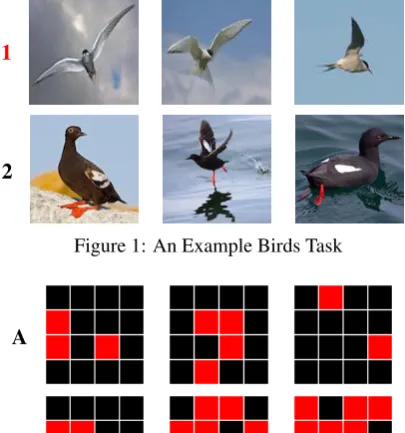
Birds Here, we show images of birds of two dif-ferent kinds, as in Figure1. The task for the anno-tators is to produce a characteristic description of one of the two kinds; i.e., a description that is true for all and only the images in the specified row. Following the question Q =“what separates the birds in 1 from those in 2” given the imagesI in Fig.(1)A=“large wingspan, grey plumage with
1
[image:2.595.312.515.65.282.2]2
Figure 1: An Example Birds Task
A
B
Figure 2: An Example Blocks Task
black head” would be a valid answer. The images are taken from theCaltech-UCSD Birds 200-2011
dataset (Wah et al., 2011). Details on the setting can be found in the appendix.
Blocks This task consists in providing a characteristic rule for one of two artificial, programmatically-created categories in the form of blocks with patterns. A valid answer for the example in Figure 2 could be “B has six or more red blocks.” Note that in this kind of rule induction task from few examples, there will always be a large number of rules that correctly describe the pattern, even if they are different from the one that was actually used to generate the examples.
1 Daniel grabbed the milk there. 2 Sandra journeyed to the garden. 3 Sandra picked up the football there. 4 Sandra put down the football.
Where is the football?
Figure 3: An Example Texts Task
Texts To provide some variety, we also tested a text comprehension task, where a question about a text has to be answered; see Figure3.
3.2 The Technical Setup & Collection
slurk (Schlangen et al., 2018). The Mechanical Turk platform was used to recruit workers. After having read the instructions for the task, workers that accepted the task were transferred to a “wait-ing area” in the chat tool; as soon as a second worker entered this area, both the players were then moved to their task room (see also figure 4
in the appendix). The participants were paid an amount of $0.14 per minute (for a maximum of 4 minutes per game, although they could discuss longer). We also paid a bonus amount of $0.10 when the participants talked about things related to the task, tried to contribute equally during the discussion and also found the correct answer.
Additionally, we ran a monological version of the tasks with individual annotators, where we just presented the annotation task and collected the an-swer.
We collected 40 dialogues per setting, for a total of 120. Each dialogue consists of the consequtive discussion of two questions. After removing failed dialogues (where one participant left in the mid-dle of the game, or participants clearly failed to follow the instructions), we were left with 93 dia-logues: 28forbirds,33forsynthetic, 32fortext. For monological annotation, we collected 40 an-notations per setting, for a total of 120 anan-notations.
4 Results
4.1 Descriptive Overall Statistics
Table1 shows some statistics about the collected data. In case of the dialogues, since the answers were marked by a prefix/answer, we could au-tomatically identify them and look at the discus-sion(everything but the answer) and theanswer(s)
separately. “Speaker contribution ratio” is a mea-sure of how balanced the dialogue was in terms of contributions by each participant. It is the ratio be-tween the number of tokens produced by the more talkative participant and the number of tokens pro-duced by the other participant; a perfectly bal-anced dialogue would rate 1 here. We also looked at the ratio of turns by each speaker.
As these numbers show, the participants in the dialogues produced more tokens overall, and, for Birds, also longer answers. The dialogues tended to be dominated by one speaker. When taking out the outliers (ratio above 3.4), which were cases where one participant had to explain the task to an inattentive other player, the imbalance is lower, but still pronounced, whereas it is not as strong
Averages Birds Blocks Texts
length (mins) 5.25 5.87 5.63
# turns 4.30 3.39 2.86
# turns w/oAs 2.96 1.83 1.39 # tokens 39.61 28.09 18.33 # tokens, finalA 14.43 11.41 7.48 speaker contr. ratio 3.46 5.53 6.13 . . . w/o outliers 2.85 4.15 4.30 speaker turn ratio 1.13 0.86 0.97
no discussion dlgs 35.7% 56.1% 57.8% # tokens (monological) 11.45 12.52 9.45
Table 1: Statistical Overview of Data
in terms of turns. The numbers for Blocks and Texts are impacted by the high proportion of dia-logue without any discussion (just/answer fol-lowed by/agree), as shown in row “no discus-sion dlgs”. Looking deeper into the dialogues, we found that in about 65% of the cases, the more dominant speaker was also the one who proposed the final answer.
4.2 The Answers
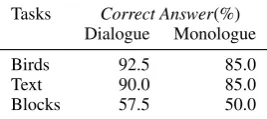
While we can automatically identify the proposed answers by the players, we cannot automatically evaluate them. For Birds and Blocks, a wide va-riety of answers could be considered correct; for Texts, there is a single correct answer, but differ-ent ways of phrasing it. Hence, we manually clas-sified the answers ascorrectandincorrect.
Incorrect answers often betray a misunderstand-ing of the task, as with “The birds in Section 2 look like the same type of bird, or breed. The birds in Section 1 all look like different types of birds, or breeds” for Birds, or “Mary is not in the bathroom because the statement is in past tense” for Texts.
Tasks Correct Answer(%) Dialogue Monologue
Birds 92.5 85.0
Text 90.0 85.0
[image:4.595.113.247.64.124.2]Blocks 57.5 50.0
Table 2: Dialogue vs. Monologue: Correct Answers
4.3 The Discussions
To further analyze the discussions, we first catego-rized them asactiveorpassive. In an active dis-cussion parts of the final answer is “rehearsed” be-fore the official reply is given or the final answer is assembled out of several turns. The following is an example of this category (for the task shown in Figure1above).
(1) A: Looks like the birds under 2 have red-orange feet.
B: The difference that I notice is that the birds in Section 1 are light feathered vs. the dark feathered birds of Section 2. A: Ah, I like your answer better than mine. B: /answer The birds in section 1 do not
have red-orange feet like the birds in sec-tion 2. Also, the feathers of the birds in Section 1 are light-colored vs. the dark-colored feathers of the birds in Section 2.
A:/agree
We consider all other dialogues as passive. This includes cases where a proposal was immediately made and accepted, as well as where one partner didn’t engage with the proposals. 28.6% of the Birds dialogues were passive, compared with 61.5% for Text and 65.5% for Blocks. This again shows an influence of the task; presumably, Text was considered too easy to warrant discussion, while Blocks may have been seen as too hard, with participants giving up (as also reflected in the accuracy on that task).
To unveil the reasoning steps of the collabora-tive thinking process we identified and quantified typical patterns in the active discussions. (2-a)
shows an example of Proposal Extension, where a proposal made by A is implicitly accepted and extended; and ofCounter Proposal, where a pro-posal is implicitly rejected and replaced with a counter proposal. (There were also explicit accep-tances and rejections, w/o proposals.)
Tasks Patterns in active dialogues(%)
Proposal- Counter- Explicit Explicit Extension Proposal Acceptance Rejection
Birds 52 68 60 8
Text 80 40 60 0
Blocks 30 80 70 30
Table 3: Proportions of active dialogues in each task with different patterns.
(2) a. Proposal Extension
A: One obvious difference that I see from the birds in section 1 is that the birds have longer beaks. [Proposal] B: another thing I noticed is it looks
like 2’s have softer feather colors [Proposal-Extension]
b. Counter Proposal
A:/answersection 1 birds all look gray feathered [Proposal]
B: They all have yellow bodies and dark heads [Counter Proposal]
Table3shows the proportions of active dialogues in which these patterns were observed, by task type. Explicit rejections happened rarely but were never observed in the texts task (too simple task). For Birds, there seems to be a balance between proposal-extension, counter-proposal and accep-tance (balanced discussion). There were fewer counter-proposals in texts task, for it being sim-pler. It also looks like there were more disagree-ments in Blocks due to the complexity of the task.
5 Conclusions
the incentives for crowd workers have to be prop-erly set so as to engage them. Our set-up also illus-trates that natural categories could bring in more balanced discussions as well as better quality an-swers. Overall, it could provide useful data for developing a system which provides justifications.
Acknowledgements
We gratefully acknowledge help with setting up the experiment from our Bielefeld student re-search assistant Ayten T¨ufekci.
References
Dario Amodei, Chris Olah, Jacob Steinhardt, Paul Christiano, John Schulman, and Dan Man´e. 2016. Concrete problems in ai safety. arXiv preprint arXiv:1606.06565.
Finale Doshi-Velez and Been Kim. 2017. Towards a rigorous science of interpretable machine learning.
arXiv preprint arXiv:1702.08608.
Leilani H. Gilpin, David Bau, Ben Z. Yuan, Ayesha Bajwa, Michael Specter, and Lalana Kagal. 2018. Explaining explanations: An approach to evaluat-ing interpretability of machine learnevaluat-ing. CoRR, abs/1806.00069.
Been Kim, Martin Wattenberg, Justin Gilmer, Carrie J. Cai, James Wexler, Fernanda B. Vi´egas, and Rory Sayres. 2018. Interpretability beyond feature attri-bution: Quantitative testing with concept activation vectors (TCAV). InProceedings of the 35th Inter-national Conference on Machine Learning, ICML 2018, Stockholmsm¨assan, Stockholm, Sweden, July 10-15, 2018.
Benjamin Letham, Cynthia Rudin, Tyler H. Mc-Cormick, and David Madigan. 2015. Interpretable classifiers using rules and bayesian analysis: Build-ing a better stroke prediction model. The Annals of Applied Statistics.
Stephen C. Levinson. 1983. Pragmatics. Cam-bridge Textbooks in Linguistics. CamCam-bridge Univer-sity Press.
Scott M Lundberg and Su-In Lee. 2017. A unified approach to interpreting model predictions. In Ad-vances in Neural Information Processing Systems 30.
Marco Tulio Ribeiro, Sameer Singh, and Carlos Guestrin. 2016. ”why should i trust you?”: Explain-ing the predictions of any classifier. In Proceed-ings of the 22Nd ACM SIGKDD International Con-ference on Knowledge Discovery and Data Mining, New York, NY, USA.
Emanuel A. Schegloff. 2007. Sequence Organization in Interaction. Cambridge University Press, Cam-bridge, UK.
David Schlangen, Tim Diekmann, Nikolai Ilinykh, and Sina Zarrieß. 2018. slurk - a lightweight interaction server for dialogue experiments and data collection. InShort Paper Proceedings of the 22nd Workshop on the Semantics and Pragmatics of Dialogue (AixDial / semdial), Aix-en-Provence, France.
Catherine Wah, Steve Branson, Peter Welinder, Pietro Perona, and Serge Belongie. 2011. The caltech-ucsd birds-200-2011 dataset. Technical Report CNS-TR-2011-001, California Institute of Technology.
Hao Yuan, Yongjun Chen, Xia Hu, and Shuiwang Ji. 2019. Interpreting deep models for text analysis via optimization and regularization methods. AAAI Conference on Artificial Intelligence.
Quanshi Zhang, Yu Yang, Haotian Ma, and Ying Nian Wu. 2019. Interpreting cnns via decision trees. In
The IEEE Conference on Computer Vision and Pat-tern Recognition (CVPR).
A
The Annotation Game Interface
[image:5.595.316.516.416.530.2]Once two workers were presented they entered the task room as shown in Figure4.
Figure 4: As soon as there are two participants in the waiting room, they are moved to the game room. Both participants see the same content on their screen. The content includes questionQ, informationIand instruc-tions by the game bot who is also present in the game room.