Beyond Bilingual: Multi-sense Word Embeddings using Multilingual
Context
Shyam Upadhyay1 Kai-Wei Chang2 Matt Taddy3 Adam Kalai3 James Zou4 1University of Illinois at Urbana-Champaign, Urbana, IL, USA
2University of Virginia, Charlottesville, VA, USA 3Microsoft Research, Cambridge, MA, USA
4Stanford University, Stanford, CA, USA [email protected],[email protected]
{taddy,adum}@microsoft.com,[email protected]
Abstract
Word embeddings, which represent a word as a point in a vector space, have become ubiquitous to several NLP tasks. A re-cent line of work uses bilingual (two lan-guages) corpora to learn a different vec-tor for each sense of a word, by ex-ploiting crosslingual signals to aid sense identification. We present a multi-view Bayesian non-parametric algorithm which improves multi-sense word embeddings by (a) using multilingual (i.e., more than two languages) corpora to significantly improve sense embeddings beyond what one achieves with bilingual information, and (b) uses a principled approach to learn a variable number of senses per word, in a data-driven manner. Ours is the first approach with the ability to lever-age multilingual corpora efficiently for multi-sense representation learning. Ex-periments show that multilingual training significantly improves performance over monolingual and bilingual training, by al-lowing us to combine different parallel corpora to leverage multilingual context. Multilingual training yields comparable performance to a state of the art mono-lingual model trained on five times more training data.
1 Introduction
Word embeddings (Turian et al., 2010; Mikolov et al.,2013,inter alia)represent a word as a point in a vector space. This space is able to capture se-mantic relationships: vectors of words with sim-ilar meanings have high cosine simsim-ilarity ( Tur-ney, 2006; Turian et al., 2010). Use of embed-dings as features has been shown to benefit
sev-eral NLP tasks and serve as good initializations for deep architectures ranging from dependency pars-ing (Bansal et al.,2014) to named entity recogni-tion (Guo et al.,2014b).
Although these representations are now ubiqui-tous in NLP, most algorithms for learning word-embeddings do not allow a word to have differ-ent meanings in differdiffer-ent contexts, a phenomenon known as polysemy. For example, the word bankassumes different meanings in financial (eg. “bank pays interest”) and geographical contexts (eg. “river bank”) and which cannot be repre-sented adequately with a single embedding vector. Unfortunately, there are no large sense-tagged cor-pora available and such polysemy must be inferred from the data during the embedding process.
My interest lies in
History. [ ]
Mon [intérêt] réside dans l'Histoire. Je suis un grand [intérêt] sur mes économies de la banque. I got high interest on my
savings from the bank. [ ]
Figure 1: Benefit of Multilingual Information (beyond bilingual): Two different senses of the word “interest” and their translations to French and Chinese (word translation shown in[bold]). While the surface form of both senses are same in French, they are different in Chinese.
Several attempts (Reisinger and Mooney,2010; Neelakantan et al., 2014;Li and Jurafsky, 2015) have been made to infer multi-sense word rep-resentations by modeling the sense as a latent variable in a Bayesian non-parametric framework. These approaches rely on the ”one-sense per col-location” heuristic (Yarowsky, 1995), which as-sumes that presence of nearby words correlate with the sense of the word of interest. This heuris-tic provides only a weak signal for sense identifi-cation, and such algorithms require large amount of training data to achieve competitive
mance.
Recently, several approaches (Guo et al.,2014a; ˇSuster et al., 2016) propose to learn multi-sense embeddings by exploiting the fact that different senses of the same word may be translated into different words in a foreign language (Dagan and Itai,1994;Resnik and Yarowsky,1999;Diab and Resnik,2002;Ng et al.,2003). For example,bank in English may be translated tobancorbanquein French, depending on whether the sense is finan-cial or geographical. Such bilingual distributional information allows the model to identify which sense of a word is being used during training.
However, bilingual distributional signals often do not suffice. It is common that polysemy for a word survives translation. Fig. 1shows an illus-trative example – both senses ofinterestget trans-lated toint´erˆetin French. However, this becomes much less likely as the number of languages under consideration grows. By looking at Chinese trans-lation in Fig. 1, we can observe that the senses translate to different surface forms. Note that the opposite can also happen (i.e. same surface forms in Chinese, but different in French). Exist-ing crosslExist-ingual approaches are inherently bilin-gual and cannot naturally extend to include addi-tional languages due to several limitations (details in Section 4). Furthermore, works like (ˇSuster et al.,2016) sets a fixed number of senses for each word, leading to inefficient use of parameters, and unnecessary model complexity.1
This paper addresses these limitations by proposing a multi-view Bayesian non-parametric word representation learning algorithm which leverages multilingual distributional information. Our representation learning framework is the first multilingual (not bilingual) approach, allowing us to utilize arbitrarily many languages to disam-biguate words in English. To move to multilin-gual system, it is necessary to ensure that the embeddings of each foreign language are relat-able to each other (i.e., they live in the same space). We solve this by proposing an algorithm in which word representations are learned jointly across languages, using English as a bridge. While large parallel corpora between two languages are scarce, using our approach we can concatenate multiple parallel corpora to obtain a large multi-lingual corpus. The parameters are estimated in
1Most words in conventional English are monosemous,
i.e. single sense (eg. the wordmonosemous)
a Bayesian nonparametric framework that allows our algorithm to only associate a word with a new sense vector when evidence (from either same or foreign language context) requires it. As a result, the model infers different number of senses for each word in a data-driven manner, avoiding wast-ing parameters.
Together, these two ideas – multilingual dis-tributional information and nonparametric sense modeling – allow us to disambiguate multiple senses using far less data than is necessary for pre-vious methods. We experimentally demonstrate that our algorithm can achieve competitive perfor-mance after training on a small multilingual cor-pus, comparable to a model trained monolingually on a much larger corpus. We present an analy-sis discussing the effect of various parameters – choice of language family for deriving the multi-lingual signal, crossmulti-lingual window size etc. and also show qualitative improvement in the embed-ding space.
2 Related Work
re-cent work has attempted to remedy this by using parallel text for retrofitting sense-specific embed-dings (Ettinger et al., 2016), their procedure re-quires creation ofsense graphs, which introduces additional tuning parameters. On the other hand, our approach only requires two tuning parameters (priorαand maximum number of sensesT).
In contrast, joint learning approaches ( Nee-lakantan et al., 2014; Li and Jurafsky, 2015) jointly learn the sense clusters and embeddings by using non-parametrics. Our approach belongs to this category. The closest non-parametric ap-proach to ours is that of (Bartunov et al., 2016), who proposed a multi-sense variant of the skip-gram model which learns the different number of sense vectors for all words from a large mono-lingual corpus (eg. English Wikipedia). Our work can be viewed as the multi-view extension of their model which leverages both monolingual and crosslingual distributional signals for learning the embeddings. In our experiments, we compare our model to monolingually trained version of their model.
Incorporating crosslingual distributional infor-mation is a popular technique for learning word embeddings, and improves performance on sev-eral downstream tasks (Faruqui and Dyer, 2014; Guo et al.,2016;Upadhyay et al.,2016). However, there has been little work on learning multi-sense embeddings using crosslingual signals (Bansal et al.,2012;Guo et al.,2014a;ˇSuster et al.,2016) with only (ˇSuster et al., 2016) being a joint ap-proach. (Kawakami and Dyer, 2015) also used bilingual distributional signals in a deep neural ar-chitecture to learn context dependent representa-tions for words, though they do not learn separate sense vectors.
3 Model Description LetE = {xe
1, .., xei, .., xeNe}denote the words of
the English side andF = {xf1, .., xfi, .., xfNf} de-note the words of the foreign side of the paral-lel corpus. We assume that we have access to word alignmentsAe→f andAf→emapping words
in English sentence to their translation in foreign sentence (and vice-versa), so that xe and xf are
aligned ifAe→f(xe) =xf.
We define Nbr(x, L, d) as the neighborhood in languageLof sized(on either side) around word
xin its sentence. The English and foreign neigh-boring words are denoted by ye and yf,
respec-tively. Note thatyeandyf need not be translations
of each other. Each wordxf in the foreign
vocab-ulary is associated with a dense vectorxf inRm,
and each wordxein English vocabulary admits at
most T sense vectors, with the kth sense vector
denoted as xe
k.2 As our main goal is to model
multiple senses for words in English, we do not model polysemy in the foreign language and use a single vector to represent each word in the foreign vocabulary.
We model the joint conditional distribution of the context wordsye, yf given an English wordxe
and its corresponding translationxfon the parallel
corpus:
P(ye, yf |xe, xf;α, θ), (1) where θ are model parameters (i.e. all embed-dings) and α governs the hyper-prior on latent senses.
Assume xe has multiple senses, which are
in-dexed by the random variable z, Eq. (1) can be rewritten,
Z
β
X
zP(y
e, yfz, β|xe, xf, α;θ)dβ
whereβare the parameters determining the model probability on each sense forxe (i.e., the weight
on each possible value forz). We place a Dirich-let process (Ferguson,1973) prior on sense assign-ment for each word. Thus, adding the word-x sub-script to emphasize that these are word-specific senses,
P(zx=k|βx) =βxk
Yk−1
r=1(1−βxr) (2)
βxk |αind∼ Beta(βxk|1, α), k= 1, . . . . (3)
That is, the potentially infinite number of senses for each word x have probability determined by the sequence of independent stick-breaking weights,βxk, in the constructive definition of the
DP (Sethuraman,1994). The hyper-prior concen-trationα provides information on the number of senses we expect to observe in our corpus.
After conditioning upon word sense, we decom-pose the context probability,
P(ye, yf |z, xe, xf;θ) =
P(ye|xe, xf, z;θ)P(yf |xe, xf, z;θ).
2We also maintain a context vector for each word in the
Both the first and the second terms are sense-dependent, and each factors as,
P(y|xe, xf, z=k;θ)∝Ψ(xe, z=k, y)Ψ(xf, y) = exp(yTxek) exp(yTxf) = exp(yT(xek+xf)),
where xe
k is the embedding corresponding to the
kthsense of the wordxe, andyis eitheryeoryf.
The factorΨ(xe, z =k, y)use the corresponding
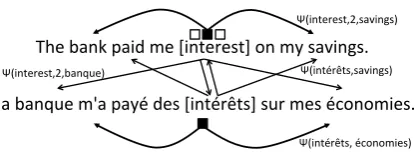
sense vector in a skip-gram-like formulation. This results in total of 4 factors,
P(ye, yf |z, xe, xf;θ)∝Ψ(xe, z, ye)Ψ(xf, yf) Ψ(xe, z, yf)Ψ(xf, ye)
(4)
See Figure 2for illustration of each factor. This modeling approach is reminiscent of (Luong et al., 2015), who jointly learned embeddings for two languagesl1andl2by optimizing a joint objective containing 4 skip-gram terms using the aligned pair (xe,xf)– two predicting monolingual contexts
l1 →l1,l2 → l2 , and two predicting crosslingual contextsl1 →l2,l2 →l1.
Learning. Learning involves maximizing the log-likelihood,
P(ye, yf |xe, xf;α, θ) =
Z
β
X
zP(y
e, yf, z, β |xe, xf, α;θ)dβ
for which we use variational approximation. Let
q(z, β) =q(z)q(β)where
q(z) =Qiq(zi) q(β) =QVw=1QTk=1βwk
(5) are the fully factorized variational approximation of the true posterior P(z, β | ye, yf, xe, xf, α),
whereV is the size of english vocabulary, andTis the maximum number of senses for any word. The optimization problem solves for θ,q(z) and q(β) using the stochastic variational inference tech-nique (Hoffman et al.,2013) similar to (Bartunov et al.,2016) (refer for details).
The resulting learning algorithm is shown as Al-gorithm1. The first for-loop (line1) updates the English sense vectors using the crosslingual and monolingual contexts. First, the expected sense distribution for the current English wordwis com-puted using the current estimate ofq(β)(line 4). The sense distribution is updated (line7) using the combined monolingual and crosslingual contexts
The bank paid me [interest] on my savings.
la banque m'a payé des [intérêts] sur mes économies. Ψ(interest,2,savings)
[image:4.595.315.523.63.139.2]Ψ(intérêts, économies) Ψ(interest,2,banque) Ψ(intérêts,savings)
Figure 2: The aligned pair (interest,int´erˆet) is used to predict monolingual and crosslingual context in both languages (see factors in eqn. (4)). We pick each sense (here 2nd) vector for interest, to perform weighted update. We only model poly-semy in English.
(line5) and re-normalized (line8). Using the up-dated sense distributionq(β)’s sufficient statistics is re-computed (line9) and the global parameterθ
is updated (line10) as follows,
θ←θ+ρt∇θ
X
k|zik>
X
y∈yc
ziklogp(y|xi, k, θ)
(6) Note that in the above sum, a sense participates in a update only if its probability exceeds a thresh-old (= 0.001). The final model retains sense vectors whose sense probability exceeds the same threshold. The last for-loop (line11) jointly opti-mizes the foreign embeddings using English con-text with the standard skip-gram updates.
Disambiguation. Similar to (Bartunov et al., 2016), we can disambiguate the sense for the word
xegiven a monolingual contextyeas follows,
P(z|xe, ye)∝
P(ye|xe, z;θ)X
βP(z|xe, β)q(β)
(7)
Although the model trains embeddings using both monolingual and crosslingual context, we only use monolingual context at test time. We found that so long as the model has been trained with mul-tilingual context, it performs well in sense dis-ambiguation on new data even if it contains only monolingual context. A similar observation was made by (ˇSuster et al.,2016).
4 Multilingual Extension
Bilingual distributional signal alone may not be sufficient as polysemy may survive translation in the second language. Unlike existing approaches, we can easily incorporate multilingual distribu-tional signals in our model. For using languages
Algorithm 1Psuedocode of Learning Algorithm
Input: parallel corpus E = {xe
1, .., xei, .., xeNe}
andF = {xf1, .., xfi, .., xfNf} and alignments
Ae→f andAf→e, Hyper-parametersαandT,
window sizesd, d0 . Output: θ,q(β),q(z)
1: fori= 1toNedo .update english vectors 2: w←xe
i
3: fork= 1toT do
4: zik←Eq(βw)[logp(zi =k|, xei)] 5: yc←Nbr(xei,E,d)∪Nbr(xfi,F,d0)∪ {xfi}
wherexfi =Ae→f(xei)
6: foryinycdo
7: SENSE-UPDATE(xei, y, zi) 8: Renormalizeziusing softmax
9: Update suff. stats. forq(β)like (Bartunov
et al.,2016)
10: Updateθusing eq. (6)
11: fori= 1toNf do .jointly update foreign vectors
12: yc←Nbr(xfi,F,d)∪Nbr(xei,E,d0)∪ {xei} wherexe
i =Af→e(xfi)
13: fory inycdo
14: SKIP-GRAM-UPDATE(xfi, y) 15: procedureSENSE-UPDATE(xi, y, zi) 16: zik←zik+ logp(y|xi, k, θ)
two foreign languages to obtain a large multilin-gual corpus.
Value ofΨ(ye, xf). The factor modeling the
de-pendence of the English context wordye on
for-eign wordxf is crucial to performance when
us-ing multiple languages. Consider the case of usus-ing French and Spanish contexts to disambiguate the financial sense of the English wordbank. In this case, the (financial) sense vector ofbank will be used to predict vector ofbanco(Spanish context) andbanque(French context). If vectors forbanco andbanquedo not reside in the same space or are not close, the model will incorrectly assume they are different contexts to introduce a new sense for bank. This is precisely why the bilingual mod-els, like that of (ˇSuster et al.,2016), cannot be ex-tended to multilingual setting, as they pre-train the embeddings of second language before running the multi-sense embedding process. As a result of naive pre-training, the French and Spanish vectors of semantically similar pairs like (banco,banque) will lie in different spaces and need not be close. A similar reason holds for (Guo et al.,2014a), as
Corpus Source Lines (M) EN-Words (M)
En-Fr EU proc. ≈10 250
En-Zh FBIS news≈9.5 286
En-Es UN proc. ≈10 270
En-Fr UN proc. ≈10 260
En-Zh UN proc. ≈8 230
[image:5.595.74.294.69.441.2]En-Ru UN proc. ≈10 270
Table 1: Corpus Statistics (in millions). Horizontal lines de-marcate corpora from the same domain.
they use a two step approach instead of joint learn-ing.
To avoid this, the vector for pairs like banco andbanqueshould lie in the same space and close to each other and the sense vector forbank. The Ψ(ye, xf)term attempts to ensure this by using the
vector forbancoandbanqueto predict the vector ofbank. This way, the model brings the embed-ding space for Spanish and French closer by using English as a bridge language during joint training. A similar idea of using English as a bridging lan-guage was used in the models proposed in ( Her-mann and Blunsom,2014) and (Coulmance et al., 2015). Beside the benefit in the multilingual case, the Ψ(ye, xf) term improves performance in the
bilingual case as well, as it forces the English and second language embeddings to remain close in space.
To show the value ofΨ(ye, xf)factor in our
ex-periments, we ran a variant of Algorithm1 with-out the Ψ(ye, xf) factor, by only using
monolin-gual neighborhoodNbr(xfi, F) in line12 of Al-gorithm1. We call this variant ONE-SIDEDmodel and the model in Algorithm1the FULLmodel.
5 Experimental Setup
We first describe the datasets and the preprocess-ing methods used to prepare them. We also de-scribe the Word Sense Induction task that we used to compare and evaluate our method.
the final result. To understand what choice of lan-guages provide suitable disambiguation signal, it is necessary to control for domain in all paral-lel corpora. To this end, we also used the En-Fr, En-Es, En-Zh and En-Ru sections of the MultiUN parallel corpus (Eisele and Chen, 2010). Word alignments were generated using fast_align
tool (Dyer et al.,2013) in the symmetric intersec-tion mode. Tokenizaintersec-tion and other preprocessing were performed using cdec 3 toolkit. Stanford
Segmenter (Tseng et al., 2005) was used to pre-process the Chinese corpora.
Word Sense Induction (WSI). We evaluate our approach on word sense induction task. In this task, we are given several sentences showing us-ages of the same word, and are required to cluster all sentences which use the same sense ( Nasirud-din,2013). The predicted clustering is then com-pared against a provided gold clustering. Note that WSI is a harder task than Word Sense Disam-biguation (WSD)(Navigli,2009), as unlike WSD, this task does not involve any supervision or ex-plicit human knowledge about senses of words. We use the disambiguation approach in eq. (7) to predict the sense given the target word and four context words.
To allow for fair comparison with earlier work, we use the same benchmark datasets as (Bartunov et al.,2016) – Semeval-2007, 2010 and Wikipedia Word Sense Induction (WWSI). We report Ad-justed Rand Index (ARI) (Hubert and Arabie, 1985) in the experiments, as ARI is a more strict and precise metric than F-score and V-measure.
Parameter Tuning. For fairness, we used five context words on either side to update each En-glish word-vectors in all the experiments. In the monolingual setting, all five words are English; in the multilingual settings, we used four neigh-boring English words plus the one foreign word aligned to the word being updated (d= 4,d0 = 0
in Algorithm1). We also analyze effect of varying
d0, the context window size in the foreign sentence
on the model performance.
We tune the parametersαandTby maximizing the log-likelihood of a held out English text.4 The
parameters were chosen from the following values
α = {0.05,0.1, ..,0.25}, T = {5,10, ..,30}. All models were trained for 10 iteration with a
decay-3github.com/redpony/cdec
4first 100k lines from the En-Fr Europarl (Koehn,2005)
ing learning rate of 0.025, decayed to 0. Unless otherwise stated, all embeddings are 100 dimen-sional.
Under various choice of α and T, we identify only about 10-20% polysemous words in the vo-cabulary using monolingual training and 20-25% polysemous using multilingual training. It is evi-dent using the non-parametric prior has led to sub-stantially more efficient representation compared to previous methods with fixed number of senses per word.
6 Experimental Results
Setting S-2007 S-2010 WWSI avg. ARI SCWS En-Fr
MONO .044 .064 .112 .073 41.1
ONE-SIDED .054 .074 .116 .081 41.9
FULL .055 .086 .105 .082 41.8
En-Zh
MONO .054 .074 .073 .067 42.6
ONE-SIDED .059 .084 .078 .074 45.0
FULL .055 .090 .079 .075 41.7
En-FrZh
MONO .056 .086 .103 .082 47.3
ONE-SIDED .067 .085 .113 .088 44.6
[image:6.595.308.530.256.420.2]FULL .065 .094 .120 .093 41.9
Table 2: Results on word sense induction (left four columns) in ARI and contextual word similarity (last column) in per-cent correlation. Language pairs are separated by horizontal lines. Best results shown inbold.
We performed extensive experiments to evalu-ate the benefit of leveraging bilingual and multi-lingual information during training. We also ana-lyze how the different choices of language family (i.e. using more distant vs more similar languages) affect performance of the embeddings.
6.1 Word Sense Induction Results.
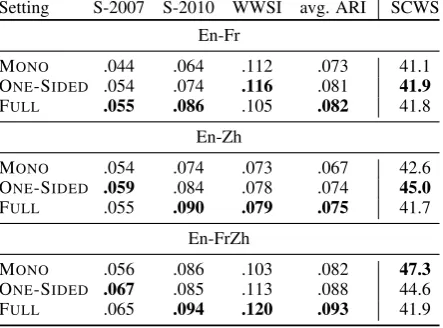
The results for WSI are shown in Table2. Recall that the ONE-SIDEDmodel is the variant of Algo-rithm1without theΨ(ye, xf)factor. MONOrefers
to the AdaGram model of (Bartunov et al.,2016) trained on the English side of the parallel corpus. In all cases, the MONOmodel is outperformed by ONE-SIDEDand FULLmodels, showing the ben-efit of using crosslingual signal in training. Best performance is attained by the multilingual model (En-FrZh), showing value of multilingual signal. The value ofΨ(ye, xf)term is also verified by the
Train S-2007 S-2010 WWSI Avg. ARI Setting En-FrEs En-RuZh En-FrEs En-FrEs En-FrEs En-RuZh En-FrEs En-RuZh
(1) MONO .035 .033 .046 .049 .054 .049 .045 .044
(2) ONE-SIDED .044 .044 .055 .063 .062 .057 .054 .055
(3) FULL .046 .040 .056 .070 .068 .069 .057 .059
(3) - (1) .011 .007 .010 .021 .014 .020 .012 .015
Table 3: Effect (in ARI) of language family distance on WSI task. Best results for each column is shown inbold. The improvement from MONOto FULLis also shown as (3) - (1). Note that this is not comparable to results in Table2, as we use a different training corpus to control for the domain.
We can also compare (unfairly to our FULL model) to the best results described in (Bartunov et al.,2016), which achieved ARI scores of 0.069, 0.097 and 0.286 on the three datasets respectively after training 300 dimensional embeddings on En-glish Wikipedia (≈ 100M lines). Note that, as WWSI was derived from Wikipedia, training on Wikipedia gives AdaGram model an undue ad-vantage, resulting in high ARI score on WWSI. In comparison, our model did not train on En-glish Wikipedia, and uses 100 dimensional em-beddings. Nevertheless, even in the unfair com-parison, it noteworthy that on S-2007 and S-2010, we can achieve comparable performance (0.067 and 0.094) with multilingual training to a model trained on almost 5 times more data using higher (300) dimensional embeddings.
6.2 Contextual Word Similarity Results.
For completeness, we report correlation scores on Stanford contextual word similarity dataset (SCWS) (Huang et al., 2012) in Table 2. The task requires computing similarity between two words given their contexts. While the bilin-gually trained model outperforms the monolin-gually trained model, surprisingly the multilin-gually trained model does not perform well on SCWS. We believe this may be due to our param-eter tuning strategy.5
6.3 Effect of Language Family Distance.
Intuitively, choice of language can affect the result from crosslingual training as some languages may provide better disambiguation signals than oth-ers. We performed a systematic set of experiment to evaluate whether we should choose languages from a closer family (Indo-European languages) or farther family (Non-Indo European Languages)
5Most works tune directly on the test dataset for Word
Similarity tasks (Faruqui et al.,2016)
as training data alongside English.6 To control for
domain here we use the MultiUN corpus. We use En paired with Fr and Es as Indo-European lan-guages, and English paired with Ru and Zh for representing Non-Indo-European languages.
From Table 3, we see that using Non-Indo Eu-ropean languages yield a slightly higher improve-ment on an average than using Indo-European lan-guages. This suggests that using languages from a distance family aids better disambiguation. Our findings echo those of (Resnik and Yarowsky, 1999), who found that the tendency to lexicalize senses of an English word differently in a second language, correlated with language distance.
6.4 Effect of Window Size.
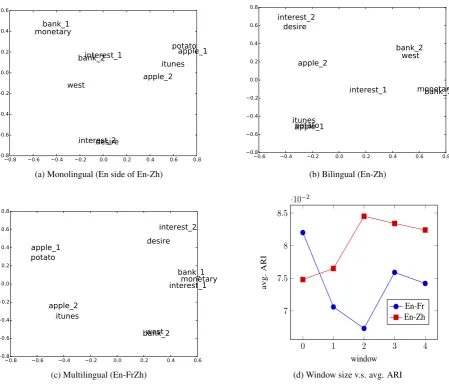
Figure 3d shows the effect of increasing the crosslingual window (d0) on the average ARI on
the WSI task for the En-Fr and En-Zh models. While increasing the window size improves the average score for En-Zh model, the score for the En-Fr model goes down. This suggests that it might be beneficial to have a separate window pa-rameter per language. This also aligns with the observation earlier that different language fami-lies have different suitability (bigger crosslingual context from a distant family helped) and require-ments for optimal performance.
7 Qualitative Illustration
As an illustration for the effects of multilingual training, Figure 3shows PCA plots for 11 sense vectors for 9 words using monolingual, bilin-gual and multilinbilin-gual models. From Fig 3a, we note that with monolingual training the senses are poorly separated. Although the model infers two senses forbank, the two senses ofbankare close to financial terms, suggesting their distinction was not recognized. The same observation can be 6 (ˇSuster et al.,2016) compared different languages but
(a) Monolingual (En side of En-Zh) (b) Bilingual (En-Zh)
(c) Multilingual (En-FrZh)
0 1 2 3 4
7 7.5 8 8.5
·10−2
window
avg.
ARI
En-Fr En-Zh
[image:8.595.75.525.61.447.2](d) Window size v.s. avg. ARI
Figure 3: Qualitative: PCA plots for the vectors for{apple, bank, interest, itunes, potato, west, monetary, desire}with multiple sense vectors forapple,interestandbankobtained using monolingual (3a), bilingual (3b) and multilingual (3c) training. Window Tuning:Figure3dshows tuning window size for En-Zh and En-Fr.
made for the senses ofapple. In Fig3b, with bilin-gual training, the model infers two senses ofbank correctly, and two sense of apple become more distant. The model can still improve eg. pulling interest towards the financial sense ofbank, and pullingitunestowardsapple 2. Finally, in Fig3c, all senses of the words are more clearly clustered, improving over the clustering of Fig 3b. The senses of apple,interest, andbankare well sepa-rated, and are close to sense-specific words, show-ing the benefit of multilshow-ingual trainshow-ing.
8 Conclusion
We presented a multi-view, non-parametric word representation learning algorithm which can leverage multilingual distributional information. Our approach effectively combines the bene-fits of crosslingual training and Bayesian non-parametrics. Ours is the first multi-sense
References
Collin F Baker, Charles J Fillmore, and John B Lowe. 1998. The berkeley framenet project. InACL.
Mohit Bansal, John DeNero, and Dekang Lin. 2012. Unsupervised translation sense clustering. In NAACL.
Mohit Bansal, Kevin Gimpel, and Karen Livescu. 2014. Tailoring continuous word representations for dependency parsing. InACL.
Sergey Bartunov, Dmitry Kondrashkin, Anton Osokin, and Dmitry Vetrov. 2016. Breaking sticks and am-biguities with adaptive skip-gram.AISTATS.
Chris Callison-Burch, Philipp Koehn, Christof Monz, and Omar F Zaidan. 2011. Findings of the 2011 workshop on statistical machine translation. In WMT Shared Task.
Jocelyn Coulmance, Jean-Marc Marty, Guillaume Wenzek, and Amine Benhalloum. 2015. Trans-gram, fast cross-lingual word-embeddings. In EMNLP.
Ido Dagan and Alon Itai. 1994. Word sense disam-biguation using a second language monolingual cor-pus. Computational linguistics.
Mona Diab and Philip Resnik. 2002. An unsupervised method for word sense tagging using parallel cor-pora. InACL.
Chris Dyer, Victor Chahuneau, and Noah A Smith. 2013. A simple, fast, and effective reparameteriza-tion of ibm model 2. InNAACL.
Andreas Eisele and Yu Chen. 2010. MultiUN: A mul-tilingual corpus from united nation documents. In LREC.
Allyson Ettinger, Philip Resnik, and Marine Carpuat. 2016. Retrofitting sense-specific word vectors using parallel text. InNAACL.
Manaal Faruqui, Jesse Dodge, Sujay K. Jauhar, Chris Dyer, Eduard Hovy, and Noah A. Smith. 2015. Retrofitting word vectors to semantic lexicons. In NAACL.
Manaal Faruqui and Chris Dyer. 2014. Improving vec-tor space word representations using multilingual correlation. InEACL.
Manaal Faruqui, Yulia Tsvetkov, Pushpendre Rastogi, and Chris Dyer. 2016. Problems with evaluation of word embeddings using word similarity tasks. In1st RepEval Workshop.
Thomas S Ferguson. 1973. A bayesian analysis of some nonparametric problems. The annals of statis-tics.
Jiang Guo, Wanxiang Che, Haifeng Wang, and Ting Liu. 2014a. Learning sense-specific word embed-dings by exploiting bilingual resources. In COL-ING.
Jiang Guo, Wanxiang Che, Haifeng Wang, and Ting Liu. 2014b. Revisiting embedding features for sim-ple semi-supervised learning. InEMNLP.
Jiang Guo, Wanxiang Che, David Yarowsky, Haifeng Wang, and Ting Liu. 2016. A representation learn-ing framework for multi-source transfer parslearn-ing. In AAAI.
Karl Moritz Hermann and Phil Blunsom. 2014. Mul-tilingual Distributed Representations without Word Alignment. InICLR.
Matthew D Hoffman, David M Blei, Chong Wang, and John William Paisley. 2013. Stochastic variational inference. JMLR.
Eric H Huang, Richard Socher, Christopher D Man-ning, and Andrew Y Ng. 2012. Improving word representations via global context and multiple word prototypes. InACL.
Lawrence Hubert and Phipps Arabie. 1985. Compar-ing partitions. Journal of classification.
Sujay Kumar Jauhar, Chris Dyer, and Eduard Hovy. 2015. Ontologically grounded multi-sense represen-tation learning for semantic vector space models. In NAACL.
Kazuya Kawakami and Chris Dyer. 2015. Learning to represent words in context with multilingual super-vision. ICLR Workshop.
Adam Kilgarriff. 1997. I don’t believe in word senses. Computers and the Humanities.
Philipp Koehn. 2005. Europarl: A parallel corpus for statistical machine translation. InMT summit. vol-ume 5, pages 79–86.
Jiwei Li and Dan Jurafsky. 2015. Do multi-sense em-beddings improve natural language understanding?
EMNLP.
Pengfei Liu, Xipeng Qiu, and Xuanjing Huang. 2015a. Learning context-sensitive word embeddings with neural tensor skip-gram model. InIJCAI.
Yang Liu, Zhiyuan Liu, Tat-Seng Chua, and Maosong Sun. 2015b. Topical word embeddings. InAAAI. Thang Luong, Hieu Pham, and Christopher D.
Man-ning. 2015. Bilingual word representations with monolingual quality in mind. InWorkshop on Vector Space Modeling for NLP.
George A Miller. 1995. Wordnet: a lexical database for english. Communications of the ACM.
Mohammad Nasiruddin. 2013. A state of the
art of word sense induction: A way towards word sense disambiguation for under-resourced lan-guages. arXiv preprint arXiv:1310.1425.
Roberto Navigli. 2009. Word sense disambiguation: A survey. ACM Computing Surveys (CSUR).
Arvind Neelakantan, Jeevan Shankar, Alexandre Pas-sos, and Andrew McCallum. 2014. Efficient non-parametric estimation of multiple embeddings per word in vector space. InEMNLP.
Hwee Tou Ng, Bin Wang, and Yee Seng Chan. 2003. Exploiting parallel texts for word sense disambigua-tion: An empirical study. InACL.
Lin Qiu, Yong Cao, Zaiqing Nie, Yong Yu, and Yong Rui. 2014. Learning word representation consider-ing proximity and ambiguity. InAAAI.
Joseph Reisinger and Raymond J. Mooney. 2010. Multi-prototype vector-space models of word mean-ing. InNAACL.
Philip Resnik and David Yarowsky. 1999. Distinguish-ing systems and distDistinguish-inguishDistinguish-ing senses: New evalua-tion methods for word sense disambiguaevalua-tion. NLE .
Jayaram Sethuraman. 1994. A constructive definition of dirichlet priors. Statistica sinica.
Huihsin Tseng, Pichuan Chang, Galen Andrew, Daniel Jurafsky, and Christopher Manning. 2005. A condi-tional random field word segmenter for sighan bake-off 2005. InProc. of SIGHAN.
Joseph Turian, Lev Ratinov, and Yoshua Bengio. 2010. Word representations: a simple and general method for semi-supervised learning. InACL.
Peter D. Turney. 2006. Similarity of semantic relations. Computational Linguistics.
Shyam Upadhyay, Manaal Faruqui, Chris Dyer, and Dan Roth. 2016. Cross-lingual models of word em-beddings: An empirical comparison. InACL. Simon ˇSuster, Ivan Titov, and Gertjan van Noord. 2016.
Bilingual learning of multi-sense embeddings with discrete autoencoders. InNAACL.
Zhaohui Wu and C Lee Giles. 2015. Senaaware se-mantic analysis: A multi-prototype word represen-tation model using wikipedia. InAAAI.