GPLSI: Supervised Sentiment Analysis in Twitter using Skipgrams
Javi Fern´andez, Yoan Guti´errez, Jos´e M. G´omez, Patricio Mart´ınez-Barco Department of Software and Computing Systems
University of Alicante
{javifm,ygutierrez,jmgomez,patricio}@dlsi.ua.es
Abstract
In this paper we describe the system sub-mitted for theSemEval 2014 Task 9 (Sen-timent Analysis in Twitter) Subtask B. Our contribution consists of a supervised ap-proach using machine learning techniques, which uses the terms in the dataset as fea-tures. In this work we do not employ any external knowledge and resources. The novelty of our approach lies in the use of words, ngrams and skipgrams (not-adjacent ngrams) as features, and how they are weighted.
1 Introduction
The Web 2.0 has become one of the most im-portant sources of data to extract useful and het-erogeneous knowledge from. Texts can provide
factual information, such as descriptions and lists of features, andopinion-based information, which would include reviews, emotions, or feelings. This subjective information can be expressed through different textual genres, such as blogs, forums, so-cial networks and microblogs.
An example of microblogging social network is Twitter1, which has gained much popularity in the
last years. This website enables its users to send and read text-based messages of up to 140 char-acters, known as tweets. This site can be a vast source of subjective information in real time; mil-lions of users share opinions on different aspects of their everyday life. Extracting this subjective information has a great value for both general and expert users. However, it is difficult to exploit it accordingly, mainly because of the short length of This work is licensed under a Creative Commons Attribu-tion 4.0 InternaAttribu-tional Licence. Page numbers and proceed-ings footer are added by the organisers. Licence details: creativecommons.org/licenses/by/4.0/
1http://twitter.com
the tweets, the informality, and the lack of context.
Sentiment Analysis(SA) systems must be adapted to face the challenges of this new textual genre.
International competitions related to the assess-ment of SA systems in Twitter have taken place. Some of them include theTASSworkshop in the
SEPLN conference (Villena-Rom´an et al., 2013), the RepLab workshop in the CLEF conference (Amig´o et al., 2012), and theSentiment Analysis in Twittertask (Task 2) in the lastSemEval work-shop (Nakov et al., 2013).
In this paper we describe the system submit-ted for the SemEval 2014 Sentiment Analysis in Twittertask (Task 9 Subtask B)2(Rosenthal et al.,
2014). This task consists of performing an au-tomatic sentiment analysis to determine whether a message expresses apositive, negative, or neu-tralsentiment. The organisers of this task provide three datasets:training,development training, and
development test. The participants can use the
traininganddevelopment trainingdatasets to train and validate their models, but thedevelopment test
dataset can only be used for validation. The size and distribution of polarities of these datasets is shown in Table 1. Once their systems are ready, the participants must classify each text in the offi-cial testcorpus and send the results to the organis-ers, who will perform the official evaluation.
Polarity Train Dev Train Dev Test
Positive 2,148 362 1,572
Neutral 2,915 448 1,640
Negative 836 187 601
[image:1.595.307.527.597.668.2]Total 5,899 997 3,813
Table 1: Dataset distribution in number of tweets.
The goal of the present work is to create a re-liable polarity classifier, built only from a training set without any external knowledge and resources.
2http://alt.qcri.org/semeval2014/
Our contribution consists of a supervised approach using machine learning techniques, which uses the terms in the dataset as features. The novelty of our approach lies in the feature generation and weight-ing, using not only single words and ngrams as features but alsoskipgrams. This approach is de-scribed in detail in Section 3. Subsequently, in Section 4 we show the assessment of our model in the competition. Finally, the conclusions and future work are presented in Section 5. The fol-lowing Section 2 shows some relevant background related to this work.
2 Related Work
The goal ofSentiment analysis(SA) is to identify the opinions expressed in text and classify texts accordingly (Dadvar et al., 2011). Two main ap-proaches can be followed (Annett and Kondrak, 2008; Liu, 2010; Taboada et al., 2011):lexical ap-proaches (unsupervised SA) andmachine learning
approaches (supervised SA). Lexical approaches focus on building dictionaries and lexicons of la-belled words. This labeling gives a score for each word, that indicates how strong is the relation be-tween that word and each polarity. The most com-mon way to classify a text using these scores is by adding the positive values and subtracting the negative values of the terms in that text. If the to-tal score is positive, that text is classified as pos-itive, otherwise it is classified as negative. These dictionaries can be created manually (Stone et al., 1966) or automatically (Turney, 2002). Examples of lexicons are WordNet Affect (Strapparava and Valitutti, 2004), SentiWordNet (Esuli and Sebas-tiani, 2006),MicroWNOP(Cerini et al., 2007) or
JRC Tonality(Balahur et al., 2009). However, it is very difficult to collect and maintain a univer-sal sentiment lexicon because different words may be used in different domains (Qiu et al., 2009) and some words are domain dependent (Turney, 2002). The second approach uses machine learning techniques. These techniques require the previous creation of a corpus containing a set of classified texts to train a classifier, which can then be applied to classify a set of unclassified texts. The majority of the researches employSupport Vector Machines
(Mullen and Collier, 2004; Prabowo et al., 2009; Wilson et al., 2005) orNa¨ıve Bayes(Pang and Lee, 2004; Wiebe et al., 2005; Tan et al., 2009) classi-fiers because they usually obtain the best results. In this approach, texts are represented as vectors
of features, and depending on the features used the system can reach better results (bag-of-words and lexeme-based features are the more commonly used (Pang and Lee, 2008)). These classifiers per-form very well in the domain that they are trained on, but their performance drops when the same classifier is used in a different domain (Pang and Lee, 2008; Tan et al., 2009).
The problem of thedomain dependenceis com-mon to both approaches. When the lexicons and classifiers generated are used in a domain different from the one they were built for, they use to per-form worse (Turney, 2002; Pang and Lee, 2008; Qiu et al., 2009; Tan et al., 2009). Creating a domain-specific lexicon or classifier means mak-ing a manual effort. Although some studies try to overcome this problem by generating the lexi-consautomatically(Turney, 2002), learning from
unannotatedtexts (Wiebe et al., 2005) or using hy-bridapproaches (Andreevskaia and Bergler, 2008; Bollen et al., 2011; Zhang and Ye, 2008), a min-imal intervention from experts in the domain is needed. In this study we use the machine learning approach due to the promising results obtained in previous works (Boldrini et al., 2009; Fern´andez et al., 2011; Fern´andez et al., 2013).
3 Methodology
Our contribution consists of a supervised approach using machine learning techniques, which uses the terms in the dataset as features. In summary, our approach starts making a basic normalisation of each tweet in the dataset (see Section 3.1). Next, these texts are tokenised to extract their terms, and these terms are combined to createskipgrams(see Section 3.2). Finally, these skipgrams are em-ployed as features for a supervised machine learn-ing algorithm (see Section 3.3).
3.1 Basic normalisation
We perform a very basic normalisation, as we do not want to lose the potential subjective infor-mation given by the not normalised original text. Each tweet in the dataset is normalised following these steps:
1. Lower case conversion. All the characters in the tweet text are converted to lower case. 2. Character repetition removal. If the same
still recognize if a word had repeated char-acters. For example, the words gooood and
goooooodwould be normalised togoood, but the wordgood would remain the same. We assume the ambiguity of some words like the one in the example, which can refer to the wordsgoodandgod.
3. Usernames and hashtags substitution. We do not consider usernames and hashtags as they are not usually the words that represent a subjective sentence, they use to be thetopic
of the tweet. They are not removed com-pletely but they are replaced by the strings
USERNAMEandHASHTAG.
So excited to go to #Alicante tomorrow with the best friend everrrrr @John!!!!
↓
so excited to go to #alicante tomorrow with the best friend everrrrr @john!!!!
↓
so excited to go to #alicante tomorrow with the best friend everrr @john!!!
↓
so excited to go to HASHTAG tomorrow with the best friend everrr USERNAME!!!
Figure 1: Example of normalisation process.
3.2 Tokenisation
Once we have normalised the texts, we extract all their terms. In this work, we consider a term as a group of adjacent characters of the same type (let-ters, numbers or punctuation symbols). For exam-ple, the textwant2go!! would be tokenised to the termswant,2,go, and!!. Note that we employ all the terms extracted, not filtering any of them.
Finally, we obtain theskipgramsof the terms in the text. Skipgrams are a technique largely used in the field of speech processing, whereby n-grams are formed (bigrams, trigrams, etc.) but in addi-tion to allowing adjacent sequences of words, it also allows tokens to be skipped (Guthrie et al., 2006). More specifically, in ak-skip-n-gram,n de-termines the maximum number of terms, andkthe maximum number of skips allowed. In this way skipgrams are new terms that retain part of the se-quentiality of the terms, but in a more flexible way than ngrams. Note that a ngram can be described as a skipgram wherek= 0. An example is shown in Figure 2.
Normalised tweet
so excited to go to HASHTAG tomorrow with the best friend everrr USERNAME!!!
↓
Single terms
(so) (excited) (to) (go) (to) (HASHTAG) (with) (the) (best) (friend) (everrr) (USERNAME) (!!!)
↓
Skipgrams (n= 2, k= 1)
(so) (so excited) (so to) (excited) (excited to) (excited go)
(to) (to go) (to to) (go) (go to) (go HASHTAG) (to) (to HASHTAG) (to with) (HASHTAG) (HASHTAG with) (HASHTAG the) (with) (with the) (with best)
(the) (the best) (the friend) (best) (best friend) (best everrr) (friend) (friend everrr) (friend USERNAME) (everrr) (everrr USERNAME) (everrr !!!) (USERNAME) (USERNAME !!!)
Figure 2: Example of tokenisation process.
3.3 Supervised Learning
To build our model we employedSupport Vector Machines(SVM) as the supervised machine learn-ing algorithm, as it has been proved to be effective on text categorisation tasks and robust on large feature spaces (Sebastiani, 2002; Mohammad et al., 2013). More specifically, we used theWeka3
(Hall et al., 2009)LibSVM(Chang and Lin, 2011) implementation with the default parameters ( lin-ear kernel,C= 1,= 0.1).
The skipgrams extracted in the previous step are employed as features for the SVM. The weight of each feature in each text will be calculated depend-ing on the skipgram it represents, usdepend-ing the for-mula in Equation 1.
w(s, t) = terms(termss) +skips(s) (s, t) (1)
Wherew(s, t)represents the weight of the skip-gram s in the text t, terms is a function that returns the number of terms in skipgram s, and
skipsis a function that returns the number of skips of the skipgramsin the textt. This formula gives more importance to the skipgrams with a lower number of skips. In the example of the Figure 2, the skipgram best friend would have a weight of
2/(2 + 0) = 1, while skipgrambest everrrwould
have a weight of2/(2 + 1) = 0.66.
Parameters P R F1 Score Baseline 0.630 0.604 0.580 0.447
Words n= 1 0.611 0.612 0.604 0.530
Ngrams n= 2 0.617 0.620 0.618 0.557
n= 3 0.620 0.621 0.621 0.564
n= 4 0.620 0.621 0.620 0.565
n=max 0.621 0.622 0.621 0.566
Skipgrams n= 2, k= 1 0.623 0.625 0.624 0.571
n= 2, k= 2 0.626 0.624 0.626 0.572
n= 2, k=max 0.627 0.624 0.625 0.575
n= 3, k= 1 0.620 0.616 0.617 0.566
n= 3, k= 2 0.625 0.614 0.618 0.564
[image:4.595.151.449.60.243.2]n= 3, k=max 0.636 0.588 0.599 0.544
Table 2: Experiments performed and scores obtained.
4 Evaluation
We performed a series of experiments employ-ing both thetraining corpus and thedevelopment trainingcorpus to create our model, and the devel-opment testcorpus to validate it. We used as base-line the system presented to the workshop TASS 2012 (Fern´andez et al., 2013), which also uses skipgrams and scores them depending on their density but, instead of using the skipgrams as fea-tures of a machine learning model, the polarity of each text is determined by a combination of the scores of its skipgrams.
The results of our experiments are shown in Ta-ble 2. In this taTa-ble we show theweighted precision
(P), theweighted recall(R), theweighted F-score
(F1) and thescoreobtained using the scorer tool provided by the workshop organisers (Score). The notation n = max indicates there was no limit with the number of terms, and k = max indi-cates there was no restriction with the number of skips. As we can see, the presented approach out-performs the baseline proposed and the best results are obtained using skipgrams, specifically when
n = 2andk = max. These are the parameters of the system submitted to the competition.
Our main observation is that incrementing the number of terms increases the precision of the sys-tem. A possible explanation for this might be that ngrams/skipgrams with a greater number of words are more specific and representative of a given polarity. In addition, using skipgrams insted of ngrams also improves the precision. However, no significant differences were found between exper-iments with a different number of skips.
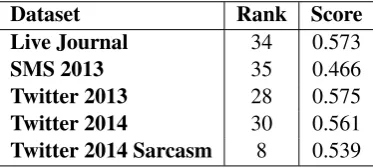
In Table 3 we can see the official results ob-tained in the SemEval 2014 competition. The best rank was obtained in the experiments with the
Twitter 2014 Sarcasmdataset.
Dataset Rank Score Live Journal 34 0.573
SMS 2013 35 0.466
Twitter 2013 28 0.575
Twitter 2014 30 0.561
Twitter 2014 Sarcasm 8 0.539
Table 3: Official SemEval 2014 Subtask B results.
5 Conclusions
In this paper we described the system submitted for theSemEval 2014 Task 9 (Sentiment Analysis in Twitter). It consists of a supervised approach using machine learning techniques, without em-ploying any external knowledge and resources. The novelty of our approach lies in the feature gen-eration and weighting, using not only single words andngramsas features but alsoskipgrams. In the experiments performed we showed that employ-ing skipgrams instead of semploy-ingle words or ngrams improves the results for these datasets. This fact suggests that our approach is promising and en-courages us to continue with our research.
[image:4.595.323.510.354.438.2]Acknowledgements
This research work has been partially funded by theUniversity of Alicante,Generalitat Valenciana,
Spanish Government and the European Com-mission through the projects, “Tratamiento in-teligente de la informaci´on para la ayuda a la toma de decisiones” (GRE12-44), ATTOS (TIN2012-38536-C03-03), LEGOLANG (TIN2012-31224),
SAM (FP7-611312), FIRST (FP7-287607) and
ACOMP/2013/067.
References
Enrique Amig´o, Adolfo Corujo, Julio Gonzalo, Edgar Meij, and Maarten de Rijke. 2012. Overview of RepLab 2012: Evaluating Online Reputation Man-agement Systems. In Conference and Labs of the Evaluation Forum (CLEF 2012).
Alina Andreevskaia and Sabine Bergler. 2008. When Specialists and Generalists Work Together: Over-coming Domain Dependence in Sentiment Tagging. InProceedings of the 46th Annual Meeting of the As-sociation for Computational Linguistics on Human Language Technologies (ACL HLT 2008), pages 290–298.
Michelle Annett and Grzegorz Kondrak. 2008. A Comparison of Sentiment Analysis Techniques: Po-larizing Movie Blogs. In Proceedings of the 21st Canadian Conference on Artificial Intelligence (CCAI 2008), pages 25–35.
Alexandra Balahur, Ralf Steinberger, Erik Van Der Goot, Bruno Pouliquen, and Mijail Kabadjov. 2009. Opinion Mining on Newspaper Quotations. In2009 IEEE/WIC/ACM International Joint Conference on Web Intelligence and Intelligent Agent Technology, pages 523–526.
Ester Boldrini, Javier Fern´andez Mart´ınez, Jos´e Manuel G´omez Soriano, Patricio Mart´ınez Barco, et al. 2009. Machine learn-ing techniques for automatic opinion detection in non-traditional textual genres.
Johan Bollen, Alberto Pepe, and Huina Mao. 2011. Modeling Public Mood and Emotion: Twitter Senti-ment and Socio-Economic Phenomena. InFifth In-ternational AAAI Conference on Weblogs and Social Media (ICWSM 2011).
Sabrina Cerini, Valentina Compagnoni, Alice Demon-tis, Maicol Formentelli, and G Gandini. 2007. Micro-WNOp: A Gold Standard for the Evaluation of Automatically Compiled Lexical Resources for Opinion Mining. Language resources and linguis-tic theory: Typology, second language acquisition, English linguistics, pages 200–210.
Chih-chung Chang and Chih-jen Lin. 2011. LIBSVM : A Library for Support Vector Machines. ACM Transactions on Intelligent Systems and Technology (TIST), 2:1–39.
Maral Dadvar, Claudia Hauff, and FMG De Jong. 2011. Scope of Negation Detection in Sentiment Analysis. InProceedings of the Dutch-Belgian In-formation Retrieval Workshop (DIR 2011), pages 16–20.
Andrea Esuli and Fabrizio Sebastiani. 2006. Sen-tiwordnet: A Publicly Available Lexical Resource for Opinion Mining. InProceedings of LREC, vol-ume 6, pages 417–422.
Javi Fern´andez, Ester Boldrini, Jos´e M. G´omez, and Patricio Mart´ınez-Barco. 2011. Evaluat-ing EmotiBlog Robustness for Sentiment Analysis Tasks. InNatural Language Processing and Infor-mation Systems, pages 290–294.
Javi Fern´andez, Yoan Guti´errez, Jos´e M. G´omez, Patri-cio Mart´ınez-Barco, Andr´es Montoyo, and Rafael Mu˜noz. 2013. Sentiment Analysis of Spanish Tweets Using a Ranking Algorithm and Skipgrams. In XXIX Congreso de la Sociedad Espa˜nola de Procesamiento de Lenguaje Natural (SEPLN 2013), pages 133–142.
David Guthrie, Ben Allison, Wei Liu, Louise Guthrie, and Yorick Wilks. 2006. A Closer Look at Skip-gram Modelling. In5th international Conference on Language Resources and Evaluation (LREC 2006), pages 1–4.
Mark Hall, Eibe Frank, Geoffrey Holmes, Bernhard Pfahringer, Peter Reutemann, and Ian H Witten. 2009. The WEKA Data Mining Software: an Update. ACM SIGKDD Explorations Newsletter, 11(1):10–18.
Bing Liu. 2010. Sentiment Analysis and Subjectiv-ity. InHandbook of Natural Language Processing, pages 1–38.
Saif M. Mohammad, Svetlana Kiritchenko, and Xiao-dan Zhu. 2013. NRC-Canada: Building the State-of-the-Art in Sentiment Analysis of Tweets. In Pro-ceedings of the International Workshop on Semantic Evaluation (SemEval-2013).
Tony Mullen and Nigel Collier. 2004. Sentiment Anal-ysis using Support Vector Machines with Diverse In-formation Sources. InProceedings of the 2004 Con-ference on Empirical Methods in Natural Language Processing (EMNLP 2004), pages 412–418.
Bo Pang and Lillian Lee. 2004. A Sentimental Educa-tion: Sentiment Analysis Using Subjectivity Sum-marization Based on Minimum Cuts. In Proceed-ings of the 42nd annual meeting on Association for Computational Linguistics (ACL 2004), page 271.
Bo Pang and Lillian Lee. 2008. Opinion Mining and Sentiment Analysis. Foundations and Trends in In-formation Retrieval, 2(1–2):1–135.
Rudy Prabowo, Mike Thelwall, and Wulfruna Street. 2009. Sentiment Analysis: A Combined Approach.
Journal of Informetrics, 3:143–157.
Guang Qiu, Bing Liu, Jiajun Bu, and Chun Chen. 2009. Expanding Domain Sentiment Lexicon through Double Propagation. InProceedings of the 21st international Joint Conference on Artificial In-telligence (IJCAI 2009), pages 1199–1204.
Sara Rosenthal, Preslav Nakov, Alan Ritter, and Veselin Stoyanov. 2014. SemEval-2014 Task 9: Sentiment Analysis in Twitter. In Proceedings of the International Workshop on Semantic Evaluation (SemEval-2014).
Fabrizio Sebastiani. 2002. Machine Learning in Au-tomated Text Categorization. ACM Computing Sur-veys (CSUR), 34(1):1–47, March.
Philip J. Stone, Dexter C. Dunphy, and Marshall S. Smith. 1966. The General Inquirer: A Computer Approach to Content Analysis.
Carlo Strapparava and Alessandro Valitutti. 2004. WordNet Affect: an Affective Extension of Word-Net. InLREC, volume 4, pages 1083–1086.
Maite Taboada, Julian Brooke, Milan Tofiloski, Kim-berly Voll, and Manfred Stede. 2011. Lexicon-based methods for sentiment analysis. Computa-tional Linguistics, 37(2):267–307.
Songbo Tan, Xueqi Cheng, Yuefen Wang, and Hongbo Xu. 2009. Adapting Naive Bayes to Domain Adap-tation for Sentiment Analysis. Advances in Informa-tion Retrieval, pages 337–349.
Peter D. Turney. 2002. Thumbs Up or Thumbs Down? Semantic Orientation Applied to Unsuper-vised Classification of Reviews. InProceedings of the 40th Annual Meeting of the Association for Com-putational Linguistics (ACL 2002), pages 417–424.
Julio Villena-Rom´an, Eugenio Mart´ınez-C´amara, Sara Lana-Serrano, and Jos´e Carlos Gonz´alez-Crist´obal. 2013. TASS - Workshop on Sentiment Analysis at SEPLN. Procesamiento del Lenguaje Natural, 50:37–44.
Janyce Wiebe, Theresa Wilson, and Claire Cardie. 2005. Annotating Expressions of Opinions and Emotions in Language. Language resources and evaluation, 39(2-3):165–210.
Theresa Wilson, Paul Hoffmann, Swapna Somasun-daran, Jason Kessler, Janyce Wiebe, Yejin Choi, Claire Cardie, Ellen Riloff, and Siddharth Patward-han. 2005. OpinionFinder: A System for Subjec-tivity Analysis. InProceedings of HLT/EMNLP on Interactive Demonstrations, pages 34–35.