Proceedings of the 13th International Workshop on Semantic Evaluation (SemEval-2019), pages 70–74 70
Fermi at SemEval-2019 Task 5: Using Sentence Embeddings to identify
Hate Speech against Immigrants and Women on Twitter
Vijayasaradhi Indurthi1,3, Bakhtiyar Syed1, Manish Shrivastava1 Nikhil Chakravartula3, Manish Gupta1,2, Vasudeva Varma1
1IIIT Hyderabad, India 2Microsoft, India
3Teradata, India
1{vijaya.saradhi, syed.b}@research.iiit.ac.in 1{m.shrivastava, manish.gupta, vv}@iiit.ac.in
2[email protected]3[email protected]
Abstract
This paper describes our system (Fermi) for Task 5 of SemEval-2019: HatEval: Multilin-gual Detection of Hate Speech Against Immi-grants and Women on Twitter. We participated in the subtask A for English and ranked first in the evaluation on the test set. We evaluate the quality of multiple sentence embeddings and explore multiple training models to eval-uate the performance of simple yet effective embedding-ML combination algorithms. Our team -Fermi’s model achieved an accuracy of 65.00% for English language in task A. Our models, which use pretrained Universal En-coder sentence embeddings for transforming the input and SVM (with RBF kernel) for clas-sification, scored first position (among 68) in the leaderboard on the test set for Subtask A in English language. In this paper we provide a detailed description of the approach, as well as the results obtained in the task.
1 Introduction
Microblogging platforms like Twitter provide channels to exchange ideas using short messages called tweets. While such a platform can be used for constructive ideas, a small group of people can propagate their notions including hatred against an individual, or a group or a race to the entire world in a few seconds. This necessitates the need to come up with computational methods to identify hate speech in user generated content.
Using computational methods to identify of-fense, aggression and hate speech in user gener-ated content has been gaining attention in the re-cent years as evidenced in (Waseem et al.,2017; Davidson et al., 2017; Malmasi and Zampieri, 2017;Kumar et al.,2018) and workshops such as Abusive Language Workshop (ALW)1and
Work-1https://sites.google.com/view/alw2018
shop on Trolling, Aggression and Cyberbullying (TRAC)2.
2 Related Work
In this section we briefly describe other work in this area.
A few of the early works related to hate speech detection employed the use of features like bag of words, word and character n-grams with relatively off-the-shelf machine learning classifiers for de-tection (Dinakar et al.,2011;Waseem and Hovy, 2016;Nobata et al.,2016). Deep learning methods for hate speech detection were used byBadjatiya et al. (2017) wherein the authors experimented with a combination of multiple deep learning ar-chitectures along with randomly initialized word embeddings learned by Long Short Term Memory (LSTM) models.
Papers published in the last two years include the surveys by (Schmidt and Wiegand,2017) and (Fortuna and Nunes,2018), the paper by ( David-son et al.,2017) which presented the Hate Speech Detection dataset used in (Malmasi and Zampieri, 2017) and a few other recent papers such as ( ElSh-erief et al., 2018; Gamb¨ack and Sikdar, 2017; Zhang et al.,2018).
A proposal of typology of abusive language sub-tasks is presented in (Waseem et al., 2017). For studies on languages other than English see (Su et al., 2017) on Chinese and (Fiˇser et al., 2017) on Slovene. Finally, for recent discussion on identifying profanity versus hate speech see (Malmasi and Zampieri, 2018). This work high-lighted the challenges of distinguishing between profanity, and threatening language which may not actually contain profane language.
Some of the similar and related previous work-shops are Text Analytics for Cybersecurity and
Online Safety (TA-COS) 3, Abusive Language Workshop 4, and TRAC 5. Related shared tasks include GermEval (Wiegand et al., 2018) and TRAC (Kumar et al.,2018).
3 Methodology
In this paper, we make use of several word embed-ding and sentence embedembed-ding methods.
3.1 Word Embeddings
Word embeddings have been widely used in mod-ern Natural Language Processing applications as they provide vector representation of words. They capture the semantic properties of words and the linguistic relationship between them. These word embeddings have improved the performance of many downstream tasks across many do-mains like text classification, machine comprehen-sion etc. (Camacho-Collados and Pilehvar,2018). Multiple ways of generating word embeddings ex-ist, such as Neural Probabilistic Language Model (Bengio et al., 2003), Word2Vec (Mikolov et al., 2013), GloVe (Pennington et al.,2014), and more recently ELMo (Peters et al.,2018).
These word embeddings rely on the distribu-tional linguistic hypothesis. They differ in the way they capture the meaning of the words or the way they are trained. Each word embedding cap-tures a different set of semantic attributes which may or may not be captured by other word em-beddings. In general, it is difficult to predict the relative performance of these word embeddings on downstream tasks. The choice of which word em-beddings should be used for a given downstream task depends on experimentation and evaluation.
3.2 Sentence Embeddings
While word embeddings can produce representa-tions for words which can capture the linguistic properties and the semantics of the words, the idea of representing sentences as vectors is an impor-tant and open research problem (Conneau et al., 2017).
Finding a universal representation of a sentence which works with a variety of downstream tasks is the major goal of many sentence embedding techniques. A common approach of obtaining a sentence representation using word embeddings is
3http://ta-cos.org/ 4
https://sites.google.com/site/alw2018
5https://sites.google.com/view/trac1
by the simple and na¨ıve way of using the sim-ple arithmetic mean of all the embeddings of the words present in the sentence. Smooth inverse fre-quency, which uses weighted averages and modi-fies it using Singular Value Decomposition (SVD), has been a strong contender as a baseline over tra-ditional averaging technique (Arora et al.,2016). Other sentence embedding techniques include p-means (R¨uckl´e et al., 2018), InferSent (Conneau et al., 2017), SkipThought (Kiros et al., 2015), Universal Encoder (Cer et al.,2018).
Task A (Hate speech detection) is a two-class clas-sification where systems have to predict whether a tweet in English or in Spanish with a given target (women or immigrants) is hateful or not hateful. TASK B (Aggressive behavior and Target Clas-sification) is a two-class classification where sys-tems have to classify hateful tweets (e.g., tweets where Hate Speech against women or immigrants has been identified) as aggressive or not aggres-sive, and second to identify the target harassed as individual or generic (i.e. single human or group). We formulate sub-task A of HatEval as a text classification tasks. In this paper, we evaluate var-ious pre-trained sentence embeddings for identify-ing the offense, hate and aggression. We train mul-tiple models using different machine learning al-gorithms to evaluate the efficacy of each of the pre-trained sentence embeddings for the downstream task. We observe that there is a class label imbal-ance in the dataset. To prevent any bias induced due to imbalanced classes, we process the trans-formed training dataset using SMOTE (Chawla et al.,2002) which synthetically oversamples data and ensures that all the classes have same number of instances.
In the following, we discuss various popular sentence embedding methods in brief.
• InferSent (Conneau et al., 2017) is a set of embeddings proposed by Facebook. In-ferSent embeddings have been trained using the popular language inference corpus. Given two sentences the model is trained to infer whether they are a contradiction, a neutral pairing, or an entailment. The output is an embedding of 4096 dimensions.
Model LR RF SVM-RBF XGB
Acc. F1 Acc. F1 Acc. F1 Acc. F1
InferSent 64.26 64.34 63.96 62.45 57.13 41.54 71.18 71.21
Concat-p mean 63.35 63.43 67.17 65.83 63.86 60.98 71.08 70.67 Lexical Vectors 67.27 66.61 67.97 67.09 58.53 46.03 67.87 68.31 Universal Encoder 70.58 70.63 70.48 70.05 57.13 41.54 64.26 64.34
ELMo 69.68 69.78 65.96 65.12 68.37 68.44 66.57 66.59
[image:3.595.104.497.63.175.2]NNLM 66.57 66.46 64.36 62.83 65.56 63.88 66.37 65.74
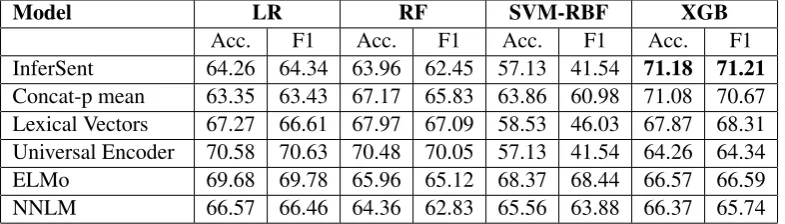
Table 1:DevSet Accuracy and Macro-F1 scores(in percentage) forSub-Task A- English.
considerably closes the gap to state-of-the-art methods mono-lingually and substantially outperforms many complex techniques cross-lingually.
• Lexical Vectors (Salle and Villavicencio, 2018) is another word embedding similar to fastText with slightly modified objective. FastText (Bojanowski et al.,2016) is another word embedding model which incorporates character n-grams into the skipgram model of Word2Vec and considers the sub-word infor-mation.
• The Universal Sentence Encoder (Cer et al., 2018) encodes text into high dimensional vectors. The model is trained and optimized for greater-than-word length text, such as sentences, phrases or short paragraphs. It is trained on a variety of data sources and a va-riety of tasks with the aim of dynamically ac-commodating a wide variety of natural lan-guage understanding tasks. The input is vari-able length English text and the output is a 512 dimensional vector.
• Deep Contextualized Word Representations (ELMo) (Peters et al., 2018) use language models to get the embeddings for individ-ual words. The entire sentence or paragraph is taken into consideration while calculating these embedding representations. ELMo uses a pre-trained bi-directional LSTM language model. For the input supplied, the ELMo ar-chitecture extracts the hidden state of each layer. A weighted sum is computed of the hidden states to obtain an embedding for each sentence.
Using each of the sentence embeddings we have mentioned above, we seek to evaluate how each of them performs when the vector representations
are supplied for classification with various off-the-shelf machine learning algorithms. For each of the evaluation tasks, we perform experiments us-ing each of the sentence embeddus-ings mentioned above and show our classification performance on thedevset given by the task organizers.
Using each of the sentence embeddings we have mentioned above, we seek to evaluate how each of them performs when the vector representations are supplied for classification with various off-the-shelf machine learning algorithms. For each of the evaluation tasks, we perform experiments us-ing each of the sentence embeddus-ings mentioned above and show our classification performance on thedevset given by the task organizers.
4 Dataset
The data collection methods used to compile the dataset used in HatEval is described in (Basile et al.,2019). We did not use any external datasets to augment the data for training our models.
5 Results and Analysis
The official test set results scored on CodaLab have been presented below in Table2.
System F1 (macro) Accuracy
Universal Encoder 0.65 0.65
Table 2: Results for Sub-task A using Universal En-coder Sentence embeddings with SVM classifier using RBF kernel.
Our results on the different algorithms from the ones stated above have been mentioned henceforth and described in Table1.
We notice the best performance for task A in English on the official test set was bagged by the model which used pretrained Universal sen-tence embeddings using SVM with RBF ker-nel. However, pretrained Infersent embeddings along with XGBoost algorithm outperformed ev-ery other combination on the dev test. This can be probably due to the difference between the distri-butions in the dev and the official test sets.
Overall, this work shows how different set of pretrained embeddings trained from different state-of-the-art architectures and methods when used with simple machine learning classifiers per-form very well in the classification task of catego-rizing text as offensive or not.
6 Conclusions and Future Work
It is also important to note that the experiments are performed using the default parameters, so there is much scope for improvement with a lot of fine-tuning, which we plan on considering for future research purposes. Further, we can explore aug-menting data from other similar shared tasks to achieve better performance.
References
Sanjeev Arora, Yingyu Liang, and Tengyu Ma. 2016. A simple but tough-to-beat baseline for sentence em-beddings.
Pinkesh Badjatiya, Shashank Gupta, Manish Gupta, and Vasudeva Varma. 2017. Deep learning for hate speech detection in tweets. In Proceedings of the 26th International Conference on World Wide Web Companion, pages 759–760. International World Wide Web Conferences Steering Committee.
Valerio Basile, Cristina Bosco, Elisabetta Fersini, Deb-ora Nozza, Viviana Patti, Francisco Rangel, Paolo Rosso, and Manuela Sanguinetti. 2019. Semeval-2019 task 5: Multilingual detection of hate speech against immigrants and women in twitter. In Pro-ceedings of the 13th International Workshop on Se-mantic Evaluation (SemEval-2019). Association for Computational Linguistics.
Yoshua Bengio, R´ejean Ducharme, Pascal Vincent, and Christian Jauvin. 2003. A neural probabilistic lan-guage model. Journal of machine learning research, 3(Feb):1137–1155.
Piotr Bojanowski, Edouard Grave, Armand Joulin, and Tomas Mikolov. 2016. Enriching word vec-tors with subword information. arXiv preprint arXiv:1607.04606.
Jose Camacho-Collados and Mohammad Taher Pile-hvar. 2018. From word to sense embeddings: A sur-vey on vector representations of meaning. Journal of Artificial Intelligence Research, 63:743–788.
Daniel Cer, Yinfei Yang, Sheng-yi Kong, Nan Hua, Nicole Limtiaco, Rhomni St John, Noah Constant, Mario Guajardo-Cespedes, Steve Yuan, Chris Tar, et al. 2018. Universal sentence encoder. arXiv preprint arXiv:1803.11175.
Nitesh V Chawla, Kevin W Bowyer, Lawrence O Hall, and W Philip Kegelmeyer. 2002. Smote: synthetic minority over-sampling technique. Journal of artifi-cial intelligence research, 16:321–357.
Alexis Conneau, Douwe Kiela, Holger Schwenk, Loic Barrault, and Antoine Bordes. 2017. Supervised learning of universal sentence representations from natural language inference data. arXiv preprint arXiv:1705.02364.
Thomas Davidson, Dana Warmsley, Michael Macy, and Ingmar Weber. 2017. Automated hate speech detection and the problem of offensive language. InEleventh International AAAI Conference on Web and Social Media.
Karthik Dinakar, Roi Reichart, and Henry Lieberman. 2011. Modeling the detection of textual cyberbully-ing. InThe Social Mobile Web, pages 11–17.
Mai ElSherief, Vivek Kulkarni, Dana Nguyen, William Yang Wang, and Elizabeth Belding. 2018. Hate Lingo: A Target-based Linguistic Analysis of Hate Speech in Social Media. arXiv preprint arXiv:1804.04257.
Darja Fiˇser, Tomaˇz Erjavec, and Nikola Ljubeˇsi´c. 2017. Legal Framework, Dataset and Annotation Schema for Socially Unacceptable On-line Discourse Prac-tices in Slovene. In Proceedings of the Workshop Workshop on Abusive Language Online (ALW), Van-couver, Canada.
Paula Fortuna and S´ergio Nunes. 2018. A Survey on Automatic Detection of Hate Speech in Text. ACM Computing Surveys (CSUR), 51(4):85.
Bj¨orn Gamb¨ack and Utpal Kumar Sikdar. 2017. Using Convolutional Neural Networks to Classify Hate-speech. In Proceedings of the First Workshop on Abusive Language Online, pages 85–90.
Ryan Kiros, Yukun Zhu, Ruslan R Salakhutdinov, Richard Zemel, Raquel Urtasun, Antonio Torralba, and Sanja Fidler. 2015. Skip-thought vectors. In
Advances in neural information processing systems, pages 3294–3302.
Shervin Malmasi and Marcos Zampieri. 2017. Detect-ing Hate Speech in Social Media. InProceedings of the International Conference Recent Advances in Natural Language Processing (RANLP), pages 467– 472.
Shervin Malmasi and Marcos Zampieri. 2018. Chal-lenges in Discriminating Profanity from Hate Speech. Journal of Experimental & Theoretical Ar-tificial Intelligence, 30:1–16.
Tomas Mikolov, Ilya Sutskever, Kai Chen, Greg S Cor-rado, and Jeff Dean. 2013. Distributed representa-tions of words and phrases and their compositional-ity. InAdvances in neural information processing systems, pages 3111–3119.
Chikashi Nobata, Joel Tetreault, Achint Thomas, Yashar Mehdad, and Yi Chang. 2016. Abusive Language Detection in Online User Content. In
Proceedings of the 25th International Conference on World Wide Web, pages 145–153. International World Wide Web Conferences Steering Committee.
Jeffrey Pennington, Richard Socher, and Christopher Manning. 2014. Glove: Global vectors for word representation. InProceedings of the 2014 confer-ence on empirical methods in natural language pro-cessing (EMNLP), pages 1532–1543.
Matthew E Peters, Mark Neumann, Mohit Iyyer, Matt Gardner, Christopher Clark, Kenton Lee, and Luke Zettlemoyer. 2018. Deep contextualized word rep-resentations. arXiv preprint arXiv:1802.05365.
Andreas R¨uckl´e, Steffen Eger, Maxime Peyrard, and Iryna Gurevych. 2018. Concatenatedp-mean word embeddings as universal cross-lingual sentence rep-resentations. arXiv preprint arXiv:1803.01400.
Alexandre Salle and Aline Villavicencio. 2018. In-corporating subword information into matrix fac-torization word embeddings. arXiv preprint arXiv:1805.03710.
Anna Schmidt and Michael Wiegand. 2017. A Sur-vey on Hate Speech Detection Using Natural Lan-guage Processing. InProceedings of the Fifth Inter-national Workshop on Natural Language Process-ing for Social Media. Association for Computational Linguistics, pages 1–10, Valencia, Spain.
Huei-Po Su, Chen-Jie Huang, Hao-Tsung Chang, and Chuan-Jie Lin. 2017. Rephrasing Profanity in Chi-nese Text. In Proceedings of the Workshop Work-shop on Abusive Language Online (ALW), Vancou-ver, Canada.
Zeerak Waseem, Thomas Davidson, Dana Warmsley, and Ingmar Weber. 2017. Understanding Abuse: A Typology of Abusive Language Detection Subtasks. In Proceedings of the First Workshop on Abusive Langauge Online.
Zeerak Waseem and Dirk Hovy. 2016. Hateful sym-bols or hateful people? predictive features for hate speech detection on twitter. InSRW@HLT-NAACL.
Michael Wiegand, Melanie Siegel, and Josef Rup-penhofer. 2018. Overview of the GermEval 2018 Shared Task on the Identification of Offensive Lan-guage. InProceedings of GermEval.
Ziqi Zhang, David Robinson, and Jonathan Tepper. 2018. Detecting Hate Speech on Twitter Using a Convolution-GRU Based Deep Neural Network. In