Parsing Graphs with Regular Graph Grammars
Sorcha Gilroy University of Edinburgh [email protected]
Adam Lopez University of Edinburgh [email protected]
Sebastian Maneth Universit¨at Bremen [email protected]
Abstract
Recently, several datasets have become available which represent natural language phenomena as graphs. Hyperedge Re-placement Languages (HRL) have been the focus of much attention as a for-malism to represent the graphs in these datasets. Chiang et al. (2013) prove that HRL graphs can be parsed in polynomial time with respect to the size of the in-put graph. We believe that HRL are more expressive than is necessary to represent semantic graphs and we propose the use of Regular Graph Languages (RGL; Cour-celle 1991), which is a subfamily of HRL, as a possible alternative. We provide a top-down parsing algorithm for RGL that runs in time linear in the size of the input graph.
1 Introduction
NLP systems for machine translation, summariza-tion, paraphrasing, and other tasks often fail to preserve the compositional semantics of sentences and documents because they model language as bags of words, or at best syntactic trees. To pre-serve semantics, they must model semantics. In pursuit of this goal, several datasets have been pro-duced which pair natural language with composi-tional semantic representations in the form of di-rected acyclic graphs (DAGs), including the Ab-stract Meaning Representation Bank (AMR; Ba-narescu et al. 2013), the Prague Czech-English Dependency Treebank (Hajiˇc et al., 2012), Deep-bank (Flickinger et al., 2012), and the Univer-sal Conceptual Cognitive Annotation (Abend and Rappoport, 2013). To make use of this data, we require models of graphs.
Consider how we might use compositional semantic representations in machine translation
Anna fehlt ihrem Kater
Anna’s cat misses her miss arg0
arg1 cat
poss
[image:1.595.311.513.223.288.2]Anna
Figure 1: Semantic machine translation using AMR (Jones et al., 2012). The edge labels identify ‘cat’ as the object of the verb ‘miss’, ‘Anna’ as the subject of ‘miss’ and ‘Anna’ as the possessor of ‘cat’. Edges whose head nodes are not attached to any other edge are interpreted as node labels.
(Figure 1), a two-step process in which seman-tic analysis is followed by generation. Jones et al. (2012) observe that this decomposition can be modeled with a pair of synchronous gram-mars, each defining a relation between strings and graphs. Necessarily, one projection of this synchronous grammar produces strings, while the other produces graphs, i.e., is agraph grammar. A consequence of this representation is that the complete translation process can be realized by parsing: to analyze a sentence, we parse the in-put string with the string-generating projection of the synchronous grammar, and read off the syn-chronous graph from the resulting parse. To gen-erate a sentence, we parse the graph, and read off the synchronous string from the resulting parse. In this paper, we focus on the latter problem: using graph grammars to parse input graphs. We call this
graph recognitionto avoid confusion with other parsing problems.
Recent work in NLP has focused primarily on hyperedge replacement grammar (HRG; Drewes et al. 1997), a context-free graph grammar formalism that has been studied in an NLP context by several researchers (Chiang et al., 2013; Peng et al., 2015; Bauer and Rambow, 2016). In partic-ular, Chiang et al. (2013) propose that HRG could be used to represent semantic graphs, and pre-cisely characterize the complexity of a CKY-style
algorithm for graph recognition from Lautemann (1990) to be polynomial in the size of the input graph. HRGs are very expressive—they can gen-erate graphs that simulate non-context-free string languages (Engelfriet and Heyker, 1991; Bauer and Rambow, 2016). This means they are likely more expressive than we need to represent the lin-guistic phenomena that appear in existing seman-tic datasets. In this paper, we propose the use of Regular Graph Grammars (RGG; Courcelle 1991) a subfamily of HRG that, like its regular counter-parts among string and tree languages, is less ex-pressive than context-free grammars but may ad-mit more practical algorithms. By analogy to Chi-ang’s CKY-style algorithm for HRG. We develop an Earley-style recognition algorithm for RGLs that is linear in the size of the input graph.
2 Regular Graph Languages
We use the following notation. Ifnis an integer, [n]denotes the set{1, . . . , n}. LetΓbe an alpha-bet, i.e., a finite set. Thens ∈ Γ∗ denotes thats is a sequence of arbitrary length, each element of which is inΓ. We denote by|s|the length ofs. A
ranked alphabetis an alphabetΓpaired with an arity mapping (i.e., a total function) rank: Γ→N. Definition 1. A hypergraph (or simply graph) over a ranked alphabet Γ is a tuple G = (VG, EG,attG,labG,extG)whereVGis a finite set of nodes;EGis a finite set of edges (distinct from VG); attG : EG → V∗
G maps each edge to a se-quence of nodes; labG:EG→Γmaps each edge to a label such that |attG(e)| = rank(labG(e)); and extGis an ordered subset ofVGcalled the ex-ternal nodesofG.
We assume that the elements of extG are
pair-wise distinct, and the elements of attG(e)for each
edge e are also pairwise distinct. An edge e is attached to its nodes by tentacles, each labeled by an integer indicating the node’s position in attG(e) = (v1, . . . , vk). The tentacle from e to viwill have labeli, so the tentacle labels lie in the
set[k]wherek=rank(e). To express that a node
v is attached to theith tentacle of an edgee, we say vert(e, i) = v. Likewise, the nodes in extG
are labeled by their position in extG. We refer to
theith external node ofG by extG(i) and in
fig-ures this will be labeled(i). Therankof an edge
e is k if att(e) = (v1, . . . , vk) (or equivalently,
rank(lab(e)) = k). The rankof a hypergraphG, denoted by rank(G) is the size of extG.
Example 1. Hypergraph G in Figure 2 has four nodes (shown as black dots) and three hyperedges labeled a, b, and X (shown boxed). The brack-eted numbers(1)and(2)denote its external nodes and the numbers between edges and the nodes are tentacle labels. Call the top nodev1and,
proceed-ing clockwise, call the other nodesv2,v3, andv4.
Call its edges e1, e2 ande3. Its definition would
state attG(e1) = (v1, v2), attG(e2) = (v2, v3),
attG(e3) = (v1, v4, v3), labG(e1) =a, labG(e2) =
b, labG(e3) =X, and extG= (v4, v2).
Definition 2. LetG be a hypergraph containing an edgeewith attG(e) = (v1, . . . , vk)and letH be a hypergraph of rankkwith node and edge sets disjoint from those ofG. Thereplacementofeby His the graphG0 =G[e/H]. Its node setV
G0 is
V ∪VH whereV =VG− {v1, . . . , vk}. Its edge set isEG0 = (EG− {e})∪EH. We define attG0 =
att∪attH where for everye0 ∈(EG−{e}), att(e) is obtained from attG(e0)by replacingviby theith external node ofH. Let labG0 =lab∪labH where
lab is the restriction of labGto edges inEG− {e}. Finally, let extG0 =extG.
Example 2. A replacement is shown in Figure 2.
2.1 Hyperedge Replacement Grammars Definition 3. Ahyperedge replacement grammar
G = (NG, TG, PG, SG) consists of ranked
(dis-joint) alphabets NG and TG of nonterminal and
terminal symbols, respectively, a finite set PG of
productions, and a start symbolSG ∈ NG. Every
production in PG is of the form X → G where
Gis a hypergraph overNG∪TGand rank(G) =
rank(X).
For each productionp :X → G, we useL(p) to refer to X (the left-hand side of p) and R(p) to refer toG(the right-hand side of p). An edge is a terminal edge if its label is terminal and a
nonterminal edge if its label is nonterminal. A graph is a terminal graphif all of its edges are terminal. The terminal subgraph of a graph is the subgraph consisting of all terminal edges and their incident nodes.
Given a HRG G, we say that graph G im-mediately derives graph G0, denoted G → G0, iff there is an edge e ∈ EG and a nonterminal X ∈ NG such that labG(e) = X and G0 = G[e/H], where X → H is in PG. We extend the idea of immediate derivation to its transitive closure G →∗ G0, and say here that G derives
G0. For every X ∈ N
de-X a b (1) (2) G (2) c (1) a (3) d H (1) c
d a (2)
b a
G[e/H]
2
1 1 2
[image:3.595.323.526.62.295.2]1 2 3 2 1 1 2 1 2 2 1 1 2 1 2 1 2 1 2
Figure 2: The replacement of theX-labeled edgeeinGby the graphH.
S p: X (1) 1 go 1 2 I
arg0 s: Y Z (1)
(2) 1 2 1 arg0 arg1 X
q: W
Y (2) (1) 1 2 1 1 2 arg1
arg0 t: W
(1)
1
want
Y
r: Z
X (2) (1) 1 2 1 1 2 arg1
arg0 u: Z
(1)
1
[image:3.595.77.300.65.161.2]need
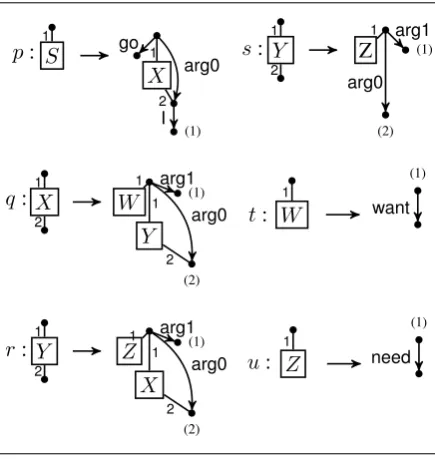
Table 1: Productions of a HRG. The labelsp, q, r, s, t, andu
label the productions so that we can refer to them in the text. Note thatY can rewrite in two ways, either via productionr
ors.
note the graph consisting of a single edgeewith lab(e) = X and nodes (v1, . . . , vrank(X)) such
that attG(e) = (v1, . . . , vrank(X)), and we define
the language LX(G) as {G | X →∗ G∧G is
terminal}. Thelanguage ofGisL(G) =LSG(G).
We call the family of languages that can be pro-duced by any HRG the hyperedge replacement languages (HRL).
We assume that terminal edges are always of rank 2, and depict them as directed edges where the direction is determined by the tentacle labels: the tentacle labeled 1 attaches to the source of the edge and the tentacle labeled 2 attaches to the tar-get of the edge.
Example 3. Table 1 shows a HRG deriving AMR graphs for sentences of the form ‘I need to want to need to want to ... to want to go’. Figure 3 is a graph derived by the grammar. The grammar is somewhat unnatural, a point we will return to (§4). We can use HRGs to generate chain graphs
(1) arg1 arg1 arg1 arg1 need want need want go I arg0 arg0 arg0 arg0 arg0
Figure 3: Graph derived by grammar in Table 1.
S (1) S (2) (1) (2)
1 2
a
1 2
b a b
Figure 4: A HRG producing the string languageanbn.
(strings) by restricting the form of the pro-ductions in the grammars. Figure 4 shows a HRG that produces the context-free string lan-guage anbn. HRGs can simulate the class of
mildly context-sensitive languages that is charac-terized, e.g., by linear context-free rewriting sys-tems (LCFRS;Vijay-Shanker et al. 1987), where the fan-out of the LCFRS will influence the max-imum rank of nonterminal required in the HRG, see (Engelfriet and Heyker, 1991).
2.2 Regular Graph Grammars
A regular graph grammar (RGG; Courcelle 1991) is a restricted form of HRG. To explain the restric-tions, we first require some definitions.
Definition 4. Given a graphG, apathinGfrom a nodevto a nodev0is a sequence
(v0, i1, e1, j1, v1)(v1, i2, e2, j2, v2)
. . .(vk−1, ik, ek, jk, vk) (1) such thatv0 = v, vk = v0, and for eachr ∈ [k], vert(er, ir) = vr−1 andvert(er, jr) = vr. The length of this path isk.
A path isterminalif every edge in the path has a terminal label. A path is internal if eachvi is
internal for1≤i≤k−1. Note that the endpoints
v0andvkof an internal path can be external.
Definition 5. A HRG G is a Regular Graph Grammar (or simply RGG) if each nonterminal inNGhas rank at least one and for eachp ∈ PG
[image:3.595.73.291.192.422.2](C1) R(p)has at least one edge. Either it is a single terminal edge, all nodes of which are exter-nal, or each of its edges has at least one internal node.
(C2) Every pair of nodes inR(p)is connected by a terminal and internal path.
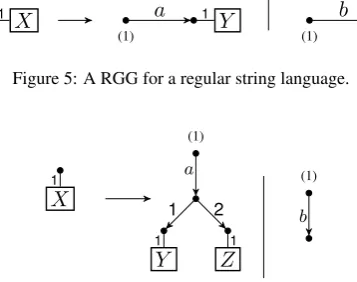
Example 4. The grammar in Table 1 is an RGG. Although HRGs can produce context-free lan-guages (and beyond) as shown in Figure 4, the only string languages RGGs can produce are the regular string languages. See Figure 5 for an example of a string generating RGG. Similarly, RGGs can produce regular tree languages, but not context-free tree languages. Figure 6 shows a tree generating RGG that generates binary trees the in-ternal nodes of which are represented bya-labeled edges, and the leaves of which are represented by
b-labeled edges. Note that these two results of reg-ularity of the string- and tree-languages generated by RGG follow from the fact that graph languages produced by RGG are MSO-definable (Courcelle, 1991), and the well-known facts that the regular string and graph languages are MSO-definable.
X
(1)
a Y
(1)
b
[image:4.595.89.268.394.535.2]1 1
Figure 5: A RGG for a regular string language.
X
(1)
Y Z
(1)
1 a
1 2
1 1
[image:4.595.109.253.460.535.2]b
Figure 6: A RGG for a regular tree language. We call the family of languages generated by RGGs theregular graph languages(RGLs). 3 RGL Recognition
To recognize RGG, we exploit the property that every nonterminal including the start symbol has rank at least one (Definition 5), and we assume that the corresponding external node is identified in the input graph. This mild assumption may be reasonable for applications like AMR parsing, where grammars could be designed so that the ex-ternal node is always the unique root. Later we relax this assumption.
The availability of an identifiable external node suggests a top-down algorithm, and we take
in-spiration from a top-down recognition algorithm for the predictive top-down parsable grammars, another subclass of HRG (Drewes et al., 2015). These grammars, the graph equivalent of LL(1) string grammars, are incomparable to RGG, but the algorithms are related in their use of top-down prediction and in that they both fix an order of the edges in the right-hand side of each production.
3.1 Top-Down Recognition for RGLs
Just as the algorithm of Chiang et al. (2013) gen-eralizes CKY to HRG, our algorithm gengen-eralizes Earley’s algorithm (Earley, 1970). Both algo-rithms operate by recognizing incrementally larger subgraphs of the input graph, using a succinct rep-resentation for subgraphs that depends on an arbi-trarily chosenmarker nodemof the input graph.
Definition 6. (Chiang et al. 2013; Definition 6) Let I be a subgraph of a graphG. A boundary node of I is a node which is either an endpoint of an edge in G\I or an external node of G. A
boundary edge of I is an edge in I which has a boundary node as an endpoint. The boundary representation of I is the tuple b(I) = hbn(I), be(I), m∈Iiwhere
1. bn(I)is the set of boundary nodes ofI 2. be(I)is the set of boundary edges ofI 3. (m ∈ I) is a flag indicating whether the marker node is inI.
Chiang et al. (2013) prove each subgraph has a unique boundary representation, and give algo-rithms that use only boundary representations to compute the union of two subgraphs, requiring time linear in the number of boundary nodes; and to check disjointness of subgraphs, requiring time linear in the number of boundary edges.
For each productionpof the grammar, we im-pose a fixed order on the edges of R(p), as in Drewes et al. (2015). We discuss this order in de-tail in§3.2. As in Earley’s algorithm, we use dot-ted rules to represent partial recognition of pro-ductions: X → e¯1. . .e¯i−1
·
¯ei. . .e¯n means thatwe have identified the edges ¯e1 to ei¯−1 and that
we must next recognize edge ¯ei. We write ¯eand
¯
vfor edges and nodes in productions andeandv
for edges and nodes in a derived graph. When the identity of the sequence is immaterial we abbrevi-ate it asα, for example writingX→
·
α.Name Rule Conditions
PREDICT [b(I), p:X→¯e1. . .
·
¯ei. . .¯en, φp][q:Y →α][φp(¯ei), q:Y →
·
α, φ0q[extR(q)=φp(¯ei)]] lab(¯ei) =YSCAN [b(I), X→¯e1. . .
·
¯ei. . .e¯n, φp][e=edglab(¯ei)(v1, . . . , vm)][b(I∪ {e}), X→¯e1. . .
·
e¯i+1. . .¯en, φp[att(¯ei) = (v1, . . . , vm)]]φp(¯ei)(j)∈VG⇒ φp(¯ei)(j) =vert(e, j)
COMPLETE [b(I), p:X→¯e1. . .
·
¯ei. . .¯en, φp][b(J), q:Y →α·
, φq][b(I∪J), X→¯e1. . .
·
¯ei+1. . .¯en, φp[att(¯ei) =φp(extR(q))]]φp(¯ei)(j)∈VG⇒ φp(¯ei)(j) = φq(extR(q))(j),
[image:5.595.81.515.65.229.2]lab(¯ei) =Y, EI∩EJ =∅
Table 2: The inference rules for the top-down recognizer. recognizer are of the form
[b(I), p:X→e¯1. . .
·
ei¯ . . .¯en, φp]where I is a subgraph that has been recognized as matching¯e1, . . . ,¯ei−1;p:X →¯e1, . . . ,e¯nis a
production in the grammar with the edges in order; andφp:ER(p) →VG∗maps the endpoints of edges
inR(p)to nodes inG.
For each production p, we number the nodes in some arbitrary but fixed order. Using this, we construct the function φ0
p : ER(p) → VR∗(p) such
that for e¯ ∈ ER(p) if att(¯e) = (¯v1,¯v2) then
φ0
p(¯e) = (¯v1,¯v2). As we match edges in the graph
with edges inp, we assign the nodes¯vto nodes in the graph. For example, if we have an edge ¯ein a productionpsuch that att(¯e) = (¯v1,v¯2)and we
find an edge ewhich matches e¯, then we update
φp to record this fact, writtenφp[att(¯e) = att(e)]. We also useφp to record assignments of external
nodes. If we assign theith external node tov, we writeφp[extp(i) =v]. We writeφ0p to represent a
mapping with no grounded nodes.
Since our algorithm makes top-down predic-tions based on known external nodes, our bound-ary representation must cover the case where a subgraph is empty except for these nodes. If at some point we know that our subgraph has external nodes φ(¯e), then we use the shorthand
φ(¯e) rather than the full boundary representation hφ(¯e),∅, m∈φ(¯e)i.
To keep notation uniform, we use dummy non-terminalS∗ 6∈NG that derivesSG via the produc-tionp0. For graphG, our system includes the
ax-iom:
[extG, p0:S∗ →
·
SG, φp00[extR(p0)=extG]].Ourgoalis to prove:
[b(G), pS :S∗ →SG
·
, φpS]whereφpS has a single edgee¯in its domain which
has labelSGinR(pS)andφpS(¯e) =extG.
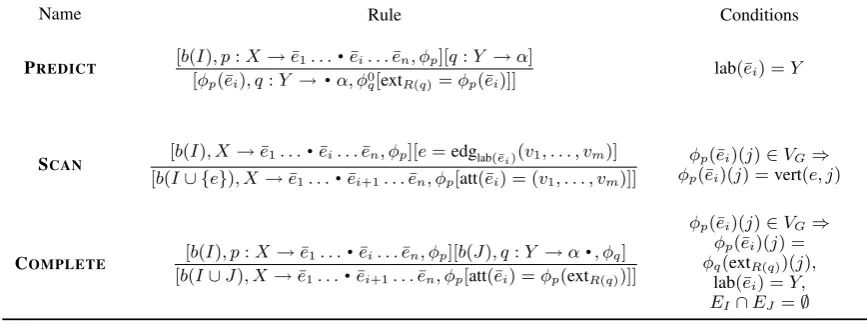
As in Earley’s algorithm, we have three infer-ence rules: PREDICT,SCAN andCOMPLETE (Ta-ble 2). PREDICTis applied when the edge after the dot is nonterminal, assigning any external nodes that have been identified. SCAN is applied when the edge after the dot is terminal. Using φp, we
may already know where some of the endpoints of the edge should be, so it requires the endpoints of the scanned edge to match. COMPLETE requires that each of the nodes of ei¯ in R(p) have been identified, these nodes match up with the corre-sponding external nodes of the subgraph J, and that the subgraphsI andJ are edge-disjoint.
We provide a high-level proof that the recog-nizer is sound and complete.
Proposition 1. LetG be a HRG andG a graph. Then the goal [b(G), pS : S∗ → SG
·
, φpS] can be proved from the axiom [extG, pS : S∗ →·
SG, φpS[extR(pS) = extG]] if and only if G ∈L(G).
Proof. We prove that for each X ∈ NG, [b(G), pX :X∗ → X
·
, φpX]can be proved from[extG, pX :X∗ →
·
X, φpX[extR(pX) =extG]]ifand only if G ∈ LX(G) where the dummy non-terminalX∗ was added to the set of nonterminals andpX :X∗→Xwas added to the set of
produc-tions. We prove this by induction on the number of edges inG.
and in the case of RGGs they are already in this form by definition.
Base Case:LetGconsist of a single edge. If: Assume G ∈ LX(G). Since G consists
of one edge, there must be a production q :
X → G. Apply PREDICT to the axiom and pX : X∗ → X to obtain the item [φpX(X), q : X →
·
G, φ0q[extG =φpX(X)]]. ApplySCAN to
the single terminal edge that makes up G to ob-tain [b(G), q : X → G
·
, φq] and finally apply COMPLETE to this and the axiom reach the goal[b(G), pX :X∗ →X, φpX].
Only if: Assume the goal can be reached from the axiom and G = e. Then the item [b(e), q :
X→e, φq]must have been reached at some point
for some q ∈ PG. Therefore q : X → e is a production and soe=G∈LX(G).
Assumption: Assume that the proposition holds whenGhas fewer thankedges.
Inductive Step: AssumeGhaskedges. If: Assume G ∈ LX(G), then there is a pro-duction q : X → H where H has nonterminals
Y1, . . . , Ynand there are graphsH1, . . . , Hnsuch
thatG = H[Y1/H1]. . .[Yn/Hn]. Each graphHi
fori ∈ [n]has fewer thankedges and so we ap-ply the inductive hypothesis to show that we can prove the items[b(Hi), ri :Yi →Ji, φri]for each i∈[n]. By applyingCOMPLETEto each such item and applyingSCANto each terminal edge ofHwe reach the goal[b(G), pX :X∗ →X
·
, φpX].Only If: Assume the goal can be proved from the axiom. Then we must have at some point reached an item of the form [b(G), q : X →
H, φq] and that H has nonterminals Y1, . . . , Yn.
This means that there are graphsH1, . . . , Hnsuch
that[b(Hi), pYi :Yi∗ → Yi, φpYi]for eachi∈[n]
andG = H[Y1/H1]. . .[Yn/Hn]. Since each Hi
has fewer thankedges, we apply the inductive hy-pothesis to get thatHi ∈LYi(G)for eachi∈[n]
and thereforeG∈LX(G).
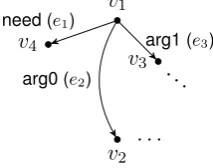
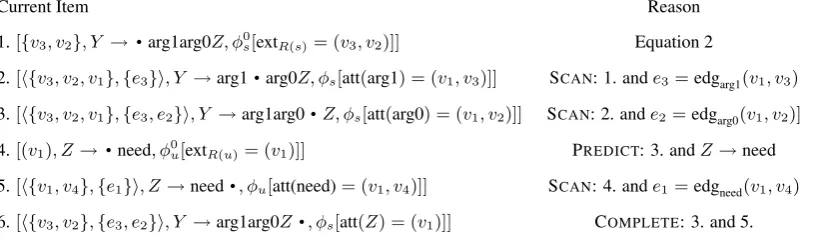
Example 5. Using the RGG in Table 1, we show how to recognize the graph in Figure 7, which can be derived by applying productionsfollowed by production u, where the external nodes of Y are (v3, v2). Assume the ordering of the edges in
pro-ductionsis arg1, arg0, Z; the top node is¯v1; the
bottom node is¯v2; and the node on the right is¯v3;
and that the marker node is not in this subgraph— we elide reference to it for simplicity. Letv¯4 be
the top node ofR(u) andv¯5 be the bottom node
ofR(u). The external nodes ofY are determined
top-down, so the recognize of this subgraph is trig-gered by this item:
[{v3, v2}, Y →
·
arg1 arg0Z,φ0
s[extR(s) = (v3, v2)]] (2)
whereφs(arg1) = (¯v1, v3), φs(arg0) = (¯v1, v2),
andφs(Z) = (¯v1).
Table 3 shows how we can prove the item
[h{v3, v2},{e3, e2}i, Y →arg1arg0Z
·
, φ]The boundary representation
h{v3, v2},{e3, e2}i in this item represents
the whole subgraph shown in Figure 7.
v1
v4
v2
v3 ...
. . .
need (e1)
arg0 (e2)
[image:6.595.362.469.280.364.2]arg1 (e3)
Figure 7: Top left subgraph of Figure 3. To refer to nodes and edges in the text, they are labeledv1, v2, v3, e1, e2, ande3.
3.2 Normal Ordering
Our algorithm requires a fixed ordering of the edges in the right-hand sides of each production. We will constrain this ordering to exploit the struc-ture of RGG productions, allowing us to bound recognition complexity. Ifs = ¯e1. . .e¯nis an
or-der, definesi:j = ¯ei. . .¯ej.
Definition 7. Lets= ¯e1, . . . ,¯enbe an edge order of a right-hand side of a production. Then s is
normalif it has the following properties: 1. ¯e1 is connected to an external node,
2. s1:j is a connected graph for allj∈[n] 3. if¯eiis nonterminal, each endpoint ofei¯ must be incident with some terminal edgee¯j for which j < i.
Example 6. The ordering of the edges of produc-tionsin Example 5 is normal.
Arbitrary HRGs do not necessarily admit a nor-mal ordering. For example, the graph in Figure 8 cannot satisfy Properties 2 and 3 simultaneously. However, RGGs do admit a normal ordering.
(1) X (2)
a 1 2 b
Current Item Reason 1.[{v3, v2}, Y →
·
arg1arg0Z, φs0[extR(s)= (v3, v2)]] Equation 22.[h{v3, v2, v1},{e3}i, Y →arg1
·
arg0Z, φs[att(arg1) = (v1, v3)]] SCAN: 1. ande3=edgarg1(v1, v3)3.[h{v3, v2, v1},{e3, e2}i, Y →arg1arg0
·
Z, φs[att(arg0) = (v1, v2)]] SCAN: 2. ande2=edgarg0(v1, v2)]4.[(v1), Z→
·
need, φ0u[extR(u)= (v1)]] PREDICT: 3. andZ→need5.[h{v1, v4},{e1}i, Z→need
·
, φu[att(need)= (v1, v4)]] SCAN: 4. ande1=edgneed(v1, v4) [image:7.595.99.509.69.192.2]6.[h{v3, v2},{e3, e2}i, Y →arg1arg0Z
·
, φs[att(Z) = (v1)]] COMPLETE: 3. and 5.Table 3: The steps of recognizing that the subgraph shown in Figure 7 is derived from productionsr2anduin the grammar in
Table 1.
Proposition 2. IfGis an RGG, for everyp∈PG,
there is a normal ordering of the edges inR(p). Proof. IfR(p)contains a single node then it must be an external node and it must have a terminal edge attached to it since R(p) must contain at least one terminal edge. If R(p) contains multi-ple nodes then by C2 there must be terminal inter-nal paths between all of them, so there must be a terminal edge attached to the external node, which we use to satisfy Property 1. To produce a normal ordering, we next select terminal edges once one of their endpoints is connected to an ordered edge, and nonterminal edges once all endpoints are con-nected to ordered edges, possible by C2. There-fore, Properties 2 and 3 are satisfied.
A normal ordering tightly constrains the recog-nition of edges. Property 3 ensures that when we apply PREDICT, the external nodes of the pre-dicted edge are all bound to specific nodes in the graph. Properties 1 and 2 ensure that when we apply SCAN, at least one endpoint of the edge is bound (fixed).
3.3 Recognition Complexity
Assume a normally-ordered RGG. Let the maxi-mum number of edges in the right-hand side of any production bem; the maximum number of nodes in any right-hand side of a productionk; the maxi-mum degree of any node in the input graphd; and the number of nodes in the input graphn.
As previously mentioned, Drewes et al. (2015) also propose a HRG recognizer which can recog-nize a subclass of HRG (incomparable to RGG) called the predictive top-down parsable grammars. Their recognizer in this case runs inO(n2)time.
A well-known bottom-up recognizing algorithm for HRG was first proposed by Lautemann (1990).
In this paper, the recognizer is shown to be polyno-mial in the size of the input graph. Later, Chiang et al. (2013) formulate the same algorithm more precisely and show that the recognizing complex-ity isO((3d×n)k+1)wherekin their case is the
treewidth of the grammar.
Remark 1. The maximum number of nodes in any right-hand side of a production (k) is also the max-imum number of boundary nodes for any subgraph in the recognizer.
COMPLETE combines subgraphs I andJ only when the entire subgraph derived fromY has been recognized. Boundary nodes ofJ are also bound-ary nodes of I because they are nodes in the ter-minal subgraph of R(p) whereY connects. The boundary nodes of I ∪J are also bounded by k
since form a subset of the boundary nodes ofI.
Remark 2. Given a boundary node, there are at most (dm)k−1 ways of identifying the remaining
boundary nodes of a subgraph that is isomorphic to the terminal subgraph of the right-hand side of a production.
The terminal subgraph of each production is connected by C2, with a maximum path length of
m. For each edge in the path, there are at mostd
subsequent edges. Hence for thek−1remaining boundary nodes there are(dm)k−1ways of
choos-ing them.
We count instantiations of COMPLETE for an upper bound on complexity (McAllester, 2002), using similar logic to (Chiang et al., 2013). The number of boundary nodes of I, J and I ∪J is at most k. Therefore, if we choose an arbitrary node to be some boundary node ofI∪J, there are at most (dm)k−1 ways of choosing its remaining
boundary nodes. For each of these nodes, there are at most(3d)kstates of their attached boundary
of instantiations is O(n(dm)k−1(3d)k), linear in
the number of input nodes and exponential in the degree of the input graph. Note that in the case of the AMR dataset (Banarescu et al. 2013), the max-imum node degree is 17 and the average is 2.12.
We observe that RGGs could be relaxed to pro-duce graphs with no external nodes by adding a dummy nonterminal S0 with rank 0 and a single productionS0 → S. To adapt the recognition al-gorithm, we would first need to guess where the graph starts. This would add a factor ofnto the complexity as the graph could start at any node.
4 Discussion and Conclusions
We have presented RGG as a formalism that could be useful for semantic representations and we have provided a top-down recognition algo-rithm for them. The constraints of RGG en-able more efficient recognition than general HRG, and this tradeoff is reasonable since HRG is very expressive—when generating strings, it can ex-press non-context-free languages (Engelfriet and Heyker, 1991; Bauer and Rambow, 2016), far more power than needed to express semantic graphs. On the other hand, RGG is so constrained that it may not be expressive enough: it would be more natural to derive the graph in Figure 4 from outermost to innermost predicate; but constraint C2 makes it difficult to express this, and the gram-mar in Table 1 does not. Perhaps we need less expressivity than HRG but more than RGG.
HRL MSOL Graphs
CFTL
CFL∗
RTL Trees
RL Strings
[image:8.595.93.267.508.605.2]RGL DAGAL
Figure 9: A Hasse diagram of various string, tree and graph language families. An arrow from family A to family B indi-cates that family A is a subfamily of family B.
A possible alternative would be to consider Re-stricted DAG Grammars (RDG; Bj¨orklund et al. 2016). Parsing for a fixed such grammar can be achieved in quadratic time with respect to the in-put graph. It is known that for a fixed HRG gen-eratingk-connected hypergraphs consisting of hy-peredges of rankkonly, parsing can be carried out in cubic time (k-HRG; (Drewes, 1993)).
More general than RDGs a is the class of graph languages recognized by DAG automata (DA-GAL; Blum and Drewes 2016), for which the de-terministic variant provides polynomial time pars-ing. Note that RGGs can generate graph languages of unbounded node degree. With respect to ex-pressive power, RDGs andk-HRGs are incompa-rable to RGGs. Figure 9 shows the relationships between the context-free and regular languages for strings, trees and graphs. Monadic-second order logic (MSOL; Courcelle and Engelfriet 2011) is a form of logic which when restricted to strings gives us exactly the regular string languages and when restricted to trees gives us exactly the regu-lar tree languages. RGLs lie in the intersection of HRG and MSOL on graphs but they do not make up this entire intersection. Courcelle (1991) de-fined (non-constructively) this intersection to be the strongly context-free languages (SCFL). We believe that there may be other formalisms that are subfamilies of SCFL which may be useful for se-mantic representations. All inclusions shown in Figure 9 are strict. For instance, RGL cannot pro-duce “star graphs” (one node that has edges ton
other nodes), while DAGAL and HRL can pro-duce such graphs. It is well-known that HRL and MSOL are incomparable. There is a language in RGL that is not in DAGAL, for instance, “ladders” (two string graphs ofnnodes each, with an edge between theith node of each string).
Another alternative formalism to RGG that is defined as a restriction of HRG are Tree-like Grammars (TLG; Matheja et al. 2015). They fine a subclass of SCFL, i.e., they are MSO de-finable. TLGs have been considered for program verification, where closure under intersection of the formalism is essential. Note that RGGs are also closed under intersection. While TLG and RDG are both incomparable to RGG, they share important characteristics, including the fact that the terminal subgraph of every production is con-nected. This means that our top-down recogni-tion algorithm is applicable to both. In the future we would like to investigate larger, less restrictive (and more linguistically expressive) subfamilies of SCFL. We plan to implement and evaluate our al-gorithm experimentally.
Acknowledgments
funded by the UK Engineering and Physical Sci-ences Research Council (grant EP/L016427/1) and the University of Edinburgh; and in part by a Google faculty research award (to AL). We thank Clara Vania, Sameer Bansal, Ida Szubert, Fed-erico Fancellu, Antonis Anastasopoulos, Marco Damonte, and the anonymous reviews for helpful discussion of this work and comments on previous drafts of the paper.
References
Omri Abend and Ari Rappoport. 2013.
Univer-sal conceptual cognitive annotation (ucca). In
ACL (1). The Association for Computational
Linguistics, pages 228–238.
http://dblp.uni-trier.de/db/conf/acl/acl2013-1.html#AbendR13.
Laura Banarescu, Claire Bonial, Shu Cai, Madalina Georgescu, Kira Griffitt, Ulf Hermjakob, Kevin Knight, Philipp Koehn, Martha Palmer, and Nathan
Schneider. 2013. Abstract meaning
representa-tion for sembanking. In Proceedings of the
7th Linguistic Annotation Workshop and Interoper-ability with Discourse. Association for Computa-tional Linguistics, Sofia, Bulgaria, pages 178–186. http://www.aclweb.org/anthology/W13-2322.
Daniel Bauer and Owen Rambow. 2016.
Hy-peredge replacement and nonprojective
de-pendency structures. In Proceedings of the
12th International Workshop on Tree Ad-joining Grammars and Related Formalisms (TAG+12), June 29 - July 1, 2016, Heinrich Heine University, D¨usseldorf, Germany. pages 103–
111.
http://aclweb.org/anthology/W/W16/W16-3311.pdf.
Henrik Bj¨orklund, Frank Drewes, and Petter
Eric-son. 2016. Between a Rock and a Hard Place
– Uniform Parsing for Hyperedge Replacement DAG Grammars, Springer International Publishing, Cham, pages 521–532. https://doi.org/10.1007/978-3-319-30000-9 40.
Johannes Blum and Frank Drewes. 2016. Properties
of regular DAG languages. In Language and
Au-tomata Theory and Applications - 10th International Conference, LATA 2016, Prague, Czech Republic, March 14-18, 2016, Proceedings. pages 427–438. https://doi.org/10.1007/978-3-319-30000-9 33.
David Chiang, Jacob Andreas, Daniel Bauer, Karl Moritz Hermann, Bevan Jones, and Kevin
Knight. 2013. Parsing graphs with
hyper-edge replacement grammars. In Proceedings
of the 51st Annual Meeting of the Associa-tion for ComputaAssocia-tional Linguistics (Volume 1: Long Papers). Association for Computational Linguistics, Sofia, Bulgaria, pages 924–932. http://www.aclweb.org/anthology/P13-1091.
Bruno Courcelle. 1991. The monadic second-order logic of graphs V: on closing the gap between
definability and recognizability. Theor. Comput.
Sci. 80(2):153–202.
https://doi.org/10.1016/0304-3975(91)90387-H.
Bruno Courcelle and Joost Engelfriet. 2011. Graph
Structure and Monadic Second-Order Logic, a Lan-guage Theoretic Approach. Cambridge University Press.
Frank Drewes. 1993. Np-completeness of
k-connected hyperedge-replacement languages
of order k. Inf. Process. Lett. 45(2):89–94.
https://doi.org/10.1016/0020-0190(93)90221-T.
Frank Drewes, Berthold Hoffmann, and Mark
Mi-nas. 2015. Predictive Top-Down Parsing for
Hyperedge Replacement Grammars, Springer International Publishing, Cham, pages 19–34. https://doi.org/10.1007/978-3-319-21145-9 2.
Frank Drewes, Hans-J¨org Kreowski, and Annegret Ha-bel. 1997. Hyperedge replacement graph grammars.
In Grzegorz Rozenberg, editor,Handbook of Graph
Grammars and Computing by Graph Transforma-tion, World Scientific, pages 95–162.
Jay Earley. 1970. An efficient context-free
parsing algorithm. ACM, New York,
NY, USA, volume 13, pages 94–102.
https://doi.org/10.1145/362007.362035.
Joost Engelfriet and Linda Heyker. 1991. The string generating power of context-free hypergraph
gram-mars. Journal of Computer and System Sciences
43(2):328–360.
Dan Flickinger, Yi Zhang, and Valia Kordoni. 2012. Deepbank : a dynamically annotated treebank of the Wall Street Journal. InProceedings of the Eleventh International Workshop on Treebanks and Linguistic Theories (TLT11). Lisbon, pages 85–96. HU.
Jan Hajiˇc, Eva Hajiˇcov´a, Jarmila Panevov, Petr Sgall, Ondˇrej Bojar, Silvie Cinkov´a, Eva Fuˇc´ıkov´a, Marie Mikulov´a, Petr Pajas, Jan Popelka, Jiˇr´ı Se-meck´y, Jana ˇSindlerov´a, Jan ˇStˇep´anek, Josef Toman, Zdeˇnka Ureˇsov´a, and Zdenˇek ˇZabokrtsk´y. 2012. Announcing prague czech-english dependency tree-bank 2.0. In Nicoletta Calzolari (Conference Chair), Khalid Choukri, Thierry Declerck, Mehmet Uur Doan, Bente Maegaard, Joseph Mariani, Asun-cion Moreno, Jan Odijk, and Stelios Piperidis,
ed-itors, Proceedings of the Eight International
Con-ference on Language Resources and Evaluation (LREC’12). European Language Resources Associ-ation (ELRA), Istanbul, Turkey.
Bevan Jones, Jacob Andreas, Daniel Bauer, Karl Mor-tiz Hermann, and Kevin Knight. 2012. Semantics-based machine translation with hyperedge
Clemens Lautemann. 1990. The complexity of graph languages generated by hyperedge
re-placement. Acta Informatica 27(5):399–421.
https://doi.org/10.1007/BF00289017.
Christoph Matheja, Christina Jansen, and Thomas
Noll. 2015. Tree-Like Grammars and
Separa-tion Logic, Springer International Publishing, Cham, pages 90–108. https://doi.org/10.1007/978-3-319-26529-2 6.
David McAllester. 2002. On the complexity
anal-ysis of static analyses. J. ACM 49(4):512–537.
https://doi.org/10.1145/581771.581774.
Xiaochang Peng, Linfeng Song, and Daniel Gildea. 2015. A synchronous hyperedge replacement
gram-mar based approach for AMR parsing. In
Pro-ceedings of the 19th Conference on Computa-tional Natural Language Learning, CoNLL 2015, Beijing, China, July 30-31, 2015. pages 32–41. http://aclweb.org/anthology/K/K15/K15-1004.pdf. Stuart M. Shieber, Yves Schabes, and Fernando C. N.
Pereira. 1995. Principles and implementation of
deductive parsing. Journal of Logic Programming
24(1-2).
K. Vijay-Shanker, David J. Weir, and Aravind K.
Joshi. 1987. Characterizing structural