Putting Semantics into Semantic Roles
James F. Allen
1,2and Choh Man Teng
11
Institute for Human and Machine Cognition, 40 S. Alcaniz St., Pensacola FL 32502, USA
2
Department of Computer Science, University of Rochester, Rochester NY 14627, USA
[email protected], [email protected]
Abstract
While there have been many proposals for theories of semantic roles over the years, these models are mostly justified by intui-tion and the only evaluaintui-tion methods have been inter-annotator agreement. We ex-plore three different ideas for providing more rigorous theories of semantic roles. These ideas give rise to more objective cri-teria for designing role sets, and lend themselves to some experimental evalua-tion. We illustrate the discussion by exam-ining the semantic roles in TRIPS.
1
Introduction
Semantic roles play a foundational role in most computational approaches to encoding meaning, yet they remain surprisingly ill-defined. For the most part, a role taxonomy is defined by an in-formal gloss and some examples. In other cases, semantic roles act purely as convenient names for arguments of a predicate, frame or event, but are otherwise uninterpreted. This paper starts from the belief that if we are going to base a representation on semantic roles, they should have consequences independent of the predicate or event they are used in. In particular, we will explore three differ-ent aspects that iddiffer-entify criteria one might want in a theory of semantic roles:
1. Entailment: We should be able to identify en-tailments from a role independent of the type that has such roles
2. Integration with ontology: Roles should obey the typical entailments in an ontology (e.g., inheritance of properties from parents in the ontology)
3. Derivability: The roles that a type has should be derivable from its semantic properties, as revealed by definitions of the type in sources such as dictionaries.
The first property helps ensure that roles are used consistently in a semantic lexicon, the second en-sures consistency with an ontology used for
rea-soning, and the third evaluates the semantic inter-dependence of roles and the types they occur in.
This paper will examine a particular role set, the TRIPS roles sketched in Allen & Teng, (2017)1. The first two properties are more formal in nature, but the third allows empirical evalua-tion, namely, whether the roles of an unknown word sense can be derived from its definition.
2
Preliminaries
Semantic roles have a long history, originating in linguistics as thematic roles (e.g., Fillmore, 1968; Dowty, 1991) and widely adopted in computa-tional linguistics for semantic representations be-cause of their compatibility with frame-based and graph-based (i.e., semantic networks) representa-tions of meaning.
Very roughly, computational approaches can be divided into two classes based on whether one be-lieves there is a single universal set of roles (e.g., LiRICS (Bunt & Rosemary, 2002; Petukhova & Bunt, 2008), VerbNet (Kipper et al., 2008; Bonial et al., 2011)), or whether one believes each type may identify its own unique roles (e.g., FrameNet (Baker et al., 1998)). Straddling a middle ground is PropBank (Palmer et al., 2005), which uses a universal set of role names, but allows each type to define what their roles mean. Our interest is in defining a universal set of roles across all types.
A key distinction that most frameworks make is between the inner (or core or argument) roles and the outer (or relational or adjunct) roles. The core roles identify objects that are typically re-quired to fully specify the content of the type, while relational roles are typically optional but add additional information. For instance, in
The snow melted into a puddle.
The subject of this sentence is clearly a critical ar-gument to the melting event. In fact, we cannot
1 More detail can be found in the TRIPS LF documentation:
trips.ihmc.us/parser/LF%20Documentation.pdf
describe a melting event in a well-formed sen-tence without mentioning what melted (even if it is vague, as in something melted). On the other hand, the result construction realized by into a puddle is optional. Typically, roles of time and lo-cation are relational roles as they can be applied to almost any event and are usually optional.
But there are differences that go beyond op-tionality. The core roles semantically are like ar-guments to a predicate, although they might be optional. The relational roles semantically denote a relationship between an event and some other condition, not an argument. For instance, the phrase into a puddle above denotes first a seman-tic relationship called RESULTING-OBJECT (one of the senses of the word into) that takes as one argument the melting event and the other ar-gument the object that the snow becomes, i.e., a puddle. We will elaborate on this later in the pa-per.
This paper describes three possible ways to es-tablish a more rigorous semantics for a set of semantic roles, and explores each method in terms of the TRIPS semantic roles. In Section 4 we describe the start of an axiomatization of the roles. In Section 5 we describe the integration of the roles with an ontology. And in Section 6 we describe experiments involving derivability, i.e., can the roles that a given verb sense has be de-rived from its dictionary definition.
3
Overview of TRIPS Semantic Roles
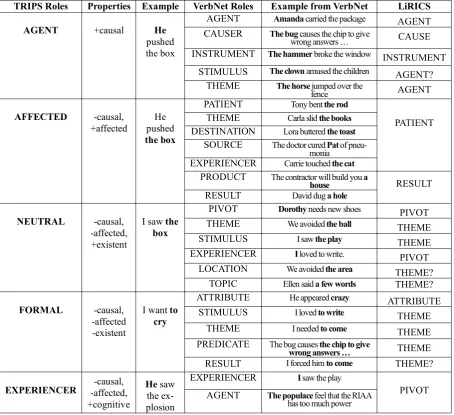
The TRIPS core roles are shown in Table 1. These roles are defined to reflect the causal relationship between the role values and the events they are in. Informally, an AGENT of an event necessarily ex-erts causal influence to bring about the event. An AFFECTED of an event is necessarily affected or changed in some way by the event but does not cause the event. Objects filling the NEUTRAL and FORMAL roles are acausal, i.e., not neces-sarily causing or changed by the event. NEU-TRAL objects are existent and can be created or destroyed. These include both physical (e.g., a box) and abstract (e.g., an idea) objects. In con-trast, FORMAL objects have no temporal exist-ence (e.g., a proposition). Finally, EXPERI-ENCER is a special class for sentient objects in stative events involving perceptual or cognitive states.Table 1 summarizes the distinguishing features of each of the roles, and shows correspondences with VerbNet and LiRICS. Note the mappings are nowhere near one-to-one, reflecting differing cri-teria that are used to define each of the role sets. In some cases, the LiRICS role is not completely clear and is marked with a question mark.
Some differences are differences of granularity (cf: the hierarchical roles in Bonial et al. (2001) and Allen (1995)). For instance, the TRIPS AGENTrole only requires a causal relationship to the event, and does not require intentionality of the agent (as in LiRICS which distinguishes be-tween its AGENT and CAUSE roles). TRIPS takes this stance as it seems most verbs with agents would also allow non-intentional causes as well. We believe the intentionality distinction is not signaled in linguistic usage, and should be de-rived based on commonsense knowledge and rea-soning. Thus, we do not make the distinction in the role set.
As another example, VerbNet identifies classes of STIMULUS/EXPERIENCER verbs, as in The clown amused the children. Roughly, the STIM-ULUS role plays a causal role similar to AGENT and the EXPERIENCER plays an AFFECTED role where the object is affected in some cognitive fashion. The TRIPS roleset stays at an abstract level of representation, assigning the clown to AGENT and children to AFFECTED. For similar reasons, TRIPS does not have INSTRUMENT as a core role (although there is a sense of the prepo-sition with that captures accomplishing actions with a tool – e.g., He opened the door with a key).
Note TRIPS and VerbNet agree on the EXPE-RIENCER role in some cases, namely with stative verbs. In TRIPS, EXPERIENCER only occurs with stative verbs of perception and cognition.
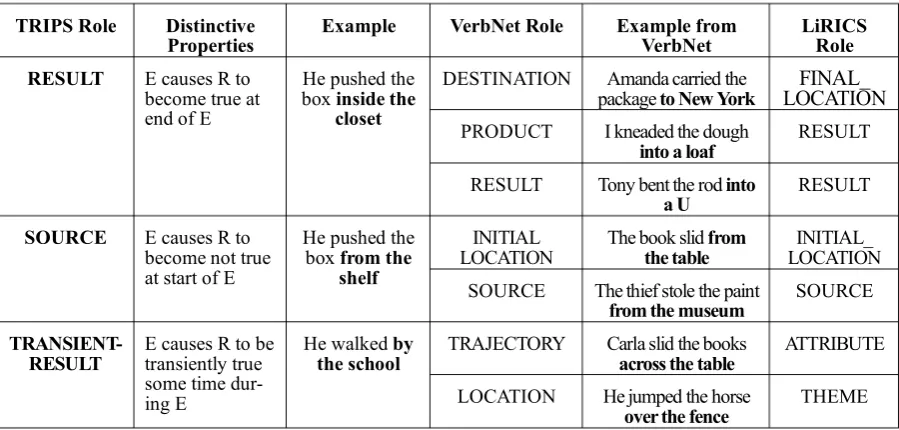
Note that based on the definitions of the roles, it is common that the same role appears more than once in a sentence. We distinguish these argu-ments by attaching numbers to them. Thus, in The box is touching the table we have two roles NEU-TRAL and NEUNEU-TRAL1 for the box and the table respectively. VerbNet uses a similar scheme and labels these arguments THEME and CO-THEME. Most of the remaining TRIPS roles are rela-tional roles, which as discussed above relate an event to some other property. Linguistically, rela-tional roles are realized by preposirela-tional phrases and other adverbial constructions. Semantically, a relational role identifies causal temporal relation-ships between the event and the property denoted by the prepositional phrase. As an example, for the sentence He pushed the box into the corner, there is an event (He pushed the box) that results in a culmination state (The box is in the corner). The key characteristic of a RESULT relation is
that the state is caused by the event and starts im-mediately at the end of the event. Table 2 shows a number of result related roles based on their tem-poral properties. These three roles differ only in the temporal properties of the caused state.
Note that many cases one might think are SOURCE roles are actually RESULT roles ac-cording to their temporal criterion. For instance, in He lifted the bottle out of the box, the state of be-ing out of the box is true at the end of the event! Using our definitions the SOURCE role seems mostly limited to cases using the preposition from. Note also that the prepositions in these con-structions have fully independent word senses, so our representation does not conflate He put the cup on the box and He put the cup in the box. In contrast, VerbNet assigns the box to a DESTINA-TION role in both and ignoring the preposition.
Other relational roles, which we will not have the space to discuss here, correspond relatively
TRIPS Roles Properties Example VerbNet Roles Example from VerbNet LiRICS
AGENT +causal He pushed the box
AGENT Amanda carried the package AGENT
CAUSER The bug causes the chip to give
wrong answers … CAUSE
INSTRUMENT The hammer broke the window INSTRUMENT
STIMULUS The clown amused the children AGENT?
THEME The horse jumped over the
fence AGENT
AFFECTED -causal, +affected
He pushed the box
PATIENT Tony bent the rod
PATIENT THEME Carla slid thebooks
DESTINATION Lora buttered the toast SOURCE The doctor cured Pat of
pneu-monia
EXPERIENCER Carrie touched the cat PRODUCT The contractor will build you a
house RESULT
RESULT David dug a hole
NEUTRAL -causal, -affected, +existent
I saw the box
PIVOT Dorothy needs new shoes PIVOT
THEME We avoided the ball THEME STIMULUS I saw the play THEME EXPERIENCER I loved to write. PIVOT
LOCATION We avoided the area THEME? TOPIC Ellen said a few words THEME?
FORMAL -causal, -affected -existent
I want to cry
ATTRIBUTE He appeared crazy ATTRIBUTE STIMULUS I loved to write THEME
THEME I needed to come THEME PREDICATE The bug causes the chip to give
wrong answers … THEME RESULT I forced him to come THEME?
EXPERIENCER -affected, -causal, +cognitive
He saw the ex-plosion
EXPERIENCER I saw the play
PIVOT AGENT The populace feel that the RIAA
[image:3.595.73.528.79.494.2]has toomuch power
well to similar roles in VerbNet, LiRICS and PropBank (e.g., LOCATION, TIME, MANNER, EXTENT, FREQUENCY, …).
4
Axiomatizing Roles
Given the space constraints we cannot present a full axiomatization of the role set. To give a fla-vor of the axiomatization we look at one core role in particular, namely the AFFECTED role. This introduces most of the formal framework that is used to define all the roles. In addition, we will show the axiomatization of one of the key rela-tional roles, namely the RESULT role.
4.1 The Framework
We start from the formalism developed in Allen & Teng (2013), extended from the interval temporal logic based framework in Allen & Ferguson (1994) and Allen (1984). In this framework, both events and property predicates are reified (cf. Da-vidson, 1967) with functional relations capturing semantic roles and arguments. Terms, rather than predicates, are temporally qualified. For example, x@t represents “object x over time t”.
Objects filling roles of events are temporally situated. For example, Jack lifted the ball (over interval t1) is represented as
∃e.(LIFT(e),time(e)=t1,
AGENT(e)=jack1@t1,
AFFECTED(e)=ball1@t1)
Key to this framework is a theory of scales. For example, height(o@t) maps a temporally situated object to the set of values on the height scale that
this object takes over period t. Note that the object o may take different values on a scale sc over a given time interval t. Thus, sc(o@t) is a set of values. If sc is not a scale applicable to o@t, then sc(o@t) is empty. For example, for all time inter-vals t, we have mood(rock1@t) = ∅.
Adjectives in natural language are typically represented as Scale Predicates, which denote (of-ten but not necessarily convex) subsets of values on a corresponding scale. Two examples are ScalePred(temperature, Cold) and ScaleP-red(mood, Happy). Thus, it is true that John is Happy today is written as
TrueOf(john1@today, Happy).
In this paper, to describe relations between time intervals, we will make use of the meets relation, written t1:t2, and “during or equal”, written t1 ⊆
t2, from Allen's temporal relations (Allen, 1983).
For more details, see Allen & Teng (2013).
4.2 The AFFECTED Role
In Allen & Teng (2013), existence is taken as a primitive in the formal framework. We will de-fine this as a scale with dichotomous values: ex-istent(o@t) = true if o exists over the time interval t. An object can go in and out of existence at dif-ferent times. This includes both physical objects such as tables and chairs as well as some abstract objects such as thoughts and orderings.
For some objects, it does not make sense to talk about their existence. These include propositions, properties, scales and scale values. (For example, hungry, five pounds.) For these objects, ∀𝑡.
exist-TRIPS Role Distinctive
Properties Example VerbNet Role Example from VerbNet LiRICS Role RESULT E causes R to
become true at end of E
He pushed the box inside the
closet
DESTINATION Amanda carried the
package to New York LOCATIONFINAL_
PRODUCT I kneaded the dough
into a loaf RESULT RESULT Tony bent the rod into
a U RESULT
SOURCE E causes R to become not true at start of E
He pushed the box from the
shelf
INITIAL
LOCATION The book slid the tablefrom LOCATION INITIAL_ SOURCE The thief stole the paint
from the museum SOURCE
TRANSIENT-RESULT E causes R to be transiently true some time dur-ing E
He walked by
the school TRAJECTORY Carla slid the books across the table ATTRIBUTE LOCATION He jumped the horse
[image:4.595.74.524.79.294.2]over the fence THEME
ent(o@t) = ∅. Note that the value is ∅, not false, meaning the existent scale is not applicable.
Now consider the AFFECTED role of an event. It denotes an object that is casually acted upon in the event by the AGENT of the event and is changed in some way by the event. In “I lifted the box”, the box changed location. In “The snow melted”, the snow changed state of matter. In “I molded the clay”, the clay changed shape.
Each event type (e.g., LIFT, MELT, MOLD) is associated with a specific dimension of change such that every occurrence of a particular event type entails a change in the AFFECTED along that particular dimension. For example, for each MOLD event, the AFFECTED of MOLD changes shape, even though the resulting shape in each in-stance might differ. This is captured by specifying that all events of the same event type share a scale on which change occurs for the AFFECTED.
We can thus formulate the conditions for AF-FECTED as follows. Let E(e) denote that e is an event occurrence of type E. Let scale(sc) denote that sc is a scale.
∀𝐸 ∃𝑠𝑐 ∀𝑒, 𝑜, 𝑡. 𝐸(𝑒), 𝑠𝑐𝑎𝑙𝑒 𝑠𝑐 ,
𝑡𝑖𝑚𝑒(𝑒) = 𝑡, 𝑨𝑭𝑭𝑬𝑪𝑻𝑬𝑫(𝑒) = 𝑜@𝑡 ⟹ ∃𝑡1, 𝑡2.
𝑡1 ⊆ 𝑡, 𝑡1: 𝑡2, 𝑠𝑐(𝑜@𝑡1) ≠ 𝑠𝑐(𝑜@𝑡2)
This says the AFFECTED of e undergoes at least one change in a scale dimension sc characteristic of the event type E. There can be more changes, both along the same scale (e.g., the clay changes shape continuously while being molded), or along other dimensions (e.g., the snow changes both shape and volume while being melted).
In the above, t1 is during or equal t, the time
in-terval of the event, whereas t2 is met by t1 but
could be during, overlaps, or at the end of t. This allows for changes that are intermittent and may not persist to the end of the event (e.g., flicker, wiggle) and also changes that occur only at the end of the event (e.g., the stick snapped). In the latter case, for AFFECTED objects that only come into existence at the end of the event (e.g., I drew a circle), it is possible that sc(o@t1) = ∅.
Note that the semantics of the roles are defined with respect to completed events. This is captured by the predicate E(e). For example, for I was drawing a circle but did not finish, even though the circle never came into existence, the roles are derived not from the progressive formulation but from the corresponding case in which the event has occurred.
4.3 Characteristic Properties of Core Roles Table 1 lists several properties: causal, affected, existent. Each of the core roles can be character-ized by a combination of the presence or absence of these properties. The axiomatization of the AFFECTED role indicates how the affected prop-erty can be defined. The existent propprop-erty is cap-tured by the existent scale discussed in the previ-ous section.
The causal property is meant to indicate that an object exerts a causal influence. In the transi-tive case the AGENT causes the event to happen to the AFFECTED (I caused the lifting of the box). The causal property is often taken as prim-itive in other rolesets, but we will outline here how it might be formalized.
We take advantage of the intuition that if X causes an event e, then if we change X in some way we can change the event that occurs. More formally, let sc_E be the scale characteristic of
event type E, that is, when an event of type E oc-curs, its AFFECTED is changed along the scale dimension sc_E. Loosely speaking, when +causal
obtains (for an AGENT oag), there exists some
scale sc* such that a change of oag on the sc*
scale would entail a change of the AFFECTED oaff on the sc_E scale. In other words, there is
some property of the AGENT such that when this property is changed, regardless by what means, some property of the AFFECTED will vary accordingly.
4.4 Wrinkles
A few further considerations complicate the for-mulation above.
First, existent objects are constantly undergoing changes. For example, an object typically gets older (on the AGE scale) as time passes, even without being involved with any explicit AGENT or EVENT. Such changes (with their associated scales) would trivially satisfy the conditions in the formulation above, such that almost any (existent) object could be a candidate for being an AF-FECTED of any EVENT. We call such innocuous changes Background Changes and exclude them from consideration.
counterfactual change. This is especially pertinent for events such as PREVENT (I prevented the ac-cident) or MAINTAIN (The pump maintained the air pressure), in which the events in question are meant to induce no change in the object being act-ed upon.
Third, the NEUTRAL role mostly entails the absence of properties: not causal and not affected. It would seem then that any existent object could fill this role, even if this object bears no relation-ship to the event in question. Similarly, in LiRICS for example, the THEME role is defined as
“Participant in a state or event that is essential to the event taking place or the state being in effect. In an event, a theme does not have con-trol over the way the event occurs and is not structurally changed by the event.” (Schiffrin & Bunt, 2007).
We need to define the notion of being relevant or essential to an event to select for the proper ob-jects. The same consideration applies to FOR-MAL and EXPERIENCER roles as well.
The axiomatization above thus represents our first attempts to formalize the semantic role en-tailments. We expect further refinements as we explore these issues in depth.
4.5 The RESULT Relational Role
Intuitively a RESULT relates an EVENT and the eventual state. The RESULT only becomes true at the end of the EVENT. For example, in “The cat slid under the table”, the cat was not under the ta-ble before or during the sliding event, but at the end of the event the cat is under the table.
In contrast, in many approaches the relationship between the event and the resulting spatial predi-cate is unclear. For example, VerbNet would treat “the table” as the DESTINATION without explicit representation of the spatial relation (under).
RESULTs are often spatial, but they can also be other general states. For example, in “I wiped the desk clean”, the result is that the desk is clean.
Resultative constructions apply to intransitive events (e.g., slide) as well as transitive events (e.g., wipe). For intransitive events, the resulting state pertains to the subject of the event (e.g., In The cat slid under the table, the result is that the cat is under the table), whereas for transitive events, the resulting state pertains to the object of the event (e.g., from I wiped the desk clean, the RESULT is that the desk is clean).
It is possible to transform intransitive construc-tions into transitive construcconstruc-tions. For example, in “The dog barked the cat up the tree”, the BARK event is normally intransitive, but in the above
re-sultative construction, the dog is the AGENT of the BARK event, the cat is the AFFECTED and the RESULT is that the cat is up the tree. (For a treatment of this, see Allen & Teng (2017).)
Thus, the RESULT role can be formalized as follows for a transitive event type E.
∃𝑠𝑐 ∀𝑒, 𝑜, 𝑡, 𝑃.
𝐸 𝑒 , 𝑠𝑐𝑎𝑙𝑒 𝑠𝑐 , 𝑆𝑐𝑎𝑙𝑒𝑃𝑟𝑒𝑑(𝑠𝑐, 𝑃), 𝑡𝑖𝑚𝑒 𝑒 = 𝑡,
𝑨𝑭𝑭𝑬𝑪𝑻𝑬𝑫(𝑒) = 𝑜@𝑡, 𝑹𝑬𝑺𝑼𝑳𝑻(𝑒) = 𝑃
⟹ ∃𝑡2. 𝑡: 𝑡2,
𝑇𝑟𝑢𝑒𝑂𝑓 𝑜@𝑡2, 𝑃 ,
∀𝑡1 ⊆ 𝑡. ~𝑇𝑟𝑢𝑒𝑂𝑓(𝑜@𝑡1, 𝑃)
For example, for the WIPE event e in “I wiped the desk clean”, we have ScalePred(cleanliness, Clean), that is, the predicate Clean is defined on the cleanliness scale. In addition, AFFECTED(e) = desk1@t and RESULT(e) = Clean; that is, the
desk is clean immediately after the WIPE event but not before.
Similarly, for the intransitive case, the AF-FECTED above is replaced by the role filled by the subject, that is, the RESULT is a change in the subject at the end of the EVENT.
Note that an EVENT can have multiple RE-SULTs. For example, “The cat climbed on the box away from the rising water”, in which case the two results combine as a conjunction true im-mediately after the event.
The scale allowed for each event type con-strains the possible interpretations of the text. For example, in “I wiped the table clean”, the table can change on the cleanliness scale and thus al-lows a RESULT construction here. In contrast, in “I wiped the table happy”, the mood scale is not applicable to tables, ruling out the RESULT con-struction. Instead, one would prefer an alternative interpretation using a manner-like construction in which “happy” is used to qualify “I”.
5
Integration with an Ontology
sense S has a semantic role R, then for all instanc-es of S there is an object that fills the R role, i.e.,
∀𝑠. 𝑆 𝑠 ⟹ ∃𝑟. 𝑅 𝑠, 𝑟
This axiom captures what is sometimes called an essential role (Palmer, 2006), i.e., a semantic role that must exist even if not specified in the input sentence. Palmer notes that other roles are obliga-tory, that is, they are both essential and linguisti-cally required, and still others are simply optional and may or may not be realized at either the lin-guistic or inferential levels.
A critical foundation of semantic networks is inheritance down type hierarchies, where a sub-type “inherits” all properties of its parent sub-types. When viewing this from the perspective of se-mantic roles, this means any role that is essential for a given type T must also then be essential for all subtypes of T.
Surprisingly, the predominant models of se-mantic roles do not address such issues in any depth. VerbNet, for instance, creates its classes based on clustering by verb usage patterns, rather than semantic entailments, and has a very limited hierarchical structure defined in terms of exten-sions in allowed usages. Within these hierar-chies, though, it does have inheritance of roles. Propbank, on the other hand, is word based and even semantically very similar verbs have differ-ent rolesets (e.g., compare the rolesets for the verbs constrict, compress and squeeze, which
one would expect would be clustered to-gether in an ontology).
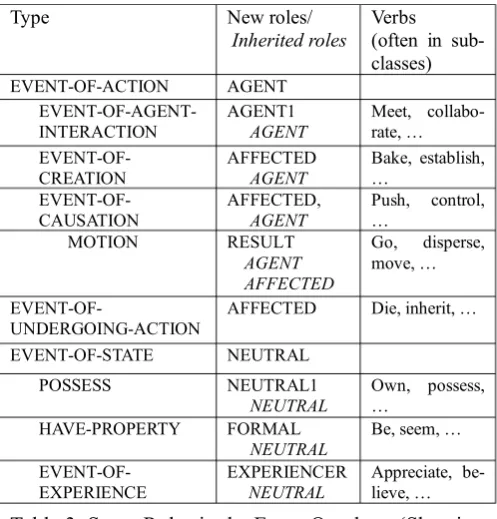
The TRIPS role set is fully integrated with a rich ontology. In this ontology, the concepts are organized both by entailment as well as the semantic roles the verb sens-es take. Table 3 shows a small part of the upper ontology for events and the roles that are defined for each type and inherited from ancestor types. Note TRIPS allows both essential and optional roles. Both are inherited down the hierarchy, and lower types can make an inherited optional role essential, but not vice versa. Whether a role is obligatory or not is not specified in the ontology, but rather in the lexicon where the words and the argument struc-tures they allow are defined. Furthermore, it employs explanation closure techniques (Schubert, 1994) – if a role is not defined as possible in the ontology then the role is not possible.
The integration of roles with an ontolo-gy mutually constrains the assignment of roles to verb sense predicates and constrains the ontology itself. For instance, if we believe that the verb disappear takes the AFFECTED role and not an AGENT role, then its word sense can-not be under the EVENT-OF-ACTION or EVENT-OF-STATE hierarchies, but it looks like a good candidate for being under the EVENT-OF-UNDERGOING-ACTION category. Like-wise, although you might think the verb analyze might take an EXPERIENCER role, if you be-lieve that analyze falls under EVENT-OF-ACTION, then it should take the AGENT role instead.
One other aspect that relates to the ontology is selectional preferences. As in many semantic networks, one can also constrain the semantic type of the arguments that can fill a role. For in-stance, one might say that the event type EAT typically concerns an animate entity (as AGENT) and some comestible substance (as the AF-FECTED role). Such knowledge is critical for driving semantic disambiguation during parsing. The TRIPS restrictions are soft constraints, i.e., the parser prefers interpretations that satisfy the constraints, but can construct interpretations that do not. As with roles, the selectional preferences are inherited down the hierarchy, with more spe-cific event types accumulating all the constraints imposed on their ancestors in the hierarchy. We do not have the space to discuss this further here.
Type New roles/
Inherited roles
Verbs (often in sub-classes)
EVENT-OF-ACTION AGENT
EVENT-OF-AGENT-INTERACTION
AGENT1 AGENT
Meet, collabo-rate, …
EVENT-OF-CREATION
AFFECTED AGENT
Bake, establish, …
EVENT-OF-CAUSATION
AFFECTED, AGENT
Push, control, …
MOTION RESULT
AGENT AFFECTED
Go, disperse, move, …
EVENT-OF-UNDERGOING-ACTION
AFFECTED Die, inherit, …
EVENT-OF-STATE NEUTRAL
POSSESS NEUTRAL1
NEUTRAL
Own, possess, …
HAVE-PROPERTY FORMAL NEUTRAL
Be, seem, …
[image:7.595.73.322.79.339.2]
EVENT-OF-EXPERIENCE EXPERIENCER NEUTRAL Appreciate, be-lieve, … Table 3: Some Roles in the Event Ontology (Showing
6
Derivability in Definitions
The third criterion we explore is derivability. The motivation is as follows: If semantic roles have a semantics independent of their predicates/events, then the semantic properties of roles would not change between a predicate and its definition. For example, consider the word sense corresponding to the predicate for kill, defined as cause to die. According to our analysis above, kill would take two essential roles: AGENT and AFFECTED. The definition, on the other hand, involves a predicate cause that takes an AGENT, AFFECTED and a FORMAL role (to die). A highly abbreviated logi-cal form for this definition is shown in Figure 1. While cause has three roles, only the FORMAL role is fixed by the definition (i.e., it is the die event). The unfilled essential roles in the defini-tion are AGENT and AFFECTED, exactly the roles for kill.
Our hypothesis is that given a good definition of a word sense, the essential roles can be de-rived from that definition automatically. This, of course, has significant impact. If the definitions in WordNet (Fellbaum, 1998) are generally rea-sonable, we can bootstrap from the items prefined in the TRIPS ontology and lexicon, and de-rive the semantic roles for any verb in WordNet. Our preliminary evaluation described here indi-cates that this is a very feasible goal.
To implement this we need a strategy for iden-tifying unfilled semantic roles in a definition. The most common case we have encountered in
WordNet definitions is that the unfilled roles are elided in the definition. The TRIPS parser instan-tiates such gaps in the logical form using its IM-PRO construct. Other cases include indicating the unfilled roles by an indefinite pronoun, such as someone or something.
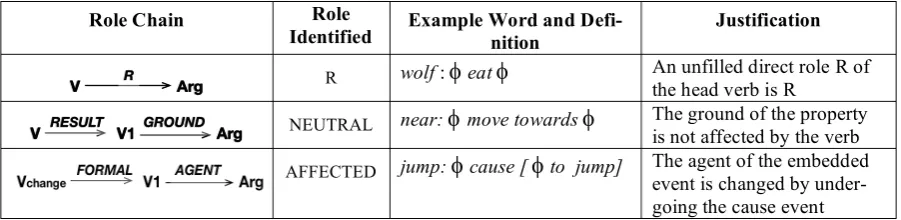
More complicated cases occur when the roles do not occur at the top level but in an embedded clause, as in one definition of approach (move towards), shown in Figure 2. The roles for the predicate Towards are FIGURE and GROUND, and an IMPRO fills the GROUND role of the predicate. Thus we have a role chain, from the head verb through RESULT and GROUND. We have analyzed such role patterns and created a mapping based on the semantics of the roles. In this case, it would indicate a NEUTRAL role, as the GROUND role is not changed by the event. Table 4 summarizes a few of the most common rules for identifying roles from role chains. 6.1 Experimental Evaluation of Derivability To test this technique, we built a customized TRIPS system to parse definitions. The main cus-tomization was the addition of about a dozen top level syntactic rules that capture the common forms of definitions, which as we have seen con-tain much ellipsis. Otherwise, the grammar and lexicon are exactly the same as in all the other variants of the TRIPS parser. Our experiment also takes advantage of the fact that the TRIPS ontolo-gy has an extensive mapping to WordNet synsets, and uses the WordNet hypernym hierarchy to
Role Chain Role
Identified Example Word and Defi-nition Justification
R wolf :
f
eatf
An unfilled direct role R ofthe head verb is R
NEUTRAL near:
f
move towardsf
The ground of the propertyis not affected by the verb
AFFECTED jump:
f
cause [f
to jump] The agent of the embedded [image:8.595.72.523.74.184.2]event is changed by under-going the cause event
Table 4: A few sample rules for deriving roles from definitions.
V R Arg
[image:8.595.82.525.644.778.2]V RESULT V1 GROUND Arg
Figure 1: Key aspects of the LF for to cause to
identify abstractions. Any WordNet synset can be mapped to its most specific type in the TRIPS on-tology (Allen & Teng, 2017).
The experiment was set up as follows. We re-peat the following to obtain 40 test cases:
1)Randomly choose a WordNet synset S such that: (a) S has a direct mapping to a TRIPS ontology type T, (b) the TRIPS lexicon has word W with type T that is also in S, and (c) the WordNet definition is not circular.
2)Remove the lexical entry for W from the TRIPS lexicon after recording its essential roles as the gold standard answer.
3)Parse the definition for S and extract the es-sential roles as described above.
4)Compare the roles from steps 2) and 3) to compute precision and recall.
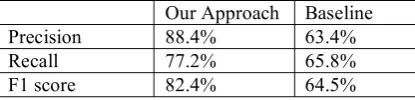
For a baseline we assigned each verb the AGENT and AFFECTED roles. Table 5 shows the results of the experiment. We obtained 88% precision and 77% recall for our approach, versus 63% and 66% respectively using the baseline assignments. Be-cause a large number of English verbs are simple transitive verbs describing change, the baseline did better than one might expect. Still our ap-proach based on parsing definitions performed far better, lending strong support that our role set passes the derivability test.
Based on a manual analysis of the errors in this experiment, the errors arose from a combination of parse errors, ambiguities, and definitions that are terse and loose. For instance, one sense of ap-pear is defined as to come into sight. This is am-biguous between entering into some state (the right interpretation here), and the acquisition read-ing where sight is acquired. The parser chose the latter, leading to an assignment of AGENT as the role rather than AFFECTED. We also missed a few roles because of parser errors. For instance, a sense of pronounce is defined as to declare judgement on (e.g., they pronounced him unfit). The parser failed to identify the second gap (i.e., the missing object of the preposition on). In addi-tion, this is the one case we found where our strat-egy for identifying arguments was inadequate. There is an argument to this verb that is the judgement, but this is not signaled by an elided argument or an indefinite pronoun. Thus the gold answer is AGENT, NEUTRAL, FORMAL but our
system was able to identify only the AGENT role. There are several additional processing steps we could take to improve the performance. For instance, sometimes multiple definitions are pre-sented in WordNet and we could process them all and try to combine them. Currently we only analyze the first one. Also, we could try to verify the roleset by attempting to parse examples that are given in the gloss. Often it seems that the lex-icographer depends on the examples to supple-ment and disambiguate the definitions.
In our error analysis we did not find any ex-ample where if we had identified the correct parse of the definition, we would have identified an inappropriate role for the word being defined. This indicates that the semantic roles appear to be consistent across the lexicon and, furthermore, are identifiable by the semantic properties in-duced by the events in the definitions. In other words, they meet the criterion of derivability!
7
Discussion
We have presented three possible criteria for how one can produce and validate a semantics for a semantic role set. We have illustrated the tech-niques by looking at the roles in the TRIPS framework. Note we do not claim this indicates the TRIPS roleset is the only roleset that could be useful in linguistic theory and computational se-mantic models. However, we have shown that the TRIPS roleset is internally consistent and has a set of desirable semantic properties: (1) it is amenable to axiomatization in a temporal logic, (2) it is in-tegrated into an ontology that supports inher-itance, and (3) the roles are derivable in the sense that they can be derived for verb senses based on their definitions.
The TRIPS roleset was created by considering the properties of causality, temporality, existence, and sentience. Other researchers choose to create rolesets based on other criteria. We encourage those researchers to attempt to formalize their roles along the dimensions we have defined to create a firm theoretical foundation by which all theories can be compared.
Acknowledgements
This work was supported in part by the DARPA CwC program under ARO contract W911NF-15-1-0542. We also thank the reviewers and Jena Hwang for helpful comments on the paper.
Our Approach Baseline Precision 88.4% 63.4%
Recall 77.2% 65.8%
[image:9.595.74.282.703.753.2]8
References
Allen, J. F. (1983). Maintaining Knowledge About Temporal intervals. Communications of the ACM
26(11):832-843.
Allen, J. F. (1984). Towards a general theory of ac-tion and time. Artificial Intelligence, 23(2):123-154.
Allen, J.F. (1995). Natural Language Understanding, Benjamin Cummings, Second Edition.
Allen, J. F. and G. Ferguson (1994). Actions and events in interval temporal logic. Journal of Logic and Computation, 4(5):531-579.
Allen, J. F. and C. M. Teng (2013). Becoming differ-ent: A language-driven formalism for com-monsense knowledge. In the 11th International Symposium on Logical Formalizations of Com-monsense Reasoning, Cyprus.
Allen, J., and C. M. Teng (2017). Broad coverage, domain-generic deep semantic parsing. AAAI Workshop on Construction Grammar, March, Stan-ford University.
Baker, Collin F., Charles J. Fillmore, and John B. Lowe. (1998). The Berkeley FrameNet Project. In
Proceedings of COLING-ACL’98, pages 86–90, Montréal, Canada.
Bonial, C., et al. (2011). A Hierarchical Unification of LIRICS and VerbNet Semantic Roles. 5th IEEE Conf. on Semantic Computing (ICSC), Palo Alto, CA.
Bunt, H. C. and L. Romary (2002). Requirements on multimodal semantic representations. Proceedings of ISO TC37/SC4 Preliminary Meeting, pages 59– 68.
Davidson, D. (1967). The Logical Form of Action Sentences. The Logic of Decision and Action. N. Rescher. Pittsburgh, University of Pittsburgh Press.
Dowty, D. (1991). Thematic Proto-Roles and Argu-ment Selection, Language, Vol 67-3, pp547-619 Fellbaum, C. (1998, ed.) WordNet: An Electronic
Lexical Database. Cambridge, MA: MIT Press.
Fillmore, Charles (1968) “The case for case”, in E. Bach and R. Harms, (eds) Universals in Linguistic Theory, Holt, Rinehart, and Winston, New York, 1– 90.
Hayes, Pat (1980). The Logic of Frames. In Reading in Artificial Intelligence, Margan Kaufman. Kipper, K., A. Korhonen, N. Ryant, and M. Palmer
(2008). A large-scale classification of English verbs. Language Resources and Evaluation Jour-nal, vol. 42, pp. 21–40, 2008.
Palmer, M. (2006). Semantic Processing for Finite Domains, Cambridge University Press.
Palmer, M., Gildea, D. and Kingsbury, P. (2005). The Proposition Bank: A corpus annotated with seman-tic roles, Computational Linguistics Journal, 31:1.
Petukhova, V. and Bunt, H. (2008). LIRICS Semantic Role Annotation: Design and Evaluation of a Set of Data Categories. LREC.
Schiffrin A. and H. C. Bunt (2007). LIRICS Delivera-ble D4.3. Documented compilation of semantic da-ta categories. http://lirics.loria.fr
Schubert, L.K. (1994). Explanation closure, action closure, and the Sandewall test suite for reasoning about change, J. of Logic and Computation 4(5), Special Issue on Actions and Processes, pp. 679-799