MI&T Lab at SemEval-2017 task 4: An Integrated Training Method of
Word Vector for Sentiment Classification
Jingjing Zhao, Yan Yang, Bing Xu
Laboratory of Machine Intelligence and Translation, Harbin Institute of Technology School of Computer Science and Technology, Harbin Institute of Technology, Harbin, China
[email protected],[email protected], [email protected]
Abstract
A CNN method for sentiment classifica-tion task in Task 4A of SemEval 2017 is presented. To solve the problem of word2vec training word vector slowly, a method of training word vector by inte-grating word2vec and Convolutional Neu-ral Network (CNN) is proposed. This training method not only improves the training speed of word2vec, but also makes the word vector more effective for the target task. Furthermore, the word2vec adopts a full connection between the input layer and the projection layer of the Con-tinuous Bag-of-Words (CBOW) for ac-quiring the semantic information of the original sentence.
1 Introduction
The polarity of a Twitter message is classified into positive, negative and neutral in Twitter sentiment analysis. However, the difficulty of sentiment analysis greatly increases due to the ambiguity and the rhetorical of natural language (Liu, 2012). In recent years, the deep learning model has shown great potential in the task of sentiment classifica-tion (Socher et al.,2011;Poria et al.,2015;Socher et al., 2013). For short text data such as Twit-ter, Convolutional Neural Network (CNN) model (Kim, 2014; Dos Santos and Gatti, 2014; Chen et al.,2016) is the most widely and successfully used, and in the SemEval 2016-task4A competi-tion, the system ranked first also uses CNN model (Deriu et al., 2016). So CNN model is used to complete the task in our system. The task 4A of SemEval 20171 is a polarity classification task
which requires participated systems to classify a
1http://alt.qcri.org/semeval2017/
task4/
given Twitter message into positive, negative or neutral (Rosenthal et al.,2017).
The system integrates the word2vec and CNN to train the labeled data, generating the word vec-tor of each word in the data. This method can improve the training speed of word vector. In or-der to preserve the more semantic information of the original sentence effectively, the word2vec is fully connected between the input layer and the projection layer of the Continuous Bag-of-Words (CBOW).
2 System description
2.1 Word vector representation method
Word2vec can represent every word that ap-pears in a large number of training texts as a lower dimension vector (usually 50-100 di-mensions). (Mikolov et al., 2013b; Rong, 2014;
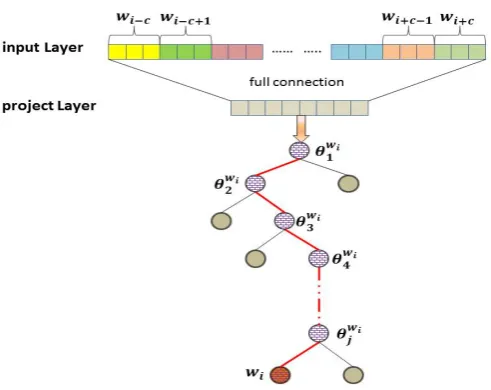
Mikolov et al., 2013a) have a detail descrip-tion of word2vec. Word2vec in our sys-tem uses Continuous Bag-of-Words (CBOW) model, and the structure is shown in Fig-ure 1, in which wi is a word, and the
se-quencehw(i−c), ..., w(i−1), w(i+1), ..., w(i+c)i rep-resents the context of the word wi, and c is the
window size. The word-vector length of the word
wiisd. The traditional word2vec adds2cwords’
word vector on the input layer to the projection layer. (Mikolov et al.,2013b) has a detail descrip-tion of this method, which has been exactly used in Google Word2vec released in 2013. However, in the sentiment analysis task, whether there is a neg-ative word before the sentiment word will influ-ence the identification of polarity (Liu,2012). So in order to preserve more emotional semantic in-formation, the input layer and the projection layer of CBOW are fully connected in this system.
The procedure of integrating word2vec and CNN to train the words vector follows four
Figure 1: The structure of word2vec in the system.
steps: (i) initialization and pre-training: initial-ize word2vec and CNN parameters, and pre-train word2vec a certain number of iterations;(ii)
CNN training: input the latest words vector from word2vec to CNN; (iii)word2vec training: input the latest words vector from CNN to word2vec;
(iv)alternate the(ii)and(iii)steps until the train-ing phase converges. CNN can help word2vec extract more effective text features. Experiments show that the model obtained by integrating CNN and word2vec performs better when the data is sufficient compared to adopting them separately.
2.2 Deep learning model
The system proposes CNN model to predict the sentiment polarity of a Twitter text. The CNN structure diagram is shown in Figure 2.
Word vector sequence: Each word is repre-sented as ad-dimensional word vector, a sentence or a Twitter text containing n words can be ex-pressed as n d-dimensional vectors, which are concatenated together into a matrix X ∈ Rd×n
form which represents a sentence or a Twitter text. Each row of matrix X is treated as a new vec-tor, thusd n-dimensional vectors are obtained and concatenated as input to the CNN network.
Convolutional layer: The convolution layer uses full convolution operation. Let Fl
i ∈ RM1
representsith feature map atlth layer2, andml j,i∈ RM2 represents the convolutional kernel of thejth
convolutional resultCl+1
j atl+ 1th layer. So the
2Here, a layer refers to one convolutional and one pooling
layer.
jth convolutional result Cl+1
j at l + 1th layer is
the result of convolution operation between each feature map at lth layer and convolutional kernel
ml j,i, i.e.,
Cjl+1=X
j
mlj,i∗Fil (1)
k-max pooling: After the convolution oper-ation, the max-pooling operation is performed which preserves the largest value in each convolu-tion result. The system usesk-max pooling, which preserves the largestkvalues instead. For exam-ple:
(1,6,3,8)−−−−→2−max (6,8)
Wherekis a parameter that needs to be set man-ually.
full-connection Layer: The full connection layer receives the output of the last layer of CNN and fully connects itself to the output layer, i.e.
W∗x+boperation, whereW andbcan be trained during the network training phase.
output Layer: The output layer uses the Soft-max operation and outputs the probability that the input sentence or Twitter text belongs to each class, and the class with the maximum probability is the predicted class judged by the system.
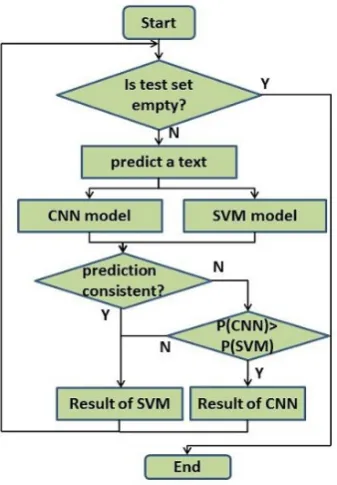
2.3 Combination prediction
Figure 2: The structure of CNN in the system.
CNN. The steps of combination prediction are shown in Figure 3.
Figure 3: The steps of combination prediction.
3 Experimental datasets and model parameters
3.1 Experimental datasets
The datasets of the experiment is provided by Se-mEval 2017, and the specific datasets used are shown in Table 1.
Dataset positive negative neutral Total
[image:3.595.111.280.384.627.2]train 18123 14354 21748 54225 dev 1000 500 1500 3000 test 2375 3972 5937 12284
Table 1: Datasets of the experiment.
3.2 Model parameters
The parameters set of word2vec and CNN in our system are shown in Table 2.
word2vec parameters
Window size of context c 3 Number of hidden layer 1 Dimensionality of hidden layer [50]
Convolutional Neural Network parameters
Number of Convolutional layer 1 Number of max-pooling layer 1 Convolutional kernel size 7 Number of feature map at Convolutional 100
k-max pooling parameterk 2
Table 2: Parameters used in the word2vec and CNN.
4 Experimental results and analysis 4.1 Evaluation method
is as follows:
ρP UN = ρP +ρ3U+ρN (2)
Here,ρP,ρU andρN denote recall for the
posi-tive class, neutral class and negaposi-tive class.
The other two measure metrics are the average macroF1and the average macro precision:
F1P UN = F1P +F31U+F1N (3)
PP UN = PP +PU+PN
3 (4)
Here, FP
1 , F1U andF1N denoteF1 for the
pos-itive class, neutral class and negative class; PP, PUandPN denote precision for the positive class,
neutral class and negative class.
4.2 Analysis of experimental results
Table 3 lists the average macro recall for each model on the development dataset. From the ta-ble 3, the effect of word2vec+CNN model is bet-ter than SVM, and word2vec + CNN + SVM is the best of the three models, so the best results on the test set are submitted.
System SVM CNN SVM+CNN
ρP UN 0.589 0.601 0.653
Table 3: The results of different models on the development dataset.
Table 4 shows the details of our system’s result in comparison with the three top ranked systems’ results. It can be seen from the table that our re-sult’sρN is not good, butρU is better than the top
three systems. The decrease of experimental re-sults is from the quantity bias in training data of different classes.
For deep learning models, a lot of training data are required. Due to the lack of Twitter texts,
word2vec training is not sufficient and do not gen-erate effective words vector representation. In the future, semi-supervisory mechanisms will be con-sidered to expand the number of training data.
In the future, we can improve the system’s per-formance from following points:(i)to expand the amount of training data; (ii) to improve the type of combination: the results can be combined with multiple CNN systems to predict;(iii)to add more emotional semantic features.
5 Conclusion
This paper presentes a method of training word vector by integrating word2vec with CNN and us-ing the trained CNN to complete the Twitter senti-ment analysis task. In the future work, we hope to continue to improve system’s performance in mul-tiple ways, such as trying to modify some param-eters or improve the type of classifiers’ combina-tion, adding some sentiment features.
Acknowledgments
This work is supported by the National Natural Science Foundation of China (No. 61402134).
References
Peng Chen, Bing Xu, Muyun Yang, and Sheng Li. 2016. Clause sentiment identification based on con-volutional neural network with context embedding. InNatural Computation, Fuzzy Systems and Knowl-edge Discovery (ICNC-FSKD), 2016 12th Interna-tional Conference on. IEEE, pages 1532–1538.
Jan Deriu, Maurice Gonzenbach, Fatih Uzdilli, Au-relien Lucchi, Valeria De Luca, and Martin Jaggi. 2016. Swisscheese at semeval-2016 task 4: Sen-timent classification using an ensemble of convo-lutional neural networks with distant supervision.
Proceedings of SemEvalpages 1124–1128.
C´ıcero Nogueira Dos Santos and Maira Gatti. 2014. Deep convolutional neural networks for sentiment analysis of short texts. InCOLING. pages 69–78.
System P Positiveρ F Negative Neutral Score
1 P ρ F1 P ρ F1 ρP UN
DataStories(1) 0.6259 0.7023 0.6619 0.5929 0.8291 0.6914 0.7471 0.5115 0.6073 0.681 BB twtr(1) 0.6851 0.6522 0.6682 0.5848 0.8776 0.7019 0.7518 0.5144 0.6109 0.681 LIA (3) 0.6480 0.6518 0.6499 0.6082 0.8170 0.6973 0.7289 0.5599 0.6333 0.676 MI&T Lab 0.4780 0.5171 0.4968 0.5496 0.5451 0.5473 0.6066 0.5902 0.5983 0.551
Yoon Kim. 2014. Convolutional neural net-works for sentence classification. arXiv preprint arXiv:1408.5882.
Bing Liu. 2012. Sentiment analysis and opinion min-ing. Synthesis lectures on human language tech-nologies5(1):1–167.
Tomas Mikolov, Kai Chen, Greg Corrado, and Jef-frey Dean. 2013a. Efficient estimation of word representations in vector space. arXiv preprint arXiv:1301.3781.
Tomas Mikolov, Ilya Sutskever, Kai Chen, Greg S Cor-rado, and Jeff Dean. 2013b. Distributed representa-tions of words and phrases and their compositional-ity. InAdvances in neural information processing systems. pages 3111–3119.
Soujanya Poria, Erik Cambria, and Alexander F Gel-bukh. 2015. Deep convolutional neural network textual features and multiple kernel learning for utterance-level multimodal sentiment analysis. In
EMNLP. pages 2539–2544.
Xin Rong. 2014. word2vec parameter learning ex-plained.arXiv preprint arXiv:1411.2738.
Sara Rosenthal, Noura Farra, and Preslav Nakov. 2017. SemEval-2017 task 4: Sentiment analysis in Twit-ter. InProceedings of the 11th International Work-shop on Semantic Evaluation. Association for Com-putational Linguistics, Vancouver, Canada, SemEval ’17.
Richard Socher, Jeffrey Pennington, Eric H Huang, Andrew Y Ng, and Christopher D Manning. 2011. Semi-supervised recursive autoencoders for predict-ing sentiment distributions. In Proceedings of the conference on empirical methods in natural lan-guage processing. Association for Computational Linguistics, pages 151–161.
Richard Socher, Alex Perelygin, Jean Y Wu, Jason Chuang, Christopher D Manning, Andrew Y Ng, Christopher Potts, et al. 2013. Recursive deep models for semantic compositionality over a senti-ment treebank. InProceedings of the conference on empirical methods in natural language processing (EMNLP). Citeseer, volume 1631, page 1642. Johan AK Suykens. 2001. Nonlinear modelling and