Will my auxiliary tagging task help?
Estimating Auxiliary Tasks Effectivity in Multi-Task Learning
Johannes Bjerva University of Groningen
The Netherlands [email protected]
Abstract
Multitask learning often improves system performance for morphosyntactic and se-mantic tagging tasks. However, the ques-tion ofwhenandwhy this is the case has yet to be answered satisfactorily. Although previous work has hypothesised that this is linked to the label distributions of the aux-iliary task, we argue that this is not suffi-cient. We show that information-theoretic measures which consider the joint label distributions of the main and auxiliary tasks offer far more explanatory value. Our findings are empirically supported by experiments for morphosyntactic tasks on 39 languages, and are in line with findings in the literature for several semantic tasks.
1 Introduction
When attempting to solve a natural language pro-cessing (NLP) task, one can consider the fact that many such tasks are highly related to one another. A common way of taking advantage of this is to apply multitask learning (MTL, Caruana (1998)). MTL has been successfully applied to many lin-guistic sequence-prediction tasks, both syntactic and semantic in nature (Collobert and Weston, 2008; Cheng et al., 2015; Søgaard and Goldberg, 2016; Mart´ınez Alonso and Plank, 2016; Bjerva et al., 2016; Ammar et al., 2016; Plank et al., 2016). It is, however, unclear when an auxiliary task is useful, although previous work has provided some insights (Caruana, 1998; Mart´ınez Alonso and Plank, 2016).
Currently, considerable time and effort need to be employed in order to experimentally investigate the usefulness of any given main task / auxiliary task combination. In this paper we wish to alle-viate this process by providing a means to investi-gatingwhenan auxiliary task is helpful, thus also
shedding light onwhythis is the case. Concretely, we apply information-theoretic measures to a col-lection of data- and tag sets, investigate correla-tions between such measures and auxiliary task effectivity, and show that previous hypotheses do not sufficiently explain this interaction. We inves-tigate this both experimentally on a collection of syntactically oriented tasks on 39 languages, and verify our findings by investigating results found in the literature on semantically oriented tasks.
2 Neural Multitask Learning
Recurrent Neural Networks (RNNs) are at the core of many current approaches to sequence predic-tion in NLP (Elman, 1990). A bidirecpredic-tional RNN is an extension which incorporates both preced-ing and proceedpreced-ing contexts in the learnpreced-ing pro-cess (Graves and Schmidhuber, 2005). Recent ap-proaches frequently use either (bi-)LSTMs (Long Short-Term Memory) or (bi-)GRUs (Gated Recur-rent Unit), which have the advantage that they can deal with longer input sequences (Hochreiter and Schmidhuber, 1997; Chung et al., 2014).
The intuition behind MTL is to improve perfor-mance by taking advantage of the fact that related tasks will benefit from similar internal representa-tions (Caruana, 1998). MTL is commonly framed such that all hidden layers are shared, whereas there is one output layer per task. An RNN can thus be trained to solve onemaintask (e.g. pars-ing), while also learning some otherauxiliarytask (e.g. POS tagging).
3 Information-theoretic Measures
We wish to give an information-theoretic perspec-tive on when an auxiliary task will be useful for a given main task. For this purpose, we intro-duce some common information-theoretic mea-sures which will be used throughout this work.1
1See Cover and Thomas (2012) for an in-depth overview.
The entropy of a probability distribution is a measure of its unpredictability. That is to say, high entropy indicates a uniformly distributed tag set, while low entropy indicates a more skewed distri-bution. Formally, the entropy of a tag set can be defined as
H(X) =−
∑
x∈Xp(x)logp(x), (1)
wherexis a given tag in tag setX.
It may be more informative to take the joint probabilities of the main and auxiliary tag sets in question into account, for instance using condi-tional entropy. Formally, the conditional entropy of a distributionY given the distribution X is de-fined as
H(Y|X) =
∑
x∈Xy∑
∈Yp(x,y)log p(x)
p(x,y), (2)
wherexandyare all variables in the given distri-butions,p(x,y)is the joint probability of variablex
cooccurring with variabley, and p(x)is the
prob-ability of variable x occurring at all. That is to say, if the auxiliary tag of a word is known, this is highly informative when deciding what the main tag should be.
The mutual information (MI) of two tag sets is a measure of the amount of information that is obtained of one tag set, given the other tag set. MI can be defined as
I(X;Y) =
∑
x∈Xy∑
∈Yp(x,y)log p(x,y)
p(x)p(y), (3)
wherexandyare all variables in the given distri-butions, p(x,y)is the joint probability of variable xcooccurring with variabley, andp(x)is the prob-ability of variablexoccurring at all. MI describes how much information is shared between X and
Y, and can therefore be considered a measure of ‘correlation’ between tag sets.
3.1 Information Theory and MTL
Entropy has in the literature been hypothesised to be related to the usefulness of an auxiliary task (Mart´ınez Alonso and Plank, 2016). We argue that this explanation is not entirely sufficient. Take, for instance, two tag setsX andX0, applied to the
same corpus and containing the same tags. Con-sider the case where the annotations differ in that the labels in every sentence using X0 have been
randomly reordered. The tag distributions in X
andX0do not change as a result of this operation,
hence their entropies will be the same. However, the tags in X0 are now likely to have a very low
correspondence with any sort of natural language signal, henceX0 is highly unlikely to be a useful
auxiliary task forX. Measures taking joint prob-abilities into account will capture this lack of cor-relation betweenX andX0. In this work we show
that measures such as conditional entropy and MI are much more informative for the effectivity of an auxiliary task than entropy.
4 Data
For our syntactic experiments, we use the Univer-sal Dependencies (UD) treebanks on 39 out of the 40 languages found in version 1.3 (Nivre et al., 2016).2 We experiment with POS tagging as a
main task, and various dependency relation clas-sification tasks as auxiliary tasks. We also inves-tigate whether our hypothesis fits with recent re-sults in the literature, by applying our information-theoretic measures to the semantically oriented tasks in Mart´ınez Alonso and Plank (2016), as well as the semantic tagging task in Bjerva et al. (2016). Although calculation of joint probabilities re-quires jointly labelled data, this issue can be by-passed without losing much accuracy. Assuming that (at least) one of the tasks under consideration can be completed automatically with high accu-racy, we find that the estimates of joint probabili-ties are very close to actual joint probabiliprobabili-ties on gold standard data. In this work, we estimate joint probabilities by tagging the auxiliary task data sets with a state-of-the-art POS tagger.
4.1 Morphosyntactic Tasks
Dependency Relation Classification is the task of predicting the dependency tag (and its direction) for a given token. This is a task that has not re-ceived much attention, although it has been shown to be a useful feature for parsing (Ouchi et al., 2014). We choose to look at several instantiations of this task, as it allows for a controlled setup un-der a number of conditions for MTL, and since data is available for a large number of typologi-cally varied languages.
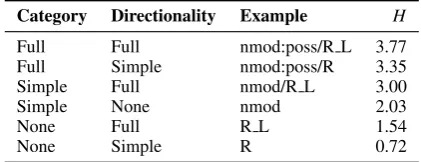
Previous work has suggested various possible instantiations of dependency relation classification labels (Ouchi et al., 2016). In this work, we use la-bels designed to range from highly complex and informative, to very basic ones.3 The labelling
schemes used are shown in Table 1.
Category Directionality Example H
Full Full nmod:poss/R L 3.77
Full Simple nmod:poss/R 3.35
Simple Full nmod/R L 3.00
Simple None nmod 2.03
None Full R L 1.54
[image:3.595.75.286.63.144.2]None Simple R 0.72
Table 1: Dependency relation labels used in this work, with entropy in bytes (H) measured on En-glish. The labels differ in the granularity and/or inclusion of the category and/or directionality.
The systems in the syntactic experiments are trained on main task data (Dmain), and on auxiliary
task data (Daux). Generally, the amount of
over-lap between such pairs of data sets differs, and can roughly be divided into three categories: i) iden-tity; ii) overlap; and iii) disjoint (no overlap be-tween data sets). To ensure that we cover several possible experimental situations, we experiment using all three categories. We generate (Dmain,
Daux) pairs by splitting each UD training set into
three portions. The first and second portions al-ways contain POS labels. In the identity condition, the second portion contains dependency relations. In the overlap condition, the second and final por-tions contain dependency relapor-tions. In the disjoint condition, the final portion contains dependency relations.
4.2 Semantic Tasks
Mart´ınez Alonso and Plank (2016) experiment with using, i.a., POS tagging as an auxiliary task, with main tasks based on several semantically ori-ented tasks: Frame detection/identification, NER, supersense annotation and MPQA. Bjerva et al. (2016) investigate using a semantic tagging task as an auxiliary task for POS tagging. We do not train systems for these data sets. Rather, we directly investigate whether changes in accuracy with the main/auxiliary tasks used in these papers are correctly predicted by any of the information-theoretic measures under consideration here.
5 Method
5.1 Architecture and Hyperparameters
We apply a deep neural network with the exact same settings in each syntactic experiment. Our system consists of a two layer deep bi-GRU (100 dimensions per layer), taking an embedded word representation (64 dimensions) as input. We
ap-ply dropout (p=0.4) between each layer in our network (Srivastava et al., 2014). The output of the final bi-GRU layer, is connected to two out-put layers – one per task. Both tasks are always weighted equally. Optimisation is done using the Adam algorithm (Kingma and Ba, 2014), with the categorical cross-entropy loss function. We use a batch size of 100 sentences, training over a maxi-mum of 50 epochs, using early stopping and mon-itoring validation loss on the main task.
We do not use pre-trained embeddings. We also do not use any task-specific features, similarly to Collobert et al. (2011), and we do not optimise any hyperparameters with regard to the task(s) at hand. Although these choices are likely to affect the overall accuracy of our systems negatively, the goal of our experiments is to investigate the effect in change in accuracy when adding an auxiliary task - not accuracy in itself.
5.2 Experimental Overview
In the syntactic experiments, we train one system per language, dependency label category, and split condition. For sentences where only one tag set is available, we do not update weights based on the loss for the absent task. Averaged results over all languages and dependency relation instantiations, per category, are shown in Table 2.
5.3 Replicability and Reproducibility
In order to facilitate the replicability and repro-ducibility of our results, we take two methodologi-cal steps. To ensure replicability, we run all exper-iments 10 times, in order to mitigate the effect of random processes on our results.4 To ensure
repro-ducibility, we release a collection including: i) A Docker file containing all code and dependencies required to obtain all data and run our experiments used in this work; and ii) a notebook containing all code for the statistical analyses performed in this work.5
6 Results and Analysis
6.1 Morphosyntactic Tasks
We use Spearman’sρ in order to calculate corre-lation between auxiliary task effectivity (as mea-sured using ∆acc) and the information-theoretic
measures. Following the recommendations in Søgaard et al. (2014), we set our p cut-off value
Auxiliary task ρ(∆acc,H(Y)) ρ(∆acc,H(Y|X)) ρ(∆acc,I(X;Y)) Dependency Relations (Identity) −0.06 (p=0.214) 0.12 (p=0.013) 0.08 (p=0.114) Dependency Relations (Overlap) 0.07 (p=0.127) 0.27 (p<0.001) 0.43 (p0.001)
Dependency Relations (Disjoint) 0.08 (p=0.101) 0.25 (p<0.001) 0.41 (p0.001)
Table 2: Correlation scores and associated p-values, between change in accuracy (∆acc) and entropy
(H(Y)), conditional entropy (H(Y|X)), and mutual information (I(X;Y)), calculated with Spearman’sρ,
across all languages and label instantiations. Bold indicates the strongest significant correlations.
to p<0.0025. Table 2 shows that MI correlates
significantly with auxiliary task effectivity in the most commonly used settings (overlap and dis-joint). As hypothesised, entropy has no significant correlation with auxiliary task effectivity, whereas conditional entropy offers some explanation. We further observe that these results hold for almost all languages, although the correlation is weaker for some languages, indicating that there are some other effects at play here. We also analyse whether significant differences can be found with respect to whether or not we have a positive∆acc, using a
bootstrap sample test with 10,000 iterations. We observe a significant relationship (p<0.001) for
MI. We also observe a significant relationship for conditional entropy (p<0.001), and again find no
significant difference for entropy (p≥0.07).
Interestingly, no correlation is found in the iden-tity condition between∆acc and any
information-theoretic measure. This is not surprising, as the most effective auxiliary task is simply more data for a task with the highest possible MI. Hence, in the overlap/disjoint conditions, high MI is highly correlated with ∆acc, while in the identity
condi-tion, there is no extra data. It is evident that tag set correlations in identical data is not helpful.
6.2 Semantic Tasks
Although we do not have access to sufficient data points to run statistical analyses on the results ob-tained by Mart´ınez Alonso and Plank (2016), or by Bjerva et al. (2016), we do observe that the mean MI for the conditions in which an auxiliary task is helpful is higher than in the cases where an auxil-iary task is not helpful.
7 Conclusions
We have examined the relation between auxiliary task effectivity and three information-theoretic measures. While previous research hypothesises that entropy plays a central role, we show exper-imentally that conditional entropy is a better pre-dictor, and MI an even better predictor. This claim
is corroborated when we correlate MI and change in accuracy with results found in the literature. It is especially interesting that MI is a better predictor than conditional entropy, since MI does not con-sider the order between main and auxiliary tasks. Our findings should prove helpful for researchers when considering which auxiliary tasks might be helpful for a given main task. Furthermore, it provides an explanation for the fact that there is no universally effective auxiliary task, as a purely entropy-based hypothesis would predict.
The fact that MI is informative when determin-ing the effectivity of an auxiliary task can be ex-plained by considering an auxiliary task to be sim-ilar to adding a feature. That is to say, useful fea-tures are likely to be useful auxiliary tasks. Inter-estingly, however, the gains of adding an auxiliary task are visible at test time for the main task, when no explicit auxiliary label information is available. We tested our hypothesis on 39 languages, rep-resenting a wide typological range, as well as a wide range of data sizes. Our experiments were run on syntactically oriented tasks of various gran-ularities. We also corroborated our findings with results from semantically oriented tasks in the lit-erature. Hence our results generalise both across a range of languages, data sizes, and NLP tasks.
Acknowledgments
References
Waleed Ammar, George Mulcaire, Miguel Ballesteros, Chris Dyer, and Noah Smith. 2016. Many lan-guages, one parser. Transactions of the Association for Computational Linguistics, 4:431–444.
Johannes Bjerva, Barbara Plank, and Johan Bos. 2016. Semantic tagging with deep residual networks. In
Proceedings of COLING 2016, page 35313541, Os-aka, Japan.
Rich Caruana. 1998. Multitask learning. Ph.D. thesis, Carnegie Mellon University.
Hao Cheng, Hao Fang, and Mari Ostendorf. 2015. Open-domain name error detection using a multi-task rnn. InEMNLP.
Junyoung Chung, Caglar Gulcehre, KyungHyun Cho, and Yoshua Bengio. 2014. Empirical evaluation of gated recurrent neural networks on sequence model-ing. arXiv preprint arXiv:1412.3555.
Ronan Collobert and Jason Weston. 2008. A unified architecture for natural language processing: Deep neural networks with multitask learning. In Pro-ceedings of the 25th international conference on Machine learning, pages 160–167. ACM.
Ronan Collobert, Jason Weston, L´eon Bottou, Michael Karlen, Koray Kavukcuoglu, and Pavel Kuksa. 2011. Natural language processing (almost) from scratch. Journal of Machine Learning Research, 12(Aug):2493–2537.
Thomas M Cover and Joy A Thomas. 2012. Elements of information theory. John Wiley & Sons.
Jeffrey L Elman. 1990. Finding structure in time.
Cognitive science, 14(2):179–211.
Alex Graves and J¨urgen Schmidhuber. 2005. Frame-wise phoneme classification with bidirectional lstm and other neural network architectures. Neural Net-works, 18(5):602–610.
Sepp Hochreiter and J¨urgen Schmidhuber. 1997. Long short-term memory. Neural computation, 9(8):1735–1780.
Diederik Kingma and Jimmy Ba. 2014. Adam: A method for stochastic optimization. arXiv preprint arXiv:1412.6980.
H´ector Mart´ınez Alonso and Barbara Plank. 2016. Multitask learning for semantic sequence prediction under varying data conditions. InarXiv preprint, to appear at EACL 2017 (long paper).
Joakim Nivre, Marie-Catherine de Marneffe, Filip Gin-ter, Yoav Goldberg, Jan Hajic, Christopher D Man-ning, Ryan McDonald, Slav Petrov, Sampo Pyysalo, Natalia Silveira, et al. 2016. Universal dependen-cies v1: A multilingual treebank collection. In Pro-ceedings of the 10th International Conference on Language Resources and Evaluation (LREC 2016).
Hiroki Ouchi, Kevin Duh, and Yuji Matsumoto. 2014. Improving dependency parsers with supertags. In
Proceedings of the 14th Conference of the European Chapter of the Association for Computational Lin-guistics, volume 2: Short Papers, pages 154–158. Association for Computational Linguistics.
Hiroki Ouchi, Kevin Duh, Hiroyuki Shindo, and Yuji Matsumoto. 2016. Transition-Based Dependency Parsing Exploiting Supertags. InIEEE/ACM Trans-actions on Audio, Speech and Language Processing, volume 24.
Barbara Plank, Anders Søgaard, and Yoav Goldberg. 2016. Multilingual part-of-speech tagging with bidirectional long short-term memory models and auxiliary loss. InProceedings of ACL 2016.
Anders Søgaard and Yoav Goldberg. 2016. Deep multi-task learning with low level tasks supervised at lower layers. InProceedings of the 54th Annual Meeting of the Association for Computational Lin-guistics, volume 2, pages 231–235. Association for Computational Linguistics.
Anders Søgaard, Anders Johannsen, Barbara Plank, Dirk Hovy, and Hector Martinez. 2014. Whats in a p-value in NLP? InCoNLL-2014.