Unit Segmentation of Argumentative Texts
Yamen Ajjour, Wei-Fan Chen, Johannes Kiesel, Henning Wachsmuth and Benno Stein
Bauhaus-Universität Weimar 99423 Weimar, Germany
<first name>.<last name>@uni-weimar.de
Abstract
The segmentation of an argumentative text into argument units and their non-argumentative counterparts is the first step in identifying the argumentative structure of the text. Despite its importance for argument mining, unit segmentation has been approached only sporadically so far. This paper studies the major parameters of unit segmentation systematically. We ex-plore the effectiveness of various features, when capturing words separately, along with their neighbors, or even along with the entire text. Each such context is reflected by one machine learning model that we evaluate within and across three domains of texts. Among the models, our new deep learning approach capturing the entire text turns out best within all domains, with an F-score of up to 88.54. While structural fea-tures generalize best across domains, the domain transfer remains hard, which points to major challenges of unit segmentation. 1 Introduction
Argument mining deals with the automatic identifi-cation and classifiidentifi-cation of arguments in a text. It has become an emerging topic of research mainly owing to its many applications, such as writing sup-port tools (Stab and Gurevych,2014a), intelligent personal assistants (Rinott et al.,2015), and argu-ment search engines (Wachsmuth et al.,2017).
Unit segmentation is often seen as the first task of an argument mining pipeline. It consists in the splitting of a text into its argumentative segments (calledargument unitsfrom here on) and their non-argumentative counterparts. Afterwards, the roles that the argument units play in the argumentative The first two authors equally contributed to this paper.
structure of the text as well as the relations between the units are classified. Conceptually, an argument unit may span a clause, a complete sentence, multi-ple sentences, or something in between. The size of the units depends on the domain of an argumen-tative text (in terms of topic, genre, or similar), but can also vary within a text. This makes unit segmentation a very challenging task.
As detailed in Section2, much existing research on argument mining has skipped the segmentation, assuming it to be given. For applications, however, an automatic segmentation is obligatory. Recently, three approaches have been presented that deal with the unit segmentation of persuasive essays:Persing and Ng(2016) rely on handcrafted rules based on the parse tree of a sentence to identify segments; Stab(2017) uses sequence modeling based on so-phisticated features to classify the argumentative-ness of each single word based on its surrounding words; andEger et al.(2017) employ a deep learn-ing architecture that uses different features to do the same classification based on the entire essay. So far, however, it is neither clear what the best seg-mentation approach is, nor how different features and models generalize across domains and genres of argumentative texts.
In this paper, we carry out a systematic study to explore the major parameters of unit segmentation, reflected in the following three research questions:
1. What features are most effective in unit seg-mentation?
2. What is the best machine learning model to capture the context of a unit that is relevant to segmentation?
3. To what extent do the features and models generalize across domains?
We approach the three questions on and across three existing argumentation corpora, each
senting a different domain (Section3): the essays corpus ofStab(2017), the editorials corpus of Al-Khatib et al.(2016), and the web discourse corpus ofHabernal and Gurevych(2015). All combina-tions of training and test domain are considered for these corpora, resulting in nine experiments.
Given the corpora, we follow the existing ap-proaches outlined above in tackling unit segmenta-tion as a token-level classificasegmenta-tion task (Secsegmenta-tion4). To capture the context around each token, we an-alyze different semantic, syntactic, structural, and pragmatic feature types, and we compare three fun-damental machine learning techniques based on these features: standard feature-based classifica-tion realized as a support vector machine (SVM), sequence modeling realized as linear-chain condi-tional random field (CRF), and a new deep learning approach realized as a bidirectional long short-term memory (Bi-LSTM). These models correspond to increasingly complex levels of modeling context: The SVM considers only the current token, result-ing in an isolated classification for each word. The CRF is additionally able to consider the preceding classifications. The Bi-LSTM, finally, can exploit all words and classifications before and after the current word.
We evaluate all features and models in Section5. Our results provide clear evidence that the capa-bility of deep learning to model the entire context is beneficial for unit segmentation within domains. The Bi-LSTM achieves the highest effectiveness on each corpus, even outperforming the approach of Stab(2017) on the essays corpus. Across domains, however, all three perform similar and notably drop in effectiveness. Matching intuition, semantic fea-tures turn out best to characterize argument units in the in-domain experiments, whereas structural fea-tures are more effective across domains. Our find-ings indicate that the concepts of argument units in the given corpora do not fully match.
Altogether, the contribution of our paper is an extensive analysis of the benefits and limitations of standard approaches to argument unit segmentation. Nevertheless, argument unit segmentation is by far not a solved task yet, which is why we end with a discussion of its major challenges in Section6, before we finally conclude (Section7).
2 Related Work
Unit segmentation is a classical segmentation task, that is related to discourse segmentation (Azar,
1999;Green,2010;Peldszus and Stede,2013) as for rhetorical structure theory (Mann and Thomp-son,1988). Both discourse and argument units are used as building blocks, which are then hierarchi-cally connected to represent the structure of the text. However, argument units are closer to classi-cal logic, with each unit representing a proposition within the author’s argumentation.
Much existing work on argument mining skips the segmentation, assuming segments to be given. Such research mainly discusses the detection of sen-tences that contain argument units (Teufel,1999; Palau and Moens, 2009; Mochales and Moens, 2011; Rooney et al., 2012), the classification of the given segments into argumentative and non-argumentative classes (Stab and Gurevych,2014b), or the classification of relations between given units (Stab and Gurevych,2014b;Peldszus,2014; Peldszus and Stede,2015).
A few publications address problems closely re-lated to unit segmentation. Madnani et al.(2012) identify non-argumentative segments, but they do not segment the argumentative parts. Levy et al. (2014), on the other hand, try to detect segments that are argumentatively related to specific topics. However, they do not segment the whole text.
A unit segmentation algorithm has been already applied byAl-Khatib et al.(2016) in the creation of the editorials corpus analyzed in this paper. The authors developed a rule-based algorithm to auto-matically pre-segment the corpus texts before the manual annotation. The algorithm was tuned to rather split segments in cases of doubt. During the annotation, annotators were then asked to correct the segmentation by merging incorrectly split seg-ments. The authors argue that—even with a simple algorithm—this approach simplifies the annotation process and makes evaluating inter-annotator agree-ment more intuitive.
does not clarify which linguistic cues are most help-ful to reach this performance. To remedy this, we also employ a deep neural network based on Bi-LSTMs, but we perform a detailed comparison of models and feature sets.
Previous work trains and tests unit segmentation algorithms on one single corpus. A frequent choice is one of the two versions of the Argument Anno-tated Essay Corpus (Stab and Gurevych, 2014a; Stab,2017), which is studied byPersing and Ng (2016),Eger et al.(2017),Stab(2017) himself, and also by us. However, for a unit segmentation al-gorithm to be integrated into applications, it has to work robustly also for new texts from other do-mains. This paper therefor extends the discussion of unit segmentation in this direction.
3 Data
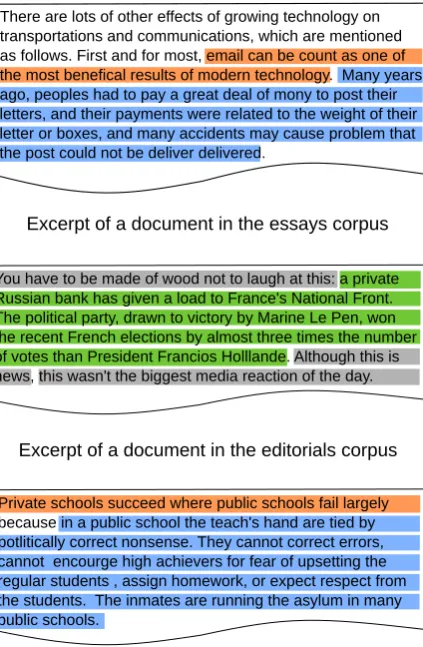
This study uses three different corpora to evaluate the models that we developed to segment argument units. The corpora resprented different domains, particularly in terms of genre. We detail each cor-pus below, give an overview in Table1, and provide example excerpts in Figure1.
Essays The Argument Annotated Essays Corpus (Stab and Gurevych,2014a;Stab,2017) includes 402 persuasive essays fromessayforum.com writ-ten by students. All essays have been segmented by three expert annotators into three types of ar-gument units (major claims, claims, and premises) and non-argumentative parts. Each argument unit covers an entire sentence or less. The essays are on average 359.5 tokens long with 70% of tokens being part of an argument unit.1 We employ the
test-training split provided by the authors.
Editorials The Webis-Editorials-16 corpus ( Al-Khatib et al.,2016) consists of 300 news editori-als from the three online news porteditori-als Al Jazeera, Fox News, and The Guardian. Prior to the anno-tation process, the corpus was automatically pre-segmented based on clauses. After that, three an-notators performed the final segmentation by merg-ing segments and distmerg-inguishmerg-ing argument units of six types (common ground, assumption, anec-dote, testimony, statistics, and other) from non-argumentative parts. The annotation guidelines de-fine a unit as a segment that spans a proposition (or two or more interwoven propositions) stated by the
1The percentage of tokens that are part of an argument unit
is calculated from Table1as(Arg-B+Arg-I)/Total.
Excerpt of a document in the essays corpus
Excerpt of a document in the editorials corpus
Excerpt of a document in the web discourse corpus
Legend
Premise
Claim Anecdote Assumption
You have to be made of wood not to laugh at this: a private Russian bank has given a load to France's National Front. The political party, drawn to victory by Marine Le Pen, won the recent French elections by almost three times the number of votes than President Francios Holllande. Although this is news, this wasn't the biggest media reaction of the day.
There are lots of other effects of growing technology on transportations and communications, which are mentioned as follows. First and for most, email can be count as one of the most benefical results of modern technology. Many years ago, peoples had to pay a great deal of mony to post their letters, and their payments were related to the weight of their letter or boxes, and many accidents may cause problem that the post could not be deliver delivered.
[image:3.595.314.526.65.389.2]Private schools succeed where public schools fail largely because in a public school the teach's hand are tied by potlitically correct nonsense. They cannot correct errors, cannot encourge high achievers for fear of upsetting the regular students , assign homework, or expect respect from the students. The inmates are running the asylum in many public schools.
Figure 1: Excerpts of three documents for the es-says, editorials and web discourse corpus. Each excerpt is highlighted with argument units as anno-tated in the original corpus
author to discuss, directly or indirectly, his or her thesis. This corpus contains the longest documents with an average of 957.9 tokens. The editorials are mainly argumentative, with 92% of the tokens in the corpus being part of an argument unit. We employ the provided training-test split.
Number of tokens
Corpus Part # Documents Arg-B Arg-I Arg-O Total Average
Essays Training 322 4,823 75,621 35,323 115,767 359.5
Test 80 1,266 18,790 8,699 28,755 359.4
Total 402 6,089 94,411 44,022 144,522 359.5 Editorials Training 240 11,323 202,279 17,227 230,829 961.8
Test 60 2,811 49,102 4,622 56,535 942.3
Total 300 14,234 251,381 21,849 287,364 957.9 Web Discourse Training 272 905 32,093 36,731 69,729 256.4
Test 68 224 7,949 8,083 16,256 239.1
Total 340 1,129 40,042 44,814 85,985 252.9
Table 1: Number of documents, tokens per class, and average tokens per document per corpus and part.
latter, the units are on average much longer than in the other two corpora: 36.5 tokens compared to 16.5 tokens (essays) and 18.7 tokens (editori-als).2 The complete documents are relatively short
though (252.9 tokens on average), and they con-tain many non-argumentative parts: only 48% of the tokens are part of an argument unit. Since the authors do not provide any split, we randomly split the corpus into a training set (80%) and test set (20%), similar to the other corpora.
The three corpora vary in terms of how argu-ments are actually annotated in the contained doc-uments. FollowingStab(2017), we converted all documents into the BIO format, where each token is labeled according to the position in the segment that it belongs to as Arg-B (the first token of an argument unit),Arg-I(any other token of an argu-ment unit), orArg-O(not in an argument unit).
4 Method
This paper explores the effectiveness of semantic, syntactic, structural, and pragmatic features when capturing tokens separately, along with their neigh-bors, or along with the entire text. In line with re-cent work (see Section2), we address unit segmen-tation as a token labeling problem. In the following, we detail each set of features as well as the three machine learning models that we employ. Each model reflects one of the outlined contexts used to classify the tokens. To demonstrate the strengths and weaknesses of the models, we encode the fea-tures as analog as possible in each model. However, some variations are necessary due to differences in the way the models utilize the features.
2Average length of argument units is calculated from
Ta-ble1as(Arg-B+Arg-I)/Arg-B
4.1 Features
For every token, we extract the following semantic, syntactic, structural and pragmatic features. Semantic Features Semantic features capture the meaning of tokens. This work employs the sim-ple but often effective way of representing meaning by using the occurrence of each token as a feature (bag-of-words). We also tested word embeddings (Pennington et al.,2014) as semantic features, but found that they performed worse for all models introduced below except for the Bi-LSTM. Syntactic Features The syntactic features that we employ capture the role of a token in a sentence or argument unit. We resort to standard part-of-speech (POS) tags as produced by the Stanford tagger (Toutanova et al.,2003) for this feature set. Structural Features Structural features capture the congruence of argument units with sentences, clauses, or phrases. We employ the Stanford parser (Klein and Manning,2003) to identify sentences, clauses, and phrases in the text and represent them with token labels. In particular, we use one feature for each token and structural level (sentence, clause, phrase), capturing whether the token is at the be-ginning, within, or at the end of such a structural span, respectively.
fea-Bi-LSTM
Bi-LSTM Bi-LSTM
Fully-connected Output1 Output2
Bi-LSTM
Output1 Output2
Bi-LSTM
Output1 Output2
Semantic Syntactic+Structual+Pragmatic Semantic Syntactic+Structual+Pragmatic Semantic Syntactic+Structual+Pragmatic Bi-LSTM
Bi-LSTM Fully-connected
Bi-LSTM
Bi-LSTM Fully-connected
label
label label label
[image:5.595.76.522.60.234.2]label label
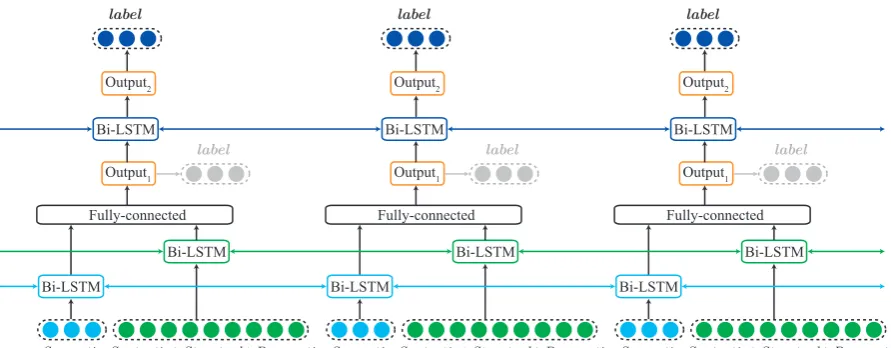
Figure 2: The neural network structure used in our paper with the input feature vectors for three tokens at the bottom. The labels byOuput1are estimated without considering label dependency and are not used;
instead we report the results forOutput2, which considers this dependency.
tures that are 1 iff. the token is before the marker, the beginning of the marker, inside a multi-token marker, the last token of a multi-token marker, or after the marker in the sentence, respectively.
4.2 Models
We make use of three common machine learning models in order to capture an increasing amount of context for the token labeling: a support vector machine (SVM), a conditional random field (CRF), and a bidirectional long short-term memory (Bi-LSTM). To provide a comparison to results from related work, we reimplemented the method ofStab (2017) and use it as a baseline.
Reimplementation The approach ofStab(2017) is based on a CRF sequence model (Lafferty et al., 2001). It has been specifically developed for the segmentation given in the essays corpus. Since the license of the original implementation prohibited the author from giving us access to the code, we fully reimplemented the approach.
Analog to Stab (2017), we employ the CRF-Suite (Okazaki,2007) with the averaged perceptron method (Collins,2002). For the reimplementation, we use the exact feature sets described by Stab (2017): Structural, Syntactic, LexSyn and Prob. Our reimplementation achieves an F-score of 82.7, which is slightly worse than the value reported by Stab(2017) for unit segmentation (86.7). We at-tribute this difference to implementation details in the employed features.
SVM We employ a linear SVM model in terms of a standard feature-based classifier that labels each consecutive token independently, disregard-ing the token’s context. In other words, features of neighboring tokens are not considered by the SVM. Accordingly, this model does not capture the transition between labels, as well.
CRF We implement a CRF sequence model to capture the context around the token for labeling the token. For labeling, the linear-chain CRF that we use considers the labels and features of the sur-rounding tokens within a certain window, which we chose to be of size 5 for our experiments. We use the same framework and method as for the reimplementation.
Since CRFs explicitly capture the local context of a token, we simplify the pragmatic features for this model and use only binary features for whether the token is at the beginning, inside, at the end, or outside of a discourse marker.
Bi-LSTM Finally, we also build a Bi-LSTM neu-ral network to capture the entire text as context. The architecture of the model is illustrated in Fig-ure2and further explained below.
em-Test on Essays Test on Editorials Test on Web Discourse Features Models Essays Editorials Web Dis. Essays Editorials Web Dis. Essays Editorials Web Dis. Semantic SVM 53.42 40.89 28.89 50.00 53.96 16.20 31.71 26.58 33.34
CRF 76.56 53.06 26.31 66.30 78.90 8.48 37.51 37.25 42.53
Bi-LSTM 87.91 57.11 36.00 60.70 81.56 24.63 41.29 36.44 54.98
Syntactic SVM 49.66 36.14 26.45 49.98 51.36 14.32 28.44 25.33 31.93
CRF 66.79 48.40 15.48 68.30 76.74 5.05 34.73 38.13 24.25
Bi-LSTM 83.10 55.70 21.65 64.92 80.35 15.28 36.58 37.40 43.02 Structural SVM 41.19 36.14 26.45 49.53 77.71 5.96 27.97 37.98 27.52
CRF 60.12 48.41 15.48 68.96 77.55 5.68 34.64 38.30 22.51
Bi-LSTM 69.77 48.63 41.19 61.54 79.62 38.08 35.46 37.75 39.51 Pragmatic SVM 38.75 28.65 30.09 31.33 33.02 22.38 30.85 22.24 35.59
CRF 40.15 31.66 15.48 37.06 40.20 5.02 24.30 30.30 23.70
Bi-LSTM 76.47 54.72 15.24 57.66 75.31 5.24 34.88 36.68 22.76
All SVM 61.40 50.88 31.26 58.84 79.89 22.55 39.14 37.42 42.76
CRF 79.15 52.50 21.74 69.80 81.97 8.00 37.09 37.63 37.74
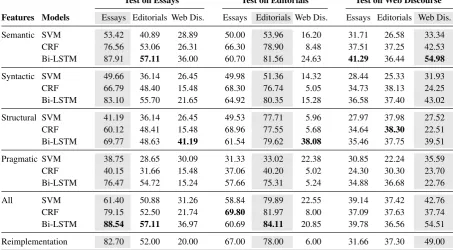
[image:6.595.71.525.72.322.2]Bi-LSTM 88.54 57.11 36.97 60.69 84.11 20.85 39.78 36.56 54.51 Reimplementation 82.70 52.00 20.00 67.00 78.00 6.00 31.66 37.30 49.00 Table 2: The in-domain (gray background) and cross-domain macro F-scores on each test (first header row) after training on one of the training sets (second header row). Each row lists the results of one of the three models (SVM, CRF, and Bi-LSTM) using one of the four feature types (semantic, syntactic, structural, and pragmatic) in isolation or their combination (all). For each column, the highest value is marked in bold. The bottom line shows the F-scores of our reimplementation of the approach ofStab(2017).
bedding ofPennington et al.(2014), which has a dimensionality of 300. For the other feature sets, we concatenate all the boolean features described in the previous section into a sparse feature vector (more precisely, a one-hot vector).
The architecture in Figure2should be viewed from bottom to top. We first feed the features into bidirectional LSTMs (Schuster and Paliwal,1997). Next, we feed the semantic features into a sepa-rate Bi-LSTM in order to be able to use a different kernel for the dense feature vector of the semantic features than for the one-hot vectors. The output of the two Bi-LSTM layers is then concatenated and fed into a fully-connected layer. To model la-bel dependencies, we add another Bi-LSTM and another output layer. Both output layers are soft-max layers, and they are trained to fit the labels of tokens. We process only the result of the second output layer, though. As we will see in Section5, the second output layer does indeed better capture the sequential relationship of labels.
5 Experiments
Using the three corpora detailed in Section3, we conduct in-domain and cross-domain experiments
to answer the three research questions from Sec-tion1. In each experiment, we use the training set of one corpus for training the model and the test set of the same or another corpus for evaluating the model. In all cases, we test all four considered feature sets both in isolation and in combination. We report the macro F-score as an evaluation mea-sure, since this allows for a comparison to related work and since we consider all three classes (Arg-B,
Arg-I, andArg-O) to be equally important.
Table 2 lists the macro F-scores of all combi-nations of features and models as well as of our reimplementation of the approach ofStab(2017) for all combinations of training and test set.
5.1 Comparison to Previous Work
To put our results into context, we also imitate the experiment setting ofStab(2017). For this purpose, we randomly split the test set of the essays corpus into five equally-sized subsets and use the student’s
Prediction
Label B-B B-I B-O I-B I-I I-O O-B O-I O-O
Gold B-B 0 0 0 0 0 0 0 0 0
B-I 1 956 11 0 152 0 0 0 0
B-O 0 0 0 0 0 0 0 0 0
I-B 0 0 0 0 0 0 0 0 0
I-I 0 71 0 4 16363 78 59 77 872
I-O 0 0 0 0 83 1109 0 0 74
O-B 0 4 0 10 131 0 958 17 144
O-I 0 0 0 0 0 0 0 0 0
[image:7.595.147.451.69.222.2]O-O 0 129 7 1 1285 157 139 87 5550
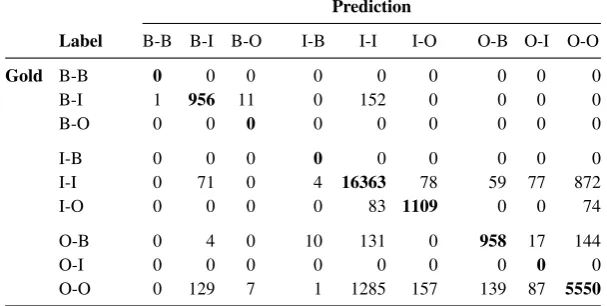
Table 3: Confusion matrix opposing the number of gold BIO labels of pairs of consecutive tokens in the essays corpus to those predicted by our best-performing method, the Bi-LSTM using all features. The correct predictions (on the diagonal) are marked in bold.
Furthermore, although the results of our reimple-mentation of the approach ofStab(2017) are lower than those reported by the author, our own CRF approach performs comparably well in almost all cases using simple linguistic features.
5.2 Improvement by Second Output Layer A side effect of predicting the BIO label of each to-ken separately is that two consecutive toto-kens can be labeled asArg-OandArg-I. This is not reasonable, since it corresponds to a unit without beginning. Without the second output layerOutput2, our
neu-ral network method produced about 400 such pairs. However, when we added the layer, the number dropped by half to 200 pairs. While the effect on the F-score is small, using the second output layer therefore produces more comprehensible results. We thus only report the results withOutput2.
5.3 Error Analysis
To learn about the behavior of our best-performing Bi-LSTM model, we carried out an error analysis. Table3presents the confusion matrix of the gold BIO label pairs and the predicted pairs on the es-says corpus. While it is not possible to discuss all errors here, we observed a few typical cases, as discussed in the following.
In particular, some wrong predictions result from cases where the Bi-LSTM combines several units into one. For instance, the two units in“... [the criminal is repeated second time]; also, [it is re-garded as the "legalized revenge"...]”are predicted as one unit. This produces errors of the types (I-O, I-I),(O-B, I-I), and(O-O, I-I)(gold vs. predic-tion). Conversely, the Bi-LSTM also sometimes
chops one unit into several units. For instance, the unit“Crimes kill someone which is illegal; never-theless, the government use law to punish them...”
is chopped into“[Crimes kill someone which is illegal]”and“[the government use law to punish them...]”. This will create(I-I, I-O),(I-I, O-O), and
(I-I, O-B)errors, despite noticing that it may also make sense for some annotators.
Finally, some(I-O, I-I)errors occurred a number of times, because of the delimiter of units (such as ",", "." or ";") were not included in the gold data but predicted as being part of it by our Bi-LSTM. 6 Discussion
Given our experimental results, we come back to the three research questions we initially raised, and then turn our head to ongoing research.
6.1 Major Parameters of Unit Segmentation Our study aims to provide insights into three major parameters of unit segmentation: features, models, and domains. Each of them is reflected in one of our guiding research questions from Section1. Research Question 1 What features are most ef-fective in unit segmentation?
Sentence Clause Phrase
Corpus Label B I E B I E B I E
Essays Arg-B 0.30 -0.19 -0.05 0.23 -0.13 -0.06 0.04 0.04 -0.08 Arg-I -0.30 0.44 -0.30 -0.23 0.34 -0.22 0.04 0.03 -0.08 Arg-O 0.18 -0.37 0.33 0.14 -0.29 0.25 -0.06 -0.04 0.11 Editorials Arg-B 0.75 -0.51 -0.05 0.57 -0.38 -0.07 0.15 -0.09 -0.09 Arg-I -0.53 0.74 0.48 -0.44 0.58 -0.33 0.02 0.12 0.11 Arg-O 0.05 -0.50 0.64 0.09 -0.41 0.47 -0.10 -0.09 0.21 Web Discourse Arg-B 0.48 -0.33 -0.03 0.32 -0.22 -0.04 0.10 -0.06 -0.05 Arg-I -0.12 0.09 0.00 -0.09 0.07 0.00 -0.02 0.01 0.01 Arg-O 0.18 0.01 -0.01 0.01 0.01 0.08 0.00 0.00 0.00
Table 4: Pearson correlation between argument unit boundaries and structural features. Values range from -1.00 (total negative correlation) to 1.00 (total positive correlation). Absolute values above or equal to 0.40
can be seen as moderately correlated and are marked in bold.
While the results of the semantic features across
essaysandeditorials— two domains that are com-parably similar — remain high, the performance of the models employing them dramatically drop when tested on web discourse after training on either of the other. The intuitive explanation for this decrease in the domain transfer is that impor-tant content words are domain-specific. Thus, the learned knowledge from one domain cannot be transferred to other domains directly. In contrast, structural features capture more general properties of argumentative text, which is why we can use them more reliably in other domains.
As shown in Table4, the sentence, clause, and phrase boundaries correlate with the boundaries of argument units. Especially in the editorials corpus, the boundaries of sentences and clauses show high Pearson coefficients. This reveals why we can still achieve reasonable performance when the training and test set differ considerably.
Research Question 2 What is the best machine learning model to capture the context of a unit that is relevant to segmentation?
Comparing the different models, the SVM per-forms worst in most experiments. This is not sur-prising, because the SVM model we used utilizes local information only. In a few cases, however, the SVM performed better than the other models, e.g., when evaluating pragmatic features onessaysthat were learned onweb discourse. One reason may be that such features rather have local relevance. As a matter of fact, adding knowledge from previous and preceding tokens will add noise to a model rather than being beneficial.
Overall, the models employing sequential fea-tures turn out stronger. Among them, the Bi-LSTM achieves the best results in most cases regardless of the domain or the features. This suggests that context information from the tokens around a to-ken to be classified is generally useful. In addition, using neural networks seems to be a better choice to encode those features.
Another advantage of using a Bi-LSTM is that this model can utilize all features related to tokens from the beginning to the end of the document. This allows the Bi-LSTM to capture long-distance dependencies. For a CRF, such dependencies are hard to encode, requiring to increase the complexity of the model dramatically and thus making the problem intractable.
Research Question 3 To what extent do the fea-tures and models generalize across domains?
From the results and the previous discussion, we conclude that our structural features (capturing the boundaries of phrases, clauses, and sentences) and the Bi-LSTM model are the most domain-robust. Other features, especially the semantic ones tend to be more domain-dependent. The ability to model long-distance dependencies and a more advanced feature encoding indicate why the Bi-LSTM ap-parently learns more general, less domain-specific features of the given argumentative texts.
the size of argument units, ranging from clause-like segments (Al-Khatib et al.,2016) to partly multiple sentences (Rinott et al.,2015). At the same time, it seems reasonable to assume that there is a common concept behind argument units that connects their different notions and that distinguishes argument units from other types of segments. Under this assumption, a general question arises that we see as fundamental in research on unit segmentation: Open Question about Argument Units What makes argument units different from syntactic and discourse units, and at what point do they deviate?
The difference between argument units and ele-mentary discourse units is discussed byStede et al. (2016). The authors claim that the boundaries of the more coarse-grained argument units clearly are also boundaries of discourse units. While this may be the case in their corpus as a result of their an-notation scheme, no reason is given why the claim should generally be true. Accordingly, for other corpora such as the essays corpus studied in this paper, the claim simply does not hold.
In principle, it is possible to more generally study the raised question based on a matching of argu-ment units with the syntactic and/or discourse units in different datasets. A generally satisfying answer might not exist, though, because we expect the seg-mentation into argument units to be task-specific to some extent. Similar observations have been made for discourse units (Taboada and Mann,2006). In case of argument units, some annotations, for ex-ample, model the hierarchical structure of a text primarily (Stab,2017), whereas others aim to cap-ture self-contained evidence (Rinott et al.,2015). Even for a given task, however, unit segmentation remains challenging, though, as underlined by the limited effectiveness we observed in some experi-ments. As a result, the notion of an argument unit is a topic of ongoing discussion in the community. This brings up another question:
Open Question in Unit Segmentation What knowledge is needed to effectively perform unit segmentation?
In particular, it has been discussed controver-sially in the community as to whether unit segmen-tation should actually be tackled as the first step of argument mining. When doing so, no knowl-edge about the main claims of an argumentation, the applied reasoning, and similar is given, making the feasibility of distinguishing argumentative from
non-argumentative parts doubtful. Of course, other orderings might lead to analog problems, which would then suggest to jointly approach the differ-ent steps. We plan to explore the best ordering and decomposition of mining steps in future work.
7 Conclusion
Most existing research on argument mining either ignores the task of argument unit segmentation, assuming the units to be given, or considers an ar-gument unit to simply span exactly a sentence or a clause (Teufel, 1999;Palau and Moens, 2009; Mochales and Moens,2011;Rooney et al.,2012). Recently, the task of argument unit segmentation was tackled on persuasive student essays by casting the problem as a sequence labeling task, classifying each token as being either at the beginning, inside, or outside an argument unit (Stab,2017;Eger et al., 2017). Both approaches perform comparably well while employing different sequential models and different feature types:Stab(2017) uses local lin-guistic features whereasEger et al.(2017) capture the global semantic and argumentative context.
In this work, we adopt the approach to frame argument unit segmentation as a sequence label-ing task. We conduct a systematic comparison of three machine learning models that encode the context and the linguistic features of a token dif-ferently. Among these, our new Bi-LSTM neural network model utilizes structural, syntactic, lexi-cal and pragmatic features, and it captures long-distance dependencies for argument unit segmenta-tion. In in-domain experiments and cross-domain experiments on three different corpora, we study what model and feature set perform best.
References
Khalid Al-Khatib, Henning Wachsmuth, Johannes Kiesel, Matthias Hagen, and Benno Stein. 2016. A News Editorial Corpus for Mining Argumentation Strategies. InProceedings of the 26th International Conference on Computational Linguistics.
M. Azar. 1999. Argumentative Text as Rhetorical Structure: An Application of Rhetorical Structure
Theory.Argumentation13:97–114.
Michael Collins. 2002. Discriminative Training Meth-ods for Hidden Markov Models: Theory and
Exper-iments with Perceptron Algorithms. InProceedings
of the 2002 Conference on Empirical Methods in Natural Language Processing. Association for Com-putational Linguistics, volume 10, pages 1–8. Steffen Eger, Johannes Daxenberger, and Iryna
Gurevych. 2017. Neural End-to-End Learning for
Computational Argumentation Mining.
Proceed-ings of the 55th Annual Meeting of the Association for Computational LinguisticsIn Press.
Nancy L. Green. 2010. Representation of Argumenta-tion in Text with Rhetorical Structure Theory. Argu-mentation24:181–196.
Ivan Habernal and Iryna Gurevych. 2015. Exploiting Debate Portals for Semi-Supervised Argumentation
Mining in User-Generated Web Discourse. In
Pro-ceedings of the 2015 Conference on Empirical Meth-ods in Natural Language Processing. Association for Computational Linguistics, pages 2127–2137. Ivan Habernal and Iryna Gurevych. 2016.
Argumen-tation Mining in User-Generated Web Discourse.
Computational Linguistics.
Dan Klein and Christopher D Manning. 2003.
Ac-curate Unlexicalized Parsing. In Proceedings of
the 41st Annual Meeting on Association for Compu-tational Linguistics. Association for Computational Linguistics, volume 1, pages 423–430.
John Lafferty, Andrew McCallum, Fernando Pereira, et al. 2001. Conditional Random Fields: Probabilis-tic models for Segmenting and Labeling Sequence
Data. In Proceedings of the Eighteenth
Interna-tional Conference on Machine Learning. volume 1, pages 282–289.
John Lawrence, Chris Reed, Colin Allen, Simon McAl-ister, and Andrew Ravenscroft. 2014. Mining Argu-ments From 19th Century Philosophical Texts Using
Topic Based Modelling. InProceedings of the First
Workshop on Argumentation Mining. Association for Computational Linguistics, Baltimore, Maryland. Ran Levy, Yonatan Bilu, Daniel Hershcovich, Ehud
Aharoni, and Noam Slonim. 2014. Context
Depen-dent Claim Detection. InProceedings of COLING
2014, the 25th International Conference on Compu-tational Linguistics: Technical Papers. Dublin City University and Association for Computational Lin-guistics, Dublin, Ireland.
Nitin Madnani, Michael Heilman, Joel Tetreault, and Martin Chodorow. 2012. Identifying High-level Or-ganizational Elements in Argumentative Discourse. InProceedings of the 2012 Conference of the North American Chapter of the Association for Computa-tional Linguistics: Human Language Technologies. Association for Computational Linguistics, Strouds-burg, Pennsylvania.
William C. Mann and Sandra A. Thompson. 1988. Rhetorical Structure Theory: Toward a Functional
Theory of Text Organization. Text -
Interdisci-plinary Journal for the Study of Discourse8. Raquel Mochales and Marie-Francine Moens. 2011.
Argumentation Mining. Artificial Intelligence and
Law19(1):1–22.
Naoaki Okazaki. 2007. CRFsuite: A Fast Implementa-tion of CondiImplementa-tional Random Fields (CRFs) . Raquel Mochales Palau and Marie-Francine Moens.
2009. Argumentation Mining: The Detection, Clas-sification and Structure of Arguments in Text. In
Proceedings of the 12th International Conference on Artificial Intelligence and Law. ACM, pages 98– 107.
Andreas Peldszus. 2014. Towards Segment-based
Recognition of Argumentation Structure in Short
Texts. InProceedings of the First Workshop on
Ar-gumentation Mining. Association for Computational Linguistics, Baltimore, Maryland.
Andreas Peldszus and Manfred Stede. 2013. From Argument Diagrams to Argumentation Mining in Texts: A Survey.International Journal of Cognitive Informatics and Natural Intelligence7(1):1–31. Andreas Peldszus and Manfred Stede. 2015. Joint
pre-diction in MST-style Discourse Parsing for
Argu-mentation Mining. InProceedings of the 2015
Con-ference on Empirical Methods in Natural Language Processing. Association for Computational Linguis-tics, Lisbon, Portugal.
Jeffrey Pennington, Richard Socher, and
Christo-pher D. Manning. 2014. GloVe: Global
Vec-tors for Word Representation. In Proceedings of the 2014 Conference on Empirical Methods in Natural Language Processing. pages 1532–1543.
http://www.aclweb.org/anthology/D14-1162.
Isaac Persing and Vincent Ng. 2016.End-to-End
Argu-mentation Mining in Student Essays. In Proceed-ings of the 2016 Conference of the North Ameri-can Chapter of the Association for Computational Linguistics: Human Language Technologies. Asso-ciation for Computational Linguistics, pages 1384– 1394.https://doi.org/10.18653/v1/N16-1164. Rashmi Prasad, Eleni Miltsakaki, Nikhil Dinesh, Alan
Ruty Rinott, Lena Dankin, Carlos Alzate Perez, M. Mitesh Khapra, Ehud Aharoni, and Noam
Slonim. 2015.Show Me Your Evidence — An
Auto-matic Method for Context Dependent Evidence De-tection. InProceedings of the 2015 Conference on Empirical Methods in Natural Language Processing. Association for Computational Linguistics, pages
440–450.https://doi.org/10.18653/v1/D15-1050.
Niall Rooney, Hui Wang, and Fiona Browne. 2012. Applying Kernel Methods to Argumentation
Min-ing. In Proceedings of the Twenty-Fifth
Interna-tional Florida Artificial Intelligence Research Soci-ety Conference.
Christos Sardianos, Ioannis Manousos Katakis Katakis, Georgios Petasis, and Vangelis Karkaletsis. 2015.
Argument Extraction from News. InProceedings
of the Second Workshop on Argumentation Mining. Association for Computational Linguistics, Denver, Colorado.
Mike Schuster and Kuldip K Paliwal. 1997.
Bidirec-tional Recurrent Neural Networks. IEEE
Transac-tions on Signal Processing45(11):2673–2681.
Christian Stab and Iryna Gurevych. 2014a. Annotat-ing Argument Components and Relations in
Persua-sive Essays. In Proceedings of the the 25th
Inter-national Conference on Computational Linguistics. Dublin City University and Association for Compu-tational Linguistics, Dublin, Ireland.
Christian Stab and Iryna Gurevych. 2014b.
Identify-ing Argumentative Discourse Structures in Persua-sive Essays. In Proceedings of the 2014 Confer-ence on Empirical Methods in Natural Language Processing. Association for Computational
Linguis-tics, pages 46–56.
https://doi.org/10.3115/v1/D14-1006.
Christian Matthias Edwin Stab. 2017. Argumentative
Writing Support by Means of Natural Language Pro-cessing. Ph.D. thesis, Technische Universität Darm-stadt.
Manfred Stede, Stergos Afantenos, Andreas Peldszus, Nicholas Asher, and Jérémy Perret. 2016. Parallel Discourse Annotations on a Corpus of Short Texts. In Proceedings of the Tenth International Confer-ence on Language Resources and Evaluation (LREC 2016).
Maite Taboada and William C. Mann. 2006. Rhetorical Structure Theory: Looking Back and Moving Ahead.
Discourse Studies8(3):423–459.
Simone Teufel. 1999. Argumentative Zoning:
Infor-mation Extraction from Scientific Text. Ph.D. thesis, University of Edinburgh.
Stephen Toulmin. 1958. The Uses of Argument.
Cam-bridge University Press.
Kristina Toutanova, Dan Klein, Christopher D Man-ning, and Yoram Singer. 2003. Feature-rich Part-of-Speech Tagging with a Cyclic Dependency
Net-work. InProceedings of the 2003 Conference of the
North American Chapter of the Association for Com-putational Linguistics on Human Language Technol-ogy. Association for Computational Linguistics, vol-ume 1, pages 173–180.
Henning Wachsmuth, Benno Stein, and Yamen Ajjour.
2017. “PageRank” for Argument Relevance. In