Constructing an Alias List for Named Entities during an Event
Anietie Andy [email protected] University of Pennsylvania
Mark Dredze [email protected] Johns Hopkins University
Chris Callison-Burch [email protected] University of Pennsylvania
Mugizi Rwebangira [email protected]
Howard University
Abstract
In certain fields, real-time knowledge from events can help in making informed de-cisions. In order to extract pertinent real-time knowledge related to an event, it is important to identify the named enti-ties and their corresponding aliases related to the event. The problem of identifying aliases of named entities that spike has remained unexplored. In this paper, we introduce an algorithm, EntitySpike, that identifies entities that spike in popularity in tweets from a given time period, and constructs an alias list for these spiked en-tities.EntitySpike uses a temporal heuris-tic to identify named entities with similar context that occur in the same time period (within minutes) during an event. Each en-tity is encoded as a vector using this tem-poral heuristic. We show how these entity-vectors can be used to create a named en-tity alias list. We evaluated our algorithm on a dataset of temporally ordered tweets from a single event, the 2013 Grammy Awards show. We carried out various ex-periments on tweets that were published in the same time period and show that our al-gorithm identifies most entity name aliases and outperforms a competitive baseline.
1 Introduction
Twitter captures a large volume of discussions and messages related to events and topics, in real-time. Knowledge has been extracted from these data streams in different domains to gain various insights, for example, election results (Tumasjan et al.,2010), democratic movements (Starbird and Palen, 2012), tracking illnesses over time (Paul
and Dredze, 2011;Guo et al.,2013) and making crucial real-time decisions such as earthquake de-tection (Sakaki et al.,2010).
Twitter is an informal forum that imposes a limit on the number of characters per tweet, hence, the vocabulary used to express tweets are diverse. This results in the prevalence of abbreviated or mis-spelled words in tweets and aliases used to rep-resent named entities. Entity name variation poses a challenge to determining what or who a name refers to (Andrews et al.,2014); identifying name variations has been shown to help in different do-mains such as community question answering sys-tems (Andy et al., 2016b,a) and automatic para-phrase acquisition (Shinyama et al., 2002). For example, given the following tweets that occurred in a 5-minute time period during an event:
• #Veep’s Julia Louis-Dreyfus wins for Lead Actress in a Comedy Series #Emmys
• At least Selina Meyer is amazing at winning #Emmys. #Veep
• How does Elaine keep winning these awards?! #Emmys
• Is JLD ever NOT going to win for Veep?#Emmys
where the actress Julia Louis-Dreyfus is referred to as Selina Meyers— from her character in the show, Veep, Elaine— from her character in the show, Seinfield, and JLD — the abbreviation of her name. Identifying these entity name variations can be challenging; however, the context in which the entities occurred and temporal information can be used to determine the aliases of named entities. The goal of our research is to construct an alias list for entities that spike in popularity in a given time period during a single event, by using a tempo-ral heuristic to cluster entities with similar context. This paper makes the following contributions:
• We formulate a temporal heuristic to identify
entities with similar context that occur in the same time period during an event.
• We develop a novel algorithm, EntitySpike, that uses this temporal heuristic to encode en-tities as vectors and creates an alias list, if one exists, for entities that spike in popularity in a given time period.
• We present detailed experiments demonstrat-ing that usdemonstrat-ing temporal information identifies most named entity aliases.
2 Background and Preliminaries
[image:2.595.71.281.329.485.2]In tweets collected during an on going event, there is a small window in time in which entities spike in popularity, though they have occurrences during the whole event (Dredze et al.,2016).
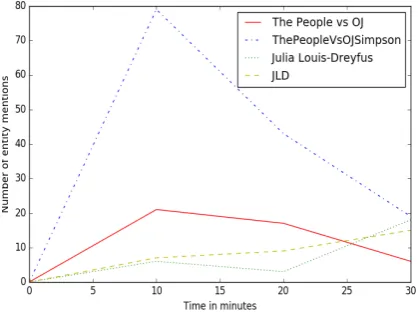
Figure 1: Name variations of entities that spike in popularity at the same time in 10 minute bins during the 2016 Emmy awards show
To investigate the validity of creating an alias list for entities that spike, we use the Twitter streaming API to collect 50,000 timestamped and temporally ordered tweets and re-tweets containing #emmys, while the 2016 Emmy Awards show was going on (we intend to make this dataset available to the research community). We selected tweets that occurred in a randomly selected 30 minutes time period and split these tweets into bins of 10 minute time periods i.e. each bin contained tweets that occurred in a 10 minute time interval. Figure 1 shows the entities that spiked the most in this time period and their name variations. We observed that when an entity spikes in popularity in a given time period, some
of its aliases spike in popularity as well. Based on these observations, we propose an algorithm, EntitySpike, that creates an alias list for entities that spike in a given time period.
Task Definition: Given a sequence of
tweets and entity mentions, denoted by X
=({e1,S1},{e2,S2},....{en,Sn}), where ei
represents a named entity that spikes in popularity in a given time period e.g. Julia Louis-Dreyfus, and Si represents the set of tweets that make
reference to this named entity, ei, during this
specified time period; the task is to create an alias list for eachei, if one exists.
Candidate Entity Identification: Following pre-vious work in entity linking (Liu et al.,2013;Guo et al., 2013), we define an entity as a Wikipedia title page. An entity mention is a sequence of to-kens in a tweet that can potentially link to an en-tity. The Grammy Awards show is mostly about famous people and so we focus only on entities belonging to thePersoncategory. In order to con-struct a Wikipedia lexicon, we collect 1.5 million English Wikipedia title pages referring toPerson named entities and extracted the backlinks (in-coming links to the Wikipedia title page) from each of these Wikipedia title pages (we intend to make this dataset available to the research commu-nity).
Given a set of tweets {t1, t2, ..., tn} that occur in a given time period (within minutes) during the Grammy awards show, we extract all k-grams of size ≤ k, from each tweet; we se-lected k = 3. We select a k-gram as a candidate entity mention if it is either an exact match of a Wikipedia title page or backlink or if it is con-tained in a Wikipedia title page or backlink, for example ”Carrie” is contained in ”Carrie Under-wood”.
3 Our Algorithm:EntitySpike
Exploiting Temporal Information about enti-ties: While the award show is going on, artists and celebrities - some of which have nicknames, are showcased walking on the red carpet, per-forming on stage, presenting awards, or sitting in the audience. On social media platforms, such as twitter, people publish tweets related to these events, in real-time. Most of the generated tweets refer to people or entities in the same context e.g. their outfit, performance, actions etc. Some tweets make reference to named entities by their aliases, some of which look similar to their corresponding named entity e.g. ”Jay Z”and”Jay-Z”and some look different e.g.”Taylor Swift”and”Tswizzle”. Given tweets that occur at a certain time period (within minutes), the context of most of the tweets will be similar. For example, one may see a burst of tweets published in the same 5-minute time pe-riod that say:”Xjust won a Grammy”or”Ywon her first Grammy”. This suggests thatXandY re-fer to the same person, regardless of how difre-ferent the names are. Based on this intuition, we propose theTemporal Entity Similarityheuristic:
Temporal Entity Similarity: In tweets (related to an event), collected sequentially, named entities that occur at the same time period and have a sim-ilar context are referring to the same named entity.
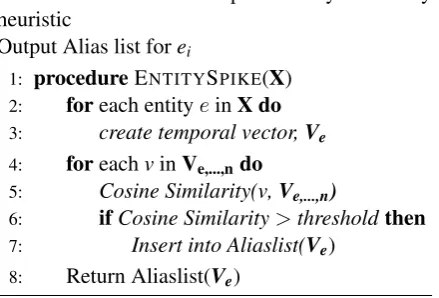
This temporal entity similarity heuristic helps capture the temporal context in which entities are mentioned and clusters entities that occur in a similar context. In figure 2, we present an out-line of EntitySpike which uses the temporal tity similarity to create an alias list for named en-tities that spike in popularity in a given time pe-riod during an event. To measure the similarity be-tween the named entities, we represent each entity as a vector. To create the vector for each entity, we select all the unique words in theEntitySpike, ({e1,S1},{e2,S2},...,{en,Sn}) and count the frequency of occurrence of each word in tweets, Sirelated to a named entityei. Two named entities
refer to the same entity if the cosine similarity of their vectors is greater than a threshold.
4 Experiments
4.1 Data
For our experiments, we evaluatedEntitySpikeon the 2013 Grammy Awards Show dataset described
Algorithm 1EntitySpike
Given X=({e1,S1},{e2,S2},....,{en,Sn}), were X satisfies the temporal entity similarity heuristic
Output Alias list forei
1: procedureENTITYSPIKE(X) 2: foreach entityeinX do 3: create temporal vector,Ve
4: foreachvinVe,...,ndo
5: Cosine Similarity(v,Ve,...,n)
6: ifCosine Similarity>thresholdthen 7: Insert into Aliaslist(Ve)
[image:3.595.309.529.114.263.2]8: Return Aliaslist(Ve)
Figure 2: Temporal Entity Similarity Algorithm
in Dredze et al. (2016). The show lasted for ap-proximately three and a half hours generating a lot of tweets, most of which made reference to artists, celebrities, and famous people - with entries in Wikipedia, by their names and nicknames (Dredze et al.,2016). To create this dataset, Dredze et al.
(2016) used the Twitter streaming API to collect 10,736 temporally ordered and unique tweets writ-ten in English containing grammy (case insensi-tive, and including #grammy) during the event. Although these tweets were temporally ordered, their timestamps were not saved, hence, we split the dataset into equal size temporal bins (11 bins), with each bin containing 976 temporally ordered tweets. We represented each entity as a vector by collecting the frequency of occurrence of each en-tity in each bin i.e. each enen-tity was represented as a vector of size 11.
4.2 Baseline
and their known aliases in our dataset. On these named entities and their aliases, this algorithm had a precision of68.25%and a recall of43.1%.
This algorithm shows that some entities that fre-quently occur in the same context at different time periods are referring to the same entity. We use this algorithm as our baseline.
Word2Vec Experiments: Given a named entity, we used word2vec as implemented by Mikolov et al.(2013) to find the top 10 most similar enti-ties to the given entity. We observed thatword2vec found related words and entities to a given en-tity, however, it found few entity aliases, some of which are misspelled words and abbreviations. Table1 shows the top 2 related entities found by word2vecfor some named entities.
Named Entity Related Entities Justin Timberlake Timberlake, Beyonce Adam Levine Maroon 5, Rob Thomas Taylor Swift Miley Cyrus, Justin Bieber JayZ Music Beats, Young Joc
Table 1: Some named entities and related entities identified byword2vec
4.3 EntitySpikeExperiments
As stated in section 4.1, we split our dataset into 11 equal size bins. In each bin, we calculated the frequency of occurrence of each entity and se-lected the topumost frequently occuring entities. We choseu = 15 because we wanted to compare a relatively small set of entities. We represented each of these entities using the method described in section 3 and calculated the cosine similarity between these entities. We selected an entity as an alias to another entity if they had a cosine sim-ilarity greater than a threshold (0.95). We evalu-atedEntitySpikeon the named entities that spiked in each of the 11 bins. We labelled the aliases of these spiked entities - that were found in the dataset. We used the algorithm described in sec-tion 4.2 as a baseline. Table2shows the precision and recall (with respect to the spiked entities and their aliases) ofEntitySpikeand the baseline.
Algorithm Precision Recall EntitySpike 73% 65%
Baseline 65% 69%
Table 2: Precision and recall of EntitySpike and baseline
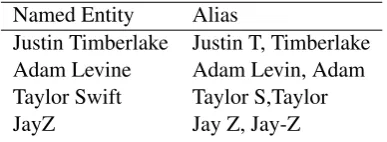
Table3shows aliases of the named entities from table1, thatEntitySpike identified. It can be seen thatEntitySpikefound more aliases.
Named Entity Alias
Justin Timberlake Justin T, Timberlake Adam Levine Adam Levin, Adam Taylor Swift Taylor S,Taylor JayZ Jay Z, Jay-Z
Table 3: Some named entities and their aliases identified by our method
EntitySpike identified entities that spiked in a given time period and created an alias list for these entities. We conducted experiments that varied this time period i.e. we combined bins, and we ob-served that some spiked entities persisted across bins and combining two adjoining bins gave opti-mal results.
EntitySpike also identified related words. For each entity that spiked, we usedEntitySpiketo cal-culate the cosine similarity between them. Two en-tities were related if they had a cosine similarity above a threshold (0.89). For each spiked entity, we compared the results from this experiment with word2vecandEntity Spikefound some of the re-lated entities inWord2vec. For example, it identi-fied that during the show,JayzandBeyoncewere related and also,Chris BrownandRihanna. Dur-ing the event, some entities were more related than usual; for example, Jay Z andJustin Timberlake preformed together during the show and a lot of tweets - referring to both of them were generated at this time period.EntitySpikewas able to identify that these two entities were related at this particu-lar time period. EntitySpike also identified some named entities that did not occur in Wikipedia e.g. ”Kelly C” for ”Kelly Clarkson” and ”Rih” for ”Ri-hanna”.
5 Conclusion and future work
[image:4.595.319.513.119.190.2]References
Nicholas Andrews, Jason Eisner, and Mark Dredze. 2014. Robust entity clustering via phylogenetic in-ference. InACL (1). pages 775–785.
Anietie Andy, Mugizi Rwebangira, and Satoshi Sekine. 2016a. An entity-based approach to answering re-current and non-rere-current questions with past an-swers. OKBQA 2016page 39.
Anietie Andy, Satoshi Sekine, Mugizi Rwebangira, and Mark Dredze. 2016b. Name variation in community question answering systems.WNUT 2016page 51. Mark Dredze, Nicholas Andrews, and Jay DeYoung.
2016. Twitter at the grammys: A social media cor-pus for entity linking and disambiguation. In Pro-ceedings of the 4th Workshop on Natural Language Processing and Social Media. pages 20–25. Stephen Guo, Ming-Wei Chang, and Emre Kiciman.
2013. To link or not to link? a study on end-to-end tweet entity linking. In HLT-NAACL. pages 1020– 1030.
Xiaohua Liu, Yitong Li, Haocheng Wu, Ming Zhou, Furu Wei, and Yi Lu. 2013. Entity linking for tweets. InACL (1). pages 1304–1311.
Tomas Mikolov, Kai Chen, Greg Corrado, and Jef-frey Dean. 2013. Efficient estimation of word representations in vector space. arXiv preprint arXiv:1301.3781.
Michael J Paul and Mark Dredze. 2011. You are what you tweet: Analyzing twitter for public health. Icwsm20:265–272.
Takeshi Sakaki, Makoto Okazaki, and Yutaka Matsuo. 2010. Earthquake shakes twitter users: real-time event detection by social sensors. In Proceedings of the 19th international conference on World wide web. ACM, pages 851–860.
Yusuke Shinyama, Satoshi Sekine, and Kiyoshi Sudo. 2002. Automatic paraphrase acquisition from news articles. In Proceedings of the second interna-tional conference on Human Language Technology Research. Morgan Kaufmann Publishers Inc., pages 313–318.
Kate Starbird and Leysia Palen. 2012. (how) will the revolution be retweeted?: information diffusion and the 2011 egyptian uprising. In Proceedings of the acm 2012 conference on computer supported coop-erative work. ACM, pages 7–16.