Learning complex inflectional paradigms through blended gradient inputs
Eric Rosen Johns Hopkins University
Abstract
Through Gradient Symbolic Computation (Smolensky and Goldrick,2016), in which in-put forms can consist of gradient blends of more than one phonological realization, we propose a way of deriving surface forms in complex inflectional paradigms that dispenses with direct references to inflectional classes and relies solely on relatively simple blends of input expressions.
In languages whose inflectional systems have a highly complex paradigmatic structure, it be-comes a challenge to explain how a speaker can produce a correct inflectional form when the num-ber of possible forms is exceedingly large. As
Ackerman and Malouf(2013, p. 429) (henceforth A&M) comment: “That speakers are able to do this is a truly puzzling accomplishment given the extraordinary variation and complexity attested in the morphological systems of the world.” When it becomes extremely difficult for a speaker to mem-orize every possible inflectional form for every lexeme in their language, it becomes attractive to posit some means by which they can produce a correct unmemorized form.
Three interacting types of paradigmatic com-plexity that put a burden on learning are ad-dressed here: (a) differences in inflectional ma-terial across lexemes, which, descriptively, result in division of lexemes into inflectional classes; (b) syncretism, where the same inflectional material occurs in different paradigm cells; (c) independent subsystems of inflectional class behaviour, evident in Mazatec (see §3.) These complexities are all ways in which inflectional patterns depart from canonicityas defined in detail byCorbett(2009);
Baerman and Corbett(2010);Stump(2016). Through Gradient Symbolic Computation (Smolensky and Goldrick, 2016), a type of Har-monic Grammar, and with examples from Russian
and Mazatec1, we propose a system that enables a speaker to produce correct forms of complex paradigms through learnable input representations without indexing to inflectional classes.
The paper is organized as follows.§1introduces
GSC and how it can be applied to learning ex-ponents of inflectional paradigms. §2shows how Russian noun inflection can be acquired through this framework. §2.1 shows how GSC limits the kinds of inflectional patterning that are possible.
§3analyses complex paradigms in Mazatec, where inflectional classes vary in three cross-cutting di-mensions. §4 discusses testing and comparison with other models.§5summarizes how this
frame-work can both explain departures from canonicity in inflectional paradigms and also constrain the de-gree of departure from the canonical.
1 Gradient Symbolic Computation We adopt here Gradient Symbolic Computation (henceforth GSC), in which gradient inputs are given numerical activation levels, which we shall show to be learnable, and are evaluated with weighted constraints that calculate the Harmony of input candidates, where the candidate with the greatest Harmony surfaces. This formalism is part of a larger research program in which computa-tion derives outputs from gradient representacomputa-tions in phonology, syntax and semantics (Cho et al.,
2017; Faust and Smolensky, 2017; Faust, 2017;
Goldrick et al., 2016; Hsu, 2018; M¨uller, 2017;
Rosen, 2016, 2018; Smolensky et al., 2014;
Smolensky and Goldrick, 2016; Van Hell et al.,
1In response to a reviewer’s question about the effects and
degree of simplification of the paradigms of these two lan-guages, we contend that (a) any linguistic analysis will have some degree of simplification, (b) the paradigms are no more simplified than those analysed by A&M and in fact include moreparadigm positions than are represented in their table A6 (p. 457), and (c) nothing in the analysis was excluded be-cause the model couldn’t handle it.
2016;Zimmermann,2017b,a,forthcoming).2 In the examples in§2from Russian noun
inflec-tion, the surface exponents that can represent gen-itive singular among the descriptive inflectional classes, form a blend of input segments, which we shall call ‘inflectional input’: {a, i}. A lexeme (basic element of the lexicon) in descriptive class 1 whose genitive sg. is vina, ‘wine’ contributes an input we shall call ‘base input’ that consists of what is traditionally thought of as a stem plus a blend of word-final segments {a, u, o}that
mir-rors segments that can occur in surface-final posi-tion. We propose that it derives as follows, with numerical details shown later in table4.
Lexical base Inflectional affix
Input:
root !"#$
vin{a,u,o} GEN.SG. ={a,i}
Output: #$!"vin #$!"a
root exponent affixal exponent
Table 1: Gen.sg. of lexeme, descriptive class 1
In this framework, a discrete output form is chosen from possible candidates by the action of Faithfulness constraints that are familiar from Optimality Theory (Prince and Smolensky,1993), but which, in GSC, have weighted values and evaluate gradient input activations. We assume a highly-weightedquantization constraint quanti-fied by an equation inCho et al. (2017) that dis-favours blended outputs and gives a higher Har-mony to discrete non-blended forms. The tableaux below thus ignore blended output candidates.3
Surface material that some models view as de-riving solely from an affix input is derived here from two distinct input sources, thus blending two competing analyses: a constructivist approach that builds whole words out of morphemes and a word-based approach that seeks relationships between whole word forms. The input representation of a lexeme that includes affixal material as an in-trinsic part of the word is based upon a whole-word model; an affix as a fully independent in-put follows a morpheme-based model. A
simi-2A reviewer asks what advantages this model
has over a “genuine connectionist model” such as Goldsmith and O’Brien (2006); Kann and Sch¨utze (2016); Malouf(2018). In this model, the knowledge it contains is completely transparent, whereas in the last two models cited by the reviewer, it is not clear what kind of knowledge is contained in those networks. (See§4for further discussion.)
3But seeZimmermann (2017b,a, 2018) for analyses of
other phenomena in which outputs are also gradient.
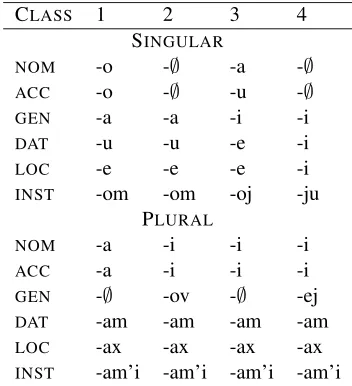
CLASS 1 2 3 4
SINGULAR
NOM -o -∅ -a -∅
ACC -o -∅ -u -∅
GEN -a -a -i -i
DAT -u -u -e -i
LOC -e -e -e -i
INST -om -om -oj -ju PLURAL
NOM -a -i -i -i
ACC -a -i -i -i
GEN -∅ -ov -∅ -ej
DAT -am -am -am -am
LOC -ax -ax -ax -ax
[image:2.612.329.505.58.251.2]INST -am’i -am’i -am’i -am’i
Table 2: Russian noun paradigm
lar approach is taken bySmolensky and Goldrick
(2016), treating French liaison as derived from both the end of a preceding word and the begin-ning of a following word, thus combibegin-ning two competing approaches to liaison in the literature.
Any matching phonological material from the two sources will combine through coalescence. When there are multiple descriptive inflectional classes, the exponent for a given inflectional com-bination varies, depending not only on the lexeme, but on the stem when there is stem allomorphy (Stump,2016). The current proposal for blended word-final input segments that mirror affixes, di-rectly encodes the fact that lexeme/stem choice will affect affix-choice. Non-concatenative and suppletive alternations can thus be represented as well, as blends of different stem alternants occur-ring underlyingly.
2 Learning Russian noun inflection For ease of exposition, we first examine the rela-tively simple paradigms of case/number noun suf-fixes in Russian, with data from A&M p. 460 given in table 2. For presentation purposes, we ignore here the paradigm defectiveness of some Russian nouns (Corbett,2007).
activa-Source a u o i Base input 0.1 0.02 0.16
GEN-SG 0.3 0.26
[image:3.612.344.496.57.190.2]Total 0.4 0.02 0.16 0.26
Table 3: Summed activations for class 1GEN-SG
vin(0.1·a,0.02·u,0.16·o)‘wine’
+GEN-SG(0.3·a,0.26·i)
MAX DEP Harmony 5 −2
vin-a 2.0 −1.2 0.8
vin-u 0.1 −1.96 −1.86
vin-o 0.8 −1.68 −0.88
vin-i 1.3 −1.48 −0.18
vin-e −2.0 −2.0
vin 0.0
Table 4: Tableau for class 1GEN-SG
tion that is the sum of the two source activa-tions. Consider again the same genitive sin-gular form vina given above in table 1. Sup-pose that the base input has a blend of three affix-mirroring segments with the following activ-ity levels: vin + (0.1·a,0.02·u,0.16·o) and affixal GEN-SING is a blend of segments (0.3·a,0.26·i). There are then four possible candidate segments that have a non-zero input activation: /-a/, /-u/, /-o/ and /-i/, whose input activations will be the sums of any pair of co-occurring segments that can coa-lesce in the output as shown in table3.
The segment a surpasses the relevant thresh-old and surfaces, having the highest aggregate in-put activation. Table4shows a harmonic tableau for this form. In GSC, a MAX constraint (here weighted 5.0) contributes positive Harmony pro-portionate to the surfacing of underlying activa-tion. A DEP constraint (here weighted at −2.0)
contributes negative Harmony for the deficit be-tween input and output activations. We assume that quantization will only allow surface activa-tions of 0 or 1 so the tableau only considers candi-dates with those values. The positive contribution to Harmony from MAXfor the winning candidate is is 5 times the sum of its input activations for /a/ which are 0.1 from the base input plus 0.3 from gen.sg. inflection input. The winning candidate has the highest Harmony.
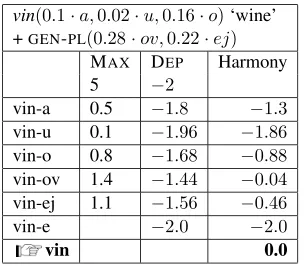
An affixless candidate incurs no MAX reward or DEPpenalty and will be optimal when all other candidates have negative Harmony (table5.)
vin(0.1·a,0.02·u,0.16·o)‘wine’
+GEN-PL(0.28·ov,0.22·ej)
MAX DEP Harmony 5 −2
vin-a 0.5 −1.8 −1.3
vin-u 0.1 −1.96 −1.86
vin-o 0.8 −1.68 −0.88
vin-ov 1.4 −1.44 −0.04
vin-ej 1.1 −1.56 −0.46
vin-e −2.0 −2.0
vin 0.0
Table 5: Tableau for class 1GEN-PL
The following simple algorithm4 learned blended base and inflectional input values such that the optimal output candidate is the correct target of learning for all 48 forms. Following
Faust and Smolensky (2017, page 2), not just an individual segment but also other structures can have an activity level.
• Initialize all activations at zero.
• Calculate the Harmony for each descriptive stem-class/number/case combination.
• If the wrong affix is predicted, decrease its two input activations if nonzero and increase the ac-tivations of the desired affix. Stepsize 0.02.
• Repeat until all 48 paradigm positions are
cor-rectly predicted.
Tables 6 and 7 show the learned input values after 72 iterations.
Nonzero inputs for an inflectional combination indicate its set of possible exponents. A co-occurring nonzero base input narrows down the choice of those exponents. For example, the loca-tive singular affix is-e for all descriptive classes except class 4, where -isurfaces. The activation of 0.12 for-i for a class 4 base input allows it to surpass other competitors where it surfaces.
In summary, representing both base and inflec-tional inputs with a blend of partially activated ex-ponents allows a speaker to encode all the infor-mation in a multi-class inflectional paradigm di-rectly on the relevant input forms.
4A reviewer suggests that the contribution of this model
[image:3.612.119.275.148.268.2]Class 1 2 3 4
a 0.1 0.04
e 0.12
u 0.02 0.06
om 0.04
ov 0.02
ax am am’i
i 0.1 0.12
oj 0.06
ju 0.06
o 0.16
[image:4.612.121.274.56.246.2]ej 0.08
Table 6: Learned nonzero input values Cell NSG ASG GSG DSG LSG ISG
a 0.28 0.3
e 0.26 0.3
u 0.28 0.3
om 0.3
ov ax am am’i
i 0.26 0.22 0.24
oj 0.26
ju 0.26
o 0.24 0.22 ej
Cell NPL APL GPL DPL LPL IPL
a 0.24 0.24 e
u om
ov 0.4
ax 0.3
am 0.3
am’i 0.3
i 0.3 0.3 oj
ju o
ej 0.22
Table 7: Learned inflectional input values
2.1 Restricting possible paradigms
The Russian noun paradigm exhibits both syn-cretism within descriptive inflectional classes and variance of exponents for a given position across inflectional classes. Our model predicts that there are limits to such departures from canonicity. In the dative singular, the affix isein class 3 and i in class 4. In the genitive singular, it isifor both
classes, makingi syncretic across those two fea-ture combinations for class 4. Our model predicts the impossibility of the pattern in the right-hand half of table8.
Real Impossible Class 3 Class 4 Class 3 Class 4
Gen. Sg. i i i e
[image:4.612.104.290.112.576.2]Dat. Sg. e i e i
Table 8: Crossing diagonals
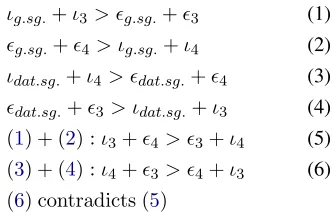
In the impossible paradigm, lines connecting the two instances ofi(coloured blue) and connect-ing the two instances of e (coloured red) would cross. Such diagonal crossing can be shown to mathematically imply activation hierarchies that lead to a contradiction (table 9) , where ι repre-sents the activation ofiandϵofefor a given (sub-scripted) feature value or descriptive inflectional class.
ιg.sg.+ι3> ϵg.sg.+ϵ3 (1)
ϵg.sg.+ϵ4> ιg.sg.+ι4 (2)
ιdat.sg.+ι4> ϵdat.sg.+ϵ4 (3)
ϵdat.sg.+ϵ3> ιdat.sg.+ι3 (4)
(1) + (2) :ι3+ϵ4> ϵ3+ι4 (5)
(3) + (4) :ι4+ϵ3> ϵ4+ι3 (6)
[image:4.612.318.519.117.168.2](6) contradicts (5)
Table 9: Contradictory inequalities
Thus, in spite of a common misconception that “you can do anything with numbers”, the pro-posed GSC model predicts that many conceivable paradigms are impossible.
3 Learning inputs in Mazatec
[image:4.612.355.522.323.431.2]NEUTRAL INCOMPLETIVE
SG PL SG PL
1INCL ˇca2s˜e2 ˇca2s˜e42
1 ba3sæ1 ˇca2s˜ı24 kwa3sæ1 ˇca4s˜ı24
2 ˇca2se2 ˇca2s˜u2 ˇca4se2 ˇca4s˜u2
[image:5.612.320.519.57.254.2]3 ba3se2 kwa4se2
Table 10: Paradigm for ‘remember’
possible combinations are actually reduced to 20 in Jamieson’s list of paradigms. Table10gives the paradigm forba3se2‘remember’ from A&M:450, taken fromJamieson(1982, p. 167). This lexeme is in stem formative descriptive class 11, tone pat-tern class B 3-1 and final vowel class 2.
Combinations of morphosyntactic features are represented by combinations of multiple expo-nents, but there is no apparent correspondence be-tween individual feature values and individual ex-ponents. The surface form for a verb expresses feature values for aspect, person and number, with a stem formative, a tone pattern and a suffix vowel. Stems in many cases consist merely of a single segment. As A&M:447 observe, a stem is much more easily identified by “its membership in an inflectional class in each of three distinct cross-cutting dimensions: tone pattern, final vowel, and stem formative.” In the proposed blended repre-sentations, a lexeme’s base input carries much of the information that predicts what exponents it oc-curs with, in this way identifying what can de-scriptively be called its stem. It also directly en-codes what is descriptively its inflectional class in a way that is not possible in a model in which paradigm information and stem information are separate. Table11 shows, with activation values omitted for now, an example basic input-output structure, which contains gradient blends of con-sonants in the input.
Tone and final vowel omitted here Lexical base Stem formative
Input: {b, kw, ˇc}a
root
!"#$s 3rd.p.def.incomp.
{sk, k> wh, s, kw} Output: #$!"kwa#$!"s
stem formative root exponent
Table 11: Input-output for ‘remember’ 3rd.p.def.inc.
Some further complexities in Jamieson’s data are omitted here for simplicity of exposition but
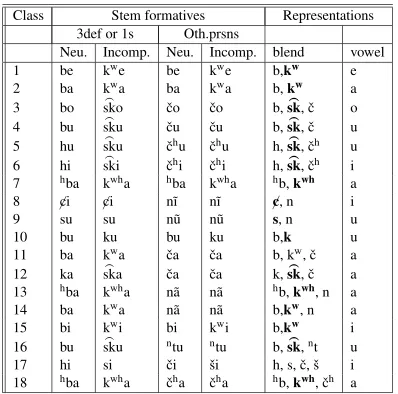
Class Stem formatives Representations
3def or 1s Oth.prsns
Neu. Incomp. Neu. Incomp. blend vowel
1 be kwe be kwe b,kw e
2 ba kwa ba kwa b,kw a
3 bo sko> ˇco ˇco b,sk>, ˇc o
4 bu sku> ˇcu ˇcu b,sk>, ˇc u
5 hu sku> ˇchu ˇchu h,sk>, ˇch u
6 hi ski> ˇchi ˇchi h,sk>, ˇch i
7 hba kwha hba kwha hb,kwh a
8 ✁ci ✁ci n˜ı n˜ı ✁c, n i
9 su su n˜u n˜u s, n u
10 bu ku bu ku b,k u
11 ba kwa ˇca ˇca b, kw, ˇc a
12 ka ska> ˇca ˇca k,sk>, ˇc a
13 hba kwha n˜a n˜a hb,kwh, n a
14 ba kwa n˜a n˜a b,kw, n a
15 bi kwi bi kwi b,kw i
16 bu sku> ntu ntu b,sk>,nt u
17 hi si ˇci ˇsi h, s, ˇc, ˇs i
18 hba kwha ˇcha ˇcha hb,kwh, ˇch a
Table 12: Representations of stem formatives
can be explained by our analysis. These include suffixing of verbs, verb compounding, verbs with no stem formative5and stem suppletion.6
Among the 35 possible stem formatives, 11 pos-sible final vowels and 15 pospos-sible tone patterns, a given lexeme’s input form only needs a blend of a small subset of each of these exponents.
3.1 Learning inputs for stem formatives Consider first the stem formatives, shown in table
12(Data fromJamieson(1982).)7
The proposed representation for each base input is simply a blend of all its possible initial conso-nants. The vowels stay the same across a class. Which consonant surfaces depends on how this blend interacts through coalescence of identical consonants with an inflectional input blend of con-sonant features.
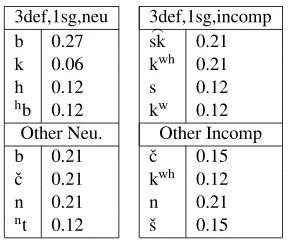
Tables13and 14show the results of the same kind of algorithm discussed on page 3for learn-ing input activations of inflectional person-number combinations and base inputs respectively.
It took 22 iterations to learn activations that derive the correct stem formative consonants for each of 4 person-number groups in 18 classes.
Abstracting away for now from tone and final
5If a stem formative is absent from the base input, an
anchoring constraint will prevent an inflection-based stem-formative input from surfacing.
6Stem suppletion can be accounted for by an input that
includes a blend of different stem allomorphs each linked to different inflectional features.
7FollowingGolston and Kehrein (1998), we take what
[image:5.612.93.302.569.663.2]3def,1sg,neu 3def,1sg,incomp b 0.27 sk> 0.21 k 0.06 kwh 0.21
h 0.12 s 0.12
hb 0.12 kw 0.12
Other Neu. Other Incomp b 0.21 ˇc 0.15 ˇc 0.21 kwh 0.12
n 0.21 n 0.21
[image:6.612.126.270.56.176.2]nt 0.12 ˇs 0.15
Table 13: Input activations for person/number
vowels, for kwa4se2‘remember’ (class 11), 3rd p. def. incompl., the activations for the input given above in table11are as follows.
Base input: (0.1·b,0.3·kw,0.3·ˇc)as Inflectional input:
(0.21·sk,> 0.21·kwh,0.12·s,0.12·kw)
For each candidate, an inflectional input can co-alesce with a base input. The segment with the highest combined activation surfaces, namely kw, with an underlying activation of0.3+0.12 = 0.42. We assume the stem consonant and the vowel of the stem formative to both have full1.0underlying activations; thus no Harmony is gained by having a gradient inflectional stem formative consonant incorrectly coalesce with the stem consonant nor for a gradient inflectional final vowel to incorrectly coalesce with the stem formative vowel.
3.2 Learning inputs for tone patterns
Tone patterns, which fall into 11 descriptive classes, were also learned by an algorithm that separately learned patterns for the first and second syllables.
Table15shows tone patterns listed by class and person-number-aspect combination. (Data from
Jamieson(1982).)
There is some phonological predictability for the tones of the second syllable, where 1 is the highest tone and 4 the lowest:
• The initial tone on the second syllable can be no
lower than the final tone of the first syllable.
• If the initial tone of the second syllable is 3 or 4 and the same as the final tone of the first, there is a further rise of two tone levels:
– e.g. 4 can be followed by 42 but not simple 4; – 3 can be followed by 31 but not 3.
– 2 can only be followed by 2 or 24.
Class stem formative input activation
1 b 0.2
kw 0.3
2 b 0.1
kw 0.3
3 b 0.1
>
sk 0.2
ˇc 0.2
4 b 0.1
>
sk 0.2
ˇc 0.3
5 sk> 0.2
h 0.2
ˇc 0.3
6 sk> 0.2
h 0.2
ˇc 0.3
7 hb 0.3
kwh 0.2
8 ✁c 0.4
n 0.2
9 n 0.2
s 0.3
10 b 0.2
k 0.3
Class stem formative input activation
11 b 0.1
kw 0.3
ˇc 0.3
12 sk> 0.2
k 0.3
ˇc 0.3
13 hb 0.2
kwh 0.2
n 0.2
14 b 0.1
kwh 0.2
n 0.3
15 b 0.2
kw 0.2
16 b 0.1
>
sk 0.2
nt 0.3
17 s 0.2
h 0.2
ˇs 0.3
ˇc 0.1
18 hb 0.2
kwh 0.1
[image:6.612.336.502.66.654.2]ˇc 0.3
Table 14: Input activations for stem formatives
– 1 can only be followed by 1.
Neutral aspect
Class 3def 1s 1in 2s 1ex 2p A 3-1 3-1 3-31 3-1 3-14 3-1 B1-1 2-2 1-1 2-2 2-2 2-24 2-2 B3-1 3-2 3-1 2-2 2-2 2-24 2-2 C 3-24 14-3 14-42 14-3 14-34 14-3 D1-1 1-1 1-1 3-2 3-2 3-24 3-2 D3-1 3-2 3-1 3-2 3-2 3-24 3-2
Incompletive aspect
[image:7.612.100.295.56.245.2]A(1-7) 4-2 3-1 3-31 3-1 3-14 3-1 A(8-18) 4-2 3-1 4-31 4-1 4-14 4-1 B1-1 (1-7) 4-2 1-1 2-2 2-2 2-24 2-2 B1-1 (8-13) 4-2 1-1 4-42 4-2 4-24 4-2 B1-1 (14-18) 4-1 1-1 4-42 4-3 4-34 4-3 B3-1 (1-7) 4-2 3-1 2-2 2-2 2-24 2-2 B3-1 (8-13) 4-2 3-1 4-42 4-2 4-24 4-2 B3-1 (14-18) 4-1 3-1 4-42 4-3 4-34 4-3 C 3-24 14-3 14-42 14-3 14-34 14-3 D1-1 (8-13) 4-2 1-1 4-42 4-2 4-24 4-2
Table 15: Tone patterns
the 1st exclusive to be a separate tonal input for 1st-exclusive.
Tables 16 and 17 show the results of learning algorithms for first and second syllable tones. Ten iterations were required for syllable 1 and 22 it-erations for syllable 2, with a stepsize of 0.05 for syllable 1 and 0.1 for syllable 2. Activations were initialized at 0.2 for each base-input and tonal person-number input for each tone pattern that actually occurs. We assume there exists a Har-monic Grammar analysis of the above constraints, in which they have higher weight than Faithful-ness, which will otherwise derive the pattern with the highest aggregate activation.
A two-syllable base input has a tone linked to the mora of each syllable. The inflectional in-put has a linearly ordered sequence of two tones on the tonal tier.8 A strongly-weighted anchoring constraint will require the tones on the inflectional input to line up with the tones on the base input when they coalesce.
Consider the second person singular incomple-tive of ‘remember’, ˇca4se2. This is tonal class B-3-1 (8-13) with inputs shown in table 18. When the two input sources coalesce on each syllable, tone level 4 has the highest activation for syllable 1 of 0.25 + 0.1 = 0.35 and tone level 2 on syllable 2 of 0.4 + 0.0 = 0.4., both the correct tones. 3.3 Learning inputs for final vowels
Table19, with data fromJamieson (1982) shows the 10 descriptive classes of final vowels.
8In the 1st person exclusive, a level 4 tone will occur
fur-ther to the right of ofur-ther tones.
First syllable tones
Tone class 1 2 3 4 14
A1-7 0.25 0.15
A8-18 0.2 0.25
B1-1-1-7 0.15 0.25 0.05 B1-1-18-13 0.2 0.25 0.2 B1-1-14-18 0.15 0.25 0.2 B3-1-1-7 0.3 0.2 0.1 B3-1-8-13 0.25 0.15 0.25 B3-1-14-18 0.25 0.1 0.25
C 0.2 0.35
D1-1 0.2 0.15 0.25 D3-1 0.15 0.2 0.25 Person/number 1 2 3 4 14 3def Neu. 0.05 0.25
1s Neu. 0.15 0.15 0.1 1in Neu. 0.2 0.15 0.05 2s Neu. 0.15 0.15 0.05 1ex Neu. 0.2 0.15 0.05 2p Neu. 0.1 0.1
[image:7.612.331.506.65.329.2]3def Inc. 0.15 0.35 1s Inc. 0.25 0.15 0.1 1in Inc. 0.05 0.05 0.1 0.05 2s Inc. 0.05 0.1 0.1 1ex Inc. 0.05 0.05 0.1 2p Inc. 0.05 0.05 0.1
Table 16: Input activations forσ1tones
Second syllable tones
Tone class 1 2 3 4 24 A1-7 0.2 0.2 -0.1
A8-18 0.5 0.2 0.2 B1-1-1-7 0.2 0.2
B1-1-18-13 0.4 0.2 B1-1-14-18 0.1 0.6 0.4 B3-1-1-7 0.2 0.2
B3-1-8-13 0.4 0.2 B3-1-14-18 0.5 0.4 0.2
C 0.3 0.3 0.2
D1-1 0.5 0.2
D3-1 0.1 0.5 0.2
Person/number 1 2 3 4 24 3def Neu. 0.2 0.4 0.2 1s Neu. 0.5 0.2
1in Neu. 0.1 0.5 0.8 2s Neu. 0.2 0.1 0.2 1ex Neu. 0.2 0.1 0.2 2p Neu. 0.2 0.1 0.2
3def Inc. 0.2 0.3 0.1 0.2 1s Inc. 0.5 0.3
1in Inc. 0.3 0.7
2s Inc. 0.1 0.3 1ex Inc. 0.1 0.2 2p Inc. 0.1 0.2
Table 17: Input activations forσ2tones
[image:7.612.337.497.357.628.2]Syllable 1
Tone→ 1 2 3 4
Tonal class B-31 (8-13) 0.25 0.15 0.25 2nd sg. incomp. 0.05 0.1 0.1
Total 0.3 0.25 0.35
Syllable 2
Tone→ 1 2 3 4
[image:8.612.108.287.59.336.2]Tonal class B-31 (8-13) 0.4 0.2 2nd sg. incomp. 0.1 0.3 Total 0.1 0.4 0.3 0.2
Table 18: Aggregate activations
Class 3def 1s 1in 2s 1ex 2p (basic)
1 i æ ˜e i ˜ı ˜u
2 e æ ˜e e ˜ı ˜u
3 æ æ ˜e e ˜ı ˜u
4 u u ˜u i ˜ı ˜u
5 o o ˜o e ˜ı ˜u
6 a a ˜a e ˜ı ˜u
[image:8.612.335.499.129.201.2]7 ˜ı ˜e ˜e ˜ı ˜ı ˜u 8 ˜e ˜e ˜e ˜ı ˜ı ˜u 9 ˜u ˜u ˜u ˜ı ˜ı ˜u 10 ˜a ˜a ˜a ˜ı ˜ı ˜u
Table 19: Classes of final vowels
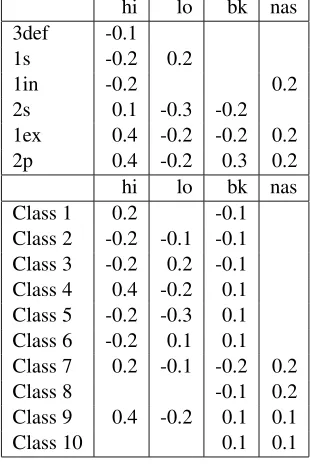
hi means 0.1−hi. We assume that∀i both +fi
and−fi do not occur in the same source. Table 21shows input vowel features forˇca4se2 ‘remem-ber’, final-vowel class 2 in the 2nd sg. incomp. (Wvdenotes base input.)
hi lo bk nas 3def -0.1
1s -0.2 0.2
1in -0.2 0.2
2s 0.1 -0.3 -0.2 1ex 0.4 -0.2 -0.2 0.2
2p 0.4 -0.2 0.3 0.2
hi lo bk nas Class 1 0.2 -0.1 Class 2 -0.2 -0.1 -0.1 Class 3 -0.2 0.2 -0.1 Class 4 0.4 -0.2 0.1 Class 5 -0.2 -0.3 0.1 Class 6 -0.2 0.1 0.1 Class 7 0.2 -0.1 -0.2 0.2
Class 8 -0.1 0.2
Class 9 0.4 -0.2 0.1 0.1
Class 10 0.1 0.1
Table 20: Input activations for vowel features
We adopt a second, strongly-weighted
quantiza-tion constraint fromCho et al.(2017) that requires the sum of activations from a binary feature group such as{+hi,−hi}to be 1. Thus−hicompetes with+hiand−hisurfaces because its higher ag-gregate activation results in greater Harmony.
Feature 2nd-sg. Wv Winner
hi 0.1 −0.2 −hi lo −0.3 −0.1 −lo bk −0.2 −0.1 −bk
nas 0nas
Table 21: Values for final-vowel class 2, 2nd-sg.
[−hi,−lo,−bk,0 nas] = e, the correct final vowel, is the output after quantization.
4 Testing and comparison with other models
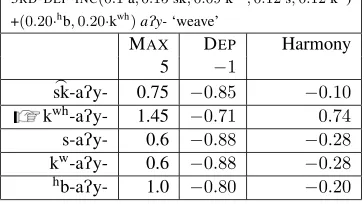
To test how a learner could predict an unseen in-flectional form for a given stem, we ran cross-vaidation on Mazatec stem formatives, tone pat-terns and final vowels, with training set items (70% of the total stemclass×inflection combina-tions) picked randomly from a Zipf-Mandelbrot distribution. On ten runs for each, the average test accuracy was 83% for stem formatives, 87% on tone 1, 92% on tone 2 and 89% on the final vowel. As a baseline, we simultaneously tested prediction of unseen forms based on frequency of occurring stem formatives, for which the accu-racy was 9.5%. The relative success of the model in cross-validation is due to the syncretism that occurs both within paradigms and across classes. The following tableau shows how the correct stem formative kwhis predicted for a never-encountered 3rd-definite-incompletive form of a class 7 stem ‘weave’aPy9 in the holdout set, using activation
values that were learned for encountered forms.10 The strength of this model is that it directly encodes knowledge of the tendency of an expo-nent to occur for a given stem and for a given morphosyntactic combination. For example, a Mazatec class 1 stem with a stem-formative blend (0.2·b, 0.3·kw) encodes the relative tendencies of
these two exponents to occur with this stem, with zero-valued exponents having no inclination to occur. In Kann and Sch¨utze (2016) and Malouf 9Since the vowelaof the stem formative does not vary,
for convenience we can take it here to be part of the stem.
10Because the activation values were learned just for a
[image:8.612.115.283.195.332.2] [image:8.612.119.274.447.679.2]3RD-DEF-INC(0.1·a,0.15·sk>,0.09·kwh,0.12·s,0.12·kw)
+(0.20·hb,0.20·kwh)aPy-‘weave’
MAX DEP Harmony 5 −1
>
sk-aPy- 0.75 −0.85 −0.10
kwh-aPy- 1.45 −0.71 0.74
s-aPy- 0.6 −0.88 −0.28
kw-aPy- 0.6 −0.88 −0.28
[image:9.612.96.278.66.168.2]hb-aPy- 1.0 −0.80 −0.20
Table 22: Tableau for ‘weave’ class 7 3rd-def-inc.
(2018), there is no indication of what kind of knowledge is represented by a given node or con-nection. Goldsmith and O’Brien(2006)11 is more similar to the present model but it is not clear how weights from input to hidden-layer nodes translate into feature-values on a symbolic level. And its winner-take-all mechanism with no thresh-old to surpass means than zero exponents in a paradigm must be represented as such, rather than resulting from any exponent failing to surpass a threshold. This results in awkward representa-tions when a form is expressed by multiple zero affixes. The advantage of the GSC model, (see
Smolensky et al.(2014, p. 1103)) is that it com-bines a subsymbolic neural level with a symbolic level, i.e. ‘microlevel representations and algo-rithms’ with symbolic grammatical theory, with an interface between the two. The subsymbolic level provides a platform for optimization and allows gradient activations. When output activations are quantized to discrete values they percolate to the symbolic level which contains symbolic descrip-tions that are familiar from symbol-based linguis-tic theory.
5 Summary
Inflectional patterns in Russian and Mazatec de-part from canonicity in a number of ways, as was outlined on page 1. If these systems were completely canonical, each morphosyntactic com-bination of feature values would have a unique, lexeme-invariant exponent. In our model, in Rus-sian, the variance of an exponent across inflec-tional classes is expressed directly by ablend of segments in an underlying form, e.g. (a,i) for gen-itive singular. Syncretism across inflectional fea-ture combinations, such as multiple instances of-i in several classes is expressed by its occurrence as
11See alsoGoldsmith and Rosen(2017), which has
simi-larities with the present model but differs in crucial ways.
a base input, so that it can coalesce with a match-ing inflectional input12 for several feature combi-nations. If a different exponent occurred in each cell and there were no inflectional class divisions, the URs could simply be a single non-blended ex-ponent for each inflectional input, with no inflec-tional formatives on base inputs. So the represen-tations proposed here directly encode and capture the kinds of departures from canonicity that occur. In Mazatec, blended inputs capture not just de-viation from paradigm canonicity but patterns of predicability within its paradigm structure. Out of1235possible stem-formative combinations that could occur in 12 paradigm positions, Jamieson only lists 18 classes. Blended input representa-tions, in which no more than four phonemes oc-cur for a base input or inflectional input, limit how many stem formatives occur for a given lex-eme and along with the occurrence of the same blended inflectional inputs in multiple person-number combinations, derive the syncretism that occurs across those paradigm positions.
This approach can also derive subtractive mor-phology, suppletion, umlaut and moraic augmen-tation. For example, if an inflectional form is sub-tractive relative to a base, the subtractable part can have partial or negative-valued underlying activa-tion in the UR and express morphosyntactic fea-tures that affect its surfacing. Umlaut (Trommer,
2017) can be derived from a blend of different vowel features where alternation occurs.
Given the vast number of ways that languages can deviate from canonical inflection (Corbett,
2009,2007; Baerman and Corbett, 2010; Stump,
2016), we hope with future research to explore in the GSC framework how it is possible to learn complex paradigmatic patterns in other languages.
6 Acknowledgements
Thanks to Paul Smolensky, Matt Goldrick, Farrell Ackerman, three anonymous reviewers and mem-bers of the Johns Hopkins Neurosymbolic Com-putation Group and the Surrey Morphology Group for valuable discussion and suggestions. Research was generously funded by NSF INSPIRE grant BCS-1344269. All errors are my own.
12In terms of correspondence, this model employs the
References
Ackerman, Farrell, and Robert Malouf. 2013. Morpho-logical Organization: the Low Conditional Entropy Conjecture.Language89:429–464.
Baerman, Matthew, and Greville Corbett. 2010. A typology of inflectional class interaction. In 14th International Morphology Meeting. Budapest, Hun-gary.
Cho, Pyeong Whan, Matthew Goldrick, and Paul Smolensky. 2017. Incremental parsing in a continu-ous dynamical system: sentence processing in Gra-dient Symbolic Computation: Supplementary Mate-rials 3: processing.Linguistics Vanguard3.
Corbett, Greville. 2007. Canonical typology, supple-tion and possible words.Language83:8–42.
Corbett, Greville. 2009. Canonical inflectional classes. In Selected Proceedings of the 6th D´ecembrettes: Morphology in Bordeaux, 1–11.
Faust, Noam. 2017. How much for that vowel? Talk, Strength in Grammar Workshop, University of Leipzig.
Faust, Noam, and Paul Smolensky. 2017. Activ-ity as an alternative to autosegmental association. In Manchester Phonology Meeting. Manchester, United Kingdom.
Goldrick, Matthew, Michael Putnam, and Lara Schwarz. 2016. Coactivation in bilingual grammars: A computational account of code mixing. Bilingual-ism: Language and Cognition19:857–876. ROA 1441.
Goldsmith, John, and Jeremy O’Brien. 2006. Learning inflectional classes. Language Learning and Devel-opment2:219–250.
Goldsmith, John, and Eric Rosen. 2017. Geomet-rical morphology. CoRR abs/1703.04481. URL http://arxiv.org/abs/1703.04481.
Golston, Chris, and Wolfgang Kehrein. 1998. Mazatec Onsets and Nuclei. International Journal of Ameri-can Linguistics64:311–337.
van Hell, Janet G., Clara Cohen, and Sarah Grey. 2016. Testing tolerance for lexically-specific fac-tors in gradient symbolic computation. Bilingual-ism: Language and Cognition19:897–899.
Hsu, Brian. 2018. Scalar constraints and gradient sym-bolic representations generate exceptional prosodi-fication effects without exceptional prosody. Hand-out, West Coast Conference on Formal Linguistics 36.
Jamieson, Carol. 1982. Conflated subsystems marking person and aspect in Chiquihuitl´an Mazatec verbs. Language48:139–167.
Kann, Katharina, and Hinrich Sch¨utze. 2016. Single-Model Encoder-Decoder with Explicit Morpholog-ical Representation for Reinflection. In Proceed-ings of the 54th Annual Meeting of the Association for Computational Linguistics (Volume 2: Short Pa-pers), 555–560. Association for Computational Lin-guistics.
Malouf, Robert. 2018. Generating morphological paradigms with a recurrent neural network. San Diego Linguistic Papers6.
M¨uller, Gereon. 2017. Gradient symbolic representa-tions in syntax. Handout, IGRA 02: Syntax II.
Prince, Alan, and Paul Smolensky. 1993. Optimality Theory: Constraint Interaction in Generative Gram-mar. Technical report, Rutgers University Center for Cognitive Science and Computer Science Depart-ment, University of Colorado at Boulder.
Pulleyblank, Douglas. 2008. The nature of the word: Studies in honor of paul kiparsky, chapter Patterns of Reduplication in Yoruba. MIT Press.
Rosen, Eric. 2016. Predicting the unpredictable: Cap-turing the apparent semi-regularity of rendaku voic-ing in japanese through gradient symbolic compu-tation. InProceedings of the Berkeley Linguistics Society, volume 42. ROA 1299.
Rosen, Eric. 2018. Predicting semi-regular patterns in morphologically complex words. Linguistics Van-guard4. ROA 1339.
Smolensky, Paul, and Matt Goldrick. 2016. Gradient Symbolic Representations in Grammar: The case of French Liaison. Rutgers Optimality Archive 1552, Rutgers University.
Smolensky, Paul, Matthew Goldrick, and Donald Mathis. 2014. Optimization and Quantization in Gradient Symbol Systems: A Framework for Inte-grating the Continuous and the Discrete in Cogni-tion.Cognitive Science38:1102–1138.
Stump, Gregory. 2016. Inflectional paradigms: Con-tent and from at the syntax-morphology interface, volume 149 of Cambridge Studies in Linguistics. Cambridge, UK: Cambridge University Press.
Trommer, Jochen. 2017. Scalar Cumulativity in Ger-man Umlaut. Talk, Strength in Grammar Workshop, University of Leipzig.
Zimmermann, Eva. 2017a. Being (slightly) stronger: Lexical stress in Moses Columbian Salish. Hand-out, Strength in Grammar Workshop, University of Leipzig.
Zimmermann, Eva. 2018. Gradient symbolic rep-resentations and the typology of ghost segments: An argument from gradient markedness. Handout and slides, Annual Meeting on Phonology, UC San Diego.