Entropy-Based Subword Mining with an Application to Word
Embeddings
Ahmed El-Kishky1, Frank Xu2, Aston Zhang3, Stephen Macke1, Jiawei Han1
The University of Illinois at Urbana Champaign Shanghai Jiao Tong University
Amazon Inc.
{elkishk2,smacke, hanj}@illinois.edu1, [email protected]2, [email protected]3
Abstract
Recent literature has shown a wide vari-ety of benefits to mapping traditional one-hot representations of words and phrases to lower-dimensional real-valued vectors known as word embeddings. Traditionally, most word embedding algorithms treat each word as the finest meaningful semantic granularity and perform embedding by learning distinct embedding vectors for each word. Contrary to this line of thought, technical domains such as scientific and medical literature compose words from subword structures such as pre-fixes, sufpre-fixes, and root-words as well as com-pound words. Treating individual words as the finest-granularity unit discards meaningful shared semantic structure between words shar-ing substructures. This not only leads to poor embeddings for text corpora that have long-tail distributions, but also heuristic methods for handling out-of-vocabulary words. In this paper we propose SubwordMine, an entropy-based subword mining algorithm that is fast, unsupervised, and fully data-driven. We show that this allows for great cross-domain perfor-mance in identifying semantically meaningful subwords. We then investigate utilizing the mined subwords within the FastText embed-ding model and compare performance of the learned representations in a downstream lan-guage modeling task.
1 Introduction
[image:1.595.305.537.223.303.2]In recent years, distributed continuous word rep-resentations have become a popular tool for pro-viding a low-dimensional, alternative representa-tion to tradirepresenta-tional one-hot bag of words ( Rumel-hart et al., 1988; Elman, 1990). These word-embedding vectors are typically a real-valued vec-tor of dimensionality much smaller than the vo-cabulary size of a corpus. In addition to computa-tional efficiency of working with low-dimensional representations, distributed representations have
Figure 1: Hierarchical segmentation of wordsspatial, spatiotemporal, temporallyinto subwords.
been shown to capture syntactic and semantic reg-ularities and have been shown to boost the perfor-mance in tasks such as text classification, sequen-tial classification, sentiment analysis, and machine translation (Mikolov et al., 2013c; Joulin et al., 2017;Huang et al., 2015;Tang et al.,2014;Zou et al., 2013). Many different methods have been proposed to derive these continuous representa-tions from large, unlabeled, text corpora ( Col-lobert and Weston,2008;Mikolov et al.,2013a,b). While distributed continuous representations have helped push the state-of-the-art in a vari-ety of NLP tasks, because most text corpora have tail distributions, embeddings in the long-tail are often of poor quality due to infrequency. This is even worse for out-of-vocabulary words which are all given the same constant embed-ding vector because no information is available to infer a meaningful representation. To address this deficiency, we propose to mine smaller sub-word structures that form the base syntactic unit and leverage the discovered subwords for gener-ating better-quality word embeddings. As seen in Figure 1, morphologically-rich words often con-tain semantically meaningful subwords that are shared among many words. Understanding the se-mantic meaning of these subwords can be used to infer the meaning of words that contain them. With this motivation, we propose SubwordMine,
an algorithm for mining semantically-meaningful subwords from corpus vocabulary. We utilize the mined subwords as the base-unit for embed-ding and combine them to construct a word’s distributed vector representation. The resultant word embeddings are robust to data-sparsity due to word infrequency and can be constructed on many out-of-vocabulary words.
We state and analyze the problem in Section 2, followed by our proposed solution in Section 3 where we present the key components of our so-lution, subword mining and subword-based word embeddings. In Section 4, we review the related work. Then we evaluate the proposed solution in Section 5, conclude in Section 6, and present fu-ture directions in Section 7.
2 SubwordMine Framework
We formalize and analyze the task of extracting subword structure and propose a framework for entropy-based subword mining.
2.1 Preliminaries
The input is a corpusW, consisting of|W|words: W = w1, . . . , w|W|. From this corpus, we
con-struct a vocabulary of unique words, V, of size
|V| such that ∀w ∈ W, w ∈ V. In
addi-tion, thevth word is a sequence of|v|characters:
cv,i, i = 1, . . . ,|v|. For convenience we index
all the unique characters that compose the input vocabulary with C characters and cv,i = x, x ∈
{1, . . . , C} means that the ith character in vth
word is the xth character in the character
vocab-ulary. Given an input corpus consisting of a word sequence and a vocabulary list of unique words, our goal is to segment the vocabulary list to iden-tify human-interpretable and semantically mean-ingful subwords, then utilize these subwords for parameter sharing when learning distributed word representations from the corpus.
Definition 1 (Subword Formalization) We formally define subwords and other necessary notation and terminology as follows:
• Asubwordis a sequence of contiguous characters:
s={cv,i, ...cv,i+n}n >0
• Apartitionovervthword is a sequence of subwords:
Gv=(sv,1, . . . , sv,Gv)Gv ≥1s.t. the concatenation
of the subword instances is the original word. In Definition1we formalize a subword and the resultant partition from segmenting a vocabulary
word into subwords. In addition we outline the de-sired properties of the resultant subword as well as the mining and embedding framework as follows:
• The subwords extracted are semantically-meaningful and human-interpretable.
• Utilizing these subwords improves word em-beddings.
• The overall method is computationally effi-cient.
• The number of subwords generated is com-parable to the vocabulary size.
2.2 SubwordMine Framework
To extract subwords that satisfy our desired re-quirements, we propose a framework that can be divided into two sequential steps: 1) subword pat-tern mining 2) subword segmentation. Our pro-cess for transforming each word in the input vo-cabulary word to a high-quality ‘bag-of-subwords’ involves creating a subword vocabulary, and then using these subwords to hierarchically segment each word in the vocabulary. By applying an information-theoretic metric to detect candidate subword boundaries, we identify candidate sub-words within each vocabulary word. From this candidate pool, we then apply an unsupervised dy-namic programming segmentation algorithm to se-lect a subset of these subwords that best segment the word. After inducing a partition on each word, we can recursively segment each subword to an ar-bitrary level of subword granularity. The resultant subwords from the hierarchical segmentation can then be used for word embedding.
3 Methodology
We present a subword mining algorithm that, given an input vocabulary list V, segments each
vocabulary word into, non-overlapping, character-ngrams. Our method is purely data-driven rely-ing on character co-occurence statistics allowrely-ing for good cross-domain performance on a variety of scientific datasets. Additionally the method oper-ates directly on an input vocabulary list, forgoing any corpus-level statistics. This allows for more scalable subword extraction as passes over large corpora are unnecessary. From a high-level per-spective, the subword segmentation algorithm can be decomposed into the following steps:
1. Mine candidate subword counts and compute relevant co-occurence statistics.
2. Apply SubwordMine to segment each word.
3. Recurse for finer-grained subword segmenta-tion.
We apply an entropy-based scoring function to identify subword boundaries: generating candi-date subwords. Given a collection of subwords, the next step in the framework is to apply a dynamic-programming algorithm to segment each word into subwords. The framework proceeds to recursively segment each subword in the segmen-tation. We will discuss these steps in greater detail in the next subsections.
3.1 Subword Vocabulary Generation
Our segmentation of words into subwords relies on the idea of subword compositionality. That is, the input vocabulary can be constructed by com-posing subwords drawn from a smaller subword vocabulary. As such we introduce a two-step ap-proach for creating the initial subword vocabulary: prefix and suffix generation followed by root-word generation.
Prefix & Suffix Generation
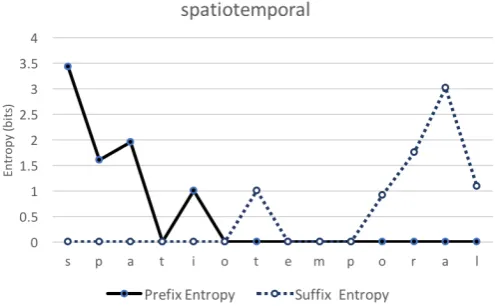
[image:3.595.309.557.63.216.2]The first step in creating the subword vocabulary is to generate a set of high-quality prefixes and suffixes. The method is based on the principle that a high-quality prefix or suffix can be mea-sured by a high level of unpredictability in transi-tion to longer substrings from the current substring state. For example, following the prefix “pr”, most prefixes transition to the character “e” with high probability forming a prefix “pre”. On the other
Figure 2: Entropy for candidate prefixes and suffixes in the word “spatiotemporal” from a DBLP titles dataset.
hand, transitioning from “pre” to a longer prefix is not as predictable as a large number of words contain the prefix “pre” followed by a variety of root words starting with different characters. We identify these high-unpredictability boundaries us-ing the concept of information entropy to score the predictability of each prefix or suffix bound-ary (Shannon,2001).
Letvbe a word consisting of|v|characters and
si be a prefix ofw ending at the ith character of
w. For each candidate prefix boundary ifor i ∈ [1. . .|v|], the information entropy of the prefix is computed as follows:
E(i) =−
C
X
j=1
P(si⊕cj|si)×log2P(si⊕cj|si)
(1) Where ⊕ denotes the binary concatenation of two subwords and the transitional probabilities be-tween a prefix and the prefix with the next charac-ter appended is estimated by:
P(si⊕cj|si) =
f(si⊕cj)
f(si) (2)
andf(si) denotes the frequency of a prefixsi in
the input vocabulary list. The entropy of suffixes can, without loss of generality, be similarly com-puted by reversing each word in the vocabulary and treating each suffix as a prefix.
we identify local maxima in entropy as candi-date boundaries for prefixes and suffixes. That is entropy of prefixes of one-character shorter and one-character longer should be lower than a can-didate prefix boundary. This is intuitive as un-der our principle of compositionality assumption, complex words are formed by concatenating sub-word structures. As such, given an incomplete subword, the next character can easily be pre-dicted, but given a complete subword, any number of new subwords can be concatenated to the com-pleted subword increasing the unpredictability and thus entropy. These high-entropy positions thus serve as a strong indicator of subword boundaries. As seen in Figure 2, for the word “spatiotempo-ral”, candidate prefixes and suffixes are found at boundaries exhibit a local maxima in entropy. For “spatiotemporal”, candidate prefixes are “spa” and “spati” while candidate suffixes include “al” and “temporal”.
Root Word Generation
While utilizing entropy-scoring, it is possible to detect subword structures that occur at the begin-ning or end of a word, often many words contain subword structure between prefixes and suffixes. For each prefix and suffix candidate identified in a word, it is possible to generate candidate root word by stemming the word and removing prefixes and suffixes. This creates a high-quality pool of root-words to be used in conjunction with prefixes and suffixes for segmenting the vocabulary.
Example 1 (Root Extraction) Removing prefixes and suffixes yields candidate root words.
[pre]+ authenticat +[ion]
The characters grouped together by[]are prefixes and suf-fixes. When removed, the remaining underlined character-sequence represent candidate root words.
As seen in Example1, when stripping the possi-ble prefixes and suffixes of a word, the remaining character sequence is considered a candidate root word. We apply some filtering conditions for each candidate root to test the viability as a shareable root. These include: 1) a minimum support of two within the vocabulary 2) the entropy boundary of each rootword must be non-zero. Additionally, for each word in the vocabulary, after stripping pre-fixes and sufpre-fixes, the candidate root words that meet the root word constraints are extracted and added to the subword vocabulary.
(a) Parsimonious
[image:4.595.305.510.58.153.2]Segmenta-tion (b) Candidate Subwords
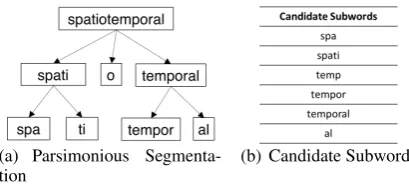
Figure 3: Segmentation of the word “spatiotemporal” using disjoint interval covering.
3.2 Parsimonious Subword Segmentation In the previous section, we introduce an unsuper-vised method of subword generation based on an entropy-based predictability metric for boundary detection. In this subsection we introduce an un-supervised segmentation algorithm that, utilizing a given subword vocabulary, segments a word into subwords. Our algorithm first identifies candidate subwords from the subword vocabulary within a word, then selects a subset of these candidate sub-words that best segment the word. The main in-sight behind the unsupervised segmentation is a per-word implementation of Occam’s Razor. That is, according to the preference for parsimonious hypotheses, we posit that each word is composed of thefewest number of subwords that maximally cover the word.
Example 2 (Parsimonious Segmentation) According to parsimonious segmentation, candidate segmentations are scored based on word coverage and number of subwords used for coverage.
Segmentation # Subwords Coverage
[spa] + tio+ [temporal] 2 11 [spati] + o + [temporal] 2 13 [spati] + o + [tempor] + [al] 3 13
. . .
[spa]+ tio [tempor] + [al] 3 11 The highlighted row displays the maximally parsimonious subword segmentation.
As seen in Figure3, for each word a set of sub-words present in the target word are identified and recursive segmentation is performed to separate the word into subwords. Example2demonstrates how the candidates are used to segment the target word under the parsimony criterion. Subsets of non-overlapping candidate subwords are used to segment and the most parsimonious segmentation is selected. Because there are aO(2|Av|)number
seg-mentation, we abstract out our parsimonious sub-word segmentation task into a general problem we dub Disjoint Interval Covering and demonstrate that this problem can be solved via dynamic pro-gramming in linear time.
We formalize the disjoint interval covering problem as follows:
Definition 2 (Disjoint Interval Covering)
Given an input N ∈ N and a set A of pairs (a, b) : a, b ∈ {1. . . N} × {1. . . N} and
a < b, find the smallest subset B ⊆ A such that |Sx|
x∈B
is maximized, |B| is minimized, and
∀x, y∈B :x6=y⇒x∩y=∅.
As seen in Definition 2, the input is a set of pairsA and a positive integerN. Within the
seg-mentation perspective, these refer to position in-dex boundary pairs for candidate subwords and the word length. Given these inputs, the objective is to select a minimum subset of disjoint subwords whose length maximize coverage of the word.
F(j) = max 0 min1
(0,0), j <1
F(j−1), j≥1
max0min1{F (i,j)∈B
(i−1)0+ (j−i+1), F(i−1)1+1}, j ≥1
(3)
We define a recurrence to the disjoint interval covering problem in Equation3. This recurrence posits that the segmentation that maximally covers the word is either the solution for the current word minus the ending character, or the max-covering, min-subword solution utilizing all subwords that have a right boundary index equal to the index of the end of the word. With proper memoiza-tion, it is evident that for a word of size|v|, there are |v| subproblems to solve. In addition,
be-cause each interval’s right boundary corresponds to the word size, each interval is iterated over a constant number of times. As such, for word v,
the total, memoized complexity of this segmenta-tion is O(v+|Av|) where Av indicates the
pre-segmentation subwords that are substrings of word
v.
Algorithm1presents the subword segmentation algorithm. The algorithm takes as input a word and a collection of intervals corresponding to in-dex boundaries of candidate subwords within the word. It then proceeds to select a set of intervals that maximally cover the word while utilizing the fewest number of intervals. Solutions to subprob-lems are memoized as to avoid repeated computa-tion.
3.3 Hierarchical Subword Segmentation In Subsection3.1we introduced the concept of uti-lizing high-entropy boundaries to create a subword vocabulary, and in Subsection 3.2 we introduce an algorithm for segmenting words into subwords based on the principle of parsimonious disjoint interval covering. In this subsection we
demon-Algorithm 1:DP Parsimonious Segmentation (DP)
Input: Wordv, Subword IntervalsAv
Output: Optimal segmentationS
n[0]←0;c[0]←0;p[0]←null;
1
forj:= 1toNvdo
2
num←n[j-1]; cov←c[j-1]; pair←p[j-1];
3
for(i, j)∈Avdo
4
cov0←c[i-1]+(j-i+1)
5
num0←n[i−1]+1
6
ifcov0>covthen
7
cov←cov0; num←num0;
8
pair←(i, j);
9
end
10
ifcov0=cov∧num0<numthen
11
num←num0; pair←(i, j)
12
end
13
end
14
n[j]←num; c[j]←cov; p[j]←pair;
15
end
16
return p
17
strate a high-level overview on how applying these two methods can be used to hierarchically segment words into multi-granular subwords.
algo-Algorithm 2:Segmentation Algorithm (SEGMENT)
Input: Wordv, Subword Vocabulary SW
Output: Set of subwords ofv
output← {v}
1
Av← {(i, j)forvi. . . vj∈SW and j-i6=|v|}
2
ifAv=∅then
3
returnoutput
4
end
5
segmented←DP(w,Av)
6
forsubword∈segmenteddo
7
output∪SEGMENT(subword, SW)
8
end
9
returnoutput
10
rithm terminates if the word cannot be further seg-mented. Otherwise, the word is segmented with the dynamic programming parsimonious segmen-tation algorithm. Each subword is then treated as a word and recursively segmented by the algorithm, and the collection of all subwords from segmenta-tion are outputted.
3.4 Word Embedding
To efficiently utilize our mined subwords to im-prove upon word embeddings, we modify the Fast-Text model for word embeddings to use our ex-tracted subwords (Bojanowski et al.,2016).
FastText utilizes the skip-gram objective with negative sampling yielding the following objective (for simplicity,`(x) = log(1 +exp(−x))):
W
X
x=1
h X
c∈Cx
`(s(wx, wc)) +
X
t∈Nx,c
`(−s(wx, t))
i
(4) The scoring function is then adapted to incorporate subword information as follows:
s(wx, wc) =
X
p∈wx
z|pvc (5)
which equates to a simple summation over sub-word embedding vectors.
4 Related Works
There have been many attempts at automatic sub-structure extraction from words. These techniques generally fall into one of three families: scoring based on segment predictability, identifying sub-words based on discovering similar and dissimilar word parts, and optimization methods.
In morphological analysis of relating phonemes to morphemes, segment predictability has been suggested as a potential identifying characteristic
for detecting subword structure. An early quanti-tative metric proposed was the number of differ-ent variations of subwords following a subword sequence whereby a high number of variations in-dicates a subword boundary (Harris,1970). While this work provided influential insight into useful metrics for subword-detection, the main objective was developing a scoring function for identifying candidate subwords, not segmentation. Following this line of work, many methods have extended the variation boundary approach to identify frequent morphemes from text corpora (Hafer and Weiss, 1974). A similar method adopts the metric to iden-tify frequent affixes (D´ejean, 1998). Both these methods seek to identify a small subset of high-quality, high frequency subwords from each cor-pus, prioritizing precision over recall. Other meth-ods propose slight variations to the predictabil-ity metric such as drops in transitional probabili-ties (Saffran et al.,1996).
Deviating from predictability-based methods, several subword detection methods have been pro-posed for detecting subwords by comparing words and identifying similar and dissimilar parts. One such method performs alignment from the left and right edge of words (Neuvel and Fulop, 2002) identifying common subwords. Another method adds words to a trie in correct order and reverse order to identify leading and trailing frequent sub-words (Schone and Jurafsky, 2001). Unfortu-nately both these methods can only identify prefix and suffix subwords, ignoring many internal sub-words. Unlike these methods, our subword seg-mentation is position insensitive and can identify subwords that occur in any position in a word.
(also called wordpieces) and has been successfully applied to a variety of NLP tasks (Wu et al.,2016; Schuster and Nakajima,2012). And similarly the byte-pair compression algorithm has been used to identify subwords for neural machine translation tasks (Sennrich et al.,2015). Both these methods construct a fixed-size subword vocabulary to con-struct each word as a sequence of subwords.
Many attempts have been proposed to address data-sparsity when learning distributed word rep-resentations. These methods posit that individ-ual words have semantically meaningful attributes that are shared among other words allowing for pa-rameter sharing between vocabulary words. One such method proposes a factored neural language model where words are represented as a set of features including subword information ( Alexan-drescu and Kirchhoff, 2006). Another method attempts to incorporate morphological informa-tion into the word embeddings by adding mor-phological similarity features into a neural net-work along with the context features (Cui et al., 2015). This method while similarly motivated, does not leverage subword structure but instead utilizes the embeddings of “morphologically sim-ilar” words in the embedding process. While this may seem appealing, identifying morpholog-ically similar words can be an expensive pro-cess as it requires a search over the entire vo-cabulary which may be prohibitive during on-the-fly computation out-of-word vocabulary. In ad-dition, this method may miss important morpho-logical cues such as negation subwords. When extended to use subword information, this model assumes subwords are already provided, this re-quires manual identification of subwords which can be an expensive human-powered task, es-pecially in domain-specific settings or new lan-guages (Qiu et al., 2014). Along similar moti-vation, a method has been proposed where given an input of morphologically annotated data, log-bilinear models are trained to jointly predict con-text words and its morphological tag (Cotterell and Sch¨utze, 2015). Despite displaying supe-rior embedding performance on German corpora, this method once again requires human-labeling for tagging words. This limits applicability to domain-specific corpora and new languages where labeled data is scarce or expensive to obtain. The method that is is closest to our approach is the extension of FastText enriched with subword
in-formation (Bojanowski et al.,2017). This method extends the standard skip-gram model but utilizes character-ngram subword embeddings for param-eter sharing. The major differences between Sub-wordMine and this method is that FastText em-bedding utilizes all character n-grams of user-specified lengths for subword embedding and per-forms a simple sum over their representations while SubwordMine performs unsupervised seg-mentation and applies a novel attention mecha-nism to combine the subword representations into word representations. Finally, utilizing subword information was shown to improve performance in machine translation (Sennrich et al.,2016).
Another spectrum of approaches address word sparsity through the use of characters as the base unit for embedding. Some approaches treat each word as a sequence of characters. and apply recur-rent neural networks to the task of language mod-eling (Bojanowski et al., 2015; Sutskever et al., 2011). Other related models apply convolutional neural networks directly on characters (Kim et al., 2016).
5 Experimental Results
We introduce the datasets used and methods for comparison. We then describe our evaluations for both subword extraction and for word embedding performance.
5.1 Datasets and methods for comparison Datasets
We use the following three datasets for evalua-tion purpose:
• DBLP Abstracts. Computer science ab-stracts containing 529K abab-stracts, 186K unique words, and 39M tokens.
• DBLP Title. Titles of computer science pa-pers published in 20 conferences containing 44K titles, 5.5K unique words, and 351K to-kens.
• PubMed Abstracts. Abstracts of research papers obtained from from PubMed Cen-tral containing 421K abstracts, 334K unique words and 5.8M tokens.
0 0.05 0.1 0.15 0.2 0.25 0.3 0.35 0.4 0.45
0 10000 20000 30000 40000 50000
Unigram Language Model Byte-Pair Encoding SubwordMine
(a) PubMed Abstracts 0 0.05 0.1 0.15 0.2 0.25 0.3 0.35 0.4
0 10000 20000 30000 40000 50000 Unigram Language Model Byte-Pair Encoding SubwordMine
[image:8.595.73.296.60.142.2](b) DBLP Abstracts
Figure 4: Accuracy in extracting Greek and Latin root words while varying subword vocabulary size.
[image:8.595.303.526.63.166.2]Model Extraction Accuracy PubMed DBLP Byte-Pair Encoding 0.2180 0.1881 Unigram LM 0.2535 0.1782 SubwordMine 0.3831 0.3363
Table 1: Accuracy in automatically extracting Greek and Latin root words.
described in the related works. For comparable methods for embedding we utilize FastText, a pro-posed variation of the Skip-Gram objective that utilize subword information, and modify FastText to use a variety of subword segmentations.
5.2 Subword Extraction Accuracy
To evaluate the effectiveness of our proposed unsupervised segmentation algorithm at extract-ing semantically meanextract-ingful subwords, we col-lect a list of approximately three-thousand English words and their Greek or Latin roots. For each segmentor trained on each dataset, we test to see if the segmentation correctly extracts the ground truth root.
As seen in Figure 4, the accuracy of extracting the root words varies with the vocabulary size for both BPE and the Unigram LM method. As seen in Table2, for the optimal vocabulary size for both methods, we see SubwordMine still outperforms both methods.
5.3 Perplexity
We investigate the benefits of using semantically meaningful subwords for parameter-sharing dur-ing when learndur-ing word embedddur-ings. For each set subword-enriched embedding vectors, we learn a language model and evaluate its quality by com-puting the language model perplexity on a DBLP title dataset. The model used for language mod-eling is an LSTM variant of a recurrent neural network with two hidden layers and 600 hidden
units per layer and regularized with dropout with
[image:8.595.71.290.190.267.2]Model Perplexity Untuned Tuned SkipGram 378.45 245.01 BPE-FastText 356.29 210.59 ULM-FastText 324.07 220.73 FastText 370.68 212.88 SubwordMine 320.65 207.84
Table 2: Test perplexity on the language modeling task for DBLP titles dataset. Evaluation is performed with fixed pre-trained embeddings, and embedding tuning.
0.2 probability. The RNNs are unrolled for 35
steps and the batch size is set to 20. Parameters
are learned using Adagrad with a gradient clip-ping of1. Each language model instance trained
on a training set partition consisting of80%of the
DBLP data and evaluation of perplexity was com-puted for each model on an independent test set consisting of 10% of the data after selecting the best performing iteration of the model on the re-maining validation set.
The results are summarized in Table 2. Be-cause our implementation performs minimal data cleaning and does not drop infrequent or out-of-vocabulary words, we expect the resulting per-plexity should be relatively higher than cleaned-datasets but directly comparable among the differ-ing methods (Bojanowski et al.,2016).
For the LSTM model, we observe that across all sub-word enriched embeddings perform bet-ter in language modeling over traditional skip-gram. Additionally, for both the untuned and tuned settings, SubwordMine segmentations im-prove test-perplexity over all other subword ex-traction method including original FastText’s enu-meration of all possible subwords. This is likely due to the sheer number of enumerated subwords and subword embeddings generated by FastText which may be more difficult to learn.
6 Conclusions
7 Future Works
Currently SubwordMine applies unsupervised segmentation. While this has be shown to yield high-quality segmentations, one natural extension is to incorporate human-labeling and perform su-pervised segmentation. Another area of work is to utilize subword structures in a variety of sequen-tial modeling tasks which could improve tasks such as entity typing, relation extraction, and ma-chine translation where substructures can provide valuable signals.
References
Andrei Alexandrescu and Katrin Kirchhoff. 2006. Fac-tored neural language models. In Proceedings of the Human Language Technology Conference of the NAACL, Companion Volume: Short Papers, pages 1–4. Association for Computational Linguistics. Piotr Bojanowski, Edouard Grave, Armand Joulin,
and Tomas Mikolov. 2016. Enriching word vec-tors with subword information. arXiv preprint arXiv:1607.04606.
Piotr Bojanowski, Edouard Grave, Armand Joulin, and Tomas Mikolov. 2017. Enriching word vectors with subword information. Transactions of the Associa-tion for ComputaAssocia-tional Linguistics, 5:135–146. Piotr Bojanowski, Armand Joulin, and Tomas Mikolov.
2015. Alternative structures for character-level rnns. Prof. ICLR.
Ronan Collobert and Jason Weston. 2008. A unified architecture for natural language processing: Deep neural networks with multitask learning. In Pro-ceedings of the 25th international conference on Machine learning, pages 160–167. ACM.
Ryan Cotterell and Hinrich Sch¨utze. 2015. Morpho-logical word-embeddings. In HLT-NAACL, pages 1287–1292.
Mathias Creutz and Krista Lagus. 2002. Unsupervised discovery of morphemes. In Proceedings of the ACL-02 workshop on Morphological and phonolog-ical learning-Volume 6, pages 21–30. Association for Computational Linguistics.
Qing Cui, Bin Gao, Jiang Bian, Siyu Qiu, Hanjun Dai, and Tie-Yan Liu. 2015. Knet: A general framework for learning word embedding using morphological knowledge. ACM Transactions on Information Sys-tems (TOIS), 34(1):4.
Herv´e D´ejean. 1998. Morphemes as necessary con-cept for structures discovery from untagged cor-pora. In Proceedings of the Joint Conferences on New Methods in Language Processing and Com-putational Natural Language Learning, pages 295– 298. Association for Computational Linguistics.
Jeffrey L Elman. 1990. Finding structure in time. Cog-nitive science, 14(2):179–211.
Margaret A Hafer and Stephen F Weiss. 1974. Word segmentation by letter successor varieties. Informa-tion storage and retrieval, 10(11-12):371–385.
Zellig S Harris. 1970. From phoneme to morpheme. In Papers in Structural and Transformational Linguis-tics, pages 32–67. Springer.
Zhiheng Huang, Wei Xu, and Kai Yu. 2015. Bidirec-tional lstm-crf models for sequence tagging. arXiv preprint arXiv:1508.01991.
Armand Joulin, Edouard Grave, and Piotr Bo-janowski Tomas Mikolov. 2017. Bag of tricks for efficient text classification. EACL 2017, page 427.
Yoon Kim, Yacine Jernite, David Sontag, and Alexan-der M Rush. 2016. Character-aware neural language models. InAAAI, pages 2741–2749.
Tomas Mikolov, Kai Chen, Greg Corrado, and Jef-frey Dean. 2013a. Efficient estimation of word representations in vector space. arXiv preprint arXiv:1301.3781.
Tomas Mikolov, Ilya Sutskever, Kai Chen, Greg S Cor-rado, and Jeff Dean. 2013b. Distributed representa-tions of words and phrases and their compositional-ity. InAdvances in neural information processing systems, pages 3111–3119.
Tomas Mikolov, Wen-tau Yih, and Geoffrey Zweig. 2013c. Linguistic regularities in continuous space word representations. In hlt-Naacl, volume 13, pages 746–751.
Sylvain Neuvel and Sean A Fulop. 2002. Unsuper-vised learning of morphology without morphemes. InProceedings of the ACL-02 workshop on Morpho-logical and phonoMorpho-logical learning-Volume 6, pages 31–40. Association for Computational Linguistics.
Siyu Qiu, Qing Cui, Jiang Bian, Bin Gao, and Tie-Yan Liu. 2014. Co-learning of word representations and morpheme representations. InCOLING, pages 141– 150.
David E Rumelhart, Geoffrey E Hinton, Ronald J Williams, et al. 1988. Learning representations by back-propagating errors. Cognitive modeling, 5(3):1.
Jenny R Saffran, Elissa L Newport, and Richard N Aslin. 1996. Word segmentation: The role of dis-tributional cues. Journal of memory and language, 35(4):606–621.
Patrick Schone and Daniel Jurafsky. 2001. Knowledge-free induction of inflectional mor-phologies. In Proceedings of the second meeting of the North American Chapter of the Association for Computational Linguistics on Language tech-nologies, pages 1–9. Association for Computational Linguistics.
Mike Schuster and Kaisuke Nakajima. 2012. Japanese and korean voice search. InAcoustics, Speech and Signal Processing (ICASSP), 2012 IEEE Interna-tional Conference on, pages 5149–5152. IEEE.
Rico Sennrich, Barry Haddow, and Alexandra Birch. 2015. Neural machine translation of rare words with subword units. arXiv preprint arXiv:1508.07909.
Rico Sennrich, Barry Haddow, and Alexandra Birch. 2016. Neural machine translation of rare words with subword units. Proc. ACL.
Claude E Shannon. 2001. A mathematical theory of communication. ACM SIGMOBILE Mobile Com-puting and Communications Review, 5(1):3–55.
Ilya Sutskever, James Martens, and Geoffrey E Hin-ton. 2011. Generating text with recurrent neural networks. InProceedings of the 28th International Conference on Machine Learning (ICML-11), pages 1017–1024.
Duyu Tang, Furu Wei, Nan Yang, Ming Zhou, Ting Liu, and Bing Qin. 2014. Learning sentiment-specific word embedding for twitter sentiment clas-sification. InACL (1), pages 1555–1565.
Yonghui Wu, Mike Schuster, Zhifeng Chen, Quoc V Le, Mohammad Norouzi, Wolfgang Macherey, Maxim Krikun, Yuan Cao, Qin Gao, Klaus Macherey, et al. 2016. Google’s neural ma-chine translation system: Bridging the gap between human and machine translation. arXiv preprint arXiv:1609.08144.