Proceedings of the Workshop on Figurative Language Processing, pages 81–90
Phrase-Level Metaphor Identification using Distributed Representations
of Word Meaning
Omnia Zayed, John P. McCrae, Paul Buitelaar Insight Centre for Data Analytics
Data Science Institute
National University of Ireland Galway IDA Business Park, Lower Dangan, Galway, Ireland [email protected]
Abstract
Metaphor is an essential element of human cognition which is often used to express ideas and emotions that might be difficult to express using literal language. Processing metaphoric language is a challenging task for a wide range of applications ranging from text sim-plification to psychotherapy. Despite the va-riety of approaches that are trying to process metaphor, there is still a need for better models that mimic the human cognition while exploit-ing fewer resources. In this paper, we present an approach based on distributional seman-tics to identify metaphors on the phrase-level. We investigated the use of different word em-beddings models to identify verb-noun pairs where the verb is used metaphorically. Several experiments are conducted to show the per-formance of the proposed approach on bench-mark datasets.
1 Introduction
Metaphor is a stylistic device used to enrich the language and represent abstract concepts using the properties of other concepts. It is considered as an analogy between a tenor (target concept) and a ve-hicle (source concept) by exploiting common sim-ilarities. The sense of a concept such as “harm-ful plant”can be transferred to another concept’s sense such as “poverty” by exploiting the prop-erties of the first concept. This then can be ex-pressed in our everyday language in terms of lin-guistic metaphoric expressions such as “...eradi-cate poverty”,“...root out the causes of poverty”, or “...the roots of poverty are...”1 (Lakoff and Johnson,1980;Veale et al.,2016). In this work, a word or an expression is a metaphor if it has at least one basic/literal sense (more concrete, phys-ical) and a secondary metaphoric sense (abstract, 1These examples could be found in the United Nations
Parallel Corpus (Ziemski et al.,2016).
non-physical) which resonates semantically with the basic sense (Steen et al.,2010;Hanks,2016).
Metaphor processing is one of the most chal-lenging problems for many natural language pro-cessing tasks such as machine translation, text summarization and text simplification. Moreover, metaphor processing could be helpful for wider applications such as political discourse analysis (Charteris-Black,2011) and psychotherapy ( Witz-tum et al.,1988;Guti´errez et al.,2017).
Understanding metaphors requires deeper lev-els of language processing that go beyond the sen-tence surface level. Among the main challenges of the computational modelling of metaphors is their pervasiveness in language which makes them oc-cur frequently in everyday language. Moreover, metaphors are often conventionalised to such an extent that they exhibit no defined lexical patterns or signals. Previous approaches relies on exten-sive lexical resources to identify metaphors and to capture their semantic features. Feature extraction from an annotated corpus is a challenge as well, not only due to the complexity of the task itself but also due to the lack of high quality annotated corpora. The process of creating such a corpus depends on the task definition as well as the tar-geted application and often requires significant ef-fort and time.
In this paper, we introduce a semi-supervised approach that makes use of distributed represen-tations of word meaning to capture metaphoricity. We focus on identifying verb-noun pairs where the verb is used metaphorically. We extract verb-noun grammar relations using the Stanford parser (Chen and Manning,2014). We then employ pre-trained word embeddings models to measure the seman-tic similarity between the candidate and a prede-fined seed set of metaphors. A similarity thresh-old, which was optimised on a sample dataset, is used to classify the given candidate. Evaluation
of the presented approach was carried out on var-ious test sets using different word embeddings al-gorithms. Additionally, a performance compari-son is carried out against the results of the state-of-the-art approach on benchmark datasets.
2 Related Work
One of the most common tasks of the computa-tional processing of metaphors is “metaphor iden-tification” which is concerned with recognising (detecting) the metaphoric expressions in the in-put text. Metaphor detection could be done on the word-level (token-level) or on the phrase-level by extracting grammatical relations.
In this paper, we are interested in phrase-level linguistic metaphor detection, focusing on verb-noun phrases (grammatical relations) by employ-ing semantic representation of word meanemploy-ing. Therefore, due to space limitation, we will discuss the most relevant research in this regard in this sec-tion. An extensive literature review is presented in (Zhou et al.,2007;Shutova,2015). Some recent work on metaphor detection has been looking into the utilization of semantic representations through word embeddings representations to design super-vised systems for metaphor detection (Rei et al.,
2017;Bulat et al.,2017;Shutova et al.,2016). Our approach also utilises such representations but in a semi-supervised manner to avoid the need for large training corpora.
Rei et al.(2017) introduced a neural network ar-chitecture to detect adjective-noun and verb-noun metaphoric constructions. Their system comprises three main components which are: word gat-ing, vector representation mapping and a weighted similarity function. The word gating is used to model the association between the properties of the source and target domains which is done via a non-linear transformation of the word embeddings vectors of the given candidate pair. The word em-beddings used in this step are obtained from a pre-trained model. Then, a vector representation map-ping is carried out to prepare a “new metaphor-specific” vector space using the original word em-beddings. Finally, a weighted cosine similarity function is used to automatically select the impor-tant vector dimensions for the metaphor detection task. The authors experimented with different pre-trained word representations, namely skip-gram model and an attribute-based model. Two different datasets, which were referred to as the TSV dataset
(Tsvetkov et al.,2013) and the MOH dataset ( Mo-hammad et al.,2016), were used to train the sys-tem and optimise its parameters as well as to as-sess its performance.
Bulat et al.(2017) is a recent approach that in-vestigated whether property-based semantic word representation can provide better concept gen-eralisation for detecting metaphors than dense linguistic representation. The authors proposed property-based vectors through cross-modal map-ping between dense linguistic representations and a property-norm semantic space. The authors built a count-based distributional vector and employed a skip-gram model trained on Wikipedia articles as their dense linguistic representations. The property-norm semantic space is obtained from the property-norm dataset (McRae et al., 2005). The TSV dataset is used to train and test a sup-port vector machine (SVM) classifier to classify adjective-noun pairs using the introduced cogni-tively salient properties as features.
An interesting approach, which employed multi-model embeddings of visual and linguistic features to detect metaphoricity in text, is intro-duced byShutova et al.(2016). The proposed ap-proach obtained linguistic word embeddings using a log-linear skip-gram model trained on Wikipedia text and obtained visual embeddings using a deep convolutional neural network trained on image data. This was done for both the words and phrases of adjective-noun and verb-noun pairs in-dividually. Then, the cosine similarity function has been employed to measure the distance be-tween the phrase vector and the corresponding vectors of its constituent words. Metaphor clas-sification is done based on an optimised threshold output of the cosine similarity function. The au-thors used the TSV and the MOH datasets to train and test their system in addition to optimising the classification thresholds.
Modelling metaphor in a distributional seman-tic space through linear transformation to improve vector representation has been investigated by
Guti´errez et al.(2016). The authors introduced a compositional distributional semantic framework to identify adjective-noun metaphoric expressions. A variety of lexical and semantic features in-cluding lexical abstractness and concreteness, im-ageability, named entities, part-of-speech tags, and the word’s supersenses2using WordNet (
baum, 1998) have been employed to develop su-pervised systems to detect metaphors (K¨oper and Schulte im Walde, 2017; Tsvetkov et al., 2013;
Hovy et al.,2013;Turney et al.,2011).
Shutova et al.(2010) was among the earliest ap-proaches to computational modelling of metaphor, avoiding task-specific hand-crafted knowledge and huge annotated resources. They introduced a semi-supervised approach to identify verb-noun metaphors using corpus-driven distributional clus-tering. Their strategy is based on clustering ab-stract nouns based on their contextual features in order to capture the metaphorical senses associ-ated with the source concept. The system exploits a small set of metaphoric expressions as a seed to detect metaphors in a semi-supervised manner. In a follow-up work,Shutova and Sun(2013) inves-tigated the use of hierarchical graph factorization clustering to derive a network of concepts in order to learn metaphorical associations in an unsuper-vised way which then was used as features to iden-tify metaphors. We consider the work introduced byShutova et al.(2010) as a baseline for our pro-posed approach, thus we are going to explain its reimplementation details in subsection3.3.
Birke and Sarkar (2006) introduced TroFi, which is considered the first statistical system to identify the metaphorical senses of verbs in a semi-supervised way. The authors adapted a sta-tistical similarity-based word sense disambigua-tion approach to cluster literal and non-literal senses. A predefined set of seed sentences is utilised to compute the similarity between a given sentence and the seed sentences.
3 Methodology
The idea behind our approach is based on find-ing synonyms and near-synonyms of metaphors. Our approach employs vector representation and semantic similarity to classify verb-noun pairs ex-tracted from a sentence using a parser as poten-tial candidates for metaphoric classification. A candidate is classified as a metaphor or not by measuring its semantic similarity to a predefined small seed set of metaphors which acts as our ex-isting known metaphors sample. Metaphoric clas-sification is performed based on a previously cal-culated similarity threshold value on a develop-ment dataset. The following subsections explain the hypothesis behind this work and our proposed approach in addition to the reimplementation of
the state-of-the-art semi-supervised system used as our baseline system.
3.1 Hypothesis
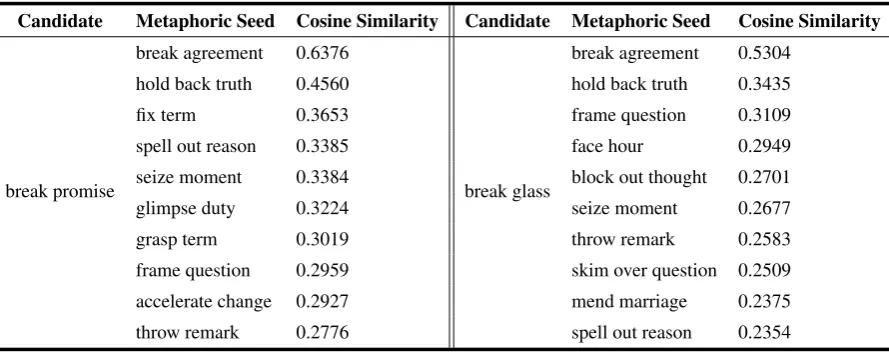
Our hypothesis in this work is that a given candi-date should have common characteristics and se-mantic features with some positive examples of metaphors. However, simply calculating the simi-larity between a given verb-noun candidate and a metaphoric seed is not enough due to the effect of each of the verb and the noun on the overall simi-larity score. For example, consider a metaphoric seed such as “break agreement” and two given candidates such as “break promise” and “break glass”. The semantic similarities between the word embeddings vectors of the seed and the two candidates measured by the cosine similarity func-tion are 0.5304 and 0.6376, respectively, using a pre-trained Word2Vec (Mikolov et al.,2013) word embedding model on the Google News dataset. This indicates that both candidates are similar to the seed and there is not enough information to tell which one should be classified as a metaphor. Ta-ble1shows the similarity values of the two candi-dates and the most similar metaphoric seeds from the predefined seed set. We decided to look into the individual words of the candidate considering the fact that semantically similar or related words will be placed near each other in the embeddings space while unrelated words will be far apart. Therefore, we expect that the noun“promise”will be in the neighbourhood of“agreement”in the se-mantic space, while“glass”will not. So if both candidates share similar verbs, classification could be done based on the similarity of the nouns; in that case, “break promise” can be classified as metaphor due to the vicinity of its noun to the noun of the metaphoric seed while“break glass” will not. Since using one positive (metaphoric) ex-ample is not enough for precise classification, we used a small set of verb-noun pairs, hereafter re-ferred to as the seed set, where the verb is used metaphorically. The specification of the seed set will be explained in detail in section4.
3.2 Approach
We start with the seed set of metaphoric verb-noun pairs asS = {(V, N)}. Given a target verb-noun
Candidate Metaphoric Seed Cosine Similarity Candidate Metaphoric Seed Cosine Similarity
break promise
break agreement 0.6376
break glass
break agreement 0.5304 hold back truth 0.4560 hold back truth 0.3435
fix term 0.3653 frame question 0.3109
spell out reason 0.3385 face hour 0.2949
seize moment 0.3384 block out thought 0.2701
glimpse duty 0.3224 seize moment 0.2677
grasp term 0.3019 throw remark 0.2583
[image:4.595.77.522.64.240.2]frame question 0.2959 skim over question 0.2509 accelerate change 0.2927 mend marriage 0.2375 throw remark 0.2776 spell out reason 0.2354
Table 1: The cosine similarity between the candidates “break promise” and “break glass” and the top 10 metaphoric seeds in the seed set using a pre-trained Word2Vec word embedding model on Google News dataset.
Dts =d(vt, vs) ∀vs ∈S
This gives a list of verbs ranked according to the distance to the verb of the candidate; we then se-lect the topnnearest verbs and we get the nouns
associated with them in the seed set as follows:
Yvt =topn{ns: (vs, ns)∈S}byDts
Finally, the average of the distances between these nouns and the target noun in the candidate phrase is calculated. If this average is less than a thresh-oldδ then the candidate phrase will be classified
as a metaphoric expression as follows:
1
|Yvt| X
ns∈Yvt
[d(nt, ns)]≤δ
Table 2 shows the cosine distance between the verbs and the nouns of the candidates “break promise”and“break glass”verses the verbs and the nouns of the top 10 metaphoric seeds from the seed set using a pre-trained Word2Vec word em-bedding model on the Google News dataset; those 10 seeds have the most similar (nearest in terms of distance) verbs to the candidate verb.
3.3 Baseline
We consider the system introduced by Shutova et al.(2010) as our baseline system. In this sub-section, we are going to explain in detail the reim-plementation of this approach and the related find-ings. The system consists of four main compo-nents which are: a seed set, a clustering com-ponent, a candidate extraction comcom-ponent, and a filtering component. The seed set is obtained from the British National Corpus (BNC) (Burnard,
2009) and consists of 62 metaphoric verb-noun pairs (more details are given in section4). Spectral clustering (Meila and Shi, 2001) is used to clus-ter the abstract concepts (nouns) and the concrete concepts (verbs) then an association (mapping) is drawn between the two clusters using the seed set. The candidate extraction component employs the Robust Accurate Statistical Parsing (RASP) parser (Briscoe et al.,2006) to extract verb-subject and verb-direct object grammar relations. After that, the linked clusters (through the seed set) is used to identify potential metaphoric candidates. The filtering component is finally used to filter out these candidates based on a selectional pref-erences strength (SPS) measure (Resnik, 1993). The verbs exhibiting weak selectional preferences are considered to have lower metaphorical poten-tial. An SPS threshold was set experimentally to be 1.32, thus, the candidates which verbs have an SPS value below this threshold are discarded.
Cand. V Seed’s V CosDist Cand. N Seed’s N CosDist Cand. N Seed’s N CosDist
break
break 0
promise
agreement 0.7479
glass
agreement 1.0093
hold back 0.6591 truth 0.7736 truth 0.8872
mend 0.6935 marriage 0.9381 marriage 0.9419
fix 0.6952 term 0.8085 term 1.0252
catch 0.6966 contagion 1.0126 contagion 0.9089
throw 0.7035 remark 0.8513 remark 0.9559
seize 0.7201 moment 0.8556 moment 0.9510
impose 0.7350 decision 0.8207 control 0.9506
impose 0.7350 control 0.9107 decision 0.9987
frame 0.7371 question 0.8462 question 0.9424
Table 2: The cosine distance between the verbs and nouns of the candidates “break promise” and “break glass” verses the verbs and the nouns of the top 10 metaphoric seeds in the seed set using a pre-trained Word2Vec word embedding model on Google News dataset.
This is one of the limitations of this system; a can-didate is either in the clusters or not. And if the candidate’s noun appeared in a noun cluster but this cluster was not mapped to the cluster where the verb occurs the candidate will be discarded.
4 System Architecture
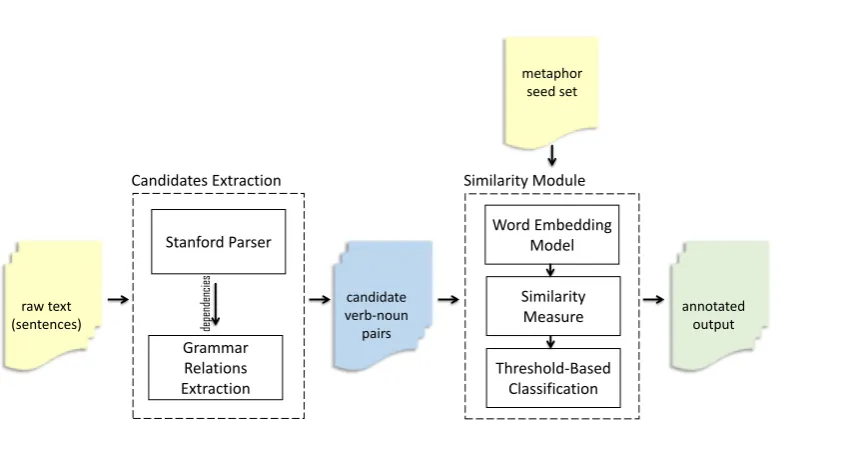
As described in Figure1 below, our system con-sists of three main components: a parser, a seed set of metaphoric expressions and a pre-trained word embedding model.
Parser: Since our aim is to identify metaphors on the phrase-level, the Stanford parser is used to extract the grammar relations in a given sen-tence. We used the recurrent neural network (RNN) parser in the Stanford CoreNLP toolkit (Manning et al., 2014) to extract dependencies focusing on verb-subject and verb-direct object grammar relations.
Seed Set: We used the seed set of Shutova et al. (2010) to act as our set of existing known metaphoric expressions (positive examples). The seed set consists of 62 verb-subject and verb-direct object phrases where the verb is used metaphori-cally3. These seeds are extracted originally from a
subset of the BNC corpus which contains 761 sen-tences. These sentences were annotated for matical relations to extract the specified gram-mar relations which are then filtered and manu-ally annotated for metaphoricity. Examples of the 3The seed set provided to us byShutova et al.(2010)
con-sists of 52 pairs out of which 11 are verb-subjects and 41 are verb-direct object
metaphors in the seed set are “mend marriage, break agreement, cast doubt, and stir excitement”. Word Embedding Model: This work utilises distributional vector representation of word mean-ing to calculate semantic similarity between a can-didate and a seed set. Word2Vec and GloVe ( Pen-nington et al.,2014) are two widely used word em-beddings algorithms to construct emem-beddings vec-tors based on the distributional hypothesis (Firth,
1957) but using different machine learning tech-niques. In this work, we investigated the effect of using different pre-trained models and similarity measures as shown in detail in the next section.
5 Experimental Settings
In this section, we give an overview of the exper-imental settings of our proposed approach and the test sets that are used to assess the performance of the methodology described above.
5.1 Models and Parameters
The utilised similarity measures, word embed-dings models, and system’s parameters are defined as follows:
Similarity Measures: We examined two simi-larity measures as follows:
– Cosine Distance Metric: The cosine similar-ity function measures the cosine of the angle between two vectors. Given the vectorsuand v, the cosine distance can be defined as:
metaphor seed set
Word Embedding Model
Similarity Measure
Threshold-Based Classification Similarity Module
annotated output candidate
verb-noun pairs
Stanford Parser
Grammar Relations Extraction Candidates Extraction
raw text
(sentences) dependen
[image:6.595.105.527.77.310.2]cies
Figure 1: The Overall System Architecture.
– Word Mover’s Distance (WMD) (Kusner et al., 2015): could be defined as the mini-mum travelling distance from one word em-beddings vector to the other.
Embeddings Models: We experimented with two different pre-trained vector representations of word embeddings which are:
– Word2Vec Google News4: The model is
trained on about 100 billion words from the Google News dataset and contains 300-dimensional vectors for 3 million words us-ing the approach described in (Mikolov et al.,
2013). The model is based on the skip-gram neural network architecture which em-ploys the negative sampling training algo-rithm and sub-sampling frequent words using a window-size of 10.
– GloVe Common Crawl5: We used a
pre-trained model on the Common Crawl dataset containing 840 billion tokens of web data (about 2 million words). The vectors are 300-dimensional using 100 training iteration. For simplicity, we used a single vector representa-tion for each word ignoring multi-word
combina-4https://code.google.com/archive/p/
word2vec/
5https://nlp.stanford.edu/projects/
glove/
tions such as phrasal verbs, examples of which in-clude e.g. “hold back, flip through”; we are plan-ing to address this issue in the future.
System’s Parameters: We performed experi-ments on a development set to select the values of the parameters topn andδ mentioned in subsec-tion 3.2. The best value obtained fornis found
to be top 10 nearest verbs. The suitable distance average threshold δ is found to be 0.80 for the GloVe Creative-Commons-840 model and 0.85 for the Word2Vec Google-News model. These values give a good trade-off between false positives and false negatives.
5.2 Test Sets
Two different test sets are used to evaluate our ap-proach as follows:
VUA Test Set: We use a subset of the training verbs dataset from the VU Amsterdam Metaphor Corpus (VUA) (Steen et al., 2010) provided by the NAACL 2018 Metaphor Shared Task6. The
original VUA corpus is a subset of the BNC Baby corpus consists of 117 texts covering various gen-res which are academic, conversation, fiction, and news. Although the dataset is annotated on the token-level, its availability and the fact that it is
6https://github.com/
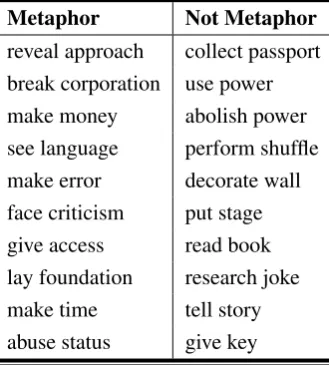
already annotated encouraged us to use it for as-sessing our approach. The verbs dataset consists of around 17,240 annotated verbs; we retrieved the original sentences of these verbs from the VUA corpus, which yielded around 8,000 sentences. We then parsed these sentences using the Stanford Parser and extracted around 5,000 verb-direct ob-ject relations. Arbitrary 300 verb-noun pairs (160 positive and 145 negative examples) are selected to be our test set where the verb is used metaphor-ically or literally. Table 3 shows some examples from this test set.
MOH dataset:Shutova et al.(2016) introduced a manually annotated dataset of verb-subject and verb-object pairs. The dataset has been referred to as MOH as it was originally obtained from
Mohammad et al. (2016) who annotated differ-ent senses of verbs in WordNet for metaphoricity. Verbs were selected if they have more than three senses and less than ten senses. Then the exam-ple sentences from WordNet for each verb were extracted and annotated by 10 annotators using crowd-sourcing. In a next step, the verb-subject and verb-direct object grammar relations were ex-tracted out of the original dataset. The final dataset consists of 647 pairs out of which 316 instances are metaphorical and 331 instances are literal.
Metaphor Not Metaphor
[image:7.595.99.264.443.626.2]reveal approach collect passport break corporation use power make money abolish power see language perform shuffle make error decorate wall face criticism put stage give access read book lay foundation research joke make time tell story abuse status give key
Table 3: Examples from the VUA test set.
6 Evaluation
In this section, we evaluate our approach using different test sets, pre-trained word embeddings models and similarity measures. Additionally, we compare the performance of our approach against the baseline system explained in subsection 3.3. We used four standard evaluation metrics, namely
precision, recall, F-score and accuracy.
6.1 Results
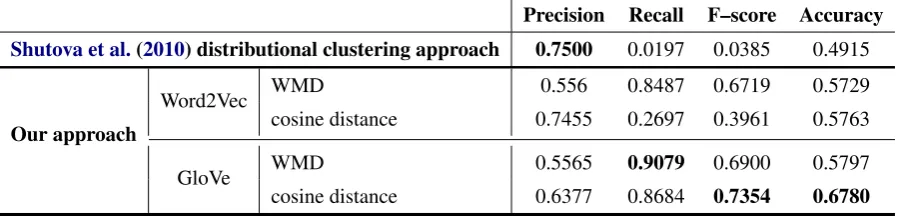
We applied our system to the three test sets intro-duced above and compared it to the defined base-line system. Table 4shows the results of the ex-periment carried out on the VUA test set. It also shows the results obtained from the baseline sys-tem. Table5shows the performance of our system on the whole MOH dataset.
6.2 Discussion and Analysis
It can be seen from the results above that our ap-proach performs better using GloVe as the pre-trained word embedding model and using cosine distance as the similarity metric. It is also noted that the system suffers from a low recall when us-ing the Word2Vec model with the cosine distance function. This might be due to the limited cover-age of the seed set where the top 10 most simi-lar metaphors are not enough to detect new candi-dates of metaphors. We manually examined our system’s output on the MOH dataset. Our sys-tem was able to correctly detect metaphoric ex-pressions such as“absorb knowledge, attack can-cer, blur distinction, buy story, capture essence, swallow word, visit illness, wear smile” as well as literal ones such as “attack village, build ar-chitect, leak container, steam ship, suck poison”. Some of the false positives, where our system de-tection was metaphor while the gold label was not, include“ascend path, blur vision, buy love, com-municate anxiety, jam mechanism, lighten room, line book, push crowd”which could be regarded as metaphors depending on the context.
Precision Recall F–score Accuracy
Shutova et al.(2010) distributional clustering approach 0.7500 0.0197 0.0385 0.4915
Our approach
Word2Vec WMD 0.556 0.8487 0.6719 0.5729
cosine distance 0.7455 0.2697 0.3961 0.5763
GloVe WMD 0.5565 0.9079 0.6900 0.5797
cosine distance 0.6377 0.8684 0.7354 0.6780
Table 4: Evaluation on the VUA test set of 300 verb-noun pairs and a performance comparison to the baseline system.
Precision Recall F–score Accuracy
Shutova et al.(2010) distributional clustering approach 1.0000 0.0095 0.0189 0.5148
Our approach
Word2Vec WMD 0.5321 0.8413 0.6519 0.5599
cosine distance 0.8727 0.1524 0.2595 0.5739
GloVe WMD 0.5243 0.8571 0.6506 0.5490
cosine distance 0.6317 0.7460 0.6841 0.6625
Table 5: Evaluation on the MOH dataset of 647 verb-noun pairs and a performance comparison to the baseline system.
definition of metaphor itself between Lakoff and Johnson(1980) and Steen et al.(2010), which in turn emphasises that the metaphorical sense does not depend solely on the properties of individual words (Guti´errez et al.,2016).
The results also indicate that the baseline sys-tem has a very low recall on the introduced test sets. The reason behind that, as mentioned in sub-section3.3, is that it utilises clusters developed us-ing the BNC corpus, which likely limit the cover-age of the system adding into account the limita-tion of the small seed set (as in our approach). For example, out of the 300 pairs in the VUA test set only 7 candidates were included in the final clas-sification as the rest of the words were not seen before in the clusters. Similarly, out of the 647 pairs in the MOH dataset only 4 were able to be recognised as candidates.
Our system’s performance could be improved by increasing the size of the seed set and optimis-ing the system’s parameters accordoptimis-ingly (which we are planing to address in the future). In order to investigate this point, we did an additional experi-ment using 10-fold cross-validation of the MOH dataset in which we included 10 different splits from the dataset as our seed set of metaphors. The best results in terms of precision, recall,
F-score, and accuracy are 0.5945, 0.756, 0.6657, and 0.6290, respectively. These results are ob-tained using the GloVe word embedding model pre-trained on the Common Crawl dataset and the cosine distance as similarity function with the same parameters values. In this experiment, we noticed that the values of n and the threshold δ
should be adapted according to the increase in the number of seeds.
We did not to compare our results to Shutova et al. (2016) or Rei et al. (2017) as these sys-tems are not directly comparable to ours.Shutova et al. (2016) is using a different test split from the MOH dataset to evaluate their system. More-over, both works proposed fully supervised ap-proaches in which they utilise negative (literal) examples as well as positive (metaphoric) exam-ples to train their systems, whereas our approach is semi-supervised (similar to (Shutova et al.,2010)) which uses only the positive (metaphoric) exam-ples. Therefore, carrying out a performance com-parison will be imperfect.
7 Conclusion and Future Work
[image:8.595.75.526.67.175.2]embeddings models have been investigated to identify phrase-level metaphors focusing on verb-noun expressions. The system utilises a prede-fined seed set of metaphoric expressions to detect unseen metaphoric expression(s) in a given sen-tence. As discussed, in contrast to other state-of-the-art approaches, our proposed approach em-ploys fewer lexical resources and does not require annotated datasets or highly-engineered features. This gives it a flexibility to be easily adapted to new languages or text types. We have performed several experiments to assess the performance of our approach on benchmark datasets. As part of our future work, we are planning to investigate the effect of increasing the number of seeds on the system’s coverage and to extend this approach to detect other metaphoric syntactic constructions taking into account multi-word expressions such as phrasal verbs.
Acknowledgments
This work was supported by Science Foundation Ireland under Grant Number SFI/12/RC/2289 (In-sight).
References
Julia Birke and Anoop Sarkar. 2006. A clustering ap-proach for nearly unsupervised recognition of non-literal language. InIn Proceedings of the 11th Con-ference of the European Chapter of the Association for Computational Linguistics, EACL ’06, pages 329–336, Trento, Italy.
Ted Briscoe, John Carroll, and Rebecca Watson. 2006. The second release of the RASP system. In
Proceedings of the Joint Conference of the Inter-national Committee on Computational Linguistics and the Association for Computational Linguistics, COLING-ACL ’06, pages 77–80, Stroudsburg, PA, USA. Association for Computational Linguistics.
Luana Bulat, Stephen Clark, and Ekaterina Shutova. 2017. Modelling metaphor with attribute-based se-mantics. InProceedings of the 15th Conference of the European Chapter of the Association for Com-putational Linguistics, pages 523–528, Valencia, Spain. Association for Computational Linguistics.
Lou Burnard. 2009. About the British National Corpus. http://www.natcorp.ox.ac.uk/
corpus/index.xml.
Jonathan Charteris-Black. 2011. Metaphor in Political Discourse. In Politicians and Rhetoric: The Per-suasive Power of Metaphor, pages 28–51. Palgrave Macmillan UK, London.
Danqi Chen and Christopher Manning. 2014. A fast and accurate dependency parser using neural net-works. InProceedings of the 2014 Conference on Empirical Methods in Natural Language Process-ing, EMNLP ’14, pages 740–750, Doha, Qatar. As-sociation for Computational Linguistics.
Christiane Fellbaum. 1998. WordNet: An Electronic Lexical Database. MIT Press.
John R. Firth. 1957. A synopsis of linguistic theory 1930-55.Studies in Linguistic Analysis (special vol-ume of the Philological Society), 1952-59:1–32.
E. Dar´ıo Guti´errez, Guillermo A. Cecchi, Cheryl Cor-coran, and Philip Corlett. 2017. Using automated metaphor identification to aid in detection and pre-diction of first-episode schizophrenia. In Proceed-ings of the 2017 Conference on Empirical Meth-ods in Natural Language Processing, EMNLP ’17, pages 2923–2930, Copenhagen, Denmark.
E. Dar´ıo Guti´errez, Ekaterina Shutova, Tyler Marghetis, and Benjamin Bergen. 2016. Lit-eral and metaphorical senses in compositional distributional semantic models. In Proceedings of the 54th Annual Meeting of the Association for Computational Linguistics, pages 183–193, Berlin, Germany. Association for Computational Linguistics.
Patrick Hanks. 2016. Three kinds of semantic reso-nance. InProceedings of the 17th EURALEX Inter-national Congress, pages 37–48, Tbilisi, Georgia. Dirk Hovy, Shashank Srivastava, Sujay Kumar Jauhar,
Mrinmaya Sachan, Kartik Goyal, Huiying Li, Whit-ney Sanders, and Eduard Hovy. 2013. Identify-ing metaphorical word use with tree kernels. In
Proceedings of the First Workshop on Metaphor in NLP, pages 52–56, Atlanta, Georgia. Association for Computational Linguistics.
Maximilian K¨oper and Sabine Schulte im Walde. 2017. Improving verb metaphor detection by propagating abstractness to words, phrases and individual senses. InProceedings of the 1st Workshop on Sense, Con-cept and Entity Representations and their Applica-tions, SENSE ’18, pages 24–30, Valencia, Spain. Matt J. Kusner, Yu Sun, Nicholas I. Kolkin, and
Kil-ian Q. Weinberger. 2015. From word embeddings to document distances. InProceedings of the 32nd International Conference on Machine Learning, vol-ume 37 ofICML’15, pages 957–966, Lille, France. George Lakoff and Mark Johnson. 1980. Metaphors
we Live by. University of Chicago Press, Chicago, USA.
55–60, Baltimore, Maryland, USA. Association for Computational Linguistics.
Ken McRae, George S. Cree, Mark S. Seidenberg, and Chris McNorgan. 2005. Semantic feature produc-tion norms for a large set of living and nonliving things. Behavior Research Methods, 37(4):547– 559.
Marina Meila and Jianbo Shi. 2001. A random walks view of spectral segmentation. InProceedings of the 8th International Workshop on Artificial Intelligence and Statistics, AISTATS 2001, Florida, USA. Tomas Mikolov, Ilya Sutskever, Kai Chen, Greg
Cor-rado, and Jeffrey Dean. 2013. Distributed represen-tations of words and phrases and their composition-ality. InProceedings of the 26th International Conference on Neural Information Processing Systems -Volume 2, NIPS’13, pages 3111–3119, Lake Tahoe, Nevada, USA. Curran Associates Inc.
Saif M. Mohammad, Ekaterina Shutova, and Peter D. Turney. 2016. Metaphor as a medium for emotion: An empirical study. InProceedings of the 5th Joint Conference on Lexical and Computational Seman-tics, *Sem ’16, pages 23–33, Berlin, Germany. Jeffrey Pennington, Richard Socher, and
Christo-pher D. Manning. 2014. GloVe: Global vectors for word representation. In Proceedings of the 2014 Conference on Empirical Methods in Natural Lan-guage Processing, EMNLP ’14, pages 1532–1543, Doha, Qatar. Association for Computational Lin-guistics.
Marek Rei, Luana Bulat, Douwe Kiela, and Ekaterina Shutova. 2017. Grasping the finer point: A super-vised similarity network for metaphor detection. In
Proceedings of the 2017 Conference on Empirical Methods in Natural Language Processing, EMNLP ’17, pages 1537–1546, Copenhagen, Denmark. As-sociation for Computational Linguistics.
Philip Stuart Resnik. 1993. Selection and Information: A Class-based Approach to Lexical Relationships. Ph.D. thesis, University of Pennsylvania, Philadel-phia, PA, USA.
Karin Kipper Schuler. 2006. VerbNet: A Broad-Coverage, Comprehensive Verb Lexicon. Ph.D. the-sis, University of Pennsylvania, Philadelphia, PA, USA.
Ekaterina Shutova. 2015. Design and evaluation of metaphor processing systems. Computational Lin-guistics, 41(4):579–623.
Ekaterina Shutova, Douwe Kiela, and Jean Maillard. 2016. Black holes and white rabbits: Metaphor identification with visual features. InProceedings of the 15th Annual Conference of the North American Chapter of the Association for Computational Lin-guistics: Human Language Technologies, NAACL-HLT ’16, pages 160–170, San Diego, California, USA. The Association for Computational Linguis-tics.
Ekaterina Shutova and Lin Sun. 2013. Unsupervised metaphor identification using hierarchical graph fac-torization clustering. In Proceedings of the 2013 Annual Conference of the North American Chap-ter of the Association for Computational Linguistics: Human Language Technologies, NAACL-HLT ’13, pages 978–988, Atlanta, Georgia. The Association for Computational Linguistics.
Ekaterina Shutova, Lin Sun, and Anna Korhonen. 2010. Metaphor identification using verb and noun clustering. InProceedings of the 23rd International Conference on Computational Linguistics, COLING ’10, pages 1002–1010, Beijing, China. Association for Computational Linguistics.
Gerard J. Steen, Aletta G. Dorst, J. Berenike Herrmann, Anna Kaal, Tina Krennmayr, and Trijntje Pasma. 2010. A Method for Linguistic Metaphor Identifi-cation: From MIP to MIPVU. Converging evidence in language and communication research. John Ben-jamins Publishing Company.
Yulia Tsvetkov, Elena Mukomel, and Anatole Gersh-man. 2013. Cross-lingual metaphor detection us-ing common semantic features. InProceedings of the First Workshop on Metaphor in NLP, pages 45– 51, Atlanta, Georgia. Association for Computational Linguistics.
Peter D. Turney, Yair Neuman, Dan Assaf, and Yohai Cohen. 2011. Literal and metaphorical sense iden-tification through concrete and abstract context. In
Proceedings of the 2011 Conference on Empirical Methods in Natural Language Processing, EMNLP ’11, pages 680–690, Edinburgh, Scotland, UK. As-sociation for Computational Linguistics.
Tony Veale, Ekaterina Shutova, and Beata Beigman Klebanov. 2016. Metaphor: A Computational Per-spective. Synthesis Lectures on Human Language Technologies, 9(1):1–160.
Eliezer Witztum, Onno van der Hart, and Barbara Friedman. 1988. The use of metaphors in psy-chotherapy. Journal of Contemporary Psychother-apy, 18(4):270–290.
Chang-Le Zhou, Yun Yang, and Xiao-Xi Huang. 2007. Computational mechanisms for metaphor in lan-guages: A survey. Journal of Computer Science and Technology, 22(2):308–319.