Proceedings of the Fifth Workshop on Computational Linguistics and Clinical Psychology: From Keyboard to Clinic, pages 113–118
A Psychologically Informed Approach to CLPsych Shared Task 2018
Almog Simchon and Michael Gilead
Department of Psychology
Ben-Gurion University of the Negev, Israel
[email protected] [email protected]
Abstract
This paper describes our approach to the CLPsych 2018 Shared Task, in which we at-tempted to predict cross-sectional psycholog-ical health at age 11 and future psychologi-cal distress based on childhood essays. We attempted several modeling approaches and observed best cross-validated prediction accu-racy with relatively simple models based on psychological theory. The models provided reasonable predictions in most outcomes. No-tably, our model was especially successful in predicting out-of-sample psychological dis-tress (across people and across time) at age 50. 1 Introduction
In recent years, technological advances have made it possible to extract psychological features from textual input in an automated manner (Boyd and Pennebaker, 2015; Pennebaker et al., 2003; Schwartz and Ungar,2015).
In a recent review,Guntuku et al.(2017b) show promising evidence that depression and mental ill-ness can be predicted from text provided in online environments at an encouraging range of moder-ate to high accuracy. Attempts for predicting other psychopathologies such as ADHD (Guntuku et al., 2017a), schizophrenia Mitchell et al. (2015) and suicidal tendencies (Robinson et al., 2016; Won et al.,2013) have also shown promise.
In the spirit of these cutting-edge developments, the Computational Linguistics and Clinical Psy-chology Workshop (CLPysch) have brought to-gether linguists, psychologists and computer sci-entists to form a place for a multidisciplinary re-search, utilizing computational linguistics to the study of mental health. In former years, CLPysch launched a Shared Task, bringing together groups of researchers to tackle a single problem ex-pressed in one dataset. Past events included de-pression and PTSD detection (Coppersmith et al.,
2015) and crisis classification from online mes-sage boards (Milne et al.,2016;Milne,2017). This year, the shared task focused on longitudinal data taken from the National Child Development Study (NCDS; UCL, 2018). Participating teams in the shared task were provided with essays of 11-year-old participants alongside with their correspond-ing gender and Socio-Economic Status (SES) and were requested to predict: (a) cross-sectional psy-chological health at age 11 measured by the to-tal score in the Bristol Social Adjustment Guides (BSAG; Stott, 1963) and two sub-measures of depression and anxiety; (b) Future psychological health at ages 23, 33, 42 and 50 as measured by the participants’ score of psychological distress in the Malaise Inventory (Rutter et al.,1970).
2 Methods
This study has undergone ethics review by the BGU Department of Psychology Ethics Commit-tee and has been deemed approved.
Participants in the Shared Task were given a training set consisted of 9,217 observations, with some missing data (Table1).
Task A Task B
total depression anxiety age 23 age 33 age 42 age 50 9,146 9,146 9,146 7,060 6,483 6,402 Not provided
Table 1: Final number of observations in the training set for each dependent variable.
2.1 Features
Spelling Errors: Since the input text belonged to 11-year-olds, data cleansing was the first step. We used spelling (Ooms and Hester, 2017) li-brary for R to detect spelling errors, and replaced all error with the first suggested correction by thehunspelllibrary (Ooms, 2017). We counted spelling errors and computed spelling-error ratio
as a feature. All other features were based on the corrected text. The intuition behind using this as a measure of psychological well-being stems from a hypothesized relation between impulsiv-ity/ADHD (Seymour et al.,2012), scholastic suc-cess (Desocio and Hootman, 2004), and psycho-logical outcomes. Apart from the high comorbid-ity between ADHD and anxiety and mood disor-ders (Kessler et al., 2006), ADHD is associated with antisocial behaviors (Storeb and Simonsen, 2016), which is embedded in different subscores of the BSAG measure.
Physical vs. Intellectual Interests: based on a lay psychological theory according to which interest in physical rather than intellectual ac-tivity could reflect tendencies towards atten-tion/hyperactivity, we included a measure of in-terest in sports and academia, by compiling dic-tionaries of sports and english premier league clubs, and University related words (i.e. Oxford, Cambridge,University). These were added us-ingLIWCalike(Benoit,2018).
Handwriting Comprehensibility: The origi-nal text file contained asterisks for marking misun-derstandings by the text typist. The comprehensi-bility measure was defined as the sum of asterisks in the original text. Again, the idea being that in-dividuals with disorganized handwriting are more likely to suffer from ADHD and lower scholastic success.
Affect Norms: We calculated mean value of the valence, arousal and dominance of the text using ANEW(Bradley and Lang,1999). The three features correspond to the three-dimensional view of emo-tion (Russell and Mehrabian,1977). The psycho-logical intuition is that individuals who are prone to negative affect and high arousal will use lan-guage that reflects these characteristics.
Passive Voice: We extracted passive voice by calculating the percentage of passive auxiliary verbs in the text usingspaCy NLP(Honnibal and Johnson,2015) and its wrapper for R (Benoit and Matsuo, 2018). The theoretical impetus behind including this feature is work showing a relation between lack of sense of control and depression (Lachman and Weaver, 1998), and work within our lab showing the relation between passive voice and lack of sense of control (Simchon and Gilead, in preparation).
LIWC: The Linguistic Inquiry and Word Count (LIWC; Pennebaker et al., 2015) is a
dictionary-based program for text analysis. LIWC holds dozens of dictionaries tapping into psychological and linguistic features. The program provides the word-use of each dictionary as output. These dic-tionaries supposedly provide a good coverage of themes that are important in individuals psycho-logical makeup (e.g., family, motivation, affect, and so on).
Absolutist Words: In light of prior research showing that the use of absolutist words are re-lated to mental health outcomes (Al-Mosaiwi and Johnstone,2017).
Text Concreteness: Brysbaert et al. (2014) compiled a list of 40k English lemmas rated on a bipolar scale from abstract to concrete. We ex-tracted the average concreteness ratings of the text. The motivation for extracting this feature lies in the idea that language abstractness often relates to cognitive performance (Fyfe et al.,2015;Vellutino and Scanlon,1985), which is associated with men-tal health outcomes (Roca et al.,2015).
Unusualness of the Text: For each individual, we calculated sum of squared deviations from the average of eachLIWCdimension across the entire sample, as a proxy for overall unusualness of the text. This was motivated by the lay psychologi-cal theory that individuals who are non-normative would also suffer from negative psychological im-plications due to such factors as social exclusion.
Unique Words: Number of unique words in the text. The idea is that linguistic richness may flect high intellect, which is believed to be a re-silience factor for mental health (Block and Kre-men,1996).
BSAG-Predictive Words: Scores of general distress, anxiety and depression related words were based on splitting the training set by the cor-responding BSAG score into low and high sub-groups, extracting the frequent words used by the two splits, subtracting the relative words use of the two parts and normalizing the score. For exam-ple, the score of the word husband is 25.95, which means it is positively associated with low score BSAG total, while the score of football is -13.08, which is positively associated with high BSAG to-tal.
3 Results and Discussion
3.1 Task A
In task A, the goal was to predict the teachers eval-uation of the Bristol Social Adjustment Guides (BSAG) at age eleven, based on the child’s text. We attempted several different models (e.g., SV regression; random forest), and saw, perhaps sur-prisingly, that the linear model produced the best cross-validated accuracies. Moreover, given our background in theoretical psychology, we favored the added benefit of the interpretability of such a model.
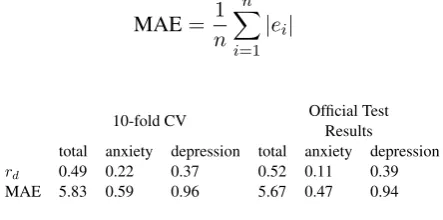
We fitted a linear regression model comprised of the above mentioned features without interac-tions to predict the square root of the BSAG to-tal, BSAG anxiety and BSAG depression. For the purpose of model estimation, we conducted a 10-fold cross-validation. The predicted values were converted back to the original scale and presented in Table 2 alongside with the true results. The main metric is Disattenuated Pearson correlation coefficient between the predicted results and the observed results, divided by the reliability of psy-chological distress questionnaires (0.77;Ploubidis et al.,2017) and of a recent assessment of related language-based measures (0.70;Park et al.,2015). In this metric, higher values represent better pre-dictions.
rDisattenuated=
rP earson
√
0.7·0.77
Mean Absolute Error (MAE), which is the average of the absolute error term between the predicted and observed values is also reported. In this met-ric, lower values represent better predictions.
MAE= 1
n n X
i=1
|ei|
10-fold CV Official TestResults total anxiety depression total anxiety depression
rd 0.49 0.22 0.37 0.52 0.11 0.39
MAE 5.83 0.59 0.96 5.67 0.47 0.94
Table 2: 10-fold cross-validation and official test re-sults of task A.
3.2 Task B
In this task, the goal was to predict psychological distress scores at ages 23, 33, 42 and 50 based on the Malaise Inventory (Rutter et al., 1970). Age
50 predictions were particularly challenging since not only were they out-of-sample across people, they were also across time (i.e. age 50 distress was never part of the training sample). To tackle this problem, we built a multivariate linear model that included the same features as in Task A. The model produced predictions for ages 23, 33 and 42. On these predicted values, we built a time se-ries for each subject, comprised of the three pre-dicted time points. We used forecast library for R (Hyndman,2017;Hyndman and Khandakar, 2008) to predict the 4th value in the series which corresponds to age 50, using an automatic expo-nential smoothing. Results are shown in Table3. Like in Task A, the main metric is Disattenuated Pearson correlation coefficient. Mean Absolute Error (MAE) is also reported.
M23-42 age 23 age 33 age 42 age 50
10-fold CV rd 0.26 0.37 0.23 0.19 NA
MAE 1.18 1.17 1.03 1.33 NA Official Test Results rd 0.27 0.45 0.25 0.13 0.30
[image:3.595.74.296.557.667.2]MAE 1.084 0.99 0.95 1.31 1.29
Table 3: 10-fold cross-validation and official test re-sults of task B.
In This task, the main evaluation was based on average prediction of ages 23-42. The model provided reasonable predictions in general, but in age 50 predictions it produced the highest result out of all other competing CLPsych 2018 partic-ipants. As described, our models favored a sim-ple approach building upon relatively straightfor-ward linear models and psychologically-informed feature selection. This may provide some ev-idence in favor of simple models when out-of-sample across-people and across-time predictions are needed.
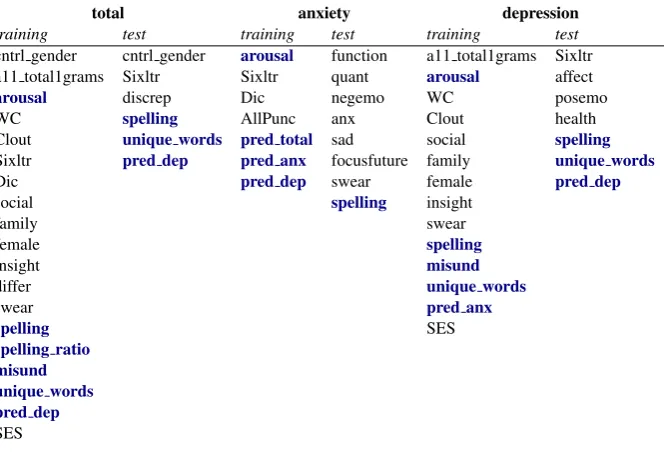
One of the benefits of using classic methods such as linear regression, is model interpretabil-ity. In Tables4and5we list the relevant features used in the our models that passed a significance threshold ofp<.05 in the training and test sets.
4 Conclusions
total anxiety depression training test training test training test cntrl gender cntrl gender arousal function a11 total1grams Sixltr
a11 total1grams Sixltr Sixltr quant arousal affect
arousal discrep Dic negemo WC posemo
WC spelling AllPunc anx Clout health
Clout unique words pred total sad social spelling
Sixltr pred dep pred anx focusfuture family unique words
Dic pred dep swear female pred dep
social spelling insight
family swear
female spelling
insight misund
differ unique words
swear pred anx
spelling SES
spelling ratio misund unique words pred dep
SES
Table 4: Significant features in Task A. Features inboldwere not incorporated in LIWC or in the original dataset.
age 23 age 33 age 42
training test training test training test
cntrl gender cntrl gender cntrl gender cntrl gender tentat a11 total1grams Analytic a11 total1grams WC relativ
WC social WC affect motion
friend motion absu posemo space
study space pred dep negemo time
SES passive aux SES power
[image:4.595.135.468.61.296.2]unique words
Table 5: Significant features in Task B. Features inboldwere not incorporated in LIWC or in the original dataset.
2018 participating teams. That said, there is still much room for model improvements and feature extraction. Despite the performance advantages afforded by novel statistical approaches (e.g., neu-ral networks, support vector regression, random forest regression and so forth), the linear mod-els may still have some practical use in prediction problems, given their low complexity and vari-ance. Furthermore, they produce the benefit of higher interpretability, which can facilitate grad-ual accumulation of knowledge regarding relevant features. Our findings also suggest that some po-tentially unexpected features (e.g., spelling mis-takes, incomprehensibility of written text) can be derived from psychological theory, and augment prediction of meaningful outcomes.
Acknowledgments
The authors wish to thank Dr. Jonathan Rosen-blatt and the CLPsych 2018 Shared Task organiz-ers. We are also grateful to The Centre for Lon-gitudinal Studies, UCL Institute of Education for the use of these data and to the UK Data Archive and UK Data Service for making them available. However, they bear no responsibility for the anal-ysis or interpretation of these data.
References
Mohammed Al-Mosaiwi and Tom Johnstone. 2017. In an absolute state: Elevated use of absolutist words is a marker specific to anxiety, depression, and sui-cidal ideation.Clinical Psychological Science, page 2167702617747074.
Kenneth Benoit and Akitaka Matsuo. 2018. spacyr: Wrapper to the ’spaCy’ ’NLP’ Library. R package version 0.9.6.
Jack Block and Adam M. Kremen. 1996. IQ and ego-resiliency: Conceptual and empirical connections and separateness. Journal of Personality and Social Psychology, 70(2):349–361.
Ryan L. Boyd and James W. Pennebaker. 2015.A way with words: Using language for psychological sci-ence in the modern era. Consumer Psychology in a Social Media World, (October):222–236.
Margaret M Bradley and Peter J Lang. 1999. Affective norms for english words (anew): Instruction manual and affective ratings. Technical report, Citeseer.
Marc Brysbaert, Amy Beth Warriner, and Victor Ku-perman. 2014.Concreteness ratings for 40 thousand generally known english word lemmas. Behavior research methods, 46(3):904–911.
Glen Coppersmith, Mark Dredze, Craig Harman, Kristy Hollingshead, and Margaret Mitchell. 2015. Clpsych 2015 shared task: Depression and ptsd on twitter. In Proceedings of the 2nd Workshop on Computational Linguistics and Clinical Psychology: From Linguistic Signal to Clinical Reality, pages 31–39.
Janiece Desocio and Janis Hootman. 2004. Children ’ s Mental Health and School Success. The Journal of School Nursing, 20(4):189–196.
Emily R Fyfe, Nicole M McNeil, and Bethany Rittle-Johnson. 2015. Easy as abcabc: Abstract lan-guage facilitates performance on a concrete pattern-ing task.Child development, 86(3):927–935.
Sharath Chandra Guntuku, J. Russell Ramsay, Raina M. Merchant, and Lyle H. Ungar. 2017a. Language of ADHD in Adults on Social Media.
Journal of Attention Disorders.
Sharath Chandra Guntuku, David B. Yaden, Mar-garet L. Kern, Lyle H. Ungar, and Johannes C. Eich-staedt. 2017b. Detecting depression and mental ill-ness on social media: an integrative review. Current Opinion in Behavioral Sciences, 18:43–49.
Matthew Honnibal and Mark Johnson. 2015. An im-proved non-monotonic transition system for depen-dency parsing. In Proceedings of the 2015 Con-ference on Empirical Methods in Natural Language Processing, pages 1373–1378.
Rob J Hyndman. 2017.forecast: Forecasting functions for time series and linear models. R package version 8.2.
Rob J Hyndman and Yeasmin Khandakar. 2008. Auto-matic time series forecasting: the forecast package for R. Journal of Statistical Software, 26(3):1–22.
Ronald C Kessler, Lenard Adler, Russell Barkley, Joseph Biederman, C Keith Conners, Olga Demler, Stephen V Faraone, Laurence L Greenhill, Mary J Howes, Kristina Secnik, et al. 2006.The prevalence and correlates of adult adhd in the united states: re-sults from the national comorbidity survey replica-tion. American Journal of psychiatry, 163(4):716– 723.
Margie E Lachman and Suzanne L Weaver. 1998. The sense of control as a moderator of social class differ-ences in health and well-being. Journal of personal-ity and social psychology, 74(3):763.
David N Milne. 2017.Triaging content in online peer-support: an overview of the 2017 CLPsych shared task.
David N Milne, Glen Pink, Ben Hachey, and Rafael A Calvo. 2016. CLPsych 2016 Shared Task: Triag-ing content in online peer-support forums. 3rd Workshop on Computational Linguistics and Clin-ical Psychology: From Linguistic Signal to ClinClin-ical Reality, pages 118–127.
Margaret Mitchell, Kristy Hollingshead, and Glen Coppersmith. 2015. Quantifying the Language of Schizophrenia in Social Media. Conference of the North American Chapter of the Association for Computational Linguistics Human Language Tech-nologies (NAACL HLT 2015), pages 11–20.
Jeroen Ooms. 2017. hunspell: High-Performance Stemmer, Tokenizer, and Spell Checker. R package version 2.9.
Jeroen Ooms and Jim Hester. 2017.spelling: Tools for Spell Checking in R. R package version 1.1.
Gregory Park, H Andrew Schwartz, Johannes C Eich-staedt, Margaret L Kern, Michal Kosinski, David J Stillwell, Lyle H Ungar, and Martin EP Seligman. 2015. Automatic personality assessment through social media language. Journal of personality and social psychology, 108(6):934.
James W Pennebaker, Ryan L Boyd, Kayla Jordan, and Kate Blackburn. 2015. The development and psy-chometric properties of liwc2015. Technical report.
James W Pennebaker, Matthias R Mehl, and Kate G Niederhoffer. 2003. Psychological Aspects of Natu-ral Language Use: Our Words, Our Selves. Review Literature And Arts Of The Americas.
GB Ploubidis, A Sullivan, M Brown, and A Goodman. 2017. Psychological distress in mid-life: evidence from the 1958 and 1970 british birth cohorts. Psy-chological medicine, 47(2):291–303.
Miquel Roca, Saray Monz´on, Margalida Vives, Emilio L´opez-Navarro, Mauro Garcia-Toro, Caterina Vi-cens, Javier Garcia-Campayo, John Harrison, and Margalida Gili. 2015. Cognitive function after clin-ical remission in patients with melancholic and non-melancholic depression: a 6 month follow-up study.
Journal of affective disorders, 171:85–92.
James A Russell and Albert Mehrabian. 1977. Evi-dence for a three-factor theory of emotions.Journal of research in Personality, 11(3):273–294.
Michael Rutter, Jack Tizard, and Kingsley Whitmore. 1970. Education, health and behaviour. Longman Publishing Group.
H. Andrew Schwartz and Lyle H. Ungar. 2015. Data-Driven Content Analysis of Social Media: A Sys-tematic Overview of Automated Methods. Annals of the American Academy of Political and Social Sci-ence, 659(1):78–94.
Karen E. Seymour, Andrea Chronis-Tuscano, Thorhildur Halldorsdottir, Brandi Stupica, Kristian Owens, and Talia Sacks. 2012. Emotion regulation mediates the relationship between ADHD and de-pressive symptoms in youth. Journal of Abnormal Child Psychology, 40(4):595–606.
Ole Jakob Storeb and Erik Simonsen. 2016. The asso-ciation between adhd and antisocial personality dis-order (aspd): A review. Journal of Attention Disor-ders, 20(10):815–824. PMID: 24284138.
Denis Herbert Stott. 1963. Bristol Social-adjustment Guides. University of London Press.
Frank R Vellutino and Donna M Scanlon. 1985. Free recall of concrete and abstract words in poor and normal readers. Journal of experimental Child psy-chology, 39(2):363–380.