A Meaning-based Statistical English Math Word Problem Solver
Chao-Chun Liang, Yu-Shiang Wong, Yi-Chung Lin and Keh-Yih Su
Institute of Information Science, Academia Sinica, Taiwan
{ccliang, yushiangwtw, lyc, kysu}@iis.sinica.edu.tw
Abstract
We introduce MeSys, a meaning-based ap-proach, for solving English math word problems (MWPs) via understanding and reasoning in this paper. It first analyzes the text, transforms both body and question parts into their corresponding logic forms, and then performs inference on them. The associated context of each quantity is rep-resented with proposed role-tags (e.g., nsubj, verb, etc.), which provides the flex-ibility for annotating an extracted math quantity with its associated context infor-mation (i.e., the physical meaning of this quantity). Statistical models are proposed to select the operator and operands. A noisy dataset is designed to assess if a solver solves MWPs mainly via under-standing or mechanical pattern matching. Experimental results show that our ap-proach outperforms existing systems on both benchmark datasets and the noisy da-taset, which demonstrates that the pro-posed approach understands the meaning of each quantity in the text more.
1
Introduction
The math word problem (MWP) (see Figure 1) is frequently chosen to study natural language un-derstanding and simulate human problem solving (Bakman, 2007; Hosseini et al., 2014; Liang et al., 2016) for the following reasons: (1) the an-swer to the MWP cannot be simply extracted by performing keyword/pattern matching. It thus shows the merit of understanding and inference.
(2) An MWP usually possesses less complicated syntax and requires less amount of domain knowledge, so the researchers can focus on the task of understanding and reasoning. (3) The body part of MWP that provides the given infor-mation for solving the problem consists of only a few sentences. The understanding and reasoning procedures thus could be more efficiently checked. (4) The MWP solver has its own appli-cations such as Computer Math Tutor (for stu-dents in primary school) and Helper for Math in Daily Life (for adults who are not good in solving mathematics related real problems).
According to the approaches used to identify entities, quantities, and to select operations and operands, previous MWP solvers can be classified into: (1) Rule-based approaches (Mukherjee and Garain, 20081; Hosseini et al., 2014), which make all related decisions based on a set of rules; (2) Purely statistics-based approaches (Kushman et al., 2014; Roy et al., 2015; Zhou et al., 2015; Upadhyay et al., 2016), in which all related deci-sions are done via a statistical classifier; (3) DNN-based approaches (Ling et al., 2017; Wang et al., 2017), which map the given text into the corre-sponding math operation/equation via a DNN; and (4) Mixed approaches, which identify entities and quantities with rules, yet, decide operands and op-erations via statistical/DNN classifiers. This cate-gory can be further divided into two subtypes: (a) Without understanding (Roy and Roth, 2015; Koncel-Kedziorski et al., 2015; Huang et al., 2017; Shrivastava et al., 2017), which does not check the entity-attribute consistency between each quantity and the target of the given question; and (b) With understanding (Lin et al., 2015; Mi-tra and Baral, 2016; Roy and Roth, 2017), which also checks the entity-attribute consistency while solving the problem.
1 It is a survey paper which reviews most of the rule-based
approaches before 2008. Math Word Problem
Mike takes 88 minutes to walk to school. If he rides a bicycle to school, it would save him 64 minutes. How much time did Mike save?
Solution
88 – 64 = 22
However, a widely covered rule-set is difficult to construct for the rule-based approach. Also, it is awkward in resolving ambiguity problem. In con-trast, the performance of purely statistics-based approaches deteriorates significantly when the MWP includes either irrelevant information or in-formation gaps (Hosseini et al., 2014), as it is solved without first understanding the meaning.
For the category (4a), since the physical mean-ing is only implicitly utilized and the result is not generated via inference, it would be difficult to explain how the answer is obtained in a human comprehensible way. Therefore, the categories (2), (3) and (4a) belong to the less favored direct translation approach2 (Pape, 2004).
In contrast, the approaches of (4b) can avoid the problems mentioned above. However, among them, Mitra and Baral (2016) merely handled Ad-dition and Subtraction. Only the meaning-based
framework proposed by Lin et al. (2015) can
han-dle general MWPs via understanding and reason-ing. Therefore, it is possible to explain how the answer is obtained in a human comprehensible way (Huang et al., 2015). However, although their design looks promising, only a few Chinese MWPs had been tested and performance was not evaluated. Accordingly, it is hard to make a fair comparison between their approach and other state-of-the-art methods. In addition, in their pro-totype system, the desired operands of arithmetic operations are identified with predefined lexico-syntactic patterns and ad-hoc rules. Reusing the patterns/rules designed for Chinese in another language is thus difficult even if it is possible.
In this paper, we adopt the framework proposed by Lin et al. (2015) to solve English MWPs (for its potential in solving difficult/complex MWPs and providing more human comprehensible ex-planations). Additionally, we make the following improvements: (1) A new statistical model is pro-posed to select operands for arithmetic operations, and its model parameters can be automatically learnt via weakly supervised learning (Artzi and Zettlemoyer, 2013). (2) A new informative and robust feature-set is proposed to select the desired arithmetic operation. (3) We show the proposed approach significantly outperforms other existing systems on the common benchmark datasets re-ported in the literature. (4) A noisy dataset with
2 According to (Pape, 2004), the meaning-based approach of
solving MWPs achieves the best performance among vari-ous behaviors adopted by middle school children.
more irrelevant quantities in MWPs is created and released. It could be used to check if an approach really understands what a given MWP looks for. (5) An experiment is conducted to compare vari-ous approaches on this new dataset. The superior performance of our system demonstrates that the proposed meaning-based approach has good po-tential in handling difficult/complex MWPs.
2
System Description
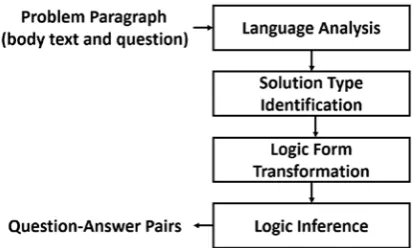
The adopted meaning-based framework (Lin et al., 2015) is a pipeline with following four stages (see Figure 2): (1) Language Analysis, (2)
Solu-tion Type IdentificaSolu-tion, (3) Logic Form
Trans-formation and (4) Logic Inference. We use the Stanford CoreNLP suite (Manning et al., 2014) as the language analysis module. The other three modules are briefly described below. Last, we adopt the weakly supervised learning (Artzi and Zettlemoyer, 2013; Kushman et al., 2014) to au-tomatically learn the model parameters without manually annotating each MWP with the adopted solution type and selected operands benchmark.
2.1 Solution Type Identification (STI)
After language analysis, each MWP is assigned with a specific solution type (such as Addition, Multiplication, etc.) which indicates the stereo-type math operation pattern that should be adopt-ed to solve this problem. We classify the English MWPs released by Hosseini et al. (2014) and Roy and Roth (2015) into 6 different types: Addition, Subtraction, Multiplication, Division, Sum and
TVQ-F3. An SVM (Chang and Lin, 2011) is used
to identify the solution type with 26 features. Most of them are derived from some important proper-ties associated with each quantity.
3TVQ-F means to get the final state of a
[image:2.595.313.521.75.199.2]Time-Variant-Quantity that involves both Addition and Subtraction.
In addition to the properties Entity4 and Verb (Hosseini et al., 2014) associated with the quanti-ty, we also introduce a new property Time which encodes the tense and aspect of a verb into an in-teger to specify a point in the timeline. We assign 2, 4, and 6 to the tenses Past, Present and Future, respectively, and then adjust it with the aspect-values -1, 0 and 1 for Perfect, Simple, and Pro-gressive, respectively.
Another property Anchor is associated with the
unknown quantity asked in the question sentence.
If the subject of the question sentence is a noun phrase (e.g., “how many apples does John have?”), Anchor is the subject (i.e., John). If the subject is an expletive nominal (e.g. “how many apples are there in the box?”), then Anchor is the associated nominal modifier nmod (i.e., “box”). Otherwise, Anchor is set to “Unknown”.
Inspired by (Hosseini et al., 2014), we trans-form Verb to Verb-Class (VC) which is positive, negative or stative. A verb is positive/negative if it increases/decreases the associated quantity of the subject. For example, in the sentence “Tom bor-rowed 3 dollars from Mike”, the verb is positive because the money of subject “Tom” increases.
However, a positive verb does not always imply the Addition operation. If the question is “How
much money does Mike have now?” for the above
body sentence, the operation should be Subtrac-tion. Two new properties Anchor-Role (AR) and Action (A) are thus proposed: ARi indicates the role that Anchor associated with qi, and is set to nsubj/obj/nmod/φ. Ai is determined by following rules: (1) Ai=positive if (VCi, ARi) is either (
posi-tive, nsubj) or (negative, obj/nmod). (2)
Ai=negative if (VCi, ARi) is either (negative,
4 In our works, the term “Entity” also includes the unit of
the quantity (e.g., “cup of coffee”).
nsubj) or (positive, obj/nmod). (3) Otherwise, Ai=VCi.
To rule out the noisy quantities introduced by irrelevant information, we further associate each known quantity with the property Relevance (R) according to the unknown quantity asked in the question sentence. Let qi denote the i-th known quantity, Ei denote the entity of qi, Xi denote the property X of qi, qU denote the unknown quantity asked, and XU denote the property X of qU. Ri is specified with following rules: (1) Ri=2 (Directly-Related) if either {Anchor is Unknown & Ei en-tails EU} or {Anchor is not Unknown & ARi≠φ & Ei entails EU} (2) Ri=1 (Indirectly-Related) if there is a qj which maps5 to qi and R
j=2 (i.e., qj is Directly-Related). (3) Ri=0 (Unrelated) otherwise.
The solution type is identified by an SVM based on 26 binary features. Let the symbols p, n,
s, A, E, R, T, V, SB, SQand wQ stand for positive, negative, stative, Action, Entity, Relevance, Time, Verb, “a body sentence”, “the question sentence” and “a word in question sentence” respectively. Also, let I(x) be the indicator function to check if x is true. The 26 features are briefly described as follows:
(1) VCU=p; (2) ∃Ri=2 s.t. Ai=p; (3) ∃Ri=2 s.t. Ai=n;
(4) ∃Ri=2 s.t. Ai=s; (5) ∑𝑖𝑖 I( Ri =2) > 2;
(6) ∑𝑖𝑖 I( Ri=2 & Ai ∈{p, n} ) = 2;
(7) ∃Ri=2 s.t. Ai=p & TU<Ti;
(8) ∃Ri=2 s.t. Ai=n & TU<Ti;
(9) ∃Ri=2 s.t. Ai=s & Ti=max Tj;
(10) ∃Ri=2 s.t. Ai=s & Ti<TU;
(11) TU ≥ max Ti; (12) TU ≤ min Ti;
(13) ∀Ri=2, Vi are the same; (14) ∀Ri=2 s.t. Ti=TU;
(15) ∀Ri=2, Ti are the same;
(16) ∃Ri=2, ∃Rj=1 s.t. qi maps to qj & qi > qj;
5 That is, 𝑞𝑞
[image:3.595.109.515.75.215.2]𝑖𝑖 is linked to a directly-related quantity 𝑞𝑞𝑗𝑗 under an expressionsuch as “2 pencils weigh 30 grams”.
(17) ∃Ri=2, ∃Rj=1 s.t. qi maps to qj & qi is associated
with a word “each/every/per/a/an”;
(18) ∃Ri=2, ∃Rj=1 s.t. qi maps to qj & qj is associated
with a word “each/every/per/a/an”; (19) ∃qi, qj, qk s.t. Ri = Rj = Rk =2 & Vi = Vj = Vk;
(20) ∃wQ ∈{total, in all, altogether, sum};
(21)∃wQ ∈{more, than} or ∃wQ s.t. wQ-POS=RBR; (22) ∃wQ =“left”; (23). ∃qi appears in SQ;
(24) “the rest V EU” appears in SB (V for any verb); (25) “each NN” appears in SQ (NN for any noun);
(26) AnchorU is Unknown/nmod & VCU = s.
2.2 Logic Form Transformation (LFT)
The results of language analysis are transformed into a logic form, which is expressed with the
first-order logic (FOL) formalism (Russell and
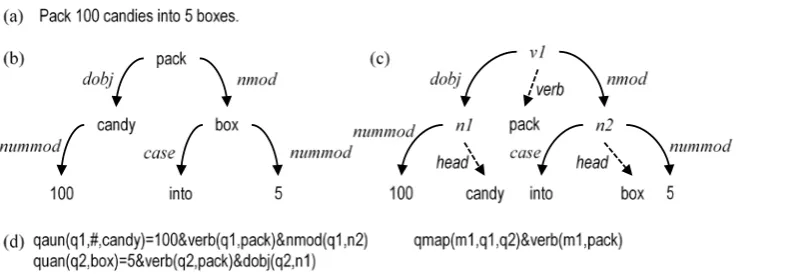
Norvig, 2009). Figure 3 shows how to transform the sentence (a) “Pack 100 candies into 5 boxes.” into the corresponding logic form (d). First, the dependency tree (b) is transformed into the se-mantic representation tree (c) adopted by Lin et al., (2015). Afterwards, according to the procedure proposed in (Lin et al., 2015), the domain-dependent logic expressions are generated in (d).
The domain-dependent logic expressions are related to crucial generic math facts, such as quan-tities and relations between quantities. The FOL function quan(quanid, unit6,entity)=number is for describing the quantity fact. The first argument denotes its unique identifier. The other arguments and the function value describe its meaning. An-other FOL predicate qmap(mapid, quanid1, quanid2) (denotes the mapping from quanid1 to quanid2) is for describing a relation between two quantity facts, where the first argument is a unique identi-fier to represent this relation.
The role-tags (e.g., verb, dobj, etc.) associated with quanid and mapid denote entity attributes (i.e., the physical meaning of the quantity), are created to help the logic inference module find the
6 This second argument denotes the associated unit used to
count the entity. It is set to “#” if the unit of the entity is not specified.
solution. For example, quan(q2,#,box) = 5 & verb(q2,pack) &… means that q2 is the quantity of boxes being packed. With those role-tags, the sys-tem can select the operands more reliably, and the inference engine can also derive new quantities to solve complex MWPs which require multi-step arithmetic operations (see section 2.3).
The question in the MWP is also transformed into an FOL-like utility function according to the solution type to ask the logic inference module to find out the answer. For example, the utility func-tion instance Division(quan(q1, #, candy), quan(q2, #, box)) asks the inference module to di-vide “100 candies” by “5 boxes”. Since associated operands must be specified before calling those utility functions, a statistical model (see section 2.4) is used to identify the appropriate quantities.
2.3 Logic Inference
The logic inference module adopts the inference engine from (Lin et al., 2015). Figure 4 shows how it uses inference rules to derive new facts from the initial facts directly provided from the description. The MWP (a) provides some facts (b) generated from the LFT module. An inference rule (c)7, which implements the common sense that people must pay money to buy something, is unified with the given facts (b) and derives new facts (d). The facts associated with q6 can be interpreted as “Mary paid 0.5 dollar for two puddings”.
The inference engine (IE) also provides 5 utili-ty functions, including Addition, Subtraction, Multiplication and Division, and Sum. The first four utilities all return a value by performing the named math operation on its two input arguments. On the other hand, Sum(function,condition) re-turns the sum of the values of FOL function in-stances which can be unified with the first argu-ment (i.e., function) and satisfy the second argu-ment (i.e., condition). For example, according to
7 In the inference rule, $q is a meta symbol to ask the
infer-ence engine to generate a unique identifier forthe newly de-rived quantity fact.
(a) A sandwich is priced at $0.75. A pudding is priced at $0.25. Tim bought 2 sandwiches and 4 puddings. Mary bought 2 puddings. How much money should Tim pay?
(b) …price(sandwich,0.75)&price(pudding,0.25)… quan(q1,#,sandwich)=2&verb(q1,buy)&nsubj(q1,Tim)… quan(q2,#,pudding)=4&verb(q2,buy)&nsubj(q2,Tim)… quan(q3,#,pudding)=2&verb(q3,buy)&nsubj(q3,Mary)… ASK Sum(quan(?q,dollar,#),verb(?q,pay)&nsubj(?q,Tim))
(c) quan(?q,?u,?o)&verb(?q,buy)&nsubj(?q,?a)&price(?o,?p) quan($q,dollar,#)=quan(?q,?u,?o)×?p & verb($q,pay) & nsubj($q,?a)
(d) quan(q4,dollar,#)=1.5&verb(q4,pay)&nsubj(q4,Tim)… quan(q5,dollar,#)=1&verb(q5,pay)&nsubj(q5,Tim)… quan(q6,dollar,#)=0.5&verb(q6,pay)&nsubj(q6,Mary)
Figure 2: A logic inference example
(a) A sandwich is priced at $0.75. A pudding is priced at $0.25. Tim bought 2 sandwiches and 4 puddings. Mary bought 2 puddings. How much money should Tim pay?
(b) …price(sandwich,0.75)&price(pudding,0.25)… quan(q1,#,sandwich)=2&verb(q1,buy)&nsubj(q1,Tim)… quan(q2,#,pudding)=4&verb(q2,buy)&nsubj(q2,Tim)… quan(q3,#,pudding)=2&verb(q3,buy)&nsubj(q3,Mary)… ASK Sum(quan(?q,dollar,#),verb(?q,pay)&nsubj(?q,Tim))
(c) quan(?q,?u,?o)&verb(?q,buy)&nsubj(?q,?a)&price(?o,?p) quan($q,dollar,#)=quan(?q,?u,?o)×?p & verb($q,pay) & nsubj($q,?a) (d) quan(q4,dollar,#)=1.5&verb(q4,pay)&nsubj(q4,Tim)… quan(q5,dollar,#)=1&verb(q5,pay)&nsubj(q5,Tim)…
quan(q6,dollar,#)=0.5&verb(q6,pay)&nsubj(q6,Mary)
the last line in Figure 4(b), three newly derived quantity facts q4, q5 and q6 (in 4(d)) can be uni-fied with the first argument quan(?q,dollar,#) in 4(c), but only q4 and q5 satisfy the second ar-gument verb(?q,pay)&nsubj(?q,Tim). As a result, the answer 2.5 is returned by taking sum on the values of the quantity facts quan(q4,dollar,#) and quan(q5,dollar,#).
2.4 Probabilistic Operand Selection
The most error-prone part in the LFT module is instantiating the utility function of math operation especially if many irrelevant quantity facts appear in the given MWP. Figure 5 shows the LFT mod-ule needs to select two quantity facts (among 4) for Addition. Please note that the question quantity
qQ, transformed from “how many flowers”, is not a
candidate for operand selection.
Lin et al., (2015) used predefined lexico-syntactic patterns and ad-hoc rules to instantiate utility functions. However, their rule-based ap-proach fails when the MWP involves more quanti-ties. Therefore, we propose a statistical model to select operands for the utility functions Addition, Subtraction, Multiplication and Division. The op-erand selection procedure can be regarded as find-ing the most likely configuration (𝑜𝑜1𝑛𝑛,𝑟𝑟), where
𝑜𝑜1𝑛𝑛=𝑜𝑜1,⋯,𝑜𝑜𝑛𝑛 is a sequence of random
indica-tors which denote if the corresponding quantity will be selected as an operand, and 𝑟𝑟 is a tri-state variable to represent the relation between the val-ues of two operands (i.e., 𝑟𝑟=−1, 0 or 1 ; which denote that the first operand is less than, equal to, or greater than the second operand, respectively). Given a solution type 𝑠𝑠, the MWP logic expres-sions 𝕃𝕃 and the 𝑛𝑛 quantities 𝑞𝑞1𝑛𝑛=𝑞𝑞1,⋯,𝑞𝑞𝑛𝑛 in 𝕃𝕃. The procedure is formulated as:
𝑃𝑃(𝑟𝑟,𝑜𝑜1𝑛𝑛|𝑞𝑞1𝑛𝑛,𝕃𝕃,𝑠𝑠)≈ 𝑃𝑃(𝑟𝑟|𝑠𝑠) ×𝑃𝑃(𝑜𝑜1𝑛𝑛|𝑞𝑞1𝑛𝑛,𝕃𝕃,𝑠𝑠), (1)
𝑃𝑃(𝑟𝑟|𝑠𝑠) simply refers to Relative Frequency (as it has only a few parameters and we have enough training samples). 𝑃𝑃(𝑜𝑜1𝑛𝑛|𝑞𝑞1𝑛𝑛,𝕃𝕃,𝑠𝑠) is further de-rived as:
𝑃𝑃(𝑜𝑜1𝑛𝑛|𝑞𝑞1𝑛𝑛,𝕃𝕃,𝑠𝑠)
≈ ∏𝑛𝑛𝑖𝑖=1𝑃𝑃(𝑜𝑜𝑖𝑖|𝑞𝑞𝑖𝑖,𝕃𝕃,𝑠𝑠)≈ ∏𝑖𝑖=1𝑛𝑛 𝑃𝑃�𝑜𝑜𝑖𝑖�Φ(𝑞𝑞𝑖𝑖,𝕃𝕃,𝑠𝑠)�,
(2)
where Φ(∙) is a feature extraction function to map
𝑞𝑞𝑖𝑖 and its context into a feature vector. Here, the
probabilistic factor 𝑃𝑃�𝑜𝑜𝑖𝑖�Φ(𝑞𝑞𝑖𝑖,𝕃𝕃,𝑠𝑠)� is obtained via an SVM classifier (Chang and Lin, 2011).
Φ(∙) extracts total 25 features (specified as fol-lows, and 24 of them are binary) for 𝑞𝑞𝑖𝑖. The fol-lowing 11 of them are independent on the ques-tion in the MWP:
1. Four features to indicate if 𝑠𝑠 is Addition, Sub-traction, Multiplication or Division.
2. A feature to indicate if 𝑞𝑞𝑖𝑖 is within a qmap(…).
3. A feature to indicate if 𝑞𝑞𝑖𝑖 = 1.
4. Five features to indicate if 𝑛𝑛< 2, 𝑛𝑛= 2, 𝑛𝑛=
3, 𝑛𝑛= 4 or 𝑛𝑛> 4; where 𝑛𝑛 is the number of quantities in Eq (1).
Φ(∙) also extracts features by matching the logic expressions of 𝑞𝑞𝑖𝑖 with those of question quantity qQ to check the role-tag consistencies between 𝑞𝑞𝑖𝑖 and qQ. Another fourteen features are extracted with three indicator functions 𝐼𝐼𝑚𝑚(⋅), 𝐼𝐼𝑒𝑒(⋅),
𝐼𝐼∃(⋅) and one tri-state function 𝑇𝑇𝑚𝑚(⋅) as follows: [ 𝐼𝐼𝑚𝑚(𝑞𝑞𝑖𝑖, qQ, entity),𝐼𝐼𝑒𝑒(𝑞𝑞𝑖𝑖, qQ, entity),
𝐼𝐼𝑚𝑚(𝑞𝑞𝑖𝑖, qQ, verb),𝐼𝐼𝑒𝑒(𝑞𝑞𝑖𝑖, qQ, verb),
𝐼𝐼∃(qQ, nsubj),𝑇𝑇𝑚𝑚(𝑞𝑞𝑖𝑖, qQ, nsubj),
𝐼𝐼∃(qQ, modifier),𝐼𝐼𝑚𝑚(𝑞𝑞𝑖𝑖, qQ, modifier),
𝐼𝐼∃(qQ, place),𝐼𝐼𝑚𝑚(𝑞𝑞𝑖𝑖, qQ, place),
𝐼𝐼∃(qQ, temporal),𝐼𝐼𝑚𝑚(𝑞𝑞𝑖𝑖, qQ, temporal),
𝐼𝐼∃(qQ, xcomp),𝐼𝐼𝑚𝑚(𝑞𝑞𝑖𝑖, qQ, xcomp) ]
where the indicator functions 𝐼𝐼𝑚𝑚(𝑥𝑥,𝑦𝑦,𝑧𝑧) checks if the 𝑧𝑧 of 𝑥𝑥 matches the 𝑧𝑧 of 𝑦𝑦, 𝐼𝐼𝑒𝑒(𝑥𝑥,𝑦𝑦,𝑧𝑧) checks if the 𝑧𝑧 of 𝑥𝑥 entails the 𝑧𝑧 of 𝑦𝑦 and 𝐼𝐼∃(𝑦𝑦,𝑧𝑧) checks if the 𝑧𝑧 of 𝑦𝑦 exists. 𝑇𝑇𝑚𝑚(𝑞𝑞𝑖𝑖, qQ, nsubj) returns “exact-match” (if nsubj of 𝑞𝑞𝑖𝑖 matches nsubj of qQ), “quasi-match” (if nsubj of qQ does not exist or is a plural pronoun), and “unmatch”.
𝐼𝐼𝑒𝑒(⋅) uses the WordNet hypernym and
hyponym relationship to judge whether one entity/verb entails another one or not via checking if they are in an inherited hypernym-path in WordNet. The entity, verb and nsubj of a quantity are determined according to the logic expressions. The modifier, place, temporal and xcomp of a quantity are extracted from the dependency tree with some lexico-syntactic patterns. For example, the modifier and place of the quantity in the sentence “There are 30 red flowers in thegarden.” are “red” and “garden” respectively. The temporal (a) Tim bought 2 roses and 3 lilies. Mary bought 4 roses
and 5 lilies. How many flowers did Tim buy? (b) quan(q1,#,rose)=2&verb(q1,buy)&nsubj(q1,Tim)…
and xcomp of a quantity are extracted according to the dependency relations “tmod” (i.e., temporal
modifier) and “xcomp” (i.e., open clausal
complement), respectively.
3
Datasets for Performance Evaluation
The AI2 dataset provided by Hosseini et al. (2014) and the IL dataset released by Roy and Roth (2015) are adopted to compare our approach with other state-of-the-art methods. The AI2 dataset has 395 MWPs on addition and subtraction, with 121 MWPs containing irrelevant information (Hosseini et al., 2014). It is the most popular one for comparing different approaches. On the other hand, the IL dataset consists of 562 elementary MWPs which can be solved by one of the four arithmetic operations (i.e., +, −, ×, and ÷) without any irrelevant quantity. It is the first publicly available dataset for comparing performances that covers all four arithmetic operations.
However, the difficulty of solving an MWP de-pends not only on the number of arithmetic opera-tions required, but also on how many irrelevant quantities inside, and even on how the quantities are described. One way to test if a proposed ap-proach solves the MWPs with understanding is to check whether it is robust to those irrelevant quan-tities. Therefore, it is desirable to have a big enough dataset that contains irrelevant quantities which are created under different situations (e.g., confusing with an irrelevant agent, entity, or mod-ifier, etc.) and allow us to probe the system weak-ness from different angles. We thus create a new dataset with more irrelevant quantities8. But be-fore we do that, we need to know how difficult the task of solving the given MWPs is. Therefore, we first propose a way to measure how easy that a system solves the problem by simply guessing.
3.1 Perplexity-flavor Measure
We propose to adopt the Perplexity to measure the task difficulty, which evaluates how likely a solver will get the correct answer by guessing. Every MWP in the datasets can be associated with a so-lution expression template, such as “⊡+⊡” or “⊡ − ⊡”, where the symbol ⊡ represents a slot to hold a quantity. The solution can be obtained by placing correct quantities at appropriate slots. A
8 The IL dataset does not include any irrelevant information;
on the other hand, the AI2 dataset only contains 121 MWPS with irrelevant information (but not systematically created).
random baseline is to solve an MWP by guessing. It first selects a solution expression template ac-cording to the prior distribution of the templates and then places quantities into the selected tem-plate according to the uniform distribution.
The expected accuracy of the random baseline on solving an MWP is a trivial combination and permutation exercise9. For example, the expected accuracy of solving an MWP associated with “⊡
+⊡” template is 𝑝𝑝⊡+⊡× 𝑛𝑛 2𝐶𝐶 −1, where the fac-tor 𝑝𝑝⊡+⊡ denotes the prior probability of the template “⊡+⊡” and 𝑛𝑛 is the total number of quantities (including irrelevant ones) in the MWP. On the other hand, expected accuracy of solving an MWP associated with “⊡ − ⊡”10 template is
𝑝𝑝⊡−⊡× 𝑛𝑛 2𝑃𝑃 −1. Let 𝐴𝐴𝑖𝑖 denote the expected
accu-racy of solving the 𝑖𝑖-th MWP in a dataset. The ac-curacy of the random baseline on the dataset of size 𝑁𝑁 is then computed as 𝐴𝐴= (1/𝑁𝑁) ×∑𝑁𝑁𝑖𝑖=1𝐴𝐴𝑖𝑖.
The word “Accuracy” comprises the opposite sense of the word “Perplexity”11 (i.e., in the sense of how hard a prediction problem is). The lower the Accuracy is, the higher the Perplexity is. Therefore, we transform the Accuracy measure in-to a Perplexity-Flavor measure (PP) via the for-mula:
PP = 2−log2𝐴𝐴
For instance, the Perplexity-Flavor measures of AI2 and IL datasets are 4.46 and 8.32 respectively.
3.2 Noisy Dataset
Human Math/Science tests have been considered more suitable for judging AI progress than Turing test (Clark and Etzioni, 2016). In our task, solving MWPs is mainly regarded as a test for intelligence (not just for creating a Math Solver package). By injecting various irrelevant quantities into original MWPs, a noisy dataset is thus created to assess if a solver solves the MWPs mainly via understand-ing or via mechanical/statistical pattern matching. If a system solves an MWP mainly via pattern matching, it would have difficulty in solving a similar MWP augmented from the original one with some irrelevant quantities. Therefore, we first create a noisy dataset by selecting some
9 Let 𝐶𝐶
𝑛𝑛 𝑘𝑘 denote 𝑘𝑘-combinations of 𝑛𝑛 and 𝑛𝑛 𝑘𝑘𝑃𝑃 denote 𝑘𝑘 -permutations of 𝑛𝑛.
10 We assume the operands have different values and,
there-fore, they are not permutable for the subtraction operator.
11 The Perplexity of a uniform distribution over k discrete
MWPs that can be correctly solved, and then augmenting each of them with an additional noisy sentence which involves an irrelevant quantity. This dataset is created to examine if the solver knows that this newly added quantity is irrelevant.
Figure 6 shows how we inject noise into an MWP (a). (a.1) is created by associating an ir-relevant quantity to a new subject (i.e., Mary). Here the ellipse symbol “…” denotes unchanged text. (a.2) is obtained by associating an irrelevant quantity to a new entity (i.e., books). In addition, we also change modifiers (such as yellow, red, …) to add new noisy sentence (not shown here). Since the noisy dataset is not designed to assess the lexi-con coverage rate of a solver, we reuse the words in the original dataset as much as possible while adding new subjects, entities and modifiers.
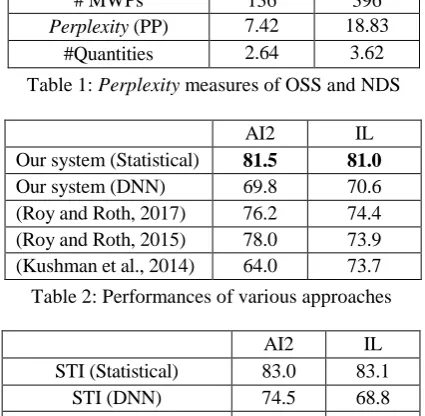
136 MWPs that both Illinois Math Solver12 (Roy and Roth, 2016) and our system can correct-ly solve are selected from the AI2 and IL datasets. This subset is denoted as OSS (Original Sub-Set). Afterwards, based on the 136 MWPs of OSS, we create a noisy dataset of 396 MWPs by adding ir-relevant quantities. This noisy dataset is named as NDS13. Table 1 lists the size of MWPs, Perplexi-ties (PP), and the average numbers of quantities in each MWP of these two datasets.
4
Experimental Results and Discussion
We compare our approach with (Roy and Roth, 2015) and (Roy and Roth, 2017) because they achieved the state-of-the-art performance on the IL dataset. In the approach of (Roy and Roth, 2015), each quantity in the MWP was associated with a quantity schema whose attributes are ex-tracted from the context of the quantity. Based on the attributes, several statistical classifiers were used to select operands and determine the opera-tor. They also reported the performances on the AI2 dataset to compare their approach with those
12 We submit MWPs to Illinois Math Solver
(https://cogcomp.cs.illinois.edu/page/demo_view/Math) in May and June, 2017.
13 The noisy dataset can be downloaded from
https://github.com /chaochun/nlu-mwp-noise-dataset. It in-cludes 102 Addition, 147 Subtraction, 101 Multiplication and 46 Division MWPs.
of others (e.g., Kushman et al. (2014), which is a purely statistical approach that aligns the text with various pre-extracted equation templates). Roy and Roth (2017) further introduced the concept of
Unit Dependency Graphs to reinforce the
con-sistency of physical units among selected oper-ands associated with the same operator.
To compare the performance of the statistical method with the DNN approach, we only imple-ment a Bi-directional RNN-based Solution Type Identifier (as our original statistical Operand Se-lector is relatively much better). It consists of a word embedding layer (for both body and ques-tion parts), and a bidirecques-tional GRU layer as an encoder. We apply the attention mechanism to scan all hidden state sequence of body by the last hidden state of question to pay more attention to those more important (i.e., more similar between the body and the question) words. Lastly, it out-puts the solution type by a softmax function. We train it for 100 epochs, with mini-batch-size = 128 and learning-rate = 0.001; the number of nodes in the hidden layer is 200, and the drop-out rate is 0.714.
We follow the same n-fold cross-validation evaluation setting adopted in (Roy and Roth, 2015) exactly. Therefore, various performances could be directly compared. Table 2 lists the accu-racies of different systems in solving the MWPs
14 Since the dataset is not large enough for splitting a
devel-opment set, we choose those hyper parameters based on the test set in coarse grain. Therefore, the DNN performance we show here might be a bit optimistic.
AI2 IL
STI (Statistical) 83.0 83.1
STI (DNN) 74.5 68.8
LFT 92.1 94.8
Table 3: Performances of different STIs and LFT (a) Tim has 10 yellow flowers and 12 red flowers. How
many flowers does Tim have?
(a.1) Tim has … Mary has 3 yellow flowers. How many … (a.2) Tim has … Tim also has 3 books. How many …
Figure 6: Examples of noisy sentences
OSS NDS
# MWPs 136 396
Perplexity (PP) 7.42 18.83
[image:7.595.307.520.94.302.2]#Quantities 2.64 3.62
Table 1: Perplexity measures of OSS and NDS
AI2 IL
Our system (Statistical) 81.5 81.0
Our system (DNN) 69.8 70.6
(Roy and Roth, 2017) 76.2 74.4 (Roy and Roth, 2015) 78.0 73.9 (Kushman et al., 2014) 64.0 73.7
of various datasets. The performance of (Roy and Roth, 2017) system is directly delivered by their code15. The last two rows are extracted from (Roy and Roth, 2015). The results show that our per-formances of the statistical approach significantly outperform that of our DNN approach and other systems on every dataset.
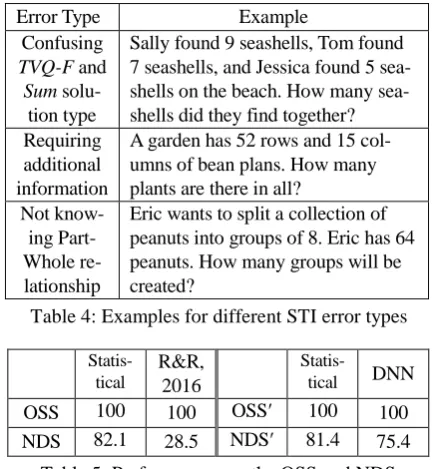
The performances of STI and LFT modules are listed in Table 3. As described in section 2, the benchmark for both solution type and the operand selection benchmark are automatically determined by weakly supervised learning. The first and sec-ond rows of Table 3 show the solution type accu-racies of our statistical and DNN approaches, re-spectively. The third row shows the operand selec-tion accuracy obtained by given the soluselec-tion type benchmark. Basically, LFT accuracies are from 92% to 95%, and the system accuracies are domi-nated by STI. We analyzed errors resulted from our statistical STI on AI2 and IL datasets, respec-tively. For AI2, major errors come from: (1) fail-ure of ruling out some irrelevant quantities (40%), and (2) making confusion between TVQ-F and Sum these two solution types (20%) for those cas-es that only involve addition operation (however, both types would return the same answer). For IL, major errors come from: (1) requiring additional information (35%), and (2) not knowing Part-Whole relation (17%). Table 4 shows a few ex-amples for different STI error types.
The left-half of Table 5 shows the performances on the OSS and NDS datasets. Recall that OSS is created by selecting some MWPs which both Illi-nois Math Solver (Roy and Roth, 2016) and our system16 can correctly solve. Therefore, both sys-tems have 100% accuracy in solving the OSS da-taset. However, these two systems behave very differently while solving the noisy dataset. The much higher accuracy of our system on the noisy dataset shows that our meaning-based approach understands the meaning of each quantity more. Therefore, it is less confused17 with the irrelevant quantities.
One MWP in the noisy dataset that confuses Il-linois Math Solver (IMS) is “Tom has 9 yellow balloons. Sara has 8 yellow balloons. Bob has 5 yellow flowers. How many yellow balloons do
15 https://github.com/CogComp/arithmetic.
16 In evaluating the performances on OSS and NDS datasets,
our system is trained on the folds 2-5 of the IL dataset.
17 Since the gap between two different types of approaches
is quite big, those 396 examples on OSS and 196 examples on NDS are sufficient to confirm the conclusion.
they have in total?”, where the underlined
sen-tence is the added noisy sensen-tence. The solver sums all quantities and gives the wrong answer 22, which reveals that IMS cannot understand that the quantity “5 yellow flowers” is irrelevant to the question “How many yellow balloons?”. On the contrary, our system avoids this mistake.
Although the meaning of each quantity is ex-plicitly checked in our LFT module, our system still cannot correctly solve all MWPs in NDS. The error analysis reveals that the top-4 error sources are STI, LFT, CoreNLP and incorrect problem construction (for 27%, 27%, 18%, 18%), which indicates that our STI and LFT still cannot com-pletely prevent the damage caused from the noisy sentences (which implies that more consistency check for quantity meaning should be done). The remaining errors are due to incorrect quantity ex-traction, lacking common-sense or not knowing entailment relationship between two entities.
A similar experiment is performed to check if the DNN approach will be affected by the noisy information more. We first select 124 MWPs (de-noted as OSS′) from OSS that can be correctly solved by both our statistical and DNN approach-es and then filter out 350 derived MWPs (denotapproach-es as NDS′) from NDS. The right-half of Table 5 shows that the performance of the DNN approach drops more than the statistical approach does in the noisy dataset, which indicates that our statisti-cal approach is less sensitive to the irrelevant quantities and more close to human’s approach.
Statis-tical
R&R, 2016
Statis-tical DNN
OSS 100 100 OSS′ 100 100
NDS 82.1 28.5 NDS′ 81.4 75.4
Table 5: Performances on the OSS and NDS
Error Type Example
Confusing TVQ-F and
Sum solu-tion type
Sally found 9 seashells, Tom found 7 seashells, and Jessica found 5 shells on the beach. How many sea-shells did they find together? Requiring
additional information
A garden has 52 rows and 15 col-umns of bean plans. How many plants are there in all?
Not know-ing Part-Whole re-lationship
[image:8.595.302.521.75.310.2]Eric wants to split a collection of peanuts into groups of 8. Eric has 64 peanuts. How many groups will be created?
5
Related Work
To the best of our knowledge, MWP solvers pro-posed before 2014 all adopted the rule-based ap-proach. Mukherjee and Garain (2008) had given a good survey for all related approaches before 2008. Afterwards, Ma et al. (2010) proposed a MSWPAS system to simulate human arithmetic multi-step addition and subtraction behavior with-out evaluation. Besides, Liguda and Pfeiffer (2012) proposed a model based on augmented semantic networks, and claimed that it could solve multi-step MWPs and complex equation systems and was more robust to irrelevant information (al-so no evaluation).
Recently, Hosseini et al. (2014) proposed a
Container-Entity based approach, which solved
the MWP with a sequence of state transition. And Kushman et al. (2014) proposed the first statistical approach, which heuristically extracts some alge-braic templates from labeled equations, and then aligns them with the given sentence. Since no se-mantic analysis is conducted, the performance is quite limited.
In more recent researches (Roy and Roth, 2015; Koncel-Kedziorski et al., 2015; Roy and Roth, 2017), quantities in an MWP were associated with attributes extracted from their contexts. Based on the attributes, several statistical classifiers were used to select operands and determine operators to solve multi-step MWPs. Since the physical mean-ing of each quantity is not explicitly considered in getting the answer, the reasoning process cannot be explained in a human comprehensible way. Be-sides, Shi et al. (2015) attacked the number word
problem, which only deal with numbers, with a
semantic parser. Mitra and Baral (2016) mapped MWPs into three types of problems, including Part-Whole, Change and Comparison. Each prob-lem was associated with a generic formula. They used a log-linear model to determine how to in-stantiate the formula with quantities and solve the only one Unknown variable. They achieved the best performance on the AI2 dataset. However, their approach cannot handle Multiplication or
Division related MWPs. Recently, DNN-based
approaches (Ling et al, 2017; Wang et al, 2017) have emerged. However, they only attacked alge-braic word problems, and required a very large training-set.
Our proposed approach mainly differs from those previous approaches in combining the statis-tical framework with logic inference, and also in
adopting the meaning-based statistical approach for selecting the desired operands.
6
Conclusion
A meaning-based logic form represented with
role-tags (e.g., nsubj, verb, etc.) is first proposed to associate the extracted math quantity with its physical meaning, which then can be used to iden-tify the desired operands and filter out irrelevant quantities. Afterwards, a statistical framework is proposed to perform understanding and reasoning based on those logic expressions. We further compare the performance with a typicalDNN ap-proach, the results show the proposed approach is still better. We will try to integrate domain con-cepts into the DNN approach to improve the learning efficiency in the future.
The main contributions of our work are: (1) Adopting a meaning-based approach to solve English math word problems and showing its su-periority over other state-of-the-art systems on common datasets. (2) Proposing a statistical mod-el to smod-elect operands by explicitly checking the meanings of quantities against the meaning of the question sentence. (3) Designing a noisy dataset to test if a system solves the problems by under-standing. (4) Proposing a perplexity-flavor meas-ure to assess the complexity of a dataset.
References
Yoav Artzi and Luke Zettlemoyer. 2013. Weakly su-pervised learning of semantic parsers for mapping instructions to actions. Transactions of the Associa-tion for ComputaAssocia-tional Linguistics, 1(1):49–62.
Yefim Bakman. 2007. Robust understanding of word problems with extraneous information. http://lanl.arxiv.org/abs/math.GM/0701393.
Chih-Chung Chang and Chih-Jen Lin. 2011. LIB- SVM: a library for support vector machines. ACM Transactions on Intelligent Systems and Technolo-gy, 2(3):27:1–27:27. Software available at http://www.csie.ntu.edu.tw/cjlin/libsvm.
Peter Clark and Oren Etzioni. 2016. My computer is an honor student - but how Intelligent is it? Stand-ardized Tests as a Measure of AI. AI Magazine, pages 5–12.
Do-ha, Qatar, A meeting of SIGDAT, a Special Interest Group of the ACL, pages 523–533.
Chien-Tsung Huang, Yi-Chung Lin, and Keh-Yih Su. 2015. Explanation generation for a math word problem solver. International Journal of Computa-tional Linguistics and Chinese Language pro-cessing (IJCLCLP), 20(2):27–44.
Danqing Huang, Shuming Shi, Chin-Yew Lin and Jian Yin. 2017. Learning fine-grained expressions to solve math word problems. In Proceedings of the 2017 Conference on Empirical Methods in Natural Language Processing, pages 816–825.
Rik Koncel-Kedziorski, Hannaneh Hajishirzi, Ashish Sabharwal, Oren Etzioni, and Siena Dumas Ang. 2015. Parsing algebraic word problems into equa-tions. Transactions of the Association for Compu-tational Linguistics, 3:585–597.
Nate Kushman, Yoav Artzi, Luke Zettlemoyer, and Regina Barzilay. 2014. Learning to automatically solve algebra word problems. In Proceedings of the 52nd Annual Meeting of the Association for Com-putational Linguistics, pages 271–281.
Chao-Chun Liang, Shih-Hong Tsai, Ting-Yun Chang, Yi-Chung Lin and Keh-Yih Su. 2016. A meaning-based English math word problem solver with un-derstanding, Reasoning and Explanation. In Pro-ceedings of COLING 2016.
Christian Liguda and Thies Pfeiffer. 2012. Modeling math word problems with augmented semantic networks. In Gosse Bouma, Ashwin Ittoo, Elisa-beth Metais, and Hans Wortmann, editors, Natural Language Processing and Information Sys-tems/17th International Conference on Applica-tions of Natural Language to Information Systems, volume 7337. Springer.
Yi-Chung Lin, Chao-Chun Liang, Kuang-Yi Hsu, Chien- Tsung Huang, Shen-Yun Miao, Wei-Yun Ma, Lun-Wei Ku, Churn-Jung Liau, and Keh-Yih Su. 2015. Designing a tag-based statistical math word problem solver with reasoning and explana-tion. International Journal of Computational Lin-guistics and Chinese Language processing (IJCLCLP), 20(2):1–26.
Wang Ling, Dani Yogatama, Chris Dyer and Phil Blunsom. 2017. Program induction by rationale generation: Learning to solve and explain algebraic word problems. In Proceedings of the 55th Annual Meeting of the Association for Computational Lin-guistics, pages 158–167.
Yuhui Ma, Ying Zhou, Guangzuo Cui, Yun Ren, and Ronghuai Huang. 2010. Frame-based calculus of soling arithmetic multi-step addition and subtrac-tion word problems. Educasubtrac-tion Technology and Computer Science, International Workshop on, 2:476–479.
Christopher D Manning, Mihai Surdeanu, John Bauer, Jenny Finkel, Steven J Bethard, and David McClosky. 2014. The Stanford CoreNLP natural language processing toolkit. In ACL Demonstra-tions.
Arindam Mitra and Chitta Baral. 2016. Learning to use formulas to solve simple arithmetic problems. In Proceedings of the 54th Annual Meeting of the Association for Computational Linguistics, pages 2144–2153.
Anirban Mukherjee and Utpal Garain. 2008. A re-view of methods for automatic understanding of natural language mathematical problems. Artif. In-tell. Rev., 29(2):93–122.
Stephen J. Pape. 2004. Middle school children’s prob-lem-solving behavior: A cognitive analysis from a reading comprehension perspective. Journal for Research in Mathematics Education, 35(3):187– 219.
Subhro Roy and Dan Roth. 2015. Solving general arithmetic word problems. In Proceedings of the 2015 Conference on Empirical Methods in Natural Language Processing, pages 1743–1752.
Subhro Roy and Dan Roth. 2016. Illinois Math Solv-er: Math reasoning on the web. In Proceedings of the 2016 Conference of the North American Chap-ter of the Association for Computational Linguis-tics: Demonstrations, pages 52–66.
Subhro Roy and Dan Roth. 2017. Unit dependency graph and its application to arithmetic word prob-lem solving. In Proceedings of the Thirty-First AAAI Conference on Artificial Intelligence (AAAI-17).
Subhro Roy, Tim Vieira, and Dan Roth. 2015. Rea-soning about quantities in natural language. Trans-actions of the Association for Computational Lin-guistics, 3:1–13.
Stuart Russell and Peter Norvig. 2009. Artificial Intel-ligence: A modern approach. Prentice Hall Press, Upper Saddle River, NJ, USA, 3rd edition.
Shuming Shi, Yuehui Wang, Chin-Yew Lin, Xiaojiang Liu, and Yong Rui. 2015. Automatically solving number word problems by semantic parsing and reasoning. In Proceedings of the 2015 Conference on Empirical Methods in Natural Language Pro-cessing, pages 1132–1142.
Manish Shrivastava and Dipti Misra Sharma. 2017. Deep neural network based system for solving arithmetic word problems. In Proceedings of the 2017 International Joint Conference on Natural Language Processing, pages 65–68.
prob-lems. In Proceedings of the 2016 Conference on Empirical Methods in Natural Language Pro-cessing, pages 297–306.
Yan Wang, Xiaojiang Liu and Shuming Shi. 2017. Deep neural solver for math word problems. In Proceedings of the 2017 Conference on Empirical Methods in Natural Language Processing, pages 856–865.