Proceedings of NAACL-HLT 2018, pages 1011–1023
Deep Generative Model for Joint Alignment and Word Representation
Miguel Rios Wilker Aziz Khalil Sima’an
Institute for Logic, Language, and Computation University of Amsterdam
{m.riosgaona, w.aziz, k.simaan}@uva.nl
Abstract
This work exploits translation data as a source of semantically relevant learning signal for models of word representation. In particular, we exploit equivalence through translation as a form of distributional context and jointly learn how to embed and align with a deep gener-ative model. Our EMBEDALIGN model em-beds words in their complete observed context and learns by marginalisation of latent lexical alignments. Besides, it embeds words as pos-terior probability densities, rather than point estimates, which allows us to compare words in context using a measure of overlap between distributions (e.g. KLdivergence). We inves-tigate our model’s performance on a range of lexical semantics tasks achieving competitive results on several standard benchmarks includ-ing natural language inference, paraphrasinclud-ing, and text similarity.
1 Introduction
Natural language processing applications often count on the availability of word representations trained on large textual data as a means to alleviate problems such as data sparsity and lack of linguis-tic resources (Collobert et al.,2011;Socher et al., 2011;Tu et al.,2017;Bowman et al.,2015).
Traditional approaches to inducing word repre-sentations circumvent the need for explicit seman-tic annotation by capitalising on some form of in-direct semantic supervision. A typical example is to fit a binary classifier to detect whether or not a target word is likely to co-occur with neighbour-ing words (Mikolov et al., 2013). If the binary classifier represents a word as a continuous vector, that vector will be trained to be discriminative of the contexts it co-occurs with, and thus words in similar contexts will have similar representations.
Code available from https://github.com/ uva-slpl/embedalign
MR and WA contributed equally.
The underlying assumption is that context (e.g. neighbouring words) stands for the meaning of the target word (Harris,1954;Firth,1957). The suc-cess of thisdistributional hypothesishinges on the definition of context and different models are based on different definitions. Importantly, the nature of the context determines the range of linguistic properties the representations may capture (Levy and Goldberg, 2014b). For example, Levy and Goldberg(2014a) propose to use syntactic context derived from dependency parses. They show that their representations are much more discriminative of syntactic function than models based on imme-diate neighbourhood (Mikolov et al.,2013).
In this work, we take lexical translation as indi-rect semantic supervision (Diab and Resnik,2002). Effectively we make two assumptions. First, that every word has a foreign equivalent that stands for its meaning. Second, that we can find this equiva-lent in translation data through lexical alignments.1 For that we induce both a latent mapping between words in a bilingual sentence pair and distributions over latent word representations.
To summarise our contributions:
• we model a joint distribution over sentence pairs that generates data from latent word rep-resentations and latent lexical alignments;
• we embed words in context mining positive correlations from translation data;
• we find that foreign observations are necessary for generative training, but test time predic-tions can be made monolingually;
• we apply our model to a range of semantic natural language processing tasks showing its usefulness.
1These assumptions are not new to the community, but in
this work they lead to a novel model which reaches more appli-cations.§4expands on the relation to other uses of bilingual data for word representation.
x
y z
a
θ
m
n
|B|
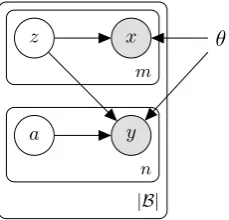
Figure 1: A sequence xm
1 is generated conditioned
on a sequence of random embeddingszm1 ; generating
the foreign sequenceyn
1 further requires latent lexical
alignmentsan
1.
2 EMBEDALIGN
In a nutshell, we model a distribution over pairs of sentences expressed in two languages, namely, a language of interestL1, and an auxiliary language L2which our model uses to mine some learning signal. Our model, EMBEDALIGN, is governed by
a simple generative story:
1. sample a lengthmfor a sentence inL1and a lengthnfor a sentence inL2;
2. generate a sequence z1, . . . , zm of d -dimensional random embeddings by sampling independently from a standard Gaussian prior; 3. generate a word observationxiin the vocabu-lary ofL1conditioned on the random embed-dingzi;
4. generate a sequenceai, . . . , anofnrandom alignments—each maps from a positionaj in
xm
1 to a positionjin theL2sentence;
5. finally, generate an observationyj in the vo-cabulary of L2 conditioned on the random embeddingzaj that stands forxaj.
The model is parameterised by neural networks and parameters are estimated to maximise a lower-bound on log-likelihood of joint observations. In the following, we present the model formally (§2.1), discuss efficient training (§2.2), and con-crete architectures (§2.3).
2.1 Probabilistic model
Notation We use block capitals (e.g. X) for
ran-dom variables, lowercase letters (e.g. x) for
as-signments, and the shorthandX1m for a sequence X1, . . . , Xm. Boldface letters are reserved for
de-terministic vectors (e.g.v) and matrices (e.g.W).
Finally,E[f(Z);α]denotes the expected value of
f(z)under a densityq(z|α).
We model a joint distribution over bilingual par-allel data, i.e., L1–L2sentence pairs. An obser-vation is a pair of random sequenceshX1m, Y1ni, where a random variableX(Y) takes on values in
the vocabulary ofL1(L2). For ease of exposition, the lengthm(n) of each sequence is assumed
ob-served throughout. TheL1sentence is generated one word at a time from a random sequence of la-tent embeddingsZ1m, eachZ taking on values in
Rd. TheL2sentence is generated one word at a time given a random sequence of latent alignments
An1, whereAj ∈ {1, . . . , m}is the position in the L1sentence to whichyj aligns.2
For i ∈ {1, . . . , m} and j ∈ {1, . . . , n} the
generative story is
Zi ∼ N(0,I) (1a)
Xi|zi ∼Cat(f(zi;θ)) (1b)
Aj|m∼ U(1/m) (1c)
Yj|z1m, aj ∼Cat(g(zaj;θ)) (1d)
and Figure1is a graphical depiction of our model. We map from latent embeddings to categorical dis-tributions over either vocabulary using a neural network whose parameters are deterministic and collectively denote byθ(thegenerative parame-ters). The marginal likelihood of a sentence pair is shown in Equation (2).
Pθ(xm1 , yn1|m, n) =
Z
p(z1m) m Y
i=1
Pθ(xi|zi)
×
n Y
j=1
m X
aj=1
P(aj|m)Pθ(yj|zaj)dz1m
(2)
Due to the conditional independences of our model, it is trivial to marginalise lexical alignments for any given latent embeddingszm
1 , but
marginalis-ing the embeddmarginalis-ings themselves is intractable. Thus, we employ amortised mean field variational infer-ence using the inferinfer-ence model
qφ(zm1 |xm1 ),
m Y
i=1
N(zi|ui,diag(sisi)) (3)
where each factor is a diagonal Gaussian. We map fromxm
1 to a sequenceum1 of independent posterior
2We padL1sentences with NULLto account for
[image:2.595.123.238.62.172.2]mean (or location) vectors, whereui ,µ(hi;φ), as well as a sequencesm1 of independent standard
deviation (or scale) vectors, wheresi ,σ(hi;φ), and hm
1 = enc(xm1 ;φ) is a deterministic
encod-ing of the L1sequence (we discuss concrete ar-chitectures in§2.3). All mappings are realised by
neural networks whose parameters are collectively denoted byφ(thevariational parameters). Note
that we choose to approximate the posterior with-out conditioning onyn
1. This allows us to use the
inference model formonolingualprediction in ab-sence ofL2data.
Variational φand generative θparameters are
jointly point-estimated to attain a local optimum of the evidence lowerbound (Jordan et al.,1999):
logPθ(xm1 , yn1|m, n)≥
m X
i=1
E[logPθ(xi|Zi);ui,si]
+ n X
j=1
E log
m X
aj=1
P(aj|m)Pθ(yj|Zaj);um1 ,sm1
−
m X
i=1
KL [N(ui,diag(sisi))||N(0,I)] .
(4) The variational family is location-scale, thus we can rely on stochastic optimisation (Robbins and Monro,1951) and automatic differentiation ( Bay-din et al.,2015) with reparameterised gradient esti-mates (Kingma and Welling,2014;Rezende et al., 2014;Titsias and L´azaro-Gredilla,2014). More-over, because the Gaussian density is an exponen-tial family, theKL terms in (4) are available in closed-form (Kingma and Welling,2014, Appendix B).
2.2 Efficient training
The likelihood terms in the ELBO (4) require eval-uating two softmax layers over rather large vo-cabularies. This makes training prohibitively slow and calls for efficient approximation. We employ an approximation proposed byBotev et al.(2017) termedcomplementary sum sampling(CSS), which we review in this section.
Consider the likelihood term logP(X = x|z) that scores an observationxgiven a sampled em-beddingz—we use serif fontxto distinguish a par-ticular observation from an arbitrary eventx∈ X
in the support. The exact class probability
P(X=x|z) = P exp(u(z,x)) x∈Xexp(u(z, x))
(5)
requires a normalisation over the complete support. CSS works by splitting the support into two sets, a setC that is explicitly summed over and must
include thepositiveclassx, and another setN that is a subset of the complement setX \C. We obtain
an estimate for the normaliser X
x∈C
exp(u(z, x)) + X x∈N
κ(x) exp(u(z, x)) (6)
by importance- or Bernoulli-sampling from the sup-port using a proposal distribution Q(X), where
κ(x)corrects for bias asN tends to the entire com-plement set. In this paper, we design C and N
per training mini-batch: we takeCto consist of all unique words in a mini-batch of training samples andN to consist of103negative classes uniformly
sampled from the complement setX \ C, in which caseκ(x) = 10−3|X \ C|.3
CSS makes it particularly easy to approximate likelihood terms such as those with respect toL2 in Equation (4). Because those terms depend on a marginalisation over alignments, an approxima-tion must give support to all words in the sequence
y1n. With CSS this is extremely simple, we just
need to make sure all unique words inyn
1 are in the
setC—which our mini-batch procedure does guar-antee.Botev et al.(2017) show that CSS is rather stable and superior to the most popularsoftmax ap-proximations. Besides being simple to implement, CSS also addresses a few problems with other ap-proximations. To name a few: unlike importance sampling approximations, CSS converges to the exactsoftmaxwith bounded computation (it takes as many samples as there are classes). Unlike hier-archicalsoftmax, CSS only affects training, that is, at test time we simply use the entire support instead of the approximation.
Without a softmax approximation, inference for our model would take time proportional to
O(m×vx+m×vy+m×n)wherevx(vy) cor-responds to the size of the vocabulary ofL1(L2). The first term (m×vx) corresponds to projecting from m latent embeddings to m categorical
dis-tributions over the vocabulary ofL1. The second term (m×vy) corresponds to projecting the same
mlatent embeddings tomcategorical distributions
over the vocabulary ofL2. Finally, the third term (m×n) is due to marginalisation of alignments.
3We sample uniformly from the complement set until we
have103unique classes. We realise this operation outside
Note, however, that with the CSS approximation we drop the dependency on vocabulary sizes (as the combined sizes ofCandN is an independent
constant). Moreover, if inference is performed on GPU, the squared term (m×n≈m2) is amortised
due to parallelism. Thus, while training our model is somewhat slower than monolingual models of word representation, which typically run inO(m), it is not at all impracticably slower.
2.3 Architectures
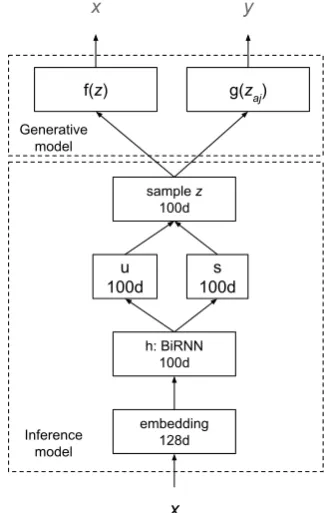
Here we present the neural network architectures that parameterise the different generative and vari-ational components of§2.1. Refer to AppendixB for an illustration.
Generative model We have two generative com-ponents, namely, a categorical distribution over the vocabulary ofL1and another over the vocabulary ofL2. We predict the parameter (event probabili-ties) of each distribution with an affine transforma-tion of a latent embedding followed by thesoftmax nonlinearity to ensure normalisation:
f(zi;θ) = softmax (W1zi+b1) (7a)
g(zaj;θ) = softmax W2zaj+b2
(7b)
where W1 ∈ Rvx×d, b1 ∈ Rvx, W2 ∈ Rvy×d,
b2 ∈ Rvy, andvx (vy) is the size of the vocab-ulary of L1 (L2). With the approximation of
§2.2, we replace the L1 softmax layer (7a) by exp zi>cx+bx
normalised by the CSS estimate (6) at training, and similarly for the L2softmax layer (7b). In that case, we have parameters for
cx,cy ∈Rd—deterministic embeddings forxand
y, respectively—as well as bias termsbx, by ∈R.
Inference model We predict approximate poste-rior parameters using two independent transforma-tions
ui =M1hi+d1 (8a)
si = softplus(M2hi+d2) (8b)
of a shared representationhi ∈Rdxof theith word in theL1sequencexm1 —whereM1,M2 ∈Rd×dx
are projection matrices,d1,d2∈Rdare bias
vec-tors, and thesoftplusnonlinearity ensures that stan-dard deviations are non-negative. To obtain the deterministic encoding hm1 , we employ two
dif-ferent architectures: (1) a bag-of-words (BOW)
encoder, wherehi is a deterministic projection of
xi ontoRdx; and (2) a bidirectional (BIRNN) en-coder, wherehi is the element-wise sum of two
LSTM hidden states (ith step) that process the se-quence in opposite directions. We use128units for deterministic embeddings, and100 units for LSTMs (Hochreiter and Schmidhuber,1997) and latent representations (i.e.d= 100).
3 Experiments
We start the section describing the data used to estimate our model’s parameters as well as details about the optimiser. The remainder of the section presents results on various benchmarks.
Training data We train our model on bilingual parallel data. In particular, we use parliament proceedings (Europarl-v7) (Koehn, 2005) from two language pairs: French and English-German.4 We employed very minimal preprocess-ing, namely, tokenisation and lowercasing using scripts from MOSES(Koehn et al.,2007), and have
discarded sentences longer than50tokens. Table1 lists more information about the training data, in-cluding the English-French Giga web corpus (Bojar et al.,2014) which we use in§3.4.5
Corpus Sentence pairs Tokens Europarl EN-FR 1.7 42.5 Europarl EN-DE 1.7 43.5 Giga EN-FR 18.3 419.6
Table 1: Training data size (in millions).
Optimiser For all architectures, we use the Adam optimiser (Kingma and Ba, 2014) with a learning rate of10−3. Except where explicitly in-dicated, we
• train our models for 30 epochs using mini batches of100sentence pairs;
• use validation alignment error rate for model selection;
• train every model10times with random Glo-rotinitialisation (Glorot and Bengio,2010) and report mean and standard deviation;
• anneal the KL terms using the following schedule: we use a scalarαfrom0to1with additive steps of size10−3every500updates. 4The proposed model is not limited to these language pairs. 5As we investigate various configurations and train every
This means that at the beginning of the train-ing, we allow the model to overfit to the like-lihood terms, but towards the end we are opti-mising the true ELBO (Bowman et al.,2016).
It is also important to highlight that we do not employ regularisation techniques (such as batch normalisation, dropout, orL2penalty) for they did
not seem to yield consistent results.
3.1 Word alignment
Since our model leverages learning signal from parallel data by marginalising latent lexical align-ments, we use alignment error rate to double check whether the model learns sensible word correspon-dences. Intrinsic assessment of word alignment quality requires manual annotation. For English-French, we use the NAACL English-French hand-aligned data (37sentence pairs for validation and 447for test) (Mihalcea and Pedersen,2003). For English-German, we use the data byPad´o and La-pata(2006) (98 sentence pairs for validation and 987for test). Alignment quality is then measured in terms of alignment error rate (AER) (Och and Ney,2000)—an F-measure over predicted align-ment links. For prediction we condition on the posterior meansE[Z1m]which is just the predicted variational meansum1 and select theL1position for which P(yj, aj|um1 ) is maximum (a form of
approximate Viterbi alignment).
Model L1accuracy L2accuracy ↓AER BOW 95.59±2.22 5.69±2.07 35.41±1.16
BOWα 99.87±0.22 6.16±0.39 30.94±2.49
BIRNN 95.72±1.28 7.31±0.64 34.32±1.08
[image:5.595.75.289.486.551.2]BIRNNα 99.97±0.09 7.25±0.62 29.18±1.91
Table 2: English-French validation ↑accuracy and ↓ AER results.
Model L1accuracy L2accuracy ↓AER BOW 93.51±0.56 10.09±0.20 53.66±0.36
BOWα 97.72±2.28 9.71±0.63 52.81±1.47
BIRNN 99.78±0.18 8.63±0.35 55.55±0.67
BIRNNα 99.96±0.05 8.32±0.29 52.32±1.77
Table 3: English-German validation ↑accuracy and ↓AER results.
We start by analysing validation results and se-lecting amongst a few variants of EMBEDALIGN.
We investigate the use of annealing and the use of a
bidirectional encoder in the variational approxima-tion. Table2(3) lists↓AER for EN-FR(EN-DE)
as well as accuracy of word prediction. It is clear that both annealing (systems decorated with sub-scriptα) and bidirectional representations improve
the results across the board. In the rest of the pa-per we still investigate whether or not recurrent encoders help, but we always report results based on annealing.
In order to establish baselines for our mod-els we report IBM modmod-els 1 and 2 (Brown et al., 1993). In a nutshell, IBM models 1 and 2 both estimate the conditional P(yj|xm1 ) =
Pm
aj=1P(aj|m)P(yj|xaj) by marginalisation of latent lexical alignments. The only difference be-tween the two models is the prior over alignments, which is uniform for IBM1 and categorical for IBM2. An important difference between IBM mod-els and EMBEDALIGNconcerns the lexical
distri-bution. IBM models are parameterised with inde-pendent categorical parameters, while our model instead is parameterised by a neural network. IBM models condition on a single categorical eventxaj, namely, the word aligned to. Our model instead conditions on the latent embeddingzaj that stands for the word aligned to.
In order to establish even stronger conditional alignment models, we embed the conditioning words and replace IBM1’s independent parame-ters by a neural network (single hidden layer MLP). We call this model aneural IBM1(or NIBM for short). Note that in an IBM model, the sequence
xm
1 is never modelled, therefore we can condition
on it without restrictions. For that reason, we also experiment with a bidirectional LSTM encoder and condition lexical distributions on its hidden states.
Model En-Fr En-De
IBM1 32.45 46.71
IBM2 22.61 40.11
NIBMBoW 27.35±0.19 46.22±0.07
NIBMBiRNN 25.57±0.40 43.37±0.11
EMBALIGNBoW 30.97±2.53 49.46±1.72
[image:5.595.311.524.561.661.2]EMBALIGNBiRNN 29.43±1.84 48.09±2.12
Table 4: Test↓AER.
[image:5.595.72.295.611.677.2]word-to-word correspondences. EMBEDALIGNcannot
catch up with NIBM, but that is not necessarily surprising. Note that NIBM is a conditional model, thus it can use all of its capacity to better explainL2 data. EMBEDALIGN, on the other hand, has to find
a compromise between generating both streams of the data. To make that point a bit more obvious, Table 5(6) lists accuracy of word prediction for EN-FR(EN-DE). Note that, without sacrificingL2 accuracy, and sometimes even improving it, EMBE -DALIGNachieves very highL1accuracy. This still does not imply that induced representations have captured aspects of lexical semantics such as word senses. All this means is that we have induced fea-tures that are jointly good at reconstructing both streams of the data one word at time. Of course it is tempting to conclude that our models must be capturing some useful generalisations. For that, the next sections will investigate a range of semantic NLP tasks.
Model L1accuracy L2accuracy NIBMBoW - 7.21±0.16
NIBMBiRNN - 6.47±0.45
[image:6.595.310.522.63.210.2]EMBALIGNBoW 98.90±0.41 7.08±0.34 EMBALIGNBiRNN 99.21±0.18 7.44±0.61
Table 5: English-French↑accuracy in test set
Model L1accuracy L2accuracy NIBMBoW - 7.94±0.03
NIBMBiRNN - 8.38±0.10
EMBALIGNBoW 96.86±2.89 8.72±0.39
EMBALIGNBiRNN 99.32±0.34 8.00±0.12
Table 6: English-German↑accuracy in test set
3.2 Lexical substitution task
The English lexical substitution task (LST) consists in selecting a substitute word for a target wordin context(McCarthy and Navigli,2009). In the most traditional variant of the task, systems are presented with a list of potential candidates and this list must be sorted by relatedness.
Dataset The LST dataset includes 201 target words present in10sentences/contexts each, along with a manually annotated list of potential replace-ments. The data are split in300instances for vali-dation and1,710for test. Systems are evaluated by
Model cos KL
RANDOM 30.0
-SKIPGRAM 44.9
-BSG - 46.1
ENBoW 29.75±0.55 27.93±0.25
ENBiRNN 21.31±1.05 27.64±0.40 EN-FRBoW 42.72±0.36 41.90±0.35 EN-FRBiRNN 42.19±0.57 41.61±0.55 EN-DEBoW 41.90±0.58 40.63±0.55
EN-DEBiRNN 42.07±0.47 40.93±0.59
Table 7: English↑GAP on LST test data.
comparing the predicted ranking to the manual one in terms of generalised average precision (GAP) (Melamud et al.,2015).
Prediction We use EMBEDALIGN to encode
each candidate (in context) as a posterior Gaus-sian density. Note that this task dispenses with inferences aboutL2. Each candidate is compared to the target word in context through a measure of overlap between their inferred densities—we take KLdivergence. We then rank candidates using this measure.
Table 7 lists GAP scores for variants of EM -BEDALIN(bottom section) as well as some
base-lines and other established methods (top section). For comparison, we also compute GAP by sorting candidates in terms of cosine similarity, in which case we take the Gaussian mean as a summary of the density. The top section of the table con-tains systems reported byMelamud et al.(2015) (RANDOM and SKIPGRAM) and by Brazinskas
et al.(2017) (BSG). Note that both SKIPGRAM
(Mikolov et al.,2013) and BSG were trained on the very large ukWaC English corpus (Ferraresi et al., 2008). SKIPGRAM is known to perform
remarkably well regardless of its apparent insen-sitivity to context (in terms of design). BSG is a close relative of our model which gives SKIPGRAM
a Bayesian treatment (also by means of amortised variational inference) and is by design sensitive to context in a manner similar to EMBEDALIGN, that
is, through its inferred posteriors.
[image:6.595.74.290.343.421.2]Model MR CR SUBJ MPQA SST TREC MRPC SICK-R SICK-E SST14
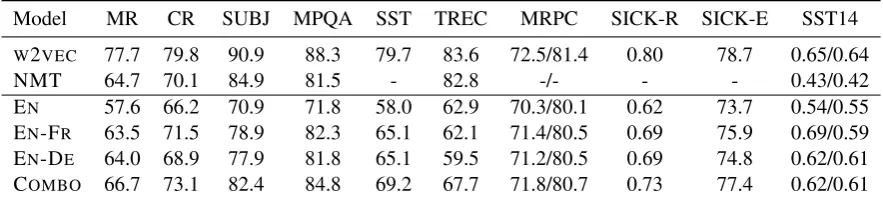
W2VEC 77.7 79.8 90.9 88.3 79.7 83.6 72.5/81.4 0.80 78.7 0.65/0.64
NMT 64.7 70.1 84.9 81.5 - 82.8 -/- - - 0.43/0.42 EN 57.6 66.2 70.9 71.8 58.0 62.9 70.3/80.1 0.62 73.7 0.54/0.55
EN-FR 63.5 71.5 78.9 82.3 65.1 62.1 71.4/80.5 0.69 75.9 0.69/0.59 EN-DE 64.0 68.9 77.9 81.8 65.1 59.5 71.2/80.5 0.69 74.8 0.62/0.61
[image:7.595.78.520.63.164.2]COMBO 66.7 73.1 82.4 84.8 69.2 67.7 71.8/80.7 0.73 77.4 0.62/0.61
Table 8: English sentence evaluation results: the last four rows correspond to the mean of 10 runs with EMBE-DALIGNmodels. All models, butW2VEC, employ bidirectional encoders.
leave it as a rather speculative point. One addi-tional point worth highlighting: the middle section of Table7. ENBoW and ENBiRNNshow what
hap-pens when we do not give EMBEDALIGNL2 su-pervision at training. That is, imagine the model of Figure1without the bottom plate. In that case, the model representations overfit forL1 word-by-word prediction. Without the need to predict any notion of context (monolingual or otherwise), the representations drift away from semantic-driven generalisations and fail at lexical substitution. 3.3 Sentence Evaluation
Conneau et al.(2017) developed a framework to evaluate unsupervised sentence level representa-tions trained on large amounts of data on a range of supervised NLP tasks. We assess our induced repre-sentations using their framework on the following benchmarks evaluated on classification↑accuracy
(MRPC is further evaluated on↑F1)
MR classification of positive or negative movie reviews;
SST fined-grained labelling of movie reviews from the Stanford sentiment treebank (SST); TREC classification of questions intok-classes; CR classification of positive or negative product
reviews;
SUBJ classification of a sentence into subjective or objective;
MPQA classification of opinion polarity; SICK-E textual entailment classification;
MRPC paraphrase identification in the Microsoft paraphrase corpus;
as well as the following benchmarks evaluated on the indicated correlation metric(s)
SICK-R semantic relatedness between two sen-tences (↑Pearson);
SST-14 semantic textual similarity (↑Pearson/Spearman).
Prediction We use EMBEDALIGN to annotate
every word in the training set of the benchmarks above with the posterior mean embedding in con-text. We then average embeddings in a sentence and give that as features to a logistic regression classifier trained with5-fold cross validation.6
For comparison, we report a SKIPGRAMmodel
(here indicated asW2VEC) as well as a model that
uses the encoder of a neural machine translation system (NMT) trained on English-French Europarl data. In both cases, we report results byConneau et al.(2017). Table8shows the results for all bench-marks.7 We report EMBEDALIGNtrained on either EN-FRor EN-DE. The last line (COMBO) shows
what happens if we train logistic regression on the concatenation of embeddings inferred by both EM -BEDALIGN models, that is, EN-FR and EN-DE.
Note that these two systems perform sometimes better sometimes worse depending on the bench-mark. There is no clear pattern, but differences may well come from some qualitative difference in the induced latent space. It is a known fact that differ-ent languages realise lexical ambiguities differdiffer-ently, thus representations induced towards different lan-guages are likely to capture different generalisa-tions.8 As COMBOresults show, the representa-tions induced from different corpora are somewhat complementary. That same observation has guided paraphrasing models based on pivoting (Bannard and Callison-Burch,2005). Once more we report a monolingual variant of EMBEDALIGN(indicated
by EN) in an attempt to illustrate how crucial the
6http://scikit-learn.org/stable/
7In AppendixAwe provide bar plots marked with error
bars (2standard deviations).
8We also acknowledge that our treatment of German is
translation signal is.
3.4 Word similarity
Word similarity benchmarks are composed of word pairs which are manually ranked out of context. For completeness, we also tried evaluating our embed-dings in such benchmarks despite our work being focussed on applications where context matters.
Prediction To assign an embedding for a word type, we infer Gaussian posteriors for all training instances of that type in context and aggregate the posterior means through an average (effectively collapsing all instances).
To cover the vocabulary of the typical bench-mark, we have to use a much larger bilingual col-lection than Europarl. Based on the results of§3.1,
we decided to proceed with English-French only— recall that models based on that pair performed better in terms of AER. Results in this section are based on EMBEDALIGN (with bidirectional
vari-ational encoder) trained on the Giga web corpus (see Table1for statistics). Due to the scale of the experiment, we report on a single run.
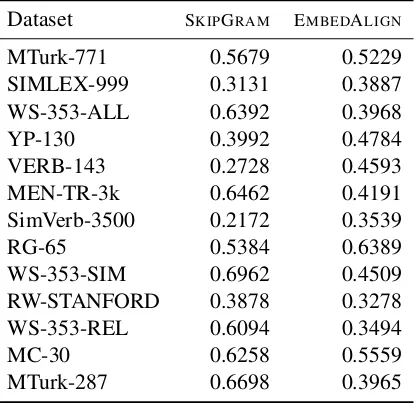
We trained on Giga with the same hyperparam-eters that we trained on Europarl, however, for3 epochs instead of30 (with this dataset an epoch amounts to 183,000 updates). Again, we per-formed model selection on AER. Table9 shows the results for several datasets using the framework of Faruqui and Dyer(2014a). Note that EMBE -DALIGNwas designed to make use of context
in-formation, thus this evaluation setup is a bit un-natural for our model. Still, it outperforms SKIP
-GRAMon 5 out of 13 benchmarks, in particular, on
SIMLEX-999, whose relevance has been argued by Upadhyay et al.(2016). We also remark that this model achieves0.25test AER and45.16test GAP on lexical substitution—a considerable improve-ment compared to models trained on Europarl and reported in Tables4(AER) and7(GAP).
4 Related work
Our model is inspired by lexical alignment mod-els such as IBM1 (Brown et al.,1993), however, we generate words yn1 from a latent vector
repre-sentationz1m ofxm1 , rather than directly from the
observationxm
1 . IBM1 takesL1sequences as
con-ditioning context and does not model their distribu-tion. Instead, we propose a joint model, whereL1 sentences are generated from latent embeddings.
Dataset SKIPGRAM EMBEDALIGN
MTurk-771 0.5679 0.5229
SIMLEX-999 0.3131 0.3887
WS-353-ALL 0.6392 0.3968
YP-130 0.3992 0.4784
VERB-143 0.2728 0.4593
MEN-TR-3k 0.6462 0.4191
SimVerb-3500 0.2172 0.3539
RG-65 0.5384 0.6389
WS-353-SIM 0.6962 0.4509
RW-STANFORD 0.3878 0.3278
WS-353-REL 0.6094 0.3494
MC-30 0.6258 0.5559
[image:8.595.314.522.63.265.2]MTurk-287 0.6698 0.3965
Table 9: Evaluation of English word embeddings out of context in terms of Spearman’s rank correlation coeffi-cient (↑). The first column is from (Faruqui and Dyer, 2014a).
There is a vast literature on exploiting multilin-gual context to strengthen the notion of synonymy captured by monolingual models. Roughly, the lit-erature splits into two groups, namely, approaches that derive additional features and/or training objec-tives based on pre-trained alignments (Klementiev et al.,2012;Faruqui and Dyer,2014b;Luong et al., 2015; ˇSuster et al.,2016), and approaches that pro-mote a joint embedding space by working with sentence level representations that dispense with explicit alignments (Hermann and Blunsom,2014; AP et al., 2014; Gouws et al., 2015; Hill et al., 2014).
The work of Koˇcisk´y et al. (2014) is closer to ours in that they also learn embeddings by marginalising alignments, however, their model is conditional—much like IBM models—and their embeddings are not part of the probabilistic model, but rather part of the architecture design. The joint formulation allows our latent embeddings to har-vest learning signal fromL2while still being driven by the learning signal fromL1—in a conditional model the representations can become specific to alignment deviating from the purpose of well rep-resenting the original language. In §3 we show
substantial evidence that our model performs better when using both learning signals.
a point estimate cannot. Brazinskas et al.(2017) recast the skip-gram model as a conditional varia-tional auto-encoder. They induce a Gaussian den-sity for each occurrence of a word in context, and for that their model is the closest to ours. Addi-tionally, they estimate a Gaussian prior per word type thus representing both types and occurrences. Unlike our model, the Bayesian skip-gram is not trained generatively by reconstructing the data, but rather discriminatively by prediction of overlapping sets of neighbouring words.
5 Discussion
We have presented a generative model of word representation that learns from positive correlations implicitly expressed in translation data. In order to make these correlations surface, we induce and marginalise latent lexical alignments.
Embedding models such as CBOW and skip-gram (Mikolov et al.,2013) are essentially speak-ing supervised classifiers. This means they depend on somewhat artificial strategies to derive labelled data from monolingual corpora—words far from the central word still have co-occurred with it even though they are taken as negative evidence. Train-ing our proposed model does not require a heuris-tic notion of negative training data. However, the model is also based on a somewhat artificial as-sumption: L1 words do not necessarily need to have anL2equivalent and, even when they do, this equivalent need not be realised as a single word.
We have shown with extensive experiments that our model can induce representations useful to sev-eral tasks including but not limited to alignment (the task it most obviously relates to). We observed interesting results on semantic natural language processing benchmarks such as natural language inference, lexical substitution, paraphrasing, and sentiment classification.
We are currently expanding the notion of dis-tributional context to multiple auxiliary foreign languages at once. This seems to only require minor changes to the generative story and could increase the model’s disambiguation power dra-matically. Another direction worth exploring is to extend the model’s hierarchy with respect to how parallel sentences are generated. For exam-ple, modelling sentence level latent variables may capture global constraints and expose additional correlations to the model.
Acknowledgments
We thank Philip Schulz for comments on an ear-lier version of this paper as well as the anonymous NAACL reviewers. One of the Titan Xp cards used for this research was donated by the NVIDIA Cor-poration. This work was supported by the Dutch Organization for Scientific Research (NWO) VICI Grant nr. 277-89-002.
References
Sarath Chandar AP, Stanislas Lauly, Hugo Larochelle, Mitesh Khapra, Balaraman Ravin-dran, Vikas C Raykar, and Amrita Saha. 2014. An autoencoder approach to learning bilingual word representations. InAdvances in Neural Information Processing Systems. pages 1853– 1861.
Colin Bannard and Chris Callison-Burch. 2005. Paraphrasing with bilingual parallel corpora. In Proceedings of the 43rd Annual Meet-ing on Association for Computational Lin-guistics. Association for Computational Lin-guistics, Stroudsburg, PA, USA, ACL ’05, pages 597–604. https://doi.org/10. 3115/1219840.1219914.
Atilim Gunes Baydin, Barak A Pearlmutter, Alexey Andreyevich Radul, and Jeffrey Mark Siskind. 2015. Automatic differentiation in machine learning: a survey. arXiv preprint arXiv:1502.05767.
Ondrej Bojar, Christian Buck, Christian Feder-mann, Barry Haddow, Philipp Koehn, Jo-hannes Leveling, Christof Monz, Pavel Pecina, Matt Post, Herve Saint-Amand, Radu Sori-cut, Lucia Specia, and Aleˇs Tamchyna. 2014. Findings of the 2014 workshop on statis-tical machine translation. In Proceedings of the Ninth Workshop on Statistical Ma-chine Translation. Association for Computa-tional Linguistics, Baltimore, Maryland, USA, pages 12–58. http://www.aclweb. org/anthology/W/W14/W14-3302.
Samuel R. Bowman, Gabor Angeli, Christopher Potts, and Christopher D. Manning. 2015. A large annotated corpus for learning natural language inference. In Proceedings of the 2015 Conference on Empirical Methods in Natural Language Processing. Association for Computational Linguistics, Lisbon, Portugal, pages 632–642. http://aclweb.org/ anthology/D15-1075.
Samuel R. Bowman, Luke Vilnis, Oriol Vinyals, Andrew M. Dai, Rafal J´ozefowicz, and Samy Bengio. 2016. Generating sentences from a continuous space. InProceedings of the 20th SIGNLL Conference on Computational Natu-ral Language Learning, CoNLL 2016, Berlin, Germany, August 11-12, 2016. pages 10–21.
Arthur Brazinskas, Serhii Havrylov, and Ivan Titov. 2017. Embedding words as distributions with a bayesian skip-gram model. Arxiv: 1711.11027.
Peter F. Brown, Vincent J. Della Pietra, Stephen A. Della Pietra, and Robert L. Mercer. 1993. The mathematics of statistical machine trans-lation: parameter estimation. Computational Linguistics19(2):263–311.
Ronan Collobert, Jason Weston, L´eon Bottou, Michael Karlen, Koray Kavukcuoglu, and Pavel Kuksa. 2011. Natural lan-guage processing (almost) from scratch.
J. Mach. Learn. Res. 12:2493–2537. http://dl.acm.org/citation. cfm?id=1953048.2078186.
Alexis Conneau, Douwe Kiela, Holger Schwenk, Loic Barrault, and Antoine Bordes. 2017. Su-pervised learning of universal sentence rep-resentations from natural language inference data. arXiv preprint arXiv:1705.02364.
Mona Diab and Philip Resnik. 2002. An unsuper-vised method for word sense tagging using parallel corpora. InProceedings of 40th An-nual Meeting of the Association for Compu-tational Linguistics. Association for Compu-tational Linguistics, Philadelphia, Pennsylva-nia, USA, pages 255–262. https://doi. org/10.3115/1073083.1073126.
Manaal Faruqui and Chris Dyer. 2014a. Commu-nity evaluation and exchange of word vectors
at wordvectors.org. In Proceedings of the 52nd Annual Meeting of the Association for Computational Linguistics: System Demon-strations. Association for Computational Lin-guistics, Baltimore, USA.
Manaal Faruqui and Chris Dyer. 2014b. Im-proving vector space word representations using multilingual correlation. In Proceed-ings of the 14th Conference of the Euro-pean Chapter of the Association for Com-putational Linguistics. Association for Com-putational Linguistics, Gothenburg, Sweden, pages 462–471. http://www.aclweb. org/anthology/E14-1049.
Adriano Ferraresi, Eros Zanchetta, Marco Baroni, and Silvia Bernardini. 2008. Introducing and evaluating ukwac, a very large web-derived corpus of english. InIn Proceedings of the 4th Web as Corpus Workshop (WAC-4.
J. R. Firth. 1957. A synopsis of linguistic the-ory 1930-1955. Studies in Linguistic Analysis
pages 1–32.
Xavier Glorot and Yoshua Bengio. 2010. Under-standing the difficulty of training deep feedfor-ward neural networks. In Yee Whye Teh and Mike Titterington, editors,Proceedings of the Thirteenth International Conference on Artifi-cial Intelligence and Statistics. PMLR, Chia Laguna Resort, Sardinia, Italy, volume 9 of
Proceedings of Machine Learning Research, pages 249–256. http://proceedings. mlr.press/v9/glorot10a.html.
Stephan Gouws, Yoshua Bengio, and Greg Cor-rado. 2015. Bilbowa: Fast bilingual dis-tributed representations without word align-ments. In Francis Bach and David Blei, editors, Proceedings of the 32nd Interna-tional Conference on Machine Learning. PMLR, Lille, France, volume 37 of Proceed-ings of Machine Learning Research, pages 748–756. http://proceedings.mlr. press/v37/gouws15.html.
Zellig S. Harris. 1954. Distributional structure.
Word10(23):146–162.
the 52nd Annual Meeting of the Associa-tion for ComputaAssocia-tional Linguistics (Volume 1: Long Papers). Association for Compu-tational Linguistics, Baltimore, Maryland, pages 58–68. http://www.aclweb. org/anthology/P14-1006.
Felix Hill, Kyunghyun Cho, Sebastien Jean, Coline Devin, and Yoshua Bengio. 2014. Embedding word similarity with neural machine transla-tion.arXiv preprint arXiv:1412.6448. Sepp Hochreiter and J¨urgen Schmidhuber. 1997.
Long short-term memory. Neural Comput.
9(8):1735–1780. https://doi.org/10. 1162/neco.1997.9.8.1735.
MichaelI. Jordan, Zoubin Ghahramani, TommiS. Jaakkola, and LawrenceK. Saul. 1999. An introduction to variational methods for graph-ical models. Machine Learning 37(2):183– 233.
Diederik P. Kingma and Jimmy Ba. 2014. Adam: A method for stochastic optimization. CoRR
abs/1412.6980.
Diederik P. Kingma and Max Welling. 2014. Auto-encoding variational bayes. InInternational Conference on Learning Representations.
Alexandre Klementiev, Ivan Titov, and Binod Bhat-tarai. 2012. Inducing crosslingual distributed representations of words. In Proceedings of COLING 2012. The COLING 2012 Or-ganizing Committee, Mumbai, India, pages 1459–1474.http://www.aclweb.org/ anthology/C12-1089.
Philipp Koehn. 2005. Europarl: A Parallel Corpus for Statistical Machine Translation. In Confer-ence Proceedings: the tenth Machine Trans-lation Summit. AAMT, AAMT, Phuket, Thai-land, pages 79–86.http://mt-archive. info/MTS-2005-Koehn.pdf.
Philipp Koehn, Hieu Hoang, Alexandra Birch, Chris Callison-Burch, Marcello Federico, Nicola Bertoldi, Brooke Cowan, Wade Shen, Christine Moran, Richard Zens, Chris Dyer, Ondˇrej Bojar, Alexandra Constantin, and Evan Herbst. 2007. Moses: Open source toolkit for statistical machine trans-lation. In Proceedings of the 45th An-nual Meeting of the ACL on Interactive
Poster and Demonstration Sessions. Associa-tion for ComputaAssocia-tional Linguistics, Strouds-burg, PA, USA, ACL ’07, pages 177–
180. http://dl.acm.org/citation.
cfm?id=1557769.1557821.
Tom´aˇs Koˇcisk´y, Karl Moritz Hermann, and Phil Blunsom. 2014. Learning Bilingual Word Representations by Marginalizing Alignments. InProceedings of ACL.
Omer Levy and Yoav Goldberg. 2014a. Dependency-based word embeddings. InProceedings of the 52nd Annual Meeting of the Association for Computational Linguistics (Volume 2: Short Papers). Association for Computational Linguistics, Baltimore, Maryland, pages 302–308. http://www.
aclweb.org/anthology/P14-2050.
Omer Levy and Yoav Goldberg. 2014b. Linguis-tic regularities in sparse and explicit word representations. InProceedings of the Eigh-teenth Conference on Computational Natural Language Learning. Association for Compu-tational Linguistics, Ann Arbor, Michigan, pages 171–180. http://www.aclweb. org/anthology/W14-1618.
Thang Luong, Hieu Pham, and Christopher D Man-ning. 2015. Bilingual word representations with monolingual quality in mind. In Pro-ceedings of the 1st Workshop on Vector Space Modeling for Natural Language Processing. pages 151–159.
Diana McCarthy and Roberto Navigli. 2009. The english lexical substitution task. Language Resources and Evaluation43(2):139–159.
Oren Melamud, Omer Levy, and Ido Dagan. 2015. A simple word embedding model for lexi-cal substitution. In Proceedings of the 1st Workshop on Vector Space Modeling for
Nat-ural Language Processing, VS@NAACL-HLT 2015, June 5, 2015, Denver, Colorado, USA. pages 1–7.
Computational Linguistics, Stroudsburg, PA, USA, HLT-NAACL-PARALLEL ’03, pages 1–10. https://doi.org/10.3115/ 1118905.1118906.
Tomas Mikolov, Ilya Sutskever, Kai Chen, Greg S Corrado, and Jeff Dean. 2013. Distributed representations of words and phrases and their compositionality. In C.J.C. Burges, L. Bot-tou, M. Welling, Z. Ghahramani, and K.Q. Weinberger, editors, Advances in Neural In-formation Processing Systems 26, Curran As-sociates, Inc., pages 3111–3119.
Franz Josef Och and Hermann Ney. 2000. Im-proved statistical alignment models. In38th Annual Meeting of the Association for Compu-tational Linguistics, Hong Kong, China, Octo-ber 1-8, 2000..
Sebastian Pad´o and Mirella Lapata. 2006. Opti-mal constituent alignment with edge covers for semantic projection. In Proceedings of the 21st International Conference on Compu-tational Linguistics and 44th Annual Meet-ing of the Association for Computational Linguistics. Association for Computational Linguistics, Sydney, Australia, pages 1161– 1168. https://doi.org/10.3115/ 1220175.1220321.
Danilo Jimenez Rezende, Shakir Mohamed, and Daan Wierstra. 2014. Stochastic backprop-agation and approximate inference in deep generative models. InProceedings of the 31th International Conference on Machine Learn-ing, ICML 2014, BeijLearn-ing, China, 21-26 June 2014. pages 1278–1286.
Herbert Robbins and Sutton Monro. 1951. A stochastic approximation method.The Annals of Mathematical Statistics22(3):400–407.
Philip Schulz, Wilker Aziz, and Khalil Sima’an. 2016. Word alignment without null words. InProceedings of the 54th Annual Meeting of the Association for Computational Linguis-tics (Volume 2: Short Papers). Association for Computational Linguistics, Berlin, Germany, pages 169–174. http://anthology. aclweb.org/P16-2028.
Richard Socher, Jeffrey Pennington, Eric H. Huang, Andrew Y. Ng, and Christopher D.
Man-ning. 2011. Semi-supervised recursive au-toencoders for predicting sentiment distribu-tions. In Proceedings of the 2011 Confer-ence on Empirical Methods in Natural Lan-guage Processing. Association for Computa-tional Linguistics, Edinburgh, Scotland, UK., pages 151–161. http://www.aclweb. org/anthology/D11-1014.
Michalis Titsias and Miguel L´azaro-Gredilla. 2014. Doubly stochastic variational bayes for non-conjugate inference. InProceedings of the 31st International Conference on Machine Learning (ICML-14). pages 1971–1979.
Lifu Tu, Kevin Gimpel, and Karen Livescu. 2017. Learning to embed words in con-text for syntactic tasks. In Proceedings of the 2nd Workshop on Representation Learning for NLP. Association for Computa-tional Linguistics, Vancouver, Canada, pages 265–275. http://www.aclweb.org/ anthology/W17-2632.
Shyam Upadhyay, Manaal Faruqui, Chris Dyer, and Dan Roth. 2016.Cross-lingual models of word embeddings: An empirical comparison. InProceedings of the 54th Annual Meeting of the Association for Computational Linguis-tics (Volume 1: Long Papers). Association for Computational Linguistics, Berlin, Germany, pages 1661–1670.http://www.aclweb. org/anthology/P16-1157.
Luke Vilnis and Andrew McCallum. 2014. Word representations via gaussian embedding.
arXiv preprint arXiv:1412.6623.
Simon ˇSuster, Ivan Titov, and Gertjan van No-ord. 2016. Bilingual learning of multi-sense embeddings with discrete autoencoders. In
A Multiple runs sentence evaluation
Figure 2 shows multiple runs of our proposed model on sentence evaluation. The first figure re-ports the mean and two standard deviations (error bars) for benchmarks based on accuracy (ACC), the second figure reports benchmarks based on F1, and finally the third figure reports benchmarks based on correlation metrics Spearman (S) and Pearson (P).
Figure 2: Mean and two standard deviations (error bars) for 10 runs of EMBEDALIGNon the sentence eval-uation benchmarks.
B Architecture
Figure3shows the architecture for the inference and generative models in EMBEDALIGN, with
BiRNN encoder (h).
x
embedding 128d h: BiRNN
100d
u 100d f(z)
x
s 100d
sample z
100d
g(zaj) y
Generative model
Inference model
[image:13.595.333.497.139.396.2] [image:13.595.78.293.225.699.2]