Insights from Russian second language readability classification:
complexity-dependent training requirements, and
feature evaluation of multiple categories
Robert Reynolds
UiT: The Arctic University of Norway Postboks 6050 Langnes
9037 Tromsø, Norway
Abstract
I investigate Russian second language read-ability assessment using a machine-learning approach with a range of lexical, morpholog-ical, syntactic, and discourse features. Test-ing the model with a new collection of Russian L2 readability corpora achieves an F-score of 0.671 and adjacent accuracy 0.919 on a 6-level classification task. Information gain and fea-ture subset evaluation shows that morpholog-ical features are collectively the most infor-mative. Learning curves for binary classifiers reveal that fewer training data are needed to distinguish between beginning reading levels than are needed to distinguish between inter-mediate reading levels.
1 Introduction
Reading is one of the core skills in both first and second language learning, and it is arguably the most important means of accessing information in the modern world. Modern second language peda-gogy typically includes reading as a major compo-nent of foreign language instruction. There has been debate regarding the use of authentic materials ver-sus contrived materials, where authentic materials are defined as “A stretch of real language, produced by a real speaker or writer for a real audience and de-signed to convey a real message of some sort” (Mor-row, 1977, p. 13).1 Many empirical studies have demonstrated advantages to using authentic materi-als, including increased linguistic, pragmatic, and
1The definition of authenticity is itself a matter of disagree-ment (Gilmore, 2007, §2), but Morrow’s definition is both well-accepted and objective.
discourse competence (Gilmore, 2007, citations in §3). However, Gilmore (2007) notes that “Finding appropriate authentic texts and designing tasks for them can, in itself, be an extremely time-consuming process.” An appropriate text should arguably be interesting, linguistically relevant, authentic, recent, and at the appropriate reading level.
Tools to automatically identify a given text’s com-plexity would help remove one of the most time-consuming steps of text selection, allowing teach-ers to focus on pedagogical aspects of text selection. Furthermore, these tools would also make it possible for learners to find appropriate texts for themselves. A thorough conceptual and historical overview of readability research can be found in Vajjala (2015, §2.2). The last decade has seen a rise in research on readability classification, primarily focused on En-glish, but also including French, German, Italian, Portuguese, and Swedish (Roll et al., 2007; Vor der Brück et al., 2008; Aluisio et al., 2010; Francois and Watrin, 2011; Dell’Orletta et al., 2011; Hancke et al., 2012; Pilán et al., 2015). Broadly speaking, these languages have limited morphology in com-parison with Russian, which has relatively rich mor-phology among major world languages. It is there-fore not surprising that morphology has received lit-tle attention in studies of automatic readability clas-sification. One important exception is Hancke et al. (2012) which examines lexical, syntactic and mor-phological features with a two-level corpus of Ger-man magazine articles. In their study, morphologi-cal features are collectively the most predictive cat-egory of features. Furthermore, when combining feature categories in groups of two or three, the
highest performing combinations included the mor-phology category. If morphological features figure so prominently in German readability classification, then there is good reason to expect that they will be similarly informative for Russian second-language readability classification.
This article explores to what extent textual fea-tures based on morphological analysis can lead to successful readability classification of Russian texts for language learning. In Section 2, I give an overview of previous research on readability, includ-ing some work on Russian. The corpora collected for use in this study are described in Section 3. The features extracted for machine learning are outlined in Section 4. Results are discussed in Sections 5 and 6, and conclusions and outlook for future research are presented in Section 7.
2 Background
The history of empirical readability assessment be-gan as early as 1880 (DuBay, 2006), with methods as simple as counting sentence length by hand. Today, research on readability is dominated by machine-learning approaches that automatically extract com-plex features based on surface wordforms, part-of-speech analysis, syntactic parses, and models of lex-ical difficulty. In this section, I give an abbreviated history of the various approaches to readability as-sessment, including the kinds of textual features that have received attention. Although some proprietary solutions are relevant here, I focus primarily on work that has resulted in publically available knowledge and resources.
2.1 History of evaluating text complexity
The earliest approaches to readability analysis con-sisted of developing readability formulas, which combined a small number of easily countable fea-tures, such as average sentence length, and aver-age word length (Kincaid et al., 1975; Coleman and Liau, 1975). Although formulas for comput-ing readability have been criticized for becomput-ing overly simplistic, they were quickly adopted and remain in widespread use today.2 An early extension of
2The Flesch Reading Ease test and the Flesch-Kincaid Grade Level test are implemented in the proofing tools of many major word processors.
these simple ‘counting’ formulas was to addition-ally rely on lists of words deemed “easy”, based on either their frequency or polling of young learners (Dale and Chall, 1948; Chall and Dale, 1995; Sten-ner, 1996). A higher proportion of words belonging to these lists resulted in lower readability measures, and vice versa.
With the recent growth of natural language pro-cessing techniques, it has become possible to ex-tract information about the lexical and/or syntac-tic structure of a text, and automasyntac-tically train read-ability models using machine-learning techniques. Some of the earliest attempts at this built unigram language models based on American textbooks, and estimated a text’s reading level by testing how well it was described by each unigram model (Si and Callan, 2001; Collins-Thompson and Callan, 2004). This approach was extended in the REAP project3 to include a number of grammatical features as well (Heilman et al., 2007; Heilman et al., 2008a; Heil-man et al., 2008b).
Over time, readability researchers have increas-ingly taken inspiration from various subfields of lin-guistics to identify features for modeling readability, including syntax (Schwarm and Ostendorf, 2005; Petersen and Ostendorf, 2009), discourse (Feng, 2010; Feng et al., 2010), textual coherence (Graesser et al., 2004; Crossley et al., 2007a; Crossley et al., 2007b; Crossley et al., 2008), and second lan-guage acquisition (Vajjala and Meurers, 2012). The present study expands this enterprise by examining second language readability for Russian.
2.2 Automatic readability assessment of Russian texts
The history of readability assessment of Russian texts takes a very similar trajectory to the work re-lated above. Early work was based on developing formulas based on simple countable features (Mikk, 1974; Oborneva, 2005; Oborneva, 2006a; Oborneva, 2006b; Mizernov and Grašˇcenko, 2015).
Some researchers have tried to be more objective about defining readability, by obtaining data from expert raters, or from other experimental means, and then performing statistical analysis—such as linear regression, or correlation—to identify
tant factors of text complexity (Sharoff et al., 2008; Petrova and Okladnikova, 2009; Okladnikova, 2010; Špakovskij, 2003; Špakovskij, 2008; Ivanov, 2013; Kotlyarov, 2015), such as lexical properties, mor-phological categories, typographic layout, and syn-tactic complexity.
To my knowledge, only one study has previ-ously examined readability in the context of Rus-sian second-language pedagogical texts. Karpov et al. (2014) performed a series of experiments using several different kinds of machine-learning models to automatically classify Russian text complexity, as well as single-sentence complexity. They collected a small corpus of texts (described in Section 3 be-low), with texts at 4 of the CEFR levels:4 A1, A2, B1, and C2. They extracted 25 features from these texts, including document length, sentence length, word length, lexicon difficulty, and presence of each part of speech. No morphological features were in-cluded, despite the fact that morphology is the most challenging feature of Russian grammar for most language learners. Using Classification Tree, SVM, and Logistic Regression models for binary classi-fication (A1-C2, A2-C2, and B1-C2), they report achieving accuracy close to 100%. It should be noted that no results were reported with more cus-tomary stepwise binary combinations, such as A1-A2, A2-B1, and B1-C2, which are more difficult— and more useful—distinctions. In a four-way classi-cation task, they state that their results were lower, but they only provide precision, recall, and accuracy metrics for the B1 readability level during four-way classification, which were as high as 99%. Irregular-ities in reporting make it difficult to draw firm con-clusions from their work, especially because their corpora covered only four out of six CEFR levels with no more than 60 data points per level.
3 Corpora
The corpora5in this study all use the same scale for rating L2 readability, the Common European Frame-work of Reference for Languages (CEFR). The six
4CEFR levels are introduced in Section 3.
5Some of the corpora used in this study are proprietary, so they cannot be published online. However, they can be shared privately for research purposes. With the exception of the two corpora from Karpov et al. (2014), all of the corpora were cre-ated and used for the first time in this study.
common reference levels of CEFR can be divided into three levels—Basic user (A), Independent user (B), and Proficient user (C)—each of which is sub-divided into two levels. This yields the following six levels in ascending order: A1, A2, B1, B2, C1, and C2.6 For all corpora, reading levels were as-signed by the original author or publisher, so there is no guarantee that the reading levels between cor-pora align well.
Two subcorpora were used by Karpov et al. (2014). The CIE corpus includes texts created by teachers for learners of Russian. These texts are taken from a collection of materials kept in an open repository athttp://texts.cie.ru. The sec-ond subcorpus used by Karpov et al. (2014) consists of 50 original news articles for native readers, rated at level C2.
The LingQ corpus (LQ) is a corpus of texts from http://www.lingq.com, a commercial language-learning website that includes lessons up-loaded by member enthusiasts, with 3481 texts. Reading levels were determined by the member who uploaded each lesson.
The Red Kalinka (RK) corpus is a collection of 99 texts taken from 13 books in the “Russian books with audio” series available at http:// www.redkalinka.com. These books include stories, dialogues, texts about Russian culture, and business dialogues.
The TORFL corpus comes from the Test of Rus-sian as a Foreign Language, a set of standardized tests administered by the Russian Ministry of Educa-tion and Science. It is a collecEduca-tion of 168 texts that I extracted from official practice tests for the TORFL. The Zlatoust corpus (Zlat) comes from a series of readers for language learners at the lower CEFR levels, with 746 documents.
The Combined corpus is a combination of the cor-pora described above. The distribution of documents per level is given in Table 1. Note that some corpora do not have texts at every reading level.
Table 2 shows the median document length (in words) per level in each of the corpora. The over-all median document size is 268 words. Within each corpus, median document length tends to
All A1 A2 B1 B2 C1 C2 CIE 145 28 57 60 – – –
news 50 – – – – – 50
LQ 3481 323 653 716 832 609 348
RK 99 40 18 17 18 6 –
[image:4.612.73.298.54.147.2]TORFL 168 31 36 36 26 28 11 Zlat. 746 – 66 553 127 – – Comb. 4689 422 830 1382 1003 643 409
Table 1:Distribution of documents per level for each corpus
crease with each level, with some exceptions. Tests were conducted with a modified corpus in which longer documents were truncated to approximately 300 words; classifier performance was slightly lower with this modified corpus.
All A1 A2 B1 B2 C1 C2 CIE 314 116 340 354 – – –
news 174 – – – – – 174
[image:4.612.74.298.261.359.2]LQ 246 65 47 225 522 3247 436 RK 286 68 296 418 278 292 – TORFL 158 55 160 196 238 146 284 Zlat. 344 – 122 345 414 – – Comb. 268 67 68 275 474 2621 313
Table 2: Median words per document for each level of each corpus
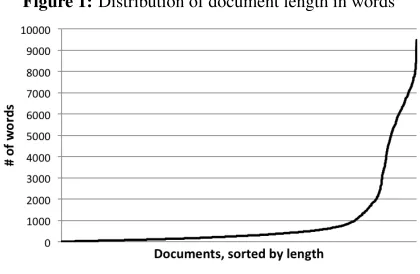
The overall distribution of document length is shown in Figure 1, where the x-axis is all docu-ments ranked by document length and the y-axis is document length. The shortest document contains 7 words, and the longest document contains over 9000 words.
Figure 1:Distribution of document length in words
4 Features
In the following sections, I give an overview of the features used in this study, both the rationale for
their inclusion, as well as details regarding their op-erationalization and implementation. I combine tures used in previous research with some novel tures based on morphological analysis. I divide fea-tures into the following categories: lexical, morpho-logical, syntactic, and semantic.
4.1 Lexical features (LEX)
The lexical features (LEX) are divided into three
subcategories: lexical variability (LEXV), lexical
complexity (LEXC), and lexical familiarity (LEXF).
LEXV The lexical variability category contains
features that are intended to measure the variety of lexemes found in a document. One of the most ba-sic measures of lexical variability is the type-token ratio, which is the number of unique wordforms divided by the number of tokens in a text. Be-cause the type-token ratio is dependent on document length, I included a few more robust metrics that have been proposed: Root TTR (T/√N), Corrected TTR (T/√2N), Bilogarithmic TTR (logT/logN), and the Uber Index (log2T/log(N/T)). For all of these metrics, a higher score signifies higher con-centrations of unique tokens, which indicates more difficult readability levels.
LEXC Lexical complexity includes multiple
con-cepts. One is the degree to which individual words can be parsed into component morphemes. This is a reflection of the derivational or agglutinative struc-ture of words. Another measure of lexical complex-ity is word length, which reflects the difficulty of chunking and storing words in short-term memory. Depending on the particulars of a given language or the development level of a given learner, lexi-cal complexity can either inhibit or enhance compre-hension. For example, the word neftepererabatyva-jušˇcij (zavod)‘oil-refining (factory)’ is overwhelm-ing for a beginnoverwhelm-ing learner, but an advanced learner who has never seen this word can easily deduce its meaning by recognizing its component morphemes: nefte-pere-rabat-yvaj-ušˇcij‘oil-re-work-IPFV-ing’.
[image:4.612.81.291.494.631.2]words only.7 The features for word length in mor-phemes were computed on the basis of Tixonov’s Morpho-orthographic dictionary (Tixonov, 2002), which contains parses for about 100 000 words. All words that are not found in the dictionary were ig-nored. In addition to average and maximum word lengths, I also followed Karpov et al. (2014) in cal-culating word length bands, such as the proportion of words with five or more characters. These bands are calculated for 5–13 characters (9 features) and 3–6 syllables (4 features). All 13 of these features were calculated both for all words and for content words only.
LEXF Lexical familiarity features were computed
to attempt to capture the degree to which the words of a text are familiar to readers of various levels. These features model the development of learners’ vocabulary from level to level. Unlike the features for lexical variability and lexical complexity, which are primarily based on surface structure, the features for lexical familiarity rely on a predefined frequency lists or lexicons.
The first set of lexical familiarity features are de-rived from the official “Lexical Minimum” lists for the TORFL examinations. The lexical minimum lists are compiled for the four lowest levels (A1, A2, B1, and B2), where each list contains the words that should be mastered for the tests at each level. These lists can be seen asprescriptivevocabulary for lan-guage learners. Following Karpov et al. (2014), I computed features for the proportion of words above a given reading level.
The second set of lexical familiarity features are taken from the Kelly Project (Kilgarriff et al., 2014), which is a “corpus-based vocabulary list” for lan-guage learners. These lists are based primarily on word frequency, with manual adjustments made by professional teachers. Just like the features based on the Lexical Minimum, I computed the proportion of words over each of the six CEFR levels.
The third set of lexical familiarity features are based on raw frequency and frequency rank for both lemma frequency and token frequency.8 For each of
7The following parts of speech were considered content words: adjectives, adverbs, nouns and verbs.
8Lemma frequency data were taken from Ljaševskaja and Šarov (2009) (available digitally at http://dict.
the four kinds of frequency data, I computed aver-age, median, minimum, and standard deviation.
4.2 Morphological features (MORPH)
Morphological features are primarily based on phosyntactic values, as output by an automatic mor-phological analyzer. The first three sets of features reflect simple counts of whether a morphosyntac-tic tag is present or what proportion of tokens re-ceive each morphosyntactic tag. The first set of features expresses whether a given morphosyntac-tic tag is present in the document. A second set of features, expresses the ratio of tokens with each morphosyntactic tag, normalized by token count. A third set of features, the value-feature ratio (VFR), was calculated as the number of tokens that express a morphosyntactic value (e.g. past), normalized by the number of tokens that express the corresponding morphosyntactic feature (e.g. tense).
In the early stages of learning Russian, learners do not have a knowledge of all six cases, so I hy-pothesized that texts intended for the lowest reading level might be distinguished by a limited number of attested cases. Similarly, two subcases in Russian, partitive genitive and second locative, are generally rare, but are overrepresented in texts written for be-ginners who are being introduced to these subcases. Two features were computed to capture these intu-itions: the number of cases and the number of sub-cases attested in the document.
Following Nikin et al. (2007; Krioni et al. (2008; Filippova (2010), I calculated a feature to measure the proportion of abstract words. This was done by using a regular expression to test lemmas for the presence of a number of abstract derivational suf-fixes. This feature is normalized to the number of tokens in the document.
4.2.1 Sentence length-based features (SENT)
The SENT category consists of features that
tions per sentence. In addition, I also compute the type frequency of morphosyntactic readings per sen-tence. This category also includes the traditional readability formulas: Russian Flesch Reading Ease (Oborneva, 2006a), Flesch Reading Ease, Flesch-Kincaid Grade Level, and the Coleman-Liau Index.
4.3 Syntactic features (SYNT)
Syntactic features for this study were primarily based on the output of thehunpos9trigram part-of-speech tagger andmaltparser10syntactic depen-dency parser, both trained on the SynTagRus11 tree-bank. Usingmaltoptimizer,12 I found that the best-performing algorithm was Nivre Eager, which achieved a labeled attachment score of 81.29% with cross-validation of SynTagRus.
Researchers of automatic readability classifica-tion and closely related tasks have used a number of syntactic dependency features which I also imple-ment here (Yannakoudakis et al., 2011; Dell’Orletta et al., 2011; Vor der Brück and Hartrumpf, 2007; Vor der Brück et al., 2008). These include features based on dependency lengths (the number of tokens intervening between a dependent and its head), as well as the number of dependents belonging to par-ticular parts of speech, in parpar-ticular nouns and verbs. In addition, I also include features based on de-pendency tree depth (the path length from root to leaves).
4.4 Discourse/content features (DISC)
The discourse/content features (DISC) are intended
to capture the broader difficulty of understanding the text as a whole, rather than the difficulty of pro-cessing the linguistic structure of particular words or sentences. One set of features are based on defi-nitions(Krioni et al., 2008), which are a set of words and phrases that are used to introduce or define new terms in a text. Using regular expressions, I cal-culate definitions per token and definitions per sen-tence.
Another set of features is adapted from the work
9https://code.google.com/p/hunpos/ 10http://www.maltparser.org/
11http://ruscorpora.ru/
instruction-syntax.html
12http://nil.fdi.ucm.es/maltoptimizer/
index.html
of Brown et al. (2007; 2008), who show that logi-cal propositional density—a fundamental measure-ment in the study of discourse comprehension—can be accurately measured purely on the basis of part-of-speech counts.
One other feature is based on the intuition that reading dialogic texts is generally easier than read-ing prose. This feature is computed as the number of dialog symbols13per token.
4.5 Summary of features
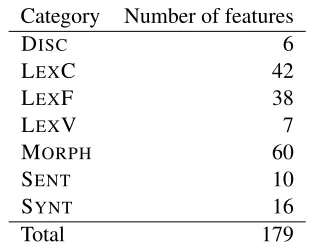
As outlined in the preceding sections, this study makes use of 179 features. Many of the features are inspired by previous research of readability, both for Russian and for other languages. The distribution of these features across categories is shown in Table 3.
Category Number of features
DISC 6
LEXC 42
LEXF 38
LEXV 7
MORPH 60
SENT 10
SYNT 16
[image:6.612.348.504.283.406.2]Total 179
Table 3:Distribution of features across categories
5 Results
The machine-learning and evaluation for this study were performed using the weka data mining soft-ware (Hall et al., 2009). Based on preliminary tests, the Random Forest model was selected as the clas-sifier algorithm for the study.14 All results reported below are achieved using the Random Forest algo-rithm with default parameters. Unless otherwise specified, evaluation was performed using ten-fold cross validation.
Results are given in Table 4. Precisionis a mea-sure of how many of the documents predicted to be at a given readability level are actually at that level (true positives divided by true and false positives).
Recall measures how many of the documents at a given readability level are predicted correctly (true positives divided by true positives and false nega-tives). The two metrics are calculated for each read-ing level and weighted averages are reported for the classifier as a whole. The F-score is a harmonic mean of precision and recall. Adjacent accuracy is the same as weighted recall, except that it con-siders predictions that are off by one category as correct. For example, a B2 document is counted as being correctly classified if the classifier predicts B1, B2, or C1. The baseline performance achieved by predicting the mode reading level (B1)—using
weka’s ZeroR classifier—is precision 0.097 and re-call 0.312 (F-score 0.149). The OneR classifier, which is based on only the most informative fea-ture (corrected type-token ratio), achieves precision 0.487 and recall 0.497 (F-score 0.471). The Ran-dom Forest classifier, trained on the full Combined corpus with all 179 features, achieves precision 0.69 and recall 0.677 (F-score 0.671), with adjacent ac-curacy 0.919.
[image:7.612.328.524.54.148.2]Classifier Precis. Recall F-score ZeroR 0.097 0.312 0.149 OneR 0.487 0.497 0.471 RandomForest 0.690 0.677 0.671
Table 4: Baseline and RandomForest results with Combined corpus
A confusion matrix is given in Table 5, which shows the predictions of the RandomForest classi-fier. The rows represent the actual reading level as specified in the gold standard, whereas the columns represent the reading level predicted by the classi-fier. Correct classifications appear along the diago-nal. Table 5 shows that the majority of misclassifi-cations are only off by one level, and indeed the ad-jacent accuracy is 0.919, which means that less than 10% of the documents are more than one level away from the gold standard.
5.1 Binary classifiers
Evaluation was performed with binary classifiers, in which the datasets contain only two adjacent read-ability levels. Since the Combined corpus has six levels, there are five binary classifier pairs: A1-A2, A2-B1, B1-B2, B2-C1, C1-C2. The results of
A1 A2 B1 B2 C1 C2
A1 234 120 48 0 0 0
A2 41 553 192 17 0 0 B1 16 76 1130 90 5 5 B2 1 57 311 478 83 4
C1 1 20 66 98 394 6
C2 0 3 40 58 9 78
Table 5: Confusion matrix for RandomForest, all features, Combined corpus. Rows are actual and columns are predicted.
the cross-validation evalution of these classifiers is given in Table 6. Red Kalinka and LQsupp (the second largest subcorpus of LingQ)—which were judged to be the most reliable subcorpora—were also examined individually.
A1-A2 A2-B1 B1-B2 B2-C1 C1-C2 Comb. prec. 0.821 0.857 0.817 0.833 0.894 recall 0.821 0.857 0.811 0.831 0.897 F-score 0.812 0.855 0.806 0.826 0.892 RK prec. 0.967 0.943 0.832 0.837 – recall 0.966 0.943 0.829 0.792 – F-score 0.965 0.943 0.828 0.730 – LQsupp prec. 0.911 0.806 0.955 0.914 0.926 recall 0.903 0.806 0.956 0.915 0.924 F-score 0.901 0.806 0.954 0.912 0.924
Table 6:Evalution metrics for binary classifiers: RandomFor-est, all features
Re-sults of this experiment are given in Figure 2.
Figure 2:Learning curves of binary classifiers trained on LQ-supp subcorpus
The results of this experiment support the hy-pothesized difference between binary classifier lev-els, albeit with some exceptions. The A1-A2 clas-sifier rises quickly, and begins to level off after see-ing about 40 documents. The A2-B1 classifier rises more gradually, and levels off after seeing about 55 documents. The B1-B2 classifier rises even more slowly, and does not level off within the scope of this figure.
Up to this point, the data confirm my hypothesis that lower levels require less training data. However, the B2-C1 and C1-C2 classifiers buck this trend, with learning curves that outperform the simplest binary classifier with very little training data. One possible explanation for this is that the increasing complexity of CEFR levels is not linear, meaning that the leap from A1 to A2 is much smaller than the leap from C1 to C2. The increasing rate of change is explicitly formalized in the official standards for the TORFL tests. For example, the number of words that a learner should know has the following pro-gression: 750, 1300, 2300, 10 000, 12 000 (7 000 active), 20 000 (8 000 active). This means that dis-tinguishing B2-C1 and C1-C2 should be easier be-cause the distance between their respective levels is an order of magnitude larger than the distance be-tween the respective levels of A1-A2, A2-B1. Fur-thermore, development of grammar should be more or less complete by level B2, so that the the num-ber of features that distinguish C1 from C2 should be smaller than in lower levels, where grammar de-velopment is a limiting factor.
6 Feature evaluation
As summarized in Section 4.5, this study makes use of 179 features, divided into 7 categories: DISC,
LEXC, LEXF, LEXV, MORPH, SENT, and SYNT.
Many of the features used in this study are taken from previous research of related topics, and some features are proposed for the first time here. Pre-vious researchers of Russian readability have not included morphological features, so the results of these features are of particular interest here.
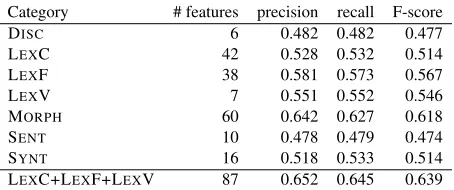
In this section, I explore the extent to which the selected corpora can support the relevance and im-pact of these features in Russian second language readability classification. One rough test for the value of each category of features is to run cross-validation with models trained on only one category of features. In Table 7, I report the results of this experiment using the Combined corpus.
Category # features precision recall F-score DISC 6 0.482 0.482 0.477 LEXC 42 0.528 0.532 0.514 LEXF 38 0.581 0.573 0.567 LEXV 7 0.551 0.552 0.546 MORPH 60 0.642 0.627 0.618 SENT 10 0.478 0.479 0.474 SYNT 16 0.518 0.533 0.514 LEXC+LEXF+LEXV 87 0.652 0.645 0.639
Table 7: Precision, recall, and F-score for six-level Random Forest models trained on the Combined corpus
The results in Table 7 show that MORPH, has the
highest score of any single category, with an F-score just 0.053 below a model trained on all 179 features. True comparisons between categories are problematic because the number of features per cat-egory varies significantly.
In order to evaluate the usefulness of each feature as a member of a feature set, I used the correlation-based feature subset selection algorithm (CfsSub-setEval) (Hall, 1999), which selects the most pre-dictive subset of features by minimizing redundant information, based on feature correlation.
[image:8.612.314.541.321.416.2]gain—now include 14 features, which indicates that although these features are not as informative, the information that they contribute is unique.
A classifier trained on only these 32 features with the Combined corpus achieved precision 0.674 and recall 0.665 (F-score 0.659), which is only 0.01 worse than the model trained on all 179 features.
7 Conclusions and Outlook
This article has presented new research in auto-matic classification of Russian texts according to second language readability. This technology is in-tended to support learning activities that enhance student engagement through online authentic mate-rials (Erbaggio et al., 2010). I collected a new corpus of Russian language-learning texts classified accord-ing to CEFR proficiency levels. The corpus comes from a broad spectrum of sources, which resulted in a richer and more robust dataset, while also compli-cating comparisons between subsets of the data.
Classifier performance A six-level Random For-est classifier achieves an F-score of 0.671, with ad-jacent accuracy of 0.919. Binary classifiers with only two adjacent reading levels achieve F-scores between 0.806 and 0.892. This is the first large-scale study of this task with Russian data, and although these results are promising, there is still room for improvement, both in corpus quality and modeling features.
In Section 5.1, I showed that binary classifiers at the lowest and highest reading levels required less training data to approach their upper limit. Begin-ning with the lowest levels, each successive binary classifier learned more slowly than the last until the B2-C1 level. I interpret this as evidence that simple texts are all similar, but complex texts can be com-plex in many different ways.
Features Among the most informative individual features used in this study are type-token ratios, as well as various measures of maximum syntac-tic dependency lengths and maximum tree depth. However, as a category, the morphological features are most informative. When features with over-lapping information are removed using correlation-based feature selection, the resulting set includes 14 MORPH features, 8 SYNT features, 4 LEXV
fea-tures, 3 LEXF features, and 2 LEXC features, and 1
DISCfeature. Models trained on only one category
of features also show the importance of morphology in this task, with the MORPH category achieving a
higher F-score than other individual categories. Although the feature set used in this study had fairly broad coverage, there are still a number of possible features that could likely improve classifier performance further. Other researchers have seen good results using features based on semantic am-biguity, derived from word nets. Implementing such features would be possible with the new and growing resources from the Yet Another RussNet project.15
Another category of features that is absent in this study is language modeling, including the possi-bility of calculating information-theoretic metrics, such as surprisal, based on those models.
The syntactic features used in this study could be expanded to capture more nuanced features of the dependency structure. For instance, currently im-plemented syntactic features completely ignore the kinds of syntactic relations between words. In ad-dition, some theoretical work in dependency syntax, such as catenae (Osborne et al., 2012) and depen-dency/locality (Gibson, 2000) may serve as the basis for other potential syntactic features.
Applications One of the most promising applica-tions of the technology discussed in this article is a grammar-aware search engine or similar information retrieval framework that can assist both teachers and students to identify texts at the appropriate reading level. Such systems have been discussed in the lit-erature (Ott, 2009), and similar tools can be created for Russian language learning.
Acknowledgments
I am indebted to Detmar Meurers and Laura Janda for insightful feedback at various stages of this project. I am grateful to Nikolay Karpov for openly sharing his research source files. I am also thank-ful to the CLEAR research group at UiT and three anonymous reviewers for feedback on an earlier ver-sion of this paper. Any remaining errors or short-comings are my own.
References
Sandra Aluisio, Lucia Specia, Caroline Gasperin, and Carolina Scarton. 2010. Readability assessment for text simplification. InProceedings of the NAACL HLT 2010 Fifth Workshop on Innovative Use of NLP for Building Educational Applications, pages 1–9. Cati Brown, Tony Snodgrass, Michael A. Covington,
Ruth Herman, and Susan J. Kemper. 2007. Measuring propositional idea density through part-of-speech tag-ging. poster presented at Linguistic Society of Amer-ica Annual Meeting, Anaheim, California, January. Cati Brown, Tony Snodgrass, Susan J. Kemper, Ruth
Herman, and Michael A. Covington. 2008. Auto-matic measurement of propositional idea density from part-of-speech tagging. Behavior Research Methods, 40(2):540–545.
Jeanne S. Chall and Edgar Dale. 1995. Readability revis-ited: the new Dale-Chall Readability Formula. Brook-line Books.
Meri Coleman and T. L. Liau. 1975. A computer read-ability formula designed for machine scoring. Journal of Applied Psychology, 60:283–284.
Kevyn Collins-Thompson and Jamie Callan. 2004. A language modeling approach to predicting reading dif-ficulty. InProceedings of HLT/NAACL 2004, Boston, USA.
Scott A. Crossley, David F. Dufty, Philip M. McCarthy, and Danielle S. McNamara. 2007a. Toward a new readability: A mixed model approach. In Danielle S. McNamara and Greg Trafton, editors,Proceedings of the 29th annual conference of the Cognitive Science Society. Cognitive Science Society.
Scott A. Crossley, Max M. Louwerse, Philip M. Mc-Carthy, and Danielle S. McNamara. 2007b. A lin-guistic analysis of simplified and authentic texts. The Modern Language Journal, 91(1):15–30.
Scott A. Crossley, Jerry Greenfield, and Danielle S. Mc-Namara, 2008. Assessing text readability using cogni-tively based indices, pages 475–493. Teachers of En-glish to Speakers of Other Languages, Inc. 700 South Washington Street Suite 200, Alexandria, VA 22314. Edgar Dale and Jeanne S. Chall. 1948. A formula for
predicting readability. Educational research bulletin; organ of the College of Education, 27(1):11–28. Felice Dell’Orletta, Simonetta Montemagni, and Giulia
Venturi. 2011. Read-it: Assessing readability of Ital-ian texts with a view to text simplification. In Proceed-ings of the 2nd Workshop on Speech and Language Processing for Assistive Technologies, pages 73–83. William H. DuBay. 2006. The Classic Readability
Stud-ies. Impact Information, Costa Mesa, California.
P Erbaggio, S Gopalakrishnan, S Hobbs, and H Liu. 2010. Enhancing student engagement through on-line authentic materials. International Association for Language Learning Technology, 42(2).
Lijun Feng, Martin Jansche, Matt Huenerfauth, and Noémie Elhadad. 2010. A comparison of features for automatic readability assessment. InIn Proceedings of the 23rd International Conference on Computational Linguistics (COLING 2010), Beijing, China.
Lijun Feng. 2010. Automatic Readability Assessment. Ph.D. thesis, City University of New York (CUNY). Anastasija Vladimirovna Filippova. 2010. Upravlenie
kaˇcestvom uˇcebnyx materialov na osnove analize trud-nosti ponimanija uˇcebnyx tekstov [Managing the qual-ity of educational materials on the basis of analyz-ing the difficulty of understandanalyz-ing educational texts]. Ph.D. thesis, Ufa State Aviation Technology Univer-sity.
Thomas Francois and Patrick Watrin. 2011. On the con-tribution of MWE-based features to a readability for-mula for French as a foreign language. InProceedings of Recent Advances in Natural Language Processing, pages 441–447.
Edward Gibson. 2000. The dependency locality theory: A distance-based theory of linguistic complexity. Im-age, languIm-age, brain, pages 95–126.
Alex Gilmore. 2007. Authentic materials and authentic-ity in foreign language learning. Language teaching, 40(02):97–118.
Arthur C. Graesser, Danielle S. McNamara, Max M. Louweerse, and Zhiqiang Cai. 2004. Coh-metrix: Analysis of text on cohesion and language. Behav-ior Research Methods, Instruments and Computers, 36:193–202.
Mark Hall, Eibe Frank, Geoffrey Holmes, Bernhard Pfahringer, Peter Reutemann, and Ian H. Witten. 2009. The weka data mining software: An update. In
The SIGKDD Explorations, volume 11, pages 10–18. Mark A Hall. 1999. Correlation-based feature selection
for machine learning. Ph.D. thesis, The University of Waikato.
Julia Hancke, Detmar Meurers, and Sowmya Vajjala. 2012. Readability classification for German using lexical, syntactic, and morphological features. In
Proceedings of the 24th International Conference on Computational Linguistics (COLING), pages 1063– 1080, Mumbay, India.
Michael Heilman, Kevyn Collins-Thompson, Jamie Callan, and Maxine Eskenazi. 2007. Combining lexical and grammatical features to improve readabil-ity measures for first and second language texts. In
Associa-tion for ComputaAssocia-tional Linguistics (HLT-NAACL-07), pages 460–467, Rochester, New York.
Michael Heilman, Kevyn Collins-Thompson, and Max-ine Eskenazi. 2008a. An analysis of statistical mod-els and features for reading difficulty prediction. In
Proceedings of the 3rd Workshop on Innovative Use of NLP for Building Educational Applications at ACL-08, Columbus, Ohio.
Michael Heilman, Le Zhao, Juan Pino, and Maxine Eske-nazi. 2008b. Retrieval of reading materials for vocab-ulary and reading practice. InProceedings of the Third Workshop on Innovative Use of NLP for Building Ed-ucational Applications (BEA-3) at ACL’08, pages 80– 88, Columbus, Ohio.
V. V. Ivanov. 2013. K voprocu o vozmožnosti is-pol’zovanija lingvistiˇceskix xarakteristik složnosti tek-sta pri issledovanii okulomotornoj aktivnosti pri ˇctenii u podrostkov [toward using linguistic profiles of text complexity for research of oculomotor activity during reading by teenagers]. Novye issledovanija [New stud-ies], 34(1):42–50.
Nikolay Karpov, Julia Baranova, and Fedor Vitugin. 2014. Single-sentence readability prediction in Rus-sian. In Proceedings of Analysis of Images, Social Networks, and Texts conference (AIST).
Adam Kilgarriff, Frieda Charalabopoulou, Maria Gavrili-dou, Janne Bondi Johannessen, Saussan Khalil, Sofie Johansson Kokkinakis, Robert Lew, Serge Sharoff, Ravikiran Vadlapudi, and Elena Volodina. 2014. Corpus-based vocabulary lists for language learners for nine languages. Language resources and evaluation, 48(1):121–163.
J. P. Kincaid, R. P. Jr. Fishburne, R. L. Rogers, and B. S Chissom. 1975. Derivation of new readability for-mulas (Automated Readability Index, Fog Count and Flesch Reading Ease formula) for Navy enlisted per-sonnel. Research Branch Report 8-75, Naval Techni-cal Training Command, Millington, TN.
A. Kotlyarov. 2015. Measuring and analyzing compre-hension difficulty of texts in contemporary Russian. In
Materials of the annual scientific and practical con-ference of students and young scientists (with inter-national participation), pages 63–65, Kostanay, Kaza-khstan.
Nikolaj Konstantinoviˇc Krioni, Aleksej Dmitrieviˇc Nikin, and Anastasija Vladimirovna Filippova. 2008. Av-tomatizirovannaja sistema analiza složnosti uˇcebnyx tekstov [automated system for analyzing the com-plexity of educational texts]. Vestnik Ufimskogo Go-sudarstvennogo Aviacionnogo Texniˇceskogo Univer-siteta [Bulletin of the Ufa State Aviation Technical University], 11(1):101–107.
O. N. Ljaševskaja and S. A. Šarov. 2009. ˇCastotnyj
slovar’ sovremennogo russkogo jazyka (na materialax
Nacional’nogo Korpusa Russkogo Jazyka) [Frequency dictionary of Modern Russian (based on the Russian National Corpus)]. Azbukovnik, Moscow.
Ja. A. Mikk. 1974. Metodika razrabotki formul ˇcita-bel’nosti [methods for developing readability formu-las]. Sovetskaja pedagogika i škola IX, page 273. I. Ju. Mizernov and L. A. Grašˇcenko. 2015. Analiz
metodov ocenki složnosti teksta [analysis of meth-ods for evaluating text complexity]. Novye infor-macionnye texnologii v avtomatizirovannyx sistemax [New information technologies in automated systems], 18:572–581.
Keith Morrow. 1977. Authentic texts in ESP. English for specific purposes, pages 13–16.
Aleksej Dmitrieviˇc Nikin, Nikolaj Konstantinoviˇc Kri-oni, and Anastasija Vladimirovna Filippova. 2007. Informacionnaja sistema analiza uˇcebnogo teksta [information system for analyzing educational texts]. In Trudy XIV Vserossijskoj nauˇcno-metodiˇcskoj konferencii Telematika [Proceedings of the XIV pan-Russian scientific-methodological conference Telematika], pages 463–465.
Irina Vladimirovna Oborneva. 2005. Matematiˇceskaja model’ ocenki uˇcebnyx tekstov [mathematical model of evaluation of scholastic texts]. In Informa-cionnye texnologii v obrazovanii: XV Meždunarodaja konferencija-vystavka [Information technology in edu-cation: XV international conference-exhibit.
Irina Vladimirovna Oborneva. 2006a. Avtomatizacija ocenki kaˇcestva vosprijatija teksta [automation of eval-uating the quality of text comprehension]. No longer available on internet.
Irina Vladimirovna Oborneva. 2006b. Avtomatizirovan-naja ocenka složnosti uˇcebnyx tekstov na osnove statistiˇceskix parametrov [Automatic evaluation of the complexity of educational texts on the basis of statisti-cal parameters]. Ph.D. thesis.
Svetlana Vladimirovna Okladnikova. 2010. Model’ kompleksnoj ocenki ˇcitabel’nosti testovyx materialov na etape razrabotki [a model of multidimensional eval-uation of the readability of test materials at the de-velopment stage]. Prikaspijskij žurnal: upravlenie i vysokie texnologii, 3:63–71.
Timothy Osborne, Michael Putnam, and Thomas Groß. 2012. Catenae: Introducing a novel unit of syntactic analysis.Syntax, 15(4):354–396.
Niels Ott. 2009. Information retrieval for language learning: An exploration of text difficulty measures. ISCL master’s thesis, Universität Tübingen, Seminar für Sprachwissenschaft, Tübingen, Germany.
I. Ju. Petrova and S. V. Okladnikova. 2009. Metodika rasˇceta bazovyx pokazatelej ˇcitabel’nosti testovyx ma-terialov na osnove ekspertnyx ocenok [method of cal-culating basic indicators of readability of test materials on the basis of expert evaluations]. Prekaspijskij žur-nal: upravlenie i vysokie texnologii, page 85.
Ildikó Pilán, Sowmya Vajjala, and Elena Volodina. 2015. A readable read: Automatic assessment of language learning materials based on linguistic complexity. In
Proceedings of CICLING 2015- Research in Comput-ing Science Journal Issue (to appear).
Mikael Roll, Johan Frid, and Merie Horne. 2007. Mea-suring syntactic complexity in spontaneous spoken Swedish. Language and Speech, 50(2):227–245. Sarah Schwarm and Mari Ostendorf. 2005. Reading
level assessment using support vector machines and statistical language models. In Proceedings of the 43rd Annual Meeting of the Association for Computa-tional Linguistics (ACL-05), pages 523–530, Ann Ar-bor, Michigan.
Serge Sharoff, Svitlana Kurella, and Anthony Hartley. 2008. Seeking needles in the web’s haystack: Finding texts suitable for language learners. InProceedings of the 8th Teaching and Language Corpora Conference (TaLC-8), Lisbon, Portugal.
Luo Si and Jamie Callan. 2001. A statistical model for scientific readability. InProceedings of the 10th Inter-national Conference on Information and Knowledge Management (CIKM), pages 574–576. ACM.
Jurij Franceviˇc Špakovskij, 2003. Formuly ˇcitabel’nosti kak metod ocenki kaˇcestva knigi [Formulae of read-ability as a method of evaluating the quality of a book], pages 39–48. Ukrainska akademija drukarstva, Lviv’. Jurij Franceviˇc Špakovskij. 2008. Razrabotka
koliˇcestvennoj metodiki ocenki trudnosti vosprijatija uˇcebnyx tekstov dl’a vysšej školy [development of quantitative methods of evaluating the difficulty of comprehension of educational texts for high school].
Nauˇcno-texniˇceskij vestnik [Instructional-technology bulletin], pages 110–117.
A. Jackson Stenner. 1996. Measuring reading compre-hension with the lexile framework. In Fourth North American Conference on Adolescent/Adult Literacy. A. N. Tixonov. 2002. Morfemno-orfografiˇceskij slovar’:
okolo 100 000 slov [Morpho-orthographic dictionary: approx 100 000 words]. AST/Astrel’, Moskva. Sowmya Vajjala and Detmar Meurers. 2012. On
im-proving the accuracy of readability classification us-ing insights from second language acquisition. In Joel Tetreault, Jill Burstein, and Claudial Leacock, edi-tors,In Proceedings of the 7th Workshop on Innovative Use of NLP for Building Educational Applications, pages 163–173, Montréal, Canada, June. Association for Computational Linguistics.
Sowmya Vajjala. 2015. Analyzing Text Complexity and Text Simplification: Connecting Linguistics, Process-ing and Educational Applications. Ph.D. thesis, Uni-versity of Tübingen.
Tim Vor der Brück and Sven Hartrumpf. 2007. A se-mantically oriented readability checker for German. In Zygmunt Vetulani, editor, Proceedings of the 3rd Language & Technology Conference, pages 270–274, Pozna´n, Poland. Wydawnictwo Pozna´nskie.
Tim Vor der Brück, Sven Hartrumpf, and Hermann Hel-big. 2008. A readability checker with supervised learning using deep syntactic and semantic indicators.
Informatica, 32(4):429–435.
Helen Yannakoudakis, Ted Briscoe, and Ben Medlock. 2011. A new dataset and method for automati-cally grading ESOL texts. In Proceedings of the 49th Annual Meeting of the Association for Com-putational Linguistics: Human Language Technolo-gies - Volume 1, HLT ’11, pages 180–189, Strouds-burg, PA, USA. Association for Computational Lin-guistics. Corpus available: http://ilexir.co.