Supervised Machine Learning for Hybrid Meter
Alex Estes & Christopher Hench University of California, Berkeley
Department of German Berkeley, CA 94720, USA {estes,chench}@berkeley.edu
Abstract
Following classical antiquity, European poetic meter was complicated by traditions negotiat-ing between the prosodic stress of vernacular dialects and a classical system based on syl-lable length. Middle High German (MHG) epic poetry found a solution in a hybrid qual-itative and quantqual-itative meter. We develop a CRF model to predict the metrical values of syllables in MHG epic verse, achieving an F-score of .894 on 10-fold cross-validated devel-opment data (outperforming several baselines) and .904 on held-out testing data. The method used in this paper presents itself as a viable op-tion for other literary tradiop-tions, and as a tool for subsequent genre or author analysis.
1 Introduction
The divergence of Latin into distinct regional di-alects had profound linguistic and literary impli-cations for all of Europe. Even before the Mid-dle Ages, the syllable length of classical Latin had been nearly forgotten in the vernacular.1 Latin
po-etry had used quantitative meter, whereby syllable length was the organizing principle. However, the emerging dialects differed from Latin in that stress became a phonologically important feature, and so-called qualitative meter predominated. In order to reconcile these linguistic differences, poetic forms emerged in which meter relied on both stress and syllable length. These hybrid metrical forms pose unique challenges to automated scansion (the
pro-1Augustine writes toward the end of the fourth century that
while he recognizes time intervals, he can no longer distinguish between long and short syllables:syllabarum longarum et bre-vium cognicionem me non habere... “I cannot recognize long and short syllables...” cf. Augustinus,De musica, III, 3, 5.
cess of determining the metrical value of each sylla-ble for a line of poetry). In applying machine learn-ing techniques to scan syllables of a hybrid meter, we believe we can contribute to the study of both metrics and poetics, medieval and otherwise. Our system serves not only pedagogical purposes by in-troducing students to the meter of medieval German epic poetry, but also presents itself as a tool for fur-ther research in author identification or topic model-ing metrical form.
To illustrate quantitative meter, we consider the epic poetry of Latin and Greek. Each line consists of six feet, each foot typically a dactyl (a long sylla-ble followed by two short syllasylla-bles) or spondee (two long syllables). A syllable is considered long if it has a long vowel or diphthong, or ends in a conso-nant (Hayes, 1989). All other syllables are short. The first line of Virgil’sAeneidserves as example:2
¯arma vi|rumque ca|n¯o, Tro|jae qu¯i|pr¯imus ab|¯or¯is —^^| — ^ ^|— —|— —| —^ ^|— —
Shakespeare’s verse, on the other hand, exhibits qualitative meter, structured in iambic pentameter, where each line has five iambs (a bisyllabic foot con-sisting of an unstressed first syllable followed by a stressed second syllable). The first line of Romeo and Julietis scanned below:3
|Two house|holds, both|alike|in dig|nity.| | × × | ×´ × |×´ × |×´ × |×´ ×|´
2 Middle High German Meter
This paper considers the meter of twelfth and thir-teenth century Middle High German (MHG) epic
2— represents a long syllable and^a short syllable. 3Every syllable is marked with×. The acute accent ´ marks
stress.
verse. Although written in a Germanic language, MHG poetry was greatly influenced by the Romance tradition. This heritage is evident in its hybrid metri-cal structure: MHG verse patterns according to both syllable stress and length (Bostock, 1947).
The predominating pattern is an alternation be-tween stressed and unstressed syllables (Tervooren, 1997).4 MHG epic verse employs trochaic
tetrame-ter: each line has four feet (Bostock, 1947), and each foot is a trochee. Phonologically, a trochee consists of two syllables; the first syllable is stressed, and the second is unstressed. For example, the English word “better” is a trochee, but the word “alive” is not. The famous Longfellow epic poemThe Song of Hiawathais written in trochaic tetrameter, and the first line serves to illustrate this rhythm:
Should you ask me, whence these stories? | ×´ × | × × |´ ×´ × | × × |´
Similarly, the typical MHG epic verse foot is two syllables in length, a stressed syllable followed by an unstressed syllable. However, feet can also be filled by one or three syllables (Domanowski et al., 2009). If a foot is filled by one syllable, the syllable must be phonologically long. If the foot is filled by three syllables, either the first two or the last two syllables must both be phonologically short.
It is in these atypical feet that the influence of quantitative meter, where syllable length is the key factor, becomes evident. We must slightly redefine the foot to account for this. Syllable length is mea-sured in morae. Phonologically, a mora is a unit of time such that a short syllable has one mora and a long syllable has two morae (Fox, 2000).5A foot in
this meter is more precisely defined as having two morae, not necessarily two syllables.6 Indeed, the
mora, not the syllable, has been called the funda-mental unit of MHG verse (Tervooren, 1997, p. 1), although the mora functions differently in this
po-4There is no consensus view on MHG meter. For this work
we have most closely followed the viewpoints presented by Do-manowski et al. (2009) and Heusler (1956), as well as more explicitly addressed the function of morae.
5For example, the English word “red” has two morae since
it ends in a consonant, whereas the first syllable in the English word “reduce” has one mora, since it ends in a short vowel.
6It can be helpful to think of MHG meter in the musical
sense. Each foot is a measure of 2/4 meter, where one mora is equivalent to one quarter note (B¨ogl, 2006).
etic tradition than in its phonological definition. If a foot has only one syllable, the syllable must be long because a long syllable is two morae and the MHG foot requires two morae. A short syllable cannot be the only syllable in a foot, since it cannot be two morae. If a foot has three syllables, two must be short because only short syllables can be scanned as half morae, together forming one mora.7 The other
syllable is analyzed as one mora, yielding the re-quired two morae in the foot. To summarize, a syl-lable can have one of three length values: mora, half mora, or double mora. A half mora must be logically short, and a double mora must be phono-logically long. Phonological length is otherwise ir-relevant and any syllable can be one mora.
In addition to length, as a function of morae, syl-lables are also assigned stress. There are three stress values: primary, secondary, or unstressed. Primary stress is assigned to the first or only stressed sylla-ble in a word. Secondary stress is assigned to any following stressed syllable(s) in that word. All other syllables are unstressed.8
The final mora of the final foot of a line is omitted by convention. This is construed as a pause, and receives its own symbol in the scansion, even though there is no corresponding word or syllable. A short, word final syllable may also be elided before a word beginning with a vowel. MHG epic verse permits up to three syllables in anacrusis (a series of syllables at the beginning of a line that do not count in the meter). These syllables may or may not carry lexical or syntactic stress, but they are always scanned as unstressed morae.
The above features yield eight possible metrical values for any syllable:
7Occasionally very weakly stressed long syllables can also
count as a half mora.
8The metrical distinction between different degrees of stress
• mora - primary stress(×): a syllable with pri-´ mary stress
• mora - secondary stress(×): a syllable with` secondary stress
• mora - unstressed(×): an unstressed syllable • half mora - primary stress(^´): a short
sylla-ble with primary stress; according to metrical convention the preceding syllable must be long • half mora - secondary stress(^`): a short
syl-lable with secondary stress
• half mora - unstressed(^): a short unstressed
syllable
• double mora (—): a stressed long syllable; double morae always carry primary stress • elision(e.): an elided syllable
Line 1 of Hartmann von Aue’s Der arme Hein-richis prototypical. Each foot consists of a stressed syllable followed by an unstressed syllable. There is a one-syllable anacrusis:9
Ein| rˆıter| sˆo ge|lˆeret| was10
× | × × |´ × ×|´ × × |´ ×´ ˆ
Line 6 also begins with one syllable in anacrusis. The second foot has a stressed mora consisting of two syllables, each one a half mora. The third foot has one syllable; a diphthong allows it to be scanned as long. The final foot has a mora with secondary stress, since the preceding syllable is stressed and in the same word:
der|nam im|manege|schou|we11
× | × × |´ ^ ^´ × | — |×` ˆ
Line 34 has no anacrusis, and in the second foot two half mora syllables form the unstressed mora:
|die ein|ritter in|sˆıner|jugent12
| × × |´ ×´ ^ ^|× × |´ ^ ^´ ˆ
Line 8 shows an elided syllable in the second foot: dar|an be|gunde. er|suo|chen13
× |× × |´ ×´ × |—| ×` ˆ
9 ˆ represents the rest for the empty mora at the end of a
line. Note that this notation differs slightly from that which is used for classical and Shakespearian verse.
10“There was a knight so learned” 11“he looked extensively,”
12“which a knight [should have] in his youth.” 13“in [these books] he began to search,”
3 Previous Computational Approaches to Meter
There are two prevailing treatments of meter in the literature concerned with computational poetic text analysis. One approach takes a known meter and as-signs syllables to stress patterns based on such pa-rameters (Hartman, 1996). The second approach assumes nothing of the meter, and seeks to deter-mine it by marking syllables and identifying pat-terns (Plamondon, 2006; McAleese, 2007; Greene et al., 2010; Agirrezabal et al., 2013; Navarro, 2015). Our approach draws more on the latter.
Previous scholarship has focused on relatively simple systems of meter and adopted rule-based, sta-tistical, or unsupervised approaches. The hybrid na-ture of MHG meter, and other complex systems de-veloping out of classical antiquity, makes it difficult to scan poetry using these methodologies.14
4 Data
As supervised machine learning is a novel approach to scansion, annotated metrical data do not exist for MHG or most other languages. Following the scan-sion categorization system outlined above, the au-thors annotated syllables of MHG epic poetry into the eight categories of metrical value.
The annotated data consist of 450 lines from Hart-mann von Aue’sDer arme Heinrich, 200 lines from Wolfram von Eschenbach’s Parzival, and 100 lines from Wirnt von Grafenberg’sWigalois.15 An
addi-tional 10% (75 lines of Hartmann von Aue’sIwein) was annotated to be held-out for testing, yielding a total of 825 annotated lines. Summary statistics for all annotated data are given in Table 1.
Syllabification was performed prior to annota-tion. The principles of onset maximization (early formulation in Vennemann (1972)) and sonority sequencing (early formulation in Jesperson (1904)) govern syllabification in many languages, includ-ing, to a great degree, MHG. The division of words
14A strictly rule-based approach was undertaken by Friedrich
Dimpel (2004). While Dimpel’s approach is accurate, it is an ar-duous task, restrictive, and extremely language specific. More-over, by identifying only the stressed syllables, it does not en-compass the full complexity of MHG meter.
15Incorporating different poems from different poets
mean std. min. max. char. per line 21.34 3.39 9 32 syll. per line. 7.62 1.04 5 11
words per line 5.01 1.13 1 8
char. per word 4.26 1.96 1 17
syll. per word 1.52 .71 1 7
[image:4.612.81.283.60.152.2]char. per syll. 2.80 .81 1 7
Table 1:Summary statistics for annotated dataset
with only one intervocalic consonant such asta-ge
“days” poses no difficulties. Only certain conso-nant clusters necessitate further information from MHG phonology. For example, the orthographic sequence of a nasal followed by a velar obstru-ent, although representing simply a velar nasal in modern German, were in fact still two separate phonemes in MHG (Paul et al., 1982). Thus the wordlange“long” is syllabified aslan-ge. Intervo-calic affricates can be viewed as either ambisyllabic or biphonemic, for example in sitzen “sit”; under both interpretations the first syllable has a coda and the second has an onset. There are also instances where morpheme boundaries interfere with the oth-erwise normal processes of syllabification. For ex-ample, the common MHG suffix -lichinwˆıplich “fe-male” results in the syllabificationwˆıp-lich, not wˆı-plich, despite onset maximization preferring the lat-ter. Accounting for these idiosyncrasies, beyond on-set maximization and sonority sequencing, with ad-ditional rules resulted in syllabification with an ac-curacy of 99.4% on the first 1,000 words in Hart-mann von Aue’sIwein, yielding a 95% confidence interval of 98.9% to 99.9%.
Annotation was carried out by both authors, who are trained in MHG scansion.16 In the case that a
line exhibits multiple permissible scansions, prior-ity is given to the scansion which best preserves the alternation of stressed and unstressed syllables. If a decision still cannot be made, then stress is given to semantic importance. An additional consideration is the syntactic stress of a particular line. Clearly, such evaluations allow some room for interpretation. Nevertheless, on a sample of 100 lines from the an-notated data (739 syllables), the Cohen’s kappa
co-16Although neither author is a native speaker of New High
German, the two phases of the language and the metrical tra-ditions are sufficiently different that both native and non-native speakers require training in MHG scansion.
Annotator 2
× ×´ ×` — ^ ^´ e. ^`
× 285 4 0 1 3 0 0 0
´
× 0 225 1 0 1 0 0 0
`
× 1 2 74 0 2 0 0 0
— 1 2 0 72 0 0 0 0
^ 1 0 0 0 36 0 0 0
´
^ 0 1 0 0 0 17 0 0
Annotator
1
e. 0 0 0 0 0 0 9 0
`
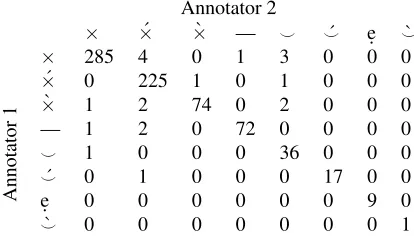
^ 0 0 0 0 0 0 0 1 Table 2:Inter-annotator agreement confusion matrix
efficient for the inter-annotator agreement is .962. The greatest disagreement for the human annotators was among unstressed and stressed morae, and be-tween unstressed morae and unstressed half morae (Table 2), implying both some stress and some value disagreement.
5 Conditional Random Fields Model Our efforts were focused on constructing a Condi-tional Random Fields (CRF) model to predict scan-sion for MHG meter (Lafferty et al., 2001).17
Fea-tures are applied to the focal syllable, as well as to the ten preceding syllables and the ten following syl-lables of the line, if present.18 Our resulting MHG
features and their motivations are:
• Position within line: the last mora of a line is always stressed, and double morae occur most often in the third foot.
• Length of syllable in characters: longer sylla-bles are more likely to be stressed. Unstressed prefixes and suffixes tend to be maximally three characters.
• Syllable characters: the characters in a sylla-ble can help identify grammatical morphemes that are often unstressed. Slices were taken of the first character, first and second characters, last three characters, last two characters, and last character.
• Elision: the last two characters of the previous syllable and the first two characters of the
cur-17Future work might consider an LSTM neural network
model. The decision to implement a CRF model was predicated on the interpretability of CRF modeling and understanding the primary features for MHG scansion.
18The implementation of the CRF model was expedited with
[image:4.612.319.526.62.181.2]rent syllable are identified to detect conditions for elision.
• Syllable weight and length: syllables ending in a vowel or consonant are open and closed, respectively. Syllables ending in a short vowel are short; otherwise they are long. Such values are useful in identifying double or half mora syllables, which must be long or short respec-tively. For example, the syllable “schou” in line 6 ofDer Arme Heinrichabove is a double mora, and is accordingly long.
• Word boundaries: stress usually occurs on the first syllable of a word.
The model was tuned only on the development data and the best performing model was chosen. The resulting best model uses an L1 coefficient of 1.3 and L2 coefficient of .001. No further changes were made after the model features and parameters were selected.
6 Results and Comparison to Other Models19
To evaluate the performance of our CRF model, we compare against two baselines: an n-gram model cascading into regular expressions, and a Brill transformatiobased model on top of the n-gram model, both using syllables as units, just as the CRF model does. The n-gram model consists of cascading trigram, bigram, unigram, and regu-lar expressions models, i.e. first a label is predicted based on the previous two labels, if possible; oth-erwise it is predicted based on the previous one la-bel, and if the first two models fail it is predicted solely based on the label probability for the sylla-ble itself. If the syllasylla-ble did not appear in the train-ing data, and it cannot be predicted by the first three models, it resorts to regular expressions. Based on MHG scansion theory and observations while anno-tating, syllables with long vowels were assigned to double mora, short syllables to unstressed mora, and the remaining syllables to mora with primary stress (which proved important to recognize stress alter-nation). The n-gram model was implemented with default settings.
[image:5.612.311.524.73.198.2]19The results for all models are 10-fold cross-validated.
Figure 1:F-score of different models with 95% confidence in-tervals
The Brill model (Brill, 1995), implemented with the help of NLTK (Bird et al., 2009), first assigns the most likely label from the n-gram model de-scribed above, and then generates rules to improve the initial estimate of the n-gram model according to the training data. It then iterates over these rules, correcting labels until accuracy no longer increases. The Brill model was implemented with a maximum of 200 rules.
The n-gram model found little success even with added training data, ending with an accuracy of only 61.8%. The transformation-based Brill model improved quickly upon the n-gram model, but plateaued at 82.8% accuracy. Figure 1 shows the increase in accuracy with an increase in the num-ber of annotated lines for all models, suggesting that marginal returns to annotation begin to diminish sig-nificantly after around 400 lines, or, in the case of MHG, about 3,000 syllables. Supervised machine learning thus proves to be an economical option for languages with complex meter.
The final results of the cross-validated CRF model are given in Table 3 in descending order of fre-quency in the data, along with a final held-out test set of 75 lines from Hartmann von Aue’s Iwein. The model achieves an F-score of .894 on the cross-validated development data and .904 on the held-out testing data.
dou-held-out metrical value F obs. F obs. mora - unstr. .922 2403 .938 253
mora - prim. .918 2025 .947 216
mora - sec. .856 437 .880 37
double mora .842 425 .865 34
half mora - unstr. .574 231 .585 41 half mora - prim. .771 103 .737 11
elision .763 65 .500 2
half mora - sec. 0 4 0 0
[image:6.612.317.530.57.236.2](macro) average .894 .904
Table 3:CRF model F-score for individual metrical values and (macro) average in development and on held-out data
ble morae marked as unstressed morae, and (4) un-stressed half morae marked as unun-stressed morae. Three of these issues mirror those of the human an-notators. Issues (1) and (2) are attributable not only to the frequency with which these features appear, but also to the pattern of alternating stress. If the stress assignment on one syllable is wrong, then it will likely be wrong for all following syllables in the line. (1) and (2) also affect (3), as shown be-low in line 14 of Der arme Heinrich, where the CRF model labels the penultimate syllable as an un-stressed mora, when a double mora is correct:
und dˆa mite. er sich m¨ohte20
CRF model: | × × |´ × × |´ ×´ × |×` ˆ correct: × | × × |´ × × |´ —|×` ˆ This error can be attributed to the overgeneralization of stress alternation. Formally, the model’s predic-tion constitutes a metrically valid line of verse, but it cannot be correct for this particular line because the first syllable inm¨ohtemust be stressed. The model notably identifies the elision correctly. The worst performance, on unstressed half morae (4), paints a different picture, as illustrated in 21,7 ofParzival:
unsern goten, die in uns brˆahten21
CRF model: × × | × × × |´ × × |´ —|×` ˆ correct: × × | ×´ ^ ^|× × |´ —|×` ˆ
The model correctly predicts stress, but does not hold to the constraints of a foot as defined above. While these errors may be common, they are not as
20“and with which he might”
21“to our gods, who brought him to us”
CRF Brill
(1) not×´ if next syll. is
end of line (1)
´
× → × if at word
boundary and follow-ing syll. is×´
(2) — if end of line is
next syll. (2)
´
× →— if followed by×` and word bound-ary
(3) e. if last char is “e” and first char. of next syll. is “e”
(3) × → ×` if end of line
(4) not — if syll. is
open and light (4)
`
× →×´ if monosyl-labic
(5)×if syll in pos. +7
is not end of line (5)× →
´
[image:6.612.77.290.58.208.2]×if following syll. is “ge”
Table 4:Top five CRF features and Brill rules
severe as the situation depicted in the first example. The top five highest scoring features of the CRF model and rules of the Brill model are given in Table 4. The CRF feature scores show that syllable qual-ity is helpful (4), something the Brill model cannot generalize. Both models recognize alternation, but while the Brill model adopts a more general rule (1), CRF features (1) and (5) recognize alternation us-ing the number of syllables and the end of the line. CRF feature (5) also accounts for anacrusis. No-tably, the Brill model took more advantage of word boundaries in (1) and (2), while these features rank lower in the CRF model. Features for phonemes do not rank high individually, unsurprising considering their impact among the other features. Nevertheless, “ver” and “ge” (MHG prefixes) both score highly in the CRF for marking a syllable unstressed, but only “ge” ranks as a top five rule for the Brill model.
The scores from both models confirm extant MHG metrical theory and suggest new methods of approach for students of MHG meter. Instead of first marking stress, as suggested byMinimalmetrik
7 Conclusion
This paper has presented a new application of ma-chine learning models to poetry, specifically to tra-ditions with hybrid meter. It promises to contribute to other literary interests in computational linguis-tics such as author and genre analysis. Research has shown that a proper account of meter must con-sider its variation throughout an entire text (Gol-ston, 2009); automated scansion makes this a realis-tic enterprise. In applying this method, researchers can survey large scale variation within and across texts to discover the patterns that characterize au-thors and genres. Indeed, subtle differences in me-ter may prove to be distinct authorial voice or reveal significant stylistic choices. This paper also paves the way for further work such as: cluster analysis of meter over a large corpus of texts, topic modeling cadence across genre, and charting the literary affect of meter.22
Acknowledgments
We are grateful to David Bamman for commenting on drafts, and to the anonymous reviewers for useful feedback. This work was generously supported by Digital Humanities at Berkeley.
22The data and source code for this paper are available online
at https://github.com/henchc/CLFL 2016.
References
[Agirrezabal et al.2013] Manex Agirrezabal, Bertol Arri-eta, Aitzol Astigarraga, and Mans Hulden. 2013. ZeuScansion: a tool for scansion of English poetry.
Finite State Methods and Natural Language Process-ing, pages 18–24.
[Bird et al.2009] Steven Bird, Edward Loper, and Ewan Klein. 2009. Natural Language Processing with Python. O’Reilly Media Inc.
[B¨ogl2006] Herbert B¨ogl. 2006. Abriss der mittel-hochdeutschen Metrik: mit einem ¨Ubungsteil. G. Olms, Hildesheim ; New York.
[Bostock1947] J. Knight Bostock. 1947.Der Arme Hein-rich by Hartman von Ouwe. Basil Blackwell and Mott, Oxford.
[Brill1995] Eric Brill. 1995. Transformation-based error-driven learning and natural language processing: A case study in part-of-speech tagging. Computational linguistics, 21(4):543–565.
[Dimpel2004] Friedrich Dimpel. 2004. Comput-ergest¨utzte textstatistische Untersuchungen an mittel-hochdeutschen Texten - Bd. II. Daten und Programme. A. Francke, T¨ubingen.
[Domanowski et al.2009] Anna Domanowski, Yochanan Rauert, Hanno R¨uther, and Tomas Tomasek. 2009. Mittelhochdeutsche Metrik Online. https://www.uni-muenster.de/MhdMetrikOnline/. Accessed on 04-02-2016.
[Fox2000] Anthony Fox. 2000. Prosodic Features and Prosodic Structure: The Phonology of Suprasegmen-tals. Oxford University Press, New York.
[Giegerich1985] Heinz J. Giegerich. 1985. Metrical Phonology and Phonological Structure: German and English. Cambridge University Press, Cambridge. [Golston2009] Chris Golston. 2009. Old English Feet.
In Versatility in Versification: Multidisciplinary Ap-proaches to Metrics, pages 105–122. Peter Lang. [Greene et al.2010] Erica Greene, Tugba Bodrumlu, and
Kevin Knight. 2010. Automatic analysis of rhythmic poetry with applications to generation and translation. In Proceedings of the 2010 conference on empirical methods in natural language processing, pages 524– 533. Association for Computational Linguistics. [Hartman1996] Charles O. Hartman. 1996. Virtual
Muse: Experiments in Computer Poetry. Wesleyan University Press, Hanover, N.H.
[Hayes1989] Bruce Hayes. 1989. Compensatory Length-ening in Moraic Phonology. Linguistic Inquiry, 20:253–306.
[Jespersen1904] Otto Jespersen. 1904. Lehrbuch der Phonetik. Teubner, Leipzig.
Random Fields: Probabilistic Models for Segment-ing and LabelSegment-ing Sequence Data. In Proceedings of the Eighteenth International Conference on Machine Learning, ICML ’01, pages 282–289. Morgan Kauf-mann Publishers Inc.
[Longfellow1932] Henry Wadsworth Longfellow. 1932.
The poems of Longfellow, including Evangeline, The song of Hiawatha, The courtship of Miles Standish, Tales of a wayside inn. B. A. Cerf, D. S. Klopfer, New York.
[McAleese2007] Gareth McAleese. 2007. Improving Scansion with Syntax: an Investigation into the Ef-fectiveness of a Syntactic Analysis of Poetry by Com-puter using Phonological Scansion Theory.
[Navarro2015] Borja Navarro. 2015. A computational linguistic approach to Spanish Golden Age Sonnets: metrical and semantic aspects. InProceedings of the Fourth Workshop on Computational Linguistics for Literature, pages 105–113, Denver, Colorado, USA, June. Association for Computational Linguistics. [Okazaki2007] Naoaki Okazaki. 2007. CRFsuite: a
fast implementation of Conditional Random Fields (CRFs). http://www.chokkan.org/software/crfsuite/. [Paul et al.1982] Hermann Paul, Hugo Moser, Ingeborg
Schr¨obler, and Siegfried Grosse. 1982. Mittel-hochdeutsche Grammatik. Max Niemeyer, T¨ubingen. [Plamondon2006] M. R. Plamondon. 2006. Virtual Verse
Analysis: Analysing Patterns in Poetry. Literary and Linguistic Computing, 21:127–141.
[Shakespeare and Gibbons1980] William Shakespeare and Brian Gibbons. 1980. Romeo and Juliet. The Arden edition of the works of William Shakespeare. Methuen, London ; New York.
[Tervooren1997] Helmut Tervooren. 1997. Minimal-metrik zur Arbeit mit mittelhochdeutschen Texten. K¨ummerle Verlag, G¨oppingen.
[Vennemann1972] Theo Vennemann. 1972. On the The-ory of Syllabic Phonology. Linguistische Berichte, 18:1–18.
[von Aue2004] Hartmann von Aue. 2004. Der arme Heinrich. Number 6 in Bibliothek des Mittelalters. Deutscher Klassiker Verlag.
[von Eschenbach et al.1994] Wolfram von Eschenbach, Karl Lachmann, Eberhard Nellmann, and Dieter Kuhn. 1994. Parzival. Bibliothek deutscher Klas-siker. Deutscher Klassiker Verlag, Frankfurt am Main, 1 aufl edition.
[von Grafenberg2014] Wirnt von Grafenberg. 2014.