Differentiating Phrase Structure Parsing and Memory Retrieval in the Brain
Shohini BhattasaliCornell University Ithaca, NY, USA
John Hale Cornell University
Ithaca, NY, USA
Christophe Pallier INSERM-CEA Paris-Saclay, France
Jonathan R. Brennan University of Michigan
Ann Arbour, MI, USA
Wen-Ming Luh Cornell University
Ithaca, NY, USA
R. Nathan Spreng McGill University Montreal, Canada
Abstract
On some level, human sentence comprehen-sion must involve both memory retrieval and structural composition. This study differen-tiates these two processes using neuroimag-ing data collected durneuroimag-ing naturalistic listenneuroimag-ing. Retrieval is formalized in terms of “multiword expressions” while structure-building is for-malized in terms of bottom-up parsing. The results most strongly implicate Anterior Tem-poral regions for structure-building and Pre-cuneus Cortex for memory retrieval.
1 Introduction
This study differentiates processes of structure-building and memory retrieval in the brain, as they occur during naturalistic language comprehension. We use multiword expressions to investigate this distinction. The term itself comes from computa-tional linguistics; roughly it means expressions that are better treated non-compositionally (Sag et al., 2002). Figure 2 on page 2 highlights several exam-ples.
MWEs raise an important theoretical question about language processing, namely the balance be-tween productivity and reuse (Goldberg, 2006; Jack-endoff, 2002; O’Donnell, 2015). If MWEs indeed lack internal structure, then perhaps their compre-hension proceeds through a single, unitary memory retrieval operation, rather than some kind of multi-step composition process. Proceeding from this hy-pothesis, the paper contributes a localization of these two cognitive processes in the brain through an anal-ysis of fMRI timecourses collected during naturalis-tic listening.
2 Memory Retrieval vs. Structure-building
The name MWE loosely groups a wide variety of linguistic phenomena including idioms, perfunc-tory greetings and personal titles.
(1) When I drew the baobabs, I was spurred on by asense of urgency
(2) “Good morning”, said thelittle prince po-litely, who then turned around, but saw noth-ing.
The syntactic or semantic properties of the bold-faced expressions cannot be derived just from their parts and in some way, they are conventionalized. They are plausibly stored, rather than built on the fly (Cacciari, 2014).
By contrast, other expressions are less likely to have been explicitly memorized and therefore call for some degree of structural composition, in com-prehension. This sort of processing can be formal-ized using parsing algorithms (Hale, 2014). Figure 1 on page 2 indicates the number of reduce steps that a bottom-up parser would take, word-by-word, as it builds the depicted phrase structure. Our analysis of the neuroimaging data described in the next section takes this number as an index of structure-building effort.
3 fMRI Study 3.1 Method
We follow Brennan et al. (2012) in using a spoken narrative as a stimulus. Participants hear the story over headphones while they are in the scanner. The
74
Figure 1: Phrase structure tree with bottom-up parser action counts in purple. For more on parsing algorithms see Hale (2014).
sequence of neuroimages collected during their ses-sion becomes the dependent variable in a regresses-sion against word-by-word predictors, derived from the text of the story.
3.2 Stimuli
The audio stimulus was Antoine de Saint-Exup´ery’s The Little Prince, translated by David Wilkinson and read by Nadine Eckert-Boulet.
Within this text, 1,274 MWEs were identified us-ing a CRF tagger. This tagger was trained on exam-ples from the English Universal Dependency tree-bank, in combination with external lexicons as sug-gested by Constant and Tellier (2012). The tagger used feature templates, as seen in Table 1 below, where wt stands for the token at the relative posi-tiontfrom the current token andltis the label at the relative position t. The external lexicons included the Unitex lexicon (Paumier et al., 2009), SAID cor-pus (Kuiper et al., 2003), Cambridge International Dictionary of Idioms (White, 1998), and Dictionary of American Idioms (Makkai et al., 1995).
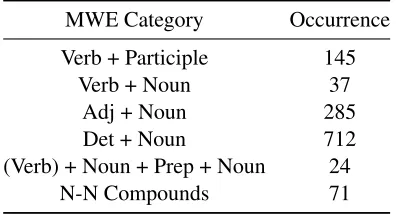
Among these MWEs, attestation rates for particu-lar subtypes are given in Table 2.
Figure 2:Samples MWEs in the English text, visualized with mwetoolkit (Ramisch et al., 2010)
wt=X, t∈ {2,1,0,1,2} &l0=L Lowercase form ofw0 =W &l0=L Prefix ofw0 =P with|P|<5 &l0=L Suffix ofw0 =Swith|S|<5 &l0=L
w0contains a hyphen &l0=L
w0contains a digit &l0=L
w0is capitalized &l0=L
w0is all in capital &l0=L
w0is capitalized and BOS &l0=L
w0is part of a multiword &l0=L
wiwj =XY,(j, k)∈ {(1,0),(0,1),(1,1)} &l0=L
[image:2.612.315.541.73.443.2]l−1=L0 &l0=L Table 1:Feature templates to detect MWEs
3.3 Participants
[image:2.612.317.553.488.656.2]MWE Category Occurrence Verb + Participle 145
Verb + Noun 37
Adj + Noun 285
Det + Noun 712
(Verb) + Noun + Prep + Noun 24
[image:3.612.87.285.72.179.2]N-N Compounds 71
Table 2:MWE Attestation Rates
psychiatric, neurological, or other medical illness or history of drug or alcohol abuse that might compromise cognitive functions. All qualified as right-handed on the Edinburgh handedness inven-tory (Oldfield, 1971). They self-identified as native English speakers and gave their written informed consent prior to participation, in accordance with Cornell University IRB guidelines.
3.4 Presentation
After giving their informed consent, participants were familiarized with the MRI facility and assumed a supine position on the scanner gurney. The presen-tation script was written in PsychoPy (Peirce, 2007). Auditory stimuli were delivered through MRI-safe, high-fidelity headphones (Confon HP-VS01, MR Confon, Magdeburg, Germany) inside the head coil. The headphones were secured against the plastic frame of the coil using foam blocks. Using a spo-ken recitation of the US Constitution, an experi-menter increased the volume until participants re-ported that they could hear clearly. Participants then listened passively to the audio storybook for 1 hour 38 minutes. The story had nine chapters and at the end of each chapter the participants were presented with a multiple-choice questionnaire with four ques-tions (36 quesques-tions in total), concerning events and situations described in the story. These questions were used to confirm their comprehension and were viewed by the participants via a mirror attached to the head coil and they answered through a button box. The entire session lasted around 2.5 hours.
3.5 Data Collection
Imaging was performed using a 3T MRI scan-ner (Discovery MR750, GE Healthcare, Milwau-kee, WI) with a 32-channel head coil at the Cor-nell MRI Facility. Blood Oxygen Level
Depen-dent (BOLD) signals were collected using a T2-weighted echo planar imaging (EPI) sequence (rep-etition time: 2000 ms, echo time: 27 ms, flip angle: 77deg, image acceleration: 2X, field of view: 216 x 216 mm, matrix size 72 x 72, and 44 oblique slices, yielding 3 mm isotropic voxels). Anatomical images were collected with a high resolution T1-weighted (1 x 1 x 1 mm3 voxel) with a
Magnetization-Prepared RApid Gradient-Echo (MP-RAGE) pulse sequence.
4 Data Analysis 4.1 Preprocessing
fMRI data is acquired with physical, biological con-straints and preprocessing allows us to make adjust-ments to improve the signal to noise ratio. Primary preprocessing steps were carried out in AFNI ver-sion 16 (Cox, 1996) and include motion correction, coregistration, and normalization to standard MNI space. After the previous steps were completed, ME-ICA (Kundu et al., 2012) was used to further preprocess the data. ME-ICA is a denoising method which uses Independent Components Analysis to split the T2*-signal into BOLD and non-BOLD components. Removing the non-BOLD components mitigates noise due to motion, physiology, and scan-ner artifacts (Kundu et al., 2017).
4.2 Statistical Analysis
The GLM typically used in fMRI is a hierarchical model with two levels (see Poldrack et al., 2011). At the first level, the data for each subject is mod-elled separately to calculate subject-specific param-eter estimates and within-subject variance such that for each subject, a regression model is estimated for each voxel against the time series. The second-level model takes subject-specific parameter estimates as input. It uses the between-subject variance to make statistical inferences about the larger population.
Stan-ford parser (Klein and Manning, 2003). Another regressor formalizes memory retrieval, by marking multiword expressions (MWE; see section 3.2). Each word in the text was annotated with a 0 or 1, depending on whether it was the last word of a MWE. This coding scheme expresses the idea that a different process occurs at the end of multiword expressions, and this provisionally assumes a very conservative approach to the Configuration Hypoth-esis (Cacciari and Tabossi, 1988; Tabossi et al., 2009). We regressed the word-by-word predictors described above against fMRI timecourses recorded during passive story-listening in a whole-brain anal-ysis. Along with the parsing and MWE regressors of theoretical interest, we entered four “nuisance” variables or regressors of non-interest into the GLM analysis using SPM12. One regressor simply marks the offset of each spoken word in time. Another gives the log-frequency of the individual word in movie subtitles (Brysbaert and New, 2009). The last two reflect the pitch (f0) and intensity (RMS) of the talker’s voice. These nuisance regressors are added to the GLM analysis to improve sensitivity, specificity and validity of activation maps (Bullmore et al., 1999; Lund et al., 2006). In particular, we sought to ensure that any conclusions about parsing and memory retrieval would be specific to those processes, as opposed to more general aspects of speech perception.
5 Results
In the second-level group analysis, bottom-up pars-ing and multi-word expressions were analyzed sep-arately. Results are presented below in Tables 3 and
4 using region names from the Harvard-Oxford Cor-tical Structure Atlas.
5.1 Group level results for bottom-up parsing
MNI Coordinates Region p-value k-size T-score x y z (corrected) (cluster) (peak-level) 52 8 -22 Temporal pole 0.000 2769 12.72 54 -40 12 Supramarginal Gyrus 0.000 2212 12.69 -34 18 -12 Frontal Orbital Cortex 0.000 2380 10.40 12 20 58 Superior Frontal Gyrus 0.000 7191 9.27 42 2 48 Middle Frontal Gyrus 0.000 286 9.19 -38 26 36 Middle Frontal Gyrus 0.000 382 8.47 -40 -78 6 Lateral Occipital Cortex 0.000 693 7.42 -52 -56 32 Angular Gyrus 0.000 802 7.12
28 -52 -8 Temporal Occipital
[image:4.612.313.540.139.247.2]Fusiform Cortex 0.001 83 6.74 -44 46 -12 Frontal Pole 0.000 176 6.28
Table 3:Significant clusters for bottom-up parser action count after FWE voxel correction.
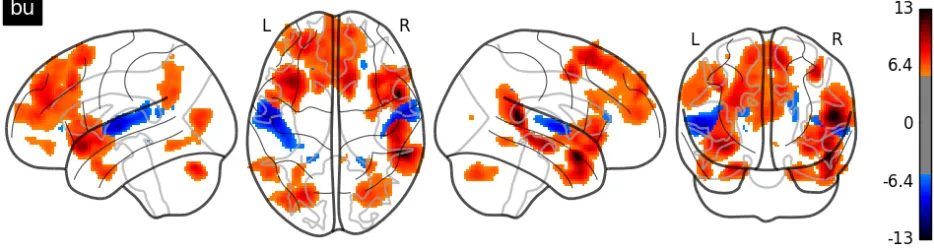
The largest clusters (p < 0.05 FWE) were ob-served in Anterior Temporal regions (Temporal Pole) and Frontal regions.
Figure 3, plotted with nilearn (Abraham et al., 2014) is the T-score map for the bottom-up parser action count regressor. This regressor formalizes processing effort related to structural composition.
5.2 Group level results for MWE
MNI Coordinates Region p-value k-size T-score x y z (corrected) (cluster) (peak-level) 6 -60 52 Precuneus Cortex 0.000 559 7.62 24 10 56 Superior Frontal Gyrus 0.000 182 7.23 -40 42 26 Frontal Pole 0.000 158 6.94 66 -38 34 Supramarginal Gyrus 0.000 103 6.77 34 38 36 Frontal Pole 0.001 58 5.83
Table 4: Significant clusters for MWEs after FWE voxel cor-rection
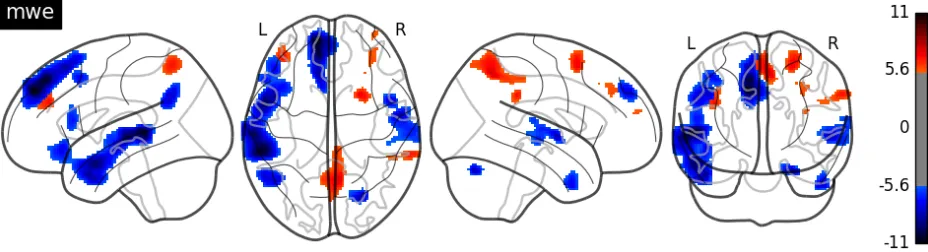
[image:4.612.72.539.562.687.2]The largest clusters (p < 0.05 FWE) were ob-served in Precuneus Cortex and Frontal regions.
Figure 4:T-score map for the MWE status regressor. Red represents the positive score while blue represents the negative score.
Figure 4 (also plotted with nilearn) is the T-score map for the MWE status regressor, which is meant to formalize the retrieval of these noncompositional expressions.
6 Discussion
The operationalization of structure-building as bottom-up parsing highlights Anterior Temporal as well as Frontal regions. These results are consis-tent with earlier work including deficit-lesion data (Dronkers et al., 2004), fMRI studies of text com-prehension (Ferstl et al., 2008), and magnetoen-cephalography studies of phrasal composition (Be-mis and Pylkk¨anen, 2011). This literature also con-firms the sensitivity of Anterior Temporal regions to parametric variation of phrase size (Pallier et al., 2011).
With respect to MWEs, significant activation was observed in the Precuneus. The Precuneus has not traditionally been viewed as part of the language net-work. However, it has been designated as part of the Protagonist’s Perspective Interpreter Network (Ma-son and Just, 2006). This network in fact appears to be activated by many different sorts of story char-acters, not just the protagonist (Wehbe et al., 2014). Along these lines, the Precuneus activation in Fig-ure 4 might be interpreted narrowly as an effect of reference to dramatis personae in the narrative stim-ulus. This restricted interpretation would be chal-lenged by the fact that less than 25% of the MWEs in the stimulus text are references to story charac-ters. To account for the full collection, including verbal MWEs, a more general characterization in terms of memory retrieval seems appropriate.
This more general characterization is bolstered by
data that implicate the Precuneus in memory tasks:
• Verbal memory (Halsband et al., 2002)
• Spatial memory (Wallentin et al., 2008)
• Episodic memory (Andreasen et al., 1995)
• Memory-related imagery (Fletcher et al., 1995;
Mashal et al., 2014)
As Spreng et al. (2009) suggest, the Precuneus could be part of a wider, task-general network that is also recruited in Theory-of-Mind, Prospection and Autobiographical memory tasks. These considera-tions strengthen the interpretation, based on MWEs, that the Precuneus mediates memory retrieval during naturalistic language comprehension.
The findings as a whole are broadly consistent with existing neurocognitive models of language. For example, within Hagoort’s (2016) MUC model, MWE comprehension might tap memory resources, whereas bottom-up parsing might involve unifica-tion. With MUC, our analysis suggests a localiza-tion of these memory resources to the Parietal lobe. Within the Procedural/Declarative model (Ullman, 2001; 2004), rule-based linguistic knowledge would be localized to Frontal regions. This is consistent with the Frontal activations that we observe in re-sponse to the bottom-up parsing regressor.
7 Conclusion
Acknowledgments
This material is based upon work supported by the National Science Foundation under Grant No. 1607441.
References
Alexandre Abraham, Fabian Pedregosa, Michael Eicken-berg, Philippe Gervais, Andreas Mueller, Jean Kos-saifi, Alexandre Gramfort, Bertrand Thirion, and Ga¨el Varoquaux. 2014. Machine learning for neuroimaging with scikit-learn. Frontiers in neuroinformatics, 8. Nancy C Andreasen, Daniel SO Leary, Ted Cizadlo,
Stephan Arndt, et al. 1995. Remembering the past: two facets of episodic memory explored with positron emission tomography. The American journal of psy-chiatry, 152(11):1576.
Douglas K Bemis and Liina Pylkk¨anen. 2011. Sim-ple composition: A magnetoencephalography investi-gation into the comprehension of minimal linguistic phrases. The Journal of Neuroscience, 31(8):2801– 2814.
Jonathan Brennan, Yuval Nir, Uri Hasson, Rafael Malach, David J Heeger, and Liina Pylkk¨anen. 2012. Syntactic structure building in the anterior temporal lobe during natural story listening. Brain and lan-guage, 120(2):163–173.
Marc Brysbaert and Boris New. 2009. Moving beyond kuˇcera and francis: A critical evaluation of current word frequency norms and the introduction of a new and improved word frequency measure for american english. Behavior research methods, 41(4):977–990. ET Bullmore, MJ Brammer, S Rabe-Hesketh, VA
Cur-tis, RG Morris, SCR Williams, T Sharma, and PK McGuire. 1999. Methods for diagnosis and treat-ment of stimulus-correlated motion in generic brain activation studies using fmri. Human brain mapping, 7(1):38–48.
Cristina Cacciari and Patrizia Tabossi. 1988. The com-prehension of idioms. Journal of memory and lan-guage, 27(6):668–683.
Cristina Cacciari. 2014. Processing multiword idiomatic strings: Many words in one? The Mental Lexicon, 9(2):267–293.
Matthieu Constant and Isabelle Tellier. 2012. Evaluating the impact of external lexical resources into a crf-based multiword segmenter and part-of-speech tagger. In8th International Conference on Language Resources and Evaluation (LREC’12), pages 646–650.
Robert W. Cox. 1996. Afni: software for analysis and visualization of functional magnetic resonance neuroimages. Computers and Biomedical research, 29(3):162–173.
Nina F Dronkers, David P Wilkins, Robert D Van Valin, Brenda B Redfern, and Jeri J Jaeger. 2004. Lesion analysis of the brain areas involved in language com-prehension. Cognition, 92(1):145–177.
Evelyn C Ferstl, Jane Neumann, Carsten Bogler, and D Yves Von Cramon. 2008. The extended lan-guage network: a meta-analysis of neuroimaging stud-ies on text comprehension. Human brain mapping, 29(5):581–593.
PC Fletcher, CD Frith, SC Baker, T Shallice, RSJ Frack-owiak, and RJ Dolan. 1995. The mind’s eyeprecuneus activation in memory-related imagery. Neuroimage, 2(3):195–200.
Adele E. Goldberg. 2006. Constructions at work: The nature of generalization in language. Oxford Univer-sity Press.
Peter Hagoort. 2016. MUC (memory, unification, con-trol): A model on the neurobiology of language be-yond single word processing. InNeurobiology of lan-guage, pages 339–347. Elsever.
John T Hale. 2014. Automaton theories of human sen-tence comprehension. CSLI Publications.
U Halsband, BJ Krause, H Sipil¨a, M Ter¨as, and A Laihi-nen. 2002. Pet studies on the memory processing of word pairs in bilingual finnish–english subjects. Be-havioural brain research, 132(1):47–57.
Ray Jackendoff. 2002. Foundation of language: Brain, meaning, grammar.Evolution.
Dan Klein and Christopher D Manning. 2003. Ac-curate unlexicalized parsing. In Proceedings of the 41st Annual Meeting on Association for Computa-tional Linguistics-Volume 1, pages 423–430. Associ-ation for ComputAssoci-ational Linguistics.
Koenraad Kuiper, Heather McCann, Heidi Quinn, Therese Aitchison, and Kees van der Veer. 2003. Syntactically Annotated Idiom Dataset (SAID) LDC2003T10. In Linguistic Data Consortium, Philadelphia.
Prantik Kundu, Souheil J Inati, Jennifer W Evans, Wen-Ming Luh, and Peter A Bandettini. 2012. Differentiat-ing bold and non-bold signals in fmri time series usDifferentiat-ing multi-echo epi.Neuroimage, 60(3):1759–1770. Prantik Kundu, Valerie Voon, Priti Balchandani,
Michael V. Lombardo, Benedikt A. Poser, and Peter A. Bandettini. 2017. Multi-echo fmri: A review of appli-cations in fmri denoising and analysis of bold signals.
NeuroImage, 154:59 – 80. Cleaning up the fMRI time series: Mitigating noise with advanced acquisition and correction strategies.
Torben E Lund, Kristoffer H Madsen, Karam Sidaros, Wen-Lin Luo, and Thomas E Nichols. 2006. Non-white noise in fmri: does modelling have an impact?
Adam Makkai, M. T. Boatner, and J. E. Gates. 1995. A Dictionary of American idioms. ERIC.
Nira Mashal, Tali Vishne, and Nathaniel Laor. 2014. The role of the precuneus in metaphor comprehension: evi-dence from an fmri study in people with schizophrenia and healthy participants. Frontiers in human neuro-science, 8.
Robert A Mason and Marcel Adam Just. 2006. Neu-roimaging contributions to the understanding of dis-course processes. Handbook of psycholinguistics, 799. Timothy J O’Donnell. 2015. Productivity and reuse in language: A theory of linguistic computation and stor-age. MIT Press.
Richard C Oldfield. 1971. The assessment and analysis of handedness: the edinburgh inventory. Neuropsy-chologia, 9(1):97–113.
Christophe Pallier, Anne-Dominique Devauchelle, and Stanislas Dehaene. 2011. Cortical representation of the constituent structure of sentences. Proceedings of the National Academy of Sciences, 108(6):2522–2527. S´ebastien Paumier, Takuya Nakamura, and Stavroula Voyatzi. 2009. Unitex, a corpus processing system with multi-lingual linguistic resources. eLEX2009, page 173.
Jonathan W Peirce. 2007. Psychopypsychophysics soft-ware in python. Journal of neuroscience methods, 162(1):8–13.
William D Penny, Karl J Friston, John T Ashburner, Ste-fan J Kiebel, and Thomas E Nichols. 2011.Statistical parametric mapping: the analysis of functional brain images. Academic press.
Ivan A Sag, Timothy Baldwin, Francis Bond, Ann Copes-take, and Dan Flickinger. 2002. Multiword expres-sions: A pain in the neck for NLP. InInternational Conference on Intelligent Text Processing and Com-putational Linguistics, pages 1–15. Springer.
R Nathan Spreng, Raymond A Mar, and Alice SN Kim. 2009. The common neural basis of autobiographical memory, prospection, navigation, theory of mind, and the default mode: a quantitative meta-analysis. Jour-nal of cognitive neuroscience, 21(3):489–510. Patrizia Tabossi, Rachele Fanari, and Kinou Wolf. 2009.
Why are idioms recognized fast? Memory & Cogni-tion, 37(4):529–540.
Michael T Ullman. 2001. A neurocognitive perspective on language: The declarative/procedural model. Na-ture reviews. Neuroscience, 2(10):717.
Michael T Ullman. 2004. Contributions of memory cir-cuits to language: The declarative/procedural model.
Cognition, 92(1):231–270.
Mikkel Wallentin, Ethan Weed, Leif Østergaard, Kim Mouridsen, and Andreas Roepstorff. 2008. Accessing the mental spacespatial working memory processes for
language and vision overlap in precuneus. Human Brain Mapping, 29(5):524–532.
Leila Wehbe, Brian Murphy, Partha Talukdar, Alona Fyshe, Aaditya Ramdas, and Tom Mitchell. 2014. Si-multaneously uncovering the patterns of brain regions involved in different story reading subprocesses. PloS one, 9(11):e112575.