Generating Text from Anonymised Structures
Émilie Colin
Université de Lorraine / LORIA Nancy, France
Claire Gardent
CNRS / LORIA Nancy, France
Abstract
Surface realisation maps a meaning repretation (MR) to a text, usually a single sen-tence. In this paper, we introduce a new par-allel dataset of deep meaning representations and French sentences and we present a novel method for MR-to-text generation which seeks to generalise by abstracting away from lexical content. Most current work on natural lan-guage generation focuses on generating text that matches a reference using BLEU as eval-uation criteria. In this paper, we additionally consider the model’s ability to reintroduce the function words that are absent from the deep input meaning representations. We show that our approach increases both BLEU score and the scores used to assess function words gen-eration.
1 Introduction
Surface realisation (SR), the ability to generate text from meaning representations (MR), is a key component of data-to-text generation. In this pa-per, we focus on surface realisation for French. We make two contributions.
First, we present a method for automatically creating a parallel dataset of sentences and their meaning representations1.
Second, we propose a novel surface realisation approach which differs from previous work in that
troduction in the generated sentence of the func-tion words that are absent from the input.
2 Related Work
SR Corpora Various datasets have been intro-duced to support the learning of surface realisers.
The 2017 AMR SemEval generation shared task (May and Priyadarshi, 2017) provides a paral-lel corpus where the input semantic representa-tions are AMRs (Abstract Meaning Representa-tion, (Banarescu et al., 2013)) and the task is to generate a sentence verbalising that AMR.
Mille et al.(2018) derived multilingual MR-to-Text datasets from the UD (Universal Dependen-cies) treebanks2creating two types of input, shal-low and deep. In the shalshal-low input, the nodes of the UD dependency tree are scrambled to remove word order information and words are replaced by their lemmas. The generation task consists in or-dering and inflecting the lemmas decorating the in-put tree. The deep inin-put is closer to an applicative context. It abstracts away from the surface form by removing additional information from the UD tree and replacing syntactic edge labels with Prob-Bank/NomBank labels.
Finally, (Novikova et al., 2017) introduce a dataset where the input MRs are dialog moves.
SR Models. Using the parallel MR-to-text cor-pora just described, various SR models have been proposed. We focus here on SR from deep mean-ing representations (AMRs and SR’18 deep track MRs) as this is closest to our proposal.
Early work on MR-to-text generation linearise the input graph and use various statistical methods to generate text (Flanigan et al.,2016;Song et al.,
2017; Pourdamghani et al., 2016; Bohnet et al.,
2010). Similarly, early neural approaches linearise the input graph and use a sequence-to-sequence (S2S) model.Konstas et al.(2017) achieve strong results on the AMR-to-text task by using data ex-pansion and anonymising data entities whileCao and Clark (2019) additionally leverages syntactic information to improve performance. On the deep SR data, (Elder and Hokamp,2018) uses data ex-pansion and a factored S2S model.
Graph-to-sequence models have also been pro-posed using various graph encoders and testing on different datasets Marcheggiani and Perez-Beltrachini (2018); Song et al. (2018); Beck et al. (2018); Koncel-Kedziorski et al. (2019);
Veliˇckovi´c et al.(2018).
Our approach is closest to the S2S model used byElder and Hokamp(2018) in that it uses a fac-tored S2S model to create rich node embeddings capturing the structure of the graph. We differ from that work in that we use full anonymization on input and output data.
3 Data
Instead of relying on hand annotations, we au-tomatically create a silver corpus using syntactic parsing and post-processing. Creating the dataset consists of two main steps. First, we compare the output of three syntactic dependency parsers and keep only those sentences for which there is a strong consensus. Second, we derive a meaning
basis for the alignment. For POS tags and depen-dency relations, the alignment is neither one-to-one nor one-to-one-to-many. We only keep those map-pings whose frequency is above 95% for POS tags and 94% for dependency relations. Grew is used as a reference and a POS tag/Dependency relation from Talismane and the Stanford parser is judged compatible if it matches one of these mappings. We only keep those sentences for which a mapping could be found for all three parsers (for both POS tags and dependency relations) and which contain less than 70 tokens6.
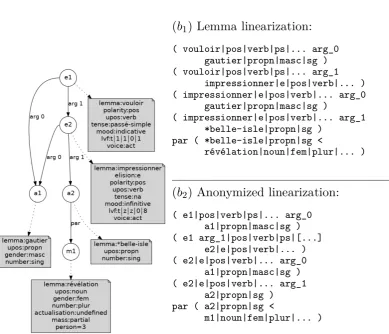
We then derive deep meaning representations from the parse tree by mapping grammatical func-tions (subject, etc) to semantic ones (arg0, arg1, etc.), removing function words (determiners, aux-iliaries, relative pronouns, complementizers, non subcategorised prepositions), lemmatizing word forms and keeping only those features which can-not be learned e.g., the number and gender of a noun and the tense of a verb. Since determin-ers and auxiliary are removed from the mean-ing representations their number must be learned by the model or more generally, agreement con-straints (between verb and subject and between noun, determiners and adjectives) must be learned. The mapping from syntactic to semantic relations makes use of a verb lexicon7which permits iden-tifying which phrases are arguments (rather than modifiers). The arg0 relation is assigned to the subject of verbs in the active voice, arg1 the ob-ject and arg2 is used for prepositional arguments.
Figure1 shows an example meaning represen-tation.
4 Model
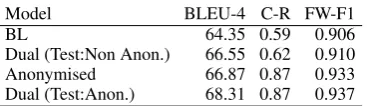
Model BLEU-4 C-R FW-F1
BL 64.35 0.59 0.906
Dual (Test:Non Anon.) 66.55 0.62 0.910
Anonymised 66.87 0.87 0.933
[image:4.595.73.257.92.145.2]Dual (Test:Anon.) 68.31 0.87 0.937
Table 1: Results
Our approach extends a standard S2S model with full anonymization and factored token em-beddings which capture the linguistic and struc-tural information associated with each node in the input graph.
Full Anonymization. Anonymisation (also of-ten dubbed, delexicalisation) has frequently been used in neural NLG to help handle unknown or rare words (Wen et al.,2015;Dušek and Jurcicek,
2015;Chen et al.,2018). Rare items are replaced by placeholders both in the input data or MR and in the output sentence or text. Models are trained on the anonymized data. Finally, a post-processing step ensures that the generated text is relexicalised using the placeholders original value. In these ap-proaches, anonymization is restricted to rare items (named entities) and replaces them with a simple identifier. In contrast, we apply anonymization to all lemmatized content words, adverbs excepted. As we derive the input MR from the sentence parse tree (cf. Section3), we keep track of which word form in the target sentence matches which lemma in the input MR and use this at post-processing time to relexicalise the anonymous output struc-ture.
Factored Sequence-to-Sequence model. We use OpenNMT factored S2S model with atten-tion. Each input token is represented by the con-catenation of 18 embeddings whereby each em-bedding represents a distinct feature type (part-of-speech, gender, number, tense etc) (Alexandrescu and Kirchhoff,2006). We focus on word ordering and use a table lookup to match output lemmas to word forms.
5 Experimental Settings
Evaluation Metrics. Following common prac-tice in NLG, we evaluate our model using BLEU-410. To further assess the ability of the model to
10We use sacrebleu (Post,2018)
learn linguistic structure, we also evaluate recall on content words (C-R) and F1 on function words (FW-F1). We define content words to be the lem-mas present in the input meaning representation. Function words are the words in the (lemmatized) output sentence that are not content words.
Models. The baseline is a factored S2S model with attention trained on the original data (no anonymization). We compare this baseline with the same model trained on anonymised data (Anonymised) and with two models trained on a corpus consisting of both the original and the anonymised data. The intuition behind used both anonymised and non anonymised data for train-ing is to see whether the combination of both sources of information can help. The first model (Dual Lexicalised) is tested on lexicalised data (does the adjunction of anonymised training data help improve generation from non anonymised meaning representations?) while the second (Dual Anonymised) is tested on anonymised data (does the adjunction of non anonymised training data help improve generation from anonymised mean-ing representations?). We did never anonymised adverbs, having them in outputs, waiting them in outputs.
Results. The results are shown in Table1. The BLEU scores show that training on anonymised structures yields better results (+2.52 BLEU). Us-ing both lexicalised and anonymised data for train-ing further improves results which is not surpris-ing given that the size of the trainsurpris-ing data has doubled. Interestingly, the delta is slightly better when testing on anonymised data (+3.96 vs. +2.2) which suggests that adding lexical information to the training data is more beneficial to anonymised generation than vice versa.
A similar trend can be observed concerning the handling of function words although the increase is much less.
Qualitative Analysis. On the whole test corpus (49,026 sentences), an automatic analysis of the results shows that (i) 34.76% of the generated sentences are the same as the reference sentence, (ii) relexicalisation fails for some input token for 34.07 % of cases and (iii) in total, 94.8% of the input content words are present in the output.
We also manually examined 50 randomly se-lected sentences11 generated by our model. 34%
of these are exactly the same as the reference. 58% are both grammatically and semantically correct. 78% are grammatically correct. All verbs were found to be in the correct form (agreement and tense). We detected only one agreement error be-tween a noun and its determiner. A detailed analy-sis of the errors found can be found in the supple-mentary material.
6 Conclusion
We introduced a new MR-to-text dataset for French and showed that full anonymization helps improve surface realisation. The automatic con-struction of parallel data using parsing makes available a detailed linguistic description of the target sentences to be generated. We are currently exploring how to extend the data creation method described in section3to better evaluate the ability of neural models to generate under syntactic con-straints.
Acknowledgments
The research presented in this paper was par-tially supported by the E-FRAN Program (Es-paces de Formation, de Recherche et d’Animation Numérique) within the framework of the METAL Project (Modèles et Traces au Service de l’Apprentissage des Langues).
References
Andrei Alexandrescu and Katrin Kirchhoff. 2006. Fac-tored neural language models. In Proceedings of the Human Language Technology Conference of the
NAACL, Companion Volume: Short Papers, pages
1–4. Association for Computational Linguistics.
Laura Banarescu, Claire Bonial, Shu Cai, Madalina Georgescu, Kira Griffitt, Ulf Hermjakob, Kevin Knight, Philipp Koehn, Martha Palmer, and Nathan
Bernd Bohnet, Leo Wanner, Simon Mille, and Alicia Burga. 2010. Broad coverage multilingual deep sen-tence generation with a stochastic multi-level real-izer. InProceedings of the 23rd International
Con-ference on Computational Linguistics, pages 98–
106. Association for Computational Linguistics.
Kris Cao and Stephen Clark. 2019. Factorising amr generation through syntax. In Proceedings of the 2019 Conference of the North American Chapter of the Association for Computational Linguistics:
Hu-man Language Technologies (NAACL-HLT).
Mingje Chen, Gerasimos Lampouras, and Andreas Vlachos. 2018. Sheffield at e2e: structured predic-tion approaches to end-to-end language generapredic-tion. Technical report, E2E Challenge System Descrip-tions.
Ondˇrej Dušek and Filip Jurcicek. 2015. Training a natural language generator from unaligned data.
In Proceedings of the 53rd Annual Meeting of the
Association for Computational Linguistics and the 7th International Joint Conference on Natural
Lan-guage Processing (Volume 1: Long Papers), pages
451–461. Association for Computational Linguis-tics.
Henry Elder and Chris Hokamp. 2018. Generating high-quality surface realizations using data augmen-tation and factored sequence models. In Proceed-ings of the First Workshop on Multilingual Surface Realisation, pages 49–53. Association for Computa-tional Linguistics.
Jeffrey Flanigan, Chris Dyer, Noah A Smith, and Jaime Carbonell. 2016. Generation from abstract mean-ing representation usmean-ing tree transducers. In Pro-ceedings of the 2016 Conference of the North Amer-ican Chapter of the Association for Computational
Linguistics: Human Language Technologies, pages
731–739.
Diego Marcheggiani and Laura Perez-Beltrachini. 2018. Deep graph convolutional encoders for struc-tured data to text generation. In Proceedings of the 11th International Conference on Natural Lan-guage Generation, pages 1–9, Tilburg University, The Netherlands. Association for Computational Linguistics.
Jonathan May and Jay Priyadarshi. 2017. Semeval-2017 task 9: Abstract meaning representation pars-ing and generation. In Proceedings of the 11th International Workshop on Semantic Evaluation
(SemEval-2017), pages 536–545. Association for
Computational Linguistics.
Simon Mille, Anja Belz, Bernd Bohnet, Yvette Gra-ham, Emily Pitler, and Leo Wanner. 2018. The first multilingual surface realisation shared task (sr’18): Overview and evaluation results. InProceedings of the First Workshop on Multilingual Surface Reali-sation, pages 1–12. Association for Computational Linguistics.
Jekaterina Novikova, Ondˇrej Dušek, and Verena Rieser. 2017. The e2e dataset: New challenges for end-to-end generation. InProceedings of the 18th
An-nual SIGdial Meeting on Discourse and Dialogue,
pages 201–206. Association for Computational Lin-guistics.
Matt Post. 2018. A call for clarity in reporting BLEU scores. InProceedings of the Third Conference on Machine Translation: Research Papers, pages 186– 191, Belgium, Brussels. Association for Computa-tional Linguistics.
Nima Pourdamghani, Kevin Knight, and Ulf Her-mjakob. 2016. Generating english from abstract meaning representations. InProceedings of the 9th International Natural Language Generation confer-ence, pages 21–25.
Linfeng Song, Xiaochang Peng, Yue Zhang, Zhiguo Wang, and Daniel Gildea. 2017. Amr-to-text gener-ation with synchronous node replacement grammar.
arXiv preprint arXiv:1702.00500.
Linfeng Song, Yue Zhang, Zhiguo Wang, and Daniel Gildea. 2018. A graph-to-sequence model for AMR-to-text generation. InProceedings of the 56th Annual Meeting of the Association for Computa-tional Linguistics (Volume 1: Long Papers), pages 1616–1626, Melbourne, Australia. Association for Computational Linguistics.
Petar Veliˇckovi´c, Guillem Cucurull, Arantxa Casanova, Adriana Romero, Pietro Liò, and Yoshua Bengio. 2018. Graph Attention Networks. International Conference on Learning Representations. Accepted as poster.
Tsung-Hsien Wen, Milica Gasic, Nikola Mrkši´c, Pei-Hao Su, David Vandyke, and Steve Young. 2015.
Semantically conditioned lstm-based natural lan-guage generation for spoken dialogue systems. In
Proceedings of the 2015 Conference on Empirical
Methods in Natural Language Processing, pages