For further information contact:
Office of the Director of Corporate Enforcement,
16 Parnell Square, Dublin 1. Tel: 01 858 5800 Lo-call: 1890 315 015
Fax: 01 858 5801 Email: [email protected]
Web: www.odce.ie
© Government of Ireland, 2009 ISBN 978-1-4064-2285-6
DUBLIN:
PRINTED BY THE STATIONERY OFFICE. __________________ To be purchased directly from the GOVERNMENT PUBLICATIONS SALE OFFICE, SUN ALLIANCE HOUSE, MOLESWORTH STREET, DUBLIN 2,
or by mail order from
GOVERNMENT PUBLICATIONS, POSTAL TRADE SECTION, 51 ST. STEPHEN’S GREEN, DUBLIN 2. (Tel: 01 647 6834/35/36/37; Fax: 01 672 5449)
or through any bookseller. ___________________
O
ff
ic
e
of
t
h
e
D
ir
ec
to
r o
f C
or
p
or
at
e
En
fo
rc
em
en
t A
n
n
u
al
R
ep
or
t 2
0
0
8
Contents
Foreword by the Director of Corporate Enforcement
3
Introduction
4
Goal 1 – Encouraging Compliance with the Companies Acts
5
Goal 2 – Uncovering Suspected Breaches of Company Law
11
Goal 3 – Prosecuting Detected Breaches of the Companies Acts
17
Goal 4 – Sanctioning Improper Conduct with respect to Insolvent Companies
22
Goal 5 – Providing Quality Services to Internal and External Customers
29
Conclusion
33
O
ff
ic
e
of
t
h
e
D
ir
ec
to
r
of
C
or
p
or
at
e
En
fo
rc
em
en
t
A
n
n
u
al
R
ep
or
t
2
0
0
8
2
Copyright and Disclaimer Statement
The contents of this document are the copyright of the Director of Corporate Enforcement. All or part of this publication may be reproduced without further permission, provided the source is acknowledged.
Nothing herein should be construed as a representation by, or on behalf of, the Director of Corporate Enforcement as to his understanding or interpretation of any of the provisions of the Companies Acts or as to the interpretation of any law. Independent legal advice should be sought in relation to the effects of any legal provision. The Director of Corporate Enforcement accepts no responsibility or liability howsoever arising from the contents of this publication or any errors, inaccuracies or omissions in the contents of this document. The Director reserves the right to take action, which may or may not be in accordance with the provisions of this document.
O
ff
ic
e
of
t
h
e
D
ir
ec
to
r o
f C
or
p
or
at
e
En
fo
rc
em
en
t A
n
n
u
al
R
ep
or
t 2
0
0
8
Foreword
Pursuant to section 16(1) of the Company Law Enforcement Act 2001, I am pleased to present Ms Mary Coughlan, T.D., Tánaiste and Minister for Enterprise Trade and Employment, with my Office’s Annual Report for 2008.
Throughout 2008, the ODCE continued to pursue its objective of improving compliance with company law. The Office adopts a twin-pronged approach to its role. Firstly, it seeks to encourage and facilitate voluntary compliance by deepening and widening levels of knowledge among relevant company stakeholders about their rights and responsibilities. Secondly, the Office seeks to drive compliance through a range of actions that include encouragement to correct detected breaches through to criminal prosecutions for more serious breaches of law or duty.
Highlights for the ODCE in 2008 by primary activity included:
n the appointment of a High Court Inspector to DCC
plc, S&L Investments Ltd. and Lotus Green Ltd. to investigate aspects of various purchases and sales of the shares of Fyffes plc in 1995 and 2000;
n the publication of a detailed Company Law Handbook/
Guidance on Property Management Companies to help improve their governance;
n attendance at some 80 public events where ODCE staff
gave presentations to and engaged with the public to urge compliance with the Companies Acts;
n a total of 32 convictions, 20 disqualifications and one
restriction. A record amount of €46,600 in fines was also imposed. 12 of the 20 disqualifications arose from the Office’s evaluation of dissolved insolvent companies;
n a 42% increase to 406 in the number of initial
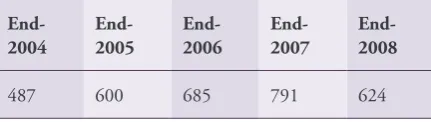
liquidator reports received. This reflected the declining performance of the national economy, and more than double the number of 2008 liquidations are expected in 2009. The Office also determined about 350 initial liquidator reports, a 22% rise on the 2007 outturn;
n a 15% increase to 584 in the number of cases of alleged
breaches of the Companies Acts which were closed by the Office after investigation. In the majority of these cases, closure followed satisfactory rectification of the company law difficulty by administrative means. A further 78 cases were referred for investigation of possible legal action by the Office;
n a fourfold increase to €134 million in the amount of
excessive directors’ loans reported by auditors, many in construction and property companies. The Office is satisfied that its involvement resulted in compliance being achieved in many cases, while others remained under review at year-end;
n the first conviction of a company director for knowingly
using company assets in breach of the legal restrictions on the giving of loans to directors;
n the first case of a company director being handed down
a custodial sentence which was not suspended by the Court. However, the company director in question has appealed both the conviction and the sentence. The case involved a person acting as a director in breach of a High Court disqualification order.
I wish to express particular appreciation to the Department of Enterprise Trade and Employment for the four
additional staff which were made available in 2008 in line with a Departmental commitment on increased staffing levels for the Office. Some of the increased throughput reported above was made possible by this increase.
Our expenditure outturn in 2008 was €4.34 million, a slight reduction on the €4.37 million spent in 2007. This reduction was achieved notwithstanding the expenditure associated with four additional staff and the initial cost of the DCC Inspection. These additional costs were largely met by curtailing advertising and publicity work in response to Government requests for cutbacks in uncommitted spending.
Our successful results in 2008 were achieved by a dedicated and hard working staff. I want to thank them for their continuing commitment to the work of the Office. Our collective efforts are helping business people, community interests and the general public to engage fairly and equitably with one another through corporate structures.
I also want to acknowledge the continuing support given to the Office by the Oireachtas, the Government and the Courts. Thanks is also due to those legal and accounting professionals who supported our work in 2008. I hope that this will continue for 2009 and that we will keep making a positive difference to improving corporate standards in the overall public interest.
Paul Appleby
O
ff
ic
e
of
t
h
e
D
ir
ec
to
r
of
C
or
p
or
at
e
En
fo
rc
em
en
t
A
n
n
u
al
R
ep
or
t
2
0
0
8
Introduction
The present Strategy Statement of the Director of Corporate Enforcement identifies the following primary ODCE goals and related sub-goals:
Goal :
Encouraging Compliance with the
Companies Acts
n Sub-Goal 1.1: Publishing Accessible Company Law
Information
n Sub-Goal 1.2: Promoting Compliance
n Sub-Goal 1.3: Improving Company Law and
Associated Corporate Practices
Goal 2:
Uncovering Suspected Breaches of
Company Law
n Sub-Goal 2.1: Developing Detection and Reporting
Arrangements for Suspected Breaches of the Companies Acts
n Sub-Goal 2.2: Identifying Suspected Breaches of the
Companies Acts
n Sub-Goal 2.3: Commissioning/Supporting Formal
Company Investigations
Goal :
Prosecuting Detected Breaches of the
Companies Acts
n Sub-Goal 3.1: Developing a Balanced Enforcement
Policy
n Sub-Goal 3.2: Upholding the Disclosure Requirements
of the Companies Acts
n Sub-Goal 3.3: Sanctioning Parties Disregarding
Company or Other Interests
n Sub-Goal 3.4: Acting against Parties Denying
Accountability under the Law
Goal :
Sanctioning Improper Conduct
relating to Insolvent Companies
n Sub-Goal 4.1: Supervising Liquidators in the Proper
Discharge of their Duties
n Sub-Goal 4.2: Assessing Directors’ Conduct in
Insolvent Liquidation Situations
n Sub-Goal 4.3: Sanctioning Fraudulent or Abusive
Behaviour
Goal 5:
Providing Quality Services to Internal
and External Customers
n Sub-Goal 5.1: Securing and Managing ODCE
Resources
n Sub-Goal 5.2: Developing Staff
n Sub-Goal 5.3: Developing and Maintaining Quality
Customer Services
O
ff
ic
e
of
t
h
e
D
ir
ec
to
r o
f C
or
p
or
at
e
En
fo
rc
em
en
t A
n
n
u
al
R
ep
or
t 2
0
0
8
5
Goal :
Encouraging Compliance with the
Companies Acts
Introduction
The Office undertook a notable amount of work in 2008 in furthering its compliance remit and achieved record results in a number of areas. Staff supporting the compliance function prepared and issued a number of significant publications, attended over 80 public events and handled over 400 company law compliance issues. The Office’s Reception Team also successfully dealt with many more routine queries. In all, it was a very satisfactory year.
Sub-Goal .:
Publishing Accessible
Company Law Information
The Office issued nine separate publications in 2008 (five in 2007). The full list is available at Appendix 1.1.1 to this Report. The more significant of these publications are dealt with below.
In all, the Office circulated some 24,000 copies of its various publications in 2008. All of the newly published documents discussed below are available on the ODCE website at www.odce.ie.
Handbook on Residential Property Owners’
Management Companies
The most extensive guidance document issued in 2008 was the Office’s Company Law Handbook on Residential
Property Owners’ Management Companies1. This major
publication comprises more than 200 pages and was developed in order to improve the future performance of these companies. This form of company and the wider issue of multi-unit developments with which those companies have been associated have been a regular subject of public controversy in recent years. The ODCE Company Law Handbook is the latest in a series of publications by the
Law Reform Commission2, the National Consumer
Agency3 and various other parties which have addressed
aspects of the area.
1 Decision Notice D/2008/1. The Handbook is available on request from the Office or at www.odce.ie.
2 See the Law Reform Commission Report on Multi-Unit Developments (June 2008) which is available at www.lawreform.ie.
3 See the National Consumer Agency publications (September 2008) on the Conclusions and Outputs of its Multi-Unit Development Stakeholder Forum and on Buying and Living in a Multi-Unit Development Property in Ireland. Both documents are available at www.consumerproperty.ie.
The ODCE Handbook deals with the many and varied company law issues that pertain to property management companies. Among the key topics dealt with are:
n the key phases in the evolution of the management
company;
n the voting power of members of the company;
n the predominant role of the company’s directors;
n its annual general meetings;
n the legal rights of members to apply for relief to the
High Court and
n the role and approach of the ODCE in dealing with
management company issues.
The Handbook was developed from an ODCE
Consultation Paper4 which issued in December 2006.
Almost 70 submissions were received from various interested parties, and the associated comments and suggestions significantly influenced the preparation of the final Handbook. A commentary on those submissions was also published in conjunction with the Handbook.
Management Companies Booklet – A
Property Owners’ Guide to Company Law
As a companion to the lengthy Handbook, the Office also issued a Booklet entitled “Management Companies – A Property Owners’ Guide to Company Law.” This summary guidance was prepared to give ordinary members of residential management companies (namely the property owners) an overview of their rights in company law. The Booklet was developed as an introduction to the area enabling those interested in learning more to consult the greater level of detail available in the Handbook.The Booklet explains the concepts of the management company and the managing agent and outlines the respective roles of directors, members and the company secretary. It highlights the importance of the company’s financial statements, the audit and the annual return and explains how company law can help members to assert their rights. The Booklet also defines the rather limited role of the ODCE in addressing the many problems which arise with management companies.
O
ff
ic
e
of
t
h
e
D
ir
ec
to
r
of
C
or
p
or
at
e
En
fo
rc
em
en
t
A
n
n
u
al
R
ep
or
t
2
0
0
8
Handbook and Summary Guide on Residential Property Owners’ Management Companies
Consistent with its intended accessibility, the Booklet was produced in conjunction with the National Adult Literacy Agency and received the Plain English mark. Both the Handbook and the Booklet are available in Irish as well as English on the ODCE website at www.odce.ie. The website also contains for ease of reference a chapter-by-chapter
version of the Handbook5.
Several thousand copies of the Booklet were issued to management companies, libraries, citizens’ advice centres and public representatives following publication.
Consultation Paper on Whistle-blowing and
Company Law
The Office issued three separate Consultation Papers during 2008. The first of these in June discussed the merits of a
whistle-blowing provision in Irish company law6. ODCE
staff primarily developed this Consultation Paper in late 2007/early 2008 as part of their contribution to the examination by the Company Law Review Group (CLRG) of the desirability of including a whistle-blowing provision
in the new Companies Consolidation Bill7.
5 Available at www.odce.ie/en/media_general_publications_article.aspx. 6 Consultation Paper C/2008/1 – Discussion Paper entitled ‘Whistle-blowing
and Irish Company Law’.
7 Some background to this work is also available in the Office’s Annual Report for 2007.
The Paper provides extensive analysis of whistle-blowing both within and beyond the company law context by reference to national and international experience. It contains a modest ODCE legislative proposal which was developed in an effort to establish a consensus on the inclusion of a whistle-blowing provision in Irish company law.
Unfortunately, this proposal failed to attract CLRG support. In reporting in its Annual Report to the Minister
in March 20088, the CLRG recommended that no
company law-specific whistle-blowing provision should be included in the new Companies Bill. At year-end, it is understood that the Department of Enterprise Trade and Employment had accepted this CLRG recommendation.
Notwithstanding the CLRG recommendation, it was nevertheless decided in 2008 that the ODCE’s valuable research and analysis of the topic of whistle-blowing should be published separate from the CLRG’s own evaluation. Having regard to the circumstances giving rise to the publication of this Consultation Paper, no specific
timeframe was set for receiving feedback on its content9.
Consultation Paper on the Draft ODCE
Statement of Strategy, 2009-202
The Office also issued in July a Consultation Paper on a new Statement of ODCE Strategy for the period
2009-201210. The Paper contained a short statement summarising
the Office’s current strategy and outlined a series of questions to elicit helpful comments on the subject of the Office’s medium and long term strategic direction. The consultation period closed on 30 September, and the Office received 13 submissions in total.
The Office also conducted a number of staff workshops and meetings in order to assess the relevance of the current strategy and the extent to which future changes were necessary.
The Director is considering all of the inputs into the new Strategy Statement, and the final document will endeavour to take full account of the significant changes to the external economic and regulatory environment which have occurred in recent months.
Consultation Paper for Stakeholders in
Business Expansion Scheme Companies
In September 2008, the Office issued a Consultation Paper for the directors of and investors in companies benefiting from the Business Expansion Scheme and its sister scheme,8 The CLRG Annual Report is available at www.clrg.org.
9 Comments may be made on the Whistle-blowing Consultation Paper to [email protected].
O
ff
ic
e
of
t
h
e
D
ir
ec
to
r o
f C
or
p
or
at
e
En
fo
rc
em
en
t A
n
n
u
al
R
ep
or
t 2
0
0
8
the Seed Capital Scheme11 in order to help mitigate
occasional problems arising with these companies. While the primary source of guidance on these schemes is available from the Revenue Commissioners, the ODCE Consultation Paper focussed in particular on the rights and responsibilities of directors and investors under company law. It also explained the important role of auditors in helping to provide assurance to stakeholders.
The Office received eight responses to the Consultation Paper. Final guidance is currently being drafted, and it is intended to publish it in the first half of 2009.
‘Corporate Compliance Matters’
The Office continued its collaboration with the Companies Registration Office in publishing the newsletter titled ‘Corporate Compliance Matters’. The newsletter was issued in March 2008 and was distributed to the home addresses of some 240,000 company directors. The Office
contributed three articles on the following subjects:
n areas for attention by company directors. This was
based on the recent experience of the Office in dealing with cases of indicated non-compliance;
n practical debt management for company directors, and
n facing up to business difficulties.
Guidance Leaflets
The Office also published single page guidance leaflets for use as handouts at presentations, exhibitions and
conferences attended by ODCE staff. The subjects covered were particularly suited for the present difficult economic conditions:
n rights of creditors;
n the corporate health check, and
n facing up to business difficulties.
Planned Publications
The Office also substantially completed work in 2008 in developing a number of summary booklets which will serve as companion publications to our more comprehensive
Information Books12 on the duties and powers of company
directors, secretaries, shareholders, creditors, etc. These booklets have received the Plain English mark from the National Adult Literacy Agency and will be available shortly. Irish language versions of these publications will also be available.
11 Consultation Paper C/2008/3 – Draft Guidance for Investors and Directors in Companies availing of the Business Expansion and Seed Capital Schemes.
12 Decision Notice D/2002/1.
Sub-Goal .2:
Promoting
Compliance
Advocacy Work
With the benefit of an increase in staff, the Office was able to expand its work in informing company directors and other interested parties on key aspects of company law. The Office re-ran its radio advertising campaign in the first half of 2008 focussing on topics of relevance to directors and shareholders. Where relevant, the Office also placed occasional advertisements in various publications highlighting important company law issues as well as reinforcing the “Get Informed” message. However, expenditure on advertising and publicity was necessarily curtailed in the second half of the year in response to Government requests for cutbacks in uncommitted spending.
2008 also saw a significant expansion in the number of presentations given by ODCE staff to directors and other interested parties on company law issues and on the work of the Office. In all, Office staff delivered some 65 presentations to over 3,100 people (45 presentations in 2007). A full list of these presentations is at Appendix 1.2.1.
Minister for Foreign Affairs, Mr Micheál Martin, TD, meets ODCE staff at the BT Small Business Show in Cork on 16/17 May 2008.
O
ff
ic
e
of
t
h
e
D
ir
ec
to
r
of
C
or
p
or
at
e
En
fo
rc
em
en
t
A
n
n
u
al
R
ep
or
t
2
0
0
8
8
Office staff attended sixteen exhibitions, conferences and events (seven in 2007). The list of events attended is at Appendix 1.2.2. Staff provided information on company law as well as copies of guidance booklets to the many thousands of people who attended these events. Where relevant, complaints were received for investigation.
Public Enquiries
Throughout the year, the Office continued to deal with company law queries of a general and specific nature. ODCE reception staff dealt with general queries such as requests for copies of guidance or questions concerning the remit of the Office.
Where a more considered response was considered necessary, relevant staff responded to the queries. In total,
the Office dealt with some 400 queries in this fashion. A sample of these queries is at Illustration 1.2.2. While those contacting the Office had questions covering a wide range of company law topics, the issues which regularly arose included director disputes and how to resolve issues such as board deadlock, the rights of members and directors in residential property management companies and the extent to which specific company law enactments had yet been commenced by Statutory Instrument.
2008 was also notable for an increase in the number of callers with questions concerning insolvency and the non-payment of debts. As indicated above, the Office responded to the upsurge in these queries by developing articles and guidance leaflets containing some helpful information for company directors in particular.
Illustration .2.2: Sample of Public Enquiries dealt with by the Office in 2008
A person called in relation to an unsatisfied debt by a company that ceased trading. The director
subsequently transferred the company’s assets to a new business and continued to trade as a sole trader.
The caller was informed that debt recovery is a civil matter between the parties and that independent legal advice should be sought. He was also directed to the ODCE website to view recent guidance on the “Rights of Creditors”.
A member of a management company complained that the company was not being managed properly. The complex was poorly maintained even though high service charges were imposed. The management company members were not aware of company annual general meetings (AGMs) having been held, and therefore they had no say in the election of directors. They had never received copies of company financial statements. In addition, they complained about the poor performance of the managing agent.
The caller was told that the company must hold an AGM every calendar year and that each AGM must not be more than 15 months apart. Members have a right to 21 days’ notice of the meeting and its agenda as well as copies of its financial statements. The caller was referred to the ODCE website to view
information guides on the duties of companies and directors. He was also invited to submit a complaint form on the failure of the company to hold AGMs. He was advised that the performance of the managing agent was ordinarily a contractual matter between the management company and its agent.
A member of a company indicated that a Company Secretary had refused a request for a copy of the register of members on the basis that the company was not allowed under the Data Protection Acts to release the details without the members’ prior consent.
The person was informed that they have a right to a copy of the register under Section 119 of the Companies Act 1963. If the company fails to comply with the request, a complaint should be submitted to the ODCE.
A company director sought assistance in relation to an internal dispute between two directors who were also shareholders. One director had assumed the role of decision maker and had totally excluded the other from any aspect of company management. What can the director do?
O
ff
ic
e
of
t
h
e
D
ir
ec
to
r o
f C
or
p
or
at
e
En
fo
rc
em
en
t A
n
n
u
al
R
ep
or
t 2
0
0
8
9
Media Contacts
The Director issued five formal press statements in 2008 as outlined in Appendix 1.2.3. The Office also dealt with well in excess of 100 media queries.
The Director undertook from time to time a number of media interviews to promote the Office’s compliance work. The publication of the guidance on management companies was a case in point.
In addition, ODCE staff wrote or contributed to a number of media articles, dealing with issues such as the ongoing work of the Office and the company law implications of the current economic difficulties. In all, the Office featured in almost 500 press and media articles with particular reference to the Office’s enforcement work.
Sub-Goal .:
Improving Company
Law and Associated Practices
The Office made two formal responses to consultation papers in 2008.The first of these was made to the Director of Public Prosecutions (DPP) relating to their Discussion Paper on Prosecution Policy on the Giving of Reasons for
Decisions13. In its submission, the Office concurred in
general with the DPP’s proposal to give reasons in certain circumstances to affected parties where a decision was made not to prosecute a case. In terms of detail, the Office stated that where appropriate a full statement of the reasons supporting a decision not to prosecute should be supplied, unless such disclosure would compromise a person’s right to their good name or to the presumption of innocence.
The Office’s second policy submission was in response to a Consultation Paper issued by the Department of Enterprise Trade and Employment (DETE) in relation to the transposition of Directive 2006/46/EC of the European
Parliament and Council14. The Directive provides for new
requirements with regard to, for instance, disclosures about corporate governance, clarification of board responsibility for financial statements and key non-financial information, transparency in intra-group relations and transactions with related parties. The DETE Paper asked a series of questions relating to national implementation of the Directive. Broadly, the Office was supportive of enhanced disclosure requirements and argued against the introduction of any increase of thresholds that would allow companies to limit such disclosures.
13 More information on the DPP Discussion Paper and on the results of the consultation exercise is available at www.dppireland.ie/publications/ reasons_project/.
14 The full text of the Directive is available at http://eur-lex.europa.eu/ LexUriServ/LexUriServ.do?uri=CELEX:32006L0046:EN:HTML.
The Office also made some comments to DETE in regard to the response of the Institute of Directors in Ireland to the Draft Criminal Justice (Money Laundering) Bill
200815. The Office indicated its support for the retention of
the current powers of the Garda Síochána in this area, as well as outlining the difficulties occasionally encountered in obtaining certainty regarding the identity of rogue directors under the law as it stands.
Company Law Review Group
The Director is a member of the Company Law Review Group, and in that position, he attended a number of meetings of the Group during 2008 which began consideration of its new two year work programme up to the end of 2009.
Late in 2008, the CLRG published its Annual Report for 2007 which outlined the thinking behind its
recommendations with respect to the issues arising under its 2006/2007 work programme. A copy of the CLRG Report is on its website at www.clrg.org. Further information on the proposals in which the ODCE had an interest is contained in the ODCE’s Annual Report for 2007.
NSAI – ISO 2000 on Corporate
Social Responsibility
The International Standards Organisation (ISO) made significant strides in developing a global standard in the area of Corporate Social Responsibility in 2008. The ODCE continued to contribute in an appropriate manner to developments as a member of the Irish ‘Mirror Committee’ which is managed by the National Standards Authority of Ireland (NSAI) and is tasked with reviewing the work of the ISO on behalf of the State. As the standard is currently at a preliminary Committee Draft stage, it is not available for public inspection.
Irish Auditing and Accounting
Supervisory Authority (IAASA)
The Director is a director of the board of IAASA as well as being a member of its Remuneration Committee, and he continued in 2008 to work with his fellow directors in developing the remit of the Authority. At year-end, he was appointed as a member of an IAASA Enquiry Committee which will investigate in 2009 allegations which were made against the Institute of Chartered Accountants in Ireland in a newspaper article some time ago. A copy of IAASA’s Annual Report will be available from its website at www.iaasa.ie in mid-2009.
O
ff
ic
e
of
t
h
e
D
ir
ec
to
r
of
C
or
p
or
at
e
En
fo
rc
em
en
t
A
n
n
u
al
R
ep
or
t
2
0
0
8
0
International Association of Insolvency
Regulators (IAIR)
The ODCE is a member of the IAIR and actively participates in its annual work programme. At its Annual Conference in St Petersburg in June, ODCE staff introduced the results of two research studies which the ODCE had undertaken on behalf of the Association.
One study dealt with the value of information-sharing among national insolvency regulators in a world where commerce increasingly extended beyond national borders. The research provided in particular a directory of
information sources for IAIR members by which they could seek to cooperate with one another in dealing with
transnational insolvencies or domestic insolvencies that have an international dimension. This research was undertaken in cooperation with the Office of the Superintendent of Bankruptcy in Canada.
The second study explored the extent to which sanctions imposed on individuals for past misconduct in insolvency situations are mutually recognised in IAIR jurisdictions. The study suggested that further work would be beneficial in strengthening our respective regulatory frameworks. The reports of both studies are available in the publications section of the IAIR website at www.insolvencyreg.org.
At the invitation of the IAIR, the ODCE undertook to host its 2010 Conference in Dublin.
OECD Peer Review of Bribery Convention
In the ODCE’s Annual Reports for 2006 and 2007, reference was made to the Convention on Combating the Bribery of Foreign Public Officials in International BusinessTransactions (1997).16 In connection with Ireland’s
implementation of its obligations under this Convention of the Organisation for Economic Cooperation and Development (OECD), the Government established a Senior Officials’ Compliance Committee during 2007, and a staff member of the ODCE serves on this Committee.
In June 2008, an examination team (composed of lead examiners from Estonia and New Zealand, as well as officials from the OECD Secretariat) visited Dublin to enquire into Ireland’s progress with the implementation of its obligations under the Convention. The examiners had discussions with a large number of relevant bodies, including with officials of the ODCE. The resulting OECD evaluation report on Ireland’s implementation of the
Convention was published in December 2008.17
16 Information on the Convention is available at www.oecd.org and at www.anticorruption.ie.
17 www.oecd.org/dataoecd/33/6/41869600.pdf
Engagement with the Law Reform
Commission (LRC)
As noted in our 2007 Annual Report, the ODCE responded to the LRC’s Consultation Paper on Multi-Unit Developments. During the first half of 2008, the ODCE had further engagement with the Commission concerning property management companies.
Following on from the Consultation Paper, the LRC
published a Report entitled ‘Multi-Unit Developments’18 in
June 2008. This Report made inter alia various
recommendations for legal change, and Appendix 2 to the Report contains a draft Multi-Unit Developments Bill intended to implement the Report’s recommendations. The ODCE was gratified by the favourable comments in the Commission’s Report concerning the ODCE’s guidance work with respect to property management companies.
High Level Inter-Departmental Committee
on Multi-Unit Developments
Following publication of the LRC’s Consultation Paper on Multi-Unit Developments, the Government decided in 2007 to establish a High Level Inter-Departmental Committee comprising representatives of relevant Departments and Offices to assist in the development of a coherent and comprehensive legislative response to the Commission’s analysis and recommendations. An ODCE official served as a member of this Committee throughout the period of its activities.
In August 2008, the Committee concluded its deliberations and delivered its Report to the Cabinet Committee on Multi-Unit Developments (following publication of the June 2008 LRC Report referred to above).
Conclusion
The Office’s compliance work is a primary driver in its attempts to support a growing culture of compliance in the State. However to be effective, this important work must be supported by a credible regime of balanced but effective actions which encourage the correction of defaults or sanction wrongdoing where appropriate. The following sections of this Report set out how the Office carried out this work in 2008.
O
ff
ic
e
of
t
h
e
D
ir
ec
to
r o
f C
or
p
or
at
e
En
fo
rc
em
en
t A
n
n
u
al
R
ep
or
t 2
0
0
8
Goal 2:
Uncovering Suspected Breaches of
Company Law
Introduction
In its assessment of suspected company law breaches, the ODCE is anxious to improve corporate conduct and foster a culture of compliance with the Companies Acts. The Office is particularly motivated to secure the correction of unlawful behaviour where that results in those who are culpable for the defaults actually or potentially deriving an unfair competitive or other advantage over other company stakeholders. On occasion of course, the conduct in question may merit legal action in which case a formal investigation is undertaken.
Sub-Goal 2.:
Developing Detection
and Reporting Arrangements for
Suspected Breaches of the
Companies Acts
In 2008, the Office again received a large number of auditor reports and public complaints alleging breaches to the Companies Acts. However, a feature of 2008 was the incidence of financial statement defaults which were detected following the ODCE’s decision to focus some attention on the financial statements of companies limited by guarantee in particular.
The cases which emerged in 2008 derived from the following main business sectors.
Complaints/Reports by Business Sector in 2008
% of Complaints/
Reports
Real Estate, Renting and Associated
Business Activities 26%
Community and Personal Services 17%
Construction 9%
Wholesale, Retail and Motor Trades 7%
Transport and Communications 6%
Manufacturing 6%
Financial Intermediation 3%
Hotels and Restaurants 3%
Other Business Sector 9%
Unknown Business Sector 9%
Not a company 5%
Total 100%
Number/Sources of Issues Examined
In all, some 627 cases were opened in 2008, a 7% decline on the 674 cases for 2007. Appendix 2.1.1 contains further details on these figures.
Most of this reduction was attributable to an 11% decline in public complaints which dropped to 295 cases from 331 in 2007. However, an 8% rise from 204 in 2007 to 221 in 2008 was also evident in the number of reports received from auditors, recognised accountancy bodies and others who are required to report suspected breaches of the Companies Acts to the ODCE. This increase in cases was primarily due to auditor reports which grew by 11%.
Much of the balance was due to an ODCE ‘campaign item’ which in 2008 focused attention on the detection of deficiencies in the financial statements of companies limited by guarantee in particular. The corresponding ‘campaign item’ in late 2007 was an examination of compliance with new disclosure obligations in the European Communities (Companies) (Amendment) Regulations 2007.
Cooperation between Regulatory Authorities
In the face of limited company document and premises inspection powers, the Office must rely to a large extent on public information and on third parties to identify possible misconduct. It is important therefore that its information sources for possible company law breaches should be wide-ranging, and that is why the Office seeks on an ongoing basis to encourage other regulators to report possible non-compliance with the Companies Acts. These mutually supportive information-sharing arrangements are sometimes formalised in bilateral Memoranda of Understanding (MOUs).ODCE/Accountancy Body Contacts
O
ff
ic
e
of
t
h
e
D
ir
ec
to
r
of
C
or
p
or
at
e
En
fo
rc
em
en
t
A
n
n
u
al
R
ep
or
t
2
0
0
8
2
In November 2008, new protocols were also put in place regarding the referral of issues from the ODCE to the bodies relating to individual members of the accountancy profession. The spur for these protocols was a sequence of referrals made by the ODCE to the bodies and to the Irish Auditing and Accounting Supervisory Authority (IAASA) arising from the ODCE’s detection of financial statement defaults primarily in companies limited by guarantee in particular. The ODCE welcomes the fact that the bodies in question have reminded their members that companies limited by guarantee are ineligible for audit exemption. Hopefully, this will serve to improve compliance with this statutory obligation in the future.
Work was also undertaken during the year in reviewing the wording of the obligation in Section 202 of the Companies Act 1990 under which companies and directors must keep proper books of account. The purpose of this review is to clarify the intent and scope of the obligation in the current commercial environment. It is intended that any revised wording will be forwarded for consideration as part of the proposed Companies Consolidation and Reform Bill in due course.
ODCE/IAASA Contacts
Regular contacts took place at staff level between both bodies in 2008. In addition to the financial statement default issues identified above, cases involving unqualified persons acting as auditors was also a cause of regular contact.
ODCE/Revenue Contacts
There were extensive contacts during the year with the Revenue Commissioners on company law related issues. The contacts focused in particular with respect to the Office’s work in addressing the area of unliquidated insolvent companies where Revenue would often be a substantial creditor. In all, information on some 80 companies and former companies was shared.
ODCE/Financial Regulator Contacts
The relationship between the ODCE and the Financial Regulator developed during the year as contacts became more frequent. Late in 2008, the Director and the Chief Executive of the Financial Regulator met to agree revisions to their existing Memorandum of Understanding (MOU), and a revised MOU was signed.
ODCE/Pensions Board Contacts
A preliminary meeting took place between the ODCE and the Chief Executive of the Pensions Board to formalise cooperation with respect to cases involving insolvent
companies which had deducted pension contributions from employees but had failed to remit them to the pensions provider. The ODCE forwarded a draft MOU to the Pensions Board for consideration, and its finalisation will be pursued in 2009.
ODCE/Garda Bureau of Fraud Investigation (GBFI) Contacts
Regular contacts also took place between in particular the Garda members seconded to the ODCE and their colleagues in GBFI and elsewhere in the Force.
At the invitation of GBFI, the Director attended in late 2008 a presentation given in Dublin by members of the Federal Bureau of Investigation from the United States of America. Other regulators and financial entities were also represented.
ODCE/Companies Registration Office (CRO) Contacts
The staff of the CRO again provided valuable assistance to the Office in 2008, particularly in retrieving and certifying filed original documentation for use by the ODCE in Court enforcement proceedings.
Sub-Goal 2.2:
Identifying Suspected
Breaches of the Companies Acts
In general, it was readily apparent from auditor reports and from the Office’s own detection work what were the issues of detected non-compliance. Where it was necessary to establish if the issues raised actually concerned breaches of company law, ODCE staff engaged with the relevant complainants.Nature of Issues identified in Auditor and
Other Mandatory Reports
The 221 mandatory reports received in 2008 contained seven main suspected offences. Appendix 2.2.1 to this Report identifies the types of offences reported.
Consistent with previous years, the following two issues represented 87% of the reported defaults:
n 161 cases involved excessive directors’ transactions
where directors used company funds contrary to the restrictions in Section 31 of the Companies Act 1990. This figure represented a 17% increase on the 138 reports received in 2007;
n 32 instances of a suspected failure to keep proper books
O
ff
ic
e
of
t
h
e
D
ir
ec
to
r o
f C
or
p
or
at
e
En
fo
rc
em
en
t A
n
n
u
al
R
ep
or
t 2
0
0
8
Directors’ Loans
Previous ODCE Annual Reports have highlighted the phenomenon of directors’ transactions, and unfortunately, events in 2008 kept this issue in the public eye.
With regard to 161 reported cases of excessive directors’ transactions, the associated loan amounts grew to €134 million in 2008, a fourfold increase on the €33.7 million reported by auditors in 2007. A particular feature was the incidence of loans taken by directors from companies in the construction and property development sectors where some 47 auditor reports were received involving about €98 million in loans. This figure represents approximately 73% of all transactions reported by auditors in 2008.
Having regard to the high burden of proof required for the prosecution of these defaults, the Office continued in 2008 with its established policy of encouraging directors to return the loans in question to the company and warning them of the future consequences of repeating this default. In all, company directors repaid some €164 million, and the Office cautioned 423 directors during the year, the vast bulk of which were cases notified to us by auditors. At year-end, 43 cases including one quite significant case remained on hands.
A new feature to emerge in late 2008 was an apparent failure to make adequate disclosure of the amount of directors’ transactions in company financial statements. This issue particularly surfaced in Anglo Irish Bank Corporation plc (“Anglo”) and directly led to the resignation of its chairman and another director who had been beneficiaries of these loans. This issue was the subject of detailed scrutiny by ODCE staff at year-end.
Sections 41 to 46 of the Companies Act 1990 set down the disclosure obligations which were the subject of previous
ODCE Guidance19. In essence, information involving
transactions between companies and their directors or between companies and other parties connected to the directors must be disclosed in the notes to company financial statements. Special disclosure provisions in Sections 43 and 44 in particular apply to licensed banks. Having regard to the developments in Anglo, the ODCE decided in late December to write to some 40 licensed banks in the State to assess the extent to which they were compliant with their obligations under Sections 43 and 44.
Nature of Issues Identified in Voluntary
Reports and Other Detections
Appendix 2.2.2 outlines in summary form the character of the various public complaints and other detected issues which came to attention in 2008.
19 The Guide to Transactions involving Directors (November 2003) is available at www.odce.ie. Section 9 of the Guide deals with the applicable disclosure obligations.
Property Management Companies
A further 61 complaints about management companies were made to the ODCE in 2008. As in previous years, some of these complaints dealt with issues which fell outside the remit of the Office (such as the level of service charges and the non-assignment of the common areas to the management company). The relevant company law issues in these complaints primarily related to failures to:
n convene annual general meetings (AGMs);
n inform members in good time of the holding of these
meetings;
n disclose to members the companies’ latest financial
accounts and
n permit the inspection of company registers.
Illustration 2.2.1 provides an example of a management company case in an apartment block in Dublin City which was the subject of recurring problems but which was satisfactorily resolved by the Office on an administrative basis.
Illustration 2.2.: Residential Property Management Company Case
In 2008, the ODCE received a number of complaints from the members of a property management company whose concerns centred on the failure to convene its AGM and to supply members with unabridged audited company accounts. The
complainants satisfied the Office that they were indeed members of the company and that they had engaged in extensive correspondence with the company secretary over some time seeking to have their concerns addressed. The company secretary had apparently promised on more than one occasion to rectify the identified deficiencies.
The ODCE proceeded to write to the company’s directors seeking certain information with respect to the fulfilment of their statutory duties, and it
transpired that the directors had entrusted the running of the company to the company secretary and the managing agents. In response to the ODCE’s intervention, the directors then:
n convened an AGM in accordance with the
Companies Acts;
n confirmed that the company’s auditor was in place
and
n undertook to grant the members access to the
company’s books and records.
O
ff
ic
e
of
t
h
e
D
ir
ec
to
r
of
C
or
p
or
at
e
En
fo
rc
em
en
t
A
n
n
u
al
R
ep
or
t
2
0
0
8
Financial Statement Defaults
In its investigations of complaints in recent years, the ODCE had occasionally detected in its examination of the financial statements of companies limited by guarantee incorrect claims for filing and audit exemption and other financial statement defaults. Companies limited by guarantee are usually ‘not-for-profit’ companies that are formed for some charitable, community or social purpose. By virtue of their character, the law requires that the assets managed by them must be subject to the assurance of an independent audit.
In a focused campaign in 2008, the ODCE examined the financial statements of 264 companies. In 68 cases (some 25% of the companies examined), it was evident from the company financial statements that there was non-compliance with the Companies Acts to a greater or lesser extent. In all, over 100 deficiencies were detected, and the primary defaults were the following:
n on 64 occasions, the auditors certified that they were
satisfied that the directors were entitled to lodge abridged accounts and the companies then filed abridged accounts, notwithstanding the fact that companies limited by guarantee are not entitled to file
abridged accounts20;
n in 30 cases, the auditors reported a deficiency of capital
notwithstanding the fact that companies limited by
guarantee have no issued share capital21;
n on eight occasions, the auditors failed to provide a
complete audit opinion in accordance with the
statutory requirement22, and
n in a small number of other cases, no audit was
undertaken.
Following ODCE contact with the company auditors and/ or directors concerned, all of the defaults in question were rectified. As indicated earlier, the auditors’ professional bodies and IAASA were advised of the professional lapses in question so that they could take appropriate remedial action. Illustration 2.2.2 provides an example of a company which had improperly claimed audit exemption for many years.
20 Only private companies are entitled to file abridged accounts under the Companies (Amendment) Act 1986 (as amended).
21 The requirement on auditors to make such a report under Section 40 of the Companies (Amendment) Act 1983 is only relevant to companies which have a share capital.
22 As required by Section 193 of the Companies Act 1990 (as amended).
Illustration 2.2.2: West of Ireland Community-Based Company
A community-based company had owned and managed property for many years. It had been inappropriately claiming audit exemption for some time. Having recently disposed of assets, it had received substantial funds as a result.
Following ODCE contact with the company, the directors took steps to appoint an auditor, to prepare audited financial statements and to file them in the CRO.
Outstanding Debts
In 2008, a significant number of complaints alleged a failure on the part of companies to pay outstanding debts was also received. In the absence of any evident breach of company law, the ODCE suggested to the complainants that they explore their own legal remedies to recover any monies due to them.
Throughput of Cases
Appendix 2.2.3 provides details of case throughput. Of the 950 or so cases on hands in 2008, some 584 cases were closed. This represents a 15% increase on the 507 cases closed in 2007. This result was due in part to a concerted effort on the part of Office staff in 2008 to clear a large number of the Office’s outstanding cases.
Appendix 2.2.4 provides information on the manner of disposal of these 584 cases:
n 56% of the cases were closed having secured a remedy
of the company law default and/or having adopted a compliance approach to the default. In many cases, the ODCE issued a caution to the relevant persons warning of the consequences of a repetition of the detected default. Over half of these cases involved excessive directors’ transactions;
n 25% of them were concluded on the basis that there
was insufficient evidence of default under the
O
ff
ic
e
of
t
h
e
D
ir
ec
to
r o
f C
or
p
or
at
e
En
fo
rc
em
en
t A
n
n
u
al
R
ep
or
t 2
0
0
8
5
n 12% were closed on the basis that it was more
appropriate that the complainants pursued their own legal or other remedies to advance their interests. The accompanying Illustration 2.2.3 involves a case in which a prominent company asked the ODCE in 2008 to consider taking disqualification or restriction proceedings against two of its former directors;
n the remaining cases were generally considered to be a
matter for primary evaluation by other authorities, e.g., the Pensions Board in respect of a failure to remit pension contributions to the pensions provider.
Illustration 2.2.: Request to the ODCE to consider Disqualification Proceedings
On the instruction of his Board of Directors, a Company Secretary complained to the ODCE in 2008 that there had been a gross dereliction of duty by two former directors. The Company had taken emergency legal action in the form of injunctive relief to protect its interests, and it was said to be considering further unspecified legal action against the former directors and related parties. Acting on legal advice, the Board had formed the opinion that both former directors were not fit persons to be directors of any limited liability company and that they ought to be disqualified or restricted. The ODCE was asked to consider taking appropriate action on foot of the complaint.
In reply, the ODCE sought all relevant documents evidencing the Board’s contentions and further information in relation to the legal action already taken and now being contemplated and the timescale for making that decision. The reply also asked the Company to address the following issue:
“The legal advice made available to your Company will no doubt have pointed out that under Section 160(4) of the Companies Act [1990], it is open to any member or officer of your Company to apply to the High Court for the disqualification of any of its former officers in the indicated circumstances of this case. Accordingly, I have to ask why your Company should be asking this Office to consider exercising its right to make a disqualification application when the same right of action is available to you.”
The Company did not avail of the opportunity to pursue its complaint with the Office, and no information is available to suggest that it launched its own disqualification proceedings against the former directors in question.
In addition to the 584 closed cases, a further 78 cases were deemed appropriate for more detailed investigation. This included a number of auditor reports where the Office considered that legal action may be warranted if relevant evidence of misconduct were obtained and certain property management company cases where the directors had failed to respond positively to ODCE attempts to secure rectification of the identified defaults.
Sub-Goal 2.:
Commissioning/
Supporting Formal Company
Investigations
On occasion, it is necessary for the ODCE to consider undertaking a thorough fact-finding investigation of a company’s activities in order to identify if misconduct has occurred. In circumstances suggesting fraud, illegality or prejudicial conduct, the Companies Acts permit the ODCE to require the production of specified books and documents of a company for examination.
High Court Inspection
On foot of an application by the ODCE, the High Court appointed Mr Bill Shipsey SC in July 2008 as Inspector to DCC plc, S&L Investments Ltd and Lotus Green Ltd to investigate aspects of various purchases and sales of the shares of Fyffes plc in 1995 and 2000. This was the first occasion in which the Office had applied to the High Court for the appointment of an inspector to a company.
The ODCE’s successful petition to the Court followed:
n the Office’s examination of the High Court and
Supreme Court Judgments in the civil proceedings with respect to alleged insider dealing in 2000 which were initiated by Fyffes plc against DCC plc, S&L Investments Ltd, Lotus Green Ltd and James Flavin and
n its own investigations which raised questions about
the legal validity of certain related share transactions in 1995.
The Inspector commenced work in Autumn 2008, and the known cost of the Inspection was some €180,000 up to the end of 2008.
Ongoing Investigations
O
ff
ic
e
of
t
h
e
D
ir
ec
to
r
of
C
or
p
or
at
e
En
fo
rc
em
en
t
A
n
n
u
al
R
ep
or
t
2
0
0
8
Previous Annual Reports have referred to the ODCE’s examination of the books and documents of Cologne Reinsurance Ltd. It is understood that some related legal proceedings in the USA involving a number of parties may have concluded in 2008, and the Office was awaiting confirmation of the details from the US authorities at year-end prior to considering what ODCE action, if any, may be appropriate.
Two further company examinations which had been initiated prior to 2008 remained ongoing at year-end.
New Company Investigations
Other than the Inspection of DCC plc, S&L Investments Ltd and Lotus Green Ltd, no new fact-finding examination of a company’s books and documents was initiated in 2008.
Departmental Company Examinations
In 2008, the Department of Enterprise Trade and Employment kept the Director informed of developments in relation to the examinations of the books and documents of College Trustees Limited, Guinness and Mahon (Ireland) Limited and Hamilton Ross Company Limited.Conclusion
Having regard to the volume of cases examined and closed, 2008 was a very busy year for the Office in evaluating possible company law defaults. As the year ends however, it is clear that the events disclosed at Anglo will dominate Office attention in 2009. This will place a considerable strain on its available resources and will inevitably pose challenges in managing the normal throughput of detection work in parallel. In those circumstances, it is unlikely that a similarly large number of cases will be dealt with in 2009.