Analyzing and Visualizing Coreference Resolution Errors
Sebastian Martschat1, Thierry G¨ockel2 and Michael Strube1 1Heidelberg Institute for Theoretical Studies gGmbH, Heidelberg, Germany
(sebastian.martschat|michael.strube)@h-its.org 2iQser GmbH, Walldorf, Germany
Abstract
We present a toolkit for coreference resolution error analysis. It implements a recently pro-posed analysis framework and contains rich components for analyzing and visualizing re-call and precision errors.
1 Introduction
Coreference resolution is the task of determining which mentions in a text refer to the same en-tity. Both the natural language processing engineer (who needs a coreference resolution system for the problem at hand) and the coreference resolution re-searcher need tools to facilitate and support system development, comparison and analysis.
In Martschat and Strube (2014), we propose a framework for error analysis for coreference resolu-tion. In this paper, we presentcort1, an implementa-tion of this framework, and show how it can be use-ful for engineers and researchers.cortis released as open source and is available for download2.
2 Error Analysis Framework
Due to the set-based nature of coreference resolu-tion, it is not clear how to extract errors when an entity is not correctly identified. The idea underly-ing the analysis framework of Martschat and Strube (2014) is to employ spanning trees in a graph-based entity representation.
1Short forcoreferenceresolutiontoolkit. 2http://smartschat.de/software
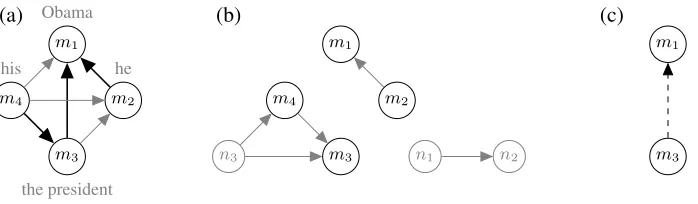
Figure 1 summarizes their approach. They repre-sent reference and system entities as complete one-directional graphs (Figures 1a and 1b). To extract recall errors, they compute a spanning tree of the reference entity (Figure 1a). All edges in the span-ning tree which do not appear in the system output are extracted as recall errors (Figure 1c). For ex-tracting precision errors, the roles of reference and system entities are switched.
The analysis algorithm is parametrized only by the spanning tree algorithm employed: different al-gorithms lead to different notions of errors. In Martschat and Strube (2014), we propose an algo-rithm based on Ariel’s accessibility theory (Ariel, 1990) for reference entities. For system entity span-ning trees, we take each output pair as an edge.
3 Architecture
Our toolkit is available as a Python library. It consists of three modules: the core module pro-vides mention extraction and preprocessing, the
coreference module implements features for and approaches to coreference resolution, and the
analysis module implements the error analysis framework described above and ships with other analysis and visualization utilities.
3.1 core
All input and output must conform to the format of the CoNLL-2012 shared task on coreference resolu-tion (Pradhan et al., 2012). We employ a rule-based mention extractor, which also computes a rich set of mention attributes, including tokens, head, part-of-speech tags, named entity tags, gender, number,
(a) m1
Obama
m2
he
m3
the president
m4
his
(b)
m1
m2
m3
the president
m4
n1 n2
n3
(c) m1
m3
the president
Figure 1: (a) a reference entityr(represented as a complete one-directional graph) and its spanning treeTr, (b) a set
Sof three system entities, (c) the errors: all edges inTrwhich are not inS.
mantic class, grammatical function, coarse mention type and fine-grained mention type.
3.2 coreference
cort ships with two coreference resolution ap-proaches. First, it includes multigraph, which is a deterministic approach using a few strong features (Martschat and Strube, 2014). Second, it includes a mention-pair approach (Soon et al., 2001) with a large feature set, trained via a perceptron on the CoNLL’12 English training data.
System MUC B3 CEAF
e Average
[image:2.612.125.474.59.161.2]StanfordSieve 64.96 54.49 51.24 56.90 BerkeleyCoref 70.27 59.29 56.11 61.89 multigraph 69.13 58.61 56.06 61.28 mention-pair 69.09 57.84 53.56 60.16
Table 1: Comparison of systems on CoNLL’12 English development data.
In Table 1, we compare both approaches with
StanfordSieve (Lee et al., 2013), the winner of the CoNLL-2011 shared task, andBerkeleyCoref (Dur-rett and Klein, 2013), a state-of-the-art structured machine learning approach. The systems are eval-uated via the CoNLL scorer (Pradhan et al., 2014).
Both implemented approaches achieve competi-tive performance. Due to their modular implemen-tation, both approaches are easily extensible with new features and with training or inference schemes. They therefore can serve as a good starting point for system development and analysis.
3.3 analysis
The core of this module is the ErrorAnalysis
class, which extracts and manages errors extracted from one or more systems. The user can define own spanning tree algorithms to extract errors. We already implemented the algorithms discussed in Martschat and Strube (2014). Furthermore, this module provides functionality to
• categorize and filter sets of errors,
• visualize these sets,
• compare errors of different systems, and
• display errors in document context.
Which of these features is interesting to the user de-pends on the use case. In the following, we will describe the popular use case of improving a coref-erence system in detail. Our system also supports other use cases, such as the cross-system analysis described in Martschat and Strube (2014).
4 Use Case: Improving a Coreference Resolution System
A natural language processing engineer might be in-terested in improving the performance of a corefer-ence resolution system since it is necessary for an-other task. The needs may differ depending on the task at hand: for some tasks proper name corefer-ence may be of utmost importance, while other tasks need mostly pronoun coreference. Through model and feature redesign, the engineer wants to improve the system with respect to a certain error class.
The user will start with a baseline system, which can be one of the implemented systems in our toolkit or a third-party system. We now describe howcort
[image:2.612.85.285.408.478.2]4.1 Initial Analysis
To get an initial assessment, the user can extract all errors made by the system and then make use of the plotting component to compare these errors with the maximum possible number of errors3.
For a meaningful analysis, we have to find a suit-able error categorization. Suppose the user is inter-ested in improving recall for non-pronominal coref-erence. Hence, following Martschat and Strube (2014), we categorize all errors by coarse mention type of anaphor and antecedent (proper name, noun, pronoun, demonstrative pronoun or verb)4.
Both name Noun-Name Name-Noun Both noun
Category
0 500 1000 1500 2000 2500 3000 3500 4000
Number of errors
Recall Errors
[image:3.612.73.296.242.375.2]maximum
multigraph
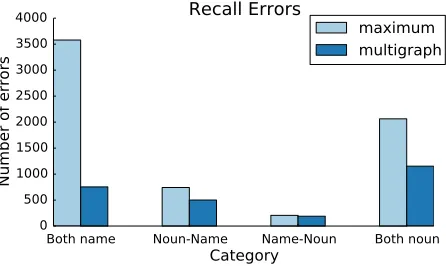
Figure 2: Recall errors of themultigraphbaseline.
Figure 2 compares the recall error numbers of the multigraphsystem with the maximum possible number of errors for the categories of interest to the engineer. The plot was created by our toolkit viamatplotlib(Hunter, 2007). We can see that the model performs very well for proper name pairs. Relative to the maximum number of errors, there are much more recall errors in the other categories. A plot for precision errors shows that the system makes only relatively few precision errors, especially for proper name pairs.
After studying these plots the user decides to im-prove recall for pairs where the anaphor is a noun and the antecedent is a name. This is a frequent cat-egory which is handled poorly by the system.
3For recall, the maximum number of errors are the errors made by a system which puts each mention in its own cluster. For precision, we take all pairwise decisions of a model.
4For a pair of mentions constituting an error, we call the mention appearing later in the text theanaphor, the other men-tionantecedent.
4.2 Detailed Analysis
In order to determine how to improve the system, the user needs to perform a detailed analysis of the noun-name errors. Our toolkit provides sev-eral methods to do so. First of all, one can browse through the pairwise error representations. This sug-gests further subcategorization (for example by the presence of token overlap). An iteration of this pro-cess leads to a fine-grained categorization of errors.
However, this approach does not provide any doc-ument context, which is necessary to understand some errors. Maybe context features can help in re-solving the error, or the error results from multiple competing antecedents. We therefore include a visu-alization component, which also allows to study the interplay between recall and precision.
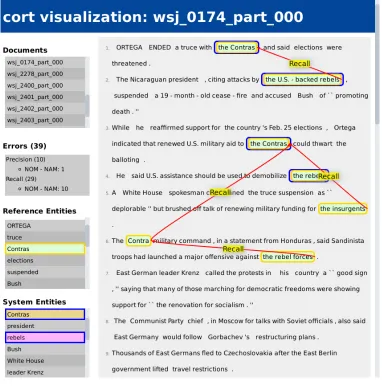
Figure 3 shows a screenshot of this visualiza-tion component, which runs in a web browser using JavaScript. The header displays the identifier of the document in focus. The left bar contains the naviga-tion panel, which includes
• a list of all documents in the corpus,
• a summary of all errors for the document in fo-cus, and
• lists of reference and system entities for the document in focus.
To the right of the navigation panel, the document in focus is shown. When the user picks a reference or system entity from the corresponding list,cort dis-plays all recall and precision errors for all mentions which are contained in the entity (as labeled red ar-rows between mentions). Alternatively, the user can choose an error category from the error summary. In that case, all errors of that category are displayed.
We use color to distinguish between entities: mentions in different entities have different back-ground colors. Additionally mentions in reference entities have a yellow border, while mentions in sys-tem entities have a blue border (for example, the mentionthe U.S.-backed rebelsis in a reference en-tity and in a system enen-tity). The user can choose to color the background of mentions either depending on their gold entity or depending on their system en-tity.
Figure 3: Screenshot of the visualization component.
The result of the analysis is that almost all errors are missed is-a relations, such as in the examples in Figure 3 (the U.S.-backed rebelsandthe Contras). 4.3 Error Comparison
Motivated by this, the user can add features to the system, for example incorporating world knowledge from Wikipedia. The output of the changed model can be loaded into the ErrorAnalysis object which already manages the errors made by the base-line system.
To compare the errors, cort implements various functions. In particular, the user can access com-mon errors and errors which are unique to one or more systems. This allows for an assessment of the qualitative usefulness of the new feature.
Depend-ing on the results of the comparison, the user can decide between discarding, retaining and improving the feature.
5 Related Work
Compared to our original implementation of the error analysis framework (Martschat and Strube, 2014), we made the analysis interface more user-friendly and provide more analysis functionality. Furthermore, while our original implementation did not include any visualization capabilities, we now allow for both data visualization and document vi-sualization.
complements these. Kummerfeld and Klein (2013) present a toolkit which extracts errors from transfor-mation of reference to system entities. Hence, their definition of what an error is not rooted in a pairwise representation, and is therefore conceptually differ-ent from our definition. They do not provide any visualization components.
ICE (G¨artner et al., 2014) is a toolkit for corefer-ence visualization and corpus analysis. In particu-lar, the toolkit visualizes recall and precision errors in a tree-based visualization of coreference clusters. Compared to ICE, we provide more extensive func-tionality for error analysis and can accommodate for different notions of errors.
6 Conclusions and Future Work
We presented cort, a toolkit for coreference reso-lution error analysis. It implements a graph-based analysis framework, ships with two strong coref-erence resolution baselines and provides extensive functionality for analysis and visualization.
We are currently investigating whether the analy-sis framework can also be applied to structurally re-lated tasks, such as cross-document coreference res-olution (Singh et al., 2011) or entity linking.
Acknowledgements
This work has been funded by the Klaus Tschira Foundation, Heidelberg, Germany. The first author has been supported by a HITS PhD scholarship.
References
Mira Ariel. 1990. Accessing Noun Phrase Antecedents. Routledge, London, U.K.; New York, N.Y.
Greg Durrett and Dan Klein. 2013. Easy victories and uphill battles in coreference resolution. In Proceed-ings of the 2013 Conference on Empirical Methods in Natural Language Processing, Seattle, Wash., 18–21 October 2013, pages 1971–1982.
Markus G¨artner, Anders Bj¨orkelund, Gregor Thiele, Wolfgang Seeker, and Jonas Kuhn. 2014. Visualiza-tion, search, and error analysis for coreference anno-tations. In Proceedings of 52nd Annual Meeting of the Association for Computational Linguistics: System Demonstrations, Baltimore, Md., 22–27 June 2014, pages 7–12.
John D. Hunter. 2007. Matplotlib: A 2D graphics environment. Computing in Science & Engineering, 9(3):90–95.
Jonathan K. Kummerfeld and Dan Klein. 2013. Error-driven analysis of challenges in coreference resolution. In Proceedings of the 2013 Conference on Empiri-cal Methods in Natural Language Processing,Seattle, Wash., 18–21 October 2013, pages 265–277.
Heeyoung Lee, Angel Chang, Yves Peirsman, Nathanael Chambers, Mihai Surdeanu, and Dan Jurafsky. 2013. Deterministic coreference resolution based on entity-centric, precision-ranked rules. Computational Lin-guistics, 39(4):885–916.
Sebastian Martschat and Michael Strube. 2014. Recall error analysis for coreference resolution. In Proceed-ings of the 2014 Conference on Empirical Methods in Natural Language Processing,Doha, Qatar, 25–29 October 2014, pages 2070–2081.
Sameer Pradhan, Alessandro Moschitti, Nianwen Xue, Olga Uryupina, and Yuchen Zhang. 2012. CoNLL-2012 Shared Task: Modeling multilingual unrestricted coreference in OntoNotes. In Proceedings of the Shared Task of the 16th Conference on Computational Natural Language Learning,Jeju Island, Korea, 12–14 July 2012, pages 1–40.
Sameer Pradhan, Xiaoqiang Luo, Marta Recasens, Ed-uard Hovy, Vincent Ng, and Michael Strube. 2014. Scoring coreference partitions of predicted mentions: A reference implementation. InProceedings of the 52nd Annual Meeting of the Association for Compu-tational Linguistics (Volume 2: Short Papers), Balti-more, Md., 22–27 June 2014, pages 30–35.
Sameer Singh, Amarnag Subramanya, Fernando Pereira, and Andrew McCallum. 2011. Large-scale cross-document coreference using distributed inference and hierarchical models. InProceedings of the 49th An-nual Meeting of the Association for Computational Linguistics (Volume 1: Long Papers),Portland, Oreg., 19–24 June 2011, pages 793–803.