Applying Pairwise Ranked Optimisation to Improve the Interpolation of
Translation Models
Barry Haddow University of Edinburgh
Scotland
Abstract
In Statistical Machine Translation we often have to combine different sources of parallel training data to build a good system. One way of doing this is to build separate translation models from each data set and linearly inter-polate them, and to date the main method for optimising the interpolation weights is to min-imise the model perplexity on a heldout set. In this work, rather than optimising for this indi-rect measure, we diindi-rectly optimise for BLEU
on the tuning set and show improvements in average performance over two data sets and 8 language pairs.
1 Introduction
Statistical Machine Translation (SMT) requires large quantities of parallel training data in order to produce high quality translation systems. This train-ing data, however, is often scarce and must be drawn from whatever sources are available. If these data sources differ systematically from each other, and/or from the test data, then the problem of combining these disparate data sets to create the best possible translation system is known asdomain adaptation.
One approach to domain adaptation is to build separate models for each training domain, then weight them to create a system tuned to the test main. In SMT, a successful approach to building do-main specific language models is to build one from each corpus, then linearly interpolate them, choos-ing weights that minimise the perplexity on a suit-able heldout set of in-domain data. This method has been applied by many authors (e.g. (Koehn and
Schroeder, 2007)), and is implemented in popular language modelling tools like IRSTLM (Federico et al., 2008) and SRILM (Stolcke, 2002).
Similar interpolation techniques have been devel-oped for translation model interpolation (Foster et al., 2010; Sennrich, 2012) for phrase-based systems but have not been as widely adopted, perhaps be-cause the efficacy of the methods is not as clear-cut. In this previous work, the authors used stan-dard phrase extraction heuristics to extract phrases from a heldout set of parallel sentences, then tuned the translation model (i.e. the phrase table) inter-polation weights to minimise the perplexity of the interpolated model on this set of extracted phrases.
In this paper, we try to improve on this perplexity optimisation of phrase table interpolation weights by addressing two of its shortcomings. The first prob-lem is that the perplexity is not well defined because of the differing coverage of the phrase tables, and their partial coverage of the phrases extracted from the heldout set. Secondly, perplexity may not corre-late with the performance of the final SMT system.
So, instead of optimising the interpolation weights for the indirect goal of translation model perplexity, we optimise them directly for transla-tion performance. We do this by incorporating these weights into SMT tuning using a modified version of Pairwise Ranked Optimisation (PRO) (Hopkins and May, 2011).
In experiments on two different domain adapta-tion problems and 8 language pairs, we show that our method achieves comparable or improved per-formance, when compared to the perplexity minimi-sation method. This is an encouraging result as it
shows that PRO can be adapted to optimise transla-tion parameters other than those in the standard lin-ear model.
2 Optimising Phrase Table Interpolation Weights
2.1 Previous Approaches
In the work of Foster and Kuhn (2007), linear inter-polation weights were derived from different mea-sures of distance between the training corpora, but this was not found to be successful. Optimising the weights to minimise perplexity, as described in the introduction, was found by later authors to be more useful (Foster et al., 2010; Sennrich, 2012), gener-ally showing small improvements over the default approach of concatenating all training data.
An alternative approach is to use log-linear inter-polation, so that the interpolation weights can be easily optimised in tuning (Koehn and Schroeder, 2007; Bertoldi and Federico, 2009; Banerjee et al., 2011). However, this effectively multiplies the prob-abilities across phrase tables, which does not seem appropriate, especially for phrases absent from 1 ta-ble.
2.2 Tuning SMT Systems
The standard SMT model scores translation hy-potheses as a linear combination of features. The model score of a hypothesis e is then defined to be w·h(e, f, a) where w is a weight vector, and
h(e, f, a) a vector of feature functions defined over source sentences (f), hypotheses, and their align-ments (a). The weights are normally optimised (tuned) to maximiseBLEUon a heldout set (the tun-ingset).
The most popular algorithm for this weight op-timisation is the line-search based MERT (Och, 2003), but recently other algorithms that support more features, such as PRO (Hopkins and May, 2011) or MIRA-based algorithms (Watanabe et al., 2007; Chiang et al., 2008; Cherry and Foster, 2012), have been introduced. All these algorithms assume that the model score is a linear function of the pa-rameters w. However since the phrase table prob-abilities enter the score function in log form, if these probabilities are a linear interpolation, then the model score is not a linear function of the interpola-tion weights. We will show that PRO can be used
to simultaneously optimise such non-linear parame-ters.
2.3 Pairwise Ranked Optimisation
PRO is a batch tuning algorithm in the sense that there is an outer loop which repeatedly decodes a small (1000-2000 sentence) tuning set and passes the n-best lists from this tuning set to the core al-gorithm (also known as the inner loop). The core algorithm samples pairs of hypotheses from the n -best lists (according to a specific procedure), and uses these samples to optimise the weight vectorw. The core algorithm in PRO will now be explained in more detail. Suppose that theN sampled hypoth-esis pairs(xαi, xβi)are indexed byiand have corre-sponding feature vectors pairs(hαi,hβi). If the gain of a given hypothesis (we use smoothed sentence BLEU) is given by the functiong(x), then we define
yiby
yi ≡sgn(g(xαi)−g(x β
i)) (1)
For weights w, and hypothesis pair (xαi, xβi), the (model) score difference∆swi is given by:
∆swi ≡sw(xαi)−sw(xβi)≡w·hαi −hβi (2)
Then the core PRO algorithm updates the weight vector tow∗ by solving the following optimisation problem:
w∗= arg max
w
N
X
i=1
log (σ(yi∆swi )) (3)
where σ(x) is the standard sigmoid function. The derivative of the function can be computed easily, and the optimisation problem can be solved with standard numerical optimisation algorithms such as L-BFGS (Byrd et al., 1995). PRO is normally im-plemented by converting each sample to a training example for a 2 class maximum entropy classifier, with the feature values set to∆hi and the responses set to theyi, whereupon the log-likelihood is the ob-jective given in Equation (3). As in maximum en-tropy modeling, it is usual to add a Gaussian prior to the objective (3) in PRO training.
2.4 Extending PRO for Mixture Models
optimise the weights of the translation system, and the interpolation weights.
In the standard phrase-based model, some of the features are derived from logs of phrase translation probabilities. If the phrase table is actually a linear interpolation of two (or more) phrase tables, then we can consider these features as also being func-tions of the interpolation weights. The interpola-tion weights then enter the score differences{∆swi } via the phrase features, and we can jointly optimise the objective in Equation (3) for translation model weights and interpolation weights.
To make this more concrete, suppose that the fea-ture vector consists of m phrase table features and
n−mother features1
h≡(log(p1), . . . ,log(pm), hm+1, . . . hn) (4)
where eachpj is an interpolation of two probability distributionspjAandpjB. So,pj ≡λjpjA+(1−λj)pjB
with 0 ≤ λj ≤ 1. Definingλ ≡ (λ1. . . λm), the optimisation problem is then:
(w∗,λ∗) = arg max(w,λ)
PN i=1log
σyi∆s (w,λ) i
(5) where the sum is over the sampled hypothesis pairs and the ∆ indicates the difference between the model scores of the two hypotheses in the pair, as before. The model scores(iw,λ)is given by
m
X
j=1
wj·log
λjpjAi+ (1−λj)pjBi)
+
n
X
j=m+1
wjhji (6)
where w ≡ (wi. . . wn). A Gaussian regularisa-tion term is added to the objective, as it was for PRO. By replacing the core algorithm of PRO with the optimisation above, the interpolation weights can be trained simultaneously with the other model weights.
Actually, the above explanation contains a simpli-fication, in that it shows the phrase features interpo-lated at sentence level. In reality the phrase features
1
Since the phrase penalty feature is a constant across phrase pairs it is not interpolated, and so is classed with the the “other” features. The lexical scores, although not actually probabilities, are interpolated.
are interpolated at the phrase level, then combined to give the sentence level feature value. This makes the definition of the objective more complex than that shown above, but still optimisable using bounded L-BFGS.
3 Experiments
3.1 Corpus and Baselines
We ran experiments with data from the WMT shared tasks (Callison-Burch et al., 2007; Callison-Burch et al., 2012), as well as OpenSubtitles data2released by the OPUS project (Tiedemann, 2009).
The experiments targeted both the news-commentary (nc) and OpenSubtitles (st) domains,
with nc-devtest2007 and nc-test2007
for tuning and testing in the nc domain, respec-tively, and corresponding 2000 sentence tuning and test sets selected from thestdata. The news-commentary v7 corpus and a 200k sentence corpus selected from the remaining st data were used as in-domain training data for the respective domains, with europarl v7 (ep) used as out-of-domain train-ing data in both cases. The language pairs we tested were the WMT language pairs fornc(English (en) to and from Spanish (es), German (de), French (fr) and Czech (cs)), with Dutch (nl) substituted for de in thestexperiments.
To build phrase-based translation systems, we used the standard Moses (Koehn et al., 2007) train-ing pipeline, in particular employtrain-ing the usual 5 phrase features – forward and backward phrase probabilities, forward and backward lexical scores and a phrase penalty. The 5-gram Kneser-Ney smoothed language models were trained by SRILM (Stolcke, 2002), with KenLM (Heafield, 2011) used at runtime. The language model is always a linear interpolation of models estimated on the in- and out-of-domain corpora, with weights tuned by SRILM’s perplexity minimisation3. All experiments were run three times with BLEU scores averaged, as recom-mended by Clark et al. (2011). Performance was evaluated using case-insensitiveBLEU (Papineni et al., 2002), as implemented in Moses.
The baseline systems were tuned using the Moses version of PRO, a reimplementation of the original
2www.opensubtitles.org
3
algorithm using the sampling scheme recommended by Hopkins and May. We ran 15 iterations of PRO, choosing the weights that maximised BLEU on the tuning set. For the PRO training of the interpo-lated models, we used the same sampling scheme, with optimisation of the model weights and interpo-lation weights implemented in Python using scipy4. The implementation is available in Moses, in the contrib/promixdirectory.
The phrase table interpolation and perplexity-based minimisation of interpolation weights used the code accompanying Sennrich (2012), also avail-able in Moses.
3.2 Results
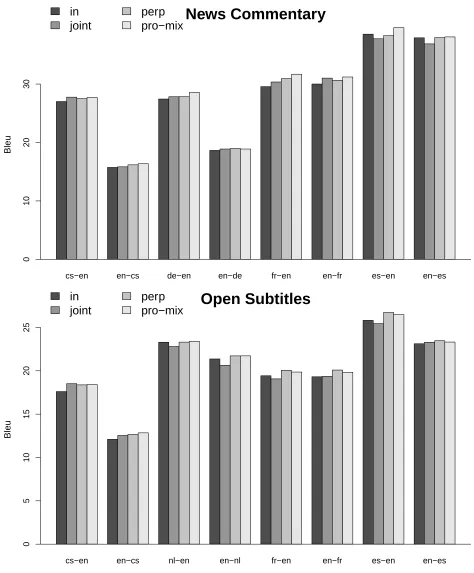
For each of the two test sets (ncandst), we com-pare four different translation systems (three base-line systems, and our new interpolation method):
in Phrase and reordering tables were built from just the in-domain data.
joint Phrase and reordering tables were built from the in- and out-of-domain data, concatenated.
perp Separate phrase tables built on in- and out-of-domain data, interpolated using perplexity min-imisation. The reordering table is as forjoint.
pro-mix As perp, but interpolation weights opti-mised using our modified PRO algorithm. So the two interpolated models (perpandpro-mix) are the same asjointexcept that their 4 non-constant phrase features are interpolated across the two sep-arate phrase tables. Note that the language models are the same across all four systems.
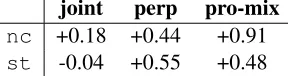
The results of this comparison over the 8 language pairs are shown in Figure 1, and summarised in Ta-ble 1, which shows the mean BLEUchange relative to the in system. It can be seen that the pro-mix
method presented here is out-performing the per-plexity optimisation on thencdata set, and perform-ing similarly on thestdata set.
joint perp pro-mix
[image:4.612.114.258.591.629.2]nc +0.18 +0.44 +0.91 st -0.04 +0.55 +0.48
Table 1: Mean BLEUrelative toinsystem for each data set. System names as in Figure 1
.
4www.scipy.org
4 Discussion and Conclusions
The results show that thepro-mix method is a vi-able way of tuning systems built with interpolated phrase tables, and performs better than the current perplexity minimisation method on one of two data sets used in experiments. On the other data set (st), the out-of-domain data makes much less difference to the system performance in general, most proba-bly because the difference between the in and out-of-domain data sets in much larger (Haddow and Koehn, 2012). Whilst the differences between pro-mixand perplexity minimisation are not large on the nctest set (about +0.5BLEU) the results have been demonstrated to apply across many language pairs.
The advantage of thepro-mixmethod over other approaches is that it directly optimises the mea-sure that we are interested in, rather than optimising an intermediate measure and hoping that translation performance improves. In this work we optimise for BLEU, but the same method could easily be used to optimise for any sentence-level translation metric.
Acknowledgments
The research leading to these results has received funding from the European Union Seventh Frame-work Programme (FP7/2007-2013) under grant agreement 288769 (ACCEPT).
References
Pratyush Banerjee, Sudip K. Naskar, Johann Roturier, Andy Way, and Josef van Genabith. 2011. Domain Adaptation in Statistical Machine Translation of User-Forum Data using Component Level Mixture Mod-elling. InProceedings of MT Summit.
Nicola Bertoldi and Marcello Federico. 2009. Domain Adaptation for Statistical Machine Translation from Monolingual Resources. InProceedings of WMT. R. H. Byrd, P. Lu, and J. Nocedal. 1995. A limited
memory algorithm for bound constrained optimiza-tion. SIAM Journal on Scientific and Statistical Com-puting, 16(5):1190–1208.
Chris Callison-Burch, Cameron Fordyce, Philipp Koehn, Christof Monz, and Josh Schroeder. 2007. (meta-) evaluation of machine translation. InProceedings of the Second Workshop on Statistical Machine Transla-tion, pages 136–158, Prague, Czech Republic, June. Association for Computational Linguistics.
Findings of the 2012 Workshop on Statistical Machine Translation. In Proceedings of the Seventh Work-shop on Statistical Machine Translation, pages 10– 51, Montr´eal, Canada, June. Association for Compu-tational Linguistics.
Colin Cherry and George Foster. 2012. Batch Tuning Strategies for Statistical Machine Translation. In Pro-ceedings of NAACL.
David Chiang, Yuval Marton, and Philip Resnik. 2008. Online Large-Margin Training of Syntactic and Struc-tural Translation Features. InProceedings of EMNLP. Jonathan Clark, Chris Dyer, Alon Lavie, and Noah Smith. 2011. Better hypothesis testing for statistical machine translation: Controlling for optimizer instability. In
Proceedings of ACL.
Marcello Federico, Nicola Bertoldi, and Mauro Cettolo. 2008. IRSTLM: an Open Source Toolkit for Handling Large Scale Language Models. InProceedings of In-terspeech, Brisbane, Australie.
George Foster and Roland Kuhn. 2007. Mixture-model adaptation for SMT. In Proceedings of the Second Workshop on Statistical Machine Translation, pages 128–135, Prague, Czech Republic, June. Association for Computational Linguistics.
George Foster, Cyril Goutte, and Roland Kuhn. 2010. Discriminative Instance Weighting for Domain Adap-tation in Statistical Machine Translation. In Proceed-ings of the 2010 Conference on Empirical Methods in Natural Language Processing, pages 451–459, Cam-bridge, MA, October. Association for Computational Linguistics.
Barry Haddow and Philipp Koehn. 2012. Analysing the Effect of Out-of-Domain Data on SMT Systems. In Proceedings of the Seventh Workshop on Statisti-cal Machine Translation, pages 422–432, Montr´eal, Canada, June. Association for Computational Linguis-tics.
Kenneth Heafield. 2011. KenLM: Faster and Smaller Language Model Queries. InProceedings of the Sixth Workshop on Statistical Machine Translation, pages 187–197, Edinburgh, Scotland, July. Association for Computational Linguistics.
Mark Hopkins and Jonathan May. 2011. Tuning as Ranking. In Proceedings of the 2011 Conference on Empirical Methods in Natural Language Processing, pages 1352–1362, Edinburgh, Scotland, UK., July. As-sociation for Computational Linguistics.
Philipp Koehn and Josh Schroeder. 2007. Experiments in Domain Adaptation for Statistical Machine Transla-tion. InProceedings of the Second Workshop on Sta-tistical Machine Translation, pages 224–227, Prague, Czech Republic, June. Association for Computational Linguistics.
Philipp Koehn, Hieu Hoang, Alexandra Birch, Chris Callison-Burch, Marcello Federico, Nicola Bertoldi, Brooke Cowan, Wade Shen, Christine Moran, Richard Zens, Chris Dyer, Ondrej Bojar, Alexandra Con-stantin, and Evan Herbst. 2007. Moses: Open Source Toolkit for Statistical Machine Translation. In Pro-ceedings of the ACL Demo Sessions, pages 177–180, Prague, Czech Republic, June. Association for Com-putational Linguistics.
Franz J. Och. 2003. Minimum Error Rate Training in Statistical Machine Translation. InProceedings of ACL.
Kishore Papineni, Salim Roukos, Todd Ward, and Wei-Jing Zhu. 2002. Bleu: a Method for Automatic Eval-uation of Machine Translation. InProceedings of 40th Annual Meeting of the Association for Computational Linguistics, pages 311–318, Philadelphia, Pennsylva-nia, USA, July. Association for Computational Lin-guistics.
Rico Sennrich. 2012. Perplexity Minimization for Trans-lation Model Domain Adaptation in Statistical Ma-chine Translation. InProceedings of EACL.
Andreas Stolcke. 2002. SRILM – An Extensible Lan-guage Modeling Toolkit. InProc. Intl. Conf. on Spo-ken Language Processing, vol. 2, pages 901–904. J¨org Tiedemann. 2009. News from OPUS - A Collection
of Multilingual Parallel Corpora with Tools and Inter-faces. In N. Nicolov, K. Bontcheva, G. Angelova, and R. Mitkov, editors,Recent Advances in Natural Lan-guage Processing (vol V), pages 237–248. John Ben-jamins, Amsterdam/Philadelphia.
cs−en en−cs de−en en−de fr−en en−fr es−en en−es in
joint
perp
pro−mix
News Commentary
Bleu
0
10
20
30
cs−en en−cs nl−en en−nl fr−en en−fr es−en en−es in
joint
perp
pro−mix
Open Subtitles
Bleu
0
5
10
15
20
[image:6.612.75.549.69.642.2]25