Exploring Relational Features and Learning under Distant Supervision for
Information Extraction Tasks
Ajay Nagesh
Dept. of Computer Science and Engineering, IIT Bombay. Faculty of Information Technology, Monash University.
Abstract
Information Extraction (IE) has become an in-dispensable tool in our quest to handle the data deluge of the information age. IE can broadly be classified into Named-entity Recognition (NER) and Relation Extraction (RE). In this thesis, we view the task of IE as finding pat-terns in unstructured data, which can either take the form of features and/or be specified by constraints. In NER, we study the cate-gorization of complex relational1features and outline methods to learn feature combinations through induction. We demonstrate the effi-cacy of induction techniques in learning : i) rules for the identification of named entities in text – the novelty is the application of induc-tion techniques to learn in a very expressive declarative rule language ii) a richer sequence labeling model – enabling optimal learning of discriminative features. In RE, our investiga-tions are in the paradigm ofdistant supervi-sion, which facilitates the creation of large al-beit noisy training data. We devise an infer-ence framework in which constraints can be easily specified in learning relation extractors. In addition, we reformulate the learning ob-jective in a max-margin framework. To the best of our knowledge, our formulation is the first to optimize multi-variate non-linear per-formance measures such as Fβ for a latent
variable structure prediction task.
1 Introduction
Most of the content that we come across in the digital media in the form of emails, blogs, web-pages, enterprise data and so on are authored in nat-ural language and have very little structure to them. With the dawn of the information age, we produce a colossal amount of unstructured data everyday. This
1Terminology is borrowed fromlogic, where relational logic
is more powerful than propositional logic with the inclusion of quantifiers, but is a subset of first-order logic
presents an enormous challenge for machines to pro-cess, curate, search and reason in such data.
The process of automatically identifying and dis-ambiguating entities, their attributes and relation-ships in unstructured data sources is termed as In-formation Extraction (IE). IE facilitates a rich and structured representation of data, enabling down-stream applications to process unstructured docu-ments like a standard database. The richness present in natural language text, presupposition of world knowledge and the rapid rate of content creation makes IE a highly challenging task. As a result, it has been a very active area of research in the computational linguistics community for over two decades (Sarawagi, 2008).
A few of the challenges faced when performing information extraction: (i) Entity Disambiguation:
Jeff Bezos and Bezos refer to the same en-tity. Washington could be either a city, a state, or a person depending on the context. (ii) Scope Resolution: Certain Entities such asWashington
in “Washington Post” should not be labeled as a location name because the entire textual span is an organization name (iii)Type Disambiguation: In the sentence, “ England beat Australia 2 - 0”.
England and Australia are sports organiza-tions. (iv) Relation mention detection: The co-occurrence of Obama and US in a sentence is not a sure indication that thePresidentrelation (ob-tained from a database of facts) is expressed in it. 1.1 Contributions of the thesis
The problem of Information Extraction can be viewed as that of finding patterns in the data. These patterns can either take the form of features or can be specified as constraints on the search space. Data-driven Patterns : Feature Combinations
Let us suppose that we are given a set of basic fea-tures (e.g. Caps-a capitalized token;LastName -occurrence in a dictionary of last-names).
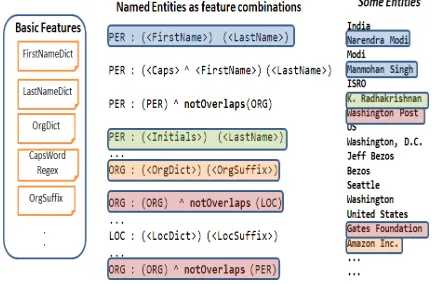
Figure 1: Patterns as Feature Combinations Figure 2: Patterns as Constraints
entities can be discovered by learning combinations of such features. For instance,“if a span of text con-tains two tokens,Capsfollowed byLastName, then it is most probably a person named entity”. We con-sider the previous statement as a pattern, leading to a named-entity.
Figure 1 depicts some of the basic features, a number of patterns (basic feature combinations) and the entities in text that can potentially match with these patterns. Named-entity recognition (NER) can immensely benefit from such patterns, some of which are specific and others, domain-independent. Several patterns are non-trivial com-binations of basic features. For instance, “if a
locationname overlaps with anorganization, then it is not a location named-entity”. (e.g. WashingtoninWashington Post).
These patterns are very large in number and we could define them as feature classes. The set of fea-tures defined by them form a feature space. Since the number patterns are many and we are not sure which ones are triggered in a given piece of text, we would like to learn / induce such patterns.
In this thesis, we study the categorization of the feature classes. We also define various methods to learn feature combinations through induction. The features induced are consumed by a rule-based NER system to learn compact and “interpretable” rules that have a reasonable accuracy. We also demon-strate the use of these features in max-margin based sequence labeling models.
User-Specified Patterns : Constraints
Consider the problem of identifying relationships between entities in text. Here we can look at pat-terns as constraints that need to be enforced on rela-tions extracted. Some of these are listed in Figure 2. They are few compared to the entity recognition case and can be specified by the user to restrict the search space.
For instance, we would like to enforce the follow-ing constraint: For a Prime-minister relation, the first argument has to be apersonand the sec-ond argument has to be acountry.
In this thesis, we look at a specific paradigm of relation extraction calleddistant supervision(Mintz et al., 2009). The goal is to learn relation extrac-tion models by aligning facts in a database (Figure 2) to sentences in a large unlabeled corpus. Since the individual sentences are not hand labeled, the facts in the database act as “weak” or “distant” labels, and hence, the learning scenario is termed as dis-tantly supervised. We look at ways in which con-straints can be specified while learning relation ex-tractors in this setting. We formulate an integer lin-ear programming-based framework to facilitate the addition of constraints.
Existing distant supervision-based systems are of-ten trained by optimizing performance measures (such as conditional log-likelihood or error rate) that are not directly related to the task-specific non-linear performance measure,e.g., theF1-score. We present
[image:2.612.81.297.64.206.2]su-pervised relation extraction models.
2 Learning for Named-Entity Extraction Several problems in Machine Learning are im-mensely benefited from a rich structural representa-tion of the data (Flach and Lachiche, 1999; Roth and Yih, 2001). Specifically, the tasks in Information Extraction are relation-intensive and the usage of re-lational features has been shown to be quite effective in practice (Califf, 1998; Roth and Yih, 2001). In this section, we define categories of predicates and discuss the complexity-based classification of rela-tional features followed by techniques to induce fea-tures in several of these categories.
Feature Space Categorization
The relational features are in a language that is similar in expressive power as first order definite clauses(Horn, 1951). Predicates are defined on tex-tual spans. The head predicate is the class label of a textual span.
We define two types of body predicates, namely, relation and basic feature predicates. A rela-tion predicate is a binary predicate that represents the relationship between two spans of text. E.g. overlaps(X,Y). Abasic featurepredicate is an as-sertion of a situation or a property of aspanor a sub-span. For example,FirstName(X)states that the span of textXoccurs in a dictionary of first names. We illustrate each of these feature classes with an example of a typical definite clause belonging to the feature class.
1. Simple Conjuncts (SCs):
Org(X) :- OrgGazeteer(X),CapsWord(X).
e.g.Microsoft
2. Candidate Definition Features (CDs): These con-sist of the two following feature classes.
(a) Absolute Features (AFs): non-overlapping evidence predicates chained by relation predicates.
person-AF(X) :- contains(X, X1), FirstNameDict(X1), CapsWord(X1), before(X1,X2), contains(X, X2), CapsWord(X2).e.g.:Sachin Tendulkar (b) Composite Features (CFs): Defined as a
conjunction of two AFs that share the same head predicate.
person(X) :- person-AF (X), leftContext(X, 1, L2),
Salutation(L2). e.g.: Mr. Sachin
Tendulkar (note the presence of contextual clues such as salutation)
3. Candidate Refinement Features (CRs): The body of the clause is defined by head predicates that belong to different class labels, and can contain negations in the body (hence, not a definite clause)
Loc(X) :- Loc1(X),org1(Y),¬overlaps(X,Y). A span of text is a location, “if it matches a location feature and does not overlap with an organization feature”. e.g.: Washington in “Washington Post” will not be marked as a location, due to this feature.
2.1 Feature Induction in a Rule-based Setting Rule-based systems for NER achieve state-of-the-art accuracies (Chiticariu et al., 2010). However, man-ually building and customizing rules is a complex and labor-intensive process. In this work, we outline an approach that facilitates the process of building customizable rules for NER through rule induction. Given a set of basic feature predicates and an an-notated document collection, our goal is to gener-ate with reasonable accuracy an initial set of rules that are interpretable and thus can be easily refined by a human developer. Our contributions include (i) an efficient rule induction process in a declarative rule language, (ii) usage of induction biases to en-hance rule interpretability, and (iii) definition of ex-tractor complexity as a first step to quantify the inter-pretability of an extractor. We present initial promis-ing results with our system and study the effect of in-duction bias and customization of basic features on the accuracy and complexity of induced rules. We demonstrate through experiments that the induced rules have good accuracy and low complexity, ac-cording to our complexity measure.
Figure 3: Correspondence between Manual Rule devel-opment and Rule Induction
Figure 4: Relative Least General Generalization
in the following paragraphs.
Background Knowledge. We represent each exam-ple in the form offirst order definite clauses, in con-junction with relevant background knowledge. This background knowledge will serve as input to our in-duction system.
Clustering and RLGG. The first phase of induc-tion uses a combinainduc-tion of clustering and rel-ative least general generalization (RLGG) tech-niques (Nienhuys-Cheng and Wolf, 1997; Muggle-ton and Feng, 1992). Using clustering, we group the examples based on the similarity of their back-ground knowledge. This process is interleaved by RLGG where we take a set of examples and find their generalization that is analogous to theleast up-per bound. We recursively find pairwise-RLGGs of all examples in a cluster. At the end of this phase, we have a number of CD features.
The representation of an example and the RLGG procedure is shown in Figure 4.
Propositional Rule Learning. In the second phase, we begin by forming a structure known as the span-view table. Broadly speaking, this is an attribute-value table formed by all the features induced in the first phase along with the textual spans generated by them. The attribute-value table is used as input to a
propositional rule learner such asJRIPto learn accu-rate compositions of a useful (as determined by the learning algorithm) subset of the CD features. This forms the second phase of our system. The rules learnt from this phase are in the space of CR fea-tures.
Induction Biases. At various phases, several in-duction biases are introduced to enhance the inter-pretability of rules. These biases capture the exper-tise gleaned from manual rule development and con-strain the search space in our induction system. Extractor Complexity. Since our goal is to gener-ate extractors with manageable complexity, we must introduce a quantitative measure of extractor com-plexity, in order to (1) judge the complexity of the extractors generated by our system, and (2) reduce the search space considered by the induction system. To this end, we define a simple complexity score that is a function of the number of rules, and the number of predicates in the body of each rule of the extrac-tor. Our simple notion of rule length is motivated by existing literature in the area of database systems.
AQL and SystemT : Advantages. The hypothesis languageof our induction system is AQL, and we employ SystemT as the theorem prover. SystemT provides a very fast rule execution engine and is cru-cial to our induction system because we test multi-ple hypotheses in the search for the more promising ones. AQL provides a very expressive rule repre-sentation language that has proven to be capable of encoding all the paradigms that any rule-based rep-resentation can encode. The dual advantages ofrich rule-representationandexecution efficiency are the main motivations behind our choice.
[image:4.612.71.300.207.303.2]2.2 Feature Induction in a Max-margin Setting In this piece of work, we view the problem of NER from the perspective of sequence labeling. The goal is to investigate the effectiveness of using relational features in the input space of a max-margin based se-quence labeling model. Our work is based on Struc-tHKL (Nair et al., 2012) and standard StructSVM formulations. We propose two techniques to learn a richer sequence labeling model by using relational features discussed above.
In one technique, we leverage an existing system that is known to learn optimal feature conjunctions (SCs) in order to learn relational features such as AFs and CFs. To achieve this, we propose a two-step process : (i) enumerate a good set of AFs using existing induction techniques (ii) use the StructHKL framework, which learns optimal conjunctions to learn CFs.
In the other technique, we leverage the StructSVM framework. We define a subse-quence kernel to implicitly capture the relational features and reformulate the training objective.
Our experiments in sequence labeling tasks rein-force the importance of induction bias and the need for interpretability to achieve high-quality NER rules, as observed in the experiments of our previ-ous work on rule induction.
3 Learning for Relation Extraction
In the second part of the thesis, we investigate another important problem in IE, namely, rela-tion extracrela-tion. The task of extracting relational facts that pertains to a set of entities from natu-ral language text is termed as relation extraction. For example, given a natural language sentence, “On Friday, President Barack Obama defended his administration’s mass collection of telephone and Internet records in the United States”, we can infer the relation, President(Barack Obama, United States) between the entities Barack ObamaandUnited States.
Our framework is motivated by distant supervi-sion for learning relation extraction models (Mintz et al., 2009). Prior work casts this problem as a multi-instance multi-label learning problem (Hoff-mann et al., 2011; Surdeanu et al., 2012). It is multi-instance because for a given entity-pair, only the
la-bel of the bag of sentences that contains both entities (aka mentions) is given. It is multi-label because a bag of mentions can have multiple labels. The inter-dependencies between relation labels and (hidden) mention labels are modeled by a Markov Random Field (Hoffmann et al., 2011).
3.1 Constrained Distant Supervision
Various models have been proposed in recent litera-ture to align the facts in the database to their men-tions in the corpus. In this work, we discuss and critically analyze a popular alignment strategy called the“at least one”heuristic. We provide a simple, yet effective relaxation to this strategy.
Our work extends the work by Hoffmann et al. (2011). We formulate the inference procedures in training as integer linear programming (ILP) prob-lems and implement the relaxation to the “at least one ”heuristic through a soft constraint in this for-mulation. This relaxation is termed as“noisy-or”. The idea is to model the situation where a fact is present in the database but it is not instantiated in the text.
Additionally, our inference formulation enables us to model additional type of constraints such as se-lectional preferences of arguments. Empirically, we demonstrate that this simple strategy leads to a better performance under certain settings when compared to the existing approaches. For additional details, please refer to our paper (Nagesh et al., 2014). 3.2 Distant Supervision in a Max-margin
Setting
Rich models with latent variables are popular in many problems in natural language processing. For instance, in IE, one needs to predict the relation la-bels that an entity-pair can take based on the hidden relation mentions,i.e., the relation labels for occur-rences of the entity-pair in a given corpus. These models are often trained by optimizing performance measures (such as conditional log-likelihood or er-ror rate) that are not directly related to the task-specific non-linear performance measure, e.g., the F1-score. However, better models may be trained
by optimizing the task-specific performance mea-sure while allowing latent variables to adapt their values accordingly.
compelling approach to learn rich models detailing the inter-dependencies among the output variables. Some methods optimize loss functions decompos-able over thetraining instances(Taskar et al., 2003; Tsochantaridis et al., 2004) compared to others that optimize non-decomposable loss functions (Ranjbar et al., 2013; Tarlow and Zemel, 2012; Rosenfeld et al., 2014; Keshet, 2014). They have also been shown to be powerful when applied to latent vari-able models when optimizing for decomposvari-able loss functions (Wang and Mori, 2011; Felzenszwalb et al., 2010; Yu and Joachims, 2009).
In this work (Haffari et al., 2015), we describe a novel max-margin learning approach to opti-mize non-linear performance measures for distantly-supervised relation extraction models. Our approach can be generally used to learn latent variable mod-els under multivariate non-linear performance mea-sures, such as Fβ-score.
Our approach involves solving the hard-optimization problem in learning by interleaving Concave-Convex Procedure with dual decomposi-tion. Dual decomposition allowed us to solve the hard sub-problems independently. A key aspect of our approach involves a local-search algorithm that has led to a speed-up of 7,000 times in our experiments over an exhustive search baseline proposed in previous work (Ranjbar et al., 2012; Joachims, 2005).
Our work is the first to make use of max-margin training in distant supervision of relation extraction models. We demonstrate the effectiveness of our proposed method compared to two strong baseline systems which optimize for the error rate and con-ditional likelihood, including a state-of-the-art sys-tem by Hoffmann et al. (2011). On several data con-ditions, we show that our method outperforms the baseline and results in up to 8.5% improvement in theF1-score.
4 Conclusion
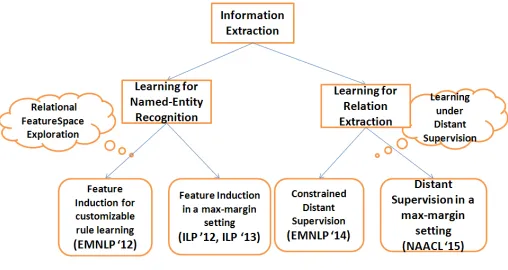
[image:6.612.314.568.55.190.2]Our thesis can be summarized as shown in Figure 5. The broad theme of each work along with its pub-lication forum is indicated. In the entity extraction setting, we work in the paradigm of relational fea-ture space exploration, and in the relation extrac-tion setting, our research has been in the paradigm
Figure 5: Thesis Summary
oflearning under distant supervision.
The design of our feature induction approach is aimed at producing accurate rules that can be un-derstood and refined by humans, by placing special emphasis on low complexity and efficient computa-tion of the induced rules. According to our com-plexity measure, the induced rules have good ac-curacy and low complexity. While our complexity measure informs the biases in our system and leads to simpler, smaller extractors, it captures extrac-tor interpretability only to a certain extent. There-fore, we believe more work is required to devise a more comprehensive quantitative measure for inter-pretability. Another interesting direction of future work, is the designing of human-computer interac-tion experiments, to present the induced rules to a manual rule-developer and evaluating the quality of rules induced.
In the distantly supervised relation extraction, our ILP formulation provides a good framework to add new types of constraints to the problem. In the fu-ture, we would like to experiment with other con-straints such as modeling the selectional preferences of entity types.
Our max-margin framework for distant supervi-sion provided a way to optimize F1 score while
like to explore our approach for other latent variable models in NLP, such as those in machine translation.
References
Mary Elaine Califf. 1998. Relational Learning Tech-niques for Natural Language Information Extraction. Ph.D. thesis, Department of Computer Sciences, Uni-versity of Texas, Austin, TX, August. Also appears as Artificial Intelligence Laboratory Technical Report AI 98-276.
Laura Chiticariu, Rajasekar Krishnamurthy, Yunyao Li, Frederick Reiss, and Shivakumar Vaithyanathan. 2010. Domain adaptation of rule-based annotators for named-entity recognition tasks. InEMNLP.
Pedro F. Felzenszwalb, Ross B. Girshick, David A. McAllester, and Deva Ramanan. 2010. Object detec-tion with discriminatively trained part-based models.
IEEE Trans. Pattern Anal. Mach. Intell., 32(9):1627– 1645.
Peter Flach and Nicolas Lachiche. 1999. 1bc: a first-order bayesian classifier. In Proceedings Of the 9th International workshop on Inductive Logic Program-ming, Volume 1634 of Lecture Notes in Artificial Intel-ligence, pages 92–103. Springer-Verlag.
Gholamreza Haffari, Ajay Nagesh, and Ganesh Ramakr-ishnan. 2015. Optimizing multivariate performance measures for learning relation extraction models. In
Human Language Technologies: Conference of the North American Chapter of the Association of Com-putational Linguistics, Proceedings, May 31 - Jun 5, 2015, Denver, Colorado, USA. The Association for Computational Linguistics.
Raphael Hoffmann, Congle Zhang, Xiao Ling, Luke Zettlemoyer, and Daniel S. Weld. 2011. Knowledge-based weak supervision for information extraction of overlapping relations. InProceedings of the 49th An-nual Meeting of the Association for Computational Linguistics: Human Language Technologies - Volume 1, HLT ’11, pages 541–550, Stroudsburg, PA, USA. Association for Computational Linguistics.
Alfred Horn. 1951. On sentences which are true of direct unions of algebras. The Journal of Symbolic Logic, 16(1):pp. 14–21.
T. Joachims. 2005. A support vector method for multi-variate performance measures. InInternational Con-ference on Machine Learning (ICML), pages 377–384. Joseph Keshet. 2014. Optimizing the measure of perfor-mance in structured prediction. In Sebastian Nowozin, Peter V. Gehler, Jeremy Jancsary, and Christoph H. Lampert, editors, Advanced Structured Prediction. The MIT Press.
Mike Mintz, Steven Bills, Rion Snow, and Dan Jurafsky. 2009. Distant supervision for relation extraction with-out labeled data. InProceedings of the Joint Confer-ence of the 47th Annual Meeting of the ACL, ACL ’09, pages 1003–1011, Stroudsburg, PA, USA. Association for Computational Linguistics.
Stephen Muggleton and C. Feng. 1992. Efficient induc-tion in logic programs. InILP.
Ajay Nagesh, Ganesh Ramakrishnan, Laura Chiticariu, Rajasekar Krishnamurthy, Ankush Dharkar, and Push-pak Bhattacharyya. 2012. Towards efficient named-entity rule induction for customizability. In Proceed-ings of the 2012 Joint Conference on Empirical Meth-ods in Natural Language Processing and Computa-tional Natural Language Learning, EMNLP-CoNLL ’12, pages 128–138, Stroudsburg, PA, USA. Associa-tion for ComputaAssocia-tional Linguistics.
Ajay Nagesh, Gholamreza Haffari, and Ganesh Ramakr-ishnan. 2014. Noisy or-based model for relation ex-traction using distant supervision. InProceedings of the 2014 Conference on Empirical Methods in Natural Language Processing (EMNLP), Doha, Qatar, Octo-ber. Association for Computational Linguistics. Naveen Nair, Amrita Saha, Ganesh Ramakrishnan, and
Shonali Krishnaswamy. 2012. Rule ensemble learn-ing uslearn-ing hierarchical kernels in structured output spaces. InAAAI.
Shan-Hwei Nienhuys-Cheng and Ronald de Wolf. 1997.
Foundations of Inductive Logic Programming. Mani Ranjbar, Arash Vahdat, and Greg Mori. 2012.
Complex loss optimization via dual decomposition. In
2012 IEEE Conference on Computer Vision and Pat-tern Recognition, Providence, RI, USA, June 16-21, 2012, pages 2304–2311.
Mani Ranjbar, Tian Lan, Yang Wang, Stephen N. Robi-novitch, Ze-Nian Li, and Greg Mori. 2013. Opti-mizing nondecomposable loss functions in structured prediction. IEEE Trans. Pattern Anal. Mach. Intell., 35(4):911–924.
Nir Rosenfeld, Ofer Meshi, Amir Globerson, and Daniel Tarlow. 2014. Learning structured models with the auc loss and its generalizations. In Proceedings of the 17th International Conference on Artificial Intel-ligence and Statistics (AISTATS).
D. Roth and W. Yih. 2001. Propositionalization of rela-tional learning: An information extraction case study. Number UIUCDCS-R-2001-2206.
Sunita Sarawagi. 2008. Information extraction. Found. Trends databases, 1(3):261–377, March.
Meth-ods in Natural Language Processing and Computa-tional Natural Language Learning, EMNLP-CoNLL ’12, pages 455–465, Stroudsburg, PA, USA. Associa-tion for ComputaAssocia-tional Linguistics.
Daniel Tarlow and Richard S Zemel. 2012. Structured output learning with high order loss functions. In Pro-ceedings of the 15th Conference on Artificial Intelli-gence and Statistics.
Benjamin Taskar, Carlos Guestrin, and Daphne Koller. 2003. Max-margin markov networks. InNIPS. Ioannis Tsochantaridis, Thomas Hofmann, Thorsten
Joachims, and Yasemin Altun. 2004. Support vec-tor machine learning for interdependent and structured output spaces. InProceedings of the twenty-first inter-national conference on Machine learning, ICML ’04, pages 104–, New York, NY, USA. ACM.
Yang Wang and Greg Mori. 2011. Hidden part mod-els for human action recognition: Probabilistic versus max margin. IEEE Trans. Pattern Anal. Mach. Intell., 33(7):1310–1323.