A Case for Shorter Queries, and Helping Users Create Them
Giridhar Kumaran and James Allan Center for Intelligent Information Retrieval
Department of Computer Science University of Massachusetts Amherst
Amherst, MA 01003, USA
{giridhar,allan}@cs.umass.edu
Abstract
Information retrieval systems are fre-quently required to handle long queries. Simply using all terms in the query or re-lying on the underre-lying retrieval model to appropriately weight terms often leads to ineffective retrieval. We show that re-writing the query to a version that com-prises a small subset of appropriate terms from the original query greatly improves effectiveness. Targeting a demonstrated potential improvement of almost 50% on some difficult TREC queries and their as-sociated collections, we develop a suite of automatic techniques to re-write queries and study their characteristics. We show that the shortcomings of automatic meth-ods can be ameliorated by some simple user interaction, and report results that are on average 25% better than the baseline.
1 Introduction
Query expansion has long been a focus of infor-mation retrieval research. Given an arbitrary short query, the goal was to find and include additional related and suitably-weighted terms to the original query to produce a more effective version. In this pa-per we focus on a complementary problem – query
re-writing. Given a long query we explore whether
there is utility in modifying it to a more concise ver-sion such that the original information need is still expressed.
The Y!Q beta1 search engine allows users to se-lect large portions of text from documents and issue them as queries. The search engine is designed to encourage users to submit long queries such as this example from the web site “I need to know the gas
mileage for my Audi A8 2004 model”. The
moti-vation for encouraging this type of querying is that longer queries would provide more information in the form of context (Kraft et al., 2006), and this ad-ditional information could be leveraged to provide a better search experience. However, handling such long queries is a challenge. The use of all the terms from the user’s input can rapidly narrow down the set of matching documents, especially if a boolean retrieval model is adopted. While one would ex-pect the underlying retrieval model to appropriately assign weights to different terms in the query and return only relevant content, it is widely acknowl-edged that models fail due to a variety of reasons (Harman and Buckley, 2004), and are not suited to tackle every possible query.
Recently, there has been great interest in personal-ized search (Teevan et al., 2005), where the query is modified based on a user’s profile. The profile usu-ally consists of documents previously viewed, web sites recently visited, e-mail correspondence and so on. Common procedures for using this large amount of information usually involve creating huge query vectors with some sort of term-weighting mecha-nism to favor different portions of the profile.
The queries used in the TREC ad-hoc tracks con-sist of title, description and narrative sections, of progressively increasing length. The title, of length
1
http://yq.search.yahoo.com/
ranging from a single term to four terms is ered a concise query, while the description is consid-ered a longer version of the title expressing the same information need. Almost all research on the TREC ad-hoc retrieval track reports results using only the title portion as the query, and a combination of the title and description as a separate query. Most re-ported results show that the latter is more effective than the former, though in the case of some hard col-lections the opposite is true. However, as we shall show later, there is tremendous scope for improve-ment. Formulating a shorter query from the descrip-tion can lead to significant improvements in perfor-mance.
In the light of the above, we believe there is great utility in creating query-rewriting mechanisms for handling long queries. This paper is organized in the following way. We start with some examples and explore ways by which we can create concise high-quality reformulations of long queries in Sec-tion 2. We describe our baseline system in SecSec-tion 3 and motivate our investigations with experiments in Section 4. Since automatic methods have shortfalls, we present a procedure in Section 5 to involve users in selecting a good shorter query from a small selec-tion of alternatives. We report and discuss the results of this approach in Section 6. Related work is pre-sented in Section 7. We wrap up with conclusions and future directions in Section 8.
2 Selecting sub-queries
Consider the following query:
Define Argentine and British international rela-tions.
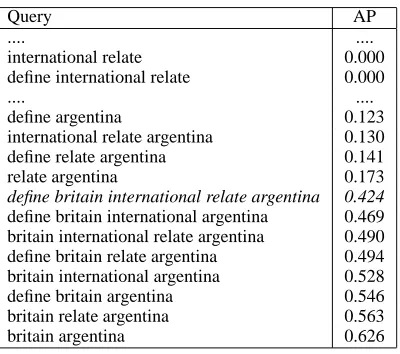
When this query was issued to a search engine, the average precision (AP, Section 3) of the results was 0.424. When we selected subsets of terms (sub-queries) from the query, and ran them as distinct queries, the performance was as shown in Table 1. It can be observed that there are seven different ways of re-writing the original query to attain better per-formance. The best query, also among the shortest, did not have a natural-language flavor to it. It how-ever had an effectiveness almost 50% more than the original query. This immense potential for improve-ment by query re-writing is the motivation for this paper.
Query AP
.... ....
international relate 0.000 define international relate 0.000
.... ....
define argentina 0.123 international relate argentina 0.130 define relate argentina 0.141 relate argentina 0.173
define britain international relate argentina 0.424
[image:2.612.330.530.57.234.2]define britain international argentina 0.469 britain international relate argentina 0.490 define britain relate argentina 0.494 britain international argentina 0.528 define britain argentina 0.546 britain relate argentina 0.563 britain argentina 0.626
Table 1: The results of using all possible subsets (ex-cluding singletons) of the original query as queries. The query terms were stemmed and stopped.
Analysis of the terms in the sub-queries and the relationship of the sub-queries with the original query revealed a few interesting insights that had po-tential to be leveraged to aid sub-query selection.
1. Terms in the original query that a human would consider vital in conveying the type of infor-mation desired were missing from the best sub-queries. For example, the best sub-query for the example was britain argentina, omitting any reference to international relations. This also reveals a mismatch between the user’s query and the way terms occurred in the corpus, and suggests that an approximate query could at times be a better starting point for search.
2. The sub-query would often contain only terms that a human would consider vital to the query while the original query would also (naturally) contain them, albeit weighted lower with re-spect to other terms. This is a common prob-lem (Harman and Buckley, 2004), and the fo-cus of efforts to isolate the key concept terms in queries (Buckley et al., 2000; Allan et al., 1996).
4. Sub-queries a human would consider as an in-complete expression of information need some-times performed better than the original query. Our example illustrates this point.
Given the above empirical observations, we ex-plored a variety of procedures to refine a long query into a shorter one that retained the key terms. We ex-pected the set of terms of a good sub-query to have the following properties.
A. Minimal Cardinality: Any set that contains more than the minimum number of terms to retrieve relevant documents could suffer from concept drift.
B. Coherency: The terms that constitute the sub-query should be coherent, i.e. they should buttress each other in representing the information need. If need be, terms that the user considered important but led to retrieval of non-relevant documents should be dropped.
Some of the sub-query selection methods we ex-plored with these properties in mind are reported be-low.
2.1 Mutual Information
Let X and Y be two random variables, with joint distributionP(x, y)and marginal distributionsP(x) and P(y) respectively. The mutual information is then defined as:
I(X;Y) = X
x
X
y
p(x, y)log p(x, y) p(x)p(y)
(1)
Intuitively, mutual information measures the infor-mation aboutXthat is shared byY. IfXandY are independent, thenXcontains no information about Y and vice versa and hence their mutual information is zero. Mutual Information is attractive because it is not only easy to compute, but also takes into consid-eration corpus statistics and semantics. The mutual information between two terms (Church and Hanks, 1989) can be calculated using Equation 2.
I(x, y) =log n(x,y)
N n(x)
N n(y)
N
(2)
n(x, y)is the number of times termsxandy oc-curred within a term window of 100 terms across the
corpus, whilen(x)and n(y) are the frequencies of xandyin the collection of sizeN terms.
To tackle the situation where we have an arbi-trary number of variables (terms) we extend the two-variable case to the multivariate case. The extension, called multivariate mutual information (MVMI) can be generalized from Equation 1 to:
I(X1;X2;X3;...;XN) = N
X
i=1
(−1)i−1 X
X⊂(X1,X2,X3,...,XN),|X|=k
H(X) (3)
The calculation of multivariate information using Equation 3 was very cumbersome, and we instead worked with the approximation (Kern et al., 2003) given below.
I(X1;X2;X3;...;XN) = (4)
X
i,j={1,2,3,...,N;i6=j}
I(Xi;Xj) (5)
For the case involving multiple terms, we calcu-lated MVMI as the sum of the pair-wise mutual in-formation for all terms in the candidate sub-query. This can be also viewed as the creation of a com-pletely connected graphG= (V, E), where the ver-ticesV are the terms and the edges Eare weighted using the mutual information between the vertices they connect.
To select a score representative of the quality of a sub-query we considered several options includ-ing the sum, average, median and minimum of the edge weights. We performed experiments on a set of candidate queries to determine how well each of these measures tracked AP, and found that the aver-age worked best. We refer to the sub-query selection procedure using the average score as Average.
2.2 Maximum Spanning Tree
to tackle this problem by considering another mea-sure that involved creating a maximum spanning tree (MaxST) over the fully connected graphG, and us-ing the weight of the identified tree as a measure rep-resentative of the candidate query’s quality (Rijsber-gen, 1979). We used Kruskal’s minimum spanning tree (Cormen et al., 2001) algorithm after negating the edge weights to obtain a MaxST. We refer to the sub-query selection procedure using the weight of the maximum spanning tree as MaxST.
2.3 Named Entities
Named entities (names of persons, places, organiza-tions, dates, etc.) are known to play an important anchor role in many information retrieval applica-tions. In our example from Section 2, sub-queries without Britain or Argentina will not be effective even though the mutual information score of the other two terms international and relations might indicate otherwise. We experimented with another version of sub-query selection that considered only sub-queries that retained at least one of the named entities from the original query. We refer to the vari-ants that retained named entities as NE Average and
NE MasT.
3 Experimental Setup
We used version 2.3.2 of the Indri search engine, de-veloped as part of the Lemur2 project. While the inference network-based retrieval framework of In-dri permits the use of structured queries, the use of language modeling techniques provides better es-timates of probabilities for query evaluation. The pseudo-relevance feedback mechanism we used is based on relevance models (Lavrenko and Croft, 2001).
To extract named entities from the queries, we used BBN Identifinder (Bikel et al., 1999). The named entities identified were of type Person,
Lo-cation, Organization, Date, and Time.
We used the TREC Robust 2004 and Robust 2005 (Voorhees, 2006) document collections for our ex-periments. The 2004 Robust collection contains around half a million documents from the Finan-cial Times, the Federal Register, the LA Times, and FBIS. The Robust 2005 collection is the one-million
2
http://www.lemurproject.org
document AQUAINT collection. All the documents were from English newswire. We chose these col-lections because they and their associated queries are known to be hard, and hence present a chal-lenging environment. We stemmed the collections using the Krovetz stemmer provided as part of In-dri, and used a manually-created stoplist of twenty terms (a, an, and, are, at, as, be, for, in, is, it, of, on,
or, that, the, to, was, with and what). To determine
the best query selection procedure, we analyzed 163 queries from the Robust 2004 track, and used 30 and 50 queries from the 2004 and 2005 Robust tracks re-spectively for evaluation and user studies.
For all systems, we report mean average preci-sion (MAP) and geometric mean average precipreci-sion (GMAP). MAP is the most widely used measure in Information Retrieval. While precision is the frac-tion of the retrieved documents that are relevant, av-erage precision (AP) is a single value obtained by averaging the precision values at each new relevant document observed. MAP is the arithmetic mean of the APs of a set of queries. Similarly, GMAP is the geometric mean of the APs of a set of queries. The GMAP measure is more indicative of performance across an entire set of queries. MAP can be skewed by the presence of a few well-performing queries, and hence is not as good a measure as GMAP from the perspective of measure comprehensive perfor-mance.
4 Experiments
train-MAP GMAP
Long Query Baseline 0.243 0.136
(Description) PRF 0.270 0.124
Short Query Baseline 0.249 0.154
(Title) PRF 0.269 0.148
Best sub-query Baseline 0.342 0.270
[image:5.612.81.292.59.158.2](Combination) PRF 0.343 0.241
Table 2: Results across 163 training queries on the Robust 2004 collection. Using the best sub-query results in almost 50% improvement over the baseline
ing queries.
To show the potential and utility of query re-writing, we first present results that show the upper bound on performance that can obtained by doing so. We ran retrieval experiments with every combi-nation of query terms. For a query of lengthn, there are 2n combinations. We limited our experiments to queries of length n ≤ 12. Selecting the perfor-mance obtained by the best sub-query of each query revealed an upper bound in performance almost 50% better than the baseline (Table 2).
To evaluate the automatic sub-query selection procedures developed in Section 2, we performed retrieval experiments using the sub-queries selected using them. The results, which are presented in Ta-ble 3, show that the automatic sub-query selection process was a failure. The results of automatic se-lection were worse than even the baseline, and there was no significant difference between using any of the different sub-query selection procedures.
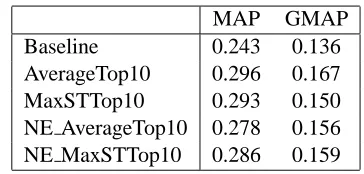
The failure of the automatic techniques could be attributed to the fact that we were working with the assumption that term co-occurrence could be used to model a user’s information need. To see if there was any general utility in using the procedures to select sub-queries, we selected the best-performing sub-query from the top 10 ranked by each selection procedure (Table 4). While the effectiveness in each case as measured by MAP is not close to the best possible MAP, 0.342, they are all significantly better than the baseline of 0.243.
5 Interacting with the user
The final results we presented in the last section hinted at a potential for user interaction. We
envi-MAP GMAP
Baseline 0.243 0.136
Average 0.172 0.025
MaxST 0.172 0.025
NE Average 0.170 0.023
NE MaxST 0.182 0.029
Table 3: Score of the highest rank sub-query by var-ious measures.
MAP GMAP
Baseline 0.243 0.136
AverageTop10 0.296 0.167
MaxSTTop10 0.293 0.150
NE AverageTop10 0.278 0.156
[image:5.612.354.504.59.143.2]NE MaxSTTop10 0.286 0.159
Table 4: Score of the best sub-query in the top 10 ranked by various measures
sioned providing the user with a list of the top 10 sub-query candidates using a good ranking proce-dure, and asking her to select the sub-query she felt was most appropriate. This additional round of hu-man intervention could potentially compensate for the inability of the ranking measures to select the best sub-query automatically.
5.1 User interface design
[image:5.612.335.517.196.283.2]Percentage of candidates better than baseline
Average 28.5%
MaxST 35.5%
NE Average 31.1%
NE MaxST 36.6%
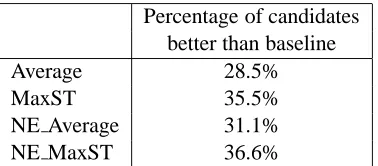
Table 5: Number of candidates from top 10 that ex-ceeded the baseline
5.2 User interface content issues
The two key issues we faced while determining the content of the user interface were:
A. Deciding which sub-query selection procedure
to use to get the top 10 candidate sub-queries: To
determine this in the absence of any significant dif-ference in performance due to the top-ranked can-didate selected by each procedure, we looked at the number of candidates each procedure brought into the top 10 that were better than the baseline query, as measured by MAP. This was guided by the belief that greater the number of better candidates in the top 10, the higher the probability that the user would select a better sub-query. Table 5 shows how each of the selection procedures compared. The NE MaxST ranking procedure had the most number of better sub-queries in the top 10, and hence was chosen.
B. Displaying context: Simply displaying a list of 10 candidates without any supportive information would make the task of the user difficult. This was in contrast to query expansion techniques (Anick and Tipirneni, 1999) where displaying a list of terms suf-ficed as the task of the user was to disambiguate or expand a short query. An experiment was per-formed in which a single user worked with a set of 30 queries from Robust 2004, and an accompanying set of 10 candidate sub-queries each, twice - once with passages providing context and one with snip-pets providing context. The top-ranked passage was generated by modifying the candidate query into one that retrieved passages of fixed length instead of documents. Snippets, like those seen along with links to top-ranked documents in the results from almost all popular search engines, were generated after a document-level query was used to query the collection. The order in which the two contexts were presented to the user was randomized to prevent the
MAP GMAP
[image:6.612.94.283.59.142.2]Snippet as Context 0.348 0.170 Passage as Context 0.296 0.151
Table 6: Results showing the MAP over 19 of 30 queries that the user provided selections for using each context type.
user from assuming a quality order. We see that pre-senting the snippet led to better MAP that prepre-senting the passage (Table 6). The reason for this could be that the top-ranking passage we displayed was from a document ranked lower by the document-focussed version of the query. Since we finally measure MAP only with respect to document ranking, and the snip-pet was generated from the top-ranked document, we hypothesize that this led to the snippet being a better context to display.
6 User Evaluation
We conducted an exploratory study with five par-ticipants - four of them were graduate students in computer science while the fifth had a background in the social sciences and was reasonably proficient in the use of computers and internet search engines. The participants worked with 30 queries from Ro-bust 2004, and 50 from RoRo-bust 20053. The baseline values reported are automatic runs with the
descrip-tion as the query.
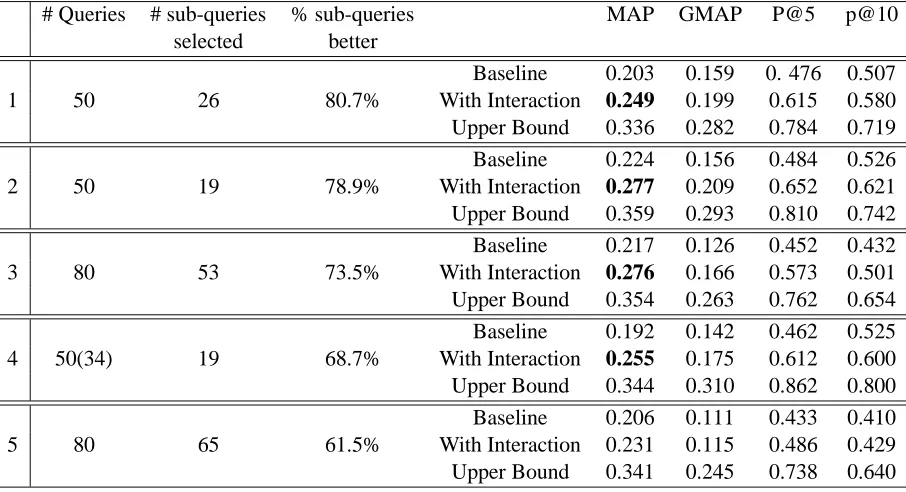
Table 7 shows that all five participants4 were
able to choose sub-queries that led to an improve-ment in performance over the baseline (TREC title query only). This improvement is not only on MAP but also on GMAP, indicating that user interaction helped improve a wide spectrum of queries. Most notable were the improvements in P@5 and P@10. This attested to the fact that the interaction tech-nique we explored was precision-enhancing. An-other interesting result, from # sub-queries selected was that participants were able to decide in a large number of cases that re-writing was either not useful for a query, or that none of the options presented to them were better. Showing context appears to have helped.
3
Participant 4 looked that only 34 of the 50 queries presented
4
Thepvalue for testing statistical significance of MAP
# Queries # sub-queries % sub-queries MAP GMAP P@5 p@10
selected better
Baseline 0.203 0.159 0. 476 0.507
1 50 26 80.7% With Interaction 0.249 0.199 0.615 0.580
Upper Bound 0.336 0.282 0.784 0.719
Baseline 0.224 0.156 0.484 0.526
2 50 19 78.9% With Interaction 0.277 0.209 0.652 0.621
Upper Bound 0.359 0.293 0.810 0.742
Baseline 0.217 0.126 0.452 0.432
3 80 53 73.5% With Interaction 0.276 0.166 0.573 0.501
Upper Bound 0.354 0.263 0.762 0.654
Baseline 0.192 0.142 0.462 0.525
4 50(34) 19 68.7% With Interaction 0.255 0.175 0.612 0.600
Upper Bound 0.344 0.310 0.862 0.800
Baseline 0.206 0.111 0.433 0.410
5 80 65 61.5% With Interaction 0.231 0.115 0.486 0.429
[image:7.612.81.534.60.306.2]Upper Bound 0.341 0.245 0.738 0.640
Table 7: # Queries refers to the number of queries that were presented to the participant while # sub-queries
selected refers to the number of queries for which the participant chose a sub-query. All scores including
upper bounds were calculated only considering the queries for which the participant selected a sub-query. An entry in bold means that the improvement in MAP is statistically significant. Statistical significance was measured using a paired t-test, withαset to 0.05.
7 Related Work
Our interest in finding a concise sub-query that ef-fectively captures the information need is reminis-cent of previous work in (Buckley et al., 2000). However, the focus was more on balancing the ef-fect of query expansion techniques such that differ-ent concepts in the query were equally benefited.
Mutual information has been used previously in (Church and Hanks, 1989) to identify collocations of terms for identifying semantic relationships in text. Experiments were confined to bigrams. The use of MaST over a graph of mutual information values to incorporate the most significant dependencies be-tween terms was first noted in (Rijsbergen, 1979). Extensions can be found in a different field - image processing (Kern et al., 2003) - where multivariate mutual information is frequently used.
Work done by (White et al., 2005) provided a ba-sis for our decision to show context for sub-query se-lection. The useful result that top-ranked sentences could be used to guide users towards relevant mate-rial helped us design an user interface that the
par-ticipants found very convenient to use.
A related problem addressed by (Cronen-Townsend et al., 2002) was determining query qual-ity. This is known to be a very hard problem, and various efforts (Carmel et al., 2006; Vinay et al., 2006) have been made towards formalizing and un-derstanding it.
(Spink and Ozmultu, 2002). More experimentation in the Web domain is required to substantiate this.
8 Conclusions
Our results clearly show that shorter reformulations of long queries can greatly impact performance. We believe that our technique has great potential to be used in an adaptive information retrieval environ-ment, where the user starts off with a more general information need and a looser notion of relevance. The initial query can then be made longer to express a most focused information need.
As part of future work, we plan to conduct a more elaborate study with more interaction strategies in-cluded. Better techniques to select effective sub-queries are also in the pipeline. Since we used mu-tual information as the basis for most of our sub-query selection procedures, we could not consider sub-queries that comprised of a single term. We plan to address this issue too in future work.
9 Acknowledgments
This work was supported in part by the Center for Intelligent Information Retrieval and in part by the Defense Advanced Research Projects Agency (DARPA) under contract number HR0011-06-C-0023. Any opinions, findings and conclusions or recommendations expressed in this material are the authors and do not necessarily reflect those of the sponsor. We also thank the anonymous reviewers for their valuable comments.
References
James Allan, James P. Callan, W. Bruce Croft, Lisa Ballesteros, John Broglio, Jinxi Xu, and Hongming Shu. 1996. Inquery at TREC-5. In TREC.
Peter G. Anick and Suresh Tipirneni. 1999. The paraphrase search assistant: terminological feedback for iterative infor-mation seeking. In 22nd ACM SIGIR Proceedings, pages 153–159.
Daniel M. Bikel, Richard Schwartz, and Ralph M. Weischedel. 1999. An algorithm that learns what’s in a name. Machine
Learning, 34(1-3):211–231.
Chris Buckley, Mandar Mitra, Janet Walz, and Claire Cardie. 2000. Using clustering and superconcepts within smart: TREC 6. Information Processing and Management,
36(1):109–131.
David Carmel, Elad Yom-Tov, Adam Darlow, and Dan Pelleg. 2006. What makes a query difficult? In 29th ACM SIGIR
Proceedings, pages 390–397.
Kenneth Ward Church and Patrick Hanks. 1989. Word associ-ation norms, mutual informassoci-ation, and lexicography. In 27th
ACL Proceedings, pages 76–83.
Thomas H. Cormen, Charles E. Leiserson, Ronald L. Rivest, and Clifford Stein. 2001. Introduction to Algorithms,
Sec-ond Edition. The MIT Electrical Engineering and Computer
Science Series. The MIT Press.
Steve Cronen-Townsend, Yun Zhou, and W. Bruce Croft. 2002. Predicting query performance. In 25th ACM SIGIR
Proceed-ings, pages 299–306.
Donna Harman and Chris Buckley. 2004. The NRRC reliable information access (RIA) workshop. In 27th ACM SIGIR
Proceedings, pages 528–529.
Jeffrey P. Kern, Marios Pattichis, and Samuel D. Stearns. 2003. Registration of image cubes using multivariate mutual infor-mation. In Thirty-Seventh Asilomar Conference, volume 2, pages 1645–1649.
Reiner Kraft, Chi Chao Chang, Farzin Maghoul, and Ravi Ku-mar. 2006. Searching with context. In 15th International
CIKM Conference Proceedings, pages 477–486.
Victor Lavrenko and W. Bruce Croft. 2001. Relevance based language models. In 24th ACM SIGIR Conference
Proceed-ings, pages 120–127.
C. J. Van Rijsbergen. 1979. Information Retrieval.
Butterworth-Heinemann, Newton, MA, USA, 2 edition.
Jacob Shapiro and Isak Taksa. 2003. Constructing web search queries from the user’s information need expressed in a nat-ural language. In Proceedings of the 2003 ACM Symposium
on Applied Computing, pages 1157–1162.
Amanda Spink and H. Cenk Ozmultu. 2002. Characteristics of question format web queries: An exploratory study.
Infor-mation Processing and Management, 38(4):453–471.
Amanda Spink, Bernard J. Jansen, Dietmar Wolfram, and Tefko Saracevic. 2002. From e-sex to e-commerce: Web search changes. Computer, 35(3):107–109.
Jaime Teevan, Susan T. Dumais, and Eric Horvitz. 2005. Per-sonalizing search via automated analysis of interests and ac-tivities. In 28th ACM SIGIR Proceedings, pages 449–456.
Vishwa Vinay, Ingemar J. Cox, Natasa Milic-Frayling, and Ken Wood. 2006. On ranking the effectiveness of searches. In
29th ACM SIGIR Proceedings, pages 398–404.
Ellen M. Voorhees. 2006. The TREC 2005 robust track. SIGIR
Forum, 40(1):41–48.