A Translation-Based Knowledge Graph Embedding
Preserving Logical Property of Relations
Hee-Geun Yoon, Hyun-Je Song, Seong-Bae Park, Se-Young Park School of Computer Science and Engineering
Kyungpook National University Daegu, 41566, Korea
{hkyoon, hjsong, sbpark, sypark}@sejong.knu.ac.kr
Abstract
This paper proposes a novel translation-based knowledge graph embedding that preserves the logical properties of relations such as tran-sitivity and symmetricity. The embedding space generated by existing translation-based embeddings do not represent transitive and symmetric relations precisely, because they ignore the role of entities in triples. Thus, we introduce a role-specific projection which maps an entity to distinct vectors according to its role in a triple. That is, a head entity is jected onto an embedding space by a head pro-jection operator, and a tail entity is projected by a tail projection operator. This idea is ap-plied to TransE, TransR, and TransD to pro-duce lppTransE, lppTransR, and lppTransD, respectively. According to the experimental results on link prediction and triple classifica-tion, the proposed logical property preserving embeddings show the state-of-the-art perfor-mance at both tasks. These results prove that it is critical to preserve logical properties of relations while embedding knowledge graphs, and the proposed method does it effectively.
1 Introduction
Representing knowledge as a graph is one of the most effective ways to utilize human knowledge with a machine, and various large-scale knowledge graphs such as Freebase (Bollacker et al., 2008) and Yago (Suchanek et al., 2007) are available these days. However, the sparsity of the graphs makes it difficult to utilize them in real world applications. In spite of their huge volume, the relations among entities in the graphs are insufficient, which results
in very limited inference of the knowledge of the graphs. Therefore, it is of importance to resolve such sparsity of knowledge graphs.
One of the most promising methods to complete knowledge graphs is to embed the graphs in a low-dimensional continuous vector space. This method learns a vector representation of a knowledge graph, and the plausibility of a certain knowledge within the graph is measured with algebraic operations in the vector space. Thus, new knowledge can be harvested from the space by finding knowledge in-stances with high plausibility.
The translation-based model among various knowledge-embedding models shows the state-of-the-art performance of knowledge graph completion (Bordes et al., 2013; Wang et al., 2014; Lin et al., 2015; Ji et al., 2015). TransE (Bordes et al., 2013) is one of the well-known translation-based approaches to this problem. When a set of knowledge triples
(h, r, t) composed of a relation (r) and two enti-ties (handt) is given, it finds vector representations ofh, t, and r by compelling the vector of t to be same with the sum of the vectors ofhandr. While TransE embeds all relations in a single vector space, TransH (Wang et al., 2014) and TransR (Lin et al., 2015) assume that each relation has its own embed-ding space. On the other hand, Ji et al. (2015) found out that even a single relation or a single entity usu-ally has multiple types. Thus, they have proposed TransD which allows multiple mapping matrices of entities and relations.
Even though these translation-based models achieve high performance in knowledge graph com-pletion, they all ignore logical properties of
tions. That is, transitive relations and symmetric relations lose their transitivity or symmetricity in the vector space generated by the translation-based models. As a result, the models can not complete only new knowledge with such relations, but also new knowledge with a relation affected by the rela-tions. In most knowledge graphs, transitive or sym-metric relations are common. For instance, FB15K, one of the benchmark datasets for knowledge graph completion, has a number of transitive and symmet-ric relations. About 20% of triples in FB15K have a transitive or a symmetric relation. Therefore, the ignorance of logical properties of relations becomes a serious problem in knowledge graph completion.
The main reason why existing translation-based embeddings can not reflect logical properties of rela-tions is that they do not consider the role of entities. An entity should be a different vector in the embed-ding space accorembed-ding to its role. Therefore, the so-lution to preserve the logical properties of relations in the embedding space is to distinguish the role of entities while embedding entities and relations.
In this paper, we propose a role-specific projec-tion to preserve logical properties of relaprojec-tions in an embedding space. This can be implemented by pro-jecting a head entity onto an embedding space by a head projection operator and a tail entity by a tail projection operator. As a result, an identical en-tity is represented as two distinct vectors. This idea can be applied to various translation-based models including TransE, TransR, and TransD. Therefore, we also propose how to modify existing translation-based models to preserve logical properties. The effectiveness of the proposed idea is verified with two tasks of link prediction and triple classification using standard benchmark datasets of WordNet and Freebase. According to the experimental results, the logical property preserving embeddings achieve the state-of-the-art performance in both tasks.
2 Related Work
The sparsity of knowledge graphs is one of the most critical issues in utilizing them in real-world appli-cations. Thus, there have been a number of stud-ies on completing knowledge graphs as a solution to overcome the sparsity. Link prediction is one of the promising ways for knowledge graph
comple-tion. This task predicts new relations between enti-ties on a knowledge graph by investigating existing relations of the graph (Nickel et al., 2015; Neelakan-tan and Chang, 2015). The methods used for link prediction can be categorized into three groups. One group consists of the methods based on graph fea-tures. The observable features used in these methods are the paths between entity pairs (Lao and Cohen, 2010; Lao et al., 2011) and subgraphs (Gardner and Mitchell, 2015). The other group is composed of the methods based on Markov random fields. The stud-ies belonging to this group inference new relations by probabilistic soft logic (Pujara et al., 2013) and first-order logic (Jiang et al., 2012).
Knowledge graph embedding is another promi-nent method for link prediction (Bordes et al., 2011; Nickel et al., 2011; Guo et al., 2015; Neelakantan et al., 2015). It embeds entities of a knowledge graph into a continuous low dimensional space as vectors, and embeds relations as vectors or matrices. These vectors are optimized by a score function of each knowledge graph embedding model. The Semantic Matching Energy (SME) model proposed by Bor-des et al. (2014) finds vector representations of en-tities and relations using a neural network. When a triple(h, r, t) is given, SME makes two relation-dependent embeddings of(h, r)and(r, t). Its score function for a triple is the similarity between the embeddings. Since relations are expressed as vec-tors instead of matrices, the complexity of SME is relatively low compared to other embedding meth-ods. Jenatton et al. (2012) suggested Latent Factor Model (LFM). In order to capture both the first-order and the second-order interactions between two en-tities, LFM adopts a bilinear function as its score function. In addition, it represents a relation as a weighted sum of sparse latent factors to work with a large number of relations. Socher et al. (2013) proposed the Neural Tensor Network (NTN) model. NTN is a highly expressive embedding model which has a bilinear tensor layer instead of a standard lin-ear neural network layer. As a result, it can process various interactions between entity vectors. How-ever, it is difficult to process large-scale knowledge graphs with NTN due to its high complexity.
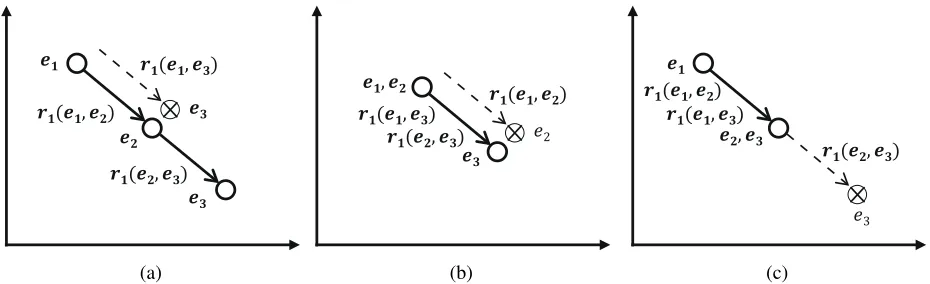
(a) (b) (c) Figure 1: An example of entity vectors trained wrong by a transitive relation.
relations are represented as vectors, and relations are treated as operators to translate entities into other positions on an embedding space. Thus, they try to find vector representations of h, t, andr so that the vector oftbecomes the sum of the vectors ofh
andr. TransE (Bordes et al., 2013) is the simplest translation-based graph embedding. It assumes that all vectors of entities and relations lie on a single vector space. As a result, it fails in dealing with the reflexivity and the multiplicities of relations except 1-to-1. The solution to this problem is to allow the entities to play different roles according to relations, but TransE is unable to do it.
An entity plays multiple roles in TransH (Wang et al., 2014), since TransH allows entities to have tiple vector representations. In order to obtain mul-tiple representations of an entity, TransH projects an entity vector into relation-specific hyperplanes. TransR (Lin et al., 2015) also solves the problems of TransE by introducing relation spaces. It allows an entity to have various vector representations by map-ping an entity vector into relation-specific spaces rather than relation-specific hyperplanes. Although both TransH and TransR overcome the limitations of TransE, they are still not able to handle multi-ple types of relations which is determined by head and tail entities of each relation. For example, let us consider two triples of (California,part of,USA) and (arm, part of, body). Both triples have a re-lation part of in common, but the relation should be interpreted differently in each triple. Ji et al. (2015) have proposed TransD in which a relation can have multiple relation spaces according to its en-tities. TransD constructs relation mapping matrices
dynamically by considering entities and a relation si-multaneously. For this, it introduces projection vec-tors for entities and relations, and then constructs the mapping matrices by multiplying these entity and re-lation projection vectors. As a result, every rere-lation in TransD has multiple entity-specific spaces.
3 Loss of Logical Properties in Translation-Based Embeddings
Translation-based embeddings aim to find vector representations of knowledge graph entities in an embedding space by regarding relations as transla-tion of entities in the space. Since they map the enti-ties onto a vector space regardless of the role of the entities, they do not express logical properties of re-lations such as transitivity and symmetricity. That is, the vectors of transitive or symmetric relations do not deliver transitivity or symmetricity in the em-bedding spaces from translation-based emem-beddings. For instance, let us consider a transitive rela-tion. Assume that we have three triples(e1, r1, e2), (e2, r1, e3), and(e1, r1, e3)andr1is a transitive re-lation. When the vector of r1 is not a zero vec-tor, there could be three types of entity vectors as shown in Figure 1. In Figure 1-(a),e1,e2, ande3are placed linearly. In this case,(e1, r1, e3) can not be expressed in this figure. Whene1ande2 are placed at the same point like Figure 1-(b), (e1, r1, e2)can not be expressed. In Figure 1-(c),(e2, r1, e3)can not be expressed whene2 ande3 are same. In a similar way, translation-based embeddings can not express symmetric relations perfectly.
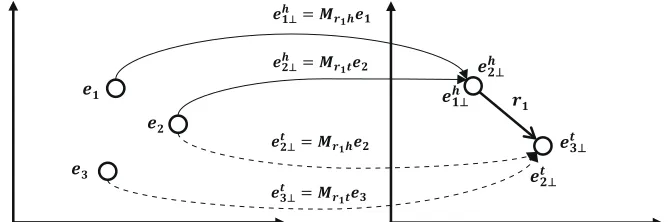
Figure 2: Simple illustration on a transitive relation with role-specific projections.
Figure 3: Simple illustration on a symmetric relation with role-specific projections.
One fold is that the relations with logical properties are common in knowledge bases. Two benchmark datasets of FB15K and WN18 in Table 2 prove it. There are 483,142 triples in FB15K, and 84,172 (= 47,841 + 36,331) triples among them have a transi-tive or symmetric relation. That is, the translation-based embeddings do not express triples precisely for about 17% of triples in FB15K. 22.4% of triples in another dataset WN18 also have a transitive or symmetric relation. The other is that transitive or symmetric relations do not affect the entities that are directly connected by the relations, but affect also other entities shared by transitive and non-symmetric relations through the entities. Therefore, it is of importance in translation-based embeddings to represent transitive and symmetric relations pre-cisely.
4 Logical Property Preserving Embedding
4.1 Role-Specific Projection of Entity Vectors The main reason why transitive or symmetric re-lations are not represented precisely by existing translation-based embeddings is that they ignore the role of entities in embedding them onto a vector space. That is, when a triple(h, r, t)is given,hand
t plays different roles. However, the existing em-beddings treat them equally and embed them into a space in the same way. Therefore, in order to ex-press entities and relations more precisely, entities should be represented differently according to their role in a triple.
Figure 2 shows how entities can be represented according to their role. In this figure, solid lines represent entity mappings as head roles and dotted lines mean that entities are mapped as tails. As-sume that three triples of (e1, r1, e2), (e2, r1, e3), and (e1, r1, e3) are given with a transitive relation
r1. e1 plays only a head role ande3 plays only a tail role, whilee2 plays both roles. Then, the entity vectors in the entity space are mapped into the space ofr1 using two mapping matricesMr1h andMr1t. That is, head entities are mapped by Mr1h, while tail entities are projected byMr1t. Leteh1⊥andeh2⊥ be the projected vectors of e1 and e2 respectively byMr1h, and letet2⊥andet3⊥be the projected vec-tors ofe2ande3 respectively byMr1t.eh1⊥andeh2⊥ are placed at the same point in the space ofr1from (e2, r1, e3)and(e1, r1, e3). Similarly,et2⊥ andet3⊥ are same from(e1, r1, e2)and(e1, r1, e3). Sincee2 is used as both a head and a tail, it is mapped dif-ferently aseh
three triples are well expressed in this space. Symmetric relations also can be expressed pre-cisely by logical property preserving knowledge graph embedding. Assume that two triples of
(e4, r2, e5)and(e5, r2, e4)are given with a symmet-ric relationr2. Figure 3 shows how the triples are well represented. The solid lines imply that entities are mapped by Mr2h while the dotted lines mean that entities are mapped byMr2t. By placing eh4⊥ and eh
5⊥ at the same point and imposing et4⊥ and
et
5⊥ at the same point, r2 is precisely expressed as a symmetric relation in the embedding space.
4.2 Realization of Logical Property Preserving Embedding
Due to the simplicity of role-specific projection of entity vectors, it can be applied to various translation-based embeddings. In this paper, we ap-ply it to TransE, TransR, and TransD.
4.2.1 TransE
The score function of TransE is
frE(h, t) =kh+r−tkl1/2,
whereh,t ∈ Rn, andr ∈ Rn are the vectors of a
head entity, a tail entity, and a relation on a single embedding space. In the logical property preserv-ing TransE (lppTransE), handtshould be mapped differently. For this purpose, we adopt a head and a tail space mapping matrices ofMh ∈ Rn×n and
Mt ∈Rn×n. As a result, the score function of
lpp-TransE becomes
frlppE(h, t) =kMhh+r−Mttkl1/2.
This is similar to the score function of TransR. The difference between lppTransE and TransR is that both h andtare mapped by a single mapping ma-trix forr in TransR, whilehis mapped byMh and
tis byMtin lppTransE.
4.2.2 TransR
The entities in TransR are mapped into vectors in different relation space according to a relation. Thus, its score function is defined as
frR(h, t) =kMrh+r−Mrtkl1/2,
whereMr ∈Rm×nis a mapping matrix for a
rela-tionrwhich is represented asr∈Rm. Thus, in the
logical property preserving TransR (lppTransR), the mapping matrix of each relation is split into a head mapping matrix Mrh ∈ Rm×nand a tail mapping matrixMrt ∈ Rm×n. Then, the score function of lppTransR is
frlppR(h, t) =kMrhh+r−Mrttkl1/2.
With these two distinct mapping matrices, entities can have two different vector representations in the same relation space.
4.2.3 TransD
TransD maps entity vectors into different vectors in relation spaces according to entity and relation types. That is, the entity vectors are mapped by entity-relation specific mapping matrices. Thus, its score function is defined as
fD
r (h, t) = kMrhh+r−Mrttkl1/2,
whereMrh ∈Rm×n andMrt ∈ Rm×nare
entity-relation specific mapping matrices. These mapping matrices are computed by multiplying projection vectors of an entity and a relation as follows.
Mrh = rphTp +Im×n,
Mrt = rptTp +Im×n,
wherehp,tp andrp,are the projection vectors for a
head, a tail and a relation.
The logical property preserving TransD (lpp-TransD) divides rp into two projection vectors rph andrpt to reflect the role of entities. The mapping matrices then becomes
M0rh = rphhTp +Im×n,
M0rt = rpttTp +Im×n.
Then, its score function is
Table 2: A simple statistics on datasets.
Dataset #Rel #Ent #Train #Valid #Test #Transitive #Symmetric Ratio
WN11 11 38,696 112,581 2,609 10,544 822 1,597 2.2%
FB13 13 75,043 316,232 5,908 23,733 262 4,152 1.4%
WN18 18 40,943 141,442 5,000 5,000 2,001 29,667 22.4%
FB15K 1,345 14,951 483,142 50,000 59,071 47,841 36,331 17.4%
Table 1: Complexity of knowledge graph embed-ding models.
Model No. of parameters
TransE O(Nen+Nrn)
TransR O(Nen+Nr(m+ 1)n)
TransD O(2Nen+ 2Nrm)
lppTransE O Nen+Nrn+n2
lppTransR O(Nen+Nr(2m+ 1)n)
lppTransD O(2Nen+ 3Nrm)
4.3 Training Logical Property Preserving Embeddings
Since all logical property preserving embeddings are based on the score function used by previ-ous translation-based knowledge graph embeddings, they can be trained using a margin-based ranking loss defined as
L= X
(h,r,t)∈P
X
(h0,r,t0)∈N
max(0, f∗
r(h, t)+γ−fr∗(h0, t0)),
where f∗
r is the score function of a corresponding
logical property preserving embedding. Here,P and
N are sets of correct and incorrect triples, andγ is a margin. N is constructed by replacing a head or a tail entity in an existing triple because a knowledge graph has only correct triples. All logical property preserving embeddings are optimized by stochastic gradient descent.
The complexities of the logical property preserv-ing embeddpreserv-ings are shown in Table 1. Ne andNr
in this table are the number of entities and relations, and n and m are the dimensions of entity and re-lation embedding spaces. Their complexity mainly depends on the number of relations. Thus, the in-creased complexities of the logical property preserv-ing embeddpreserv-ings is not significant, when compared with TransE, TransR, and TransD.
5 Experiments
The superiority of the proposed logical property pre-serving embeddings is shown through two kinds of tasks. The first task islink prediction(Bordes et al., 2013). This task predicts the missing entity when there is a missing entity in a given triple. The other is
triple classification(Socher et al., 2013). This task aims to decide whether a given triple is correct or not.
5.1 Data Sets
Two popular knowledge graphs of WordNet (Miller, 1995) and Freebase (Bollacker et al., 2008) are used for evaluating embeddings. WordNet provides the semantic relations among words, and there exist its two widely-used subsets which are WN11 (Socher et al., 2013) and WN18 (Bordes et al., 2014). WN18 is used for link prediction, and WN11 is adopted for triple classification. Freebase represents gen-eral facts about the world. It has two subsets of FB13 (Socher et al., 2013) and FB15K (Bordes et al., 2014). FB15K is used for both triple classifi-cation and link prediction, while FB13 is employed only for triple classification.
Table 2 summarizes a simple statistics of each dataset. #Triples is the number of training triples in each benchmark dataset. #Transitive and #Symmet-ric are the number of triples which have transitive and symmetric relations, respectively. Ratio denotes the proportion of triples of which relation is transi-tive or symmetric. As shown in this table, the triples with a transitive or symmetric relation take a large proportion in WN18 and FB15K.
5.2 Link Prediction
Table 4: Experimental results on link prediction.
Dataset WN18 FB15K
Metric Raw FilterMean Rank RawHits@10 (%)Filter Raw FilterMean Rank RawHits@10 (%)Filter
TransE 263 251 75.4 89.2 243 125 34.9 47.1
TransH (unif) 318 301 75.4 86.7 211 84 42.5 58.5
TransH (bern) 401 388 73.0 82.3 212 87 45.7 64.4
TransR (unif) 232 219 78.3 91.7 226 78 43.8 65.5
TransR (bern) 238 225 79.8 92.0 198 77 48.2 68.7
TransD (unif) 242 229 79.2 92.5 211 67 49.4 74.2
TransD (bern) 224 212 79.6 92.2 194 91 53.4 77.3
[image:7.612.71.303.307.389.2]lppTransE (unif) 336 323 77.7(+2.3) 89.5(+0.3) 228 78 47.4(+12.5) 72.9(+25.8) lppTransE (bern) 342 329 79.5(+4.1) 92.7(+3.5) 215 95 48.9(+14.0) 73.1(+26.0) lppTransR (unif) 331 317 79.2(+0.9) 92.7(+1.0) 238 79 47.2(+3.4) 74.4(+8.9) lppTransR (bern) 334 321 79.6 (-0.2) 92.8(+0.8) 219 92 50.4(+2.2) 77.2(+8.5) lppTransD (unif) 342 328 79.3(+0.1) 93.6(+1.1) 218 69 49.6(+0.2) 77.4(+3.2) lppTransD (bern) 283 270 80.5(+0.9) 94.3(+2.1) 195 78 53.0 (-0.4) 78.7(+1.4)
Table 3: Parameter values in link prediction.
Dataset Model α B γ n, m D.S
WN18 lppTransElppTransR 0.0010.001 1,4401,440 11 5050 LL11 lppTransD 0.001 1,440 2 50 L1
FB15K lppTransElppTransR 0.0010.001 4,800480 11 100100 LL11 lppTransD 0.0001 4,800 2 100 L1
methods for this task, two metrics of mean rank and Hits@10 are used. The mean rank measures the av-erage rank of all correct entities, and Hits@10 is the proportion of correct triples ranked in top 10. Since there are two evaluation settings of “raw” and “fil-ter” in this task (Bordes et al., 2013), we report both results. In addition, we report the results for two sampling methods of “bern” and “unif” (Wang et al., 2014) as the previous studies did.
There are five parameters in the proposed property preserving embeddings. They are a learning rateα, the number of training triples in each mini-batchB1,
a margin γ, the embedding dimension for entities and relations (nandm), and a dissimilarity measure in embedding score functions (D.S). The parameter values used in our experiments are given at Table 3. The iteration number of stochastic gradient descent is 1,000.
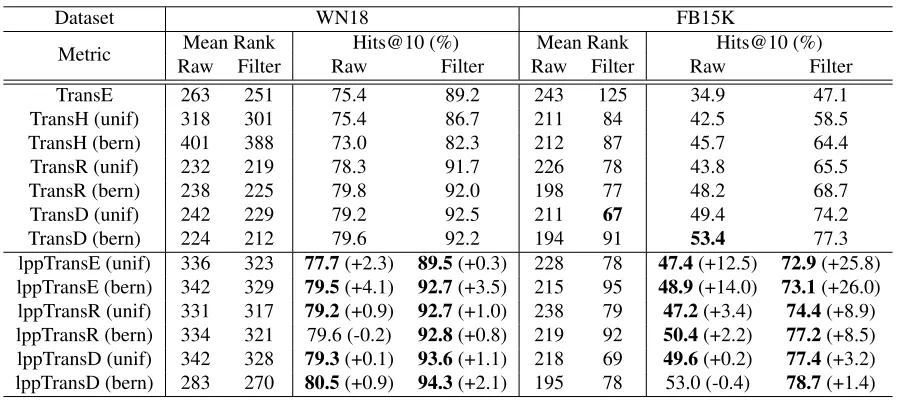
Table 4 shows the results on link prediction. The results of previous studies are referred from their report, since the same datasets are used. The
val-1αandBare related with stochastic gradient descent.
ues between parentheses are the improvement over their base models. The logical property preserv-ing embeddpreserv-ings outperform all other methods for both “bern” and “unif” on WN18 except lppTransR with “bern” in the raw setting. In the raw set-ting, lppTransE, lppTransR, and lppTransD achieve 79.5%, 79.6%, and 80.5% of Hits@10 respectively in “bern”, which are 4.1%, -0.2%, and 0.9% higher than those of TransE, TransR, and TransD. The logical property preserving embeddings show even higher performance in the filter setting. Hits@10 of lppTransD in “bern” is 94.3%, while that of TransD in “unif” is 92.5% and that in “bern” is 92.2%. Thus, lppTransD improves 2.1% over TransD in “bern”. Especially, this performance of lppTransD is 1.8% higher than that of TransD in “unif”, the previous state-of-the-art performance.
notice-Table 6: Parameter values in triple classification.
Dataset Model α B γ n, m D.S
WN11 lppTransElppTransR 0.0010.01 120120 24 2020 LL11 lppTransD 0.0001 1,000 1 100 L2
FB13 lppTransElppTransR 0.00010.001 30030 11 100100 LL11 lppTransD 0.0001 300 1 100 L2
FB15K lppTransElppTransR 0.0010.001 4,800480 11 100100 LL11 lppTransD 0.0001 4,800 2 100 L1
able. Since Hits@10 of TransD in “bern” is the best performance ever reported, that of lppTransD in “bern” becomes a new state-of-the-art performance. Table 5 exhibits Hits@10s according to mapping property of the relations of FB15K. The notable trend of this table is that the logical property preserv-ing embeddpreserv-ings show much higher Hits@10 than their base models in N-to-1 and N-to-N, while their Hits@10s are similar to those of their base models in 1-to-1 and 1-to-N. This is notable with TransD and lppTransD. lppTransD improves TransD, the previ-ous state-of-the-art method by 7.3% (N-to-1) and 3.7% to-N) in predicting head, and by 0.9% (N-to-1) and 0.3% (N-to-N). Note that it is important to verify if logical property preserving embeddings achieve good performances in N-to-N, since all tran-sitive relations and some symmetric relations are, in general, N-to-N. According to this table, Hits@10s of most logical property preserving embeddings are improved significantly in N-to-N, which proves that the proposed method solves transitivity and sym-metricity problem of previous embeddings.
5.3 Triple Classification
Three datasets of WN11, FB13, and FB15K are used in this task. WN11 and FB13 have negative triples, but FB15K has only positives. Thus, we generated negative triples for FB15K by following the strategy of (Socher et al., 2013). As a result, the classification accuracies on FB15K can not be compared directly with previous studies, and the ac-curacies on FB15K in this table are those obtained with our dataset. The parameter values for training TransE, TransH, TransR, and TransD are borrowed from their reports, and those for logical property pre-serving embeddings are shown in Table 6.
Table 7 shows the accuracies of triple
classifi-Table 7: Accuracies on triple classification. (%)
Dataset WN11 FB13 FB15K
TransE (unif) 75.9 70.9 80.3
TransE (bern) 75.9 81.5 80.8
TransH (unif) 77.7 76.5 81.9
TransH (bern) 78.8 83.3 82
TransR (unif) 85.5 74.7 82.6
TransR (bern) 85.9 82.5 82.7
TransD (unif) 85.6 85.9 84.2
TransD (bern) 86.4 89.1 84.8
lppTransE (unif) 81.3 (+5.4) 72.3 (+1.4) 83.2 (+2.9) lppTransE (bern) 81.3 (+5.4) 83.4 (+1.9) 83.6 (+2.8) lppTransR (unif) 85.5 (+0.0) 79.5 (+4.8) 83.4 (+0.8) lppTransR (bern) 85.5 (-0.4) 83.1 (+0.6) 84.6 (+1.9) lppTransD (unif) 86.1 (+0.5) 86.6 (+0.7) 84.7 (+0.5) lppTransD (bern) 86.2 (-0.2) 88.6 (-0.5) 85.3(+0.5)
cation on the three datasets. The logical property preserving embeddings in general outperform their base models. lppTransE always shows higher ac-curacy than TransE, lppTransR than TransR except for WN11, and lppTransD than TransD in FB15K. One thing to note is that the improvements by the logical property preserving embeddings are always observed in FB15K, while those in WN11 and FB13 are small or slightly negative. This can be explained with the number of triples with a transitive or sym-metric relation in the datasets. As shown in Table 2, the triples with such a relation take just a small portion of WN11 and FB13. The ratio of those triples is less than 2.3% in these datasets. How-ever, as noted before, more than 17% triples are such ones in FB15K. Thus, the improvement in FB15K is remarkable. The other thing to note is that lpp-TransD shows the best accuracy in FB15K. These results imply that the proposed logical property pre-serving embeddings solve the problems of existing translation-based embeddings effectively.
6 Conclusion
[image:8.612.315.545.75.247.2] [image:8.612.71.299.75.189.2]represen-Table 5: Experimental results on FB15K according to mapping properties of relations. (%) Tasks Predicting Head (Hits@10) Predicting Tail (Hits@10) Relation Category 1-to-1 1-to-N N-to-1 N-to-N 1-to-1 1-to-N N-to-1 N-to-N
TransE 43.7 65.7 18.2 47.2 43.7 19.7 66.7 50.0
TransH (unif) 66.7 81.7 30.2 57.4 63.7 30.1 83.2 60.8
TransH (bern) 66.8 87.6 28.7 64.5 65.5 39.8 83.3 67.2
TransR (unif) 76.9 77.9 38.1 66.9 76.2 38.4 76.2 69.1
TransR (bern) 78.8 89.2 34.1 69.2 79.2 37.4 90.4 72.1
TransD (unif) 80.7 85.8 47.1 75.6 80.0 54.5 80.7 77.9
TransD (bern) 86.1 95.5 39.8 78.5 85.4 50.6 94.4 81.2
lppTransE (unif) 77.5 86.5 43.1 75.9 76.7 46.4 79.4 75.5
lppTransE (bern) 78.3 93.5 35.4 74.7 78.1 45.9 80.3 76.6
lppTransR (unif) 75.2 88.1 41.5 75.2 76.6 44.9 82.7 72.6
lppTransR (bern) 84.3 94.2 49.7 79.2 84.3 46.9 91.9 79.6
lppTransD (unif) 82.7 89.5 53.2 81.6 82.3 52.6 84.8 81.5
lppTransD (bern) 86.0 94.2 54.4 82.2 79.7 43.2 95.3 79.7
tations according to its role in a triple. This idea has been applied to TransE, TransR, and TransD, and they are called as lppTransE, lppTransR, and lpp-TransD. Their superiority was shown through two tasks of link prediction and triple classification. The logical property preserving embeddings showed the improved performance over their base models2.
Es-pecially, lppTransD showed the state-of-the-art per-formance in both tasks. These results imply that the proposed role-specific projection is plausible to pre-serve logical properties of relations.
Acknowledgments
This work was supported by Institute for Infor-mation & communications Technology Promotion (IITP) grant funded by the Korea government (MSIP) (No. R0101-15-0054, WiseKB: Big data based self-evolving knowledge base and reasoning platform).
References
[Bollacker et al.2008] Kurt Bollacker, Colin Evans, Praveen Paritosh, Tim Sturge, and Jamie Taylor. 2008. Freebase: a collaboratively created graph database for structuring human knowledge. In Proceedings of the 2008 ACM SIGMOD
Interna-2The source codes and resources can be downloaded from
http://ml.knu.ac.kr/lppKE.
tional Conference on Management of Data, pages 1247–1250.
[Bordes et al.2011] Antoine Bordes, Jason Weston, Ro-nan Collobert, and Yoshua Bengio. 2011. Learning structured embeddings of knowledge bases. In Pro-ceedings of the 28th AAAI Conference on Artificial In-telligence, pages 301–306.
[Bordes et al.2013] Antoine Bordes, Nicolas Usunier, Alberto Garcia-Duran, Jason Weston, and Oksana Yakhnenko. 2013. Translating embeddings for mod-eling multi-relational data. InAdvances in Neural In-formation Processing Systems, pages 2787–2795. [Bordes et al.2014] Antoine Bordes, Xavier Glorot,
Ja-son Weston, and Yoshua Bengio. 2014. A seman-tic matching energy function for learning with multi-relational data.Machine Learning, 94(2):233–259. [Gardner and Mitchell2015] Matt Gardner and Tom
Mitchell. 2015. Efficient and expressive knowledge base completion using subgraph feature extraction. In Proceedings of the 2015 Conference on Empirical Methods in Natural Language Processing, pages 1488–1498.
[Guo et al.2015] Shu Guo, Quan Wang, Bin Wang, Li-hong Wang, and Li Guo. 2015. Semantically smooth knowledge graph embedding. InProceedings of the 53rd Annual Meeting of the Association for Computa-tional Linguistics and the 7th InternaComputa-tional Joint Con-ference on Natural Language Processing, pages 84– 94.
[image:9.612.96.517.72.287.2][Ji et al.2015] Guoliang Ji, Shizhu He, Liheng Xu, Kang Liu, and Jun Zhao. 2015. Knowledge graph embed-ding via dynamic mapping matrix. InProceedings of the 53rd Annual Meeting of the Association for Com-putational Linguistics and the 7th International Joint Conference on Natural Language Processing, pages 687–696.
[Jiang et al.2012] Shangpu Jiang, Daniel Lowd, and De-jing Dou. 2012. Learning to refine an automati-cally extracted knowledge base using markov logic. In Proceedings of the IEEE International Conference on Data Mining, pages 912–917.
[Lao and Cohen2010] Ni Lao and William W. Cohen. 2010. Relational retrieval using a combination of path-constrained random walks. Machine Learning, 81(1):53–67.
[Lao et al.2011] Ni Lao, Tom Mitchell, and William W. Cohen. 2011. Random walk inference and learning in a large scale knowledge base. In Proceedings of the 2011 Conference on Empirical Methods in Natural Language Processing, pages 529–539.
[Lin et al.2015] Yankai Lin, Zhiyuan Liu, Maosong Sun, Yang Liu, and Xuan Zhu. 2015. Learning entity and relation embeddings for knowledge graph completion. InProceedings of the 29th AAAI Conference on Artifi-cial Intelligence, pages 2181–2187.
[Miller1995] George A. Miller. 1995. WordNet: A lexi-cal database for english. Communications of the ACM, 38(11):39–41.
[Neelakantan and Chang2015] Arvind Neelakantan and Ming-Wei Chang. 2015. Inferring missing entity type instances for knowledge base completion: New dataset and methods. InProceedings of the 2015 Conference of the North American Chapter of the Association for Computational Linguistics: Human Language Tech-nologies, pages 515–525.
[Neelakantan et al.2015] Arvind Neelakantan, Benjamin Roth, and Andrew McCallum. 2015. Compositional vector space models for knowledge base completion. InProceedings of the 53rd Annual Meeting of the As-sociation for Computational Linguistics and the 7th International Joint Conference on Natural Language Processing, pages 156–166.
[Nickel et al.2011] Maximilian Nickel, Volker Tresp, and Hans peter Kriegel. 2011. A three-way model for col-lective learning on multi-relational data. In Proceed-ings of the 28st International Conference on Machine Learning, pages 809–816.
[Nickel et al.2015] Maximilian Nickel, Kevin Murphy, Volker Tresp, and Evgeniy Gabrilovich. 2015. A review of relational machine learning for knowl-edge graphs: From multi-relational link prediction to automated knowledge graph construction. CoRR, abs/1503.00759.
[Pujara et al.2013] Jay Pujara, Hui Miao, Lise Getoor, and William Cohen. 2013. Knowledge graph identifica-tion. InProceedings of the 12th International Seman-tic Web Conference, pages 542–557.
[Socher et al.2013] Richard Socher, Danqi Chen, Christo-pher D. Manning, and Andrew Ng. 2013. Reasoning with neural tensor networks for knowledge base com-pletion. InAdvances in Neural Information Process-ing Systems, pages 926–934.
[Suchanek et al.2007] Fabian M. Suchanek, Gjergji Kas-neci, and Gerhard Weikum. 2007. YAGO: A core of semantic knowledge unifying wordnet and wikipedia. In Proceedings of the 16th International Conference on World Wide Web, pages 697–706.