Jointly Modeling Inter-Slot Relations by Random Walk on Knowledge
Graphs for Unsupervised Spoken Language Understanding
Yun-Nung Chen, William Yang Wang, and Alexander I. Rudnicky School of Computer Science, Carnegie Mellon University
5000 Forbes Avenue, Pittsburgh, PA 15213-3891, USA
{yvchen, yww, air}@cs.cmu.edu
Abstract
A key challenge of designing coherent seman-tic ontology for spoken language understand-ing is to consider inter-slot relations. In prac-tice, however, it is difficult for domain experts and professional annotators to define a coher-ent slot set, while considering various lexi-cal, syntactic, and semantic dependencies. In this paper, we exploit the typed syntactic de-pendency theory for unsupervised induction and filling of semantics slots in spoken dia-logue systems. More specifically, we build two knowledge graphs: a slot-based seman-tic graph, and a word-based lexical graph. To jointly consider word, word-to-slot, and slot-to-slot relations, we use a ran-dom walk inference algorithm to combine the two knowledge graphs, guided by dependency grammars. The experiments show that con-sidering inter-slot relations is crucial for gen-erating a more coherent and compete slot set, resulting in a better spoken language under-standing model, while enhancing the inter-pretability of semantic slots.
1 Introduction
An important requirement for building a success-ful spoken dialogue system (SDS) is to define a co-herent slot set and the corresponding slot-fillers for the spoken language understanding (SLU) compo-nent. Unfortunately, since the semantic slots are of-ten mutually-related, it is non-trivial for domain ex-perts and professional annotators to design a such slot set for semantic representation of SLU.
Considering a restaurant domain (Henderson et
al., 2012), “restaurant” is the target slot, and impor-tant adjective modifiers such as “Asian” (the restau-rant type) and “cheap” (the price of the restaurant) should be included in the slot set, so that the se-mantic representation of SLU can be more coherent and complete. In this case, it is challenging to de-sign such a coherent and complete slot set manually, while considering various lexical, syntactic, and se-mantic dependencies.
Instead of considering slots independently, this paper takes a data-driven approach to model word-to-word relations via syntactic dependencies and further infer slot-to-slot relations. To do this, we incorporate the typed dependency grammar the-ory (De Marneffe and Manning, 2008) in a state-of-the-art frame-semantic driven unsupervised slot induction framework (Chen et al., 2013b). In par-ticular, we build two knowledge graphs: a slot-based semantic knowledge graph, and a word-slot-based lexical knowledge graph. Using typed dependency triples, we then study the stochastic relations be-tween slots and words, using a mutually-reinforced random walk inference procedure to combine the two knowledge graphs. In evaluations, we use the jointly learned inter-slot relations to induce a coher-ent slot set in an unsupervised fashion. Our contri-butions are three-fold:
• We are among the first to consider unsuper-vised spoken language understanding combin-ing semantic and lexical knowledge graphs;
• We propose a novel typed syntactic dependency grammar driven random walk model for rela-tion discovery;
• Our experimental results suggest that jointly considering inter-slot relations helps obtain a more coherent and complete semantic slot set.
2 Related Work
With the recent success of commercial dialogue sys-tems and personal assistants (e.g., Microsoft’s Cor-tana1, Google Now2, Apple’s Siri3, and Amazon’s
Echo4), a key focus on developing spoken
under-standing techniques is the scalability issue.
From the knowledge management perspective, empowering the system with a large knowledge base is of crucial significance to modern spoken dia-logue systems. On this end, our work clearly aligns with recent studies on leveraging semantic knowl-edge graphs for SLU modeling (Heck et al., 2013; Hakkani-T¨ur et al., 2013; Hakkani-T¨ur et al., 2014; El-Kahky et al., 2014; Chen et al., 2014a). While leveraging external knowledge is the trend, effi-cient inference algorithms, such as random walk, are still less-studied for direct inference on knowledge graphs of the spoken contents.
In the natural language processing literature, Lao et al. (2011) used a random walk algorithm to con-struct inference rules on large entity-based knowl-edge bases, and leveraged syntactic information for reading the Web (Lao et al., 2012). Even though this work has important contributions, the proposed algorithm cannot learn mutually-recursive relations, and does not to consider lexical items— in fact, more and more studies show that, in addi-tion to semantic knowledge graphs, lexical knowl-edge graphs (Inkpen and Hirst, 2006; Song et al., 2011; Li et al., 2013b) that model surface-level natu-ral language realization, multiword expressions, and context (Li et al., 2013a), are also critical for short text understanding (Song et al., 2011; Wang et al., 2014).
From the engineering perspective, quick and easy development turnaround time for domain-specific dialogue applications is also critical (Chen and Rud-nicky, 2014). Prior work shows that it is possible to use the frame-semantics theory to automatically
in-1http://www.windowsphone.com/en-us/how-to/
wp8/cortana
2http://www.google.com/landing/now 3http://www.apple.com/ios/siri 4http://www.amazon.com/oc/echo
duce and fill semantic slots (Chen et al., 2013b), and that leveraging distributional semantics helps im-proving the performance (Chen et al., 2014b). How-ever, prior works treat each slot independently and have not considered the inter-slot relations when in-ducing the semantic slots. To the best of our knowl-edge, we are the first to use syntactically-informed random walk algorithms to combine the semantic and lexical knowledge graphs, and not individually but globally inducing the semantic slots for building better unsupervised SLU components.
3 The Proposed Framework
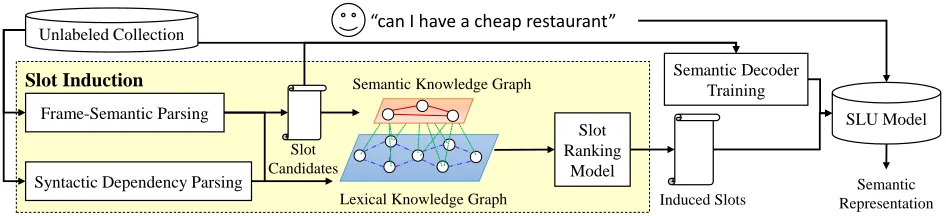
We build our approach on top of the recent suc-cess of an unsupervised frame-semantic parsing ap-proach (Chen et al., 2013b). The main motivation of prior work is to use a FrameNet-trained statis-tical probabilistic semantic parser to generate ini-tial frame-semantic parses from automatic speech recognition (ASR) decodings of the raw audio con-versation files, and then adapt the FrameNet-style frames to the semantic slots in the target semantic space, so that they can be used practically in the SDSs. Chen et al. formulated the semantic map-ping and adaptation problem as a ranking problem to differentiate generic semantic concepts from target semantic space for task-oriented dialogue systems. This paper improves the adaptation process by lever-aging distributed word embeddings associated with typed syntactic dependencies between words to infer inter-slot relations (Mikolov et al., 2013b; Mikolov et al., 2013c; Levy and Goldberg, 2014). The pro-posed framework is shown in Figure 1. In the re-mainder of the section, we first introduce frame-semantic parsing to obtain slot candidates. With slot candidates, then we train the independent semantic decoders. The adaptation process, which is the main focus of this paper, is performed to decide outputted slots. Finally we can build an SLU model based on the learned semantic decoders and induced slots.
3.1 Probabilistic Semantic Parsing
(Fill-Slot Ranking
Model
SLU Model
Induced Slots Representation Semantic “can I have a cheap restaurant”
Slot Induction
Slot Candidates Frame-Semantic Parsing
Semantic Decoder Training Unlabeled Collection
Syntactic Dependency Parsing
[image:3.612.73.546.60.168.2]Lexical Knowledge Graph Semantic Knowledge Graph
Figure 1: The proposed framework
can i have a cheap restaurant
Frame: capability
FT LU: can FE Filler: i
Frame: expensiveness
FT LU: cheap
Frame: locale_by_use
[image:3.612.83.288.217.284.2]FT/FE LU: restaurant
Figure 2: An example of probabilistic frame-semantic parsing on ASR output. FT: frame target. FE: frame ele-ment. LU: lexical unit.
more, 1976), which holds that the meaning of most words can be expressed on the basis of semantic frames, which encompass three major components:
frame (F), frame elements (FE), andlexical units (LU). For example, the frame “food” contains words referring to items of food. A descriptor frame ele-ment within thefoodframe indicates the character-istic of the food. For example, the phrase “low fat milk” should be analyzed with “milk” evoking the
foodframe and “low fat” filling the descriptor FE of that frame.
In our approach, we parse all ASR-decoded ut-terances in our corpus using SEMAFOR5, a
state-of-the-art semantic parser for frame-semantic pars-ing (Das et al., 2010; Das et al., 2013), and ex-tract all frames from semantic parsing results as slot candidates, where the LUs that correspond to the frames are extracted for slot filling. For example, Figure 2 shows an example of an ASR-decoded text output parsed by SEMAFOR. SEMAFOR generates three frames (capability, expensiveness, and lo-cale by use) for the utterance, which we consider as slot candidates for training the SLU model. Note that for each slot candidate, SEMAFOR also in-cludes the corresponding lexical unit (can i,cheap,
5http://www.ark.cs.cmu.edu/SEMAFOR/
andrestaurant), which we consider as possible slot-fillers.
3.2 Independent Semantic Decoder
With outputted semantic parses, we extract the frames with the top50highest frequency as our slot candidates for training SLU. The features for train-ing are generated by word confusion network, where confusion network features are shown to be useful in developing more robust systems for SLU (Hakkani-T¨ur et al., 2006; Henderson et al., 2012). We build a vector representation of an utterance asu= [x1, ..., xj, ...].
xj =E[Cu(n-gramj)]1/|n-gramj|, (1)
where Cu(n-gramj) counts how many times n
-gramj occurs in the utterance u, E(Cu(n-gramj))
is the expected frequency of n-gramj in u, and |n-gramj|is the number of words inn-gramj.
For each slot candidatesi, we generate a pseudo
training dataDi to train a binary classifier Mi for
predicting the existence of si given an utterance, Di = {(uk, li
k) | uk ∈ R+, lki ∈ {−1,+1}}Kk=1,
whereli
k = +1when the utteranceuk contains the
slot candidatesi in its semantic parse,lki =−1
oth-erwise, andK is the number of utterances. 3.3 Adaptation Process and SLU Model
w1
w2
w3
w4
w5
w6
w7
Lexical Knowledge Graph s2
Semantic Knowledge Graph
[image:4.612.78.291.62.173.2]s1 s3
Figure 3: A simplified example of the two knowledge graphs, where a slot candidatesiis represented as a node
in a semantic knowledge graph and a wordwj is
repre-sented as a node in a lexical knowledge graph.
the “capability” frame does not convey particular valuable information for SLU. With the trained in-dependent semantic decoders for all slot candidates, adaptation process computes the prominence of slot candidates for ranking and then selects a list of in-duced slots associated with their corresponding se-mantic decoders for use in domain-specific dialogue systems, where the detail is described in Section 4.
Then with each induced slotsiand its
correspond-ing trained semantic decoderMi, an SLU model can
be built to predict whether the semantic slot occurs in the given utterance in a fully unsupervised way. In other words, the SLU model is able to transform the testing utterance into semantic representations with-out human involvement.
4 Slot Ranking Model
The purpose of the ranking model is to distinguish between generic semantic concepts and domaspecific concepts that are relevant to an SDS. To in-duce meaningful slots for the purpose of SDS, we compute the prominence of the slot candidates us-ing a slot rankus-ing model described below.
With the semantic parses from SEMAFOR, where each frame is viewed independently, so inter-slot re-lations are not included, the model ranks the slot candidates by integrating two information: (1) the frequency of each slot candidate in the corpus, since slots with higher frequency may be more important. (2) the relations between slot candidates. Assuming that domain-specific concepts are usually related to each other, globally considering inter-slot relations induces a more coherent slot set. Here for baseline
can i have a cheap restaurant
ccompamod dobj
nsubj det
capability expensiveness locale_by_use
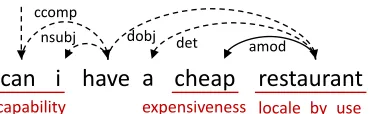
Figure 4: The dependency parsing result on an utterance.
scores, we only use the frequency of each slot can-didate as its prominence.
First we construct two knowledge graphs, one is a slot-based semantic knowledge graph and an-other is a word-based lexical knowledge graph, both of which encode the typed dependency relations in their edge weights. We also connect two graphs to model the relations between slot-filler pairs.
4.1 Knowledge Graphs
We construct two undirected graphs, semantic and lexical knowledge graphs. Each node in the seman-tic knowledge graph is a slot candidatesioutputted
by the frame-semantic parser, and each node in the lexical knowledge graph is a wordwj.
• Slot-based semantic knowledge graphis built as Gs = hVs, Essi, where Vs = {si} and
Ess={eij |si, sj ∈Vs}.
• Word-based lexical knowledge graphis built asGw = hVw, Ewwi, where Vw = {wi} and
Eww={eij |wi, wj ∈Vw}.
With two knowledge graphs, we build the edges between slots and slot-fillers to integrate them as shown in Figure 3. Thus the combined graph can be formulated asG=hVs, Vw, Ess, Eww, Ewsi, where Ews = {eij | wi ∈ Vw, sj ∈ Vs}. Ess, Eww, andEws correspond to slot-to-slot relations,
word-to-word relations, and word-to-slot relations respec-tively (Chen and Metze, 2012; Chen and Metze, 2013).
4.2 Edge Weight Estimation
Considering the relations in the knowledge graphs, the edge weights for Eww and Ess are measured
[image:4.612.336.521.63.120.2]de-Typed Dependency Relation Target Word Contexts Word hrestaurant,AMOD,cheapi restaurant cheap/AMOD
cheap restaurant/AMOD−1
[image:5.612.80.528.60.131.2]Slot hlocale by use,AMOD,expensivenessi locale by useexpansiveness locale by useexpensiveness//AMOD AMOD−1
Table 1: The contexts extracted for training dependency-based word/slot embeddings from the utterance of Fig. 2.
pendency relations from headwords to their de-pendents, and words on arcs denote types of the dependencies. All typed dependencies between two words are encoded in triples and form a word-based dependency set Tw = {hwi, t, wji},
where t is the typed dependency between the headword wi and the dependent wj. For exam-ple, Figure 4 generateshrestaurant,AMOD,cheapi, hhave,DOBJ,restauranti, etc. for Tw.
Simi-larly, we build a slot-based dependency set Ts = {hsi, t, sji}by transforming dependencies between
slot-fillers into ones between slots. For example,
hrestaurant,AMOD,cheapi from Tw is transformed
into hlocale by use,AMOD,expensivenessi for
building Ts, because both sides of the non-dotted
line are parsed as slot-fillers by SEMAFOR. For the edges within a single knowledge graph, we assign a weight of the edge connecting nodesxi
andxj asrˆ(xi, xj), wherexis eithersorw. Since
the weights are measured based on the relations be-tween nodes regardless of the directions, we com-bine the scores of two directional dependencies:
ˆ
r(xi, xj) =r(xi →xj) +r(xj →xi), (2)
where r(xi → xj) is the score estimating the
de-pendency includingxias a head andxj as a
depen-dent. In Section 4.2.1 and 4.2.2, we propose two scoring functions forr(·), frequency-based asr1(·)
and embedding-based asr2(·)respectively.
For the edges in Ews, we estimate the edge weights based on the frequency that the slot candi-dates and the words are parsed as slot-filler pairs. In other words, the edge weight between the slot-filler
wi and the slot candidate sj, rˆ(wi, sj), is equal to
how many times the fillerwicorresponds to the slot
candidatesj in the parsing results. 4.2.1 Frequency-Based Measurement
Based on the dependency setTx, we uset∗xi→xjto
denote the most frequent typed dependency withxi
as a head andxj as a dependent.
t∗
xi→xj = arg maxt C(xi −→t xj), (3)
whereC(xi −→t xj)counts how many times the
de-pendencyhxi, t, xjioccurs in the dependency setTx.
Then the scoring function that estimates the de-pendencyxi→xjis measured as
r1(xi →xj) =C(xi −−−−→t∗
xi→xj xj), (4)
which equals to the highest observed frequency of the dependencyxi →xj among all types fromTx.
4.2.2 Embedding-Based Measurement
Most neural embeddings use linear bag-of-words contexts, where a window size is defined to produce contexts of the target words (Mikolov et al., 2013c; Mikolov et al., 2013b; Mikolov et al., 2013a). How-ever, some important contexts may be missing due to smaller windows, while larger windows capture broad topical content. A dependency-based em-bedding approach was proposed to derive contexts based on the syntactic relations the word participates in for training embeddings, where the embeddings are less topical but offer more functional similarity compared to original embeddings (Levy and Gold-berg, 2014).
Table 1 shows the extracted dependency-based contexts for each target word from the example in Figure 4, where headwords and their dependents can form the contexts by following the arc on a word in the dependency tree, and−1denotes the directional-ity of the dependency. After replacing original bag-of-words contexts with dependency-based contexts, we can train dependency-based embeddings for all target words (Yih et al., 2014; Bordes et al., 2011; Bordes et al., 2013).
Rd and each context c is represented as a context
vectorvc ∈ Rd, wheredis the embedding
dimen-sionality. We learn vector representations for both words and contexts such that the dot productvw·vc
associated with “good” word-context pairs belong-ing to the trainbelong-ing data Dis maximized, leading to the objective function:
arg max
vw,vc X
(w,c)∈D
log 1
1 + exp(−vc·vw), (5)
which can be trained using stochastic-gradient up-dates (Levy and Goldberg, 2014). Then we can obtain the dependency-based slot and word embed-dings usingTsandTw respectively.
With trained dependency-based embeddings, we estimate the probability thatxi is the headword and xj is its dependent via the typed dependencytas
P(xi −→t xj) =Sim(xi, xj/t) +Sim(xj, xi/t
−1)
2 ,
(6) where Sim(xi, xj/t) is the cosine similarity
be-tween the slot/word embeddingsvxiand the context embeddingsvxj/tafter normalizing to [0,1]. Then we can measure the scoring functionr2(·)as r2(xi →xj) =C(xi −−−−→t∗
xi→xj xj)·P(xi −−−−→t∗xi→xj xj),
(7) which is similar to (4) but additionally weighted by the estimated probability. The estimated probability smooths the observed frequency to avoid overfitting due to a smaller dataset.
4.3 Random Walk Algorithm
We first compute Lww = [ˆr(wi, wj)]|Vw|×|Vw| and
Lss = [ˆr(si, sj)]|Vs|×|Vs|, where rˆ(wi, wj) and
ˆ
r(si, sj) are either from frequency-based (r1(·))
or embedding-based measurements (r2(·)).
Sim-ilarly, Lws = [ˆr(wi, sj)]|Vw|×|Vs| and Lsw =
[ˆr(wi, sj)]T
|Vw|×|Vs|, whererˆ(wi, sj)is the frequency
that sj and wi are a slot-filler pair computed in Section 4.2. Then we only keep the top N high-est weights for each row in Lww and Lss (N = 10), which means that we filter out the edges with smaller weights within the single knowledge graph. Column-normalization are performed forLww,Lss, Lws, Lsw (Shi and Malik, 2000). They can be viewed as word, slot-to-slot, and word-to-slot relation matrices.
4.3.1 Single-Graph Random Walk
Here we run random walk only on the semantic knowledge graph to propagate the scores based on inter-slot relations through the edgesEss.
R(st+1) = (1−α)R(0)s +αLssR(st), (8)
where R(st) denotes the importance scores of the
slot candidates Vs in t-th iteration. In the
algo-rithm, the score is the interpolation of two scores, the normalized baseline importance of slot candidates (R(0)s ), and the scores propagated from the
neigh-boring nodes in the semantic knowledge graph based on slot-to-slot relations viaLss. The algorithm will
converge whenRs(t+1) =Rs(t) =R∗s and (9) can be
satisfied.
R∗s =(1−α)Rs(0)eT +αLss
R∗s =M1R∗s,
(9) where e = [1,1, ...,1]T. It has been shown that
the closed-form solutionR∗
s of (9) is the dominant
eigenvector of M1 (Langville and Meyer, 2005),
the eigenvector corresponding to the largest abso-lute eigenvalue of M1. The solution of R∗s
de-notes the updated importance scores for all utter-ances. Similar to the PageRank algorithm (Brin and Page, 1998), the solution can also be obtained by it-eratively updatingR(st).
4.3.2 Double-Graph Random Walk
Here we borrow the idea from two-layer mutu-ally reinforced random walk to propagate the scores based on not only internal importance propagation within the same graph but external mutual reinforce-ment between different knowledge graphs (Chen and Metze, 2012; Chen and Metze, 2013).
(
Rs(t+1) = (1−α)Rs(0)+αLssLswR(wt)
R(wt+1)= (1−α)R(0)w +αLwwLwsR(st) (10)
In the algorithm, they are the interpolations of two scores, the normalized baseline importance (R(0)s
and R(0)w ) and the scores propagated from another
graph. For the semantic knowledge graph,LswR(wt)
is the score from the word set weighted by slot-to-word relations, and then the scores are propagated based on slot-to-slot relations via Lss. Similarly,
the scores propagated from the semantic knowledge graph. ThenR(st+1)andRw(t+1)can be mutually
up-dated by the latter parts in (10) iteratively. When the algorithm converges, we haveR∗
sas follows.
Rs∗ = (1−α)R(0)s (11)
+ αLssLsw(1−α)R(0)w +αLwwLwsR∗s
= (1−α)R(0)s eT +α(1−α)LssLswR(0)w eT
+ α2L
ssLswLwwLws
R∗
s =M2R∗s.
The closed-form solutionR∗
sof (11) is the dominant
eigenvector ofM2. 5 Experiments
We evaluate our approach in two ways. First, we ex-amine the slot induction accuracy by comparing the ranked list of induced slots with the reference slots created by system developers (Young, 2007). Sec-ondly, with the ranked list of induced slots and their associated semantic decoders, we can evaluate the SLU performance. For the experiments, we evaluate both on ASR transcripts of the raw audio, and on the manual transcripts.
5.1 Experimental Setup
In this experiment, we used the Cambridge Univer-sity SLU corpus, previously used on several other SLU tasks (Henderson et al., 2012; Chen et al., 2013a). The domain of the corpus is about restaurant recommendation in Cambridge; subjects were asked to interact with multiple SDSs in an in-car setting. The corpus contains a total number of 2,166 dia-logues, including 15,453 utterances (10,571 for self-training and 4,882 for testing). The data is gender-balanced, with slightly more native than non-native speakers. The vocabulary size is 1868. An ASR sys-tem was used to transcribe the speech; the word error rate was reported as 37%. There are 10 slots cre-ated by domain experts: addr, area, food, name,
phone, postcode, price range, signature, task, andtype.
For parameter setting, the damping factor for ran-dom walk α is empirically set as0.9 for all exper-iments. For training the semantic decoders, we use SVM with a linear kernel to predict each semantic slot. We use Stanford Parser to obtain the collapsed
speak on topic addr area food
phone part orientational
direction locale
part inner outer food
origin
contacting
postcode price range
task type
sending
commerce scenario expensiveness range
seeking desiring locating locale by use building
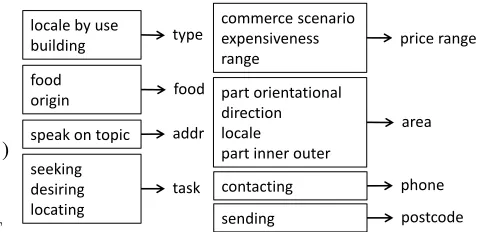
Figure 5: The mappings from induced slots (within blocks) to reference slots (right sides of arrows).
typed syntactic dependencies (Socher et al., 2013) and set the dimensionality of embeddingsd= 300
in all experiments.
5.2 Evaluation Metrics
To eliminate the influence of threshold selection when choosing induced slots, in the following met-rics, we take the whole ranking list into account and evaluate the performance by the metrics that are in-dependent of the selected threshold.
5.2.1 Slot Induction
To evaluate the accuracy of the induced slots, we measure their quality as the proximity between in-duced slots and reference slots. Figure 5 shows the mappings that indicate semantically related in-duced slots and reference slots (Chen et al., 2013b). For example, “expensiveness→price”, “food→ food”, and “direction→area” show that these in-duced slots can be mapped into the reference slots defined by experts and carry important semantics in the target domain for developing the task-oriented SDS. Since we define the adaptation task as a rank-ing problem, with a ranked list of induced slots and associated scores, we can use the standard average precision (AP) and the area under the precision-recall curve (PR-AUC) as our metrics, where the in-duced slot is counted as correct when it has a map-ping to a reference slot.
5.2.2 SLU Model
[image:7.612.304.543.60.176.2]Approach Slot InductionASR SLU Model Slot InductionManualSLU Model AP PR-AUC WAP AF AP PR-AUC WAP AF (a) Baseline (Frequency) 56.69 54.67 35.82 43.28 53.01 50.80 36.78 44.20 (b) Single Frequency 63.88 62.05 41.67 47.38 63.02 61.10 43.76 48.53 (c) Embedding 69.04 68.25 46.29 48.89 75.15 74.50 54.50 50.86 (d) Double Frequency 56.83 55.31 32.64 44.91 52.12 50.54 34.01 45.05 (e) Embedding 71.48 70.84 44.06 47.91 76.42 75.94 52.89 50.40
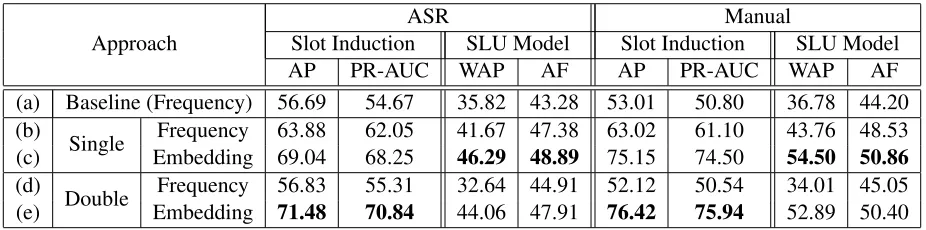
Table 2: The performance of induced slots and corresponding SLU models (%)
For each induced slot with the mapping to a ref-erence slot, we can compute an F-measure of the corresponding semantic decoder, and weight the av-erage precision with corresponding F-measure as weighted average precision (WAP) to evaluate the performance of slot induction and SLU tasks to-gether. The metric scores the ranking result higher if the induced slots corresponding to better semantic decoders are ranked higher. Another metric is the average F-measure (AF), which is the average micro F-measure of SLU models at all cut-off positions in the ranked list. Compared to WAP, AF additionally considers the slot popularity in the dataset.
5.3 Evaluation Results
Table 5.1 shows the results on both ASR and manual transcripts. Rows (a) is the baseline only consider-ing the frequency of each slot candidate for rank-ing (Chen et al., 2013b). Rows (b) and (c) show performance after leveraging a semantic knowledge graph through random walk. Rows (d) and (e) are the results after combining two knowledge graphs. We find almost all results are improved by addi-tionally considering inter-slot relations in terms of single- and double-graph random walk for both ASR and manual transcripts.
5.3.1 Slot Induction
For both ASR and manual transcripts, almost all results outperform the baseline, showing that inter-slot relations significantly influence the perfor-mance of slot induction. The best perforperfor-mance is from the results of double-graph random walk with the embedding-based measurement, which integrate a semantic knowledge graph and a lexical knowl-edge graph together and jointly consider slot-to-slot, word-to-word, and word-to-slot relations when
scor-ing the prominence of slot candidates to generate a coherent slot set.
5.3.2 SLU Model
For both ASR and manual transcripts, almost all results outperform the baseline, which shows the practical usage for training dialogue systems. The best performance is from the results of single-graph random walk with the embedding-based measure-ment, which only use the semantic knowledge graph to involve the inter-slot relations. The semantic knowledge graph is not as precise as the lexical one and may be influenced by the performance of the se-mantic parser more. Although the row (e) does not show better performance than the row (c), double-graph random walk may be more robust because it additionally includes the word relations to avoid only relying on the relations tied with the slot candi-dates.
5.4 Discussion and Analysis 5.4.1 Comparing Frequency- and
Embedding-Based Measurements
5.4.2 Comparing Single- and Double-Graph Approaches
Considering that the embedding-based measure-ment performs better, we only compare the results of single- and double-graph random walk using this measurement (rows (c) and (e)). It can be seen that the difference between them is not consistent in terms of slot induction and SLU model.
For evaluating slot induction (AP and PR-AUC), the double-graph random walk (row (e)) performs better on both ASR and manual results, which im-plies that additionally integrating the lexical knowl-edge graph helps decide a more coherent and com-plete slot set since we can model the score propa-gation more precisely (not only slot-level but word-level information). However, for SLU evaluation (WAP and AF), the single-graph random walk (row (c)) performs better, which may imply that the slots carrying the coherent relations from the row (e) may not have good semantic decoder performance so that the performance is decreased a little. For exam-ple, double-graph random walk scores the slots lo-cal by useandexpensivenesshigher than the slot
contacting, while the single-graph method ranks the latter higher.local by useandexpensiveness
are more important on this domain but contacting
has very good performance of its semantic decoder, so the double-graph approach does not show the im-provement when evaluating SLU models. This al-lows us to try an improved method of jointly opti-mizing the slot coherence and SLU performance in the future.
5.4.3 Relation Discovery Analysis
To interpret the inter-slot relations, we output the slot-to-slot relations with highest scores from the best results (row (e) in Table 5.1) in Table 3, and the automatically constructed ontology is shown in Figure 6. It can be shown that the outputted inter-slot relations are reasonable and usually connect two important semantic slots in this restaurant domain. This proves that inter-slot relations help decide a coherent and complete slot set and enhance the in-terpretability of semantic slots. Therefore, from a practical perspective, developers are able to design the framework of dialogue systems more easily, and the development of SDS can be speeded up with less human effort.
Rank Relation
1 hlocale by use,NN,foodi
2 hfood,AMOD,expensivenessi
3 hlocale by use,AMOD,expensivenessi
4 hseeking,PREP FOR,foodi
5 hfood,AMOD,relational quantityi
6 hdesiring,DOBJ,foodi
7 hseeking,PREP FOR,locale by usei
[image:9.612.312.544.58.184.2]8 hfood,DET,quantityi
Table 3: The top inter-slot relations learned from the training set of ASR outputs.
locale_by_use
food expensiveness seeking
relational_quantity
PREP_FOR
PREP_FOR
NN AMOD
AMOD
AMOD
desiring
DOBJ
Figure 6: The automatically constructed domain-specific ontology based on Table 3.
6 Conclusion
The paper proposes an approach of jointly consid-ering inter-slot relations for slot induction to out-put a more coherent slot set, where two knowledge graphs, a slot-based semantic knowledge graph and a word-based lexical knowledge graph, are built and combined by a random walk algorithm. The au-tomatically induced slots carry coherent and inter-pretable relations and can be used for training better SLU models of SDSs in an unsupervised fashion. Acknowledgments
[image:9.612.323.535.236.352.2]References
Collin F Baker, Charles J Fillmore, and John B Lowe. 1998. The Berkeley FrameNet project. In Proceed-ings of COLING, pages 86–90.
Antoine Bordes, Jason Weston, Ronan Collobert, Yoshua Bengio, et al. 2011. Learning structured embeddings of knowledge bases. InProceedings of AAAI.
Antoine Bordes, Nicolas Usunier, Alberto Garcia-Duran, Jason Weston, and Oksana Yakhnenko. 2013. Trans-lating embeddings for modeling multi-relational data. In Advances in Neural Information Processing Sys-tems, pages 2787–2795.
Sergey Brin and Lawrence Page. 1998. The anatomy of a large-scale hypertextual web search engine.Computer networks and ISDN systems, 30(1):107–117.
Yun-Nung Chen and Florian Metze. 2012. Two-layer mutually reinforced random walk for improved multi-party meeting summarization. InProceedings of The 4th IEEE Workshop on Spoken Language Tachnology, pages 461–466.
Yun-Nung Chen and Florian Metze. 2013. Multi-layer mutually reinforced random walk with hidden parame-ters for improved multi-party meeting summarization. InINTERSPEECH, pages 485–489.
Yun-Nung Chen and Alexander I. Rudnicky. 2014. Dy-namically supporting unexplored domains in conversa-tional interactions by enriching semantics with neural word embeddings. InProceedings of 2014 IEEE Spo-ken Language Technology Workshop (SLT),.
Yun-Nung Chen, William Yang Wang, and Alexander I. Rudnicky. 2013a. An empirical investigation of sparse log-linear models for improved dialogue act classification. InProceedings of ICASSP, pages 8317– 8321.
Yun-Nung Chen, William Yang Wang, and Alexander I Rudnicky. 2013b. Unsupervised induction and filling of semantic slots for spoken dialogue systems using frame-semantic parsing. InProceedings of 2013 IEEE Workshop on Automatic Speech Recognition and Un-derstanding (ASRU), pages 120–125. IEEE.
Yun-Nung Chen, Dilek Hakkani-T¨ur, and Gokhan Tur. 2014a. Deriving local relational surface forms from dependency-based entity embeddings for unsuper-vised spoken language understanding. InProceedings of 2014 IEEE Spoken Language Technology Workshop (SLT),.
Yun-Nung Chen, William Yang Wang, and Alexander I. Rudnicky. 2014b. Leveraging frame semantics and distributional semantics for unsupervised semantic slot induction in spoken dialogue systems. InProceedings of 2014 IEEE Spoken Language Technology Workshop (SLT),.
Dipanjan Das, Nathan Schneider, Desai Chen, and Noah A Smith. 2010. Probabilistic frame-semantic parsing. In Proceedings of The Conference of the North American Chapter of the Association for Com-putational Linguistics: Human Language Technolo-gies, pages 948–956.
Dipanjan Das, Desai Chen, Andr´e F. T. Martins, Nathan Schneider, and Noah A. Smith. 2013. Frame-semantic parsing.Computational Linguistics.
Marie-Catherine De Marneffe and Christopher D Man-ning. 2008. The Stanford typed dependencies repre-sentation. InColing 2008: Proceedings of the work-shop on Cross-Framework and Cross-Domain Parser Evaluation, pages 1–8. Association for Computational Linguistics.
Ali El-Kahky, Derek Liu, Ruhi Sarikaya, G¨okhan T¨ur, Dilek Hakkani-T¨ur, and Larry Heck. 2014. Extending domain coverage of language understanding systems via intent transfer between domains using knowledge graphs and search query click logs. InProceedings of ICASSP.
Charles J Fillmore. 1976. Frame semantics and the na-ture of language.Annals of the NYAS, 280(1):20–32. Dilek Hakkani-T¨ur, Fr´ed´eric B´echet, Giuseppe Riccardi,
and Gokhan Tur. 2006. Beyond ASR 1-best: Using word confusion networks in spoken language under-standing. Computer Speech & Language, 20(4):495– 514.
Dilek Hakkani-T¨ur, Larry Heck, and Gokhan Tur. 2013. Using a knowledge graph and query click logs for un-supervised learning of relation detection. In Proceed-ings of ICASSP, pages 8327–8331.
Dilek Hakkani-T¨ur, Asli Celikyilmaz, Larry Heck, Gokhan Tur, and Geoff Zweig. 2014. Probabilistic en-richment of knowledge graph entities for relation de-tection in conversational understanding. In Proceed-ings of INTERSPEECH.
Larry P Heck, Dilek Hakkani-T¨ur, and Gokhan Tur. 2013. Leveraging knowledge graphs for web-scale un-supervised semantic parsing. In Proceedings of
IN-TERSPEECH.
Matthew Henderson, Milica Gasic, Blaise Thomson, Pir-ros Tsiakoulis, Kai Yu, and Steve Young. 2012. Discriminative spoken language understanding using word confusion networks. In Proceedings of SLT, pages 176–181.
Diana Inkpen and Graeme Hirst. 2006. Building and using a lexical knowledge base of near-synonym dif-ferences.Computational Linguistics, 32(2):223–262. Amy N Langville and Carl D Meyer. 2005. A survey
of eigenvector methods for web information retrieval.
SIAM review, 47(1):135–161.
knowledge base. InProceedings of the Conference on Empirical Methods in Natural Language Processing, pages 529–539. Association for Computational Lin-guistics.
Ni Lao, Amarnag Subramanya, Fernando Pereira, and William W Cohen. 2012. Reading the web with learned syntactic-semantic inference rules. In Pro-ceedings of the 2012 Joint Conference on Empirical Methods in Natural Language Processing and Com-putational Natural Language Learning, pages 1017– 1026. Association for Computational Linguistics. Omer Levy and Yoav Goldberg. 2014.
Dependency-based word embeddings. InProceedings of ACL. Peipei Li, Haixun Wang, Hongsong Li, and Xindong Wu.
2013a. Assessing sparse information extraction us-ing semantic contexts. In Proceedings of the 22nd ACM international conference on Conference on infor-mation & knowledge management, pages 1709–1714. ACM.
Peipei Li, Haixun Wang, Kenny Q Zhu, Zhongyuan Wang, and Xindong Wu. 2013b. Computing term similarity by large probabilistic isa knowledge. In Pro-ceedings of the 22nd ACM international conference on Conference on information & knowledge management, pages 1401–1410. ACM.
Tomas Mikolov, Kai Chen, Greg Corrado, and Jeffrey Dean. 2013a. Efficient estimation of word representa-tions in vector space. InProceedings of Workshop at ICLR.
Tomas Mikolov, Ilya Sutskever, Kai Chen, Greg S Cor-rado, and Jeff Dean. 2013b. Distributed representa-tions of words and phrases and their compositional-ity. InProceedings of Advances in Neural Information Processing Systems, pages 3111–3119.
Tomas Mikolov, Wen-tau Yih, and Geoffrey Zweig. 2013c. Linguistic regularities in continuous space word representations. In HLT-NAACL, pages 746– 751. Citeseer.
Jianbo Shi and Jitendra Malik. 2000. Normalized cuts and image segmentation. Pattern Analysis and Ma-chine Intelligence, IEEE Transactions on, 22(8):888– 905.
Richard Socher, John Bauer, Christopher D Manning, and Andrew Y Ng. 2013. Parsing with compositional vec-tor grammars. InProceedings of the ACL conference. Citeseer.
Yangqiu Song, Haixun Wang, Zhongyuan Wang, Hong-song Li, and Weizhu Chen. 2011. Short text con-ceptualization using a probabilistic knowledgebase. In
Proceedings of the Twenty-Second international joint conference on Artificial Intelligence-Volume Volume Three, pages 2330–2336. AAAI Press.
Fang Wang, Zhongyuan Wang, Zhoujun Li, and Ji-Rong Wen. 2014. Concept-based short text classification
and ranking. InProceedings of the 23rd ACM Interna-tional Conference on Conference on Information and Knowledge Management, pages 1069–1078. ACM. Wen-tau Yih, Xiaodong He, and Christopher Meek.
2014. Semantic parsing for single-relation question answering. InProceedings of ACL.