Active Learning with Rationales for Text Classification
Manali Sharma, Di Zhuang and Mustafa Bilgic
Department of Computer Science Illinois Institute of Technology
Chicago, IL USA
{msharm11, dzhuang3}@hawk.iit.edu and [email protected]
Abstract
We present a simple and yet effective ap-proach that can incorporate rationales elicited from annotators into the training of any off-the-shelf classifier. We show that our sim-ple approach is effective for multinomial na¨ıve Bayes, logistic regression, and support vector machines. We additionally present an active learning method tailored specifically for the learning with rationales framework.
1 Introduction
Annotating documents for supervised learning is a tedious, laborious, and time consuming task for hu-mans. Given huge amounts of unlabeled documents, it is impractical for annotators to go over each doc-ument and provide a label. To reduce the anno-tation time and effort, various approaches such as semi-supervised learning (Chapelle et al., 2006) that utilizes both labeled and unlabeled data, and active learning (Settles, 2012) that carefully chooses in-stances for annotation have been developed. To fur-ther minimize the human effort, recent work looked at eliciting domain knowledge, such as rationales and feature annotations, from the annotators instead of just the labels of documents.
One of the bottlenecks in eliciting domain knowl-edge from annotators is that the traditional super-vised learning approaches cannot readily handle the elicited rich feedback. To address this issue, many methods have been developed that are classifier-specific. Examples include knowledge-based neural networks (e.g., (Towell and Shavlik, 1994), (Girosi
and Chan, 1995), (Towell et al., 1990)), knowledge-based support vector machines (Fung et al., 2002), pooling multinomial na¨ıve Bayes (Melville and Sindhwani, 2009), incorporating constraints into the training of na¨ıve Bayes (Stumpf et al., 2007), and converting rationales and feature annotations into constraints for support vector machines (e.g., (Small et al., 2011) and (Zaidan et al., 2007)). Being classifier-specific limits their applicability when one wants to test a different classifier for his/her domain, necessitating an approach that can be utilized by sev-eral off-the-shelf classifiers.
In this paper we present a simple and yet effective approach that can incorporate the elicited rationales in the form of feature annotations into the training of any off-the-shelf classifier. We empirically show that it is effective at incorporating rationales into the learning of na¨ıve Bayes, logistic regression, and sup-port vector machines using four text categorization datasets. We further discuss a novel active learn-ing strategy specifically geared towards the learnlearn-ing with rationales framework and empirically show that it improves over traditional active learning.
The rest of the paper is organized as follows. In Section 2, we provide a brief background on elicit-ing rationales in the context of active learnelicit-ing. In Section 3, we describe our approach for incorpo-rating rationales into the training of classifiers and compare learning without rationales and learning with rationales. In Section 4, we present an active learning method using the learning with rationales framework and present relevant results. Finally, we discuss limitations and future work in Section 5, re-lated work in Section 6, and conclude in Section 7.
2 Background
In this section, we provide a brief background on data annotation with rationales in the context of ac-tive learning and introduce the notation to be used throughout the paper.
Let D be a set of document-label pairs hx, yi, where the label (value ofy) is known only for a small subset L ⊂ D of the documents: L = {hx, yi} and the rest U = D \ L consists of the unlabeled documents: U = {hx,?i}. We assume that each document xi is represented as a vector of features (most commonly as a bag-of-words model with a dictionary of predefined set of phrases, which can be unigrams, bigrams, etc.):xi ,{fi
1, f2i,· · ·, fni}. Each feature fi
j represents the binary presence (or absence), frequency, or tf-idf representation of the word/phrasejin documentxi. Each labely ∈ Y is discrete-valued variableY ,{y1, y2,· · · , yl}.
Typical greedy active learning algorithms itera-tively select a documenthx,?i ∈ U, query a labeler for its label y, and incorporate the new document hx, yiinto its training setL. This process continues until a stopping criterion is met, usually until a given budget,B, is exhausted.
In the learning with rationales framework, in ad-dition to querying for labelyiof a documentxi, the active learner asks the labeler to provide a rationale, R(xi)for the chosen label. The rationale in its most general form consists of a subset of the terms that are present in xi: R(xi) = {fi
k : j ∈ xi}. Note that there might be cases where the labeler cannot pinpoint any phrase as a rationale, in which case R(xi)is allowed to beφ. Algorithm 1 formally de-scribes the active learning process that elicits ratio-nales from the labeler.
The goal of eliciting rationales is to improve the learning efficiency by incorporating domain knowl-edge. However, it is not trivial to integrate domain knowledge into state-of-the-art classifiers, such as logistic regression and support vector machines.
Next, we describe our approach for incorporating rationales into the learning process.
3 Learning with Rationales
In this section we first provide the formulation of our approach to incorporate rationales into learning and then present the results to compare learning
with-Algorithm 1Active Learning with Rationales 1: Input: U - unlabeled documents, L - labeled
documents,θ- underlying classification model, B- budget
2: repeat
3: x∗ = argmax
x∈U utility(x|θ)
4: request label and rationale for this label 5: L ← L ∪ {hx∗, y∗, R(x∗)i}
6: U ← U \ {hx∗i} 7: TrainθonL
8: untilBudgetBis exhausted; e.g.,|L|=B
out rationales(Lw/oR) andlearning with rationales
(LwR) on four datasets. We evaluate our approach using multinomial na¨ıve Bayes, logistic regression, and support vector machines classifiers.
3.1 Training a Classifier Using Labels and Rationales
Like most previous work, we assume that the ra-tionales, i.e. the phrases, returned by the labeler already exist in the dictionary of the vectorizer. Hence, rationales correspond to features in our vec-tor representation. It is possible that the labeler re-turns a phrase that is currently not in the dictionary; for example, the labeler might return a phrase that consists of three words whereas the representation has single words and bi-grams only. In that case, the representation can be enriched by creating and adding a new feature that represents the phrase re-turned by the labeler.
Our simple approach works as follows: we modify the features of the annotated document hx∗, y∗, R(x∗)i to emphasize the rationale(s) and
de-emphasize the remaining phrases in that docu-ment. We simply multiply the features correspond-ing to phrase(s) that are returned as rationale(s) by weightr and we multiply the remaining features in the document by weighto, wherer > o, andrand oare hyper-parameters. The modified document be-comes:
xi0 =hr×fi
document and yet it might not be the rationale for the label of another document. Hence, the feature weightings are done at the document level, rather than globally. To illustrate this concept, we provide an example dataset below with three documents. In these documents, the words that are returned as ra-tionales are underlined.
Document 1: This is a great movie.
Document 2: The plot was great, but the perfor-mance of the actors was terrible. Avoid it.
Document 3: I’ve seen this at an outdoor cinema; great atmosphere. The movie was terrific.
[image:3.612.315.539.224.354.2]As these examples illustrate, the word “great” ap-pears in all three documents, but it is marked as a rationale only for Document 1. Hence, we do not weight the rationales globally; rather, we modify only the labeled document using its particular ratio-nale. Table 1 illustrates both the Lw/oR and LwR representations for these documents.
Table 1: The Lw/oR binary representation (top) and its LwR transformation (bottom) for Documents 1, 2, and 3. Stop words are removed. LwR multiplies the rationales withrand other features witho.
great movie plot performance actor terrible avoid outdoor cinema atmosphere terrific Lw/oR Representation (binary)
D1 1 1
D2 1 1 1 1 1 1
D3 1 1 1 1 1 1
LwR Transformation of the binary Lw/oR repr. D1 r o
D2 o o o o r r
D3 o o o o o r
This approach is simple, intuitive, and classifier-agnostic. As we will show later, it is quite effec-tive empirically as well. To gain a theoretical un-derstanding of this approach, consider the work on regularization: the aim is to build a sparse/simple model that can capture the most important features of the training data and thus have large weights for important features and small/zero weights for irrel-evant features. For example, consider the gradient
for wj of feature fj for logistic regression with l2 regularization (assumingyis binary with 0/1):
∇wj =C×
X
xl∈L
fjl×(yl−P(y= 1|xl))−wj (2)
whereC is the complexity parameter that balances between fit to the data and the model complexity.
With our rationales framework, the gradient for wjwill be:
∇wj =
C×
X
xl∈L:fl j∈R(xl)
r×fl
j×(yl−P(yl= 1|xl))
+ X
xl∈L:fl j∈/R(xl)
o×fl
j×(yl−P(yl= 1|xl))
−wj (3)
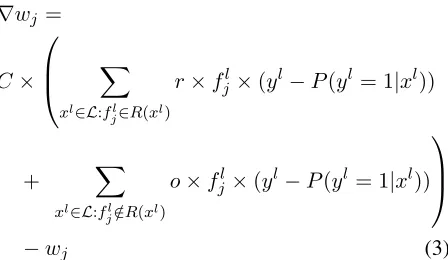
In the above equation, a featurefj contributes more to the gradient of its weight wj when a document in which it is marked as a rationale is misclassified. Whenfj appears in another documentxk but is not a rationale, it’s contribution to the gradient is muted byo. And hence, whenr > o, this framework im-plicitly provides more granular (per instance-feature combination) regularization by placing a higher im-portance on the contribution of the rationales versus non-rationales in each document.1
Note that in our framework the rationales are tied to their own documents; that is, we do not weight rationales and non-rationales globally. In addition to providing more granular regularization, this ap-proach has the benefit of allowing different ratio-nales to contribute differently to the objective func-tion of the trained classifier. For example, consider the case where the number of documents in which one wordfj (e.g., “excellent”) is marked as a ratio-nale is much more than the number of documents where another wordfk (e.g., “good”) is marked as
1The justification for our approach is similar for support
vec-tor machines. The idea is also similar for multinomial na¨ıve Bayes with Dirichlet priorsαj. For a fixed Dirichlet prior with
hα1, α2,· · ·, αni setting, wheno < 1 for a feature fj, its
a rationale. Then, the first sum in equation 3 will range over more documents for the gradient of wj compared to the gradient ofwk, giving more impor-tance to wj than to wk. In the traditional feature annotation work, this can be achieved only if the labeler can rank the features; even then, it is often very difficult, if not impossible, for the labelers to determine how much more important one feature is compared to another.
3.2 Experiments Comparing Lw/oR to LwR
In this section we first describe the settings, datasets, and classifiers used for our experiments and how we simulated a human labeler to provide rationales. Then, we present the results comparing the learn-ing curves achieved withlearning without rationales
(Lw/oR) andlearning with rationales(LwR).
3.2.1 Methodology
For this study, we used four text classification datasets. The IMDB dataset consists of 25K movie reviews (Maas et al., 2011). The SRAA2 dataset
consists of 48K documents that discuss either auto or aviation. Nova is a text classification dataset used in active learning challenge (Guyon, 2011) and con-tains 12K documents. WvsH is a 20 Newsgroups3
dataset in which we use the Windows vs. hardware categories, and it contains 1176 documents.
To make sure our approach works across repre-sentations, we experimented with both binary and tf-idf representations for these text datasets. We eval-uated our strategy using multinomial na¨ıve Bayes, logistic regression, and support vector machines, as these are strong classifiers for text classification. We used the scikit-learn (Pedregosa et al., 2011) imple-mentation of these classifiers with their default pa-rameter settings for our experiments.
To compare various strategies, we used learn-ing curves. The initially labeled dataset was boot-strapped using 10 documents by picking 5 random documents from each class. A budget (B) of 200 documents was used in our experiments, because most of the learning curves flatten out after about 200 documents. We evaluated all the strategies us-ing AUC (Area Under an ROC Curve) measure. The
2http://people.cs.umass.edu/ mccallum/data.html 3http://qwone.com/ jason/20Newsgroups/
code to repeat our experiments is available at Github
http://www.cs.iit.edu/˜ml/code/.
While incorporating the rationales into learning, we set the weights for rationales and the remaining features of a document as 1 and 0.01 respectively (i.e. r = 1 and o = 0.01). That is, we did not overemphasize the features corresponding to ratio-nales but rather de-emphasized the remaining fea-tures in the document. These weights worked rea-sonably well for all four datasets, across all three classifiers, and for both binary and tf-idf data repre-sentations.
Obviously, these are not necessarily the best weight settings one can achieve; the optimal settings forr andodepend on many factors, such as the ex-tent of the knowledge of the labeler (i.e., how many words a labeler can recognize), how noisy the la-beler is, and how much labeled data we have in our training set. Ideally, one should haver >> owhen the labeled data is small andrshould be closer too when the labeled data is large; a more practical ap-proach would be to tune for these parameters (e.g., cross-validation) at each step of the learning curve. However, in our experiments, we fixedr andoand we found that most settings where r > o worked quite well.
3.2.2 Simulating the Human Expert
the artificial labeler knew about only 49 words (23 for one class and 26 for the other class) for IMDB, 67 words (32 for one class and 35 for the other class) for SRAA, 95 words (42 for one class and 53 for the other class) for WvsH, and 111 words (31 for one class and 80 for the other class) for the Nova dataset. To determine whether the rationales selected by this artificial labeler are meaningful, we printed out the actual words used as rationales, and we ourselves verified that these words are human-recognizable words that could be naturally provided as rationales for classification. For example, the positive terms for the IMDB dataset included “great”, “excellent”, and “wonderful” and the negative terms included “worst”, “bad”, and “waste.”
3.2.3 Results
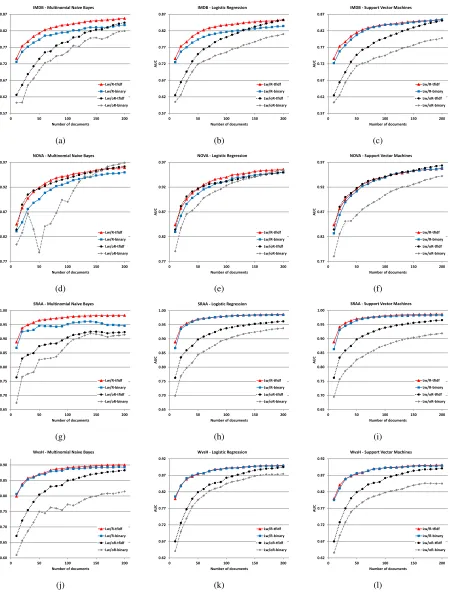
Next, we compare Lw/oR to LwR. Figure 1 presents the learning curves for random sampling on four text classification datasets with binary and tf-idf representations and using multinomial na¨ıve Bayes, logistic regression, and support vector ma-chines. Figure 1 shows that even though the arti-ficial labeler knew only about a tiny subset of the vocabulary, and returned anyoneword, rather than the top word or all the words, as rationale, LwR still drastically outperformed Lw/oR across all datasets, classifiers, and representations. This shows that our method for incorporating rationales into the learning process is empirically effective.
We used the default complexity parameters for logistic regression and support vector machines and used Laplace smoothing for multinomial na¨ıve Bayes. In our rationale framework, most features were non-rationales, and hence in Equation 3, most features appeared in the second summation term, with o = 0.01. We tested whether the improve-ments that LwR provide over Lw/oR are simply due to implicit higher regularization for most of the features with o = 0.01, and hence experimented with equation 2 (which is Lw/oR) usingC = 0.01. We observed that setting C = 0.01 and indis-criminately regularizing all the terms did not im-prove Lw/oR, further providing experimental evi-dence that the improvements provided by LwR are not due to just higher regularization, but they are due to a more fine-grained regularization, as explained in Section 3.1.
Even though LwR provides huge benefits, pro-viding both a label and a rationale is expected to take more time of the labeler than simply provid-ing a label. However, the improvements of LwR over Lw/oR is so huge that it might be worth spend-ing the extra time in providspend-ing rationales. For ex-ample, in order to achieve a target AUC of 0.95
for SRAA dataset (using tf-idf representation with MNB classifier), Lw/oR required labeling 656 doc-uments, whereas LwR required annotating a mere 29 documents, which is 22.6 times reduction in the number of documents. As another example, in or-der to achieve a target AUC of 0.8 for WvsH dataset (using binary representation with SVM classifier), Lw/oR required labeling 113 documents, whereas LwR achieved this target with only 13 documents.
(Zaidan et al., 2007) conducted user studies and showed that providing 5 to 11 rationales and a class label per document takes roughly twice the time of providing only the label for the document. (Ragha-van et al., 2006) also conducted user studies and showed that labeling instances takes five times more time than labeling features. We worked with simu-lated user and showed that a document that is anno-tated with a label and a single rationale can be worth as many as 22 documents that are annotated with only a label and thus these results suggest that LwR, compared to Lw/oR, can lead to significant time sav-ings for the annotator.
4 Active Learning with Rationales
0.57 0.62 0.67 0.72 0.77 0.82 0.87
0 50 100 150 200
A
UC
Number of documents IMDB - Multinomial Naive Bayes
Lw/R-tfidf Lw/R-binary Lw/oR-tfidf Lw/oR-binary (a) 0.57 0.62 0.67 0.72 0.77 0.82 0.87
0 50 100 150 200
A
UC
Number of documents IMDB - Logistic Regression
Lw/R-tfidf Lw/R-binary Lw/oR-tfidf Lw/oR-binary (b) 0.57 0.62 0.67 0.72 0.77 0.82 0.87
0 50 100 150 200
A
UC
Number of documents IMDB - Support Vector Machines
Lw/R-tfidf Lw/R-binary Lw/oR-tfidf Lw/oR-binary (c) 0.77 0.82 0.87 0.92 0.97
0 50 100 150 200
A
UC
Number of documents NOVA - Multinomial Naive Bayes
Lw/R-tfidf Lw/R-binary Lw/oR-tfidf Lw/oR-binary (d) 0.77 0.82 0.87 0.92 0.97
0 50 100 150 200
A
UC
Number of documents NOVA - Logistic Regression
Lw/R-tfidf Lw/R-binary Lw/oR-tfidf Lw/oR-binary (e) 0.77 0.82 0.87 0.92 0.97
0 50 100 150 200
A
UC
Number of documents NOVA - Support Vector Machines
Lw/R-tfidf Lw/R-binary Lw/oR-tfidf Lw/oR-binary (f) 0.65 0.70 0.75 0.80 0.85 0.90 0.95 1.00
0 50 100 150 200
A
UC
Number of documents SRAA - Multinomial Naive Bayes
Lw/R-tfidf Lw/R-binary Lw/oR-tfidf Lw/oR-binary (g) 0.65 0.70 0.75 0.80 0.85 0.90 0.95 1.00
0 50 100 150 200
A
UC
Number of documents SRAA - Logistic Regression
Lw/R-tfidf Lw/R-binary Lw/oR-tfidf Lw/oR-binary (h) 0.65 0.70 0.75 0.80 0.85 0.90 0.95 1.00
0 50 100 150 200
A
UC
Number of documents SRAA - Support Vector Machines
Lw/R-tfidf Lw/R-binary Lw/oR-tfidf Lw/oR-binary (i) 0.60 0.65 0.70 0.75 0.80 0.85 0.90
0 50 100 150 200
A
UC
Number of documents WvsH - Multinomial Naive Bayes
Lw/R-tfidf Lw/R-binary Lw/oR-tfidf Lw/oR-binary (j) 0.62 0.67 0.72 0.77 0.82 0.87 0.92
0 50 100 150 200
A
UC
Number of documents WvsH - Logistic Regression
Lw/R-tfidf Lw/R-binary Lw/oR-tfidf Lw/oR-binary (k) 0.62 0.67 0.72 0.77 0.82 0.87 0.92
0 50 100 150 200
A
UC
Number of documents WvsH - Support Vector Machines
Lw/R-tfidf Lw/R-binary Lw/oR-tfidf Lw/oR-binary
[image:6.612.81.534.70.669.2](l)
4.1 Active Learning to Select Documents based on Rationales
Arguably, one of the most successful active learn-ing strategies for text categorization is uncertainty sampling, which was first introduced by (Lewis and Catlett, 1994) for probabilistic classifiers and later formalized for support vector machines (Tong and Koller, 2001). The idea is to label instances for which the underlying classifier is uncertain, i.e., the instances that are close to the decision boundary of the model. It has been successfully applied to text classification tasks in numerous publications, including (Zhu and Hovy, 2007), (Sindhwani et al., 2009), and (Segal et al., 2006).
We adapt uncertainty sampling for the learning with rationales framework. To put simply, when the underlying model is uncertain about an unla-beled document, we look whether the unlaunla-beled doc-ument contains words/phrases that were returned as rationales for any of the existing labeled documents. More formally, letR+denote the union of all the ra-tionales returned for the positive documents so far. Similarly, let R− denote the union of all the
ratio-nales returned for the negative documents so far. An unlabeled document can be of these three types:
1. Type1: has no words in common withR+ and R−.
2. Type2: has word(s) in common with eitherR+ orR−but not both.
3. Type3: has at least one word in common with R+and at least one word in common withR−.
One would imagine that labeling each of the type1, type2, and type3 documents has its own ad-vantage. Labeling type1 documents has the potential to elicit new domain knowledge, i.e., terms that were not provided as a rationale for any of the existing labeled documents. It also carries the risk of con-taining little to no useful information for the clas-sifier (e.g., a neutral review). For type2 documents, even though the document shares a word that was re-turned as a rationale for another document, the clas-sifier is still uncertain about the document either be-cause that word is not weighted high enough by the classifier and/or there are other words that pull the classification decision in the other direction, making
the classifier uncertain. Type3 documents contain conflicting words/phrases and are potentially harder cases, however, they also have the potential to re-solve the conflicts for the classifier.
Building on our previous work (Sharma and Bil-gic, 2013) we devised an active learning approach, where given uncertain documents, the active learner prefers instances of type3 over type1 and type2. We call this strategy as uncertain-prefer-conflict
(UNC-PC) because type3 documents carry conflict-ing words (with respect to rationales) whereas type1 and type2 do not. The difference between this ap-proach and our previous work (Sharma and Bil-gic, 2013) is that in (Sharma and BilBil-gic, 2013), we selected uncertain instances based on model’s per-ceived conflict whereas in this work, we are se-lecting documents based on conflict caused by the domain knowledge provided by the labeler. Next, we compare the vanilla uncertainty sampling (UNC) and UNC-PC strategies using LwR to see if using uncertain documents of type3 could improve active learning.
4.2 Active Learning with Rationales Experiments
We used the same four text datasets and evalu-ated our method UNC-PC using multinomial na¨ıve Bayes, logistic regression, and support vector ma-chines. For the active learning strategies, we used a bootstrap of 10 random documents, and labeled five documents at each round of active learning. We used a budget of 200 documents for all meth-ods. UNC simply picks the top five uncertain doc-uments, whereas UNC-PC looks at top 20 uncertain documents and picks five uncertain documents giv-ing preference to the conflictgiv-ing cases (type 3) over the non-conflicting cases (type1 and type2). We re-peated each experiment 10 times starting with a dif-ferent bootstrap at each trial and report the average results.
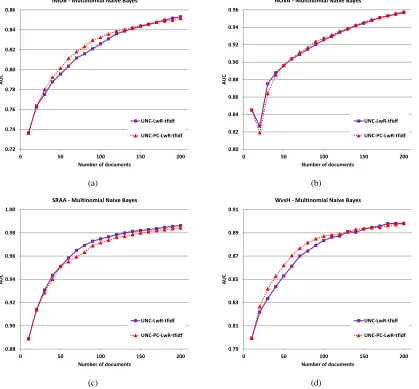
Bayes, UNC-PC improves over traditional uncer-tainty, UNC, on two datasets, and hurts performance on one dataset. Next, we discuss the significance re-sults for all classifiers.
Table 2 shows the paired t-test results comparing the learning curves of UNC-PC with the learning curves of UNC at each step of the active learning (i.e, if the average of one learning curve is signifi-cantly better or worse than the average of the learn-ing curve of the other). If UNC-PC has a higher av-erage AUC than UNC with a t-test significance level of 0.05 or better, it is a Win (W), if it has signifi-cantly lower performance, it is a Loss (L), and if the difference is not statistically significant, the result is a Tie (T).
Using multinomial na¨ıve Bayes, UNC-PC wins over UNC for two of the datasets (IMDB and WvsH), does not cause any significant changes for Nova (ties all the time), and loses for SRAA. Using logistic regression, UNC-PC wins for two datasets (Nova and SRAA), ties for WvsH and loses for IMDB. Using support vector machines, UNC-PC wins for three datasets (Nova, SRAA, and WvsH) and loses for IMDB. The t-test results show that UNC-PC often improves learning over UNC.
Table 2: Significant W/T/L counts for UNC-PC versus UNC. UNC-PC improves over UNC significantly for all three classifiers and most of the datasets.
UNC baseline MNB LR SVM
UNC-PC 2/1/1 2/1/1 3/0/1
5 Limitations and Future Work
A limitation of our work is that we simulated the la-beler in our experiments. Even though we simulated the labeler in a very conservative way (that is, our simulated labeler knows only a few most apparent words) and asked the simulated labeler to provide any one (rather than the top) rationale, a user study is needed to i) experiment with potentially noisy la-belers, and ii) measure how much actual time saving LwR provides over Lw/oR.
Another line of future work is to allow the la-beler to provide richer feedback. This is especially useful for resolving conflicts that stem from seem-ingly conflicting words and phrases. For example,
for the movie review “The plot was great, but the performance of the actors was terrible. Avoid it.” the word “great” is at odds with the words “terri-ble” and “avoid”. If the labeler is allowed to provide richer feedback, saying that the word “great” refers to the plot, “terrible” refers to the performance, and “avoid” refers to the movie, then the learner might be able to learn to resolve similar conflicts in other documents. However, this requires a conflict reso-lution mechanism in which the labeler can provide rich feedback, and a learner that can utilize such rich feedback. This is an exciting future research direc-tion that we would like to pursue.
We showed that our strategy to incorporate ratio-nales works well for text classification. The pro-posed framework can potentially be used for non-text domains where the domain experts can provide rationales for their decisions, such as medical do-main where the doctor can provide a rationale for his/her diagnosis and treatment decisions. Each do-main is expected to have its own unique research challenges and working with other domains is an-other interesting future research direction.
6 Related Work
The closest related work deals with eliciting ratio-nales from users and incorporating them into the learning (e.g., (Zaidan et al., 2007), (Donahue and Grauman, 2011), (Zaidan et al., 2008), and (Parkash and Parikh, 2012)). However, much of this work is specific to a particular classifier, such as sup-port vector machines. The framework we present is classifier-agnostic and we have shown that it works across classifiers and feature representations. Addi-tionally, we provide a novel active learning approach tailored for the learning with rationales framework.
0.72 0.74 0.76 0.78 0.80 0.82 0.84 0.86
0 50 100 150 200
A
UC
Number of documents
IMDB - Multinomial Naive Bayes
UNC-LwR-tfidf
UNC-PC-LwR-tfidf
(a)
0.80 0.82 0.84 0.86 0.88 0.90 0.92 0.94 0.96
0 50 100 150 200
A
UC
Number of documents
NOVA - Multinomial Naive Bayes
UNC-LwR-tfidf
UNC-PC-LwR-tfidf
(b)
0.88 0.90 0.92 0.94 0.96 0.98 1.00
0 50 100 150 200
A
UC
Number of documents
SRAA - Multinomial Naive Bayes
UNC-LwR-tfidf
UNC-PC-LwR-tfidf
(c)
0.79 0.81 0.83 0.85 0.87 0.89 0.91
0 50 100 150 200
A
UC
Number of documents
WvsH - Multinomial Naive Bayes
UNC-LwR-tfidf
UNC-PC-LwR-tfidf
[image:9.612.101.520.67.456.2](d)
Figure 2: Comparison of LwR using UNC and UNC-PC for all datasets with tf-idf representation and using multino-mial na¨ıve Bayes classifier.
feature annotation work can be utilized for the learn-ing with rationales framework by decoupllearn-ing ratio-nales from their documents, this is expected to re-sult in information loss (such as weighting features globally rather than locally). The precise effect of decoupling rationales and documents on the classi-fier performance still needs to be tested empirically.
7 Conclusion
We introduced a novel framework to incorporate ra-tionales into active learning for text classification. Our simple strategy to incorporate rationales can uti-lize any off-the-shelf classifier. The empirical eval-uations on four text datasets with binary and tf-idf
representations and three classifiers showed that our proposed method utilizes rationales effectively. Ad-ditionally, we presented an active learning strategy that is tailored specifically for the learning with ra-tionales framework and empirically showed that it improved active learning.
Acknowledgment
References
Josh Attenberg, Prem Melville, and Foster Provost. 2010. A unified approach to active dual supervision for la-beling features and examples. In European confer-ence on Machine learning and knowledge discovery in
databases, pages 40–55.
Olivier Chapelle, Bernhard Sch¨olkopf, and Alexander Zien, editors. 2006. Semi-Supervised Learning. MIT Press, Cambridge, MA.
Jeff Donahue and Kristen Grauman. 2011. Annota-tor rationales for visual recognition. InComputer
Vi-sion (ICCV), 2011 IEEE International Conference on,
pages 1395–1402.
G. Druck, B. Settles, and A. McCallum. 2009. Ac-tive learning by labeling features. InProceedings of the 2009 Conference on Empirical Methods in
Natu-ral Language Processing: Volume 1-Volume 1, pages
81–90.
Glenn M Fung, Olvi L Mangasarian, and Jude W Shavlik. 2002. Knowledge-based support vector machine clas-sifiers. InAdvances in neural information processing
systems, pages 521–528.
Federico Girosi and Nicholas Tung Chan. 1995. Prior knowledge and the creation of virtual examples for rbf networks. InNeural Networks for Signal Processing
[1995] V. Proceedings of the 1995 IEEE Workshop,
pages 201–210.
Isabell Guyon. 2011. Results of active learning chal-lenge.
D.D. Lewis and J. Catlett. 1994. Heterogeneous uncer-tainty sampling for supervised learning. In Proceed-ings of the eleventh international conference on
ma-chine learning, pages 148–156.
David D. Lewis and William A. Gale. 1994. A sequential algorithm for training text classifiers. InACM SIGIR Conference on Research and Development in
Informa-tion Retrieval, pages 3–12.
Andrew L Maas, Raymond E Daly, Peter T Pham, Dan Huang, Andrew Y Ng, and Christopher Potts. 2011. Learning word vectors for sentiment analysis. In Pro-ceedings of the 49th Annual Meeting of the Associa-tion for ComputaAssocia-tional Linguistics: Human Language
Technologies-Volume 1, pages 142–150.
Prem Melville and Vikas Sindhwani. 2009. Active dual supervision: Reducing the cost of annotating examples and features. InProceedings of the NAACL HLT 2009 Workshop on Active Learning for Natural Language
Processing, pages 49–57.
Amar Parkash and Devi Parikh. 2012. Attributes for classifier feedback. InComputer Vision–ECCV 2012, pages 354–368. Springer.
F. Pedregosa, G. Varoquaux, A. Gramfort, V. Michel, B. Thirion, O. Grisel, M. Blondel, P. Prettenhofer,
R. Weiss, V. Dubourg, J. Vanderplas, A. Passos, D. Cournapeau, M. Brucher, M. Perrot, and E. Duches-nay. 2011. Scikit-learn: Machine learning in Python.
Journal of Machine Learning Research, 12:2825–
2830.
Hema Raghavan and James Allan. 2007. An interactive algorithm for asking and incorporating feature feed-back into support vector machines. InProceedings of the 30th annual international ACM SIGIR conference
on Research and development in information retrieval,
pages 79–86.
Hema Raghavan, Omid Madani, and Rosie Jones. 2006. Active learning with feedback on features and in-stances. Journal of Machine Learning Research, 7:1655–1686.
Nicholas Roy and Andrew McCallum. 2001. Toward op-timal active learning through sampling estimation of error reduction. In International Conference on
Ma-chine Learning, pages 441–448.
Richard Segal, Ted Markowitz, and William Arnold. 2006. Fast uncertainty sampling for labeling large e-mail corpora. InConference on Email and Anti-Spam. Burr Settles. 2012. Active Learning. Synthesis Lectures on Artificial Intelligence and Machine Learning. Mor-gan & Claypool Publishers.
H. S. Seung, M. Opper, and H. Sompolinsky. 1992. Query by committee. In ACM Annual Workshop on
Computational Learning Theory, pages 287–294.
Manali Sharma and Mustafa Bilgic. 2013. Most-surely vs. least-surely uncertain. InIEEE 13th International
Conference on Data Mining, pages 667–676.
Vikas Sindhwani, Prem Melville, and Richard D Lawrence. 2009. Uncertainty sampling and transduc-tive experimental design for actransduc-tive dual supervision.
InProceedings of the International Conference on
Ma-chine Learning, pages 953–960.
Kevin Small, Byron Wallace, Thomas Trikalinos, and Carla E Brodley. 2011. The constrained weight space svm: learning with ranked features. InProceedings of the 28th International Conference on Machine
Learn-ing (ICML-11), pages 865–872.
Simone Stumpf, Vidya Rajaram, Lida Li, Margaret Bur-nett, Thomas Dietterich, Erin Sullivan, Russell Drum-mond, and Jonathan Herlocker. 2007. Toward har-nessing user feedback for machine learning. In Pro-ceedings of the 12th international conference on
Intel-ligent user interfaces, pages 82–91.
S. Stumpf, E. Sullivan, E. Fitzhenry, I. Oberst, W.K. Wong, and M. Burnett. 2008. Integrating rich user feedback into intelligent user interfaces. In Proceed-ings of the 13th international conference on Intelligent
user interfaces, pages 50–59.
classification. Journal of Machine Learning Research, 2:45–66.
Geoffrey G Towell and Jude W Shavlik. 1994. Knowledge-based artificial neural networks. Artificial
intelligence, 70(1):119–165.
Geofrey G Towell, Jude W Shavlik, and Michiel No-ordewier. 1990. Refinement of approximate domain theories by knowledge-based neural networks. In Pro-ceedings of the eighth National conference on
Artifi-cial intelligence, pages 861–866.
Omar Zaidan, Jason Eisner, and Christine D Piatko. 2007. Using” annotator rationales” to improve ma-chine learning for text categorization. InHLT-NAACL, pages 260–267.
Omar F Zaidan, Jason Eisner, and Christine Piatko. 2008. Machine learning with annotator rationales to reduce annotation cost. In Proceedings of the NIPS* 2008
Workshop on Cost Sensitive Learning.
J. Zhu and E. Hovy. 2007. Active learning for word sense disambiguation with methods for addressing the class imbalance problem. InProceedings of the 2007 Joint Conference on Empirical Methods in Natural guage Processing and Computational Natural