Assessing Relative Sentence Complexity using an Incremental CCG Parser
Bharat Ram Ambati and Siva Reddy and Mark Steedman
School of Informatics, University of Edinburgh 10 Crichton Street, Edinburgh EH8 9AB
[email protected], [email protected], [email protected]
Abstract
Given a pair of sentences, we present com-putational models to assess if one sentence is simpler to read than the other. While ex-isting models explored the usage of phrase structure features using a non-incremental parser, experimental evidence suggests that the human language processor works incre-mentally. We empirically evaluate if syn-tactic features from an incremental CCG parser are more useful than features from a non-incremental phrase structure parser. Our evaluation on Simple and Standard Wikipedia sentence pairs suggests that incre-mental CCG features are indeed more use-ful than phrase structure features achieving 0.44 points gain in performance. Incremen-tal CCG parser also gives significant improve-ments in speed (12 times faster) in comparison to the phrase structure parser. Furthermore, with the addition of psycholinguistic features, we achieve the strongest result to date re-ported on this task. Our code and data can be downloaded from https://github. com/bharatambati/sent-compl.
1 Introduction
The task of assessing text readability aims to clas-sify text into different levels of difficulty, e.g., text comprehensible by a particular age group or second language learners (Petersen and Ostendorf, 2009; Feng, 2010; Vajjala and Meurers, 2014). There have been efforts to automatically simplify Wikipedia to cater its content for children and English language learners (Zhu et al., 2010; Woodsend and Lapata, 2011; Coster and Kauchak, 2011; Wubben et al.,
2012; Siddharthan and Mandya, 2014). A related attempt of Vajjala and Meurers (2016) studied the usage of linguistic features for automatic classifi-cation of a pair of sentences – one from Standard Wikipedia and the other its corresponding
simplifi-cation from Simple Wikipedia – intoCOMPLEXand
SIMPLE. As syntactic features, they use
informa-tion from phrase structure trees produced by a non-incremental parser, and found them useful.
However, psycholinguistic theories suggest that humans process text incrementally, i.e., humans build syntactic analysis interactively by enhancing current analysis or choosing an alternative analy-sis on the baanaly-sis of the plausibility with respect to context (Marslen-Wilson, 1973; Altmann and Steed-man, 1988; Tanenhaus et al., 1995). Besides being cognitively possible, incremental parsing has shown to be useful for many real-time applications such as language modeling for speech recognition (Chelba and Jelinek, 2000; Roark, 2001), modeling text read-ing time (Demberg and Keller, 2008), dialogue sys-tems (Stoness et al., 2004) and machine translation (Schwartz et al., 2011). Furthermore, incremental parsers offer linear time speed. Here we explore the usefulness of incremental parsing for predicting rel-ative sentence readability.
Given a pair of sentences – one sentence a sim-plified version of the other – we aim to classify the
sentences into SIMPLE or COMPLEX. We use the
sentences from Standard Wikipedia (WIKI) paired
with their corresponding simplifications in Simple
Wikipedia (SIMPLEWIKI) as training and evaluation
data. We pose this problem as a pairwise classifi-cation problem (Section 2). For feature extraction,
we use an incremental CCG parser which provides a trace of each step of the parse derivation (Section 3). Our evaluation results show that incremental parse features are more useful than non-incremental parse features (Section 5). With the addition of psycholin-guistic features, we attain the best reported results on this task. We make our system available for pub-lic usage.
2 Problem Formulation
Initially Vajjala and Meurers (2014) trained a
bi-nary classifier to classify sentences in SIMPLEWIKI
to the class SIMPLE, and sentences in WIKI to the
class COMPLEX. This model performed poorly on
relative readability assessment. Noting that not all SIMPLEWIKIsentences are simpler than every other
sentence in WIKI, Vajjala and Meurers (2016)
re-framed the problem as a ranking problem according
to which given a pair of parallel SIMPLEWIKI and
WIKI sentences, the former must be ranked better
than the latter in terms of readability. Inspired by Vajjala and Meurers (2016), we also treat each pair together, and model relative readability assessment
as a pairwise classification problem. Leta, b be a
pair of parallel sentences. Let a, b represent their
corresponding feature vectors. We define our
classi-fierΦas
Φ(a−b) = 1 if a∈SIMPLE &b∈COMPLEX =−1 if b∈SIMPLE &a∈COMPLEX
The motivation for our modelling is that relative features (difference) are more useful than absolute features, e.g., intuitively shorter sentences are sim-ple to read, but length can only be defined in com-parison with another sentence.
3 Incremental CCG Parse Features
Below we provide necessary background, and then present the features.
3.1 Combinatory Categorial Grammar (CCG)
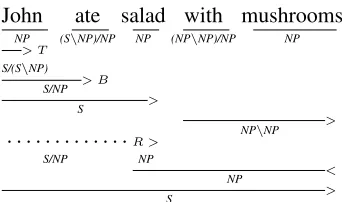
CCG (Steedman, 2000) is a lexicalized formalism in which words are assigned syntactic types encod-ing subcategorization information. Figure 1 dis-plays an incremental CCG derivation. Here, the
syntactic type (category) (S\NP)/NP on ate
indi-cates that it is a transitive verb looking for a NP
John ate salad with mushrooms
NP (S\NP)/NP NP (NP\NP)/NP NP
> T
S/(S\NP)
> B
S/NP
>
S
>
NP\NP
. . . .R >
S/NP NP
<
NP
>
[image:2.612.342.513.57.158.2]S
Figure 1: Incremental CCG derivation tree.
(object) on the righthand side and a NP (subject)
on the lefthand side. Due to its lexicalized and strongly typed nature, the formalism offers attrac-tive properties like elegant composition mechanisms which impose context-sensitive constraints, effi-cient parsing algorithms, and a synchronous
syntax-semantics interface. In Figure 1, the category ofwith
(NP\NP)/NPcombines with the category of
mush-roomsNPon its righthand side using the
combina-tory rule offorward application(indicated by>), to
form the category NP\NP representing the phrase
with mushrooms. This phrase in turn combines with other contextual categories using CCG combinators to form new categories representing larger phrases.
In contrast to phrase structure trees, CCG deriva-tion trees encode a richer noderiva-tion of syntactic type and constituency. For example, in a phrase
struc-ture tree, the category (constituency tag) of ate
would be VBD irrespective of whether it is
transi-tive or intransitransi-tive, whereas the CCG category dis-tinguishes these types. As the linguistic complexity increases, the complexity of the CCG category may increase, e.g., the relative pronoun has the category
(NP\NP)/(S\NP)in relative clause constructions.
In addition, CCG derivation trees have combinators annotated at each level which indicate the way in which the category is derived, e.g., in Figure 1 the
categoryS/NP ofJohn ate is formed by first
type-raising (indicated by >T) John and then applying
forward composition (indicated by >B) with ate. CCG combinators can throw light into the linguistic
complexity of the construction, e.g., crossed
com-position is an indicator of long-range dependency. Phrase structure trees do not have this additional in-formation encoded on their nodes.
3.2 Incremental CCG
in-Mourners and admirers came to lay flowers and light candles at the Apple Store N conj N (S[dcl]\NP)/(S[to]\NP) (S[to]\NP)/(S[b]\NP) (S[b]\NP)/NP N conj (S[b]\NP)/NP N ((S\NP)\(S\NP))/NP NP[nb]/N N/N N
T
NP
T
NP
>
NP\NP
<
NP
T
S/(S\NP)
> B
S/(S[to]\NP)
> B
S/(S[b]\NP)
> B
S/NP
T
NP
> B
S
T
NP
>
S[b]\NP
>
(S[b]\NP)\(S[b]\NP)
R >
S
>
N > NP[nb]
>
(S\NP)\(S\NP)
R <
[image:3.612.87.530.53.247.2]S
Figure 2: Incremental Derivation for a relatively complex sentence.
cremental CCG parser for English.1 The main
dif-ference between this incremental version and stan-dard non-incremental CCG parsers such as Zhang and Clark (2011) is that as soon as the grammar al-lows two types to combine, they are greedily
com-bined. For example, in Figure 1, firstJohnis pushed
on the stack but is immediately reduced when its
headateappears on the stack (i.e., John’s category
combines with ate’s category to form a new
cate-gory), and similarly whensaladis seen, it is reduced
withate. Whenwithappears it waits to be reduced
until its headmushroomsappears on the stack, and
later mushrooms is reduced with salad via ate
us-ing a specialrevealingoperation (indicated byR>)
followed by a sequence of operations. Therevealing
operation is performed when a category has greedily consumed a head in advance of a subsequently en-countered post-modifier to regenerate the head. In
the non-incremental version, salad is not reduced
withateuntilwith mushroomsis reduced with it.
Consider the following sentences (A) and (B) where (B) is a simpler version of (A).
(A) Mourners and admirers came to lay flow-ers and light candles at the Apple Store. (B) People went to the Apple Store with
flowers and candles.
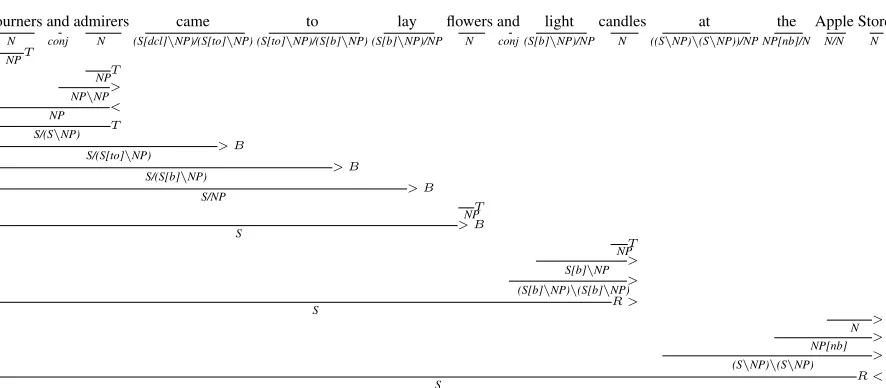
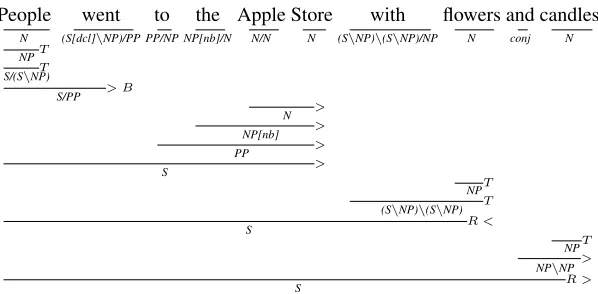
Figures 2 and 3 present the incremental
deriva-1This parser is not word by word (strictly) incremental but is incremental with respect to CCG derivational constituents fol-lowing Strict Competence Hypothesis (Steedman, 2000).
tions for both these sentences. Consider the CCG
category for to in both the sentences. In (A), the
category of to is (S[dcl]\NP)/(S[to]\NP)
which is more complex compared to the category of
toin (B) which isPP/NP. Both the derivations have
one right reveal action (indicated byR >). In (A),
the depth of this action is two since it is a VP
coordi-nation.2 Whereas in (B) the depth is only one. Such
information can be useful in predicting the complex-ity of a sentence.
3.3 Features
As discussed above, as the complexity of a sentence increases, the complexity of CCG categories, com-binators and the number of revealing operations in-crease in the incremental analysis. We exploit this information to assess the readability of a sentence. For each sentence, we build a feature vector using the features defined below extracted from its incre-mental CCG derivation.
Sentence Level Features. These features include sentence length, height of the CCG derivation, and the final number of constituents. A CCG derivation may have multiple constituents if none of the combi-nators allow the constituents to combine. This hap-pens mainly in ungrammatical sentences.
CCG Rule Counts. These features include the number of applications, forward applications,
People went to the Apple Store with flowers and candles N (S[dcl]\NP)/PP PP/NP NP[nb]/N N/N N (S\NP)\(S\NP)/NP N conj N
T
NP
T
S/(S\NP)
> B
S/PP
>
N
>
NP[nb]
>
PP
>
S
T
NP
T
(S\NP)\(S\NP)
R <
S
T
NP
>
NP\NP
R >
[image:4.612.157.456.57.204.2]S
Figure 3: Incremental Derivation for a relatively simple sentence.
ward applications, compositions, forward compo-sitions, backward compocompo-sitions, left punctuations, right punctuations, coordinations, type-raisings, type-changing, left revealing, right revealing oper-ations used in the CCG derivation. Each combinator is treated as a different feature dimension with its count as the feature value. For the revealing opera-tions, we also add additional features which indicate the depth of the revealing which is analogous to sur-prisal (Hale, 2001).
CCG Categories. We define the complexity of a CCG category as the number of basic syntac-tic types used in the category, e.g., the complexity of (S[pss]\NP)/(S[to]\NP) is 4 since it has one
S[pss], one S[to], and two NPs. Note that CCG type S[pss] indicates asentence but of the subtype
passive. We use average complexity of all the CCG categories used in the derivation as a real valued fea-ture. In addition, we define integer-valued features representing the frequency of specific subtypes (we have 21 subtypes each defined as a different dimen-sion) and the frequency of the top 8 syntactic types (each as a different dimension).
4 Experimental Setup
4.1 Evaluation Data
As evaluation data, we use WIKIand SIMPLEWIKI
parallel sentence pairs collected by Hwang et al. (2015), a newer and larger version compared to Zhu et al. (2010)’s collection. We only use the pairs
from the sectionGOODconsisting of 150K pairs. We
further removed pairs containing identical sentences which resulted in 117K clean pairs. We randomly
divided the data into training (60%), development (20%) and test (20%) splits.
4.2 Implementation details
As our classifier (see Section 2) we use SVM with Sequential Minimal Optimization in Weka toolkit (Hall et al., 2009) following its popularity in read-ability literature (Feng, 2010; Hancke et al., 2012;
Vajjala and Meurers, 2014).3 We use Ambati et
al. (2015)’s CCG parser for extracting CCG deriva-tions. This parser requires a CCG supertagger to limit its search space for which we use EasyCCG tagger (Lewis and Steedman, 2014).
4.3 Baseline
NON-INCREMENTAL PST. Following Vajjala
and Meurers (2016), we use features extracted from
PhraseStructureTrees (PST) produced by the
Stan-ford parser (Klein and Manning, 2003), a non-incremental parser. We use the exact code used by Vajjala and Meurers (2016) to extract these features which include part-of-speech tags, constituency fea-tures like the number of noun phrases, verb phrases and preposition phrases, and the average size of the constituent trees. Vajjala and Meurers (2016) used a
total of 57 features.4
5 Results
First we analyze the impact of incremental CCG
features (and so the name INCREMENTAL CCG).
3We also experimented with Naive Bayes and Logistic Re-gression and observed similar pattern in the results. But, SVM gave the best results among the classifiers we explored.
Model Accuracy NON-INCREMENTALPST 71.68 INCREMENTALCCG 72.12
Table 1: Impact of different syntactic features.
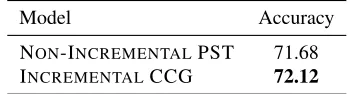
Table 1 presents the results of predicting
rela-tive readability on the test data.5 INCREMEN
-TAL CCG achieves 72.12% accuracy, a
signif-icant6 improvement of 0.44 points over NON
-INCREMENTAL PST (71.68%) indicating that
in-cremental CCG features are empirically more use-ful than non-incremental phrase structure features. We also evaluate if this result holds for incremen-tal vs. non-incremenincremen-tal CCG parse features. Am-bati et al. (2015) can also produce non-incremental CCG parses by turning off a flag. Note that in the non-incremental version, revealing features are ab-sent. This version achieves an accuracy of 72.02%,
around 0.1% lower than the winner INCREMENTAL
CCG, yet higher than NON-INCREMENTAL PST
showing that CCG derivation trees offer richer syn-tactic information than phrase structure trees. POS taggers used for Stanford and CCG parsers gave similar accuracy. This shows that the improvements are indeed due to the incremental CCG parse fea-tures rather than the POS feafea-tures.
Apart from the syntactic features, Vajjala and Meurers (2016) have also used psycholinguistic fea-tures such as age of acquisition of words, word im-agery ratings, word familiarity ratings, and ambigu-ity of a word, collected from the psycholinguistic repositories Celex (Baayen et al., 1995), MRC (Wil-son, 1988), AoA (Kuperman et al., 2012) and Word-Net (Fellbaum, 1998). These features are found to be highly predictive for assessing readability. We
enhance our syntactic models NON-INCREMENTAL
PST and INCREMENTALCCG by adding these
psy-cholinguistic features to build NON-INCREMENTAL
PST++ and INCREMENTAL CCG++ respectively.
Table 2 presents the final results along with the pre-vious state-of-the-art results of Vajjala and Meurers
(2016).7 Psycholinguistic features gave a boost of
5All feature engineering is done on the development data. 6Numbers in bold indicate significant results, significance measured using McNemar’s test.
7We ran Vajjala and Meurers (2016)’s code on our dataset and get similar results reported on Zhu et al. (2010)’s dataset.
Model Accuracy
[image:5.612.333.519.62.117.2]Vajjala and Meurers (2016) 74.58 NON-INCREMENTALPST++ 78.68 INCREMENTALCCG++ 78.87
Table 2: Performance of models with both syntactic and psycholinguistic features.
around 6.75 points on the syntactic models.8
Ad-ditionally the performance gap between our mod-els decrease (from 0.44 to 0.19) showing some of the psycholinguistic features also model a subset
of the syntactic features. INCREMENTAL CCG++
achieves an accuracy of 78.77% outperforming the previous best system of Vajjala and Meurers (2016) by a wide margin.
Speed. In addition to accuracy, parsing speed is important in real-time applications. The Stanford parser took 204 minutes to parse the test data with a speed of 3.8 sentences per second. The incremental CCG parser took 16 minutes with an average speed of 47.5 sentences per second, a 12X improvement over the Stanford parser. These numbers include POS tagging time for the Stanford parser, and POS tagging and supertagging time for the incremental CCG parser. All the systems are run on the same hardware (Intel i5-2400 CPU @ 3.10GHz).
6 Conclusion
Our empirical evaluation on assessing relative sen-tence complexity suggests that syntactic features ex-tracted from an incremental CCG parser are more useful than from a non-incremental phrase struc-ture parser. This result aligns with psycholinguis-tic findings that human sentence processor is incre-mental. Our incremental model enhanced with psy-cholinguistic features achieves the best reported re-sults on predicting relative sentence readability. We experimented with Simple Wikipedia and Wikipedia data from Hwang et al. (2015). We can explore the usefulness of our system on other datasets like On-eStopEnglish (OSE) corpus (Vajjala and Meurers, 2016) or the dataset from Xu et al. (2015). We are also currently exploring the usefulness of incremen-tal analysis for psycholinguistic data by switching off the lookahead feature.
Acknowledgments
We thank Sowmya Vajjala and Dave Howcroft for providing data and settings for the baseline. We also thank the three anonymous reviewers for their useful suggestions. This work was supported by ERC Ad-vanced Fellowship 249520 GRAMPLUS, EU IST Cognitive Systems IP Xperience and a Google PhD Fellowship for the second author.
References
[Altmann and Steedman1988] Gerry Altmann and Mark Steedman. 1988. Interaction with context during hu-man sentence processing. Cognition, 30(3):191–238. [Ambati et al.2015] Bharat Ram Ambati, Tejaswini
De-oskar, Mark Johnson, and Mark Steedman. 2015. An Incremental Algorithm for Transition-based CCG Parsing. InProceedings of the 2015 Conference of the North American Chapter of the Association for Com-putational Linguistics: Human Language Technolo-gies, pages 53–63, Denver, Colorado, May–June. As-sociation for Computational Linguistics.
[Baayen et al.1995] R. H. Baayen, R. Piepenbrock, and L. Gulikers. 1995. The CELEX Lexical Database (CD-ROM). Linguistic Data Consortium, University of Pennsylvania, Philadelphia, PA.
[Chelba and Jelinek2000] Ciprian Chelba and Frederick Jelinek. 2000. Structured language modeling. Com-puter Speech & Language, 14(4):283–332.
[Coster and Kauchak2011] William Coster and David Kauchak. 2011. Simple English Wikipedia: A New Text Simplification Task. InProceedings of the 49th Annual Meeting of the Association for Computational Linguistics: Human Language Technologies, pages 665–669, Portland, Oregon, USA, June. Association for Computational Linguistics.
[Demberg and Keller2008] Vera Demberg and Frank Keller. 2008. Data from eye-tracking corpora as evi-dence for theories of syntactic processing complexity.
Cognition, 109(2):193–210.
[Fellbaum1998] Christiane Fellbaum. 1998. WordNet. Wiley Online Library.
[Feng2010] Lijun Feng. 2010. Automatic readability as-sessment. Ph.D. thesis, City University of New York. [Hale2001] John Hale. 2001. A probabilistic Earley
parser as a psycholinguistic model. In Proceedings of the second meeting of the North American Chap-ter of the Association for Computational Linguistics on Language technologies, pages 159–166. Associa-tion for ComputaAssocia-tional Linguistics.
[Hall et al.2009] Mark Hall, Eibe Frank, Geoffrey Holmes, Bernhard Pfahringer, Peter Reutemann,
and Ian H Witten. 2009. The WEKA Data Mining Software: An Update. ACM SIGKDD explorations newsletter, 11(1):10–18.
[Hancke et al.2012] Julia Hancke, Sowmya Vajjala, and Detmar Meurers. 2012. Readability Classification for German using Lexical, Syntactic, and Morpholog-ical Features. InProceedings of COLING 2012, pages 1063–1080, Mumbai, India, December. The COLING 2012 Organizing Committee.
[Hwang et al.2015] William Hwang, Hannaneh Ha-jishirzi, Mari Ostendorf, and Wei Wu. 2015. Aligning Sentences from Standard Wikipedia to Simple Wikipedia. In Proceedings of the 2015 Conference of the North American Chapter of the Association for Computational Linguistics: Human Language Technologies, pages 211–217, Denver, Colorado, May–June. Association for Computational Linguistics.
[Klein and Manning2003] Dan Klein and Christopher D. Manning. 2003. Accurate Unlexicalized Parsing. In
Proceedings of the 41st Annual Meeting of the Associ-ation for ComputAssoci-ational Linguistics, pages 423–430, Sapporo, Japan, July. Association for Computational Linguistics.
[Kuperman et al.2012] Victor Kuperman, Hans Stadthagen-Gonzalez, and Marc Brysbaert. 2012. Age-of-acquisition ratings for 30,000 English words.
Behavior Research Methods, 44(4):978–990.
[Lewis and Steedman2014] Mike Lewis and Mark Steed-man. 2014. Improved CCG parsing with Semi-supervised Supertagging. Transactions of the Asso-ciation for Computational Linguistics (TACL), 2:327– 338.
[Marslen-Wilson1973] W. Marslen-Wilson. 1973. Lin-guistic structure and speech shadowing at very short latencies. Nature, 244:522–533.
[Petersen and Ostendorf2009] Sarah E Petersen and Mari Ostendorf. 2009. A machine learning approach to reading level assessment. Computer speech & lan-guage, 23(1):89–106.
[Roark2001] Brian Roark. 2001. Probabilistic Top-Down Parsing and Language Modeling. Computational Lin-guistics, 27:249–276.
[Schwartz et al.2011] Lane Schwartz, Chris Callison-Burch, William Schuler, and Stephen Wu. 2011. Incremental Syntactic Language Models for Phrase-based Translation. InProceedings of the 49th Annual Meeting of the Association for Computational Linguis-tics: Human Language Technologies, pages 620–631, Portland, Oregon, USA, June. Association for Compu-tational Linguistics.
using synchronous dependency grammars with hand-written and automatically harvested rules. In Proceed-ings of the 14th Conference of the European Chap-ter of the Association for Computational Linguistics, pages 722–731, Gothenburg, Sweden, April. Associa-tion for ComputaAssocia-tional Linguistics.
[Steedman2000] Mark Steedman. 2000. The Syntactic Process. MIT Press, Cambridge, MA, USA.
[Stoness et al.2004] Scott C Stoness, Joel Tetreault, and James Allen. 2004. Incremental Parsing with Refer-ence Interaction. InProceedings of the Workshop on Incremental Parsing: Bringing Engineering and Cog-nition Together, pages 18–25.
[Tanenhaus et al.1995] MK Tanenhaus, MJ Spivey-Knowlton, KM Eberhard, and JC Sedivy. 1995. Integration of visual and linguistic information in spoken language comprehension. Science, 268(5217):1632–1634.
[Vajjala and Meurers2014] Sowmya Vajjala and Detmar Meurers. 2014. Assessing the relative reading level of sentence pairs for text simplification. In Proceed-ings of the 14th Conference of the European Chap-ter of the Association for Computational Linguistics, pages 288–297, Gothenburg, Sweden, April. Associa-tion for ComputaAssocia-tional Linguistics.
[Vajjala and Meurers2016] Sowmya Vajjala and Detmar Meurers. 2016. Readability-based Sentence Ranking for Evaluating Text Simplification. InarXiv preprint. [Wilson1988] Michael Wilson. 1988. MRC
Psycholin-guistic Database: Machine-usable dictionary, version 2.00. Behavior Research Methods, Instruments, & Computers, 20(1):6–10.
[Woodsend and Lapata2011] Kristian Woodsend and Mirella Lapata. 2011. WikiSimple: Automatic Simplification of Wikipedia Articles. InProceedings of the Twenty-Fifth AAAI Conference on Artificial Intelligence (AAAI), pages 927–932, San Francisco, California, USA.
[Wubben et al.2012] Sander Wubben, Antal van den Bosch, and Emiel Krahmer. 2012. Sentence Sim-plification by Monolingual Machine Translation. In
Proceedings of the 50th Annual Meeting of the Associ-ation for ComputAssoci-ational Linguistics (Volume 1: Long Papers), pages 1015–1024, Jeju Island, Korea, July. Association for Computational Linguistics.
[Xu et al.2015] Wei Xu, Chris Callison-Burch, and Court-ney Napoles. 2015. Problems in Current Text Sim-plification Research: New Data Can Help. Transac-tions of the Association for Computational Linguistics, 3:283–297.
[Zhang and Clark2011] Yue Zhang and Stephen Clark. 2011. Shift-Reduce CCG Parsing. InProceedings of
the 49th Annual Meeting of the Association for Com-putational Linguistics: Human Language Technolo-gies, pages 683–692, Portland, Oregon, USA, June. Association for Computational Linguistics.
[Zhu et al.2010] Zhemin Zhu, Delphine Bernhard, and Iryna Gurevych. 2010. A Monolingual Tree-based Translation Model for Sentence Simplification. In