The ATILF-LLF System for Parseme Shared Task:
a Transition-based Verbal Multiword Expression Tagger
Hazem Al Saied
Universit´e de Lorraine, ATILF, CNRS Nancy, France
Marie Candito
Universit´e Paris Diderot, LLF Paris, France
Matthieu Constant
Universit´e de Lorraine, ATILF, CNRS Nancy, France
Abstract
We describe the ATILF-LLF system built for the MWE 2017 Shared Task on au-tomatic identification of verbal multiword expressions. We participated in the closed track only, for all the 18 available lan-guages. Our system is a robust greedy transition-based system, in which MWE are identified through a MERGE transi-tion. The system was meant to accom-modate the variety of linguistic resources provided for each language, in terms of accompanying morphological and syntac-tic information. Using per-MWE Fscore, the system was ranked first1for all but two
languages (Hungarian and Romanian).
1 Introduction
Verbal multi-word expressions (hereafter VMMEs) tend to exhibit more morphological and syntactic variation than other MWEs, if only because in general the verb is inflected, and it can receive adverbial modifiers. Furthermore some VMWEs, in particular light verb constructions (one of the VMWE categories provided in the shared task), allow for the full range of syntactic variation (extraction, coordination etc...). This renders the VMWE identification task even more challenging than general MWE identification, in which fully frozen and contiguous expressions help increasing the overall performance.
The data sets are quite heterogeneous, both in terms of the number of annotated VMWEs and of accompanying resources (for the closed track).2 12 systems participated for one language only (French),
and 5 systems participated for more than one language.
2Some of the data sets contain the tokenized sentences
plus VMWEs only (BG, ES, HE, LT), some are accompanied with morphological information such as lemmas and POS
So our first priority when setting up the architec-ture was to build a generic system applicable to all the 18 languages, with limited language-specific tuning. We thus chose to participate in the closed track only, relying exclusively on training data, ac-companying CoNLL-U file when available, and basic feature engineering. We developed a one-pass greedy transition-based system, which we be-lieve can handle discontinuities elegantly. We in-tegrated more or less informed feature templates, depending on their availability in the data.
We describe our system in section 2, the exper-imental setup in section 3, the results in section 4 and the related works in section 5. We conclude in section 6 and give perspectives for future work.
2 System description
The identification system we used is a simpli-fied and partial implementation of the system pro-posed in Constant and Nivre (2016), which is in itself a mild extension of an arc-standard depen-dency parser (Nivre, 2004). Constant and Nivre (2016) proposed a parsing algorithm that jointly predicts a syntactic dependency tree and a forest of lexical units including MWEs. In particular, in line with Nivre (2014), this system integrates spe-cial parsing mechanisms to deal with lexical anal-ysis. Given that the shared task focuses on the lex-ical task only and that datasets do not always pro-vide syntactic annotations, we have modified the structure of the original system by removing syn-tax prediction, in order to use the same system for all 18 languages.
A transition-based system consists in applying a sequence of actions (namely transitions) to incrementally build the expected output struc-ture in a bottom-up manner. Each transition is (CS, MT, RO, SL), and for the third group (the 10 remaining languages) full dependency parses are provided. See (Savary et al., 2017) for more information on the data sets.
Transition Configuration
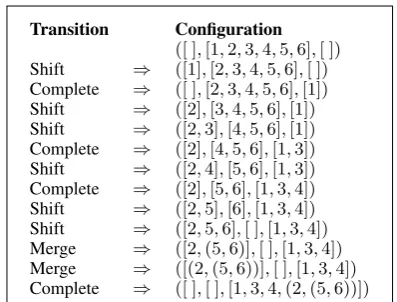
[image:2.595.81.280.60.211.2]([ ],[1,2,3,4,5,6],[ ]) Shift ⇒ ([1],[2,3,4,5,6],[ ]) Complete ⇒ ([ ],[2,3,4,5,6],[1]) Shift ⇒ ([2],[3,4,5,6],[1]) Shift ⇒ ([2,3],[4,5,6],[1]) Complete ⇒ ([2],[4,5,6],[1,3]) Shift ⇒ ([2,4],[5,6],[1,3]) Complete ⇒ ([2],[5,6],[1,3,4]) Shift ⇒ ([2,5],[6],[1,3,4]) Shift ⇒ ([2,5,6],[ ],[1,3,4]) Merge ⇒ ([2,(5,6)],[ ],[1,3,4]) Merge ⇒ ([(2,(5,6))],[ ],[1,3,4]) Complete ⇒ ([ ],[ ],[1,3,4,(2,(5,6))])
Figure 1: Transition sequence for tagging He1
took2this3argument4into5account6.
usually predicted by a classifier given the current state of the parser (namely configuration). A configuration in our system consists of a triplet
c = (σ, β, L), whereσis a stack containing units under processing, β is a buffer containing the remaining input tokens, andLis a set of processed lexical units. The processed units correspond either to tokens or to VMWEs. When correspond-ing to a scorrespond-ingle token, a lexical unit is composed of one node only, whereas a unit representing a (multi-token) VMWE is represented as a binary lexical tree over the input tokens. Every unit is associated with a set of linguistic attributes (when available in the working dataset): its actual form, lemma, part-of-speech (POS) tag, syntactic head and label. The initial configuration for a sentence
x = x1, ..., xn, i.e. a sequence of n tokens, is
represented bycsas: cs(x) = ([],[x1, . . . , xn],∅)
and the set of terminal configurationsCtcontains any configuration of the form c = ([],[], L). At the end of the analysis, the identified VMWEs are simply extracted fromL.
The transitions of this system are limited to the following: (a) the Shift transition takes the first element in the buffer and pushes it onto the stack; (b) theMergetransition removes the two top ele-ments of the stack, combines them as a single el-ement, and adds it to the stack;3(c) theComplete
transition moves the upper element of the stack to L, whether the element is a single token or an identified VMWE and finally (d) the Complete-MWTtransition, only valid for multiword tokens
3The newly created element is assigned linguistic
at-tributes using basic concatenation rules that would deserve to be improved in future experiments: e.g., the lemma is the concatenation of the lemmas of the two initial elements.
(MWT), acts as Complete, but also marks the ele-ment moved toLas VMWE.4
Training such a system means enabling it to classify a configuration into the next transition to apply. This requires an oracle that determines what is an optimal transition sequence given an input sentence and the gold VMWEs. We created a static oracle using a greedy algorithm that per-forms Complete as soon as possible (i.e. when a non VMWE token or a gold VMWE is on top of the stack) and Merge as late as possible (i.e. when the right-most component of the VMWE is on top of the stack) (see Figure 1). Note that an oracle se-quence is exactly composed of2ntransitions: ev-ery single token requires one Shift and one Com-plete, and each multi-token VMWE of length m
requiresmShifts,m−1Merges and a single Com-plete.
The proposed system has some limitations with respect to the shared task annotation scheme. First, for now, our system does not handle embed-ded VMWEs (only the longest VMWE is consid-ered in the oracle, and the transition system can-not predict embeddings). This feature could be straightforwardly activated as VMWEs are repre-sented with lexical trees. Note also that the sys-tem cannot handle overlapping MWEs liketake1,2 abath1 then ashower2, since it requires a graph representation (not a tree).
3 Experimental setup
For replication purposes, we now describe how the system has been implemented (Subsec-tion 3.1), which feature templates have been used (Subsection 3.2) and how they have been tuned (Subsection 3.3). Simple descriptions of the sys-tem settings are provided in Table 1. We thereafter use symbol Bi to indicate the ith element in the
buffer. S0 andS1stand for the top and the second top elements of the stack. For every unitXin the stack or the buffer, we denoteXwits word form,
Xlits lemma andXpits POS tag. The concatena-tion of two elementsXandY is notedXY. 3.1 Implementation
For a given language, and a given train/dev split, we train three SVM classifiers (one vs all, one vs
4We had to add this transition to cope with MWTs, which
one and error-correcting output codes) and we se-lect the majority vote one.5
Note that some configurations only allow for a unique transition type, and thus do not require transition prediction. A configuration with a one token stack and empty buffer requires the applica-tion of a Complete, as last transiapplica-tion of the tran-sition sequence. Similarly, a configuration with empty stack and non-empty buffer must lead to a Shift transition.
During the feature tuning phase, for a few lan-guages we added a number of hard-coded pro-cedures aiming at enforcing specific transitions in given contexts. These procedures all use a VMWE dictionary extracted from the training set (hereafter the VMWE dictionary). For German and Hungarian, we noticed a high percentage of VMWEs with one token only.6 We added the
Complete-MWT transition for these languages, which we systematically apply when the head of the stack S0 is a token appearing as MWT in the VMWE dictionary (cf. setting Q in Table 1). For other languages with long and discontinuous ex-pressions, we used other hard-coded procedures that experimentally proved to be beneficial (setting P in Table 1). We systematically apply a Complete transition when S1lB0lor S1lB1lforms a VMWE existing in the VMWE dictionary. Moreover, an obligatory Shift is applied when the concatena-tion of successive elements in the stack and the buffer belongs to the VMWE dictionary. In par-ticular, we test S1lS0lB0l, S0lB0l, S0lB0lB1land S0lB0lB1lB2l.
3.2 Feature Templates
A key point in a classical transition-based sys-tem is feature engineering, where feature sys-template design and tuning could play a very important role in increasing the accuracy of system results. Basic Linguistic Features
First of all, depending on their availability in the working dataset and on the activation of related settings (cf. G and J in Table 1), we extracted linguistic attributes in order to generate features such as S0l, S0pand S0w wherep,land
5The whole system was developed using Python 2.7, with
2,200 lines of code, using the open-source Scikit-learn 0.19 libraries for the SVMs. The code is available on Github:
https://goo.gl/EDFyiM
6These correspond mainly to cases of verb-particle
(tagged VPC in the data sets) in which the particle is not sep-arated from the verb.
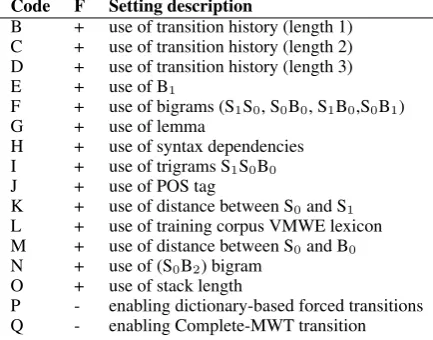
Code F Setting description
B + use of transition history (length 1) C + use of transition history (length 2) D + use of transition history (length 3)
E + use of B1
F + use of bigrams (S1S0, S0B0, S1B0,S0B1)
G + use of lemma
H + use of syntax dependencies I + use of trigrams S1S0B0 J + use of POS tag
K + use of distance between S0and S1 L + use of training corpus VMWE lexicon M + use of distance between S0and B0 N + use of (S0B2) bigram
O + use of stack length
[image:3.595.308.525.64.234.2]P - enabling dictionary-based forced transitions Q - enabling Complete-MWT transition
Table 1: System setting code descriptions. The ’F’ column indicates whether the setting is a feature-related setting (’+’) used by the classifiers or whether (’-’) it is a hard-coded implementation en-hancement.
wstand for the lemma, the part of speech, and the word form respectively. The same features are extracted for unigrams S1, B0and B1(when used) (cf. E in Table 1).
When enabled, the bigrams features for the pair XY of elements are XpYp, XlYl, XwYw, XpYl and XlYp. The trigram-based features are extracted in the same way.
Basically, the involved bigrams are S1S0, S0B0, S1B0 and S0B1 (cf. setting F in Table 1), but we also added the S0B2 bigram for a few languages (cf. N in Table 1). For trigrams, we only used the features of the S1S0B0triple (cf. I in Table 1).
Finally, because the datasets for some languages do not provide the basic linguistic attributes such as lemmas and POS tags, we tried to bridge the gap by extracting unigram ”morphological” attributes when POS tag and lemma extraction settings were disabled (cf. G and J in Table 1). The features of S0 for such languages would be S0w, S0r, S0s wherer andsstand for the last two and three let-ters of S0wrespectively.
Syntax-based Features
provided syntactic dependencies when available: for each token Bn that both appears in the buffer
and is a syntactic dependent of S0 with label
l, we capture the existence of the dependency using the features RightDep(S0, Bn) = T rue
andRightDepLabel(S0, Bn) = l. We also use the opposite featuresIsGovernedBy(S0, Bn) = T rue and IsGovernedByLabel(S0, G) = l when S0’s syntactic governor G appears in the buffer. Other syntax-based features aim at mod-eling the direction and label of a syntactic relation between the two top elements of the stack (fea-turesyntacticRelation(S0, S1) =±lis used for S0 governing/governed by S1).7 All these syntac-tic features (cf. H in Table1) try to capture syn-tactic regularities between the tokens composing a VMWE.
History-based Features
We found that other traditional transition-based system features were sometimes useful like (local) transition history of the system. We thus added features to represent the sequence of previous tran-sitions (of length one, two or three, cf. settings B, C and D in Table 1).
Distance-based Features
Distance between sentence components is also known to help transition-based dependency pars-ing (Zhang and Nivre, 2011). We thus added the distance between S0 and B0 and the distance be-tween S0 and S1 (cf. settings K and M in Table 1).
Dictionary-based Features
We also added features based on the VMWE dictionary automatically extracted from the train-ing set. Such features inform the system when one of the focused elements (Si, Bj) is a component
of a VMWE present in the dictionary (cf. L in Table 1).
Stack-length Features
Using the length of the stack as an additional feature (cf. O in Table 1) has also proven benefi-cial during our feature tuning.
7For the shared task, we used gold syntactic features for
the languages accompanied with gold dependency compan-ion files, as authorized in the closed track. Performance when using predicted syntax will be evaluated in future work.
Finally, it is worthwhile to note that system set-tings (cf. Table 1) interact when used to generate the precise set of features. For instance if lemma extraction is disabled (code G) while bigram ex-traction is enabled (code F), the produced features for e.g. the S1S0 bigram would not include the following features: S1lS0l, S1pS0land S1lS0p.
3.3 Feature Tuning
We first divided the data sets into 3 groups, based on the availability of CoNLL-U files: (a) for BG, HE and LTonly the VMWEs on tokenized sentences are available; (b)CS, ES, FA, MT and ROare accompanied by CoNLL-U files but with-out syntactic dependency annotations, and (c)the other languagesare accompanied by a fully anno-tated CoNLL-U file. In the first tuning period, we tested the various configurations using three pilot languages (BG, CS, FR) representing one group each. In the latest days of the experiments, the set of languages tested was enlarged to all of them and systematic tuning was performed for every lan-guage.
4 Results
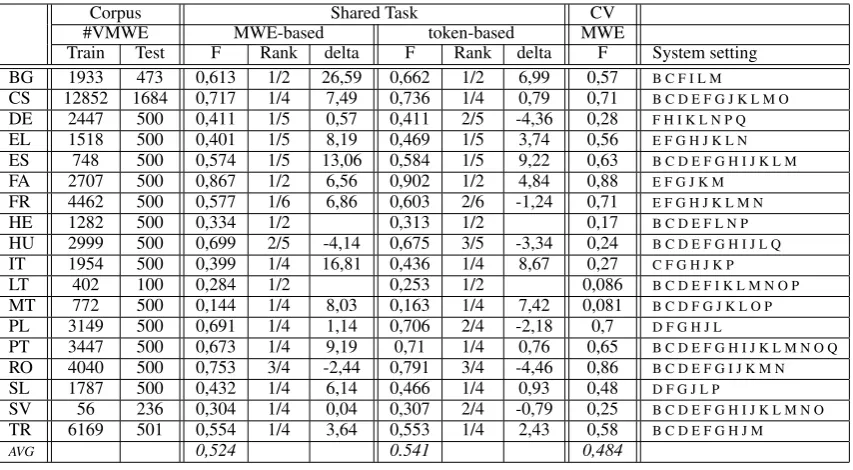
Table 2 summarizes the results of the system performance over all the languages proposed by the shared task. Each row of the table displays its per-MWE and per-token F-scores for a given lan-guage (identified by its ISO 639-1 code) for test dataset, on top of a 5-fold cross-validation (CV) per-MWE F-score on training dataset. The system settings are represented as a sequence of codes de-scribed in Table 1.
We can observe that results are very heteroge-neous. For instance, five languages (CS, FA, FR, PL, RO) are above 0.70 per-MWE F-score in the case of cross-validation, while seven languages (DE, HE, HU, IT, LT, MT, SV) are below 0.30. In general, we can see an approximative linear cor-relation between the number of training VMWEs and the performance. This suggests that the size of training datasets is not large enough as systems’ performance does not converge. We note though that some languages like CS and TR reach rela-tively low scores given the size of training data, which shows the high complexity of this task for these languages.
Corpus Shared Task CV
#VMWE MWE-based token-based MWE
Train Test F Rank delta F Rank delta F System setting
BG 1933 473 0,613 1/2 26,59 0,662 1/2 6,99 0,57 B C F I L M
CS 12852 1684 0,717 1/4 7,49 0,736 1/4 0,79 0,71 B C D E F G J K L M O
DE 2447 500 0,411 1/5 0,57 0,411 2/5 -4,36 0,28 F H I K L N P Q
EL 1518 500 0,401 1/5 8,19 0,469 1/5 3,74 0,56 E F G H J K L N
ES 748 500 0,574 1/5 13,06 0,584 1/5 9,22 0,63 B C D E F G H I J K L M
FA 2707 500 0,867 1/2 6,56 0,902 1/2 4,84 0,88 E F G J K M
FR 4462 500 0,577 1/6 6,86 0,603 2/6 -1,24 0,71 E F G H J K L M N
HE 1282 500 0,334 1/2 0,313 1/2 0,17 B C D E F L N P
HU 2999 500 0,699 2/5 -4,14 0,675 3/5 -3,34 0,24 B C D E F G H I J L Q
IT 1954 500 0,399 1/4 16,81 0,436 1/4 8,67 0,27 C F G H J K P
LT 402 100 0,284 1/2 0,253 1/2 0,086 B C D E F I K L M N O P
MT 772 500 0,144 1/4 8,03 0,163 1/4 7,42 0,081 B C D F G J K L O P
PL 3149 500 0,691 1/4 1,14 0,706 2/4 -2,18 0,7 D F G H J L
PT 3447 500 0,673 1/4 9,19 0,71 1/4 0,76 0,65 B C D E F G H I J K L M N O Q
RO 4040 500 0,753 3/4 -2,44 0,791 3/4 -4,46 0,86 B C D E F G I J K M N
SL 1787 500 0,432 1/4 6,14 0,466 1/4 0,93 0,48 D F G J L P
SV 56 236 0,304 1/4 0,04 0,307 2/4 -0,79 0,25 B C D E F G H I J K L M N O
TR 6169 501 0,554 1/4 3,64 0,553 1/4 2,43 0,58 B C D E F G H J M
[image:5.595.87.514.61.296.2]AVG 0,524 0.541 0,484
Table 2: Detailed results of all experiments over all the languages. F columns provide F-score results and delta columns display the difference in F-score (times10−2) between our system and the best other system of the shared task for the current evaluation/language configuration.
robustness of our approach. Moreover, evalua-tion using per-MWE F-score (i.e. exact VMWE matching) ranks our system first on all languages but two (HU:2nd:, RO:3rd), displaying an aver-age difference of 6.73 points with the best other system in the current evaluation/language pair. Concerning per-token scores (which allow partial matchings), results are relatively lower: our sys-tem is ranked first for 12 languages (out of 18), with a positive average difference of 1.84 points as compared with the best other system. Such very enthusiastic results for per-MWE evaluations seem to show that our system succeeds more in considering a MWE as a whole. Further error analysis is needed to explain this trait, and in par-ticular to check the impact of the Merge transition, which transforms sequences of elements into one.
5 Related Work
Previous approaches for VMWE identification include the two-pass method of candidate extrac-tion followed by binary classificaextrac-tion (Fazly et al., 2009; Nagy T. and Vincze, 2014).
VMWE identification has also been performed using sequence labeling approaches, with IOB-scheme. For instance, Diab and Bhutada (2009) apply a sequential SVM to identify verb-noun idiomatic combinations in English. Such ap-proaches were used for MWE identification in
general (including verbal expressions) ranging from contiguous expressions (Blunsom and Bald-win, 2006) to gappy ones (Schneider et al., 2014). A joint syntactic analysis and VMWE identifi-cation approach using off-the-shelf parsers is an-other interesting alternative that has shown to help VMWE identification such as light verb construc-tions (Eryi˘git et al., 2011; Vincze et al., 2013).
6 Conclusion and future work
This article presents a simple transition-based system devoted to VMWE identification. In par-ticular, it offers a simple mechanism to handle dis-continuity since foreign elements are iteratively discarded from the stack, which is a crucial point for VMWEs. It also has the advantage of being robust, accurate and efficient (linear time com-plexity). As future work, we would like to apply more sophisticated syntax-based features, as well as more advanced machine-learning techniques like neural networks and word embeddings. We also believe that a dynamic oracle could help in-crease results to better deal with cases where the system is unsure.
Acknowledgements
References
Phil Blunsom and Timothy Baldwin. 2006. Multilin-gual deep lexical acquisition for hpsgs via supertag-ging. InProceedings of the 2006 Conference on Em-pirical Methods in Natural Language Processing, pages 164–171, Sydney, Australia, July. Association for Computational Linguistics.
Matthieu Constant and Joakim Nivre. 2016. A transition-based system for joint lexical and syn-tactic analysis. InProceedings of the 54th Annual Meeting of the Association for Computational Lin-guistics (Volume 1: Long Papers), pages 161–171, Berlin, Germany, August. Association for Computa-tional Linguistics.
Mona Diab and Pravin Bhutada. 2009. Verb noun con-struction mwe token classification. InProceedings of the Workshop on Multiword Expressions: Identifi-cation, Interpretation, Disambiguation and Applica-tions, pages 17–22, Singapore, August. Association for Computational Linguistics.
G¨uls¸en Eryi˘git, Tugay ˙Ilbay, and Ozan Arkan Can. 2011. Multiword expressions in statistical depen-dency parsing. InProc. of IWPT Workshop on Sta-tistical Parsing of Morphologically-Rich Languages (SPMRL 2011), pages 45–55, Dublin.
Afsaneh Fazly, Paul Cook, and Suzanne Stevenson. 2009. Unsupervised type and token identification of idiomatic expressions. Computational Linguistics, 35(1):61–103.
Istv´an Nagy T. and Veronika Vincze. 2014. Vpc-tagger: Detecting verb-particle constructions with syntax-based methods. InProceedings of the 10th Workshop on Multiword Expressions (MWE), pages 17–25, Gothenburg, Sweden, April. Association for Computational Linguistics.
Joakim Nivre. 2004. Incrementality in determinis-tic dependency parsing. In Frank Keller, Stephen Clark, Matthew Crocker, and Mark Steedman, edi-tors,Proceedings of the ACL Workshop Incremental Parsing: Bringing Engineering and Cognition To-gether, pages 50–57, Barcelona, Spain, July. Asso-ciation for Computational Linguistics.
Joakim Nivre. 2014. Transition-Based Parsing with Multiword Expressions. In2ndPARSEME General Meeting, Athens, Greece.
Agata Savary, Carlos Ramisch, Silvio Cordeiro, Fed-erico Sangati, Veronika Vincze, Behrang Qasem-iZadeh, Marie Candito, Fabienne Cap, Voula Giouli, Ivelina Stoyanova, and Antoine Doucet. 2017. The PARSEME Shared Task on Automatic Identifica-tion of Verbal Multi-word Expressions. In Proceed-ings of the 13th Workshop on Multiword Expressions (MWE 2017), Valencia, Spain.
Nathan Schneider, Emily Danchik, Chris Dyer, and Noah A. Smith. 2014. Discriminative lexical se-mantic segmentation with gaps: running the MWE gamut. TACL, 2:193–206.
Violeta Seretan. 2011. Syntax-based collocation ex-traction. Text, Speech and Language Technology. Springer.
Veronika Vincze, J´anos Zsibrita, and Istv´an Nagy T. 2013. Dependency parsing for identifying hun-garian light verb constructions. In Proceedings of the Sixth International Joint Conference on Natu-ral Language Processing, pages 207–215, Nagoya, Japan, October. Asian Federation of Natural Lan-guage Processing.