696
NIT Agartala NLP Team at SemEval-2019 Task 6:
An Ensemble Approach to Identifying and Categorizing
Offensive Language in Twitter Social Media Corpora
Steve Durairaj Swamy1, Anupam Jamatia1, Bj¨orn Gamb¨ack2and Amitava Das3
1National Institute of Technology, Agartala, India
2Norwegian University of Science and Technology, Trondheim, Norway
3Mahindra ´Ecole Centrale,Hyderabad, Telangana, India
{steve050798,anupamjamatia}@gmail.com,[email protected],[email protected]
Abstract
The paper describes the systems submit-ted to OffensEval (SemEval 2019, Task 6) on ‘Identifying and Categorizing Offen-sive Language in Social Media’ by the ‘NIT Agartala NLP Team’. A Twitter anno-tated dataset of 13,240 English tweets was pro-vided by the task organizers to train the indi-vidual models, with the best results obtained using an ensemble model composed of six dif-ferent classifiers. The ensemble model pro-duced macro-averaged F1-scores of 0.7434,
0.7078 and 0.4853 on Subtasks A, B, and C, respectively. The paper highlights the over-all low predictive nature of various linguistic features and surface level count features, as well as the limitations of a traditional machine learning approach when compared to a Deep Learning counterpart.
1 Introduction
Offensive language has been the scourge of the in-ternet since the rise of social media. Social me-dia provides a platform for everyone and anyone to voice their opinion. This has empowered peo-ple to make their voices heard and to speak out on global issues. The downside to this, however, is the misuse of such platforms to attack an individ-ual or a minority group, and to spread hateful opin-ions. Pairing this with the perceived anonymity the internet provides, there has been a massive up-swing in the use of social media for cyberbullying and hate speech, with technology giants coming under increased pressure to address the issue.
Most of what we may be interested in detect-ing can be broadly labelled as hate speech, cyber-bullying or abusive use of swearing. The union of these three subsets form what can be identified as ‘Offensive Language on Social Media’. However, what we consider offensive is often a grey area, as is evident by the low inter-annotator agreement
rates when labelling data for offensive language (Waseem et al.,2017b).
Detecting offensive language has proven to be difficult, due to the broad spectrum in which lan-guage can be used to convey an insult. The na-ture of the abuse can be implicit — drawing from sarcasm and humour rather than offensive terms — as well as explicit, by making extensive use of traditional offensive terms and profanity. It does not help that the reverse is also entertained, with profanity often being used to imply informality in speech or for emphasis. Coincidentally, these are also the reasons why lexical detection methods have been unfruitful in classifying text as offensive or non-offensive.
The OffensEval 2019 shared task (Zampieri et al.,2019b) is one of several endeavours to fur-ther the state-of-the-art in addressing the offen-sive language problem. The paper describes the insights obtained when tackling the shared task using an ensemble of traditional machine learn-ing classification models and a Long Short-Term Memory (LSTM) deep learning model. Section2 first discusses other related approaches to detect-ing hate speech and offensive language. Then Sec-tion3describes the dataset and Section4the ideas and methodology behind our approach. Section5 reports the results obtained, while Section 6 dis-cusses those results with a particular eye towards the errors committed by the models. Finally, Sec-tion7sums up the key results and points to ways the work can be extended.
2 Related Work
varying degrees of success.Waseem et al.(2017b) state that annotation via crowd-sourcing tends to work best when the abuse is explicit (Waseem and Hovy,2016), but is considerably less reliable when considering implicit abuse (Dadvar et al., 2013; Justo et al., 2014; Dinakar et al., 2011). They propose a typology that can synthesise different offensive language detection subtasks. Zampieri et al. (2019a) expand on these ideas and propose a hierarchical three-level-annotation model, which is used in the OffensEval 2019 shared task. Another issue is whether the datasets should be balanced or not (Waseem and Hovy, 2016), since there are much fewer offensive com-ments than benign comcom-ments in randomly sam-pled real-life data (Schmidt and Wiegland,2017).
Classical Machine learning algorithms have been wielded to some success in automated offen-sive language detection, mainly Logistic Regres-sion (Davidson et al., 2017; Waseem and Hovy, 2016; Burnap and Williams, 2015) and Support Vector Machines (Xu et al., 2012;Dadvar et al., 2013). Recently, however, deep learning mod-els have outperformed their traditional machine learning counterparts, with both Recurrent Neu-ral Networks (RNN) — such as LSTM (Pitsilis et al.,2018) and Bi-LSTM (Gao and Huang,2017) — and Convolutional Neural Networks (CNN) having been used. Gamb¨ack and Sikdar (2017) utilised a CNN model with word2vec embeddings to obtain higher F1-score and precision than a
previous logistic regression model (Waseem and Hovy,2016), whileZhang et al.(2018) combined a CNN model with a Gated Recurrent Unit (GRU) layer. Malmasi and Zampieri(2018) used an en-semble system much like ours to separate profan-ity from hate speech, but reported no significant improvement over a single classifier system.
In terms of features, simple bag of words mod-els have proven to be highly predictive (Waseem and Hovy, 2016; Davidson et al., 2017; Nobata et al.,2016;Burnap and Williams,2015).Mehdad and Tetreault (2016) endorsed the use of charac-ter n-grams over token n-grams citing their abil-ity to glaze over the spelling errors that are fre-quent in online texts. Nobata et al.(2016);Chen et al. (2012) showed small improvements by in-cluding features capturing the frequency of dif-ferent entities such as URLs and mentions, with other features such as part-of-speech (POS) tags (Xu et al., 2012;Davidson et al.,2017) and
sen-timent scores (Van Hee et al., 2015; Davidson et al.,2017) also having been used (Schmidt and Wiegland, 2017). More recently, meta informa-tion about the users have been suggested as fea-tures, but no consistent correlation between user information and tendency for offensive behaviour online has been shown, with Waseem and Hovy (2016) claiming gender information leading to im-provements in classifier performance, but with Unsv˚ag and Gamb¨ack(2018) challenging this and reporting user-network data to be more important instead. Wulczyn et al. (2017) concluded that anonymity leads to an increase in the likelihood of a comment being an attack.
3 Data
The training dataset used for the shared task, the Offensive Language Identification Dataset (Zampieri et al., 2019a), contains 13,240 tweets, with each tweet having been annotated on the basis of a hierarchical three-level model. An additional 860 tweets were used as the test set for the shared task. The three levels/subtasks are as follows: A – Whether the tweet is offensive (OFF) or
non-offensive (NOT).
B – Whether the tweet is targeted (TIN) or untar-geted (UNT).
C – If the target is an individual (IND), group (GRP) or other (OTH; e.g., an issue or an or-ganisation).
The dataset does not have an equal number of of-fensive and non-ofof-fensive tweets. Only about one-third of the tweets are marked offensive, to par-tially account for the fact that most online dis-course mainly is non-offensive. The corpus ex-hibits a larger number of male (∼3000) than fe-male pronouns (∼2500), but is reasonably bal-anced.
Noticeably, the annotators were very conser-vative in their classification of tweets as non-offensive. It is unclear whether this was due to a more strict definition provided by the task or-ganisers. For example, it is not immediately clear why tweets such as:1 “@USER Ouch!” (23159),
“@USER He is a beast” (50771), and “@USER That shit weird! Lol” (31404)were annotated as offensive.
The annotators furthermore seemed to disagree over the cathartic and emphatic use of swearing, as in “@USER Oh my Carmen. He is SO
ING CUTE” (39021), “@USER GIVE ME A FUCKING MIC” (60566), and “@USER why are you so fucking good.” (80097). These tweets do not really seem to be offensive except for them containing varying degrees of profanity. However, this is inconsistent, with some other tweets anno-tated not offensive, as expected: “@USER No fucking way he said this!” (47427), and “@USER IT’S FUCKING TIME!!” (59465), although most tweets that contained profanity were included in the offensive class.
Another thing to note is a large amount of po-litical criticism within the tweets in the corpus. Whether it be left wing or right wing, extreme cases seem to be correctly annotated as offensive, while a healthy amount of criticism and political discourse correctly is annotated as non-offensive. The dataset also exhibits a dearth of racist tweets.
4 Methodology
Initially, a suite of features was composed based on those used successfully in previous work such as Waseem and Hovy (2016), Davidson et al. (2017), Nobata et al. (2016) and Burnap and Williams (2015): surface-level token unigrams, bigrams, and trigrams, weighted by TF-IDF; POS tags obtained through the CMU tagger2 (Gim-pel et al.,2011), which was specifically developed for the language used on Twitter; sentiment score assigned using a pre-trained model included in
TextBlob3; and count features for URLs, men-tions, hashtags, punctuation marks, words, sylla-bles, and sentences.
Scikit-learn4(Pedregosa et al.,2011) was used as the primary library for modelling and training. L1-regularised Logistic Regression and a Linear Support Vector Classifier stood out initially as the best models. Further experimentation dis-played that while those two models exhibited the highest accuracy, their recall of offensive tweets in subtask A and of untargeted insults in sub-task B were lower than other classifiers provided in the Scikit-learn library, such as the Passive-Aggressive (PA) classifier (Crammer et al.,2006) and stochastic gradient descent (SGD).
Further exploration showed that the classifiers were not in agreement on certain tweets. This led to the idea of a vote-based ensemble model
2
www.cs.cmu.edu/˜ark/TweetNLP/ 3
textblob.readthedocs.io/en/dev/ 4scikit-learn.org/stable/
built on the following five classifiers combined by plurality voting (Kuncheva,2004): L1-regularised Logistic Regression, L2-regularised Logistic Re-gression, Linear SVC, SGD, and PA. The en-semble model exhibited the best results in sub-tasks A and B. In subtask C, the multi-class clas-sification problem and a severe reduction of the size of the training set led to much lower macro-averaged F1-scores, with the ensemble model
per-forming badly. A deep learning approach, based on an LSTM architecture (Hochreiter and Schmid-huber, 1997), was adopted specifically for this subtask. The model used a 200 dimensional
GloVe embedding5 pre-trained on 2 billion tweets (Pennington et al.,2014), with trainability set to False. The embedding layer was followed by a 1D convolution layer with 64 output filters and a Rectified Linear Unit (ReLU) activation function. The output of this layer was down-sampled using a max pooling layer of size 4. These inputs were fed into an LSTM layer of 200 units and subsequently a dense layer of 3 units with a softmax activation function. The model used the ‘Adam’ optimiser and the categorical cross entropy loss function. Due to the less amount of data, overfitting was quite common on as few as 3 epochs. Therefore, the model benefited from larger dropout values (up to 0.5). This model exhibited a better result than the ensemble model in subtask C, although only by a small margin.
5 Results
The experiments were run in three stages. First, before choosing the models, a mini ablation study was carried out on how various features affected the accuracy and F1-score metrics of different
models. The selected models were then optimised on the training set, before being evaluated on the test dataset.
5.1 Feature Engineering
The initial ablation study was carried out on a small sample space of models: the Linear SVC and L1/L2-penalised Logistic Regression. The re-sults are represented in Table1.
The ablation analysis revealed that surface-level token/character n-grams are by far the most pre-dictive of the features. An interesting observa-tion is the significantly improved recall of offen-sive tweets when character n-grams are included.
Features Linear SVC Logistic Regression L1 Logistic Regression L2 Acc F1 Rec Acc F1 Rec Acc F1 Rec
(1,3) word n-gram .7694 .7257 .4884 .7671 .7309 .5938 .7583 .7193 .5684 + POS tags .7647 .7192 .4650 .7584 .7155 .5659 .7482 .7072 .5502 + Sentiment Score .7635 .7188 .4920 .7399 .7057 .5997 .7261 .6894 .5752 + Sentiment Score - POS Tags .7694 .7265 .5068 .7558 .7226 .6161 .7384 .7033 .5929 + Count Features .7673 .7234 .4925 .7422 .7096 .6125 .7327 .7004 .6075 + Count Features - POS Tags .7710 .7286 .5115 .7587 .7260 .6209 .7478 .7149 .6138
[image:4.595.75.526.64.209.2](2,5) char n-gram .7532 .7185 .6032 .7376 .7080 .6288 .7487 .7203 .6459 + Sentiment Score .7539 .7189 .6015 .7315 .7060 .6490 .7503 .7240 .6604 + Count Features .7534 .7191 .6068 .7323 .7077 .6557 .7523 .7262 .6636
Table 1: Ablation analysis on subtask A, with the training set.
Subtask Subtask Subtask
A B C
All All Linear Ensemble All All Ensemble All All All Ensemble LSTM
NOT OFF SVC model TIN UNT model GRP IND OTH model network
F1 .4189 .2182 .7369 .7434 .4702 .1011 .7079 .1787 .2130 .0941 .4854 .5056
[image:4.595.70.525.244.318.2]Acc. .7209 .2790 .8012 .8023 .8875 .1125 .8833 .3662 .4695 .1643 .6291 .6385
Table 2: Test set results (macro-F1and accuracy) for all subtasks, with class baselines (“AllX”).
However, the best F1-score/accuracy was never
achieved with the character n-gram model, and hence only token n-grams were included on the final feature list. Other features provided only small improvements in accordance with previous observations (Wiegand et al., 2018). The addi-tion of POS informaaddi-tion seems to cause a reduc-tion in performance, so this feature was dropped, except for in subtask C, where a small positive ef-fect could be observed. Furthermore, artificially balancing the classes by modifying class weights helped alleviate the low recall issue to some ex-tent.
5.2 Training Set
A 10-fold cross-validation was performed on each model used in the ensemble, with the metrics ob-tained in each fold averaged to obtain a median for each model’s performance on the dataset. These initial results were obtained only for subtask A, to decide which models would be a part of the en-semble. Most models used in the ensemble ex-hibited similar accuracy, but varied in the recall of offensive tweets. It was also observed that models with the higher recall of offensive tweets exhibited equivalently lower recall of non-Offensive tweets. These observations are graphically represented in Figure1. Small improvements in F1-score and
ac-curacy were achieved while using the ensemble model (F1-score: .7338 and Accuracy: .7720)
NB LR L1 LR L2 LSVC Ridge PA SGD
0 0.2 0.4 0.6 0.8
Accuracy F1-Score Recall
Figure 1: Performance of individual classifiers
over any other single classifier model.
5.3 Test Set
After the models were trained, their performance was measured on a separate set of 860 unseen tweets. All F1-scores provided by the OffensEval
organising team were macro-averaged. Baselines for each metric were also provided.
Subtask A: The best single model, Linear SVC came in at .7369 F1-score and .8012 accuracy,
while the ensemble model achieved a slightly im-proved .7434 F1 and .8023 accuracy, as
high-lighted in Table2. Most models used in the ensem-ble exhibited similar F1 and accuracy, but recall
[image:4.595.310.525.370.509.2]with models with high offensive recall exhibit-ing equivalent decrease in recall of non-offensive tweets. On the unseen test data, the ensemble model reached a .5792 recall on offensive tweets and .8887 on non-offensive tweets.
Subtask B: This subtask represented a highly imbalanced dataset, with the number of targeted instances (213) dwarfing the number of untargeted instances (27). Here the ensemble model per-formed the best by far, while the different indi-vidual models exhibited high disparity on separa-tion into the two classes. Though the ensemble at .7079 exhibited the highest F1-score, its accuracy
still trailed behind the baseline targeted (TIN) ac-curacy by a small margin (.8833 vs .8875). The recall of the targeted and untargeted (UNT) tweets were .9343 and .4815, respectively.
Subtask C: Subtask C entailed multi-class clas-sification over the target type of insult. This was the only subtask which exhibited improvement through the inclusion of POS data. As seen in Ta-ble2, the ensemble model achieved .4854 F1 and
.6291 accuracy. The LSTM network provided bet-ter results, coming in at .5056 F1-score and .6385
accuracy, when using a 200-dimensional GloVe embedding. In this subtask, as expected, classi-fication of the minority class, OTH, proved to be the most troublesome. Both the ensemble model and the LSTM exhibited very low recall on that class: .0571 and .0857, respectively. The recall of the IND and GRP classes were .7800 and .6923, respectively.
6 Error Analysis
This section gives a short qualitative analysis of the misclassifications in each subtask and hypoth-esises potential reasons for the errors.
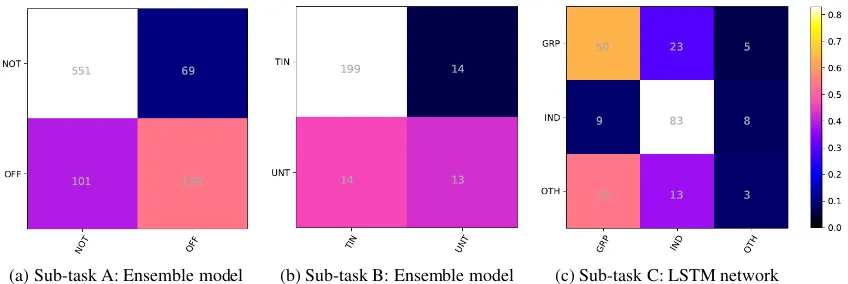
Subtask A: As seen in Figure 2a, the ensem-ble model had more difficulty identifying offen-sive tweets than the non-offenoffen-sive ones. As also noted in previous work byDavidson et al.(2017) and others, we see that the classifier finds it diffi-cult to identify offensive tweets that lack profanity such as “@USER Get back on your peanut farm old man” (24726) and “@USER She is such a witch. All she needs is a broom” (49813). The classifier also faced issues in classifying political discourse, as it may have learned trends of words such as ‘MAGA’, ‘Trump’, ‘Liberals’ and ‘Con-servatives’ being appearing relatively often under
the OFF (offensive) label. This leads to misclassi-fication of tweets such as“@USER Up next: liber-als calling us out for calling him guilty.” (59807)
and“@USER there is a point where even liberals must question motives” (15788)as offensive.
Subtask B: Due to the highly imbalanced data set, the minority class (UNT) as expected ac-counted for most of the misclassifications, as seen in Figure2b. The simple trend deduced was that tweets with pronouns such as ‘she’, ‘your’, ‘he’, and ‘I’ were biased to be classified as targeted (TIN). This leads to misclassification of untar-geted insults such as, “@USER @USER Still no excuse... Where TF are her parents??? They are using him & he is using her” (10641) and
“@USER If someone is being too nice to you at happy hour and asking probing questions about what you do at Pub Citizen....make sure to troll them and say you’re with Antifa or something.” (58699),“@USER I hate him im so fucking sorry” (91969). The opposite is also true, with targeted insults that contain no pronouns being misclassi-fied as untargeted: “@USER Google go to hell!” (52798), “@USER and bale is shit” (47806).
Subtask C: Most misclassification in this sub-task occurred on the Other (OTH) label; see Fig-ure 2c. Here most tweets labelled OTH were classified under the Group (GRP) class, due to close similarity between the two labels. Con-sider the following examples: “@USER @USER Because 45% of Americans are too lazy to vote. Non-voters skew liberal. And too many liberals who do vote throw their vote away on 3rd party losers. Next question?” (82171) and “@USER @USER @USER @USER Connections are vital with all of the crap Twitter forces on conserva-tives.” (89193). Both these tweets are classified as GRP insults, probably due to the presence of terms such as ‘Americans’, ‘liberals’, and ‘conser-vatives’ that tend to relate to groups, while actually being annotated as OTH as they address an issue rather than a group.
(a) Sub-task A: Ensemble model (b) Sub-task B: Ensemble model (c) Sub-task C: LSTM network
Figure 2: Confusion matrices (X-axis = predicted label; Y-axis = true label)
7 Conclusion
The idea of a hierarchical classification of offen-sive language is a step in the right direction in reducing the ambiguity existing between various similar subtasks. It is yet to be seen, however, how effective this method would be in synthesis-ing more specific subsets of offensive language. For example, the cyberbullying subtask instances may yield either OFF, TIN or IND labels at each level of classification, but we are unaware of how effectively models developed for the OffensEval subtask perform on cyberbullying data sets. Some issues that have plagued offensive language detec-tion — such as the problem of ambiguity and over-lap between various subtasks — could effectively be solved if the idea of hierarchical classification achieves what it sets out to do.
Consistent with previous work, we find that it is difficult to classify non-offensive tweets contain-ing profanity and offensive tweets lackcontain-ing profan-ity. We also found that a similar issue persists with tweets that are politically motivated and valid crit-icism incorrectly classified as offensive and sim-ilarly, political hate incorrectly classified as non-offensive.
On the topic of selecting a classification model, it is noteworthy that even a simple and crude deep learning model such as the one used here can ob-tain better results than a more polished ensemble model. Except for surface level n-grams, most fea-tures are not as predictive as we would like them to be.
The data analysis showed that even though the annotators of the OLID data set were experienced with the platform, there still exist quite a few cases of erroneous classification by the annotators, just as noted for other datasets (Waseem and Hovy,
2016;Davidson et al.,2017;Nobata et al.,2016), for which amateur annotators were found unreli-able.
Offensive language detection has proven to be a more layered issue than was initially expected, but with various developments in research the task seems surmountable. Future work must focus on building upon previous endeavours, to reduce the redundancy between subtasks and publications. The OffensEval shared task is a significant step forward in achieving this goal and we look for-ward to seeing how future research will be affected by the work that has been done here.
References
Peter Burnap and Matthew Leighton Williams. 2015. Hate speech, machine classification and statistical modelling of information flows on Twitter: Interpre-tation and communication for policy decision mak-ing.Policy and Internet, 7(2):223–242.
Ying Chen, Yilu Zhou, Sencun Zhu, and Heng Xu. 2012. Detecting offensive language in social me-dia to protect adolescent online safety. In Proceed-ings of the 2012 ASE/IEEE International Confer-ence on Social Computing and 2012 ASE/IEEE In-ternational Conference on Privacy, Security, Risk and Trust, pages 71–80, Amsterdam, Netherlands. IEEE.
Koby Crammer, Ofer Dekel, Joseph Keshet, Shai Shalev-Shwartz, and Yoram Singer. 2006. Online passive-aggressive algorithms. Journal of Machine Learning Research, 7:551–585.
Maral Dadvar, Dolf Trieschnigg, Roeland Ordelman, and Franciska de Jong. 2013. Improving cyber-bullying detection with user context. In Advances in Information Retrieval, pages 693–696. Springer.
Proceedings of the 11th International Conference on Web and Social Media, pages 512–516, Montr´eal, Qu´ebec, Canada. AAAI Press.
Karthik Dinakar, Roi Reichart, and Henry Lieberman. 2011. Modeling the detection of textual cyber-bullying. InThe Social Mobile Web, pages 11–17.
Antigoni-Maria Founta, Constantinos Djouvas, De-spoina Chatzakou, Ilias Leontiadis, Jeremy Black-burn, Gianluca Stringhini, Athena Vakali, Michael Sirivianos, and Nicolas Kourtellis. 2018. Large scale crowdsourcing and characterization of Twitter abusive behavior. CoRR, abs/1802.00393.
Bj¨orn Gamb¨ack and Utpal Kumar Sikdar. 2017. Us-ing convolutional neural networks to classify hate-speech. In (Waseem et al.,2017a), pages 85–90.
Lei Gao and Ruihong Huang. 2017. Detecting online hate speech using context aware models. CoRR, abs/1710.07395.
Kevin Gimpel, Nathan Schneider, Brendan O’Connor, Dipanjan Das, Daniel Mills, Jacob Eisenstein, Michael Heilman, Dani Yogatama, Jeffrey Flani-gan, and Noah A. Smith. 2011. Part-of-speech tag-ging for Twitter: annotation, features, and experi-ments. InProceedings of the 49th Annual Meeting of the Association for Computational Linguistics: Human Language Technologies, volume 2, short pa-pers, pages 42–47, Portland, Oregon, USA. ACL.
Sepp Hochreiter and J¨urgen Schmidhuber. 1997. Long short-term memory. Neural Computation, 9(8):1735–1780.
Raquel Justo, Thomas Corcoran, Stephanie M. Lukin, Marilyn Walker, and M. In´es Torres. 2014. Extract-ing relevant knowledge for the detection of sarcasm
and nastiness in the social web. Knowledge-Based
Systems, 69(1):124–133.
Ludmila I. Kuncheva. 2004. Combining Pattern Classifiers: Methods and Algorithms. Wiley-Interscience, New York, New York, USA.
Shervin Malmasi and Marcos Zampieri. 2018. Chal-lenges in discriminating profanity from hate speech.
Journal of Experimental & Theoretical Artificial In-telligence, 30:1–16.
Yashar Mehdad and Joel R. Tetreault. 2016. Do charac-ters abuse more than words? InProceedings of the 17th Annual Meeting of the Special Interest Group on Discourse and Dialogue, pages 299–303, Los Angeles, California, USA. ACL/SIGDIAL.
Chikashi Nobata, Joel Tetreault, Achint Thomas, Yashar Mehdad, and Yi Chang. 2016. Abusive lan-guage detection in online user content. In Pro-ceedings of the 25th International Conference on World Wide Web, pages 145–153, Montr´eal, Qu´ebec, Canada. IW3C2.
F. Pedregosa, G. Varoquaux, A. Gramfort, V. Michel, B. Thirion, O. Grisel, M. Blondel, P. Pretten-hofer, R. Weiss, V. Dubourg, J. Vanderplas, A.
Pas-E. Duchesnay. 2011. Scikit-learn: Machine learning in Python. Journal of Machine Learning Research, 12:2825–2830.
Jeffrey Pennington, Richard Socher, and Christo-pher D. Manning. 2014. GloVe: Global vectors for word representation. In Proceedings of the 2014 Conference on Empirical Methods in Natural Lan-guage Processing, pages 1532–1543, Doha, Qatar. ACL.
Georgios Pitsilis, Heri Ramampiaro, and Helge Langseth. 2018. Effective hate-speech detection in
twitter data using recurrent neural networks.
Ap-plied Intelligence, 48(12):47304742.
Anna Schmidt and Michael Wiegland. 2017. A sur-vey on hate speech detection using natural language processing. InProceedings of the 5th International Workshop on Natural Language Processing for So-cial Media, pages 1–10, Valencia, Spain. ACL.
Elise Fehn Unsv˚ag and Bj¨orn Gamb¨ack. 2018. The ef-fects of user features on Twitter hate speech detec-tion. InProceedings of the 2nd Workshop on Abu-sive Language Online, pages 75–86, Brussels, Bel-gium. ACL.
Cynthia Van Hee, Els Lefever, Ben Verhoeven, Julie Mennes, Bart Desmet, Guy De Pauw, Walter Daele-mans, and Veronique Hoste. 2015. Detection and fine-grained classification of cyberbullying events. InProceedings of Recent Advances in Natural Lan-guage Processing, Proceedings, pages 672–680.
Zeerak Waseem, Wendy Hui Kyong Chung, Dirk Hovy, and Joel Tetreault, editors. 2017a. Proceedings of the First Workshop on Abusive Language Online. ACL, Vancouver, Canada.
Zeerak Waseem, Thomas Davidson, Dana Warmsley, and Ingmar Weber. 2017b. Understanding abuse: A typology of abusive language detection subtasks. In (Waseem et al.,2017a), pages 78–84.
Zeerak Waseem and Dirk Hovy. 2016. Hateful sym-bols or hateful people? Predictive features for hate speech detection on Twitter. In Proceedings of the North American Chapter of the Association for Computational Linguistics, Student Research Work-shop, pages 88–93, San Diego, California, USA. ACL.
Michael Wiegand, Melanie Siegel, and Josef Ruppen-hofer. 2018. Overview of the GermEval 2018 shared task on the identification of offensive language. In
Proceedings of the GermEval 2018 Workshop, Aus-trian Academy of Sciences, Vienna, Austria.
Jun-Ming Xu, Kwang-Sung Jun, Xiaojin Zhu, and Amy Bellmore. 2012. Learning from bullying traces in social media. InProceedings of the 2012 Con-ference of the North American Chapter of the As-sociation for Computational Linguistics: Human Language Technologies, pages 656–666, Montr´eal, Canada. ACL.
Marcos Zampieri, Shervin Malmasi, Preslav Nakov, Sara Rosenthal, Noura Farra, and Ritesh Kumar. 2019a. Predicting the type and target of offensive posts in social media. In Proceedings of the 2019 Conference of the North American Chapter of the Association for Computational Linguistics: Human Language Technologies, Minneapolis, Minnesota, USA. ACL.
Marcos Zampieri, Shervin Malmasi, Preslav Nakov, Sara Rosenthal, Noura Farra, and Ritesh Kumar. 2019b. SemEval-2019 Task 6: Identifying and Cat-egorizing Offensive Language in Social Media (Of-fensEval). InProceedings of the 13th International Workshop on Semantic Evaluation (SemEval). ACL.
Ziqi Zhang, David Robinson, and Jonathan Tepper. 2018. Detecting hate speech on Twitter using a convolution-GRU based deep neural network. In