Which argument is more convincing? Analyzing and predicting
convincingness of Web arguments using bidirectional LSTM
Ivan Habernal† and Iryna Gurevych†‡ †Ubiquitous Knowledge Processing Lab (UKP)
Department of Computer Science, Technische Universit¨at Darmstadt
‡Ubiquitous Knowledge Processing Lab (UKP-DIPF)
German Institute for Educational Research www.ukp.tu-darmstadt.de
Abstract
We propose a new task in the field of computational argumentation in which we investigate qualitative properties of Web arguments, namely their convincingness. We cast the problem as relation classifica-tion, where a pair of arguments having the same stance to the same prompt is judged. We annotate a large datasets of 16k pairs of arguments over 32 topics and investi-gate whether the relation “A is more con-vincing than B” exhibits properties of total ordering; these findings are used as global constraints for cleaning the crowdsourced data. We propose two tasks: (1) predicting which argument from an argument pair is more convincing and (2) ranking all argu-ments to the topic based on their convinc-ingness. We experiment with feature-rich SVM and bidirectional LSTM and obtain 0.76-0.78 accuracy and 0.35-0.40 Spear-man’s correlation in a cross-topic evalua-tion. We release the newly created corpus
UKPConvArg1and the experimental soft-ware under open licenses.
1 Introduction
What makes a good argument? Despite the re-cent achievements in computational argumenta-tion, such as identifying argument components (Habernal and Gurevych, 2015; Habernal and Gurevych, 2016), finding evidence for claims (Rinott et al., 2015), or predicting argument structure (Peldszus and Stede, 2015; Stab and Gurevych, 2014), this question remains too hard to be answered.
Even Aristotle claimed that perceiving an argu-ment as a “good” one depends on multiple fac-tors (Aristotle and Kennedy (translator), 1991)
— not only the logical structure of the argument (logos), but also on the speaker (ethos), emo-tions (pathos), or context (cairos) (Schiappa and Nordin, 2013). Experiments also show that differ-ent audiences perceive the very same argumdiffer-ents differently (Mercier and Sperber, 2011). A solid body of argumentation research has been devoted to the quality of arguments (Walton, 1989; John-son and Blair, 2006), giving more profound cri-teria that “good” arguments should fulfill. How-ever, the empirical evidence proving applicabil-ity of many theories falls short on everyday argu-ments (Boudry et al., 2015).
Since the main goal of argumentation is persua-sion (Nettel and Roque, 2011; Mercier and Sper-ber, 2011; Blair, 2011; OKeefe, 2011) we take a pragmatic perspective on qualitative properties of argumentation and investigate a new high-level task. We asked whether we could quantify and predict how convincing an argument is.
Prompt: Should physical education be mandatory in schools?Stance:Yes!
Argument 1 Argument 2
physical education should be mandatory cuhz 112,000 peo-ple have died in the year 2011 so far and it’s because of the lack of physical activity and people are becoming obese!!!!
YES, because some children don’t under-stand anything excect physical education especially rich children of rich parents.
Figure 1: Example of an argument pair.
If we take Argument 1 from Figure 1, assigning a single “convincingness score” is highly subjec-tive, given the lack of context, reader’s prejudice, beliefs, etc. However, when comparing both argu-ments from the same example, one can decide that A1 is probably more convincing than A2, because it uses at least some statistics, addresses the health
factor, and A2 is just harsh and attacks.1 We adapt
pairwise comparison as our backbone approach. We propose a novel task of predicting con-vincingness of arguments in an argument pair, as well as ranking arguments related to a certain topic. Since no data for such a task are avail-able, we create a new annotated corpus. We em-ploy SVM model with rich linguistic features as well as bidirectional Long Short-Term Memory (BLSTM) neural networks because of their excel-lent performance across various end-to-end NLP tasks (Goodfellow et al., 2016; Piech et al., 2015; Wen et al., 2016; Dyer et al., 2015; Rockt¨aschel et al., 2016).
Main contributions of this article are (1) large annotated dataset consisting of 16k argument pairs with 56k reasons in natural language (700k tokens), (2) thorough investigation of the annotated data with respect to properties of convincingness as a measure, (3) a SVM model and end-to-end BLSTM model. The an-notated data, licensed under CC-BY-SA license, and the experimental code are publicly avail-able at https://github.com/UKPLab/ acl2016-convincing-arguments. We hope it will foster future research in computational argumentation and beyond.
2 Related Work
Recent years can be seen as a dawn of computa-tional argumentation – an emerging sub-field of NLP in which natural language arguments and argumentation are modeled, searched, analyzed, generated, and evaluated. The main focus has been paid to analyzing argument structures, under the umbrella entitled argumentation mining.
Web discourse as a data source has been ex-ploited in several tasks in argumentation mining, such as classifying propositions in user comments into three classes (verifiable experiential, verifi-able non-experiential, and unverifiverifi-able) (Park and Cardie, 2014), or mapping argument components to Toulmin’s model of argument in user-generated Web discourse (Habernal and Gurevych, 2015), to name a few. While these approaches are crucial for understanding the structure of an argument, they do not directly address any qualitative criteria of argumentation.
Argumentation quality has been an active topic 1These are actualreasonsprovided by annotators, as will be explained later in Section 3.
among argumentation scholars. Walton (1989) discusses validity of arguments in informal logic, while Johnson and Blair (2006) elaborate on crite-ria for practical argument evaluation (namely Rel-evance, Acceptability, and Sufficiency). Yet, em-pirical research on argumentation quality does not seem to reflect these criteria and leans toward sim-plistic evaluation using argument structures, such as how many premises support a claim (Stegmann et al., 2011), or by the complexity of the ana-lyzed argument scheme (Garcia-Mila et al., 2013). To the best of our knowledge, there have been only few attempts in computational argumentation that go deeper than analyzing argument structures (e.g., (Park and Cardie, 2014) mentioned above). Persing and Ng (2015) model argument strength in persuasive essays using a manually annotated cor-pus of 1,000 documents labeled with a 1–4 score value.
Our newly created corpus of annotated pairs of arguments might resemble recent large-scale corpora for textual inference. Bowman et al. (2015) introduced a 570k sentence pairs writ-ten by crowd-workers, the largest corpus to date. Whereas their task is to classify whether the sen-tence pair representsentailment,contradiction, or isneutral (thus heading towards a deepsemantic
understanding), our goal is to assess the pragmat-icalproperties of the given multiple sentence-long arguments (to which extent they fulfill the goal of persuasion). Moreover, each of our annotated ar-gument pairs is accompanied with five textual rea-sons that explain the rationale behind the labeler’s decision. This is, to the best of our knowledge, a unique novel feature of our data.
Pairwise assessment for obtaining relative pref-erence was examined by (Chen et al., 2013), among many others.2 Their system was tested
on ranking documents by their reading difficulty. Relative preference annotations have also been heavily employed in assessing machine translation (Aranberri et al., 2016). By contrast to our work, the underlying relations (reading difficulty 1-12 or better translation) have well known properties of total ordering, while convincingness of arguments is a yet unexplored task, thus no assumptions can be made apriori. There is also a substantial body of work on learning to rank, where also a pair-wise approach is widely used (Cao et al., 2007). These methods have been traditionally used in IR,
where the retrieved documents are ranked accord-ing to their relevance and pairs of documents are automatically sampled.
Employing LSTM for natural language in-ference tasks has recently gained popularity (Rockt¨aschel et al., 2016; Wang and Jiang, 2016; Cheng et al., 2016). These methods are usually tested on the SNLI data introduced above (Bow-man et al., 2015).
3 Data annotation
Since assessing convincingness of a single argu-ment directly is a very subjective task with high probability of introducing annotator’s bias (be-cause of personal preferences, beliefs, or back-ground), we cast the problem as a relation anno-tation task. Given two arguments, one should be selected as more convincing, or they might be both equally convincing (see an example in Figure 1).
3.1 Sampling annotation candidates
Sampling large sets of arguments for annotation from the Web poses several challenges. First, we must be sure that the obtained texts are actual argu-ments. Second, the context of the argument should be known (the prompt and the stance). Finally, we need sources with permissive licenses, which al-low us to release the resulting corpus further to the community. These criteria are met by arguments from twodebate portals.3
We will use the following terminology. We use
topicto refer to a subset of an on-line debate with a given prompt and a certain stance (for exam-ple,”Should physical education be mandatory in schools? – yes” is considered as a single topic). Each debate has two topics, one for each stance.
Argumentis a single comment directly addressing the debate prompt. Argument pair is an ordered set of two arguments (A1andA2) belonging to the same topic; see Figure 1.
We automatically selected debates that con-tained at least 25 top-level4 arguments that were
10-110 words long (the mean for all top-level ar-guments was66±130and the median 36, so we excluded the lengthy outliers in our sampling). We manually filtered out obvious silly debates (e.g.,
’Superman vs. Batman’) and ended up with 32
topics(the full topic list is presented together with 3Namely,createdebate.comandprocon.org. 4Such arguments directly address the topic and are not a part of a threaded discussion.
experimental results later in Table 3). From each topic we automatically sampled 25-35 random ar-guments and created (n ∗(n−1)/2) argument pairsby combining all selected arguments. Sam-pling argument pairs only from the same topics and not combining opposite stances was a design decision how to mitigate annotators’ bias.5 The
order of arguments A1 and A2 in each argument pair was randomly shuffled. In total we sampled 16,927 argument pairs.
3.2 Crowdsourcing annotations
Let us extend our terminology. Workeris a single annotator in Amazon Mechanical Turk. Reasonis an explanation whyA1is more convincing thanA2
(or the other way round, or why they are equally convincing). Gold reasonis a reason whose label matches the gold label in the argument pair (see Figure 2).
In the HIT, workers were presented with an ar-gument pair, the prompt, and the stance as in Fig-ure 1. They had to choose either“A1 is more con-vincing than A2”(A1>A2),“A1 is less convinc-ing than A2”(A1<A2), or “A1 and A2 are con-vincing equally”(A1=A2). Moreover, they were obliged to write thereason30-140 characters long. An example of fully annotated argument pair is shown in Figure 2. The workers were also pro-vided with clear and crisp instructions (e.g., do not judge the truth of the proposition; be objective; do not express your position; etc.).
All 16,927 argument pairs were annotated by five workers each (85k assignments in total). We also allowed workers to express their own stand-point toward the topics. While 66% of workers had no standpoint, 14% had the opposite view and 20% the same view. This indicates that there should be no systematic bias in the data. Crowd-sourcing took about six weeks in 2016 plus two weeks of pilot studies. In total, about 3,900 work-ers participated. Total costs including pilot studies and bonus payments were 5,520 USD.
3.3 Quality control and agreement
Argument 1 Argument 2
physical education should be mandatory cuhz 112,000 people have [...]
YES, because some chil-dren don’t understand any-thing expect [...]
• A1>A2,becauseA1 uses statistics, and doesn’t make assumptions.
• A1>A2, because A1 talks about the importance of health.
• A1>A2, because A1 provides a health-related argu-ment.
• A1>A2,becauseA2 is very harsh and attacks • A1=A2,because Neither A1 or A2 cite evidence to
support their claims.
Figure 2: Example of anargument pairannotated by five workers. The arguments are shortened versions of Figure 1. The explanations (called
reasons) after ‘because’ are written by workers; the estimated gold label for this pair is probably
A1>A2, thus there are fourgold reasons.
the true labels and ranking the annotators. We set the MACE’s parameterthreshold to 0.95 to keep only instances whose entropy is among the 95% best estimates. Third, we manually checked all the reasons for each worker. With paying more attention to workers with low MACE scores, we rejected all assignments of workers if they (1) copied&pasted the same or very similar reasons
across argument pairs, (2) were only copying or rephrasing the texts from the arguments, (3) pro-vided their opinion or were arguing, (4) had many typos or provided obvious nonsense. In total, we rejected 1161 assignments.
We do not report any ‘standard’ inter-annotator agreement measures such as Fleiss’κor Krippen-dorff’s α, as their suitability for crowdsourcing has been recently disputed (Passonneau and Car-penter, 2014). However, in order to estimate the human performance, we analyzed the output of the pilot study. For eachargument pair, we took the best-ranked worker for that particular pair (worker ranks are globally estimated by MACE) and com-puted her accuracy against the estimated gold la-bels.6 The best-ranked worker for each argument
pair is not necessarily the globally best-ranked worker; in the pilot study, the average global rank of this hypothetical worker was 11 ±6.6. This rank can be interpreted as a decently performing worker; the obtained score reached 0.935 accu-racy.
6A similar approach was recently reported by Nakov et al. (2016).
3.4 Examining properties of convincingness 3.4.1 What makes a convincing argument? We manually examined a small sample of 200
gold reasons to find out what makes one argu-ment more convincing than the other. A very com-mon type of answer mentioned giving examples or actual reasons (“A1 cited several reasons to back up their argument.”) andfacts(“A1 cites an outside source which can be more credible than opinion”). This is not surprising, as argumenta-tion is often perceived as reason giving (Freeley and Steinberg, 2008). Others point out strengths inexplaining the reasoningorlogical coherence (“A1 gives a succinct and logical answer to the ar-gument. A2 strays away from the argument in the response.”). Theconfirmation bias(Mercier and Sperber, 2011) also played a role (“A1 argues both viewpoints, A2 chooses a side.”). Given the noisi-ness of Web data, some of the arguments might be non-sense, which was also pointed out as a reason (“A1 attempts to argue that since porn exists, we should watch it. A2 doesn’t make sense or answer the question.”). Apart from the logical structure of the argument, emotional aspects andrhetorical moveswere also spotted (“A1 contributes a view-point based on morality, which is a stronger argu-ment than A2, which does not argue for anything at all.”, or “A1 calls for the killing of all politi-cians, which is an immature knee-jerk reaction to a topic. A2’s argument is more intellectually pre-sented.”).
3.4.2 Transitivity evaluation using argument graphs
The previous section shows a variety of reasons that makes one argument more convincing than other arguments. Considering A1 is more con-vincing than A2 as a binary relation R, we thus asked the following research question: Is convinc-ingness a measure with total strict order or strict weak order? Namely, is relationRthat compares convingcingness of two arguments transitive, anti-symmetric, and total?
In particular, does is exhibit properties such that if A≥B and B≥C, then A≥C (total order-ing)? We can treat arguments as nodes in a graph and argument pairs as graph edges. We will denote such graph as argument graph (and use nodes/arguments and edges/pairs interchangeably in this section).7 As the sampled argument pairs
contained all argument pair combinations for each topic, we ended up with an almost fully connected argument graph for each topic (remember that we discarded 5% of argument pair annotations with lowest reliability). We further investigate the prop-erties of the argument graphs. Transitivity is only guaranteed, if the argument graph is a DAG (di-rected acyclic graph).
Building argument graph from crowdsourced argument pairs We build the argument graph iteratively by sampling annotated argument pairs and adding them as graph edges (see Algorithm 1). We consider two possible scenarios in the graph building algorithm. In the first scenario, we accept only argument pairs without equivalency (thus A>B is allowed but A=B is forbidden and discarded). The second scenario accepts all pairs, but since the resulting graph must be DAG, equiv-alent arguments are merged into one node. We use Johnson’s algorithm for finding all elementary cy-cles in DAG (Johnson, 1975).
Argument pair weights By building argument graph from all pairs, introducing cycles into the graph seems to be inevitable, given a certain amount of noise in the annotations. We asked the following question: to which extent does occur-rence of cycles in an argument graph depend on the quality of annotations?
We thus compute a weight for each argument pair. Letei be a particular annotation pair (edge).
LetGibe all labels in that pair that match the pre-dicted gold label, andOiopposite labels (different
from the gold label). Let v be a single worker’s vote and cv a global worker’s competence score. Then the weightwof edgeei is computed as
fol-lows:
wei =σ
X
v∈Gi
cv−λ X v∈Oi
cv
(1)
where σ is a sigmoid function σ = 1+e1−x to
squeeze the weight into the (0,1)interval and λ
is a penalty for opposite labels (we set empirically
λto 10.0 to ensure strict penalization). For exam-ple, if the predicted gold label from Figure 2 were A1>A2, thenGiwould contain four votes andOi
one vote (the last one).
This weight allows us to sort argument pairs before sampling them for building the argument
in the argument graph.
graph. We test three following strategies. As a baseline, we use random shuffling (Rand), where no prior information about the weight of the pairs is given. The other two sorting algorithms use the argument pair weight computed by Equation 1. As the worst case scenario, we sort the pairs in as-cending order (Asc), which means that the “worse” pairs come first to the graph building algorithm. We used this scenario to see how much the prior pair weight information actually matters, because building a graph preferably from bad pair label es-timates should cause more harm. Finally, theDesc
algorithm sorts the pairs given their weight in de-scending order (the “better” estimates come first).
Algorithm 1: Building DAG from sorted ar-gument pairs.
input :argumentPairs;sortingAlg output: DAG
SortPairs(argumentPairs,sortingAlg); finalPairs←[];
foreachpairinargumentPairsdo currentPairs←[finalPairs,pair];
/* cluster edges labeled as equal so they will be treated as a single node */
clusters←clusterEqNodes(currentPairs); /* wire the pairs into directed graph */
g←buildGraph(currentPairs,clusters); ifhasCycles(g)then
// report about breaking DAG
else
finalPairs+=pair; returnbuildGraph(finalPairs);
Measuring transitivity score We measure how “good” the graph is by atransitivity score. Here we assume that the graph is a DAG. Given two nodesAandZ, letPLbe the longest path between
these nodes andPSthe shortest path, respectively.
For example, letPL = A → B → C → Z and
PS =A→D→Z. Then thetransitivity scoreis
the ratio of longest and shortest path |PL|
|PS|.(which
is 1.5 is our example). The average transitivity scoreis then an average of transitivity scores for each pair of nodes from the graph that are con-nected by two or more paths. Analogically, the
maximum transitivity score is the maximal value. We restrict the shortest path to be a direct edge only.
The motivation for the transitivity score is the following. If the longest path betweenA andZ
em-Figure 3: Final argument graph example (topic:
“Christianity or Atheism? Atheism”). Node la-bels: I/O/Tr (I: incoming edges, O: outgoing edges, Tr: maximum transitivity score). Lighter nodes have prevailingO; larger nodes have higher absolute number ofO.
pirically confirmed by the presence of the shortest path betweenAandZ. Thus the longer the longest path and the shorter the shortest path are on aver-age, the bigger empirical evidence is given about the transitivity property.
Figure 3 shows an example of argument graph built using only non-equivalent pairs and desc
prior sort or argument pairs. There are few “bad” arguments in the middle (many incoming edges, none outcoming) and few very convincing argu-ments (large circles). Notice the high maximum transitivity score even for medium-sized nodes.
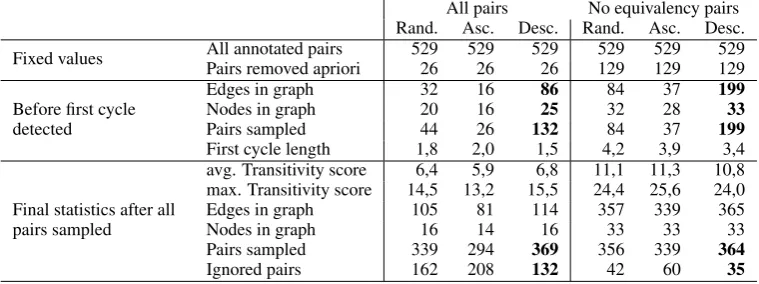
Observations First, let us compare the different sorting algorithms for each sampling strategy. As Table 1 shows, on average, 158 pairs are ignored in total when all pairs are used for sampling (26 removed by MACE and 132 by the graph building algorithm), while 164 pairs are ignored when only non-equivalent pairs are sampled (129 had already been removed apriori—26 by MACE and 103 as equivalent pairs—and 35 by the graph algorithm). The results show a tendency that, when sam-pling annotated argument pairs for building a DAG, sorting argument pairs by their weight based on workers’ scores influences the number of pairs that break the DAG by introducing cycles. In
par-ticular, starting with more confident argumenta-tion pairs, the graph grows bigger while keeping its DAG consistency. The presence of the equal
relation causes cycles to break the DAG sooner as compared to argument pairs in which one ar-gument is more convincing than the other. We in-terpret this finding as that it is easier for humans to judge A>B than A=B consistently across all pos-sible pairs of arguments from a given topic. 3.4.3 Gold-standard corpora
Our experiments show that convincingness be-tween a pair of arguments exhibits properties of strict total order when the possibility of two equally convincing arguments is prohibited. We thus used the above-mentioned method for graph building as a tool for posterior gold data filter-ing. We discard the equal argument pairs in ad-vance and filter out argument pairs that break the DAG properties. As a result, a set of 11,650 ar-gument pairs labeled as either A>B or A<B re-mains, which is summarized in Table 2. We call this corpusUKPConvArgStrict.
However, since the total strict ordering prop-erty of convincingness is only an empirically con-firmed working hypothesis, we also propose an-other realistic application. We construct a mixed graph by treating equal argument pairs (A=B) as undirected edges. Using PageRank, we rank the arguments (nodes) globally. The higher the PageRank for a particular node is, the “less con-vincing“ the argument is (has a global higher prob-ability of incoming edges). This allows us to rank all arguments for a particular topic. We call this datasetUKPConvArgRank(see Table 2).
We also release the full dataset UKPConvAr-gAll. In this data, no global filtering using graph construction methods is applied, only the local pre-filtering using MACE. We believe this dataset can be used as a supporting training data for some tasks that do not rely on the property of total or-dering. Along the actual argument texts, all the gold-standard corpora contain thereasonsas well as full workers’ information and debate meta-data. 4 Experiments
[image:6.595.78.289.64.282.2]All pairs No equivalency pairs Rand. Asc. Desc. Rand. Asc. Desc. Fixed values All annotated pairsPairs removed apriori 52926 52926 52926 529129 529129 529129
Before first cycle detected
Edges in graph 32 16 86 84 37 199
Nodes in graph 20 16 25 32 28 33
Pairs sampled 44 26 132 84 37 199
First cycle length 1,8 2,0 1,5 4,2 3,9 3,4
Final statistics after all pairs sampled
avg. Transitivity score 6,4 5,9 6,8 11,1 11,3 10,8 max. Transitivity score 14,5 13,2 15,5 24,4 25,6 24,0
Edges in graph 105 81 114 357 339 365
Nodes in graph 16 14 16 33 33 33
Pairs sampled 339 294 369 356 339 364
Ignored pairs 162 208 132 42 60 35
Table 1: Values averaged over all 32 topics reported by different sampling strategies and scenarios for argument graph building.
Dataset Size Instance type Size per topic Gold label distribution Gold reasons
a1 a2 eq size tokens
UKPConvArgAll 16,081 argument pair 502.5±91.3 6,398 6,394 3,289 56,446 696,537 UKPConvArgStrict 11,650 argument pair 364.1±71.1 5,872 5,778 0 44,121 547,057
[image:7.595.108.488.63.205.2]UKPConvArgRank 1,052 argument 32.9±3.2 — —
Table 2: Properties of resulting gold data.
challenging setting ensures that no arguments are seen in both training and test data.
4.1 Predicting convincingness of pairs
Since this task is a binary classification and the classes are equally distributed (see Table 2), we report accuracy and average the final score over folds (Forman and Scholz, 2010).
Methods As a “traditional” method, we employ SVM with RBF kernel8 based on a large set of
rich linguistic features. They include uni- and bi-gram presence, ratio ofadjective and adverb endingsthat may signalize neuroticism (Corney et al., 2002),contextuality measure(Heylighen and Dewaele, 2002),dependency tree depth, ratio of exclamationorquotation marks, ratio ofmodal verbs, counts of severalnamed entity types, ra-tio of pastvs.future tense verbs, POSn-grams, presence of dependency tree production rules, seven different readability measures (e.g., Ari
(Senter and Smith, 1967), Coleman-Liau (Cole-man and Liau, 1975), Flesch(Flesch, 1948), and others), five sentiment scores (from very nega-tive to very posinega-tive) (Socher et al., 2013), spell-checkingusing standard Unixwords, ratio of su-perlatives, and somesurfacefeatures such as sen-tence lengths, longer words count, etc. The result-ing feature vector dimension is about 64k.
We also use bidirectional Long Short-Term 8Using LISBVM (Chang and Lin, 2011).
Memory (BLSTM) neural network for end-to-end processing.9 The input layer relies on pre-trained
word embeddings, in particular GloVe (Penning-ton et al., 2014) trained on 840B tokens from Common Crawl;10the embedding weights are
fur-ther updated during training. The core of the model consists of two bi-directional LSTM net-works with 64 output neurons each. Their output is then concatenated into a single drop-out layer and passed to the final sigmoid layer for binary predictions. We train the network with ADAM op-timizer (Kingma and Ba, 2015) using binary cross-entropy loss function and regularize by early stop-ping (5 training epochs) and high drop-out rate (0.5) in the dropout layer. For both models, each training/test instance simply concatenates A1 and A2 from the argument pair.
Results and error analysis As shown in Table 3, SVM (0.78) outperforms BSLTM (0.76) with a subtle but significant difference. It is also apparent that some topics are more challenging regardless of the system (e.g.,“Is it better to have a lousy fa-ther or to be fafa-therless? – Lousy fafa-ther”). Both systems outperform a simple baseline (lemma n-gram presence features with SVM, not reported in detail, achieved 0.65 accuracy) but still do not reach the human upper bounds (0.93 as reported in Section 3.3).
9Usinghttp://keras.io/
Topic SVM BLSTM Ban Plastic Water
Bottles? NoYes .85.90 .76.83
Christianity or Atheism AtheismChristianity .81.68 .80.75 Evolution vs. Creation CreationEvolution .84.66 .88.77 Firefox vs. Internet
Explorer IEFirefox .84.82 .81.78 Gay marriage - right or
wrong? RightWrong .76.82 .74.87 Should parents use
spanking? NoYes .84.79 .78.68 If your spouse
committed murder [...] NoYes .71.79 .64.72 India has the potential
to lead the world NoYes .82.69 .77.79 Is it better to have a
lousy father or to be fatherless?
Fatherless .77 .69 Lousy
fa-ther .67 .60
Is porn wrong? NoYes .82.85 .79.85 Is the school uniform a
good or bad idea? BadGood .75.83 .78.74 Pro choice vs. Pro life ChoiceLife .71.79 .68.80 Should physical edu.
be mandatory? NoYes .79.79 .80.78 TV is better than books NoYes .78.78 .73.75 Personal pursuit or
common good? CommonPersonal .72.67 .78.68 Farquhar as the founder
of Singapore NoYes .79.85 .63.76
[image:8.595.330.505.62.93.2]Average .78 .76
Table 3: Accuracy results onUKPConvArgStrict
data. The difference between SVM and bi-directionalLSTMis significant,p= 0.0414using two-tailed Wilcoxon signed-rank test.
We examined about fifty random false predic-tions to gain some insight into the limitapredic-tions of both systems. We looked into argument pairs, in which both methods failed, as well as into instances where only one model was correct. BLSTM won in few cases by properly catching jokes or off-topic arguments; SVM was properly catching all-upper-case arguments (considered as less convincing). By examining failures common to both systems, we found several cases where the prediction was wrong due to very negative senti-ment (which might be a sign of the less convinc-ing argument), but in other cases an argument with strong negative sentiment was actually the more convincing one. In general, we did not find any tendency on failures; they were also independent of the worker assignments distribution, thus not caused by likely ambiguous (hard) instances.
SVM BLSTM p-value Pearson’sr .351 .270 0.01 Spearman’sρ .402 .354 0.01
Table 4: Correlation results on UKPConvArg-Rank.
4.2 Ranking arguments
We address this problem as a regression task. We use the UKPConvArgRank data, in which a real-value score is assigned to each argument so the arguments can be ranked by their convincingness (for each topic independently). The task is thus to predict a real-value score for each argument from the test topic (remember that we use 32-fold cross validation). We measure Spearman’s and Pear-son’s correlation coefficients on all results com-bined (not on each fold separately).
Without any modifications, we use the same SVM and features as described in Section 4.1. Re-garding the BLSTM, we only replace the output layer with a linear activation function and optimize mean absolute error loss. Table 4 shows that SVM outperforms BLSTM. All correlations are highly statistically significant.
4.3 Results discussion
Although the “traditional” SVM with rich linguis-tic features outperforms BLSTM in both tasks, there are other aspects to be considered. First, the employed features require heavy language-specific preprocessing machinery (lemmatizer, POS tagger, parser, NER, sentiment analyzer). By contrast, BLSTM only requires pre-trained em-bedding vectors, while delivering comparable re-sults. Second, we only experimented with vanilla LSTMs. Recent developments of deep neural net-works (especially attention mechanisms or grid-LSTMs) open up many future possibilities to gain performance in this end-to-end task.
5 Conclusion and future work
[image:8.595.71.290.62.429.2]under free licenses.11 To the best of our
knowl-edge, we are the first who deal with argument con-vincingness in Web data on such a large scale.
In the current article, we have only slightly touched the annotated natural text reasons. We believe that the presence of 44k reasons (550k to-kens) is another important asset of the newly cre-ated corpus, which deserves future investigation.
Acknowledgements
This work has been supported by the Volk-swagen Foundation as part of the Lichtenberg-Professorship Program under grant No I/82806,
by the German Institute for Educational Re-search (DIPF), by the German ReRe-search Founda-tion (DFG) via the German-Israeli Project Cooper-ation (DIP, grant DA 1600/1-1), by the GRK 1994 AIPHES (DFG), and by Amazon Web Services in Education Grant award. Lastly, we would like to thank the anonymous reviewers for their valuable feedback.
References
Nora Aranberri, Gorka Labaka, Arantza D´ıaz de Ilar-raza, and Kepa Sarasola. 2016. Ebaluatoia: crowd evaluation for English-Basque machine translation.
Language Resources and Evaluation. In press.
Aristotle and George Kennedy (translator). 1991. On Rhetoric: A Theory of Civil Discourse. Oxford Uni-versity Press, USA.
J. Anthony Blair. 2011. Argumentation as rational per-suasion.Argumentation, 26(1):71–81.
Maarten Boudry, Fabio Paglieri, and Massimo Pigli-ucci. 2015. The Fake, the Flimsy, and the Falla-cious: Demarcating Arguments in Real Life. Argu-mentation, 29(4):431–456.
Samuel R. Bowman, Gabor Angeli, Christopher Potts, and Christopher D. Manning. 2015. A large anno-tated corpus for learning natural language inference. In Proceedings of the 2015 Conference on Empiri-cal Methods in Natural Language Processing, pages 632–642, Lisbon, Portugal. Association for Compu-tational Linguistics.
Zhe Cao, Tao Qin, Tie-Yan Liu, Ming-Feng Tsai, and Hang Li. 2007. Learning to rank: From pairwise ap-proach to listwise apap-proach. InProceedings of the 24th International Conference on Machine Learn-ing, ICML ’07, pages 129–136, New York, NY, USA. ACM.
11https://github.com/UKPLab/ acl2016-convincing-arguments
Chih-Chung Chang and Chih-Jen Lin. 2011. LIB-SVM: A library for support vector machines. ACM Transactions on Intelligent Systems and Technology, 2:27:1–27:27.
Xi Chen, Paul N. Bennett, Kevyn Collins-Thompson, and Eric Horvitz. 2013. Pairwise ranking aggrega-tion in a crowdsourced setting. InProceedings of the sixth ACM international conference on Web search and data mining - WSDM ’13, page 193, New York, New York, USA. ACM Press.
Jianpeng Cheng, Li Dong, and Mirella Lapata. 2016. Long Short-Term Memory-Networks for Machine Reading.arXiv.
Meri Coleman and T. L. Liau. 1975. A computer read-ability formula designed for machine scoring. Jour-nal of Applied Psychology, 60:283–284.
Malcolm Corney, Olivier de Vel, Alison Anderson, and George Mohay. 2002. Gender-preferential text min-ing of e-mail discourse. InProceedings of the 18th Annual Computer Security Applications Conference (ACSAC02), pages 282–289.
Chris Dyer, Miguel Ballesteros, Wang Ling, Austin Matthews, and Noah A. Smith. 2015. Transition-based dependency parsing with stack long short-term memory. In Proceedings of the 53rd Annual Meeting of the Association for Computational Lin-guistics and the 7th International Joint Conference on Natural Language Processing (Volume 1: Long Papers), pages 334–343, Beijing, China, July. Asso-ciation for Computational Linguistics.
Rudolf Flesch. 1948. A new readability yardstick.
Journal of Applied Psychology, 32:221–233.
George Forman and Martin Scholz. 2010. Apples-to-Apples in Cross-Validation Studies: Pitfalls in Clas-sifier Performance Measurement. ACM SIGKDD Explorations Newsletter, 12(1):49–57.
Austin J. Freeley and David L. Steinberg. 2008. Ar-gumentation and Debate. Cengage Learning, Stam-ford, CT, USA, 12th edition.
Merce Garcia-Mila, Sandra Gilabert, Sibel Erduran, and Mark Felton. 2013. The effect of argumentative task goal on the quality of argumentative discourse.
Science Education, 97(4):497–523.
Ian Goodfellow, Yoshua Bengio, and Aaron Courville. 2016. Deep learning. Book in preparation for MIT Press.
Ivan Habernal and Iryna Gurevych. 2015. Exploit-ing debate portals for semi-supervised argumenta-tion mining in user-generated web discourse. In
Ivan Habernal and Iryna Gurevych. 2016. Ar-gumentation Mining in User-Generated Web Dis-course. Computational Linguistics. Under review. http://arxiv.org/abs/1601.02403.
Francis Heylighen and Jean-Marc Dewaele. 2002. Variation in the contextuality of language: An em-pirical measure. Foundations of Science, 7(3):293– 340.
Dirk Hovy, Taylor Berg-Kirkpatrick, Ashish Vaswani, and Eduard Hovy. 2013. Learning Whom to Trust with MACE. InProceedings of NAACL-HLT 2013, pages 1120–1130, Atlanta, Georgia. Association for Computational Linguistics.
Ralph H. Johnson and Anthony J. Blair. 2006. Logical Self-Defense. International Debate Education Asso-ciation.
Donald B. Johnson. 1975. Finding all the elementary circuits of a directed graph. SIAM Journal on Com-puting, 4(1):77–84.
Diederik Kingma and Jimmy Ba. 2015. Adam: A method for stochastic optimization. InProceedings of the 3rd International Conference for Learning Representations, San Diego, CA.
Hugo Mercier and Dan Sperber. 2011. Why do hu-mans reason? Arguments for an argumentative the-ory. The Behavioral and Brain Sciences, 34(2):57– 74; discussion 74–111.
Preslav Nakov, Sara Rosenthal, Svetlana Kiritchenko, Saif M. Mohammad, Zornitsa Kozareva, Alan Ritter, Veselin Stoyanov, and Xiaodan Zhu. 2016. Devel-oping a successful SemEval task in sentiment anal-ysis of Twitter and other social media texts. Lan-guage Resources and Evaluation, 50(1):35–65. Ana Laura Nettel and Georges Roque. 2011.
Persua-sive argumentation versus manipulation. Argumen-tation, 26(1):55–69.
Daniel J. OKeefe. 2011. Conviction, persuasion, and argumentation: Untangling the ends and means of influence.Argumentation, 26(1):19–32.
Joonsuk Park and Claire Cardie. 2014. Identifying appropriate support for propositions in online user comments. In Proceedings of the First Workshop on Argumentation Mining, pages 29–38, Baltimore, Maryland, June. Association for Computational Lin-guistics.
Rebecca J. Passonneau and Bob Carpenter. 2014. The Benefits of a Model of Annotation. Transactions of the Association for Computational Linguistics, 2:311–326.
Andreas Peldszus and Manfred Stede. 2015. Joint prediction in MST-style discourse parsing for ar-gumentation mining. In Proceedings of the 2015 Conference on Empirical Methods in Natural Lan-guage Processing, pages 938–948, Lisbon, Portugal,
September. Association for Computational Linguis-tics.
Jeffrey Pennington, Richard Socher, and Christopher Manning. 2014. Glove: Global vectors for word representation. In Proceedings of the 2014 Con-ference on Empirical Methods in Natural Language Processing (EMNLP), pages 1532–1543, Doha, Qatar. Association for Computational Linguistics. Isaac Persing and Vincent Ng. 2015. Modeling
ar-gument strength in student essays. InProceedings of the 53rd Annual Meeting of the Association for Computational Linguistics and the 7th International Joint Conference on Natural Language Processing (Volume 1: Long Papers), pages 543–552, Beijing, China, July. Association for Computational Linguis-tics.
Chris Piech, Jonathan Bassen, Jonathan Huang, Surya Ganguli, Mehran Sahami, Leonidas J. Guibas, and Jascha Sohl-Dickstein. 2015. Deep Knowledge Tracing. In Corinna Cortes, Neil D. Lawrence, Daniel D. Lee, Masashi Sugiyama, and Roman Gar-nett, editors, Advances in Neural Information Pro-cessing Systems 28, pages 505—-513, Montreal, CA. Curran Associates, Inc.
Ruty Rinott, Lena Dankin, Carlos Alzate Perez, Mitesh M. Khapra, Ehud Aharoni, and Noam Slonim. 2015. Show me your evidence - an au-tomatic method for context dependent evidence de-tection. InProceedings of the 2015 Conference on Empirical Methods in Natural Language Process-ing, pages 440–450, Lisbon, Portugal, September. Association for Computational Linguistics.
Tim Rockt¨aschel, Edward Grefenstette, Karl Moritz Hermann, Tom´aˇs Koˇcisk´y, and Phil Blunsom. 2016. Reasoning about entailment with neural attention. InProceedings of the 2016 International Conference on Learning Representations (ICLR), pages 1–9. Edward Schiappa and John P. Nordin. 2013.
Argumen-tation: Keeping Faith with Reason. Pearson UK, 1st edition.
J. R. Senter and E. A. Smith. 1967. Automated read-ability index. Technical report AMRL-TR-66-220, Aerospace Medical Research Laboratories, Ohio. Nihar B. Shah, Sivaraman Balakrishnan, Joseph K.
Bradley, Abhay Parekh, Kannan Ramchandran, and Martin J. Wainwright. 2015. Estima-tion from Pairwise Comparisons: Sharp Minimax Bounds with Topology Dependence. arXiv preprint, abs/1505.01462.
Christian Stab and Iryna Gurevych. 2014. Identify-ing argumentative discourse structures in persuasive essays. InProceedings of the 2014 Conference on Empirical Methods in Natural Language Processing (EMNLP), pages 46–56, Doha, Qatar, October. As-sociation for Computational Linguistics.
Karsten Stegmann, Christof Wecker, Armin Wein-berger, and Frank Fischer. 2011. Collabora-tive argumentation and cogniCollabora-tive elaboration in a computer-supported collaborative learning environ-ment.Instructional Science, 40(2):297–323. Douglas N. Walton. 1989. Informal Logic: A
Hand-book for Critical Argument. Cambridge University Press.
Shuohang Wang and Jing Jiang. 2016. Learning Nat-ural Language Inference with LSTM. In Proceed-ings of the 2016 Conference of the North American Chapter of the Association for Computational Lin-guistics: Human Language Technologies, page (to appear), San Diego, CA, June. Association for Com-putational Linguistics.