A Domain Adaptation Regularization for Denoising Autoencoders
St´ephane Clinchant, Gabriela Csurka and Boris Chidlovskii Xerox Research Centre Europe
6 chemin Maupertuis, Meylan, France [email protected]
Abstract
Finding domain invariant features is crit-ical for successful domain adaptation and transfer learning. However, in the case of unsupervised adaptation, there is a signif-icant risk of overfitting on source training data. Recently, a regularization for domain adaptation was proposed for deep models by (Ganin and Lempitsky, 2015). We build on their work by suggesting a more appro-priate regularization for denoising autoen-coders. Our model remains unsupervised and can be computed in a closed form. On standard text classification adaptation tasks, our approach yields the state of the art results, with an important reduction of the learning cost.
1 Introduction
Domain Adaptation problem arises each time when we need to leverage labeled data in one or more relatedsourcedomains, to learn a classifier for unseen data in a target domain. It has been studied for more than a decade, with applications in statistical machine translation, opinion mining, part of speech tagging, named entity recognition and document ranking (Daum´e and Marcu, 2006; Pan and Yang, 2010; Zhou and Chang, 2014).
The idea of finding domain invariant features underpins numerous works in domain adapta-tion. A shared representation eases prediction tasks, and theoretical analyses uphold such hy-potheses (Ben-David et al., 2007). For instance, (Daum´e and Marcu, 2006; Daum´e, 2009) have shown that replicating features in three main sub-spaces (source, common and target) yields im-proved accuracy as the classifier can subsequently pick the most relevant common features. With the pivoting technique (Blitzer et al., 2006; Pan
et al., 2010), the bag of words features are pro-jected on a subspace that captures the relations between some central pivot features and the re-maining words. Similarly, there are several ex-tensions of topic models and matrix factorization techniques where the latent factors are shared by source and target collections (Chen and Liu, 2014; Chen et al., 2013).
More recently, deep learning has been pro-posed as a generic solution to domain adaptation and transfer learning problems by demonstrating their ability to learn invariant features. On one hand, unsupervised models such asdenoising au-toencoders (Glorot et al., 2011) or models built on word embeddings (Bollegala et al., 2015) are shown to be effective for domain adaptation. On the other hand, supervised deep models (Long et al., 2015) can be designed to select an appropri-ate feature space for classification. Adaptation to a new domain can also be performed by fine tun-ing the neural network on the target task (Chopra et al., 2013). While such solutions perform rel-atively well, the refinement may require a signif-icant amount of new labeled data. Recent work by (Ganin and Lempitsky, 2015) has proposed a better strategy; they proposed to regularize inter-mediate layers with a domain prediction task, i.e. deciding whether an object comes from the source or target domain.
This paper proposes to combine the domain pre-diction regularization idea of (Ganin and Lempit-sky, 2015) with the denoising autoencoders. More precisely, we build on stacked Marginalized De-noising Autoencoders(sMDA) (Chen et al., 2012), which can be learned efficiently with a closed form solution. We show that such domain adaptation regularization keeps the benefits of the sMDA and yields results competitive to the state of the art re-sults of (Ganin and Lempitsky, 2015).
2 Target Regularized MDA
Stacked Denoising Autoencoders (sDA) (Vincent et al., 2008) are multi-layer neural networks trained to reconstruct input data from partial ran-dom corruption. The ranran-dom corruption, called blank-out noise or dropout, consists in randomly setting to zero some input nodes with probability
p; it has been shown to act as a regularizer (Wa-ger et al., 2013). The sDA is composed of a set of stacked one-layer linear denoising autoen-coder components, which consider a set ofN in-put documents (represented byd-dimensional fea-turesxn) to be corruptedMtimes by random fea-ture dropout and then reconstructed with a linear mapping W ∈ Rd×dby minimizing the squared reconstruction loss:
L(W) =XN n=1
M X
m=1
||xn−˜xnmW||2. (1)
As explicit corruption comes at a high com-putational cost, (Chen et al., 2012) propose to
marginalizethe loss (1) by considering the limit-ing case whenM → ∞and reducingde factothe learning cost. The main advantage of this method is a closed form solution for W, which depends only on the uncorrupted inputs (xn) and the drop-out probability. Several Marginalized Denoising Autoencoders (MDA) can be then stacked together to create a deep architecture where the representa-tions of the(l−1)thlayer serves as inputs to the
lthlayer1.
In the case of domain adaptation, the idea is to apply MDA (or sMDA) to the union of unlabeled sourceXsand targetXtexamples. Then, a stan-dard learning algorithm such as SVM or Logistic Regression is trained on the labeled source data us-ing the new feature representations (xs
nW) which captures better the correlation between the source and target data.
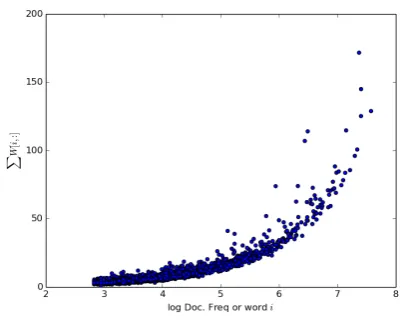
In Figure 1, we illustrate the effect of the MDA; it shows the relation between the word log docu-ment frequency (x-axes) and the expansion mass
defined as the total mass of words transformed into wordiby MDA and represented byPjWji. We can see that the mappingWlearned by MDA is heavily influenced by frequent words. In fact, MDA behaves similarly to document expansion on text documents: it adds new words with a 1Between layers, in general, a non linear function such as
[image:2.595.313.515.74.234.2]tanhorReLUis applied.
Figure 1: Relation between log document fre-quency and expansion mass. One dot represents one word.
very small frequency and sometimes words with a small negative weight. As the figure shows, MDA promotes common words (despite the use of tf-idf weighting scheme) that are frequent both in source and target domains and hence aims to be domain invariant.
This is in line with the work of (Ganin et al., 2015). To strengthen the invariance effect, they suggested a deep neural architecture which em-beds a domain prediction task in intermediate lay-ers, in order to capture domain invariant features. In this paper we go a step further and refine this argument by claiming thatwe want to be domain invariantbut also to beas close as possible to the target domain distribution. We want to match the target feature distribution because it is where the classification takes place.
We therefore propose a regularization for the denoising autoencoders, in particular for MDA, with the aim to makesource data resemble the tar-get dataand hence to ease the adaptation.
We describe here the case of two domains, but it can be easily generalized to multiple domains. LetDbe the vector of sizeN indicating for each document its domain, e.g. taking values of ’−1’ for source and ’+1’ for target examples. Letcbe a linear classifier represented as a ddimensional vector trained to distinguish between source and target,e.g. a ridge classifier that minimizes the loss
R(c, α) =||D−Xc>||2+α||c||2.
samples. Hence, we can extend each term of the loss (1) as follows:
||xn−x˜nmW||2+λ||1−x˜nmWc>||2. (2)
The first term here represents the reconstruction loss of the original input, like in MDA. In the sec-ond term,x˜mnWc>is the domain classifier pre-diction for the denoised objects forced to be close to1, the target domain indicator, andλ >0.
LetX¯ be the concatenation ofMreplicated ver-sion of the original dataX, and X˜ be the matrix representation of theM corrupted versions. Tak-ing into account the domain prediction term, the loss can be written as:
LR(W) =||X¯ −XW˜ ||2+λ||R¯ −XWc˜ >||2,
(3) whereRis a vector of sizeN, indicating a desired regularization objective, and R¯ its M-replicated version. Loss (3) represents a generic form to cap-ture three different ideas:
• IfR=1, the model incites the reconstructed features moving towards target specific fea-tures.
• IfR = −D, the model aims to promote do-main invariant features as in (Ganin et al., 2015).
• If R = [0;1], where 0 values are used for source data, the model penalizes the source specific features.
Learning the mapping W. (Chen et al., 2012) observed that the random corruption from equa-tion (1) could be marginalized out from the re-construction loss, yielding a unique and optimal solution. Furthermore, the mappingWcan be ex-pressed in closed form asW=PQ−1, with:
Qij =
Sijqiqj, if i6=j,
Sijqi, if i=j,
Pij = Sijqj, (4)
where2 q = [1−p, . . . ,1−p] ∈ Rd , p is the dropout probability, andS =XXT is the covari-ance matrix of the uncorrupted dataX.
The domain regularization term in (3) is quadratic inW, the random corruption can still be 2In contrast to (Chen et al., 2012), we do not add a bias feature so that the domain and MDA have the same dimen-sionality. Experiments shown no impact on the performance.
marginalized outand the expectations obtained in closed form. Indeed, the mappingWwhich mini-mizes the expectation of M1 LR(W)is the solution
of the following linear system3:
(P+λ(1−p)X>Rc>)(I +λcc>)−1 =QW.
(5) In (5), parameter λ controls the effect of the proposed target regularization in the MDA and the regularization on c is controlled by parame-terα. This approach preserves the good properties of MDA, i.e. the model is unsupervised and can be computed in closed form. In addition, we can easily stack several layers together and add non-linearities between layers.
3 Experiments
We conduct unsupervised domain adaptation ex-periments on two standard collections: the Ama-zon reviews (Blitzer et al., 2011) and the 20News-group (Pan and Yang, 2010) datasets.
From the Amazon dataset we consider the four most used domains:dvd (D), books (B), electron-ics (E) and kitchen (K), and adopt the settings of (Ganin et al., 2015) with the 5000 most frequent common features selected for each adaptation task and a tf-idf weighting. We then use the Logistic Regression (LR) to classify the reviews.
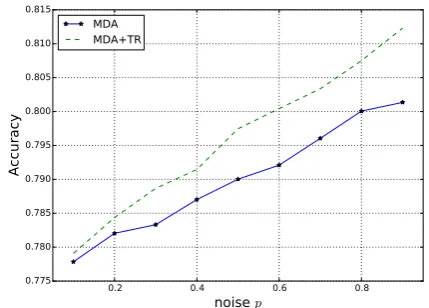
Our previous experiments with MDA revealed that the MDA noise probability pneeds to be set to high values (e.g.0.9). A possible explanation is that document representations are already sparse and adding low noise has no effect on the features already equal to zero. Figure 2 shows the average accuracy for the twelve Amazon tasks, when we vary the noise probabilityp.
In addition, we observed that a single layer
with a tanh activation function is sufficient to achieve top performance; stacking several layers and/or concatenating the outputs with the original features yields no improvement but increases the computational time.
The dropout probability pis fixed to 0.9 in all experiments, for both the MDA baseline and our model; we test the performance with a single layer and a tanhactivation function. Stacking several layers is left for future experiments. Parameters
α and λ are tuned on a grid of values4 by cross validation on the source data. In other words, we
0.2 0.4 0.6 0.8
noise p 0.775
0.780 0.785 0.790 0.795 0.800 0.805 0.810 0.815
Accuracy
[image:4.595.308.526.62.206.2]MDA MDA+TR
Figure 2: Impact of the noise parameter pon the average accuracy for the 12 Amazon adaptation tasks. Both MDA and its extension with the reg-ularization (MDA+TR) perform better with a high dropout-out noise. Here MDA+TR is run with fixed parametersα = 100andλ= 1.
select the LR parameters and the parametersα, λ
by cross validating the classification results using only the ”reconstructed” source data; for estimat-ingW we used the source with an unlabeled tar-get set (excluded at test time). This corresponds to the setting used in (Ganin et al., 2015), with the difference that they use SVM and reverse cross-validation5.
Table 3 shows the results for twelve adapta-tion tasks on the Amazon review dataset for the four following methods. Columns 1 and 2 show the LR classification results on the target set for the single layer MDA and the proposed target regularized MDA (MDA+TR). Column 3 reports the SVM result on the target from (Ganin et al., 2015). They used a 5 layers sMDA where the 5 outputs are concatenated with input to generate 30,000 features, on which the SVM is then trained and tested (G-sMDA). Finally, column 4 shows the current state of the art results obtained with Domain-Adversarial Training of Neural Networks (DA NN) instead of SVM (Ganin et al., 2015).
Despite a single layer and LR trained on the source only, the MDA baseline (80.15% on aver-age) is very close to the G-sMDA results obtained with 5 layer sMDA and 6 times larger feature set (80.18%). Furthermore, adding the target regular-ization allows to significantly outperform in many 5It consists in using self training on the target validation set and calibrating parameters on a validation set from the source labeled data.
S T MDA MDA+TR G-sMDA DA NN
D B 81.1 81.4 82.6 82.5
D K 84.1 85.3 84.2 84.9
D E 76.0 81.1 73.9 80.9
B D 82.7 81.7 83.0 82.9
B K 79.8 81.8 82.1 84.3
B E 75.9 79.3 76.6 80.4
K D 78.5 79.0 78.8 78.9
K B 77.0 77.0 76.9 71.8
K E 87.2 87.4 86.1 85.6
E D 78.5 78.3 77.0 78.1
E B 73.3 75.1 76.2 77.4
E K 87.7 88.2 84.7 88.1
Avg 80.15 81.27 80.18 81.32
Table 1: Accuracies of MDA, MDA+TR, G-sMDA and DA NN on the Amazon review dataset. Underline indicates improvement over the base-line MDA, bold indicates the highest value.
cases the baseline and the state of the art DA NN. We note that our method has a much lower cost, as it uses the closed form solutionfor the recon-struction and a simple LR on the reconstructed source data, instead of domain-adversarial train-ing of deep neural networks.
We also look at the difference between the pre-viously introduced expansion mass for the MDA and MDA+TR. In the adaptation task fromdvd(D) to electronics(E), the words for which the mass changed the most are the following6: worked,
to use, speakers, i have, work, mouse, bought, ca-ble, works, quality, unit, ipod, price, number , sound, card, phone, use, product, my. These words are mostly target specific and the results confirm that they get promoted by the new model.
Our model favors features which are more likely to appear in target examples, while DA NN seeks domain invariant features. Despite this difference, the two approaches achieve similar results. It is surprising, and we argue that eventually both ap-proaches penalizesource specific features. To test this hypothesis, we use MDA with R = [0;1] (case 3) that penalizes source specific features and we obtain again similar performances.
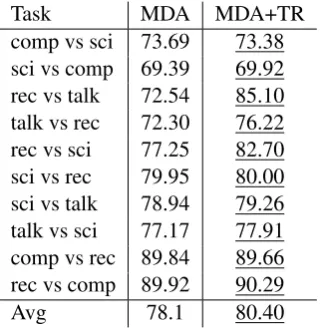
Finally, we test our approach on the 20News-group adaptation tasks described in (Pan and Yang, 2010). We first filter out rare words and keep at most 10,000 features. Then, we apply both MDA and MDA+TR as above. Table 3 shows re-sults for ten adaptation tasks. As we can see, in all cases the target regularization (MDA+TR) helps improve the classification accuracy.
[image:4.595.73.288.65.219.2]Task MDA MDA+TR
comp vs sci 73.69 73.38
sci vs comp 69.39 69.92
rec vs talk 72.54 85.10
talk vs rec 72.30 76.22
rec vs sci 77.25 82.70
sci vs rec 79.95 80.00
sci vs talk 78.94 79.26
talk vs sci 77.17 77.91
comp vs rec 89.84 89.66
rec vs comp 89.92 90.29
[image:5.595.102.263.62.227.2]Avg 78.1 80.40
Table 2: Accuracies of MDA and MDA+TR on 20Newsgroup adaptation tasks.
4 Conclusion
This paper proposes a domain adaptation regu-larization for denoising autoencoders, in particu-lar for marginalized ones. One limitation of our model is the linearity assumption for the domain classifier, but for textual data, linear classifiers are the state of the art technique. As new words and expressions become more frequent in a new do-main, the idea of using the dropout regularization that forces the reconstruction of initial objects to resemble target domain objects is rewarding. The main advantage of the new model is in the closed form solution. It is also unsupervised, as it does not require labeled target examples and yields per-formance results comparable with the current state of the art.
References
Shai Ben-David, John Blitzer, Koby Crammer, and Fernando Pereira. 2007. Analysis of representa-tions for domain adaptation. InAdvances in Neural Information Processing Systems, NIPS Conference Proceedings, Vancouver, British Columbia, Canada, December 4-7, 2006., volume 19.
John Blitzer, Ryan McDonald, and Fernando Pereira. 2006. Domain adaptation with structural correspon-dence learning. In Proceedings of Conference on Empirical Methods in Natural Language Process-ing, EMNLP, 22-23 July 2006, Sydney, Australia.
John Blitzer, Sham Kakade, and Dean P. Foster. 2011. Domain adaptation with coupled subspaces. In Pro-ceedings of the Fourteenth International Conference on Artificial Intelligence and Statistics, AISTATS, Fort Lauderdale, USA, April 11-13, 2011.
Danushka Bollegala, Takanori Maehara, and Ken-ichi Kawarabayashi. 2015. Unsupervised cross-domain word representation learning. InProceedings of the 53rd Annual Meeting of the Association for Compu-tational Linguistics, ACL, July 26-31, 2015, Beijing, China, volume 1.
Zhiyuan Chen and Bing Liu. 2014. Topic modeling using topics from many domains, lifelong learning and big data. In Proceedings of the 31st Interna-tional Conference on Machine Learning, ICML Be-jing, 21-16 June 2014.
M. Chen, Z. Xu, K. Q. Weinberger, and F. Sha. 2012. Marginalized denoising autoencoders for domain adaptation. ICML, arXiv:1206.4683.
Zhiyuan Chen, Arjun Mukherjee, Bing Liu, Meichun Hsu, Malu Castellanos, and Riddhiman Ghosh. 2013. Leveraging multi-domain prior knowledge in topic models. InProceedings of the Twenty-Third International Joint Conference on Artificial Intelli-gence, IJCAI ’13, pages 2071–2077. AAAI Press.
S. Chopra, S. Balakrishnan, and R. Gopalan. 2013. DLID: Deep learning for domain adaptation by in-terpolating between domains. InProceedings of the 30th International Conference on Machine Learn-ing, ICML, Atlanta, USA, 16-21 June 2013.
H. Daum´e and D. Marcu. 2006. Domain adaptation for statistical classifiers. JAIR, 26:101–126.
H. Daum´e. 2009. Frustratingly easy domain adapta-tion. CoRR, arXiv:0907.1815.
Yaroslav Ganin and Victor S. Lempitsky. 2015. Un-supervised domain adaptation by backpropagation. In Proceedings of the 32nd International Confer-ence on Machine Learning, ICML, Lille, France, 6-11 July 2015, pages 1180–1189.
Yaroslav Ganin, Evgeniya Ustinova, Hana Ajakan, Pascal Germain, Hugo Larochelle, Franc¸ois Lavi-olette, Mario Marchand, and Victor S. Lempitsky. 2015. Domain-adversarial training of neural net-works. CoRR, abs/1505.07818.
X. Glorot, A. Bordes, and Y. Bengio. 2011. Domain adaptation for large-scale sentiment classification: A deep learning approach. In Proceedings of the 28th International Conference on Machine Learn-ing, ICML, Bellevue, Washington, USA, June 28-July 2, 2011.
M. Long, Y. Cao, , J. Wang, and M. Jordan. 2015. Learning transferable features with deep adapta-tion networks. In Proceedings of the 32nd Inter-national Conference on Machine Learning, ICML 2015, Lille, France, 6-11 July 2015.
Sinno Jialin Pan, Xiaochuan Ni, Jian-Tao Sun, Qiang Yang, and Zheng Chen. 2010. Cross-domain sen-timent classification via spectral feature alignment. InProceedings of the 19th International Conference on World Wide Web, WWW, New York, NY, USA. ACM.
P. Vincent, H. Larochelle, Y. Bengio, and P.-A. Man-zagol. 2008. Extracting and composing robust features with denoising autoencoders. In Proceed-ings of the 25nd International Conference on Ma-chine Learning, ICML, Helsinki, Finland on July 5-9, 2008.