A Discriminative Topic Model using Document Network Structure
Weiwei Yang
Computer Science University of Maryland
College Park, MD [email protected]
Jordan Boyd-Graber
Computer Science University of Colorado
Boulder, CO
Jordan.Boyd.Graber@ colorado.edu
Philip Resnik
Linguistics andUMIACS
University of Maryland College Park, MD [email protected]
Abstract
Document collections often have links be-tween documents—citations, hyperlinks, or revisions—and which links are added is often based on topical similarity. To model these intuitions, we introduce a new topic model for documents situated within a net-work structure, integrating latent blocks of documents with a max-margin learning criterion for link prediction using topic-and word-level features. Experiments on a scientific paper dataset and collection of webpages show that, by more robustly exploiting the rich link structure within a document network, our model improves link prediction, topic quality, and block distributions.
1 Introduction
Documents often appear within a network struc-ture: social media mentions, retweets, and fol-lower relationships; Web pages by hyperlinks; sci-entific papers by citations. Network structure in-teracts with the topics in the text, in that docu-ments linked in a network are more likely to have similar topic distributions. For instance, a cita-tion link between two papers suggests that they are about a similar field, and a mentioning link between two social media users often indicates common interests. Conversely, documents’ sim-ilar topic distributions can suggest links between them. For example, topic model (Blei et al., 2003, LDA) and block detection papers (Holland et al., 1983) are relevant to our research, so we cite them. Similarly, if a social media user A finds another user B with shared interests, then A is more likely to follow B.
Our approach is part of a natural progression of network modeling in which models integrate
more information in more sophisticated ways. Some past methods only consider the network it-self (Kim and Leskovec, 2012; Liben-Nowell and Kleinberg, 2007), which loses the rich information in text. In other cases, methods take both links and text into account (Chaturvedi et al., 2012), but they are modeled separately, not jointly, limiting the model’s ability to capture interactions between the two. Therelational topic model(Chang and Blei, 2010, RTM) goes further, jointly modeling topics and links, but it considers only pairwise document relationships, failing to capture network structure at the level of groups orblocksof documents.
We propose a new joint model that makes fuller use of the rich link structure within a document network. Specifically, our model embeds the
weighted stochastic block model (Aicher et al., 2014, WSBM) to identify blocks in which docu-ments are densely connected.WSBMbasically cat-egorizes each item in a network probabilistically as belonging to one of L blocks, by reviewing its connections with each block. Our model can be viewed as a principled probabilistic extension of Yang et al. (2015), who identify blocks in a doc-ument network deterministically as strongly con-nected components(SCC). Like them, we assign a distinct Dirichlet prior to each block to capture its topical commonalities. Jointly, a linear regression model with a discriminative, max-margin objec-tive function (Zhu et al., 2012; Zhu et al., 2014) is trained to reconstruct the links, taking into account the features of documents’ topic and word distri-butions (Nguyen et al., 2013), block assignments, and inter-block link rates.
We validate our approach on a scientific pa-per abstract dataset and collection of webpages, with citation links and hyperlinks respectively, to predict links among previously unseen documents and from those new documents to training docu-ments. Embedding the WSBM in a network/topic
L L
a
b
y
A D D
[image:2.595.351.483.61.108.2]D
Figure 1: Weighted Stochastic Block Model
model leads to substantial improvements in link prediction over previous models; it also improves block detection and topic interpretability. The key advantage in embedding WSBM is its flexibility and robustness in the face of noisy links. Our re-sults also lend additional support for using max-margin learning for a “downstream” supervised topic model (McAuliffe and Blei, 2008), and that predictions from lexical as well as topic features improves performance (Nguyen et al., 2013).
The rest of this paper is organized as follows. Section 2 introduces two previous link-modeling methods,WSBMandRTM. Section 3 presents our methods to incorporate block priors in topic mod-eling and include various features in link predic-tion, as well as the aggregated discriminative topic model whose posterior inference is introduced in Section 4. In Section 5 we show how our model can improve link prediction and (often) improve topic coherence.
2 Dealing with Links
2.1 Weighted Stochastic Block Model
WSBM (Aicher et al., 2014) is a generalized
stochastic block model (Holland et al., 1983; Wang and Wong, 1987, SBM) and predicts non-negative integer-weight links, instead of binary-weight links. A block is a collection of doc-uments which are densely connected with each other but sparsely connected with documents in other blocks. WSBMassumes that a document be-longs to exactly one block. A link connecting two documents in blocks l and l0 has a weight gen-erated from a Poisson distribution with parame-ters Ωl,l0 which has a Gamma prior with
param-etersaandb, as Figure 1 shows. The whole generative process is:
1. For each pair of blocks(l, l0)∈ {1, . . . , L}2
(a) Draw inter-block link rateΩl,l0∼Gamma(a, b) 2. Draw block distributionµ∼Dir(γ)
3. For each documentd∈ {1, . . . , D}
[image:2.595.92.270.61.142.2](a) Draw block assignmentyd∼Mult(µ)
Figure 2: SCCcan be distracted by spurious links connecting two groups, whileWSBMmaintains the distinction.
K
' d
N
d
N d
'
d
' ,d d
B
d
z wd
'
d
z wd'
Figure 3: A Two-document Segment ofRTM
4. For each link(d, d0)∈ {1, . . . , D}2
(a) Draw link weightAd,d0∼Poisson(Ωyd,y d0) WSBM is a probabilistic block detection algo-rithm and more robust than some deterministic al-gorithms like SCC, which is vulnerable to noisy links. For instance, we would intuitively say Fig-ure 2 has two blocks—as denoted by coloring— whether or not the dashed link exists. If the dashed link does not exist, bothWSBMandSCCcan iden-tify two blocks. However, if the dashed link does exist,SCCwill return only one big block that con-tains all nodes, while WSBMstill keeps the nodes in two reasonable blocks.
2.2 Relational Topic Model
RTM (Chang and Blei, 2010) is a downstream model that generates documents and links simul-taneously (Figure 3). Its generative process is: 1. For each topick∈ {1, . . . , K}
(a) Draw word distributionφk∼Dir(β)
(b) Draw topic regression parameterηk∼ N(0, ν2) 2. For each documentd∈ {1, . . . , D}
(a) Draw topic distributionθd∼Dir(α) (b) For each tokentd,nin documentd
i. Draw topic assignmentzd,n∼Mult(θd) ii. Draw wordwd,n∼Mult(φzd,n) 3. For each explicit link(d, d0)
(a) Draw link weightBd,d0 ∼Ψ(· |zd,zd0,η)
[image:2.595.327.505.170.274.2]
'
K
L
d N
D
z
w [image:3.595.116.246.60.153.2]y
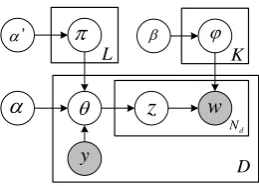
Figure 4: Graphical Model ofBP-LDA
output is fed into link probability function Ψ) is updated to maximize the network likelihood using current topic assignments.
3 Discriminative Topic Model with Block Prior and Various Features
Our model is able to identify blocks from the net-work with an embeddedWSBM, extract topic pat-terns of each block as prior knowledge, and use all this information to reconstruct the links.
3.1 LDAwith Block Priors (BP-LDA)
As argued in the introduction, linked documents are likely to have similar topic distributions, which can be generalized to documents in the same block. Inspired by this intuition and the block assignment we obtain in the previous section, we want to extract some prior knowledge from these blocks. Thus we propose an LDA with block priors, henceBP-LDA, as shown in Figure 4, which has the following generative process:
1. For each topick∈ {1, . . . , K}
(a) Draw word distributionφk∼Dir(β) 2. For each blockl∈ {1, . . . , L}
(a) Draw topic distributionπl∼Dir(α0) 3. For each documentd∈ {1, . . . , D}
(a) Draw topic distributionθd∼Dir(απyd) (b) For each tokentd,nin documentd
i. Draw topic assignmentzd,n∼Mult(θd) ii. Draw wordwd,n∼Mult(φzd,n)
Unlike conventional LDA, which uses an un-informative topic prior, BP-LDA puts a Dirich-let prior π on each block to capture the block’s topic distribution and use it as an informative prior when drawing each document’s topic distribution. In other words, a document’s topic distribution— i.e., what the document is about—is not just in-formed by the words present in the document but the broader context of its network neighborhood.
K
'
d
N
d
N
d
' d
L L
d
w
' d
w
d
z
' d
z
d
y
' d
y
' ,d d
B
Topical Feature Lexical Feature Block Feature
Figure 5: A two-document segment of VF-RTM. Various features are denoted by grayscale.Bd,d0is
observed, but we keep it in white background to avoid confusion.
3.2 RTMwith Various Features (VF-RTM)
Building on Chang and Blei (2010), we want to generate the links between documents based on various features, hence VF-RTM. In addition to topic distributions, VF-RTM also includes docu-ments’ word distributions (Nguyen et al., 2013) and the link rate of two documents’ assigned blocks, with the intent that these additional fea-tures improve link generation. VF-RTM involves the relationship between a pair of documents, so it is difficult to show the whole model; therefore Figure 5 illustrates with a two-document segment. The generative process is:
1. For each pair of blocks(l, l0)∈ {1, . . . , L}2
(a) Draw block regression parameterρl,l0∼ N(0, ν2) 2. For each topick∈ {1, . . . , K}
(a) Draw word distributionφk∼Dir(β)
(b) Draw topic regression parameterηk∼ N(0, ν2) 3. For each wordv∈ {1, . . . , V}
(a) Draw lexical regression parameterτv∼ N(0, ν2) 4. For each documentd∈ {1, . . . , D}
(a) Draw topic distributionθd∼Dir(α) (b) For each tokentd,nin documentd
i. Draw topic assignmentzd,n∼Mult(θd) ii. Draw wordwd,n∼Mult(φzd,n)
5. For each explicit link(d, d0)
(a) Draw link weight
Bd,d0∼Ψ(· |yd, yd0,Ω,zd,zd0,wd,wd0,η,τ,ρ)
Links are generated by a link probability func-tion Ψ which takes the regression valueRd,d0 of
documents d and d0 as an argument. Assuming documentsdand d0 belong to blocksl andl0 re-spectively,Rd,d0 is
[image:3.595.311.528.62.204.2]where zd is a K-length vector with each
el-ement zd,k = N1dPn1(zd,n=k); wd is a
V-length vector with each element wd,v = 1
Nd
P
n1(wd,n=v); ◦ denotes the Hadamard
(element-wise) product;1 η, τ, and ρ are the weight vectors and matrix for topic-based, lexical-based and rate-lexical-based predictions, respectively.
A common choice of Ψ is a sigmoid (Chang and Blei, 2010). However, we instead use hinge loss so thatVF-RTMcan use the max-margin prin-ciple, making more effective use of side informa-tion when inferring topic assignments (Zhu et al., 2012). Using hinge loss, the probability that doc-umentsdandd0are linked is
Pr (Bd,d0) = exp (−2 max(0, ζd,d0)), (2) whereζd,d0 = 1−Bd,d0Rd,d0. Positive and negative
link weights are denoted by 1 and -1, respectively, in contrast to sigmoid loss.
3.3 Aggregated Model
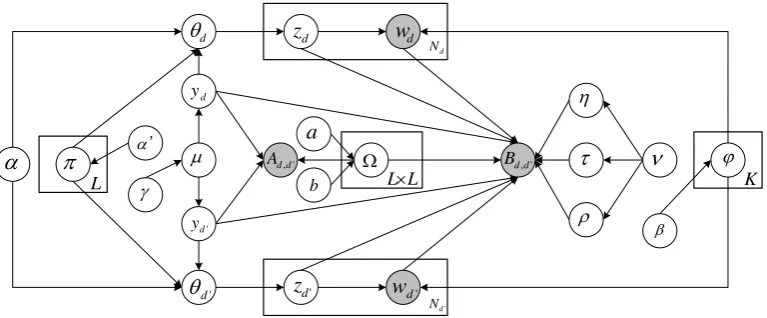
Finally, we put all the pieces together and propose LBH-RTM: RTM with lexical weights (L), block priors (B), and hinge loss (H). Its graphical model is given in Figure 6.
1. For each pair of blocks(l, l0)∈ {1, . . . , L}2
(a) Draw inter-block link rateΩl,l0∼Gamma(a, b) (b) Draw block regression parameterρl,l0∼ N(0, ν2) 2. Draw block distributionµ∼Dir(γ)
3. For each blockl∈ {1, . . . , L}
(a) Draw topic distributionπl∼Dir(α0) 4. For each topick∈ {1, . . . , K}
(a) Draw word distributionφk∼Dir(β)
(b) Draw topic regression parameterηk∼ N(0, ν2) 5. For each wordv∈ {1, . . . , V}
(a) Draw lexical regression parameterτv∼ N(0, ν2) 6. For each documentd∈ {1, . . . , D}
(a) Draw block assignmentyd∼Mult(µ) (b) Draw topic distributionθd∼Dir(απyd) (c) For each tokentd,nin documentd
i. Draw topic assignmentzd,n∼Mult(θd) ii. Draw wordwd,n∼Mult(φzd,n)
7. For each link(d, d0)∈ {1, . . . , D}2
(a) Draw link weightAd,d0 ∼Poisson(Ωyd,yd0) 8. For each explicit link(d, d0)
(a) Draw link weight
Bd,d0∼Ψ(· |yd, yd0,Ω,zd,zd0,wd,wd0,η,τ,ρ)
A and B are assumed independent in the model, but they can be derived from the same set of links in practice.
1As Chang and Blei (2010) point out, the Hadamard prod-uct is able to capture similarity between hidden topic repre-sentations of two documents.
Algorithm 1Sampling Process
1: Setλ= 1and initialize topic assignments 2: form= 1toMdo
3: Optimizeη,τ, andρusingL-BFGS 4: ford= 1toDdo
5: Draw block assignmentyd 6: foreach tokenndo
7: Draw a topic assignmentzd,n
8: end for
9: foreach explicit link(d, d0)do 10: Drawλ−d,d10 (and thenλd,d0)
11: end for
12: end for 13: end for
Link set Ais primarily used to find blocks, so it treats all linksdeterministically. In other words, the links observed in the input are considered ex-plicit positive links, while the unobserved links are considered explicit negative links, in contrast to the implicit links inB.
In terms of link setB, while it adopts all explicit positive links from the input, itdoes not denythe existence of unobserved links, or implicit negative links. Thus B consists of only explicit positive links. However, to avoid overfitting, we sample some implicit links and add them toBas explicit negative links.
4 Posterior Inference
Posterior inference (Algorithm 1) consists of the sampling of topic and block assignments and the optimization of weight vectors and matrix.2 We add an auxiliary variableλfor hinge loss (see Sec-tion 4.2), so the updating of λ is not necessary when using sigmoid loss.
The sampling procedure is an iterative process after initialization (Line 1). In each iteration, we first optimize the weight vectors and matrix (Line 3) before updating documents’ block assign-ments (Line 5) and topic assignassign-ments (Line 7). When using hinge loss, the auxiliary variableλfor every explicit link needs to be updated (Line 10). 4.1 Sampling Block Assignments
'
K
L
L L
'
d N
d N d
' d
a
b
d
y
'
d
y
' ,d d
A Bd,d'
d
z wd
' d
z wd'
[image:5.595.109.493.62.221.2]
Figure 6: The graphical model ofLBH-RTM for two documents, in which a weighted stochastic block model is embedded (γ, µ, y, a, b, Ω, and A). Each document’s topic distribution has an informative priorπ. The model predicts links between documents (B) based on topics (z), words (w), and inter-block link rates (Ω), using a max-margin objective.
excluding documentdand its related links.3 The probability thatdis assigned to blocklis
Pr(yd=l|A−d,y−d, a, b, γ)∝
N−d l +γ
×
Y l0
S−d
e (l, l0) +bS
−d w (l,l0)+a
S−d
e (l, l0) +b+Se(d, l0)S
−d
w (l,l0)+a+Sw(d,l0)
Sw(d,l0)−1
Y i=0
S−d
w (l, l0) +a+i
, (3)
whereNlis the number of documents assigned to
block l; −d denotes that the count excludes
doc-ument d; Sw(d, l) and Sw(l, l0) are the sums of
link weights from documentdto blockland from blocklto blockl0, respectively:
Sw(d, l) = X d0:y
d0=l
Ad,d0 (4)
Sw(l, l0) = X d:yd=l
Sw(d, l0). (5)
Se(d, l)is the number of possible links from
doc-umentdtol(i.e., assuming documentdconnects to every document in block l), which equals Nl.
The number of possible links from block l to l0 is Se(l, l0) (i.e., assuming every document in
blocklconnects to every document in blockl0):
Se(l, l0) =
Nl×Nl0 l6=l0 1
2Nl(Nl−1) l=l0. (6) If we rearrange the terms of Equation 3 and put the terms which haveSw(d, l0)together, the value
3These equations deal with undirected edges, but they can be adapted for directed edges. See supplementary material.
of Sw(d, l0) increases (i.e., document d is more
densely connected with documents in blockl0), the probability of assigningdto blockldecreases ex-ponentially. Thus ifdis more densely connected with block l and sparsely connected with other blocks, it is more likely to be assigned to blockl. 4.2 Sampling Topic Assignments
Following Polson and Scott (2011), by introducing an auxiliary variable λd,d0, the conditional
prob-ability of assigning td,n, the n-th token in
docu-mentd, to topickis
Pr(zd,n=k|z−d,n,w−d,n, wd,n=v, yd=l)
∝Nd,k−d,n+απl,k−d,n N
−d,n k,v +β
N−d,n k,· +V β Y
d0
exp
−(ζd,d02λ+λd,d0)2
d,d0
, (7)
whereNd,kis the number of tokens in documentd
that are assigned to topick;Nk,vdenotes the count
of word v assigned to topic k; Marginal counts are denoted by ·; −d,n denotes that the count
ex-cludes td,n; d0 denotes all documents that have
explicit links with document d. The block topic prior π−l,kd,n is estimated based on the maximal path assumption (Cowans, 2006; Wallach, 2008):
π−d,n l,k =
P d0:y
d0=lN
−d,n d0,k +α0
P d0:y
d0=lN
−d,n d0,· +Kα0
. (8)
the link prediction argumentζd,d0 is
ζd,d0 = 1−Bd,d0
η k
Nd,·
Nd0,k
Nd0,· +R
−d,n d,d0
where
R−d,n d,d0 =
K X k=1
ηkN −d,n d,k
Nd,·
Nd0,k
Nd0,·+
V X v=1
τvNNd,v d,·
Nd0,v
Nd0,· +ρyd,yd0Ωyd,yd0. (10)
Looking at the first term of Equation 7, the probability of assigning td,n to topic k depends
not only on its own topic distribution, but also the topic distribution of the block it belongs to. The links also matter: Equation 9 gives us the intuition that a topic which could increase the likelihood of links is more likely to be selected, which forms an interaction between topics and the link graph— the links are guiding the topic sampling while up-dating topic assignments is maximizing the likeli-hood of the link graph.
4.3 Parameter Optimization
While topic assignments are updated iteratively, the weight vectors and matrix η, τ, and ρ are optimized in each global iteration over the whole corpus usingL-BFGS(Liu and Nocedal, 1989). It takes the likelihood of generatingBusingη,τ,ρ, and current topic and block assignments as the ob-jective function, and optimizes it using the par-tial derivatives with respect to every weight vec-tor/matrix element.
The log likelihood ofBusing hinge loss is
L(B)∝ −X d,d0
R2
d,d0−2(1 +λd,d0)Bd,d0Rd,d0
2λd,d0
−
K X k=1
η2
k
2ν2 −
V X v=1
τ2
v
2ν2 −
L X l=1
L X l0=1
ρ2
l,l0
2ν2. (11)
We also need to update the auxiliary vari-able λd,d0. Since the likelihood of λd,d0
fol-lows a generalized inverse Gaussian distribution
GIGλd,d0;12,1, ζd,d2 0
, we sample its recipro-calλ−d,d10 from an inverse Gaussian distribution as
Pr λ−d,d10|z,w,η,τ,ρ= IG
λ−d,d10; 1 |ζd,d0|,1
. (12)
5 Experimental Results
We evaluate using the two datasets. The first one is CORA dataset (McCallum et al., 2000). After re-moving stopwords and words that appear in fewer than ten documents, as well as documents with no
Model CORAPLRWEBKB
RTM(Chang and Blei, 2010) 419.33 141.65 LCH-RTM(Yang et al., 2015) 459.55 150.32 BS-RTM 391.88 127.25 LBS-RTM 383.25 125.41
[image:6.595.316.516.62.138.2]LBH-RTM 360.38 111.79
Table 1: Predictive Link Rank Results
words or links, our vocabulary has 1,240 unique words. The corpus has 2,362 computer science pa-per abstracts with 4,231 citation links.
The second dataset is WEBKB. It is already pre-processed and has 1,703 unique words in vocabu-lary. The corpus has 877 web pages with 1,608 hyperlinks.
We treat all links as undirected. Both datasets are split into 5 folds, each further split into a devel-opment and test set with approximately the same size when used for evaluation.
5.1 Link Prediction Results
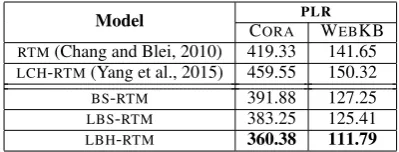
In this section, we evaluateLBH-RTMand its varia-tions on link prediction tasks usingpredictive link rank(PLR). A document’sPLRis the average rank of the documents to which it has explicit positive links, among all documents, so lowerPLRis better. Following the experiment setup in Chang and Blei (2010), we train the models on the train-ing set and predict citation links within held-out documents as well as from held-out documents to training documents. We tune two important parameters—α and negative edge ratio (the ratio of the number of sampled negative links to the number of explicit positive links)—on the devel-opment set and apply the trained model which per-forms the best on the development set to the test set.4 The cross validation results are given in Ta-ble 1, where models are differently equipped with lexical weights (L),WSBMprior (B),SCCprior (C), hinge loss (H), and sigmoid loss (S).5 Link pre-diction generally improves with incremental appli-cation of prior knowledge and more sophisticated learning techniques.
The embedded WSBM brings around 6.5% and 10.2% improvement over RTM in PLR on the 4We also tune the number of blocks for embeddedWSBM and set it to 35 (CORA) and 20 (WEBKB). The block topic priors are not applied on unseen documents, since we don’t have available links.
CORA and WEBKB datasets, respectively. This indicates that the blocks identified by WSBM are reasonable and consistent with reality. The lexi-cal weights also help link prediction (LBS-RTM), though less for BS-RTM. This is understandable since word distributions are much sparser and do not make as significant a contribution as topic dis-tributions. Finally, hinge loss improves PLR sub-stantially (LBH-RTM), about 14.1% and 21.1% im-provement over RTM on the CORA and WEBKB datasets respectively, demonstrating the effective-ness of max-margin learning.
The only difference between LCH-RTM and LBH-RTM is the block detection algorithm. How-ever, their link prediction performance is poles apart—LCH-RTM even fails to outperform RTM. This implies that the quality of blocks identified by SCC is not as good as WSBM, which we also illustrate in Section 5.4.
5.2 Illustrative Example
We illustrate our model’s behavior qualitatively by looking at two abstracts, Koplon and Sontag (1997) and Albertini and Sontag (1992) from the CORAdataset, designated K and A for short.
Paper K studies the application of Fourier-type activation functions in fully recurrent neural net-works. Paper A shows that if two neural networks have equal behaviors as “black boxes”, they must have the same number of neurons and the same weights (except sign reversals).
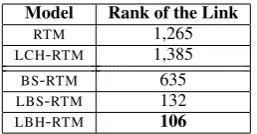
From the titles and abstracts, we can easily find that both of them are aboutneural networks(NN). They both contain words likeneural,neuron, net-work,recurrent, activation, andnonlinear, which corresponds to the topic with words neural, net-work,train, learn,function,recurrent, etc. There is a citation between K and A. The ranking of this link improves as the model gets more sophisti-cated (Table 2), except LCH-RTM, which is con-sistent with ourPLRresults.
In Figure 7, we also show the proportions of topics that dominate the two documents accord-ing to the various models. There are multiple top-ics dominating K and A according to RTM (Fig-ure 7(a)). As the model gets more sophisticated, theNNtopic proportion gets higher. Finally, only the NNtopic dominates the two documents when LBH-RTMis applied (Figure 7(e)).
LCH-RTM gives the highest proportion to the NN topic (Figure 7(b)). However, the NN topic
Model Rank of the Link
RTM 1,265
[image:7.595.353.482.61.128.2]LCH-RTM 1,385 BS-RTM 635 LBS-RTM 132 LBH-RTM 106
Table 2:PLRof the citation link between example documents K and A (described in Section 5.2)
Model CORAFETWEBKB CORALLRWEBKB
RTM 0.1330 0.1312 3.001 6.055 LCH-RTM 0.1418 0.1678 3.071 6.577 BS-RTM 0.1415 0.1950 3.033 6.418 LBS-RTM 0.1342 0.1963 2.984 6.212
LBH-RTM 0.1453 0.2628 3.105 6.669
Table 3: Average Association Scores of Topics
splits into two topics and the proportions are not assigned to the same topic, which greatly brings down the link prediction performance. The split-ting of the NN topic also happens in other mod-els (Figure 7(a) and 7(d)), but they assign propor-tions to the same topic(s). Further comparing with LBH-RTM, the blocks detected bySCCare not im-proving the modeling of topics and links—some documents that should be in two different blocks are assigned to the same one, as we will show in Section 5.4.
5.3 Topic Quality Results
We use an automatic coherence detection method (Lau et al., 2014) to evaluate topic quality. Specifically, for each topic, we pick out the topn
words and compute the average association score of each pair of words, based on the held-out documents in development and test sets.
We choose n = 25 and use Fisher’s exact test (Upton, 1992, FET) and log likelihood
ra-tio (Moore, 2004, LLR) as the association sures (Table 3). The main advantage of these mea-sures is that they are robust even when the refer-ence corpus is not large.
[image:7.595.307.523.177.255.2]0.0 0.2 0.4 0.6 0.8 1.0 NN-1
NN-2 Sequential Model Vision Belief Network Knowledge Base Parallel Computing
A K
(a) RTMTopic Proportions
0.0 0.2 0.4 0.6 0.8 1.0 NN-1
NN-2 Sequential Model Algorithm Bound
A K
(b) LCH-RTMTopic Proportions
0.0 0.2 0.4 0.6 0.8 1.0 NN
System Behavior Research Grant Optimization-1 Optimization-2
A K
(c) BS-RTMTopic Proportions
0.0 0.2 0.4 0.6 0.8 1.0 NN-1
NN-2 Random Process Optimization Evolutionary Comput.
A K
(d)LBS-RTMTopic Proportions
0.0 0.2 0.4 0.6 0.8 1.0 NN
Bayesian Network Linear Function MCMC
A K
[image:8.595.83.522.59.276.2](e) LBH-RTMTopic Proportions
Figure 7: Topic proportions given by various models on our two illustrative documents (K and A, de-scribed in dede-scribed in Section 5.2). As the model gets more sophisticated, theNNtopic proportion gets higher and finally dominates the two documents whenLBH-RTMis applied. ThoughLCH-RTMgives the highest proportion to theNNtopic, it splits theNNtopic into two and does not assign the proportions to the same one.
Block 1 2
#Nodes 42 84
#Links in the Block 55 142
#Links across Blocks 2
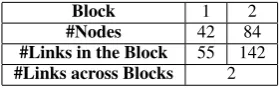
Table 4: Statistics of Blocks 1 (learning theory) and 2 (Bayes nets), which are merged inSCC.
5.4 Block Analysis
In this section, we illustrate the effectiveness of the embedded WSBM over SCC.6 As we have argued, WSBM is able to separate two internally densely-connected blocks even if there are few links connecting them, while SCCtends to merge them in this case. As an example, we focus on two blocks in the CORA dataset identified by WSBM, designated Blocks 1 and 2. Some statis-tics are given in Table 4. The two blocks are very sparsely connected, but comparatively quite densely connected inside either block. The two blocks’ topic distributions also reveal their differ-ences: abstracts in Block 1 mainly focus on learn-ing theory (learn, algorithm, bound, result, etc.) andMCMC(markov,chain,distribution,converge, etc.). Abstracts in Block 2, however, have higher
6We omit the comparison ofWSBMwith other models, be-cause this has been done by Aicher et al. (2014). In addition, WSBMis a probabilistic method whileSCCis deterministic. They are not comparable quantitatively, so we compare them qualitatively.
weights on Bayesian networks (network, model,
learn,bayesian, etc.) and Bayesian estimation ( es-timate,bayesian,parameter,analysis, etc.), which differs from Block 1’s emphasis. Because of the two inter-block links,SCC merges the two blocks into one, which makes the block topic distribution unclear and misleads the sampler. WSBM, on the other hand, keeps the two blocks separate, which generates a high-quality prior for the sampler.
6 Related Work
Topic models are widely used in information re-trieval (Wei and Croft, 2006), word sense dis-ambiguation (Boyd-Graber et al., 2007), dialogue segmentation (Purver et al., 2006), and collabora-tive filtering (Marlin, 2003).
[image:8.595.111.251.376.420.2]Blei, 2010; Boyd-Graber and Resnik, 2010) or a maximum entropy discrimination approach (Zhu et al., 2012; Yang et al., 2015).
In block detection literature, stochastic block model (Holland et al., 1983; Wang and Wong, 1987, SBM) is one of the most basic generative models dealing with binary-weighted edges. SBM assumes that each node belongs to only one block and each link exists with a probability that de-pends on the block assignments of its connect-ing nodes. It has been generalized for degree-correction (Karrer and Newman, 2011), bipartite structure (Larremore et al., 2014), and categorial values (Guimer`a and Sales-Pardo, 2013), as well as nonnegative integer-weight network (Aicher et al., 2014,WSBM).
Our model combines both topic model and block detection in a unified framework. It takes text, links, and the interaction between text and links into account simultaneously, contrast to the methods that only consider graph structure (Kim and Leskovec, 2012; Liben-Nowell and Kleinberg, 2007) or separate text and links (Chaturvedi et al., 2012).
7 Conclusions and Future Work
We introduce LBH-RTM, a discriminative topic model that jointly models topics and document links, detecting blocks in the document net-work probabilistically by embedding the weighted stochastic block model, rather via connected-components as in previous models. A separate Dirichlet prior for each block captures its topic preferences, serving as an informed prior when inferring documents’ topic distributions. Max-margin learning learns to predict links from docu-ments’ topic and word distributions and block as-signments.
Our model better captures the connections and content of paper abstracts, as measured by predic-tive link rank and topic quality. LBH-RTM yields topics with better coherence, though not all tech-niques contribute to the improvement. We sup-port our quantitative results with qualitative anal-ysis looking at a pair of example documents and at a pair of blocks, highlighting the robustness of embeddedWSBMover blocks defined asSCC.
As next steps, we plan to explore model varia-tions to support a wider range of use cases. For example, although we have presented a version of the model defined using undirected binary weight
edges in the experiment, it would be straightfor-ward to adapt to model both directed/undirected and binary/nonnegative real weight edges. We are also interested in modeling changing topics and vocabularies (Blei and Lafferty, 2006; Zhai and Boyd-Graber, 2013). In the spirit of treating links probabilistically, we plan to explore application of the model in suggesting links that do not ex-ist but should, for example in discovering missed citations, marking social dynamics (Nguyen et al., 2014), and identifying topically related content in multilingual networks of documents (Hu et al., 2014).
Acknowledgment
This research has been supported in part, under subcontract to Raytheon BBN Technologies, by DARPA award HR0011-15-C-0113. Boyd-Graber is also supported by NSF grants IIS/1320538, IIS/1409287, and NCSE/1422492. Any opinions, findings, conclusions, or recommendations ex-pressed here are those of the authors and do not necessarily reflect the view of the sponsors.
References
Christopher Aicher, Abigail Z. Jacobs, and Aaron Clauset. 2014. Learning latent block structure in weighted networks. Journal of Complex Networks.
Francesca Albertini and Eduardo D. Sontag. 1992. For neural networks, function determines form. In Pro-ceedings of IEEE Conference on Decision and Con-trol.
David M. Blei and John D. Lafferty. 2006. Dynamic topic models. In Proceedings of the International Conference of Machine Learning.
David M. Blei, Andrew Y. Ng, and Michael I. Jordan. 2003. Latent Dirichlet allocation. Journal of Ma-chine Learning Research.
Jordan Boyd-Graber and Philip Resnik. 2010. Holis-tic sentiment analysis across languages: Multilin-gual supervised latent Dirichlet allocation. In Pro-ceedings of Empirical Methods in Natural Language Processing.
Jordan Boyd-Graber, David M. Blei, and Xiaojin Zhu. 2007. A topic model for word sense disambigua-tion. InProceedings of Empirical Methods in Natu-ral Language Processing.
Snigdha Chaturvedi, Hal Daum´e III, Taesun Moon, and Shashank Srivastava. 2012. A topical graph kernel for link prediction in labeled graphs. InProceedings of the International Conference of Machine Learn-ing.
Philip J. Cowans. 2006. Probabilistic Document Mod-elling. Ph.D. thesis, University of Cambridge. Hal Daum´e III. 2009. Markov random topic fields.
InProceedings of the Association for Computational Linguistics.
Roger Guimer`a and Marta Sales-Pardo. 2013. A net-work inference method for large-scale unsupervised identification of novel drug-drug interactions. PLoS Computational Biology.
Paul W. Holland, Kathryn Blackmond Laskey, and Samuel Leinhardt. 1983. Stochastic blockmodels: First steps. Social Networks.
Yuening Hu, Ke Zhai, Vlad Eidelman, and Jordan Boyd-Graber. 2014. Polylingual tree-based topic models for translation domain adaptation. In Pro-ceedings of the Association for Computational Lin-guistics.
Brian Karrer and Mark EJ Newman. 2011. Stochastic blockmodels and community structure in networks.
Physical Review E.
Myunghwan Kim and Jure Leskovec. 2012. La-tent multi-group membership graph model. In Pro-ceedings of the International Conference of Machine Learning.
Ren´ee Koplon and Eduardo D. Sontag. 1997. Using Fourier-neural recurrent networks to fit sequential input/output data. Neurocomputing.
Daniel B. Larremore, Aaron Clauset, and Abigail Z. Ja-cobs. 2014. Efficiently inferring community struc-ture in bipartite networks. Physical Review E. Jey Han Lau, David Newman, and Timothy Baldwin.
2014. Machine reading tea leaves: Automatically evaluating topic coherence and topic model quality. InProceedings of the Association for Computational Linguistics.
Fei-Fei Li and Pietro Perona. 2005. A Bayesian hier-archical model for learning natural scene categories. InComputer Vision and Pattern Recognition. David Liben-Nowell and Jon Kleinberg. 2007. The
link-prediction problem for social networks. Jour-nal of the American Society for Information Science and Technology.
Dong C. Liu and Jorge Nocedal. 1989. On the limited memory BFGS method for large scale optimization.
Mathematical Programming.
Benjamin Marlin. 2003. Modeling user rating profiles for collaborative filtering. In Proceedings of Ad-vances in Neural Information Processing Systems.
Jon D. McAuliffe and David M. Blei. 2008. Super-vised topic models. InProceedings of Advances in Neural Information Processing Systems.
Andrew Kachites McCallum, Kamal Nigam, Jason Rennie, and Kristie Seymore. 2000. Automating the construction of Internet portals with machine learn-ing.Information Retrieval.
David Mimno and Andrew McCallum. 2012. Topic models conditioned on arbitrary features with Dirichlet-multinomial regression. InProceedings of Uncertainty in Artificial Intelligence.
Robert Moore. 2004. On log-likelihood-ratios and the significance of rare events. In Proceedings of Em-pirical Methods in Natural Language Processing.
Viet-An Nguyen, Jordan Boyd-Graber, and Philip Resnik. 2013. Lexical and hierarchical topic regres-sion. InProceedings of Advances in Neural Infor-mation Processing Systems.
Viet-An Nguyen, Jordan Boyd-Graber, Philip Resnik, Deborah Cai, Jennifer Midberry, and Yuanxin Wang. 2014. Modeling topic control to detect influence in conversations using nonparametric topic models.
Machine Learning.
Nicholas G. Polson and Steven L. Scott. 2011.
Data augmentation for support vector machines.
Bayesian Analysis.
Matthew Purver, Thomas L. Griffiths, Konrad P. K¨ording, and Joshua B. Tenenbaum. 2006. Unsu-pervised topic modelling for multi-party spoken dis-course. InProceedings of the Association for Com-putational Linguistics.
Graham JG Upton. 1992. Fisher’s exact test. Journal of the Royal Statistical Society.
Hanna M. Wallach. 2008.Structured Topic Models for Language. Ph.D. thesis, University of Cambridge.
Yuchung J. Wang and George Y. Wong. 1987. Stochas-tic blockmodels for directed graphs. Journal of the American Statistical Association.
Xing Wei and W. Bruce Croft. 2006. LDA-based doc-ument models for ad-hoc retrieval. InProceedings of the ACM SIGIR Conference on Research and De-velopment in Information Retrieval.
Weiwei Yang, Jordan Boyd-Graber, and Philip Resnik. 2015. Birds of a feather linked together: A discrim-inative topic model using link-based priors. In Pro-ceedings of Empirical Methods in Natural Language Processing.
Jun Zhu, Amr Ahmed, and Eric P. Xing. 2012. MedLDA: Maximum margin supervised topic mod-els. Journal of Machine Learning Research. Jun Zhu, Ning Chen, Hugh Perkins, and Bo Zhang.