Context-aware Argumentative Relation Mining
Huy V. Nguyen
Computer Science Department University of Pittsburgh
Pittsburgh, PA 15260
Diane J. Litman
Computer Science Department and Learning Research and Development Center
University of Pittsburgh Pittsburgh, PA 15260
Abstract
Context is crucial for identifying argumen-tative relations in text, but many argument mining methods make little use of contex-tual features. This paper presents context-aware argumentative relation mining that uses features extracted from writing top-ics as well as from windows of context sentences. Experiments on student essays demonstrate that the proposed features im-prove predictive performance in two argu-mentative relation classification tasks.
1 Introduction
By supporting tasks such as automatically iden-tifying argument components1 (e.g., premises,
claims) in text, and the argumentative relations
(e.g., support, attack) between components, ar-gument (arar-gumentation) mining has been studied for applications in different research fields such as document summarization (Teufel and Moens, 2002), opinion mining (Boltuˇzi´c and ˇSnajder, 2014), automated essay evaluation (Burstein et al., 2003), legal information systems (Palau and Moens, 2009), and policy modeling platforms (Florou et al., 2013).
Given a pair of argument components with one component as thesourceand the other as the tar-get,argumentative relation mininginvolves deter-mining whether a relation holds from the source to the target, and classifying the argumentative func-tion of the relafunc-tion (e.g., support vs. attack). Ar-1There is no consensus yet on an annotation scheme for
argument components, or on the minimal textual units to be annotated. We follow Peldszus and Stede (2013) and con-sider “argument mining as the automatic discovery of an ar-gumentative text portion, and the identification of the relevant components of the argument presented there.” We also bor-row their term “argumentative discourse unit” to refer to the textual units (e.g., text segment, sentence, clause) which are considered as argument components.
Essay 73. Topic: Is image more powerful than the written word?
...(1)Hence, I agree only to certain de-gree that in today’s world, image serves as a more effective means of communica-tion[MajorClaim].
(2)Firstly, pictures can influence the way
people think[Claim].(3)For example,
nowa-days horrendous images are displayed on the cigarette boxes to illustrate the con-sequences of smoking[P remise]. (4)As a
result, statistics show a slight reduction in the number of smokers, indicating that they realize the effects of the negative habit[P remise]...
Figure 1: Excerpt from a student persuasive essay (Stab and Gurevych, 2014a). Sentences are num-bered and argument components are tagged.
gumentative relation mining - beyond argument component mining - is perceived as an essential step towards more fully identifying the argumenta-tive structure of a text (Peldszus and Stede, 2013; Sergeant, 2013; Stab et al., 2014). Consider the second paragraph shown in Figure 1. Only detect-ing the argument components (a claim in sentence 2 and two premises in sentences 3 and 4) does not give a complete picture of the argumentation. By looking for relations between these components, one can also see that the two premises together jus-tify the claim. The argumentation structure of the text in Figure 1 is illustrated in Figure 2.
Our current study proposes a novel approach for argumentative relation mining that makes use of contextual features extracted from surround-ing sentences ofsourceandtargetcomponents as well as from topic information of the writings.
Prior argumentative relation mining studies have often used features extracted from argument com-ponents to model different aspects of the relations between the components, e.g., relative distance, word pairs, semantic similarity, textual entailment (Cabrio and Villata, 2012; Stab and Gurevych, 2014b; Boltuˇzi´c and ˇSnajder, 2014; Peldszus and Stede, 2015b). Features extracted from the text surrounding the components have been less ex-plored, e.g., using words and their part-of-speech from adjacent sentences (Peldszus, 2014). The first hypothesis investigated in this paper is that the
discourse relationsof argument components with adjacent sentences (calledcontext windowsin this study, a formal definition is given in§5.3) can help characterize the argumentative relations that con-nect pairs of argument components. Reconsider-ing the example in Figure 1, without knowReconsider-ing the content “horrendous images are displayed on the cigarette boxes” in sentence 3, one cannot easily tell that “reduction in the number of smokers” in sentence 4 supports the “pictures can influence” claim in sentence 2. We expect that such content relatedness can be revealed from a discourse anal-ysis, e.g., the appearance of a discourse connective “As a result”.
While topic information in many writing gen-res (e.g., scientific publications, Wikipedia arti-cles, student essays) has been used to create fea-tures for argument component mining (Teufel and Moens, 2002; Levy et al., 2014; Nguyen and Lit-man, 2015), topic-based features have been less explored for argumentative relation mining. The second hypothesis investigated in this paper is that features based ontopic contextalso provide useful information for improving argumentative relation mining. In the excerpt below, knowing that ‘online game’ and ‘computer’ are topically related might help a model decide that the claim in sentence 1 supports the claim in sentence 2:
(1)People who are addicted to games,
especially online games, can eventually bear dangerous consequences[Claim].
(2)Although it is undeniable that computer is
a crucial part of human life[P remise],it still
has its bad side[MajorClaim].2
Motivated by the discussion above, we propose
context-aware argumentative relation mining – a novel approach that makes use of contextual fea-2In this excerpt, the Premise was annotated as an attack to
the MajorClaim in sentence 2.
MajorClaim(1)
Claim(2)
Premise(4)
Premise(3)
Premise(6) Support
Support Attack
Support
[image:2.595.350.484.62.169.2]Support Support
Figure 2: Structure of the argumentation in the ex-cerpt. Relations are illustrated accordingly to the annotation provided in the corpus. Premises 3 and 4 were annotated for separate relations to Claim 2. Our visualization should not mislead that the two premises are linked or convergent.
tures that are extracted by exploiting context sen-tence windows and writing topic to improve rela-tion predicrela-tion. In particular, we derive features usingdiscourse relationsbetween argument com-ponents and windows of their surrounding sen-tences. We also derive features using anargument and domain word lexiconautomatically created by post-processing an essay’s topic model. Experi-mental results show that our proposed contextual features help significantly improve performance in two argumentative relation classification tasks.
2 Related Work
Unlike argument component identification where textual inputs are typically sentences or clauses (Moens et al., 2007; Stab and Gurevych, 2014b; Levy et al., 2014; Lippi and Torroni, 2015), tex-tual inputs of argumentative relation mining vary from clauses (Stab and Gurevych, 2014b; Peld-szus, 2014) to multiple-sentences (Biran and Ram-bow, 2011; Cabrio and Villata, 2012; Boltuˇzi´c and ˇSnajder, 2014). Studying claim justification be-tween user comments, Biran and Rambow (2011) proposed that the argumentation in justification of a claim can be characterized with discourse struc-ture in the justification. They however only con-sidered discourse markers but not discourse re-lations. Cabrio et al. (2013) conducted a cor-pus analysis and found certain similarity between Penn Discourse TreeBank relations (Prasad et al., 2008) and argumentation schemes (Walton et al., 2008). However they did not discuss how such similarity could be applied to argument mining.
be-tween sentences for argumentative relation min-ing. Moreover, to enable discourse relation features when the textual inputs are only sen-tences/clauses, we group the inputs with their con-text sentences. Qazvinian and Radev (2010) used the term “context sentence” to refer to sentences surrounding a citation that contained information about the cited source but did not explicitly cite it. In our study, we only require that the context sen-tences of an argument component must be in the same paragraph and adjacent to the component.
Prior work in argumentative relation mining has used argument component labels to provide con-straints during relation identification. For exam-ple, when an annotation scheme (e.g., (Peldszus and Stede, 2013; Stab and Gurevych, 2014a)) does not allow relations from claim to premise, no rela-tions are inferred during relation mining for any argument component pair where the source is a claim and the target is a premise. In our work, we follow Stab and Gurevych (2014b) and use the predicted labels of argument components as fea-tures during argumentative relation mining. We, however, take advantage of an enhanced argument component model (Nguyen and Litman, 2016) to obtain more reliable argument component labels than in (Stab and Gurevych, 2014b).
Argument mining research has studied differ-ent data-driven approaches for separating orga-nizational content (shell) from topical content to improve argument component identification, e.g., supervised sequence model (Madnani et al., 2012), unsupervised probabilistic topic models (S´eaghdha and Teufel, 2014; Du et al., 2014). Nguyen and Litman (2015) post-processed LDA (Blei et al., 2003) output to extract a lexicon of ar-gument and domain words from development data. Their semi-supervised approach exploits the topic context through essay titles to guide the extraction. Finally, prior research has explored predict-ing different argumentative relationship labels be-tween pairs of argument components, e.g., attach-ment (Peldszus and Stede, 2015a), support vs. non-support (Biran and Rambow, 2011; Cabrio and Villata, 2012; Stab and Gurevych, 2014b),
{implicit, explicit}×{support, attack} (Boltuˇzi´c and ˇSnajder, 2014), verifiability of support (Park and Cardie, 2014). Our experiments use two such argumentative relation classification tasks (Sup-port vs. Non-sup(Sup-port, Sup(Sup-port vs. Attack) to eval-uate the effectiveness of our proposed features.
3 Persuasive Essay Corpus
Stab and Gurevych (2014a) compiled the Persua-sive Essay Corpus consisting of 90 student argu-mentative essays and made it publicly available.3
Because the corpus has been utilized for differ-ent argumdiffer-ent mining tasks (Stab and Gurevych, 2014b; Nguyen and Litman, 2015; Nguyen and Litman, 2016), we use this corpus to demonstrate our context-aware argumentative relation mining approach, and adapt the model developed by Stab and Gurevych (2014b) to serve as the baseline for evaluating our proposed approach.
Three experts identified possible argument components of three types within each sentence in the corpus (MajorClaim - writer’s stance toward the writing topic,Claim- controversial statements that support or attack MajorClaim, andPremise -evidence used to underpin the validity of Claim), and also connected the argument components us-ing two argumentative relations (Supportand At-tack). According to the annotation manual, each essay has exactly one MajorClaim. A sentence can have one or more argument components ( Ar-gumentative sentences). Sentences that do not contain any argument component are labeled Non-argumentative. Figure 1 shows an example essay with components annotated, and Figure 2 illus-trates relations between those components. Argu-mentative relations are directed and can hold be-tween a Premise and another Premise, a Premise and a () Claim, or a Claim and a Major-Claim. Except for the relation from Claim to MajorClaim, an argumentative relation does not cross paragraph boundaries. The three experts achieved inter-rater accuracy 0.88 for component labels and Krippendorff’sαU 0.72 for component boundaries. Given the annotated argument com-ponents, the three experts obtained Krippendorff’s α0.81 for relation labels. The number of relations are shown in Table 1.
4 Argumentative Relation Tasks
4.1 Task 1: Support vs. Non-support
Our first task follows (Stab and Gurevych, 2014b): given a pair of source and target argument com-ponents, identify whether the source argumenta-tively supports the target or not. Note that when a support relation does not hold, the source may attack or has no relation with the target
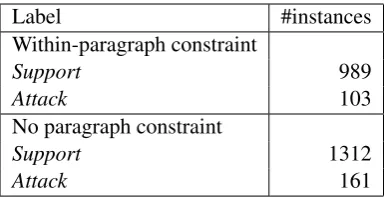
Label #instances Within-paragraph constraint
Support 989
Attack 103
No paragraph constraint
Support 1312
[image:4.595.85.279.61.160.2]Attack 161
Table 1: Data statistics of the corpus.
nent. For each of two argument components in the same paragraph4, we form two pairs (i.e.,
re-versing source and target). In total we obtain 6330 pairs, in which 989 (15.6%) have Support relation. Among 5341 Non-support pairs, 103 have Attack relation and 5238 are no-relation pairs.
Stab and Gurevych (2014b) split the corpus into an 80% training set and a 20% test set which have similar label distributions. We use this split to train and test our proposed models, and directly com-pare our models’ performance to the reported per-formance in (Stab and Gurevych, 2014b).
4.2 Task 2: Support vs. Attack
To further evaluate the effectiveness of our ap-proach, we conduct an additional task that clas-sifies an argumentative relation asSupport or At-tack. For this task, we assume that the relation (i.e., attachment (Peldszus, 2014)) between two components is given, and aim at identifying the argumentative function of the relation. Because we remove the paragraph constraint in this task, we obtain more Support relations than in Task 1. As shown in Table 1, of the total 1473 relations, we have 1312 (89%) Support and 161 (11%) At-tack relations. Because this task was not studied in (Stab and Gurevych, 2014b), we adapt Stab and Gurevych’s model to use as the baseline.
5 Argumentative Relation Models
5.1 Baseline
We adapt (Stab and Gurevych, 2014b) to use as a baseline for evaluating our approach. Given a pair of argument components, we follow (Stab and Gurevych, 2014b) by first extracting 3 feature sets: structural (e.g., word counts, sentence position), lexical (e.g., word pairs, first words), and gram-matical production rules (e.g.,S→NP,VP).
4Allowing cross-paragraph relations exponentially
in-creases the number of no-relation pairs, which makes the pre-diction data extremely skewed (Stab and Gurevych, 2014b).
Because a sentence may have more than one ar-gument component, the relative component posi-tions might provide useful information (Peldszus, 2014). Thus, we also include 8 new component position features: whether the source and target components are the whole sentences or the be-ginning/end components of the sentences; if the source is before or after the target component; and the absolute difference of their positions.
Stab and Gurevych (2014b) used a 55-discourse marker set to extract indicator features. We ex-pand their discourse maker set by combining them with a 298-discourse marker set developed in (Bi-ran and Rambow, 2011). We expect the expanded set of discourse markers will represent better pos-sible discourse relations in the texts.
Stab and Gurevych (2014b) used predicted label of argument components as features for both train-ing and testtrain-ing their argumentation structure iden-tification model.5 As their predicted labels are not
available to us, we adapt this feature set by using the argument component model in (Nguyen and Litman, 2016) which was shown to outperform the corresponding model of Stab and Gurevych.
For later presentation purposes, we name the set of all features from this section except word pairs and production rules as the common fea-tures. While word pairs and grammatical pro-duction rules were the most predictive features in (Stab and Gurevych, 2014b), we hypothesize that this large and sparse feature space may have nega-tive impact on model robustness (Nguyen and Lit-man, 2015). Most of our proposed models re-place word pairs and production rules with differ-ent combinations of new contextual features.
5.2 Topic-context Model
Our first proposed model (TOPIC) makes use of
Topic-contextfeatures derived from a lexicon of argument and domain words for persuasive essays (Nguyen and Litman, 2015). Argument words (e.g., ‘believe’, ‘opinion’) signal the argumenta-tive content and are commonly used across differ-ent topics. In contrast, domain words are specific terminologies commonly used within the topic (e.g., ‘art’, ‘education’). The authors first use
5Stab and Gurevych (2014b) reported that including
topic prompts in development data of unannotated persuasive essays to semi-automatically collect ar-gument and domain seed words. In particular, they used 10 argument seed words: agree, disagree, reason, support, advantage, disadvantage, think, conclusion, result, opinion. Domain seed words are those in the topic prompts but not argument seed words or stop words. The seeds words are then used to supervise an automated extraction of argument and domain words from output of LDA topic model (Blei et al., 2003) on the develop-ment data. The extracted lexicon consists of 263 (stemmed) argument words and 1806 (stemmed) domain words mapped to 36 LDA topics.6 All
ar-gument words are from a single LDA topic while a domain word can map to multiple LDA topics (ex-cept the topic of argument words). Using the lex-icon, we extract the following Topic-context fea-tures:
Argument word: from all word pairs extracted from the source and target components, we re-move those that have at least one word not in the argument word list. Each argument word pair de-fines a boolean feature indicating its presence in the argument component pair. We also include each argument word of the source and target com-ponents as a boolean feature which is true if the word is present in the corresponding component. We count number of common argument words, the absolute difference in number of argument words between source and target components.
Domain word count: to measure the topic sim-ilarity between the source and target components, we calculate number of common domain words, number of pairs of two domain words that share an LDA topic, number of pairs that share no LDA topic, and the absolute difference in number of do-main words between the two components.
Non-domain MainVerb-Subject dependency:
we extract MainVerb-Subject dependency triples, e.g., nsubj(belive, I), from the source and target components, and filter out triples that involve do-main words. We model each extracted triple as a boolean feature which is true if the corresponding argument component has the triple.
Finally, we include thecommon feature set. To illustrate the Topic-context features, con-sider the following source and target components. Argument words are in boldface, and domain
6An LDA topic is simply represented by a number, and
should not be misunderstood with essay topics.
words are in italic.
Essay 54. Topic: museum and art gallery will disappear soon?
Source: moreandmore people canwatch exhibitionsthroughtelevisionorinternetat
homedue tomodern technology[P remise]
Target: some people think museums and
art gallerieswilldisappear soon[Claim]
An argument word pair ispeople-think. There are 35 pairs of domain words. A pair of two do-main words that share an LDA topic is exhibitions-art. A pair of two domain words that do not share any LDA topic isinternet-galleries.
5.3 Window-context Model
Our second proposed model (WINDOW) extracts features from discourse relations and common words between context sentences in the context windowsof the source and target components.
Definition. Context window of an argument com-ponent is a text segment formed by neighboring sentences and the covering sentence of the com-ponent. The neighboring sentences are called con-text sentences, and must be in the same paragraph with the component.
In this study, context windows are determined using window-size heuristics.7 Given a
window-sizen, we form a context window by grouping the covering sentence with at mostnadjacently pre-ceding andnadjacently following sentences that must be in the same paragraph.
To minimize noise in feature space, we re-quire that context windows of the source and tar-get components must be mutually exclusive. Bi-ran and Rambow (2011) observed that the re-lation between a source argument and a target argument is usually instantiated by some elabo-ration/justification provided in a support of the source argument. Therefore we prioritize the con-text window of source component when it overlaps with the target context window. Particularly, we keep overlapping context sentences in the source window, and remove them from the target win-dow. For example, with window-size 1, context windows of the Claim in sentence 2 in Figure 1 and the Premise in sentence 4 overlap at sentence 3. When the Claim is set as source component, its 7Due to the paragraph constraint and window
BASELINE
Common features Word pairs + Production rules
TOPIC
Common features
Topic context features + Window context features
WINDOW
Common features Window context features
COMBINED
Common features
Topic context features + Window context features + Word pairs + Production rules
FULL
[image:6.595.97.503.64.155.2]Common features Topic context features
Figure 3: Features used in different models. Feature change across models are denoted by connectors.
context window includes sentences{2, 3}, and the Premise as a target has context window with only sentence 4. We extract three Window-context
feature sets from the context windows:
Common word: as common word counts
be-tween adjacent sentences were shown useful for argument mining (Nguyen and Litman, 2016), we count common words between the covering sen-tence with preceding context sensen-tences, and with following context sentences, for source and target components.
Discourse relation: for both source and tar-get components, we extract discourse relations between context sentences, and within the cov-ering sentence. We also extract discourse rela-tions between each pair of source context sen-tence and target context sensen-tence. Each relation defines a boolean feature. We extract both Penn Discourse Treebank (PDTB) relations (Prasad et al., 2008) and Rhetorical Structure Theory Dis-course Treebank (RST-DTB) relations (Carlson et al., 2001) using publicly available discourse parsers (Ji and Eisenstein, 2014; Wang and Lan, 2015). Each PDTB relation has sense label de-fined in a 3-layered (class, type, subtype), e.g.,
CONTINGENCY.Cause.result. While there are only four semantic class labels at the class-level which may not cover well different aspects of ar-gumentative relation, subtype-level output is not available given the discourse parser we use. Thus, we use relations at type-level as features. For RST-DTB relations, we use only relation labels, but ig-nore the nucleus and satellite labels of components as they do not provide more information given the component order in the pair. Because tempo-ral relations were shown not helpful for argument mining tasks (Biran and Rambow, 2011; Stab and Gurevych, 2014b), we exclude them here.
Discourse marker: while the baseline model only considers discourse markers within the ar-gument components, we define a boolean feature
for each discourse marker classifying whether the marker is present before the covering sentence of the source and target components or not. This im-plementation aims to characterize the discourse of the preceding and following text segments of each argument component separately.
Finally, we include thecommon feature set.
5.4 Combined Model
While Window-context features are extracted from surrounding text of the argument com-ponents, which exploits the local context, the Topic-context features are an abstraction of topic-dependent information, e.g., domain words are de-fined within the context of topic domain (Nguyen and Litman, 2015), and thus make use of the global context of the topic domain. We believe that local and global context information repre-sent complementary aspects of the relation be-tween argument components. Thus, we expect to achieve the best performance by combining Window-context and Topic-context models.
5.5 Full Model
Finally, the FULL model includes all features in BASELINE and COMBINED models. That is, the FULL model is the COMBINED model plus word pairs and production rules. A summary of all mod-els is shown in Figure 3.
6 Experiments
6.1 Task 1: Support vs. Non-support Tuning Window-size Parameter
REPORTED BASELINE TOPIC WINDOW COMBINED FULL
Accuracy 0.863 0.869 0.857 0.857 0.870 0.877
Kappa – 0.445 0.407 0.449 0.507* 0.481
Macro F1 0.722 0.722 0.703 0.724 0.753* 0.739
Macro Precision 0.739 0.758 0.728 0.729 0.754 0.777
Macro Recall 0.705 0.699 0.685 0.720 0.752* 0.715
F1:Support 0.519 0.519 0.488 0.533 0.583* 0.550
[image:7.595.93.501.62.175.2]F1:Non-support 0.920 0.925 0.917 0.916* 0.923 0.929
Table 2: Support vs. Non-support classification performances on test set. Best values are in bold. Values smaller than baseline are underlined. * indicates significantly different from the baseline (p <0.05).
0.62 0.63 0.64 0.65 0.66 0.67 0.68 0.69 0.7
0 1 2 3 4 5 6 7 8
Window-size
F1 score of Window-context Features
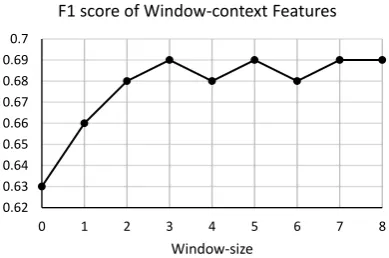
Figure 4: Performance of Window-context feature set by window-size.
window-size in range [0, 8]8 that yields the best
F1 score in 10-fold cross validation. We use the training set as determined in (Stab and Gurevych, 2014b) to train/test9the models using LibLINEAR
algorithm (Fan et al., 2008) without parameter or feature optimization. Cross-validations are con-ducted using Weka (Hall et al., 2009). We use Stanford parser (Klein and Manning, 2003) to per-form text processing. As shown in Figure 4, while increasing the window-size from 2 to 3 improves performance (significantly), using window-sizes greater than 3 does not gain further improvement. We hypothesize that after a certain limit, larger context windows will produce more noise than helpful information for the prediction. Therefore, we set the window-size to 3 in all of our experi-ments involving Window-context model (all with a separate test set).
8Windows-size 0 means covering sentence is the only
context sentence. We experimented with not using context sentence at all and obtained worse performance. Our data does not have context window with window-size 9 or larger.
9Note that via cross validation, in each fold some of our
training set serves as a development set.
Performance on Test Set
We train all models using the training set and re-port their performances on the test set in Table 2. We also compare our baseline to the reported per-formance (REPORT) for Support vs. Non-support classification in (Stab and Gurevych, 2014b). The learning algorithm with parameters are kept the same as in the window-size tuning experiment. Given the skewed class distribution of this data, Accuracy and F1 of Non-support (the major class) are less important than Kappa, F1, and F1 of Sup-port (the minor class). To conduct T-tests for per-formance significance, we split the test data into subsets by essays’ ID, and record prediction per-formance for individual essays.
We first notice that the performances of our baseline model are better than (or equal to) RE -PORTED, except the Macro Recall. We reason that these performance disparities may be due to the differences in feature extractions between our im-plementation and Stab and Gurevych’s, and also due to the minor set of new features (e.g., new predicted labels, expanded marker set, component position) that we added in our baseline.
Comparing proposed models with BASELINE, we see that WINDOW, COMBINED, and FULL models outperform BASELINE in important met-rics: Kappa, F1, Recall, but TOPIC yields worse performances than BASELINE. However, the fact that COMBINED outperforms BASELINE, espe-cially with significantly higher Kappa, F1, Recall, and F1:Support, has shown the value of Topic-context features. While Topic-Topic-context features alone are not effective, they help improve WIN -DOW model which supports our hypothesis that Topic-context and Window-context features are complementary aspects of context, and they to-gether obtain better performance.
[image:7.595.84.279.233.362.2]BASELINE TOPIC WINDOW COMBINED FULL
Accuracy 0.885 0.886 0.872 0.885 0.887
Kappa 0.245 0.305* 0.306* 0.342* 0.274*
Macro F1 0.618 0.651* 0.652* 0.670* 0.634*
Macro Precision 0.680 0.692 0.663 0.697 0.693
Macro Recall 0.595 0.628* 0.644* 0.652* 0.609*
F1:Support 0.937 0.937 0.928* 0.936 0.938
[image:8.595.127.474.61.173.2]F1:Attack 0.300 0.365* 0.376* 0.404* 0.330*
Table 3: 5×10-fold cross validation performance of Support vs. Attack classification. * indicates signif-icantly different from the baseline (p <0.01).
COMBINED models with each other shows that COMBINED obtains the best performance while TOPIC performs the worst, which reveals that Topic-context feature set is less effective than Window-context set. While FULLmodel achieves the best Accuracy, Precision, and F1:Non-support, it has lower performance than COMBINEDmodel in important metrics: Kappa, F1, F1:Support. We reason that the noise caused by word pairs and production rules even dominate the effectiveness of Topic-context and Window-context features, which degrades the overall performance.
Overall, by combining TOPIC and WINDOW models, we obtain the best performance. Most notably, we obtain the highest improvement in F1:Support, and have the best balance between Precision and Recall values among all models. These reveal that our contextual features not only dominate generic features like word pairs and pro-duction rules, but also are effective to predict mi-nor positive class (i.e., Support).
6.2 Task 2: Support vs. Attack
To evaluate the robustness of our proposed mod-els, we conduct an argumentative relation classifi-cation experiment that classifies a relation as Sup-port or Attack. Because this task was not stud-ied in (Stab and Gurevych, 2014b) and the train-ing/test split for Support vs. Not task is not ap-plicable here, we conduct 5×10-fold cross valida-tion. We do not optimize the window-size param-eter of the WINDOWmodel, and use the value 3 as set up before. Average prediction performance of all models are reported in Table 3.
Comparing our proposed models with the base-line shows that all of our proposed models sig-nificantly outperform the baseline in important metrics: Kappa, F1, F1:Attack. More notably than in the Support vs. Non-support
classifica-tion, all of our proposed models predict the minor class (Attack) significantly more effectively than the baseline. The baseline achieves significantly higher F1:Support than WINDOW model. How-ever, F1:Support of the baseline is in a tie with TOPIC, COMBINED, and FULL.
Comparing our proposed models, we see that TOPIC and WINDOW models reveal different be-haviors. TOPIC model has significantly higher Precision and F1:Support, and significantly lower Recall and F1:Attack than WINDOW. Moreover, WINDOW model has slightly higher Kappa, F1, but significantly lower Accuracy. These com-parisons indicate that Topic-context and Window-context features are equally effective but impact differently to the prediction. The different nature between these two feature sets is clearer than in the prior experiment, as now the classification in-volves classes that are more semantically differ-ent, i.e., Support vs. Attack. We recall that TOPIC model performs worse than WINDOW model in Support vs. Non-support task.
Our FULL model performs significantly worse than all of TOPIC, WINDOW, and COMBINED in Kappa, F1, Recall, and F1:Attack. Along with re-sults from Support vs. Non-support task, this fur-ther suggests that word pairs and production rules are less effective and cannot be combined well with our contextual features.
work well even in a more imbalanced with smaller data classification task. The lower performance values of all models in Support vs. Attack than in Support vs. Non-support indirectly suggest that Support vs. Attack classification is a more difficult task. We hypothesize that the difference between support and attack exposes a deeper semantic re-lation than that between support and no-rere-lation. We plan to extract textual text similarity and tex-tual entailment features (Cabrio and Villata, 2012; Boltuˇzi´c and ˇSnajder, 2014) to investigate this hy-pothesis in our future work.
7 Conclusions and Future Work
In this paper, we have presented context-aware argumentative relation mining that makes use of contextual features by exploiting information from topic context and context sentences. We have explored different ways to incorporate our pro-posed features with baseline features used in a prior study, and obtained insightful results about feature effectiveness. Experimental results show that Topic-context and Window-context features are both effective but impact predictive perfor-mance measures differently. In addition, predict-ing an argumentative relation will benefit most from combining these two set of features as they capture complementary aspects of context to bet-ter characbet-terize the argumentation in justification. The results obtained in this preliminary study are promising and encourage us to explore more directions to enable contextual features. Our next step will investigate uses of topic segmentation to identify context sentences and compare this linguistically-motivated approach to our current window-size heuristic. We plan to follow prior research on graph optimization to refine the argu-mentation structure and improve argumentative re-lation prediction. Also, we will apply our context-aware argumentative relation mining to different argument mining corpora to further evaluate its generality.
Acknowledgments
This research is supported by NSF Grant 1122504. We thank the reviewers for their helpful feedback. We also thank Christian Stab for providing us the data split for the first experiment.
References
Or Biran and Owen Rambow. 2011. Identifying Jus-tifications in Written Dialogs by Classifying Text as
Argumentative. International Journal of Semantic
Computing, 5(4):363–381.
David M Blei, Andrew Y Ng, and Michael I Jordan.
2003. Latent Dirichlet allocation. The Journal of
Machine Learning Research, 3:993–1022.
Filip Boltuˇzi´c and Jan ˇSnajder. 2014. Back up your Stance: Recognizing Arguments in Online
Dis-cussions. In Proceedings of the First Workshop
on Argumentation Mining, pages 49–58, Baltimore, Maryland, June. Association for Computational Lin-guistics.
Jill Burstein, Daniel Marcu, and Kevin Knight. 2003. Finding the WRITE Stuff: Automatic Identification
of Discourse Structure in Student Essays. IEEE
In-telligent Systems, 18(1):32–39, January.
Elena Cabrio and Serena Villata. 2012. Combining Textual Entailment and Argumentation Theory for
Supporting Online Debates Interactions. In
Pro-ceedings of the 50th Annual Meeting of the Asso-ciation for Computational Linguistics: Short Papers - Volume 2, ACL ’12, pages 208–212, Stroudsburg, PA, USA. Association for Computational Linguis-tics.
Elena Cabrio, Sara Tonelli, and Serena Villata. 2013. From Discourse Analysis to Argumentation Schemes and Back: Relations and Differences. In
Computational Logic in Multi-Agent Systems,
vol-ume 8143 of Lecture Notes in Computer Science,
pages 1–17. Springer Berlin Heidelberg.
Lynn Carlson, Daniel Marcu, and Mary Ellen Okurowski. 2001. Building a Discourse-tagged Corpus in the Framework of Rhetorical Structure
Theory. InProceedings of the Second SIGdial
Work-shop on Discourse and Dialogue - Volume 16, SIG-DIAL ’01, pages 1–10, Stroudsburg, PA, USA. As-sociation for Computational Linguistics.
Jianguang Du, Jing Jiang, Liu Yang, Dandan Song, and Lejian Liao. 2014. Shell Miner: Mining Organiza-tional Phrases in Argumentative Texts in Social
Me-dia. InProceedings of the 2014 IEEE International
Conference on Data Mining, ICDM ’14, pages 797– 802, Washington, DC, USA. IEEE Computer Soci-ety.
Rong-En Fan, Kai-Wei Chang, Cho-Jui Hsieh, Xiang-Rui Wang, and Chih-Jen Lin. 2008. LIBLINEAR:
A Library for Large Linear Classification. The
Jour-nal of Machine Learning Research, 9:1871–1874, June.
Eirini Florou, Stasinos Konstantopoulos, Antonis Koukourikos, and Pythagoras Karampiperis. 2013. Argument extraction for supporting public policy
formulation. InProceedings of the 7th Workshop on
Sciences, and Humanities, pages 49–54, Sofia, Bul-garia, August. Association for Computational Lin-guistics.
Mark Hall, Eibe Frank, Geoffrey Holmes, Bernhard Pfahringer, Peter Reutemann, and Ian H. Witten. 2009. The WEKA Data Mining Software: An
Update. ACM SIGKDD Explorations Newsletter,
11(1):10–18, November.
Yangfeng Ji and Jacob Eisenstein. 2014. Representa-tion Learning for Text-level Discourse Parsing. In
Proceedings of the 52nd Annual Meeting of the As-sociation for Computational Linguistics (Volume 1: Long Papers), pages 13–24, Baltimore, Maryland, June. Association for Computational Linguistics.
Dan Klein and Christopher D Manning. 2003.
Ac-curate unlexicalized parsing. InProceedings of the
41st Annual Meeting on Association for Computa-tional Linguistics-Volume 1, pages 423–430. Asso-ciation for Computational Linguistics.
Ran Levy, Yonatan Bilu, Daniel Hershcovich, Ehud Aharoni, and Noam Slonim. 2014. Context
Depen-dent Claim Detection. InProceedings of COLING
2014, the 25th International Conference on Compu-tational Linguistics: Technical Papers, pages 1489– 1500, Dublin, Ireland, August.
Marco Lippi and Paolo Torroni. 2015. Context-independent Claim Detection for Argument Mining. InProceedings of the 24th International Conference on Artificial Intelligence, IJCAI’15, pages 185–191, Buenos Aires, Argentina. AAAI Press.
Nitin Madnani, Michael Heilman, Joel Tetreault, and
Martin Chodorow. 2012. Identifying
High-Level Organizational Elements in Argumentative
Discourse. InProceedings of the 2012 Conference
of the North American Chapter of the Association for Computational Linguistics: Human Language Technologies, pages 20–28, Montr`eal, Canada. As-sociation for Computational Linguistics.
Marie-Francine Moens, Erik Boiy, Raquel Mochales Palau, and Chris Reed. 2007. Automatic
Detec-tion of Arguments in Legal Texts. InProceedings of
the 11th International Conference on Artificial Intel-ligence and Law, ICAIL ’07, pages 225–230, New York, NY, USA. ACM.
Huy Nguyen and Diane Litman. 2015. Extracting Argument and Domain Words for Identifying
Ar-gument Components in Texts. In Proceedings of
the 2nd Workshop on Argumentation Mining, pages 22–28, Denver, CO, June. Association for Computa-tional Linguistics.
Huy Nguyen and Diane Litman. 2016. Improving argument mining in student essays by learning and exploiting argument indicators versus essay topics. In Proceedings 29th International FLAIRS
Confer-ence, Key Largo, FL, May.
Raquel Mochales Palau and Marie-Francine Moens. 2009. Argumentation Mining: The Detection, Clas-sification and Structure of Arguments in Text. In
Proceedings of the 12th International Conference on Artificial Intelligence and Law, ICAIL ’09, pages 98–107, New York, NY, USA. ACM.
Joonsuk Park and Claire Cardie. 2014. Identifying Ap-propriate Support for Propositions in Online User
Comments. In Proceedings of the First Workshop
on Argumentation Mining, pages 29–38, Baltimore, Maryland, June. Association for Computational Lin-guistics.
Andreas Peldszus and Manfred Stede. 2013. From Argument Diagrams to Argumentation Mining in
Texts: A Survey. International Journal of
Cogni-tive Informatics and Natural Intelligence (IJCINI), 7(1):1–31, January.
Andreas Peldszus and Manfred Stede. 2015a. Joint prediction in MST-style discourse parsing for
ar-gumentation mining. In Proceedings of the 2015
Conference on Empirical Methods in Natural Lan-guage Processing (EMNLP), pages 938–948, Lis-bon, Portugal, September. Association for Compu-tational Linguistics.
Andreas Peldszus and Manfred Stede. 2015b. To-wards Detecting Counter-considerations in Text. In
Proceedings of the 2nd Workshop on Argumentation Mining, pages 104–109, Denver, CO, June. Associ-ation for ComputAssoci-ational Linguistics.
Andreas Peldszus. 2014. Towards segment-based recognition of argumentation structure in short texts. InProceedings of the First Workshop on Argumen-tation Mining, pages 88–97, Baltimore, Maryland, June. Association for Computational Linguistics. Rashmi Prasad, Nikhil Dinesh, Alan Lee, Eleni
Milt-sakaki, Livio Robaldo, Aravind Joshi, and Bonnie Webber. 2008. The Penn Discourse TreeBank 2.0. InProceedings of the Sixth International Conference on Language Resources and Evaluation (LREC-08), Marrakech, Morocco, May. European Language Re-sources Association (ELRA). ACL Anthology Iden-tifier: L08-1093.
Vahed Qazvinian and Dragomir R. Radev. 2010. Iden-tifying Non-explicit Citing Sentences for
Citation-based Summarization. In Proceedings of the
48th Annual Meeting of the Association for Com-putational Linguistics, ACL ’10, pages 555–564, Stroudsburg, PA, USA. Association for Computa-tional Linguistics.
Diarmuid ´O S´eaghdha and Simone Teufel. 2014. Un-supervised learning of rhetorical structure with
un-topic models. In Proceedings of the 25th
Inter-national Conference on Computational Linguistics (COLING-14), Dublin, Ireland.
Alan Sergeant. 2013. Automatic argumentation
Conference, pages 656–660, Montpellier, France. Springer.
Christian Stab and Iryna Gurevych. 2014a. Anno-tating Argument Components and Relations in
Per-suasive Essays. InProceedings of COLING 2014,
the 25th International Conference on Computational Linguistics: Technical Papers, pages 1501–1510, Dublin, Ireland. Dublin City University and Asso-ciation for Computational Linguistics.
Christian Stab and Iryna Gurevych. 2014b. Identifying Argumentative Discourse Structures in Persuasive
Essays. In Proceedings of the 2014 Conference on
Empirical Methods in Natural Language Processing (EMNLP), pages 46–56, Doha, Qatar. Association for Computational Linguistics.
Christian Stab, Christian Kirschner, Judith Eckle-Kohler, and Iryna Gurevych. 2014. Argumentation Mining in Persuasive Essays and Scientific Articles from the Discourse Structure Perspective. In Elena Cabrio, Serena Villata, and Adam Wyner, editors,
Proceedings of the Workshop on Frontiers and Con-nections between Argumentation Theory and Natu-ral Language Processing, pages 40–49, Bertinoro, Italy, July. CEUR-WS.
Simone Teufel and Marc Moens. 2002. Summariz-ing Scientific Articles: Experiments with Relevance
and Rhetorical Status. Computational Linguistics,
28(4), December.
Douglas Walton, Christopher Reed, and Fabrizio
Macagno. 2008. Argumentation Schemes.
Cam-bridge University Press.
Jianxiang Wang and Man Lan. 2015. A Refined
End-to-End Discourse Parser. In Proceedings of