Proceedings of the BioNLP 2019 workshop, pages 339–347 339
Improving classification of Adverse Drug Reactions through Using
Sentiment Analysis and Transfer Learning
Hassan Alhuzali Sophia Ananiadou National Centre for Text Mining
School of Computer Science, The University of Manchester, United Kingdom {hassan.alhuzali, sophia.ananiadou}@manchester.ac.uk
Abstract
The availability of large-scale and real-time data on social media has motivated research into adverse drug reactions (ADRs). ADR classification helps to identify negative effects of drugs, which can guide health profession-als and pharmaceutical companies in mak-ing medications safer and advocatmak-ing patients’ safety. Based on the observation that in so-cial media, negative sentiment is frequently expressed towards ADRs, this study presents a neural model that combines sentiment analysis with transfer learning techniques to improve ADR detection in social media postings. Our system is firstly trained to classify sentiment in tweets concerning current affairs, using the SemEval17-task4A corpus. We then apply transfer learning to adapt the model to the task of detecting ADRs in social media postings. We show that, in combination with rich repre-sentations of words and their contexts, trans-fer learning is beneficial, especially given the large degree of vocabulary overlap between the current affairs posts in the SemEval17-task4A corpus and posts about ADRs. We compare our results with previous approaches, and show that our model can outperform them by up to3%F-score.
1 Introduction
Social media generate a huge amount of data for health and are considered to be an impor-tant source of information for pharmacovigilance (Sloane et al., 2015; Harpaz et al., 2014; Kass-Hout and Alhinnawi,2013). ADR detection from social media has attracted a large amount of inter-est as a source of information regarding morbid-ity and mortalmorbid-ity. In this respect, social networks are an invaluable source of information, allowing us to extract and analyse ADRs from health com-munication threads between thousands of users in real-time.
Several ADR systems have utilised features re-lated to the sentiment of words to boost their sys-tem performance (Wu et al., 2018; Kiritchenko et al., 2017; Alimova and Tutubalina, 2017; Ko-rkontzelos et al., 2016; Sarker and Gonzalez,
2015). Korkontzelos et al. (2016) analyse the impact of sentiment analysis features on extract-ing ADR from tweets. The authors observed that users frequently express negative sentiments when tweeting/posting about ADRs and they found the use of sentiment-aware features could improve ADR sequence labelling and classification.
It may be observed that the language used to ex-press sentiment is often common across different domains. Consider, for example, the tweet “I hate how Vyvanse makes me over think everything and it makes me angry about things that I shouldn’t even be angry about”. The keywords used in this tweet to express the authors negative sentiment to-wards an ADR, i.e., hate and anger, are not specific to ADRs, and may be used to express sentiment towards many different kinds of topics. Based on this observation, we hypothesise that we can lever-age transfer learning techniques by using senti-ment analysis data to boost the detection of ADRs. Our main research contribution is a new neu-ral model that detects ADRs by firstly learning to classify sentiment, using a publicly available cor-pus of Tweets that is annotated with sentiment in-formation and then using transfer learning to adapt this classifier to the detection of ADRs in social media postings.
techniques to adapt a sentiment analysis classifier to the task of detecting ADRs. In contrast to pre-vious research, we use generalised neural methods that avoid the use of hand-crafted features, since these are time-consuming to generate, and are usu-ally domain-dependent. We also explore different fine-tuning methods, (Howard and Ruder, 2018;
Felbo et al., 2017), to determine which one per-forms best in our scenario.
The rest of the paper is organised as follows: Section2provides a review of related work. Sec-tion3presents the two datasets used to create our model. Section4describes our method and model. Section5 reports on the analysis of results while Section6provides some conclusions.
2 Related Work
There is a growing body of literature concerned with the detection and classification of ADRs in social media texts (Wang et al.,2018;Huynh et al.,
2016;Ebrahimi et al.,2016;Liu and Chen,2015). Recent work has employed sentiment analysis fea-tures to improve the classification of ADRs (Wu et al., 2018; Kiritchenko et al., 2017; Alimova and Tutubalina, 2017;Korkontzelos et al., 2016;
Sarker and Gonzalez,2015).
Nikfarjam et al. (2015) exploited a set of fea-tures, including context feafea-tures, ADR lexicon, part of speech (POS) and negation, to enhance the performance of ADR extraction. The au-thors chose Conditional Random Field as their classifier (CRF). Korkontzelos et al. (2016) fol-lowed the same research hypothesis, but focused on the evaluation of sentiment analysis features as an aid to extracting ADRs, based on the cor-relation between negative sentiments and ADRs.
Alimova and Tutubalina(2017) built a classifica-tion system for the detecclassifica-tion of ADRs for which they used a Support Vector Machine (SVM), in-stead of CRF. The authors also explored differ-ent types of features, including sdiffer-entimdiffer-ent features and demonstrated that they improved the perfor-mance of ADR identification. Wu et al. (2018) utilised a set of hand-crafted features (i.e. senti-ment features learned from lexica), similar to all of the other studies introduced above. However, the main difference is that the model is based on a neural network architecture, including word and character embeddings, Convolutional neural net-work (CNN), Long Short-Term Memory (LSTM) and multi-head attentions. This was the best
per-forming system in the 2018 ADRs shared-task1, which is part of the social media mining for health workshop (SMM4H).
In contrast to the models proposed in the above studies, it is possible to leverage sentiment analy-sis features automatically, without relying on any hand-crafted features. One common approach is to pre-train a classifier on a corpus annotated with sentiment information and then to adapt this pre-trained classifier to the detection of ADRs. The advantage of this approach is that the target sys-tem only needs access to the pre-trained model, but not the original sentiment corpus, which can be important for storage and data regulation is-sues. This method has been investigated by var-ious researchers (Devlin et al.,2018;Howard and Ruder, 2018; Felbo et al., 2017). Felbo et al.
(2017) learned a rich representation for detect-ing sentiment, sarcasm, and emotion usdetect-ing mil-lions of emojis’ dataset, acquired from Twitter. They demonstrated that this approach performs well and can achieve results that are competitive with state of the art systems. Recently, Devlin et al. (2018) built a deep bidirectional represen-tation from transformers, which can be fine-tuned to different target tasks with an additional output layer. The model, which is called “Bert”, showed significant improvements for a wide array of tasks, such as text classification, textual entailment and question answering, among others.
Compared to the above approaches, our work uses a simpler network architecture and does not require any feature engineering. Furthermore, we take advantage of transfer learning techniques ac-quired knowledge from sentiment analysis data. Our work is motivated byFelbo et al.(2017) who constructed a pre-trained classifier on emoji’s data and then adapted to sentiment and emotion detec-tion. The full details of our architecture are de-scribed in section4.1.
3 Data
Several datasets have been created for ADRs. Some of these are gathered from specialised social networking forums for health (Thompson et al.,
2018;Sampathkumar et al.,2014;Yates and Go-harian,2013;Yang et al.,2012), while others are collected from social media (Ginn et al., 2014;
Jiang and Zheng,2013;Bian et al.,2012).
1https://healthlanguageprocessing.org/
In this research, we chose a widely used dataset (containing postings from Twitter and Dai-lyStrength2) (Nikfarjam et al., 2015) that are an-notated according to the presence or absence of ADRs in each post. The authors partitioned the data into a training (75%) and test (25%) sets. We further divided the training set into a60%for training and40%for validation. The validation set is used to develop our model before it is evaluated on the original test set (i.e. 25%of the complete corpus). Our model is designed to perform binary classification, to determine whether or not a given tweet or post mentions an ADR. Table1presents the number of tweets/posts belong to each cate-gory in the three different partitions of the data. More detailed information about the datasets can be found inKorkontzelos et al.(2016) and Nikfar-jam et al.(2015).
Datasets #ADRs #None Training DailyS. 900 417
Twitter 390 384
Validation DailyS. 600 278
Twitter 260 256
Test DailyS. 533 225
[image:3.595.112.251.321.464.2]Twitter 236 192
Table 1: Data statistics (DailyS. = DailyStrength)
3.1 Sentiment Analysis corpus
We firstly train a sentiment analysis model on Twitter data from the SemEval17-task4A, which focuses on classifying the sentiment polarity of tweets on the subject of current affairs into pre-defined categories, e.g. positive, negative, and neutral. The dataset is partitioned into a train-ing set of50,000tweets and a test set of12,000 tweets (Rosenthal et al., 2017). A description of the sentiment analysis model is provided in sec-tion4.
3.2 Preprocessing
Since Twitter data possesses specific character-istics, including informal language, misspellings, and abbreviations, we pre-process the data before
2DailyStrength is a specialised social networking website for health.
applying the methods described in the next sec-tion. We use a tool that is specifically designed for the Twitter domain (Baziotis et al.,2017). The tool provides a number of different functionali-ties, such as tokenisation, normalisation, spelling-correction, and segmentation. We use the tool to tokenise the text, to convert words to lower-case, to correct misspellings, and to normalise user mentions, urls and repeated-characters.
4 Methods
This section discusses our model architecture, which is composed of two stages: the first stage in-volves building a sentiment analysis model, while the second stage adapts this model to a target task, which our case is the detection of ADRs. We describe our architectures in the following sub-sections.
4.1 Network Architecture
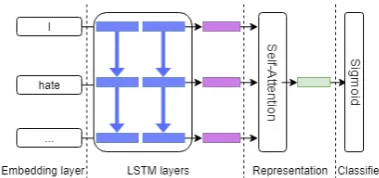
Our architecture consists of an embedding layer (Mikolov et al.,2013), a Long Short-Term Mem-ory (LSTM) layer (Hochreiter and Schmidhu-ber,1997), a self-attention mechanism (Bahdanau et al., 2014) and a classification layer. Figure 1
depicts the network architecture of our model.
Figure 1: A description of the framework for our sys-tem.
In our different experiments, we use both an LSTM and a bi-directional LSTM (BiLSTM). Both are able to capture sequential dependencies especially in time series data, of which language can be seen as an example. The model’s weights are initialized from theword2vecembedding with 300 dimensional size3. Additionally, the model consists of two LSTM/BiLSTM layers. For reg-ularisation, we apply a dropout rate of 0.2 and 0.3 on the embedding output and after the sec-ond hidden layer, respectively, to prevent the net-work from over-fitting to the training set (Hinton
3https://github.com/alexandra-chron/
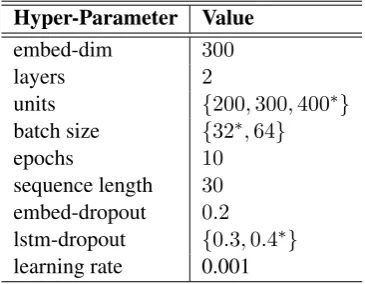
[image:3.595.320.510.435.524.2]et al.,2012). We also choose Adam (Kingma and Ba,2014) for optimisation and select0.001as the learning rate. We train the network for10epochs and the best performing cycle is only retained. It should be mentioned that the above set of hyper-parameters was determined using the validation set. Table2summarises the network architecture and hyper-parameters.
Hyper-Parameter Value
embed-dim 300
layers 2
units {200,300,400∗}
batch size {32∗,64}
epochs 10
sequence length 30
embed-dropout 0.2
lstm-dropout {0.3,0.4∗}
[image:4.595.90.273.181.323.2]learning rate 0.001
Table 2: Network architecture and hyper-parameters. The asterisk (*): denotes the best performing setting
Embedding layer: T is a sequence of words {w1, w2, ..., wn} in a tweet/post and eachwi is a d dimensional word embedding for the i-th word in the sequence, where nis the number of words in the tweet. T should have the following shape
n-by-d.
LSTM/Bi-LSTM layer: An LSTM layer takes as its input a sequence of word embeddings and generates word representations {h1, h2, ..., hn}, where each hi is the hidden state at time-step i, retaining all the information of the sequence up to wi. Additionally, we experiment with a BiL-STM where the vector representation is built as a concatenation of two vectors, the first running in a forward direction −→h from left-to-right and the second running in a backward direction ←−h from right-to-lefthi=[
− →
h;←−h].
Self-attention: A self-attention mechanism has been shown to attend to the most informative words within a sequence by assigning a weightai to each hidden statehi. The representation of the whole input is computed as follows:
ei =tanh(Whhi+bh) (1)
ai =sof tmax(ei) (2)
r= T
X
i=1
ai·hi (3)
, whereWh, bhare the attention’s weights.
Classification layer: The vector r is an en-coded representation of the whole input text (i.e. a tweet or post), which is eventually passed to a fully-connected layer for classification. A bi-nary classification decision is made according to whether or not the input text mentions ADRs.
Transfer Learning: There are two common ap-proaches to transfer learning (Peters et al.,2019). One approach is to use the last layer of a pre-trained model when fine-tuning to the target task. In this scenario, the network is used as a feature extractor. An alternative approach is to use the network for initialization, i.e., the full network is unfrozen and then fine-tuned to the target task.
In this work, After training the sentiment clas-sification model, we exclude its output layer and replace it by an ADR output layer. Finally, the network is fine-tuned to detect the ADRs adopting the same architecture and hyper-parameters as the original model. We analyse the fine-tuning meth-ods in section5.2.1.
5 Results & Analysis
5.1 Results
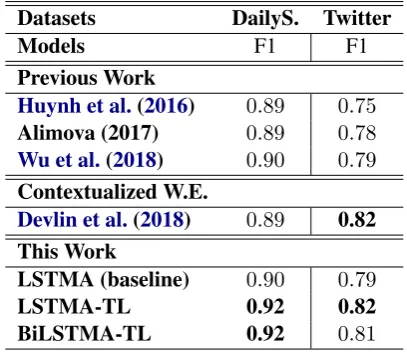
Table3presents the performance of our models in terms of F-score, and compares these to the three of the best performing models from recently pub-lished research. For our own results, we report the results of three different experiments. Firstly, the baseline (LSTMA) is trained to detect ADRs using only the ADR datasets mentioned above, without the use of transfer learning. The other two models (LSTMA-TL and BiLSTMA-TL) ap-ply transfer learning, making use of pre-training of a sentiment analysis model using the SemEval17-task4A dataset. These latter two models differ-ent in terms of whether they use a single direction or bi-directional LSTM, respectively. For experi-ments related to previous work, we replicated the three models following their details as described in Huynh et al. (2016), Alimova and Tutubalina
(2017) andWu et al.(2018).
5.1.1 Previous Work
Huynh et al.(2016) exploited different neural net-works, i.e CNN and a combination of both CNN and Gated Recurrent Units (GRU). They found that CNN obtained the best performance. For this reason, the results reported in Table3are those ob-tained for the CNN model. On the Twitter dataset, the performance of the CNN is even lower than the performance of our baseline model on this dataset. However, the performance on the DailyStrength dataset is considerably higher. The model devel-oped byWu et al.(2018) obtained the best results among the three compared systems; indeed, the re-sults reach the same level as our baseline system. However, it is important to note that in contrast to our model architecture, that of Wu et al. (2018) is more complex and it relies on hand-crafted fea-tures as well as deep neural architecfea-tures.
5.1.2 Contextualised Word Embedding
In this work, we also compared our model to con-textualized embedding (i.e. Bert) since it has been shown to achieve high results for various NLP tasks, including text classification (Devlin et al.,
2018). We use the open-source PyTorch imple-mentations 4 and only consider the “bert-base-uncase” model. The model is trained on the de-fault hyper-parameters except that the number of batch-size and sequence length are chosen as fol-lows32 and30, respectively, to match our model hyper-parameters for these two values. As shown in Table3, Bert model achieves the same perfor-mance as our best model “LSTMA-TL” when ap-plied to the Twitter data, although its performance is3%lower than our best performing model when applied to the DailyStrength dataset. Even though transfer learning is beneficial, it can achieve better performance when learned from a related domain to the problem under investigation.
5.1.3 This Work
As Table 3 demonstrates, our proposed model is able to outperform all compared systems on the DailyStrength dataset, and all systems apart from Bert when applied to the Twitter Dataset. More specifically, the “LSTMA-TL” obtained the best results, thus demonstrating the utility and advantages of transfer learning techniques. The “BiLSTMA-TL” also demonstrates competitive results for the DailyStrength dataset, but it is 1% less than the “LSTMA-TL” for the Twitter dataset.
4https://github.com/huggingface/
pytorch-pretrained-BERT
This may be due to the size of data and the archi-tecture used in this work. Although the sentiment analysis model is trained on Twitter data, our ADR detection system still demonstrated substantial im-provement on the DailyStrength dataset. Specifi-cally, we obtained3%and2%improvement over our baseline model (i.e. LSTMA) on the Twitter and Dailystrength datasets, respectively.
Even though our experiments are based on a small dataset, the model demonstrated strong per-formance for ADR classification. Recent research claims that transfer learning techniques (i.e. fine-tuning) are beneficial for downstream tasks even if the target data size is small (Howard and Ruder,
2018;Alhuzali et al.,2018).
Datasets DailyS. Twitter
Models F1 F1
Previous Work
Huynh et al.(2016) 0.89 0.75
Alimova (2017) 0.89 0.78 Wu et al.(2018) 0.90 0.79
Contextualized W.E.
Devlin et al.(2018) 0.89 0.82 This Work
LSTMA (baseline) 0.90 0.79
LSTMA-TL 0.92 0.82
[image:5.595.314.518.277.453.2]BiLSTMA-TL 0.92 0.81
Table 3: Comparison of our models to those reported in previous work. LSTMA: refers to LSTM with self−attention mechanism, whileLSTMA-TL: means the same thing except the addition of transfer learn-ing model. BiLSTM-TF: uses a BiLSTM with trans-fer learning model. Alimova (2017):Alimova and Tu-tubalina(2017). Best: bold.
5.2 Analysis
5.2.1 Impact of fine-tuning
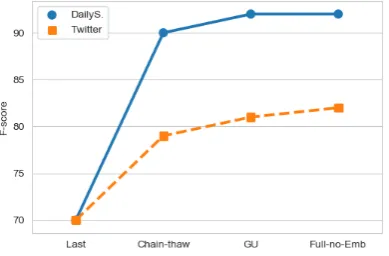
We evaluate different methods to fine-tune our model, i.e. Last, Chain-thaw, Full and Simple Gradual unfreezing (GU). The first three tech-niques are adopted fromFelbo et al.(2017) while the fourth one is described byChronopoulou et al.
differ-ent epochs. In this work, we experimdiffer-ented with these methods and selected the one that achieved the highest results for both datasets (i.e. Twit-ter and DailyStrength). The results of these four methods are reported in Figure2.
[image:6.595.85.280.335.463.2]“Last”, which is the standard technique in fine-tuning, achieved the lowest performance; this is not surprising, because it contains the least general knowledge. In contrast, “Chain-thaw” achieved better results than “Last”. The “Full” and “GU” obtained the best results for ADR classification. When we fine-tuned the whole network, we mod-ified the “Full” method such that the embedding layer is frozen and we called it “Full-no-Emb”, in-stead. The intuition behind this is that the embed-ding layer computes a word-based representation, which does not take into account the context of a word. This method obtains the best performance for both Twitter and DailyStrength datasets.
Figure 2: F-score for our model with a different set of fine-tuning methods.
5.2.2 Word Coverage
We observed that the vocabularies used in the sen-timent analysis dataset and the ADR datasets share a large proportion of common words. To fur-ther investigate this, we measured the degree of common word coverage between the training and test parts of each dataset (i.e. Twitter and Dai-lyStrength). The SemEval17-task4A training set is also included in this comparison. It should be noted that we compute the word coverage after pre-processing the data. Table 4 shows percent-age of shared-vocabulary between the datasets. As shown in Table4, the percentage of shared words between the training and test set of ADR Twit-ter data is 56.50%, while it is 74.22% between the SemEval17-task4A training set and the ADR Twitter test set. A similar pattern is also observed for the DailyStrength dataset, although there is a
greater proportion of shared vocabulary between the training and test sets of DailyStrength. The vocabulary of the SemEval17-task4A dataset ex-hibits a large degree of overlap with the test sets of both Twitter and DailyStrength.
We hypothesise a number of reasons could ac-count for this finding. Intuitively, users often use none-technical keywords when they post or tweet about ADRs. In other words, they do not em-ploy terms found in medical lexicons. This allows users to express their opinion towards ADRs us-ing terms which may be used to express sentiment towards other different topics. Additionally, sev-eral datasets have been collected for ADRs. How-ever, most of them have not been made available for the research community. In contrast, there are dozens of sentiment analysis datasets available on-line, including SemEval17-task4A5, Yelp reviews
6, Amazon reviews7 and Stanford8, among
oth-ers. Thus, this confirms our initial observations and helps to reinforce that ADR system can bene-fit from the proliferation of sentiment analysis data available online, which is the primary motivation of this work.
Dataset Train SEl17-4A ∆% Twitter test 56.50% 74.22% 17.72%
DailyS. test 68.03% 78.22% 10.19%
Table 4: Word coverage. “SEl17-4A”: corresponds to the training set of the SemEval17-task4A. ∆%: rep-resents the difference between the two percentages for each dataset in a row.
5.2.3 Error Analysis
We experiment with small data in this work and this may limit our interpretation and analysis in this section. Nevertheless, performing error anal-ysis can reveal some strengths and weaknesses of the proposed models and identify room for future work.
For error analysis, we selected examples which are incorrectly classified by the proposed model in this paper (i.e. LSTMA-TL) and previous work (i.e. (Huynh et al.,2016;Alimova and Tutubalina,
5http://alt.qcri.org/semeval2017/
task4/index.php?id=data-and-tools
6
https://www.yelp.com/dataset
7
https://s3.amazonaws.com/ amazon-reviews-pds/readme.html
8https://nlp.stanford.edu/sentiment/
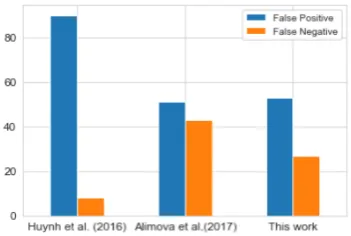
2017). Figure3and4present the number of false positive and false negative classifications for each model. As can be seen in Figure3that the num-ber of miss-classified examples as false negative is higher than false positive for the DailyStrength dataset, while the opposite pattern is observed for the Twitter dataset as shown in Figure 4. Our model also demonstrated balanced error classifica-tions for both false positive and false negative. In contrast, the other two models, proposed by pre-vious research, obtained unbalanced error classi-fications exceptAlimova and Tutubalina(2017)’s model achieved quite balanced errors for the Twit-ter dataset. For future work, it might be useful to investigate different ensemble methods that can help to reduce the false positive and false nega-tive classifications and improve the classification of ADR.
In addition, we analysed examples only classi-fied correctly by our model. We observed that our model is able to classify examples carrying none-specific keywords to ADRs, but to sentiments in general. This shows the importance of sentiment features to ADRs. Examples 1-3 below illustrate the instances that are correctly predicted by our proposed model. The first two examples are part of the Twitter test set, while the third example is part of the DailyStrength test set.
• Example 1: is it hot in here or is [durg name] just kicking in?.
• Example 2: anyone ever taken [durg name]? i’ve been on it for a week, not too sure how i feel about it yet. anyone want to share their experience?.
• Example 3: loved it , except for not being able to be woken up at night . . yeah that blew.
On the other hand, we inspected examples that our model failed to correctly classify. For instance, example (4) below was extracted from the Twit-ter test set and it was predicted as negative for the presence of ADR, whereas the true label is positive for the presence of ADR. Examples (5) also illus-trates the same observation, but is part of the Dai-lyStrength test set. We anticipate that our model failed to classify example (4) and (5) due to the lack of context and unambiguous keywords. Ex-ample (4) can also be interpreted as either positive or negative for the presence of ADRs. This may
explain that the true label can be sometimes mis-leading and requires further examination.
• Example 4: moved on to something else when it quit working.
[image:7.595.324.507.180.309.2] [image:7.595.328.504.382.500.2]• Example 5: i’m with you. even though the [durg name] works, i still don’t feel fully hu-man.
Figure 3: The number of miss-classified examples by the proposed models of this work and previous research for the DailyStrength dataset. This work: refers to the proposed model in this paper (i.e. LSTMA-TL).
Figure 4: The number of miss-classified examples by the proposed models of this work and previous research for the Twitter dataset. This work: refers to the pro-posed model in this paper (i.e. LSTMA-TL).
6 Conclusion
over previously published models. It also achieved higher results than Bert on DailyStrength dataset. Additionally, the word coverage analyses revealed that sentiment analysis dataset shares a significant amount of vocabulary with ADR dataset, which is even higher than the correlation between the words in training and test sets of the same ADR dataset. This paper has empirically discussed the advantages and utility of both sentiment analysis datasets and transfer learning techniques for im-proving the performance of ADR detection in so-cial media and speso-cialised health-related forums. Finally, we provided some error analyses and po-tential future work.
7 Acknowledgement
We thank Prof. Graciela Gonzalez-Hernandez, University of Pennsylvania, for sharing the Twit-ter and DailyStrength datasets with us. We would like also to thank Paul Thompson for his valuable comments and suggestions. The first author is sup-ported by the Ministry of Higher Education of the Kingdom of Saudi Arabia.
References
Hassan Alhuzali, Mohamed Elaraby, and Muhammad Abdul-Mageed. 2018. Ubc-nlp at iest 2018: Learn-ing implicit emotion with an ensemble of language models. In Proceedings of the 9th Workshop on Computational Approaches to Subjectivity, Senti-ment and Social Media Analysis, pages 342–347.
Ilseyar Alimova and Elena Tutubalina. 2017. Auto-mated detection of adverse drug reactions from so-cial media posts with machine learning. In Inter-national Conference on Analysis of Images, Social Networks and Texts, pages 3–15. Springer.
Dzmitry Bahdanau, Kyunghyun Cho, and Yoshua Ben-gio. 2014. Neural machine translation by jointly learning to align and translate. arXiv preprint arXiv:1409.0473.
Christos Baziotis, Nikos Pelekis, and Christos Doulk-eridis. 2017. Datastories at semeval-2017 task 4: Deep lstm with attention for message-level and topic-based sentiment analysis. In Proceedings of the 11th International Workshop on Semantic Eval-uation (SemEval-2017), pages 747–754.
Jiang Bian, Umit Topaloglu, and Fan Yu. 2012. To-wards large-scale twitter mining for drug-related ad-verse events. In Proceedings of the 2012 inter-national workshop on Smart health and wellbeing, pages 25–32. ACM.
Alexandra Chronopoulou, Christos Baziotis, and Alexandros Potamianos. 2019. An embarrass-ingly simple approach for transfer learning from pretrained language models. arXiv preprint arXiv:1902.10547.
Jacob Devlin, Ming-Wei Chang, Kenton Lee, and Kristina Toutanova. 2018. Bert: Pre-training of deep bidirectional transformers for language understand-ing.arXiv preprint arXiv:1810.04805.
Monireh Ebrahimi, Amir Hossein Yazdavar, Naomie Salim, and Safaa Eltyeb. 2016. Recognition of side effects as implicit-opinion words in drug reviews.
Online Information Review, 40(7):1018–1032.
Bjarke Felbo, Alan Mislove, Anders Søgaard, Iyad Rahwan, and Sune Lehmann. 2017. Using millions of emoji occurrences to learn any-domain represen-tations for detecting sentiment, emotion and sar-casm. In Proceedings of the 2017 Conference on Empirical Methods in Natural Language Process-ing, pages 1615–1625.
Rachel Ginn, Pranoti Pimpalkhute, Azadeh Nikfarjam, Apurv Patki, Karen OConnor, Abeed Sarker, Karen Smith, and Graciela Gonzalez. 2014. Mining twit-ter for adverse drug reaction mentions: a corpus and classification benchmark. In Proceedings of the fourth workshop on building and evaluating re-sources for health and biomedical text processing, pages 1–8. Citeseer.
Rave Harpaz, Alison Callahan, Suzanne Tamang, Yen Low, David Odgers, Sam Finlayson, Kenneth Jung, Paea LePendu, and Nigam H. Shah. 2014. Text min-ing for adverse drug events: the promise, challenges, and state of the art.Drug Safety, 37(10):777–790.
Geoffrey E Hinton, Nitish Srivastava, Alex Krizhevsky, Ilya Sutskever, and Ruslan R Salakhutdinov. 2012. Improving neural networks by preventing co-adaptation of feature detectors. arXiv preprint arXiv:1207.0580.
Sepp Hochreiter and J¨urgen Schmidhuber. 1997. Long short-term memory. Neural computation, 9(8):1735–1780.
Jeremy Howard and Sebastian Ruder. 2018. Universal language model fine-tuning for text classification. In
Proceedings of the 56th Annual Meeting of the As-sociation for Computational Linguistics (Volume 1: Long Papers), volume 1, pages 328–339.
Trung Huynh, Yulan He, Alistair Willis, and Stefan R¨uger. 2016. Adverse drug reaction classification with deep neural networks. Coling.
Keyuan Jiang and Yujing Zheng. 2013. Mining twitter data for potential drug effects. InInternational con-ference on advanced data mining and applications, pages 434–443. Springer.
Diederik P Kingma and Jimmy Ba. 2014. Adam: A method for stochastic optimization. arXiv preprint arXiv:1412.6980.
Svetlana Kiritchenko, Saif M Mohammad, Jason Morin, and Berry de Bruijn. 2017. Nrc-canada at smm4h shared task: classifying tweets mentioning adverse drug reactions and medication intake. arXiv preprint arXiv:1805.04558.
Ioannis Korkontzelos, Azadeh Nikfarjam, Matthew Shardlow, Abeed Sarker, Sophia Ananiadou, and Graciela H Gonzalez. 2016. Analysis of the effect of sentiment analysis on extracting adverse drug re-actions from tweets and forum posts. Journal of biomedical informatics, 62:148–158.
Xiao Liu and Hsinchun Chen. 2015. A research frame-work for pharmacovigilance in health social media: identification and evaluation of patient adverse drug event reports. Journal of biomedical informatics, 58:268–279.
Tomas Mikolov, Ilya Sutskever, Kai Chen, Greg S Cor-rado, and Jeff Dean. 2013. Distributed representa-tions of words and phrases and their compositional-ity. InAdvances in neural information processing systems, pages 3111–3119.
Azadeh Nikfarjam, Abeed Sarker, Karen Oconnor, Rachel Ginn, and Graciela Gonzalez. 2015. Phar-macovigilance from social media: mining adverse drug reaction mentions using sequence labeling with word embedding cluster features. Journal of the American Medical Informatics Association, 22(3):671–681.
Matthew Peters, Sebastian Ruder, and Noah A. Smith. 2019. To tune or not to tune? adapting pre-trained representations to diverse tasks. CoRR, abs/1903.05987.
Sara Rosenthal, Noura Farra, and Preslav Nakov. 2017. Semeval-2017 task 4: Sentiment analysis in twitter. In Proceedings of the 11th International Workshop on Semantic Evaluation (SemEval-2017), pages 502–518.
Hariprasad Sampathkumar, Xue-wen Chen, and Bo Luo. 2014. Mining adverse drug reactions from online healthcare forums using hidden markov model. BMC medical informatics and decision mak-ing, 14(1):91.
Abeed Sarker and Graciela Gonzalez. 2015. Portable automatic text classification for adverse drug reac-tion detecreac-tion via multi-corpus training. Journal of biomedical informatics, 53:196–207.
Richard Sloane, Orod Osanlou, David Lewis, Danushka Bollegala, Simon Maskell, and Munir Pirmohamed. 2015. Social media and pharma-covigilance: a review of the opportunities and challenges. British journal of clinical pharmacol-ogy, 80(4):910–920.
Paul Thompson, Sophia Daikou, Kenju Ueno, Riza Batista-Navarro, Junichi Tsujii, and Sophia Ana-niadou. 2018. Annotation and detection of drug effects in text for pharmacovigilance. Journal of cheminformatics, 10(1):37.
C. Wang, H. Dai, F. Wang, and E. C. Su. 2018. Ad-verse drug reaction post classification with imbal-anced classification techniques. In2018 Conference on Technologies and Applications of Artificial Intel-ligence (TAAI), pages 5–9.
Chuhan Wu, Fangzhao Wu, Junxin Liu, Sixing Wu, Yongfeng Huang, and Xing Xie. 2018. Detect-ing tweets mentionDetect-ing drug name and adverse drug reaction with hierarchical tweet representation and multi-head self-attention. In Proceedings of the 2018 EMNLP Workshop SMM4H: The 3rd Social Media Mining for Health Applications Workshop and Shared Task, pages 34–37.
Christopher C Yang, Haodong Yang, Ling Jiang, and Mi Zhang. 2012. Social media mining for drug safety signal detection. InProceedings of the 2012 international workshop on Smart health and wellbe-ing, pages 33–40. ACM.