Proceedings of the 55th Annual Meeting of the Association for Computational Linguistics, pages 168–178 Vancouver, Canada, July 30 - August 4, 2017. c2017 Association for Computational Linguistics Proceedings of the 55th Annual Meeting of the Association for Computational Linguistics, pages 168–178
Vancouver, Canada, July 30 - August 4, 2017. c2017 Association for Computational Linguistics
Automatically Generating Rhythmic Verse with Neural Networks
Jack Hopkins Computer Laboratory University of Cambridge
Douwe Kiela Facebook AI Research
Abstract
We propose two novel methodologies for the automatic generation of rhythmic po-etry in a variety of forms. The first approach uses a neural language model trained on a phonetic encoding to learn an implicit representation of both theform andcontentof English poetry. This model can effectively learn common poetic de-vices such as rhyme, rhythm and allitera-tion. The second approach considers po-etry generation as a constraint satisfac-tion problem where a generative neural language model is tasked with learning a representation of content, and a discrimi-native weighted finite state machine con-strains it on the basis of form. By manip-ulating the constraints of the latter model, we can generate coherent poetry with arbi-trary forms and themes. A large-scale ex-trinsic evaluation demonstrated that partic-ipants consider machine-generated poems to be written by humans 54% of the time. In addition, participants rated a machine-generated poem to be the most human-like amongst all evaluated.
1 Introduction
Poetry is an advanced form of linguistic commu-nication, in which a message is conveyed that sat-isfies both aesthetic and semantic constraints. As poetry is one of the most expressive forms of lan-guage, the automatic creation of texts recognis-able as poetry is difficult. In addition to requiring an understanding of many aspects of language in-cluding phonetic patterns such as rhyme, rhythm and alliteration, poetry composition also requires a deep understanding of the meaning of language.
Poetry generation can be divided into two sub-tasks, namely the problem of content, which is concerned with a poem’s semantics, and the prob-lem ofform, which is concerned with the aesthetic rules that a poem follows. These rules may de-scribe aspects of the literary devices used, and are usually highly prescriptive. Examples of different forms of poetry are limericks, ballads and sonnets. Limericks, for example, are characterised by their strict rhyme scheme (AABBA), their rhythm (two unstressed syllables followed by one stressed syl-lable) and their shorter third and fourth lines. Cre-ating such poetry requires not only an understand-ing of the language itself, but also of how it sounds when spoken aloud.
Statistical text generation usually requires the construction of a generative language model that explicitly learns the probability of any given word given previous context. Neural language models (Schwenk and Gauvain,2005;Bengio et al.,2006) have garnered signficant research interest for their ability to learn complex syntactic and seman-tic representations of natural language (Mikolov et al., 2010; Sutskever et al., 2014; Cho et al.,
2014;Kim et al.,2015). Poetry generation is an interesting application, since performing this task automatically requires the creation of models that not only focus onwhatis being written (content), but also onhowit is being written (form).
We experiment with two novel methodologies for solving this task. The first involves training a model to learn an implicit representation of con-tent and form through the use of a phonological encoding. The second involves training a gener-ative language model to represent content, which is then constrained by a discriminative pronuncia-tion model, representing form. This second model is of particular interest because poetry with arbi-trary rhyme, rhythm, repetition and themes can be generated by tuning the pronunciation model.
2 Related Work
Automatic poetry generation is an important task due to the significant challenges involved. Most systems that have been proposed can loosely be categorised as rule-based expert systems, or statis-tical approaches.
Rule-based poetry generation attempts include case-based reasoning (Gerv´as, 2000), template-based generation (Colton et al., 2012), constraint satisfaction (Toivanen et al.,2013;Barbieri et al.,
2012) and text mining (Netzer et al.,2009). These approaches are often inspired by how humans might generate poetry.
Statistical approaches, conversely, make no as-sumptions about the creative process. Instead, they attempt to extract statistical patterns from ex-isting poetry corpora in order to construct a lan-guage model, which can then be used to gener-ate new poetic variants (Yi et al., 2016; Greene et al., 2010). Neural language models have been increasingly applied to the task of poetry gener-ation. The work of Zhang and Lapata (2014) is one such example, where they were able to outper-form all other classical Chinese poetry generation systems with both manual and automatic evalua-tion. Ghazvininejad et al.(2016) andGoyal et al.
(2016) apply neural language models with regu-larising finite state machines. However, in the for-mer case the rhythm of the output cannot be de-fined at sample time, and in the latter case the fi-nite state machine is not trained on rhythm at all, as it is trained on dialogue acts. McGregor et al.
(2016) construct a phonological model for gener-ating prosodic texts, however there is no attempt to embed semantics into this model.
3 Phonetic-level Model
Our first model is a pure neural language model, trained on a phonetic encoding of poetry in or-der to represent both form and content. Phonetic encodings of language represent information as sequences of around 40 basic acoustic symbols. Training on phonetic symbols allows the model to learn effective representations of pronunciation, including rhyme and rhythm.
However, just training on a large corpus of po-etry data is not enough. Specifically, two problems need to be overcome. 1) Phonetic encoding re-sults in information loss: words that have the same pronunciation (homophones) cannot be perfectly reconstructed from the corresponding phonemes.
This means that we require an additional proba-bilistic model in order to determine the most likely word given a sequence of phonemes. 2) The va-riety of poetry and poetic devices one can use— e.g., rhyme, rhythm, repetition—means that po-ems sampled from a model trained on all poetry would be unlikely to maintain internal consistency of meter and rhyme. It is therefore important to train the model on poetry which has its own inter-nal consistency.
Thus, the model comprises three steps: translit-erating an orthographic sequence to its phonetic representation, training a neural language model on the phonetic encoding, and decoding the gen-erated sequence back from phonemes to ortho-graphic symbols.
Phonetic encoding To solve the first step, we apply a combination of word lookups from the CMU pronunciation dictionary (Weide, 2005) with letter-to-sound rules for handling out-of-vocabulary words. These rules are based on the CART techniques described byBlack et al.(1998), and are represented with a simple Finite State Transducer1. The number of letters and number of phones in a word are rarely a one-to-one match: letters may match with up to three phones. In ad-dition, virtually all letters can, in some contexts, map to zero phones, which is known as ‘wild’ or epsilon. Expectation Maximisation is used to compute the probability of a single letter match-ing a smatch-ingle phone, which is maximised through the application of Dynamic Time Warping (Myers et al.,1980) to determine the most likely position of epsilon characters.
Although this approach offers full coverage over the training corpus—even for abbreviated words like ask’d and archaic words like re-newest—it has several limitations. Irregularities in the English language result in difficulty deter-mining general letter-to-sound rules that can man-age words with unusual pronunciations such as “colonel” and “receipt”2.
In addition to transliterating words into phoneme sequences, we also represent word break characters as a specific symbol. This makes
1Implemented using FreeTTS (Walker et al.,2010) 2An evaluation of models in American English, British
English, German and French was undertaken byBlack et al.
decipherment, when converting back into an or-thographic representation, much easier. Phonetic transliteration allows us to construct a phonetic poetry corpus comprising 1,046,536 phonemes.
Neural language model We train a Long-Short Term Memory network (Hochreiter and Schmid-huber,1997) on the phonetic representation of our poetry corpus. The model is trained using stochas-tic gradient descent to predict the next phoneme given a sequence of phonemes. Specifically, we maximize a multinomial logistic regression ob-jective over the final softmax prediction. Each phoneme is represented as a 256-dimensional em-bedding, and the model consists of two hidden layers of size 256. We apply backpropagation-through-time (Werbos, 1990) for 150 timesteps, which roughly equates to four lines of poetry in sonnet form. This allows the network to learn features like rhyme even when spread over mul-tiple lines. Training is preemptively stopped at 25 epochs to prevent overfitting.
Orthographic decoding When decoding from phonemes back to orthographic symbols, the goal is to compute the most likely word correspond-ing to a sequence of phonemes. That is, we com-pute the most probable hypothesis wordW given a phoneme sequenceρ:
arg maxi P(Wi|ρ) (1)
We can consider the phonetic encoding of plain-text to be ahomophonic cipher; that is, a cipher in which each symbol can correspond to one or more possible decodings. The problem of homophonic decipherment has received significant research at-tention in the past; with approaches utilising Ex-pectation Maximisation (Knight et al.,2006), In-teger Programming (Ravi and Knight, 2009) and A* search (Corlett and Penn,2010).
Transliteration from phonetic to an ortho-graphic representation is done by constructing a Hidden Markov Model using the CMU pronunci-ation dictionary (Weide,2005) and an n-gram lan-guage model. We calculate the transition proba-bilities (using the n-gram model) and the emission matrix (using the CMU pronunciation dictionary) to determine pronunciations that correspond to a single word. All pronunciations are naively con-sidered equiprobable. We perform Viterbi decod-ing to find the most likely sequence of words. This means finding the most likely wordwt+1 given a
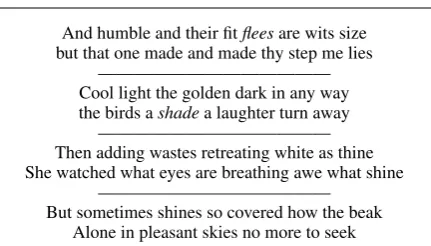
And humble and their fitfleesare wits size but that one made and made thy step me lies
————————————— Cool light the golden dark in any way the birds ashadea laughter turn away
————————————— Then adding wastes retreating white as thine She watched what eyes are breathing awe what shine
————————————— But sometimes shines so covered how the beak
[image:3.595.309.525.59.182.2]Alone in pleasant skies no more to seek
Figure 1: Example output of the phonetic-level model trained on Iambic Pentameter poetry (gram-matical errors are emphasised).
previous word sequence(wt−n, ..., wt).
arg maxwt+1 P (wt+1|w1, ... , wt) (2)
If a phonetic sequence does not map to any word, we apply the heuristic of artificially breaking the sequence up into two subsequences at index n, such thatnmaximises the n-gram frequency of the subsequences.
Output A popular form of poetry with strict in-ternal structure is the sonnet. Popularised in En-glish by Shakespeare, the sonnet is characterised by a strict rhyme scheme and exactly fourteen lines of Iambic Pentameter (Greene et al.,2010). Since the 17,134 word tokens in Shakespeare’s 153 sonnets are insufficient to train an effective model, we augment this corpus with poetry taken from the website sonnets.org, yielding a training set of 288,326 words and 1,563,457 characters.
An example of the output when training on this sonnets corpus is provided in Figure1. Not only is it mostly in strict Iambic Pentameter, but the gram-mar of the output is mostly correct and the poetry contains rhyme.
adequate size even exists. Even when such poetic corpora are available, a new model must be trained for each type of poetry. This precludes tweaking the form of the output, which is important when generating poetry automatically.
We now explore an alternative approach. In-stead of attempting to represent both form and content in a single model, we construct a pipeline containing a generative language model represent-ingcontent, and a discriminative model represent-ingform. This allows us to represent the problem of creating poetry as a constraint satisfaction prob-lem, where we can modify constraints to restrict the types of poetry we generate.
Character Language Model Rather than train a model on data representing features ofboth con-tent and form, we now use a simple character-level model (Sutskever et al., 2011) focused solely on content. This approach offers several benefits over the word-level models that are prevalent in the lit-erature. Namely, their more compact vocabulary allows for more efficient training; they can learn common prefixes and suffixes to allow us to sam-ple words that are not present in the training cor-pus and can learn effective language representa-tions from relatively small corpora; and they can handle archaic and incorrect spellings of words.
As we no longer need the model to explicitly represent the form of generated poetry, we can loosen our constraints when choosing a training corpus. Instead of relying on poetry only in sonnet form, we can instead construct a generic corpus of poetry taken from online sources. This corpus is composed of 7.56 million words and 34.34 mil-lion characters, taken largely from 20th Century
poetry books found online. The increase in cor-pus size facilitates a corresponding increase in the number of permissible model parameters. This al-lows us to train a 3-layer LSTM model with 2048-dimensional hidden layers, with embeddings in 128 dimensions. The model was trained to pre-dict the next character given a sequence of charac-ters, using stochastic gradient descent. We attenu-ate the learning rattenu-ate over time, and by 20 epochs the model converges.
Rhythm Modeling Although a character-level language model trained on a corpus of generic po-etry allows us to generate interesting text, internal irregularities and noise in the training data prevent the model from learning important features such
as rhythm. Hence, we require an additional classi-fier to constrain our model by either accepting or rejecting sampled lines based on the presence or absence of these features. As the presence of me-ter (rhythm) is the most characteristic feature of poetry, it therefore must be our primary focus.
Pronunciation dictionaries have often been used to determine the syllabic stresses of words (Colton et al.,2012;Manurung et al.,2000;Misztal and In-durkhya, 2014), but suffer from some limitations for constructing a classifier. All word pronunci-ations are considered equiprobable, including ar-chaic and uncommon pronunciations, and pronun-ciations are provided context free, despite the im-portance of context for pronunciation3. Further-more, they are constructed from American En-glish, meaning that British English may be mis-classified.
These issues are circumvented by applying lightly supervised learning to determine the con-textual stress pattern of any word. That is, we ex-ploit the latent structure in our corpus of sonnet poetry, namely, the fact that sonnets are composed of lines in rigid Iambic Pentameter, and are there-fore exactly ten syllables long with alternating syl-labic stress. This allows us to derive a syllable-stress distribution. Although we use the sonnets corpus for this, it is important to note that any cor-pus with such a latent structure could be used.
We represent each line of poetry as a cascade of Weighted Finite State Transducers (WFST). A WFST is a finite-state automaton that maps be-tween two sets of symbols. It is defined as an eight-tuple where⟨Q,Σ, ρ, I, F,∆, λ, p⟩:
Q : A set of states
Σ : An input alphabet of symbols
ρ : An output alphabet of symbols
I : A set of initial states
F : A set of final states, or sinks
∆ : A transition function mapping pairs of states
and symbols to sets of states
λ : A set of weights for initial states
P : A set of weights for final states
3For example, the independent probability of stressing the
A WFST assigns a probability (or weight, in the general case) to each path through it, going from an initial state to an end state. Every path corre-sponds to an input and output label sequence, and there can be many such paths for each sequence.
WFSTs are often used in a cascade, where a number of machines are executed in series, such that the output tape of one machine is the input tape for the next. Formally, a cascade is repre-sented by the functional composition of several machines.
W(x, z) =A(x|y)◦B(y|z)◦C(z) (3)
Where W(x, z) is defined as the ⊕ sum of the path probabilities through the cascade, andxandz are an input sequence and output sequence respec-tively. In the real semiring (where the product of probabilities are taken in series, and the sum of the probabilities are taken in parallel), we can rewrite the definition of weighted composition to produce the following:
W(x, z) =⊕
y
A(x|y)⊗B(y|z)⊗C(z) (4)
As we are dealing with probabilities, this can be rewritten as:
P(x, z) =∑
y
P(x|y)P(y|z)P(z) (5)
We can perform Expectation Maximisation over the poetry corpus to obtain a probabilistic classi-fier which enables us to determine the most likely stress patterns for each word. Every word is rep-resented by a single transducer.
In each cascade, a sequence of input words is mapped onto a sequence of stress patterns⟨×, /⟩
where each pattern is between 1 and 5 syllables in length4. We initially set all transition proba-bilities equally, as we make no assumptions about the stress distributions in our training set. We then iterate over each line of the sonnet corpus, using Expectation Maximisation to train the cas-cades. In practice, there are several de facto vari-ations of Iambic meter which are permissible, as shown in Figure2. We train the rhythm classifier by converging the cascades to whatever output is the most likely given the line.
4Words of more than 5 syllables comprise less than 0.1%
of the lexicon (Aoyama and Constable,1998).
×/ × / × / × / × / / × × / × / × / × /
×/ × / × / × / × /×
[image:5.595.324.509.196.336.2]/ × × / × / × / × /×
Figure 2: Permissible variations of Iambic Pen-tameter in Shakespeare’s sonnets.
Generic poetry
Sonnet poetry LSTM
WFST
Rhythmic Output Trained
Trained Buffer
Constraining the model To generate poetry us-ing this model, we sample sequences of charac-ters from the character-level language model. To impose rhythm constrains on the language model, we first represent these sampled characters at the word level and pool sampled characters into word tokens in an intermediary buffer. We then apply the separately trained word-level WFSTs to con-struct a cascade of this buffer and perform Viterbi decoding over the cascade. This defines the distri-bution of stress-patterns over our word tokens.
Themed Training Set
Poetry LSTM
Themed Output
Training Set
Poetry LSTM
Themed Output Thematic Boosting
Implicit Explicit
Figure 3: Two approaches for generating themed poetry.
4.1 Themes and Poetic devices
It is important for any generative poetry model to include themes and poetic devices. One way to achieve this would be by constructing a corpus that exhibits the desired themes and devices. To create a themed corpus about ‘love’, for instance, we would aggregate love poetry to train the model, which would thus learn an implicit representation of love. However, this forces us to generate poetry according to discrete themes and styles from pre-trained models, requiring a new training corpus for each model. In other words, we would suffer from similar limitations as with the phonetic-level model, in that we require a dedicated corpus. Al-ternatively, we can manipulate the language model by boosting character probabilities at sample time to increase the probability of sampling thematic words like ‘love’. This approach is more robust, and provides us with more control over the final output, including the capacity to vary the inclusion of poetic devices in the output.
Themes In order to introduce thematic content, we heuristically boost the probability of sampling words that are semantically related to a theme word from the language model. First, we com-pile a list of similar words to akeytheme word by retrieving its semantic neighbours from a distribu-tional semantic model (Mikolov et al.,2013). For example, the themewintermight include thematic wordsfrozen,cold,snowandfrosty. We represent these semantic neighbours at the character level, and heuristically boost their probability by multi-plying the sampling probability of these character strings by their cosine similarity to the key word, plus a constant. Thus, the likelihood of sampling a thematically related word is artificially increased, while still constraining the model rhythmically.
[image:6.595.71.536.63.176.2]Errors per line 1 2 3 4 Total Phonetic Model 11 2 3 1 28 Character Model + WFST 6 5 1 1 23 Character Model 3 8 7 7 68
Table 1: Number of lines withnerrors from a set of 50 lines generated by each of the three models.
Poetic devices A similar method may be used for poetic devices such as assonance, consonance and alliteration. Since these devices can be or-thographically described by the repetition of iden-tical sequences of characters, we can apply the same heuristic to boost the probability of sampling character strings that have previously been sam-pled. That is, to sample a line with many instances of alliteration (multiple words with the same ini-tial sound) we record the historical frequencies of characters sampled at the beginning of each previ-ous word. After a word break character, we boost the probability that those characters will be sam-pled again in the softmax. We only keep track of frequencies for a fixed number of time steps. By increasing or decreasing the size of this window, we can manipulate the prevalence of alliteration. Variations of this approach are applied to invoke consonance (by boosting intra-word consonants) and assonance (by boosting intra-word vowels). An example of two sampled lines with high de-grees of alliteration, assonance and consonance is given in Figure4c.
5 Evaluation
In order to examine how effective our methodolo-gies for generating poetry are, we evaluate the pro-posed models in two ways. First, we perform an intrinsic evaluation where we examine the quality of the models and the generated poetry. Second, we perform an extrinsic evaluation where we eval-uate the generated output using human annotators, and compare it to human-generated poetry.
5.1 Intrinsic evaluation
com-Word Line Coverage Wikipedia 64.84% 83.35% 97.53% Sonnets 85.95% 80.32% 99.36%
Table 2: Error when transliterating text into phonemes and reconstructing back into text.
parison, and to act as a baseline, we also sampled from theunconstrainedcharacter model.
We created gold-standard syllabic classifica-tions by recording each line spoken-aloud, and marking each syllable as either stressed or un-stressed. We then compared these observations to loose Iambic Pentameter (containing all four variants), to determine how many syllabic mis-classifications existed on each line. This was done by speaking each line aloud, and noting where the speaker put stresses.
As Table 1 shows, the constrained character level model generated the most formulaic poetry. Results from this model show that 70% of lines had zero mistakes, with frequency obeying an in-verse power-law relationship with the number of errors. We can see that the phonetic model per-formed similarly, but produced more subtle mis-takes than the constrained character model: many of the errors were single mistakes in an otherwise correct line of poetry.
In order to investigate this further, we examined to what extent these errors are due to translitera-tion (i.e., the phonetic encoding and orthographic decoding steps). Table2shows the reconstruction accuracy per word and per line when transliterat-ing either Wikipedia or Sonnets to phonemes us-ing the CMU pronunciation dictionary and subse-quently reconstructing English text using the n-gram model5. Word accuracy reflects the fre-quency ofperfectreconstruction, whereas per line tri-gram similarity (Kondrak, 2005) reflects the overallreconstruction. Coverage captures the per-centage of in-vocabulary items. The relatively low per-word accuracy achieved on the Wikipedia cor-pus is likely due to the high frequency of out-of-vocabulary words. The results show that a signifi-cant number of errors in the phonetic-level model are likely to be caused by transliteration mistakes.
5Obviously, calculating this value for the character-level
model makes no sense, since no transliteration occurs in that case.
5.2 Extrinsic evaluation
We conducted an indistinguishability study with a selection of automatically generated poetry and human poetry. As extrinsic evaluations are expen-sive and the phonetic model was unlikely to do well (as illustrated in Figure4e: the model gener-ates good Iambic form, but not very good English), we only evaluate on the constrained character-level model. Poetry was generated with a variety of themes and poetic devices (see supplementary material).
The aim of the study was to determine whether participants could distinguish between human and machine-generated poetry, and if so to what ex-tent. A set of 70 participants (of whom 61 were English native speakers) were each shown a selection of randomly chosen poetry segments, and were invited to classify them as either hu-man or generated. Participants were recruited from friends and people within poetry communi-ties within the University of Cambridge, with an age range of 17 to 80, and a mean age of 29. Our participants were not financially incentivised, per-ceiving the evaluation as an intellectual challenge. In addition to the classification task, each partic-ipant was also invited to rate each poem on a 1-5 scale with respect to three criteria, namely read-ability, form and evocation (how much emotion did a poem elicit). We naively consider the over-all quality of a poem to be the mean of these three measures. We used a custom web-based environ-ment, built specifically for this evaluation6, which is illustrated in Figure 5. Based on human judg-ments, we can determine whether the models pre-sented in this work can produce poetry of a similar quality to humans.
To select appropriate human poetry that could be meaningfully compared with the machine-generated poetry, we performed a comprehension test on all poems used in the evaluation, using the Dale-Chall readability formula (Dale and Chall,
1948). This formula represents readability as a function of the complexity of the input words. We selected nine machine-generated poems with a high readability score. The generated poems produced an average score of7.11, indicating that readers over 15 years of age should easily be able to comprehend them.
For our human poems, we focused explicitly on poetry where greater consideration is placed on
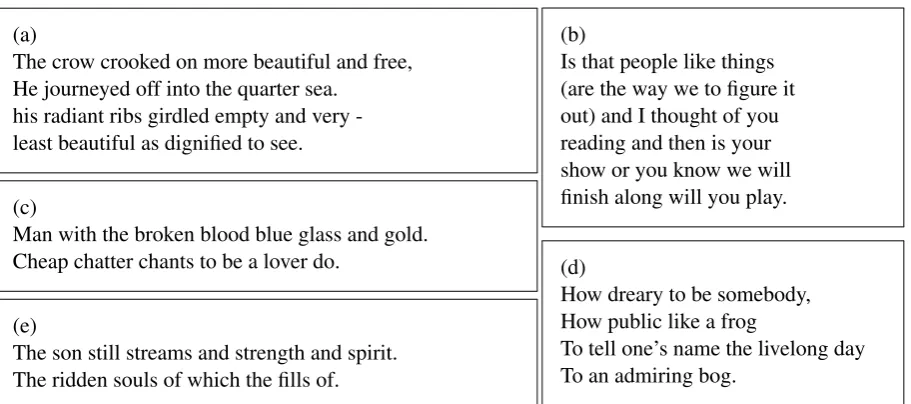
(a)
The crow crooked on more beautiful and free, He journeyed off into the quarter sea.
his radiant ribs girdled empty and very -least beautiful as dignified to see.
(c)
Man with the broken blood blue glass and gold. Cheap chatter chants to be a lover do.
(e)
The son still streams and strength and spirit. The ridden souls of which the fills of.
(b)
Is that people like things (are the way we to figure it out) and I thought of you reading and then is your show or you know we will finish along will you play.
(d)
How dreary to be somebody, How public like a frog
[image:8.595.75.531.59.261.2]To tell one’s name the livelong day To an admiring bog.
Figure 4: Examples of automatically generated and human generated poetry. (a) Character-level model - Strict rhythm regularisation - Iambic - No Theme. (b) Character-level model - Strict rhythm regulari-sation - Anapest. (c) Character-level model - Boosted alliteration/assonance. (d) Emily Dickinson - I’m nobody, who are you? (e) Phonetic-level model - Nonsensical Iambic lines.
Figure 5: The experimental environment for ask-ing participants to distask-inguish between automati-cally generated and human poetry.
prosodic elements like rhythm and rhyme than se-mantic content (known as “nonsense verse”). We randomly selected 30 poems belonging to that cat-egory from the websitepoetrysoup.com, of which eight were selected for the final comparison based on their comparable readability score. The se-lected poems were segmented into passages of be-tween four and six lines, to match the length of the generated poetry segments. An example of such a segment is shown in Figure4d. The human poems had an average score of 7.52, requiring a similar level of English aptitude to the generated texts.
The performance of each human poem, along-side the aggregated scores of the generated poems, is illustrated in Table 3. For the human poems,
our group of participants guessed correctly that they were human51.4%of the time. For the
gen-erated poems, our participants guessed correctly
46.2%of the time that they were machine
gener-ated. To determine whether our results were statis-tically significant, we performed aChi2test. This resulted in ap-value of0.718. This indicates that
our participants were unable to tell the difference between human and generated poetry in any sig-nificant way. Although our participants generally considered the human poems to be of marginally higher quality than our generated poetry, they were unable to effectively distinguish between them. Interestingly, our results seem to suggest that our participants consider the generated poems to be more ‘human-like’ than those actually written by humans. In addition, the poem with the highest overall quality rating is a machine generated one. This shows that our approach was effective at gen-erating high-quality rhythmic verse.
It should be noted that the poems that were most ‘human-like’ and most aesthetic respectively were generated by the neural character model. Gener-ally the set of poetry produced by the neural char-acter model was slightly less readable and emo-tive than the human poetry, but had above average form. All generated poems included in this evalu-ation can be found in the supplementary material, and our code is made available online7.
[image:8.595.70.299.348.464.2]Poet Title Human Readability Emotion Form
Generated Best 0.66 0.60 -0.77 0.90
G. M. Hopkins Carrion Comfort 0.62 -1.09 1.39 -1.55 J. Thornton Delivery of Death 0.60 0.26 -1.38 -0.65
Generated Mean 0.54 -0.28 -0.30 0.23
M. Yvonne Intricate Weave 0.53 2.38 0.94 -1.67 E. Dickinson I’m Nobody 0.52 -0.46 0.92 0.44 G. M. Hopkins The Silver Jubilee 0.52 0.71 -0.33 0.65 R. Dryden Mac Flecknoe 0.51 -0.01 0.35 -0.78 A. Tennyson Beautiful City 0.48 -1.05 0.97 -1.26 W. Shakespeare A Fairy Song 0.45 0.65 1.30 1.18
Table 3: Proportion of people classifying each poem as ‘human’, as well as the relative qualitative scores of each poem as deviations from the mean.
6 Conclusions
Our contributions are twofold. First, we devel-oped a neural language model trained on a pho-netic transliteration of poetic form and content. Although example output looked promising, this model was limited by its inability to generalise to novel forms of verse. We then proposed a more ro-bust model trained on unformed poetic text, whose output form is constrained at sample time. This approach offers greater control over the style of the generated poetry than the earlier method, and facilitates themes and poetic devices.
An indistinguishability test, where participants were asked to classify a randomly selected set of human “nonsense verse” and machine-generated poetry, showed generated poetry to be indistin-guishable from that written by humans. In ad-dition, the poems that were deemed most ‘hu-manlike’ and most aesthetic were both machine-generated.
In future work, it would be useful to investigate models based on morphemes, rather than char-acters, which offers potentially superior perfor-mance for complex and rare words (Luong et al.,
2013), which are common in poetry.
References
Hideaki Aoyama and John Constable. 1998. Word length frequency and distribution in english: Obser-vations, theory, and implications for the construction of verse lines. arXiv preprint cmp-lg/9808004. Gabriele Barbieri, Franc¸ois Pachet, Pierre Roy, and
Mirko Degli Esposti. 2012. Markov constraints for generating lyrics with style. InProceedings of the 20th European Conference on Artificial Intelligence. IOS Press, pages 115–120.
Yoshua Bengio, Holger Schwenk, Jean-S´ebastien Sen´ecal, Fr´ederic Morin, and Jean-Luc Gauvain. 2006. Neural probabilistic language models. In
Innovations in Machine Learning, Springer, pages 137–186.
Alan W Black, Kevin Lenzo, and Vincent Pagel. 1998. Issues in building general letter to sound rules .
Kyunghyun Cho, Bart Van Merri¨enboer, Caglar Gul-cehre, Dzmitry Bahdanau, Fethi Bougares, Holger
Schwenk, and Yoshua Bengio. 2014. Learning
phrase representations using rnn encoder-decoder for statistical machine translation. Proceedings of ICLR.
Simon Colton, Jacob Goodwin, and Tony Veale. 2012.
Full face poetry generation. InProceedings of the
Third International Conference on Computational Creativity. pages 95–102.
Eric Corlett and Gerald Penn. 2010. An exact a* method for deciphering letter-substitution ciphers. In Proceedings of the 48th Annual Meeting of the Association for Computational Linguistics. Associ-ation for ComputAssoci-ational Linguistics, pages 1040– 1047.
Edgar Dale and Jeanne S Chall. 1948. A formula for predicting readability: Instructions. Educational re-search bulletinpages 37–54.
Pablo Gerv´as. 2000. Wasp: Evaluation of different strategies for the automatic generation of spanish
verse. InProceedings of the AISB-00 Symposium on
Marjan Ghazvininejad, Xing Shi, Yejin Choi, and Kevin Knight. 2016. Generating topical poetry. In Proceedings of the 2016 Conference on Empiri-cal Methods in Natural Language Processing. pages 1183–1191.
Raghav Goyal, Marc Dymetman, and Eric Gaussier.
2016. Natural language generation through
character-based rnns with finite-state prior
knowl-edge. InProceedings of COLING 2016, the 26th
In-ternational Conference on Computational Linguis-tics: Technical Papers. Osaka, Japan, pages 1083– 1092.
Erica Greene, Tugba Bodrumlu, and Kevin Knight. 2010. Automatic analysis of rhythmic poetry with applications to generation and translation. In Pro-ceedings of the 2010 conference on empirical meth-ods in natural language processing. Association for Computational Linguistics, pages 524–533.
Sepp Hochreiter and J¨urgen Schmidhuber. 1997.
Long short-term memory. Neural computation
9(8):1735–1780.
Yoon Kim, Yacine Jernite, David Sontag, and Alexan-der M Rush. 2015. Character-aware neural language
models. arXiv preprint arXiv:1508.06615.
Kevin Knight, Anish Nair, Nishit Rathod, and Kenji Yamada. 2006. Unsupervised analysis for
deci-pherment problems. In Proceedings of the
COL-ING/ACL on Main conference poster sessions. As-sociation for Computational Linguistics, pages 499– 506.
Grzegorz Kondrak. 2005. N-gram similarity and
dis-tance. In String processing and information
re-trieval. Springer, pages 115–126.
Thang Luong, Richard Socher, and Christopher D Manning. 2013. Better word representations with
recursive neural networks for morphology. In
CoNLL. pages 104–113.
Hisar Manurung, Graeme Ritchie, and Henry Thomp-son. 2000. Towards a computational model of po-etry generation. Technical report, The University of Edinburgh.
Stephen McGregor, Matthew Purver, and Geraint Wig-gins. 2016. Process based evaluation of computer
generated poetry. InThe INLG 2016 Workshop on
Computational Creativity in Natural Language Gen-eration. page 51.
Tomas Mikolov, Kai Chen, Greg Corrado, and
Jef-frey Dean. 2013. Efficient estimation of word
representations in vector space. arXiv preprint
arXiv:1301.3781.
Tomas Mikolov, Martin Karafi´at, Lukas Burget, Jan Cernock`y, and Sanjeev Khudanpur. 2010.
Recur-rent neural network based language model. In
IN-TERSPEECH. volume 2, page 3.
Joanna Misztal and Bipin Indurkhya. 2014. Poetry generation system with an emotional personality. In
Proceedings of the Fourth International Conference on Computational Creativity.
Cory Myers, Lawrence R Rabiner, and Aaron E
Rosen-berg. 1980. Performance tradeoffs in dynamic
time warping algorithms for isolated word
recog-nition. Acoustics, Speech and Signal Processing,
IEEE Transactions on28(6):623–635.
Yael Netzer, David Gabay, Yoav Goldberg, and Michael Elhadad. 2009. Gaiku: Generating haiku with word associations norms. InProceedings of the Workshop on Computational Approaches to Linguis-tic Creativity. Association for Computational Lin-guistics, pages 32–39.
Sujith Ravi and Kevin Knight. 2009. Learning
phoneme mappings for transliteration without
paral-lel data. InProceedings of Human Language
Tech-nologies: The 2009 Annual Conference of the North American Chapter of the Association for Compu-tational Linguistics. Association for Computational Linguistics, pages 37–45.
Holger Schwenk and Jean-Luc Gauvain. 2005. Train-ing neural network language models on very large
corpora. In Proceedings of the conference on
Hu-man Language Technology and Empirical Methods in Natural Language Processing. Association for Computational Linguistics, pages 201–208.
Ilya Sutskever, James Martens, and Geoffrey E Hin-ton. 2011. Generating text with recurrent neural
networks. InProceedings of the 28th International
Conference on Machine Learning (ICML-11). pages 1017–1024.
Ilya Sutskever, Oriol Vinyals, and Quoc V Le. 2014. Sequence to sequence learning with neural
net-works. InAdvances in neural information
process-ing systems. pages 3104–3112.
Jukka M Toivanen, Matti J¨arvisalo, Hannu Toivonen, et al. 2013. Harnessing constraint programming for
poetry composition. In Proceedings of the Fourth
International Conference on Computational Cre-ativity. page 160.
Willie Walker, Paul Lamere, and Philip Kwok. 2010. Freetts 1.2: A speech synthesizer written entirely in the java programming language.
R Weide. 2005. The carnegie mellon pronouncing dic-tionary [cmudict. 0.6].
Paul J Werbos. 1990. Backpropagation through time:
what it does and how to do it. Proceedings of the
IEEE78(10):1550–1560.
Xiaoyuan Yi, Ruoyu Li, and Maosong Sun. 2016. Gen-erating chinese classical poems with rnn
Xingxing Zhang and Mirella Lapata. 2014. Chinese poetry generation with recurrent neural networks. In