579
Sentiment Tagging with Partial Labels using Modular Architectures
Xiao Zhang Purdue University [email protected]
Dan Goldwasser Purdue University [email protected]
Abstract
Many NLP learning tasks can be decomposed into several distinct sub-tasks, each associated with apartiallabel. In this paper we focus on a popular class of learning problems, sequence prediction applied to several sentiment analy-sis tasks, and suggest a modular learning ap-proach in which different sub-tasks are learned using separate functional modules, combined to perform the final task while sharing infor-mation. Our experiments show this approach helps constrain the learning process and can alleviate some of the supervision efforts.
1 Introduction
Many natural language processing tasks attempt to replicate complex human-level judgments, which often rely on a composition of several sub-tasks into a unified judgment. For example, consider the Targeted-Sentiment task (Mitchell et al., 2013), assigning a sentiment polarity score to entities de-pending on the context that they appear in. Given the sentence “according to a CNN poll, Green Book will win the best movie award”, the sys-tem has to identify both entities, and associate the relevant sentiment value with each one (neutral with CNN, and positive with Green Book). This task can be viewed as a combination of two tasks, entity identification, locating contiguous spans of words corresponding to relevant entities, and sen-timent prediction, specific to each entity based on the context it appears in. Despite the fact that this form of functional task decomposition is natural for many learning tasks, it is typically ignored and learning is defined as a monolithic process, com-bining the tasks into a single learning problem.
Our goal in this paper is to take a step to-wards modular learning architectures that exploit the learning tasks’ inner structure, and as a re-sult simplify the learning process and reduce the
annotation effort. We introduce a novel task de-composition approach, learning with partial la-bels, in which the task output labels decompose hierarchically, into partial labels capturing differ-ent aspects, or sub-tasks, of the final task. We show that learning with partial labels can help sup-port weakly-supervised learning when only some of the partial labels are available.
Given the popularity of sequence labeling tasks in NLP, we demonstrate the strength of this approach over several sentiment analysis tasks, adapted for sequence prediction. These include target-sentiment prediction (Mitchell et al.,2013), aspect-sentiment prediction (Pontiki et al., 2016) and subjective text span identification and polar-ity prediction (Wilson et al.,2013). To ensure the broad applicability of our approach to other prob-lems, we extend the popular LSTM-CRF (Lample et al., 2016) model that was applied to many se-quence labeling tasks1.
The modular learning process corresponds to a task decomposition, in which the prediction la-bel, y, is deconstructed into a set of partial la-bels{y0, .., yk}, each defining a sub-task, captur-ing a different aspect of the original task. Intu-itively, the individual sub-tasks are significantly easier to learn, suggesting that if their dependen-cies are modeled correctly when learning the fi-nal task, they can constrain the learning problem, leading to faster convergence and a better over-all learning outcome. In addition, the modular approach helps alleviate the supervision problem, as often providing full supervision for the overall task is costly, while providing additional partial la-bels is significantly easier. For example, annotat-ing entity segments syntactically is considerably easier than determining their associated sentiment, which requires understanding the nuances of the
context they appear in semantically. By exploiting modularity, the entity segmentation partial labels can be used to help improve that specific aspect of the overall task.
Our modular task decomposition approach is partially inspired by findings in cognitive neu-roscience, namely the two-streams hypothesis, a widely accepted model for neural process-ing of cognitive information in vision and hear-ing (Eysenck and Keane, 2005), suggesting the brain processes information in a modular way, split between a “where” (dorsal) pathway, special-ized for locating objects and a “what” (ventral) pathway, associated with object representation and recognition (Mishkin et al.,1983;Geschwind and Galaburda, 1987; Kosslyn, 1987; Rueckl et al., 1989). Jacobs et al. (1991) provided a compu-tational perspective, investigating the “what” and “where” decomposition on a computer vision task. We observe that this task decomposition naturally fits many NLP tasks and borrow the notation. In the target-sentiment tasks we address in this paper, the segmentation tagging task can be considered as a “where”-task (i.e., the location of entities), and the sentiment recognition as the “what”-task.
Our approach is related to multi-task learn-ing (Caruana, 1997), which has been extensively applied in NLP (Toshniwal et al.,2017;Eriguchi et al., 2017;Collobert et al.,2011;Luong,2016; Liu et al.,2018). However, instead of simply ag-gregating the objective functions of several dif-ferent tasks, we suggest to decompose a single task into multiple inter-connected sub-tasks and then integrate the representation learned into a sin-gle module for the final decision. We study sev-eral modular neural architectures, which differ in the way information is shared between tasks, the learning representation associated with each task and the way the dependency between decisions is modeled.
Our experiments were designed to answer two questions.First, can the task structure be exploited to simplify a complex learning task by using a modular approach? Second, can partial labels be used effectively to reduce the annotation effort?
To answer the first question, we conduct exper-iments over several sequence prediction tasks, and compare our approach to several recent models for deep structured prediction (Lample et al., 2016; Ma and Hovy, 2016;Liu et al.,2018), and when available, previously published results (Mitchell
et al.,2013;Zhang et al.,2015;Li and Lu,2017; Ma et al., 2018) We show that modular learning indeed helps simplify the learning task compared to traditional monolithic approaches. To answer the second question, we evaluate our model’s abil-ity to leverage partial labels in two ways. First, by restricting the amount of full labels, and ob-serving the improvement when providing increas-ing amounts of partial labels for only one of the sub-tasks. Second, we learn the sub-tasks using completely disjoint datasets of partial labels, and show that the knowledge learned by the sub-task modules can be integrated into the final decision module using a small amount of full labels.
Our contributions: (1) We provide a general modular framework for sequence learning tasks. While we focus on sentiment analysis task, the framework is broadly applicable to many other tagging tasks, for example, NER (Carreras et al., 2002; Lample et al., 2016) and SRL (Zhou and Xu, 2015), to name a few. (2) We introduce a novel weakly supervised learning approach, learn-ing with partial labels, that exploits the modular structure to reduce the supervision effort. (3) We evaluated our proposed model, in both the fully-supervised and weakly fully-supervised scenarios, over several sentiment analysis tasks.
2 Related Works
flexibil-ity, as it allows us to decouple the learning process and learn the tasks independently. Other modular neural architectures were recently studied for tasks combining vision and language analysis (Andreas et al., 2016; Hu et al., 2017; Yu et al., 2018), and were tailored for the grounded language set-ting. To help ensure the broad applicability of our framework, we provide a general modular net-work formulation for sequence labeling tasks by adapting a neural-CRF to capture the task struc-ture. This family of models, combining structured prediction with deep learning showed promising results (Gillick et al., 2015;Lample et al., 2016; Ma and Hovy,2016;Zhang et al.,2015;Li and Lu, 2017), by using rich representations through neu-ral models to generate decision candidates, while utilizing an inference procedure to ensure coherent decisions. Our main observation is that modular learning can help alleviate some of the difficulty involved in training these powerful models.
3 Architectures for Sequence Prediction
Using neural networks to generate emission poten-tials in CRFs was applied successfully in several sequence prediction tasks, such as word segmen-tation (Chen et al., 2017), NER (Ma and Hovy, 2016;Lample et al.,2016), chunking and PoS tag-ging (Liu et al., 2018;Zhang et al.,2017). A se-quence is represented as a sese-quence ofLtokens: x = [x1, x2, . . . , xL], each token corresponds to a label y ∈ Y, whereY is the set of all possible tags. An inference procedure is designed to find the most probable sequencey∗ = [y1, y2, . . . , yL] by solving, either exactly or approximately, the following optimization problem:
y∗ = arg max
y P(y|x).
Despite the difference in tasks, these models fol-low a similar general architecture: (1) Character-level information, such as prefix, suffix and cap-italization, is represented through a character em-bedding layer learned using a bi-directional LSTM (BiLSTM). (2) Word-level information is obtained through a word embedding layer. (3) The two rep-resentations are concatenated to represent an in-put token, used as inin-put to a word-level BiLSTM which generates the emission potentials for a suc-ceeding CRF. (4) The CRF is used as an inference layer to generate the globally-normalized proba-bility of possible tag sequences.
3.1 CRF Layer
A CRF model describes the probability of pre-dicted labels y, given a sequence x as input, as
PΛ(y|x) =
eΦ(x,y)
Z ,
whereZ =P
˜ y
eΦ(x,y˜)is the partition function that
marginalize over all possible assignments to the predicted labels of the sequence, and Φ(x,y) is the scoring function, which is defined as:
Φ(x,y) =X
t
φ(x, yt) +ψ(yt−1, yt).
The partition function Z can be computed effi-ciently via the forward-backward algorithm. The term φ(x, yt) corresponds to the score of a par-ticular tag yt at position t in the sequence, and
ψ(yt−1, yt)represents the score of transition from the tag at positiont−1to the tag at positiont. In the Neural CRF model, φ(x, yt) is generated by the aforementioned Bi-LSTM while ψ(yt−1, yt) by a transition matrix.
4 Functional Decomposition of Composite Tasks
To accommodate our task decomposition ap-proach, we first define the notion of partial labels, and then discuss different neural architectures capturing the dependencies between the modules trained over the different partial labels.
Partial Labels and Task Decomposition: Given a learning task, defined over an output spacey ∈ Y, where Y is the set of all possible tags, each specific labelyis decomposed into a set of partial labels, {y0, .., yk}. We refer to y as the full la-bel. According to this definition, a specific assign-ment to allkpartial labels defines a single full la-bel. Note the difference betweenpartially labeled data (Cour et al., 2011), in which instances can have more than a single full label, and our setup in which the labels are partial.
target-sentiment task. Note that the sentiment la-bels do not capture segmentation information.
Text ABC News' President
TagB-neu O O
Christiane Amanpour Exclusive Interview with
Seg
Senti
Mubarak
E-neu B-neu E-neu O B-neu E-neu
B E B E O O O B E
neu neu neu neu O O O neu neu
Figure 1: Target-sentiment decomposition example.
Modular Learning architectures: We propose three different models, in which information from the partial labels can be used. All the models have similar modules types, corresponding to the
segmentationandtypesub-tasks, and the decision module for predicting the final task. The modules are trained over the partial segmentation (yseg) and type (ytyp) labels, and the full labely infor-mation, respectively.
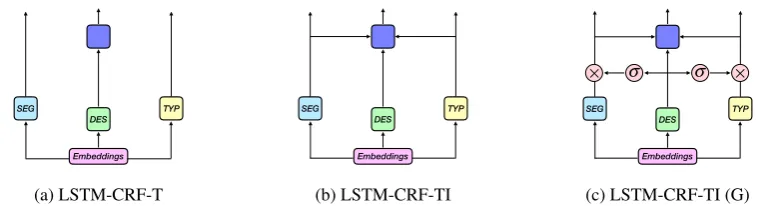
These three models differ in the way they share information. Model 1, denoted Twofold Modu-lar, LSTM-CRF-T, is similar in spirit to multi-task learning (Collobert et al., 2011) with three sepa-rate modules. Model 2, denoted Twofold mod-ular Infusion, (LSTM-CRF-TI) and Model 3, de-notedTwofold modular Infusion with guided gat-ing, (LSTM-CRF-TI(g)) both infuse information flow from two sub-task modules into the decision module. The difference is whether the infusion is direct or goes through a guided gating mechanism. The three models are depicted in Fig. 2 and de-scribed in details in the following paragraphs. In all of these models, underlying neural architecture are used for the emission potentials when CRF in-ference layers are applied on top.
4.1 Twofold Modular Model
The twofold modular model enhances the origi-nal monolithic model by using multi-task learning with shared underlying representations. The seg-mentation module and the type module are trained jointly with the decision module, and all the mod-ules share information by using the same embed-ding level representation, as shown in Figure 2a. Since the information above the embedding level is independent, the LSTM layers in the different modules do not share information, so we refer to these layers of each module asprivate.
The segmentation module predicts the segmen-tation BIO labels at positiontof the sequence by using the representations extracted from its private word level bi-directional LSTM (denoted asHseg)
as emission for a individual CRF:
hsegt =Hseg(et,
− →
hsegt−1,−→hsegt+1),
φ(x, ysegt ) =Wseg|hsegt +bseg,
whereWsegandbsegdenote the parameters of the segmentation module emission layer, andHseg de-notes its private LSTM layer.
This formulation allows the model to forge the segmentation path privately through back-propagation by providing the segmentation infor-mation yseg individually, in addition to the com-plete tag informationy.
The type module, using ytyp, is constructed in a similar way. By using representations from the its own private LSTM layers, the type module pre-dicts the sentiment (entity) type at positiontof the sequence :
htypt =Htyp(et,
− →
htypt−1,−→htypt+1),
φ(x, ytypt ) =Wtyp|htypt +btyp.
Both the segmentation informationysegand the type informationytypare provided together with the complete tag sequencey, enabling the model to learn segmentation and type recognition simul-taneously using two different paths. Also, the decomposed tags naturally augment more train-ing datato the model, avoiding over-fitting due to more complicated structure. The shared represen-tation beneath the private LSTMs layers are up-dated via the back-propagated errors from all the three modules.
4.2 Two-fold Modular Infusion Model
The twofold modular infusion model provides a stronger connection between the functionalities of the two sub-tasks modules and the final decision module, differing from multi-task leaning.
In this model, instead of separating the path-ways from the decision module as in the previous twofold modular model, the segmentation and the type representation are used as input to the final decision module. The model structure is shown in Figure2b, and can be described formally as:
Itseg =Wseg|hsegt +bseg,
Ittyp=Wtyp|htypt +btyp,
St=W|[ht;Itseg;I typ t ] +b,
SEG TYP DES
Embeddings
(a) LSTM-CRF-T
SEG TYP
DES
Embeddings
(b) LSTM-CRF-TI
SEG TYP
DES
σ σ
× ×
Embeddings
[image:5.595.107.495.64.167.2](c) LSTM-CRF-TI (G)
Figure 2: Three modular models for task decomposition. In them, blue blocks aresegmentationmodules, detecting entity location and segmentation, and yellow blocks are thetypemodules, recognizing the entity type or sentiment polarity. Green blocks are the final decision modules, integrating all the decisions. (G) refers to “Guided Gating”
concatenation operator, combining the representa-tion from the decision module and that from the type module and the segmentation module.
The term“Infusion”used for naming this mod-ule is intended to indicate that both modmod-ules ac-tively participate in the final decision process, rather than merely form two independent paths as in the twofold modular model. This formulation provides an alternative way of integrating the aux-iliary sub-tasks back into the major task in the neu-ral structure to help improve learning.
4.3 Guided Gating Infusion
In the previous section we described a way of in-fusing information from other modules naively by simply concatenating them. But intuitively, the hidden representation from the decision module plays an important role as it is directly related to the final task we are interested in. To effectively use the information from other modules forming sub-tasks, we design a gating mechanism to dy-namically control the amount of information flow-ing from other modules by infusflow-ing the expedient part while excluding the irrelevant part, as shown in Figure2c. This gating mechanism uses the in-formation from the decision module to guide the information from other modules, thus we name it as guided gating infusion, which we describe for-mally as follows:
Itseg =σ(W1ht+b1)⊗(Wseg|hsegt +bseg),
Ittyp=σ(W2ht+b2)⊗(Wtyp|htypt +b typ),
St=W|[ht;Itseg;I typ t ] +b,
where σ is the logistic sigmoid function and
⊗ is the element-wise multiplication. The
{W1, W2, b1, b2} are the parameters of these
guided gating, which are updated during the train-ing to maximize the overall sequence labeltrain-ing per-formance.
5 Learning using Full and Partial Labels
Our objective naturally rises from the model we described in the text. Furthermore, as our exper-iments show, it is easy to generalize this objec-tive, to a “semi-supervised” setting, in which the learner has access to only a few fully labeled ex-amples and additional partially labeled exex-amples. E.g., if only segmentation is annotated but the type information is missing. The loss function is a lin-ear combination of the negative log probability of each sub-tasks, together with the decision module:
J =−
N
X
i
logP(yi|xi) +αlogP(yseg(i)|x(i))
+βlogP(ytyp(i)|x(i)), (1)
whereN is the number of examples in the train-ing set, yseg and ytyp are the decomposed seg-mentation and type tags corresponding to the two sub-task modules, and α and β are the hyper-parameters controlling the importance of the two modules contributions respectively.
If the training example is fully labeled with both segmentation and type annotated, training is straightforward; if the training example is partially labeled, e.g., only with segmentation but without type, we can set the log probability of the type module and the decision module0 and only train the segmentation module. This formulation pro-vides extra flexibility of using partially annotated corpus together with fully annotated corpus to im-prove the overall performance.
6 Experimental Evaluation
Our experimental evaluation is designed to evalu-ate the two key aspects of our model:
this question, we compare our modular architec-ture to the traditional neural-CRF model and sev-eral recent competitive models for sequence label-ing combinlabel-ing inference and deep learnlabel-ing. The results are summarized in Tables1-3.
(Q2) Can partial labels be used effectively as a new form of weak-supervision? To answer this question we compared the performance of the model when trained using disjoint sets of partial and full labels, and show that adding examples only associated with partial labels, can help boost performance on the final task. The results are sum-marized in Figures3-5.
6.1 Experimental Settings
6.1.1 Datasets
We evaluated our models over three different sen-timent analysis tasks adapted for sequence predic-tion. We included additional results for multilin-gual NER in the Appendix for reference.
Target Sentiment Datasets We evaluated our models on the targeted sentiment dataset released by Mitchell et al. (2013), which consists of en-tity and sentiment annotations on both English and Spanish tweets. Similar to previous studies (Mitchell et al., 2013;Zhang et al.,2015;Li and Lu, 2017), our task focuses on people and orga-nizations (collapsed intovolitional named entities
tags) and the sentiment associated with their de-scription in tweets. After this processing, the la-bels of each tweets are composed of both segmen-tation (entity spans) and types (sentiment tags).
We used the original 10-fold cross validation splits to calculate averaged F1 score, using 10% of the training set for development. We used the same metrics in Zhang et al. (2015) and Li and Lu(2017) for a fair comparison.
Aspect Based Sentiment Analysis Datasets
We used the Restaurants dataset provided by Se-mEval 2016 Task 5 subtask 1, consisting of opin-ion target (aspect) expressopin-ion segmentatopin-ion, aspect classification and matching sentiment prediction. In the original task definition, the three tasks were designed as a pipeline, and assumed gold aspect labels when predicting the matching sentiment la-bels. Instead, our model deals with the challenging end-to-end setting by casting the problem as a se-quence labeling task, labeling each aspect segment
with the aspect label and sentiment polarity2.
Subjective Polarity Disambiguation Datasets
We adapted the SemEval 2013 Task 2 subtask A as another task to evaluate our model. In this task, the system is given a marked phrase inside a longer text, and is asked to label its polarity. Unlike the original task, we did not assume the sequence is known, resulting in two decisions, identifying subjective expressions (i.e., a segmentation task) and labeling their polarity, which can be modeled jointly as a sequence labeling task.
6.1.2 Input Representation and Model Architecture
Following previous studies (Ma and Hovy,2016; Liu et al.,2018) showing that the word embedding choice can significantly influence performance, we used the pre-trained GloVe 100 dimension Twitter embeddings only for all tasks in the main text. All the words not contained in these embed-dings (OOV, out-of-vocabulary words) are treated as an “unknown” word. Our models were de-ployed with minimal hyper parameters tuning, and can be briefly summarized as: the character em-beddings has dimension 30, the hidden layer di-mension of the character level LSTM is 25, and the hidden layer of the word level LSTM has di-mension 300. Similar toLiu et al.(2018), we also applied highway networks (Srivastava et al.,2015) from the character level LSTM to the word level LSTM. In our pilot study, we shrank the number of parameters in our modular architectures to around one third such that the total number of parameter is similar as that in the LSTM-CRF model, but we did not observe a significant performance change so we kept them as denoted. The values ofα and
βin the objective function were always set to 1.0.
6.1.3 Learning
We used BIOES tagging scheme but only during the training and convert them back to BIO2 for evaluation for all tasks3. Our model was imple-mented using pytorch (Paszke et al., 2017). To help improve performance we parallelized the
for-2using only the subset of the data containing sequence
in-formation 3
ward algorithm and the Viterbi algorithm on the GPU. All the experiments were run on NVIDIA GPUs. We used the Stochastic Gradient Descent (SGD) optimization of batch size 10, with a mo-mentum 0.9 to update the model parameters, with the learning rate 0.01, the decay rate 0.05; The learning rate decays over epochs byη/(1 +e∗ρ), whereη is the learning rate, eis the epoch num-ber, and ρ is the decay rate. We used gradient clip to force the absolute value of the gradient to be less than 5.0. We used early-stop to prevent over-fitting, with a patience of 30 and at least 120 epochs. In addition to dropout, we used Adver-sarial Training(AT) (Goodfellow et al.,2014), to regularize our model as the parameter numbers in-crease with modules. AT improves robustness to small worst-case perturbations by computing the gradients of a loss function w.r.t. the input. In this study,αandβin Eq.1are both set to1.0, and we leave other tuning choices for future investigation.
6.2 Q1:Monolithic vs. Modular Learning
Our first set of results are designed to compare our modular learning models, utilize partial labels decomposition, with traditional monolithic mod-els, that learn directly over the full labels. In all three tasks, we compare with strong sequence prediction models, including LSTM-CRF (Lam-ple et al., 2016), which is directly equivalent to our baseline model (i.e., final task decision with-out the modules), and LSTM-CNN-CRF (Ma and Hovy, 2016) and LSTM-CRF-LM (Liu et al., 2018) which use a richer latent representation for scoring the emission potentials.
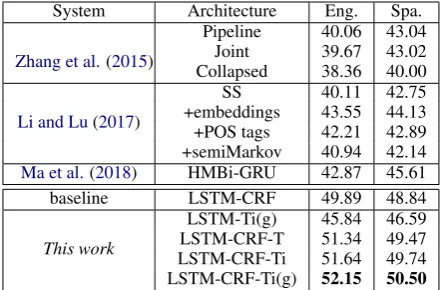
Target Sentiment task The results are summa-rized in Tab.1. We also compared our models with recently published state-of-the-art models on these datasets. To help ensure a fair comparison with Ma et al. which does not use inference, we also included the results of our model without the CRF layer (denoted LSTM-Ti(g)). All of our models beat the state-of-the-art results by a large margin. The source code and experimental setup are avail-able online4.
Aspect Based Sentiment We evaluated our models on two tasks: The first uses two modules, for identifying the position of the aspect in the text (i.e., chunking) and the aspect category prediction
4https://github.com/cosmozhang/
Modular_Neural_CRF
System Architecture Eng. Spa.
Zhang et al.(2015)
Pipeline 40.06 43.04
Joint 39.67 43.02
Collapsed 38.36 40.00
Li and Lu(2017)
SS 40.11 42.75
+embeddings 43.55 44.13
+POS tags 42.21 42.89
+semiMarkov 40.94 42.14
Ma et al.(2018) HMBi-GRU 42.87 45.61
baseline LSTM-CRF 49.89 48.84
This work
LSTM-Ti(g) 45.84 46.59
LSTM-CRF-T 51.34 49.47
LSTM-CRF-Ti 51.64 49.74
[image:7.595.306.527.62.207.2]LSTM-CRF-Ti(g) 52.15 50.50
Table 1: Comparing our models with the competing models on the target sentiment task. The results are on the full prediction of both segmentation and sentiment.
(denoted E+A). The second adds a third module that predicts the sentiment polarity associated with the aspect (denoted E+A+S). I.e., for a given sen-tence, label its entity span, the aspect category of the entity and the sentiment polarity of the entity at the same time. The results over four languages are summarized in Tab.2. In all cases, our modular approach outperforms all monolithic approaches.
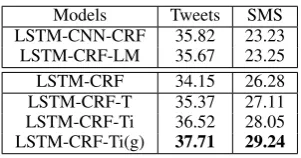
Subjective Phrase Identification and Classifica-tion This dataset contains tweets annotated with sentiment phrases, used for training the models. As in the original SemEval task, it is tested in two settings, in-domain, where the test data also con-sists of tweets, and out-of-domain, where the test set consists of SMS text messages. We present the results of experiments on these data set in Table3.
6.3 Q2:Partial Labels as Weak Supervision
Our modular architecture is a natural fit for learn-ing with partial labels. Since the modular archi-tecture decomposes the final task into sub-tasks, the absence of certain partial labels is permitted. In this case, only the module corresponding to the available partial labels will be updated while the other parts of the model stay fixed.
This property can be exploited to reduce the su-pervision effort by defining semi-supervised learn-ing protocols that use partial-labels when the full labels are not available, or too costly to annotate. E.g., in the target sentiment task, segmentation la-bels are significantly easier to annotate.
Models English Spanish Dutch Russian
E+A E+A+S E+A E+A+S E+A E+A+S E+A E+A+S
LSTM-CNN-CRF(Ma and Hovy,2016) 58.73 44.20 64.32 50.34 51.62 36.88 58.88 38.13
LSTM-CRF-LM(Liu et al.,2018) 62.27 45.04 63.63 50.15 51.78 34.77 62.18 38.80
LSTM-CRF 59.11 48.67 62.98 52.10 51.35 37.30 63.41 42.47
LSTM-CRF-T 60.87 49.59 64.24 52.33 52.79 37.61 64.72 43.01
LSTM-CRF-TI 63.11 50.19 64.40 52.85 53.05 38.07 64.98 44.03
[image:8.595.75.523.61.149.2]LSTM-CRF-TI(g) 64.74 51.24 66.13 53.47 53.63 38.65 65.64 45.65
Table 2: Comparing our models with recent results on the Aspect Sentiment datasets.
Models Tweets SMS
LSTM-CNN-CRF 35.82 23.23
LSTM-CRF-LM 35.67 23.25
LSTM-CRF 34.15 26.28
LSTM-CRF-T 35.37 27.11
LSTM-CRF-Ti 36.52 28.05
[image:8.595.106.257.187.266.2]LSTM-CRF-Ti(g) 37.71 29.24
Table 3: Comparing our models with competing mod-els on the subjective sentiment task.
modules using different partial labels. We quan-tify this ability by providing varying amounts of full labels to support the integration process. The second set studies the traditional semi-supervised settings, where we have a handful of full labels, but we have a larger amount of partial labels.
Modular Knowledge Integration The modular architecture allows us to train each model using data obtained separately for each task, and only use a handful of examples annotated for the final task in order to integrate the knowledge learned by each module into a unified decision. We simulated these settings by dividing the training data into three folds. We associated each one of the first two folds with the two sub-task modules. Each one of the these folds only included the partial labels rel-evant for that sub-task. We then used gradually increasing amounts of the third fold, consisting of the full labels, for training the decision module.
Fig. 3 describes the outcome for target-sentiment, comparing a non-modular model using only the full labels, with the modular approach, which uses the full labels for knowledge integra-tion. Results show that even when very little full data is available results significantly improve. Ad-ditional results show the same pattern for subjec-tive phrase identification and classification are in-cluded in the Appendix.
Learning with Partially Labeled Data
Partially-labeled data can be cheaper and easier to obtain, especially for low-resource languages. In this set of experiments, we model these settings
28 33 38 43 48
20% 40% 60% 80% 100%
Modularized non-Modularized
(a) Spanish
28 33 38 43 48
20% 40% 60% 80% 100%
Modularized non-Modularized
[image:8.595.313.530.195.294.2](b) English
Figure 3: Modular knowledge integration results on the Target Sentiment Datasets. The x-axis is the amount of percentage of the third fold of full labels. The “non-modularized” means we only provide fully labeled data from the third fold.
38 41 44 47 50 53
0% 20% 40% 60% 80%
LSTM-CRF-TI(g) (seg) LSTM-CRF-TI(g) (typ) LSTM-CRF
LSTM-CRF-TI(g) with fully labeled
(a) Spanish
37 39.8 42.6 45.4 48.2 51
0% 20% 40% 60% 80%
LSTM-CRF-TI(g) (seg) LSTM-CRF-TI(g) (typ) LSTM-CRF
LSTM-CRF-TI(g) with fully labeled
(b) English
Figure 4: The fully labeled data was fixed to20%of the whole training set, and gradually adding data with only segmentation information (Magenta), or with only type information (Orange), and test our model on the full prediction test. The LSTM-CRF model can only use fully labeled data as it does not decompose the task.
over the target-sentiment task. The results are summarized in Fig.4. We fixed the amount of full labels to 20% of the training set, and gradually increased the amount of partially labeled data. We studied adding segmentation and type separately. After the model is trained in this routine, it was tested on predicting the full labels jointly on the test set.
Domain Transfer with Partially Labeled Data
[image:8.595.310.528.383.478.2]20 26.5 33 39.5 46
0% 20% 40%
[image:9.595.117.243.74.160.2]Spanish English
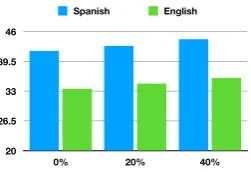
Figure 5: Domain Transfer experiments results with fixed20% in-domain data from aspect sentiment and varying amounts of out-of-domain data from target sen-timent, shown on the x-axis.
from target sentiment. However unlike the tra-ditional domain-adaptation settings, the out-of-domain data is labeled for a different task, and only shares one module with the original task.
In our experiments we fixed 20% of the fully labeled data for the aspect sentiment task, and gradually added out-of-domain data, consisting of partial sentiment labels from thetarget sentiment task. Our model successfully utilized the out-of-domain data and improved performance on the in-domain task. The results are shown on Fig5.
7 Conclusions
We present and study several modular neural ar-chitectures designed for a novel learning scenario: learning from partial labels. We experiment with several sentiment analysis tasks. Our models, in-spired by cognitive neuroscience findings (Jacobs et al.,1991;Eysenck and Keane,2005) and multi-task learning, suggest a functional decomposition of the original task into two simpler sub-tasks. We evaluate different methods for sharing information and integrating the modules into the final decision, such that a better model can be learned, while con-verging faster5. As our experiments show, modu-lar learning can be used with weak supervision, using examples annotated with partial labels only. The modular approach also provides interesting directions for future research, focusing on alle-viating the supervision bottleneck by using large amount of partially labeled data that are cheaper and easy to obtain, together with only a handful amount of annotated data, a scenario especially suitable for low-resource languages.
5Convergence results are provided in the Appendix
Acknowledgements
We thank the reviewers for their insightful com-ments. We thank the NVIDIA Corporation for their GPU donation, used in this work. This work was partially funded by a Google Gift.
References
Rodrigo Agerri and German Rigau. 2016. Robust multilingual named entity recognition with shallow semi-supervised features. Artificial Intelligence.
Jacob Andreas, Marcus Rohrbach, Trevor Darrell, and Dan Klein. 2016. Learning to compose neural net-works for question answering. InProc. of the An-nual Meeting of the North American Association of Computational Linguistics (NAACL).
Xavier Carreras, Llu´ıs M`arquez, and Llu´ıs Padr´o. 2002. Named entity extraction using adaboost. In Proc. of the Annual Conference on Computational Natural Language Learning (CoNLL).
Rich Caruana. 1997. Multitask Learning. Machine Learning, 28(1):41–75.
Chen, Shi, Qiu, and Huang. 2017. Adversarial multi-criteria learning for chinese word segmentation. In Proc. of the Annual Meeting of the Association Com-putational Linguistics (ACL).
Ronan Collobert, Jason Weston, L´eon Bottou, Michael Karlen, Koray Kavukcuoglu, and Pavel Kuksa. 2011. Natural Language Processing (Almost) from Scratch.J. Mach. Learn. Res., 12.
Timothee Cour, Ben Sapp, and Ben Taskar. 2011. Learning from partial labels. Journal of Machine Learning Research, 12(May).
Eriguchi, Tsuruoka, and Cho. 2017. Learning to parse and translate improves neural machine translation. In Proc. of the Annual Meeting of the Association Computational Linguistics (ACL).
M.W. Eysenck and M.T. Keane. 2005. Cognitive Psy-chology: A Student’s Handbook. Psychology Press.
Norman. Geschwind and Albert M. Galaburda. 1987. Cerebral lateralization : biological mechanisms, as-sociations, and pathology. MIT Press.
Gillick, Brunk, Vinyals, and Subramanya. 2015. Mul-tilingual Language Processing From Bytes.ArXiv.
I. J. Goodfellow, J. Shlens, and C. Szegedy. 2014. Explaining and Harnessing Adversarial Examples. ArXiv e-prints.
Jacobs, Jordan, and Barto. 1991. Task decomposition through competition in a modular connectionist ar-chitecture: The what and where vision tasks. Cog-nitive Science, 15(2).
Stephen M. Kosslyn. 1987. Seeing and Imagining in the Cerebral Hemispheres: A Computational Ap-proach. Psychological Review, 94(2):148–175.
Guillaume Lample, Miguel Ballesteros, Kazuya Kawakami, Sandeep Subramanian, and Chris Dyer. 2016. Neural architectures for named entity recog-nition. InProc. of the Annual Meeting of the North American Association of Computational Linguistics (NAACL).
Hao Li and Wei Lu. 2017. Learning latent sentiment scopes for entity-level sentiment analysis. InProc. of the National Conference on Artificial Intelligence (AAAI).
Liyuan Liu, Jingbo Shang, Frank F. Xu, Xiang Ren, Huan Gui, Jian Peng, and Jiawei Han. 2018. Em-power sequence labeling with task-aware neural lan-guage model. InProc. of the National Conference on Artificial Intelligence (AAAI).
Minh-Thang Luong. 2016. Multi-Task Sequence To Sequence Learning. InProc. International Confer-ence on Learning Representation (ICLR).
Dehong Ma, Sujian Li, and Houfeng Wang. 2018. Joint learning for targeted sentiment analysis. InProc. of the Conference on Empirical Methods for Natural Language Processing (EMNLP).
Xuezhe Ma and Eduard Hovy. 2016. End-to-end se-quence labeling via bi-directional lstm-cnns-crf. In Proc. of the Annual Meeting of the Association Com-putational Linguistics (ACL).
Mortimer Mishkin, Leslie G. Ungerleider, and Kath-leen A. Macko. 1983. Object vision and spatial vi-sion: two cortical pathways.
Margaret Mitchell, Jacqui Aguilar, Theresa Wilson, and Benjamin Van Durme. 2013. Open domain tar-geted sentiment. InProc. of the Conference on Em-pirical Methods for Natural Language Processing (EMNLP).
Joel Nothman, Nicky Ringland, Will Radford, Tara Murphy, and James R. Curran. 2013. Learning mul-tilingual named entity recognition from wikipedia. Artif. Intell., 194:151–175.
Adam Paszke, Sam Gross, Soumith Chintala, Gre-gory Chanan, Edward Yang, Zachary DeVito, Zem-ing Lin, Alban Desmaison, Luca Antiga, and Adam Lerer. 2017. Automatic differentiation in pytorch. InNIPS-W.
Maria Pontiki, Dimitris Galanis, Haris Papageor-giou, Ion Androutsopoulos, Suresh Manandhar, AL-Smadi Mohammad, Mahmoud Al-Ayyoub, Yanyan Zhao, Bing Qin, Orph´ee De Clercq, et al. 2016.
Semeval-2016 task 5: Aspect based sentiment anal-ysis. InProceedings of the 10th international work-shop on semantic evaluation (SemEval-2016).
L. Ratinov and D. Roth. 2009. Design challenges and misconceptions in named entity recognition. In Proc. of the Annual Conference on Computational Natural Language Learning (CoNLL).
Rueckl, Cave, and Kosslyn. 1989. Why are ”What” and ”Where” Processed by Separate Cortical Visual Systems? A Computational Investigation. cognitive neuroscience.
Tjong Kim Sang and Erik F. 2002. Introduction to the conll-2002 shared task: Language-independent named entity recognition. In Proc. of the Annual Conference on Computational Natural Language Learning (CoNLL).
Tjong Kim Sang, Erik F., and Fien De Meulder. 2003. Introduction to the conll-2003 shared task: Language-independent named entity recognition. In Proc. of the Annual Conference on Computational Natural Language Learning (CoNLL).
dos Santos and Guimar˜aes. 2015. Boosting named en-tity recognition with neural character embeddings. In Proc. of the Annual Meeting of the Association Computational Linguistics (ACL).
Rupesh Kumar Srivastava, Klaus Greff, and J¨urgen Schmidhuber. 2015. Highway Networks. ArXiv e-prints.
Shubham Toshniwal, Hao Tang, Liang Lu, and Karen Livescu. 2017. Multitask learning with low-level auxiliary tasks for encoder-decoder based speech recognition. InINTERSPEECH.
Theresa Wilson, Zornitsa Kozareva, Preslav Nakov, Alan Ritter, Sara Rosenthal, and Stoyanov Veselin. 2013. Semeval-2013 task 2: Sentiment analysis in twitter.
Licheng Yu, Zhe Lin, Xiaohui Shen, Jimei Yang, Xin Lu, Mohit Bansal, and Tamara L Berg. 2018. Mat-tnet: Modular attention network for referring expres-sion comprehenexpres-sion.arXiv.
Meishan Zhang, Yue Zhang, and Duy Tin Vo. 2015. Neural networks for open domain targeted sen-timent. In Proc. of the Conference on Empir-ical Methods for Natural Language Processing (EMNLP).
Xiao Zhang, Yong Jiang, Hao Peng, Kewei Tu, and Dan Goldwasser. 2017. Semi-supervised structured pre-diction with neural crf autoencoder. InProc. of the Conference on Empirical Methods for Natural Lan-guage Processing (EMNLP).
A Examples of Task Decomposition
In Figure6, we show an example of task decom-position for standard NER.
Text Brush Wellman .
Tag B-ORG I-ORG O O O O O
comments on beryllium lawsuits
Seg B I O O O O O
[image:11.595.74.285.132.180.2]Ent ORG ORG O O O O O
Figure 6: An example of NER decomposition.
In Figure 7, we show another example of task decomposition for target sentiment, in addition to the one in the main text.
TextKC Concepcion Get
TagB-pos O O
Rogue Magazine Photos Continue to
Seg
Senti
Praised
B-pos B-neu E-neu O S-neu
B E B E O O O S
by Fans onTwitter
O O O O O
O O O O O
[image:11.595.311.529.366.453.2]pos pos neu neu O O O O O O O O neu
Figure 7: An extra example of target sentiment decom-position.
B Full Experimental Results on Target Sentiment
The complete results of our experiments on the tar-get sentiment task are summarized in Tab.4. Our LSTM-CRF-TI(g) model outperforms all the other competing models in Precision, Recall and the F1 score.
C Experiments on Named Entity Recognition
NER datasets We evaluated our models on three NER datasets, the English, Dutch and Spanish parts of the 2002 and 2003 CoNLL shared tasks (Sang and F., 2002;Sang et al., 2003). We used the original division of training, validation and test sets. The task is defined over four different entity types: PERSON, LOCATION, ORGANIZATION,
MISC. We used the BIOES tagging scheme dur-ing the traindur-ing, and convert them back to original tagging scheme in testing as previous studies show that using this tagging scheme instead of BIO2 can help improve performance (Ratinov and Roth, 2009;Lample et al., 2016;Ma and Hovy, 2016; Liu et al., 2018). As a result, the segmentation module had5 output labels, and the entity mod-ule had4. The final decision task, consisted of the Cartesian product of the segmentation set (BIES)
and the entity set, plus the “O” tag, resulting in17
labels.
Results on NER We compared our models with the state-of-the-art systems on English6, Dutch and Spanish. For Dutch and Spanish, we used cross-lingual embedding as a way to exploit lex-ical information. The results are shown in Tab. 5 and Tab. 67. Our best-performing model outper-form all the competing systems.
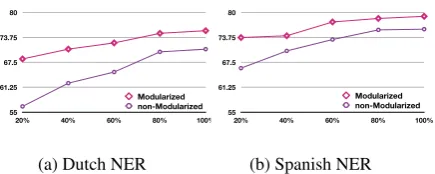
D Additional Experiments on Knowledge Integration
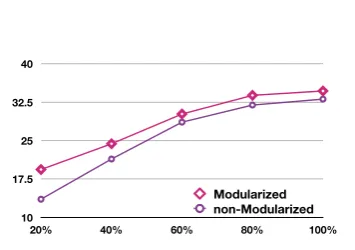
We conducted additional experiments on knowl-edge integration in the same setting as in the main text to investigate the properties of the modules. Figure8 shows the results for Dutch and Spanish NER datasets, while Figure9shows the results for the Subjective Polarity Disambiguation Datasets using the in-domain data.
55 61.25 67.5 73.75 80
20% 40% 60% 80% 100% Modularized non-Modularized
(a) Dutch NER
55 61.25 67.5 73.75 80
20% 40% 60% 80% 100% Modularized non-Modularized
(b) Spanish NER
Figure 8: Experimental results on modular knowledge integration on the Dutch and Spanish NER datasets.
E Convergence Analysis
The proposed twofold modular infusion model (with guided gating as an option) breaks the com-plex learning problem into several sub-problems and then integrate them using joint training. The process defined by this formulation has more pa-rameters and requires learning multiple objectives jointly. Our convergence analysis intends to eval-uate whether the added complexity leads to a harder learning problem (i.e., slower to converge) or whether the tasks constrain each other and as a result can be efficiently learned.
6Liu et al.’s results are different since their
implementa-tion did not convert the predicted BIOES tags back to BIO2 during evaluation. For fair comparison, we only report the results of the standard evaluation.
7We thank reviewers for pointing out a paper (Agerri and
Rigau,2016) obtains the new state-of-the-art result on Dutch
System Architecture English Spanish
Pre Rec F1 Pre Rec F1
Zhang, Zhang and Vo (2015)
Pipeline 43.71 37.12 40.06 45.99 40.57 43.04
Joint 44.62 35.84 39.67 46.67 39.99 43.02
Collapsed 46.32 32.84 38.36 47.69 34.53 40.00
Li and Lu (2017)
SS 44.57 36.48 40.11 46.06 39.89 42.75
+embeddings 47.30 40.36 43.55 47.14 41.48 44.13
+POS tags 45.96 39.04 42.21 45.92 40.25 42.89
+semiMarkov 44.49 37.93 40.94 44.12 40.34 42.14
Base Line LSTM-CRF 53.29 46.90 49.89 51.17 46.71 48.84
This work
LSTM-CRF-T 54.21 48.77 51.34 51.77 47.37 49.47
LSTM-CRF-Ti 54.58 49.01 51.64 52.14 47.56 49.74
[image:12.595.104.494.62.196.2]LSTM-CRF-Ti(g) 55.31 49.36 52.15 52.82 48.41 50.50
Table 4: Performance on the target sentiment task
Model English
LSTM-CRF (Lample et al.,2016) 90.94
LSTM-CNN-CRF (Ma and Hovy,2016) 91.21
LM-LSTM-CRF (Liu et al.,2018) 91.06
LSTM-CRF-T 90.8
LSTM-CRF-TI 91.16
[image:12.595.79.282.237.315.2]LSTM-CRF-TI(g) 91.68
Table 5: Comparing our models with several state-of-the-art systems on the CoNLL 2003 English NER dataset.
Model Dutch Spanish
Carreras et al.(2002) 77.05 81.39
Nothman et al.(2013) 78.60 N/A
dos Santos and Guimar˜aes(2015) N/A 82.21
Gillick et al.(2015) 82.84 82.95
Lample et al.(2016) 81.74 85.75
LSTM-CRF-T 83.91 84.89
LSTM-CRF-TI 84.12 85.28
[image:12.595.333.501.346.440.2]LSTM-CRF-TI(g) 84.51 85.92
Table 6: Comparing our models with recent results on the 2002 CoNLL Dutch and Spanish NER datasets.
10 17.5 25 32.5 40
20% 40% 60% 80% 100%
Modularized non-Modularized
Figure 9: Experimental results on modular knowledge integration on the Subjective Polarity Disambiguation Datasets.
We compare between our LSTM-CRF-TI(g) model and recent published top models on the En-glish NER dataset in Figure10and on the
subjec-tive polarity disambiguation datasets in Figure11. The curve compares convergence speed in terms of learning epochs. Our LSTM-CRF-TI(g) model has a much faster convergence rate compared to the other models.
48 61 74 87 100
1 2 3 4 5 6 7 8 9 10 11 12
LSTM-CRF CNN-LSTM-CRF LM-LSTM-CRF LSTM-CRF-Ti(g)
Figure 10: Comparing convergence over the develop-ment set on the English NER dataset. The x-axis is number of epochs and the y-axis is the F1-score.
0 6.25 12.5 18.75 25
1 2 3 4 5 6 7 8 9 10 11 12 LSTM-CRF CNN-LSTM-CRF LM-LSTM-CRF LSTM-CRF-Ti(g)
[image:12.595.74.290.374.472.2] [image:12.595.93.271.523.648.2] [image:12.595.332.494.552.645.2]