831
Constrained Decoding for Neural NLG from Compositional
Representations in Task-Oriented Dialogue
Anusha Balakrishnan∗Jinfeng Rao* Kartikeya Upasani* Michael White*†andRajen Subba*
Facebook Conversational AI
{anushabala,raojinfeng,kart,mwhite14850,rasubba}@fb.com
Abstract
Generating fluent natural language responses from structured semantic representations is a critical step in task-oriented conversational systems. Avenues like the E2E NLG Chal-lenge have encouraged the development of neural approaches, particularly sequence-to-sequence (Seq2Seq) models for this problem. The semantic representations used, however, are often underspecified, which places a higher burden on the generation model for sentence planning, and also limits the extent to which generated responses can be controlled in a live system. In this paper, we (1) propose using tree-structured semantic representations, like those used in traditional rule-based NLG systems, for better discourse-level structuring and sentence-level planning; (2) introduce a challenging dataset using this representation for the weather domain; (3) introduce a con-strained decoding approach for Seq2Seq mod-els that leverages this representation to im-prove semantic correctness; and (4) demon-strate promising results on our dataset and the E2E dataset.
1 Introduction
Generating fluent natural language responses from structured semantic representations is a critical step in task-oriented conversational systems. With their end-to-end trainability, neural approaches to natural language generation (NNLG), partic-ularly sequence-to-sequence (Seq2Seq) models, have been promoted with great fanfare in recent years (Wen et al., 2015, 2016; Mei et al., 2016;
Kiddon et al., 2016; Duˇsek and Jurcicek, 2016), and avenues like the recent E2E NLG challenge (Duˇsek et al., 2018, 2019) have made available large datasets to promote the development of these models. Nevertheless, current NNLG models arguably remain inadequate for most real-world
∗
Alphabetical by first name
†
Work done while on leave from Ohio State University
task-oriented dialogue systems, given their inabil-ity to (i) reliably perform common sentence plan-ning and discourse structuring operations (Reed et al., 2018), (ii) generalize to complex inputs (Wiseman et al., 2017), and (3) avoid generating texts with semantic errors including hallucinated content (Duˇsek et al.,2018,2019).1
In this paper, we explore the extent to which these issues can be addressed by incorporating lessons from pre-neural NLG systems into a neu-ral framework. We begin by arguing in favor of enriching the input to neural generators to in-clude discourse relations — long taken to be cen-tral in traditional NLG — and underscore the im-portance of exerting control over these relations when generating text, particularly when using user models to structure responses. In a closely re-lated work, Reed et al. (2018), the authors add control tokens (to indicate contrast and sentence structure) to a flat input MR, and show that these can be effectively used to control structure. How-ever, their methods are only able to control the presence or absence of these relations, without more fine-grained control over their structure. We thus go beyond their approach and propose using full tree structures as inputs, and generating tree-structured outputs as well. This allows us to define a novel method of constrained decoding for stan-dard sequence-to-sequence models for generation, which helps ensure that the generated text contains all and only the specified content, as in classic ap-proaches to surface realization.
On the E2E dataset, our experiments demon-strate much better control over CONTRAST rela-tions than using Reed et al.’s method, and also show improved diversity and expressiveness over standard baselines. We also release a new dataset of responses in the weather domain, which in-cludes the JUSTIFY, JOIN and CONTRAST
rela-1Also seehttps://ehudreiter.com/2018/11/
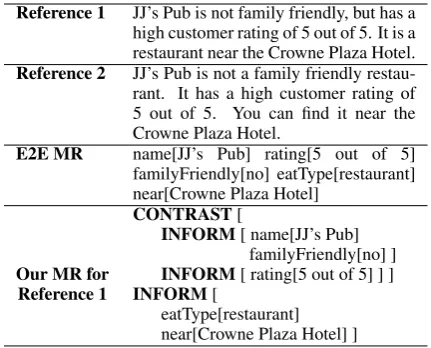
Reference 1 JJ’s Pub is not family friendly, but has a high customer rating of 5 out of 5. It is a restaurant near the Crowne Plaza Hotel.
Reference 2 JJ’s Pub is not a family friendly restau-rant. It has a high customer rating of 5 out of 5. You can find it near the Crowne Plaza Hotel.
E2E MR name[JJ’s Pub] rating[5 out of 5] familyFriendly[no] eatType[restaurant] near[Crowne Plaza Hotel]
Our MR for Reference 1
CONTRAST[
INFORM[ name[JJ’s Pub] familyFriendly[no] ]
INFORM[ rating[5 out of 5] ] ]
INFORM[
[image:2.595.73.289.61.235.2]eatType[restaurant] near[Crowne Plaza Hotel] ]
Table 1: Sample reference responses, their correspond-ing meancorrespond-ing representation in the E2E dataset, and its MR according to our proposed ontology.
tions, and where discourse-level structures come into play. On both E2E and weather datasets, we show that constrained decoding over our enriched inputs results in higher semantic correctness as well as better generalizability and data efficiency.
The rest of this paper is organized as follows: Section2describes the motivation for using com-positional inputs organized around discourse re-lations. Section 3 explains our data collection approach and dataset.2 Section 4 shows how to incorporate compositional inputs into NNLG and describes our constrained decoding algorithm. Section5presents our experimental setup and re-sults.
2 Towards More Expressive Meaning Representations
2.1 Limitations of Flat MRs
In the E2E dataset, meaning representations (MRs) are a flat list of key-value pairs, where each key is a slot name that needs to be mentioned, and the value is the value of that slot (see Ta-ble 1). In Wen et al. (2015), MRs have a simi-lar structure, and additionally contain information about the dialog act that needs to be conveyed (REQUEST, INFORM, etc.). These MRs are suf-ficient to capture basic semantic information, but fail to capture rhetorical (or discourse) relations, like CONTRAST, that have long been taken to be central to generating coherent discourse in
tradi-2The datasets and implementations can be found
at https://github.com/facebookresearch/ TreeNLG.
tional NLG (Mann and Thompson, 1988; Moore and Paris,1993;Reiter and Dale,2000;Stent et al.,
2002). The two references in Table 1 illustrate this problem with the expressiveness of such flat MRs. Critical discourse information, like whether two attributes should be contrasted (or whether to justify a recommendation, etc.), is not captured by the MR. This poses a dual challenge: First, since the MR does not specify these discourse re-lations, crowdworkers creating the dataset in turn have no instructions on when to use them, and must thus use their own judgment in creating a natural-sounding response. While the E2E orga-nizers tout the resulting response variations as a plus, Reed et al. (2018) find that current neural systems are unable to learn to express discourse relations effectively with this dataset, and explore ways of enriching input MRs to do so. Indeed, now that the E2E system outputs have been re-leased, a search through outputs from all partici-pating systems reveals only 43 outputs (0.4% out of 10080) containing contrastive tokens, on a test set containing about 300 contrastive samples.3
Second, going beyond Reed et al., we argue that thecontrollabilityof these relations through MRs is desirable in live conversational systems, where external knowledge like user models may inform decisions around contrast, grouping, or jus-tifications. While several studies have shown that controlling such discourse behaviors can be criti-cal to user perceptions of quality and naturalness (Lemon et al., 2004; Carenini and Moore, 2006;
Walker et al.,2007;White et al.,2010;Demberg et al.,2011), flat MRs provide no means to do so. This leaves it to the neural model to learn gen-eral trends in the data, such as contrasting a good attribute like a 5-star rating with a typically dis-preferred attribute like not being family friendly or serving English food. However, sometimes people are interested in adult-oriented establish-ments, and some people may even like English food; for users with these preferences, text gen-erated according to general trends will be incoher-ent. For example, for a user known to be seek-ing an adult-oriented locale, Ref. 1 in Table 1
would be incoherent, and less preferable than a
3
non-contrastive alternative such as JJ’s Pub is a highly-rated restaurant for adults near the Crowne Plaza Hotel.
2.2 Tree-Structured MRs
In order to overcome these challenges, we propose the use of structured meaning representations like those explored widely in (hybrid) rule-based NLG systems (Rambow et al., 2001; Reiter and Dale,
2000; Walker et al., 2007). Our representation consists of three parts:
1. Argument can be any entity or slot men-tioned in a response, like the name of a restaurant or the date. Some arguments can be complex and contain sub-arguments (e.g. a date time argument has subfields like
week dayandmonth).
2. Dialog actis an atomic unit that could corre-spond linguistically to a single clause. A di-alog act can contain one or more arguments that need to be expressed. Examples: IN -FORM, YES, RECOMMEND.
3. Discourse relationdefines the relationships between dialog acts. A single discourse rela-tion may contain multiple other dialog or dis-course relations, allowing for potentially ar-bitrary degrees of nesting. Examples: JOIN, JUSTIFY, CONTRAST.
A meaning representation that uses this formu-lation can consist of an arbitrary number and com-bination of discourse relations and dialog acts, re-sulting in a nested tree-structured MR with much higher expressiveness and specificity. Table 1, seen earlier, shows an example of an MR struc-tured in this way, as well as the corresponding “flat” MR and its reference in the E2E dataset.
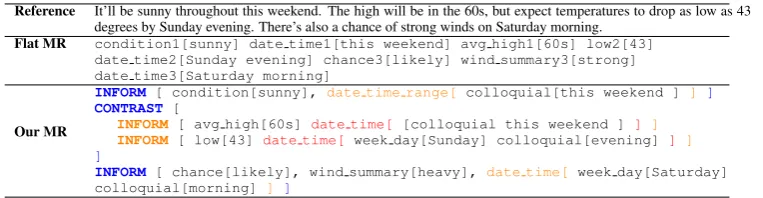
In addition to improved expressiveness, this representation results in more atomic definitions of dialog acts and arguments than in flat MRs. For example, consider the example in the weather domain from Table 2: The response contains multiple dialog acts, a contrast and several in-stances of ellipsis and grouping (i.e., temperatures are grouped and mentioned separately from wind condition). Additionally, some arguments, like
date time, occur multiple times in the response and correspond to different dialog acts, with sev-eral different values. A flat MR will struggle to represent 1) the correspondence of arguments to dialog acts; 2) what attributes to group and con-trast and 3) semantic equivalence of arguments
like date time1 and date time2. On the
other hand, our MRs ease discourse-level learning and encourage reuse of arguments across multiple dialog acts.
3 Dataset
With this representation in mind, we created an ontology of dialog acts, discourse relations, and arguments, for the weather domain. Our motiva-tion for choosing the weather domain, as explored in (Liang et al., 2009), is that this domain offers significant complexity for NLG. Weather forecast summaries in particular can be very long, and re-quire reasoning over several disjoint pieces of in-formation. In this work, we focused on collecting a dataset that showcases the complexity of weather summaries over date/time ranges. Our weather dataset is also unique in that it was collected in aconversationalsetup (see below).
We collected our dataset in multiple stages:
1. Query collection. We asked crowdworkers to come up with sample queries in the weather do-main, likeWhat’s the weather like tomorrow?and Do I need an umbrella tonight?
2. Query annotation. We then wrote rules to automatically parse these queries, and extract key pieces of information, like the location, date, and any attributes that the user specifically requested in the question.
3. MR generation. Our goal was to create MRs that are sufficiently expressive and straight-forward to create automatically in a practical sys-tem. In the weather domain, it’s conceivable that the NLG system has access to a weather API that provides it with detailed weather forecasts for the range requested by the user. To mimic this set-ting, we generated artificial weather forecasts for every user query based on the arguments (full ar-gument set in Table 3) in the user query. We then created the tree-structured MR by applying a few different types of automatic rules, like adding
CONTRASTto weather conditions that are in op-position. We add more details of our response gen-eration method and the specific rules for MR cre-ation in AppendixAandB.
in-Reference It’ll be sunny throughout this weekend. The high will be in the 60s, but expect temperatures to drop as low as 43 degrees by Sunday evening. There’s also a chance of strong winds on Saturday morning.
Flat MR condition1[sunny] date time1[this weekend] avg high1[60s] low2[43] date time2[Sunday evening] chance3[likely] wind summary3[strong] date time3[Saturday morning]
Our MR
INFORM [ condition[sunny], date time range[ colloquial[this weekend ] ] ] CONTRAST [
INFORM [ avg high[60s] date time[ [colloquial this weekend ] ] ]
INFORM [ low[43] date time[ week day[Sunday] colloquial[evening] ] ]
]
[image:4.595.115.497.61.160.2]INFORM [ chance[likely], wind summary[heavy], date time[ week day[Saturday] colloquial[morning] ] ]
Table 2: Sample flat MR with reference compared against our proposed tree-structured MR. Nodes in blue are all children of the root node of the tree.
Dialog Acts INFORM,RECOMMEND,YES,NO,ERROR
Discourse Relations JOIN, CONTRAST, JUSTIFY
Arguments
date time*, date time range*, location* attire[n], activity[n], condition[n], humidity[n] precip amount, precip amount unit, precip chance precip chance summary, precip type, sunrise time, temp, temp high[s], temp low[s], temp unit wind speed[n], wind speed unit, sunset time, task bad arg, bad value, error reason
Table 3: Ontology for the weather domain dataset that we collected. Arguments marked with * are nested arguments (see Table4). [n] indicates arguments that have a corresponding notargument; [s]indicates ar-guments that have a corresponding summary.
formation when arguments were repeated across dialog acts, and could choose the most appropri-ate surface forms for any arguments based on con-textual clues (e.g. referring to a date as tomor-row, rather thanApril 24th, depending on the user’s date). Finally, we asked them to label response spans corresponding to each argument, dialog act, and discourse relation in the MR.
5. Quality evaluation. Finally, we presented a different group of annotators with the annotated responses, and asked them to provide evaluations offluency, correctness, naturalness, and annota-tion correctness.
3.1 Dataset statistics
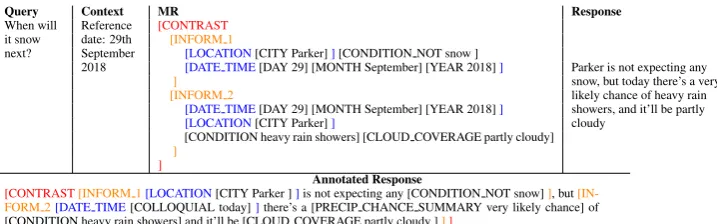
Our final dataset has 33,493 examples. Each ex-ample comprises a user query, the synthetic user context (datetime and location), the tree-structured MR, the response, and a complete tree-structured annotation of the response. Table 6 contains an example from our dataset; as shown, the response annotation structure closely mirrors that of the MR itself. The MRs and responses in the dataset range from very simple (a single dialog act) to very com-plex (an MR with a depth and width of 4). A dis-tribution of this complexity is shown in Table 5. The vocabulary size is 1485, and the max/aver-age/min lengths of responses are 151/40.6/8. The dataset also poses several challenges in addition to
Argument Subfields
date time year, month, day, weekday, colloquial
date time range start year, start month, start day, start weekday end year, end month, end day, end weekday, colloquial location city, region, country, colloquial
Table 4: Defined subfields for nested arguments.
Frequency 0 1 2 3 4 5
# Dialog Acts 0 6469 12077 9801 4095 685
# Discourse Rels 18137 12494 2393 103 1 0
Table 5: Frequency distribution of number of dialog acts and discourse relations in the weather dataset.
syntactic and semantic complexity. As mentioned before, it has a rich set of referring expressions for dates and date ranges. It also contains user queries on which the written response was based, thus creating the opportunity for studies on im-proving naturalness or relevance with respect to the user query. These could be useful in partic-ular for learning to express recommendations and justifications, as well asYESandNOdialog acts.
Our final training set contains 25,390 examples, with 11,879 unique MRs. (We consider two MRs to be identical if they have the samedelexicalized
tree structure — see Section4.1.) The test set con-tains 3,121 examples, of which 1.1K (35%) have unique MRsthat have never been seen in the train-ing set.
3.2 Enriched E2E Dataset
We also used heuristic techniques to convert the E2E dataset to use tree-structured MRs. We used the output of Juraska et al.’s (2018) tagger to find a character within each slot in the flat MR, and au-tomatically adjusted these to correspond to a token boundary if they didn’t already. We then used the Viterbi segmentations from the model released by
Query Context MR Response
When will it snow next?
Reference date: 29th September 2018
[CONTRAST
Parker is not expecting any snow, but today there’s a very likely chance of heavy rain showers, and it’ll be partly cloudy
[INFORM 1
[LOCATION[CITY Parker]][CONDITION NOT snow ] [DATE TIME[DAY 29] [MONTH September] [YEAR 2018]] ]
[INFORM 2
[DATE TIME[DAY 29] [MONTH September] [YEAR 2018]] [LOCATION[CITY Parker]]
[CONDITION heavy rain showers] [CLOUD COVERAGE partly cloudy]
]
]
Annotated Response
[CONTRAST[INFORM 1[LOCATION[CITY Parker ]]is not expecting any [CONDITION NOT snow]], but
[image:5.595.142.501.60.172.2][IN-FORM 2[DATE TIME[COLLOQUIAL today]]there’s a [PRECIP CHANCE SUMMARY very likely chance] of [CONDITION heavy rain showers] and it’ll be [CLOUD COVERAGE partly cloudy ]]]
Table 6: Example response, MR, and other metadata from our dataset
to extend Wiseman et al.’s methods to induce tree structures directly. In the final dataset we obtained (~51K examples), ~24K examples (47%) contain JOIN, while 2237 (4.3%) contain CONTRAST.
4 Model
4.1 Seq2Seq with Linearized Trees
In this work, we use a standard Seq2Seq model with attention (Sutskever et al., 2014; Bahdanau et al., 2014), implemented in the fairseq-py
repository (Gehring et al., 2017). The encoder and decoder are both Long Short-Term Mem-ory (LSTM) -based (Hochreiter and Schmidhuber,
1997) and the decoder uses beam search for gen-eration. The input to the model is a linearized rep-resentation of the tree-structured MR, and the out-put is a linearized tree-structured representation of the annotated response (see Table6). This means that in addition to predicting tokens for the sur-face realization of the response, the model must also predict non-terminals (dialog/discourse rela-tions and arguments) to indicate the start or end of each span. One advantage of predicting a tree structure is that the model has supervision on the alignment between the MR and the response. Ad-ditionally, this predicted tree structure can be used to help verify the correctness of the predicted re-sponse; we leverage this for our constrained de-coding approach described next. We also delexi-calizedtokens in the response that correspond to sparse entities, like names in the E2E dataset and temperatures in the weather dataset (see Appendix
D).
4.2 Constrained Decoding
As described above, the output structure predicted by the model forms a tree that should correspond neatly to the input MR, barring some instances of ellipses (as with thedate time argument in
Figure 1: Examples of constraint checking. (1) and (2) are valid outputs. (3) fails to meet tree constraints since the CONTRASTnode is not present and the IN-FORM node has illegal children customerrating
andpricerange.
Table 6).4 Thus, the input MR can be seen as a constraint on the semantic correctness of the pre-diction; if the predicted structure doesn’t match the MR, the prediction is incorrect and can be re-jected. Figure1illustrates such ideas.
Our beam search algorithm works as follows.5 First, the input tree is scanned to identify groups of two or more nodes that have the same value, so that ellipsis can be enabled by optionally al-lowing just one node in each group. Then, as the tree structure is incrementally decoded, non-terminals are checked against the input tree for validity. When an opening bracket token (e.g.,
[name) is generated, it is not accepted if it isn’t a child of the current parent node in the input tree, or has already been generated in the current subtree, thereby preventing repetition and hallucination of arguments or acts. When a closing bracket token
]or an end-of-sentence (EOS) token is generated, it is accepted only if all children of the current parent are covered either directly or through ellip-sis, thus ensuring that all children of every node are generated. After each timestep of the beam
4
A top-level JOINis automatically added when necessary to create a single-rooted structure.
search, the scores of candidates that violate tree constraints are masked so that they do not proceed forward. By removing candidates that violate the constraints early in the beam search, we allow the decoder to explore more hypotheses.
Checking these constraints and tracking cover-age requires an alignment between the output and input MRs. While the children of JOINnodes are required to appear in order, child nodes of other discourse relations and dialogue acts can appear in any order, and thus the corresponding input non-terminal is not always uniquely identifiable when an output non-terminal is opened. For this reason, a set of possible alignments is maintained. In par-ticular, when accepting a non-terminal, all possi-ble nodes in the input that it may correspond to are identified and a state is maintained for each possi-bility. Open states whose constraints are violated are removed from tracking, and a non-terminal is not accepted when no more open states are left. Though in principle the number of open states could grow large, empirically any alignment non-determinism is quickly resolved.
Note that although the algorithm ensures that the output tree structure is compatible with the in-put structure, it turns out that the model can still occasionally hallucinate content: since the neural model allows all possible token sequences in prin-ciple, it sometimes generates word sequences that express a hallucinated slot by simply skipping over the disallowed slot annotation—thereby bypassing the constraints—especially when given an unusual input. These cases are discussed further below.
5 Experiments
In this section, we first describe our baselines, metrics, and implementation details, followed by experimental results and analyses.
5.1 Experimental Setup
Baselines We consider a few Seq2Seq-based baselines in our experiments (we use the open fairseq implementation (Gehring et al., 2017) for all our experiments). All models use an LSTM-based encoder and decoder, with attention.
S2S-FLAT The input is a flat MR (for the E2E dataset, this is equivalent to the original form of the data; for weather, we remove all discourse re-lations and treat all dialog acts as a single large MR). The output is the raw delexicalized re-sponse.
S2S-TOKEN Following Reed et al. (2018), we add three tokens in the beginning of flat input MR (same as S2S-FLAT) to indicate the number of contrasts, joins and number of sentences (dia-log acts) to be generated.6 The output is the raw delexicalized response.
S2S-TREE Same architecture as S2S-FLAT, but
the input and output for this model are the linearized structured MR and the tree-structured response respectively.
S2S-CONSTR Our proposed model. It has the same architecture as S2S-TREE, but decoding during beam search is constrained, as described in Section4.2.
Data preprocessing In the input MR, all argu-ments within each dialog act are ordered alpha-betically, to ensure a consistent ordering across examples. We also use alignments between the reference and the MR tofilterinformation (argu-ments or dialog acts/discourse relations) that are not expressed in the reference; however, we en-sure that any arguments that occur multiple times in the MR, but are elided in the reference for re-dundancy, are still preserved in the MR. This en-sures that the model doesn’t have to learn content selection, while still achieving our primary goal of discourse structure control.
The inputs to S2S-FLAT and S2S-TOKENare prepared by removing all dialog act and discourse information in the linearized MR, and numbering arguments corresponding to the dialog act they be-long in. Global order of dialog acts is preserved such that arguments of the first act occur before those arguments in the following acts, but argu-ments within a dialog act are ordered alphabeti-cally.
Metrics We consider automatic and human
evaluationmetrics for our model. Automatic met-rics are evaluated on the raw model predictions (which have delexicalized fields, liketemp low): • Tree accuracy is a novel metric that we in-troduce for this problem. It measures whether the tree structure in the prediction matches that of the input MR exactly. We implemented our tree accuracy metric to account for grouping and ellipsis, and will release this implementa-tion along with our dataset.
6Reed et al. only report results on controlling C
ONTRAST
• BLEU-4 (Papineni et al., 2002) is a word-overlap metric commonly used for evaluating NLG systems.
Due to the limitations of automatic metrics for NLG (Novikova et al., 2017; Reiter, 2018), we also performed human evaluation studies by ask-ing annotators to evaluate the quality of responses produced by different models. Annotators pro-videdbinaryratings on the following dimensions: • Grammaticality: Measures fluency of the re-sponses. Our evaluation guidelines included considerations for proper subject-verb agree-ment, word order, repetition, and grammatical completeness.
• Correctness: Measuressemantic correctnessof the responses. Our guidelines included consid-erations for sentence structure, contrast, hallu-cinations (incorrectly included attributes), and missing attributes. We asked annotators to eval-uate model predictions against the reference (rather than the MR — see AppendixF).
5.2 Constrained Decoding Analysis
We trained each of the models described above on the weather dataset and the E2E dataset, and evalu-ated automatic metrics on the test set.7In the E2E test set, each flat MR has multiple references (and therefore multiple compositional MRs). When computing BLEU scores for the token, tree, and constrained models, we generated one hypothesis for each of the compositional MRs for a single flat MR, and chose the hypothesis with the high-est score against all references for that flat MR. We then computed corpus BLEU using these hy-potheses. While this isn’t an entirely fair way to evaluate these models against the E2E systems, it serves as a sanity check to validate that gen-eration models provided with more semantic in-formation about the references can achieve bet-ter BLEU scores against them. For both E2E and weather, we also filtered out, from all model computations, any examples where S2S-CONSTR failed to generate a valid response (5.3).
For human evaluation, we show an overall cor-rectness measure Corrmeasured on the full test sets, as well asDisc, measured on a more
chal-lenging subset of the test set that we selected. For the E2E dataset, we chose examples that contained contrasts by identifying references with abut(230
7We used the scripts provided athttps://github.
com/tuetschek/e2e-metricsby the E2E organizers for evaluating both the E2E and the weather models.
total). For the weather dataset, we chose 400 ex-amples where the MR has at least one CONTRAST or JUSTIFY. We also included test examples with argument type combinations previously unseen in the training set (313 total); we expect these to be challenging for all models, and in particular for the flat model, which has to infer the right discourse relation for new combinations of arguments.
5.3 Results
Table7 shows the results of this experiment. On both the E2E and weather datasets, S2S-CONSTR improves tree accuracy significantly (using Mc-Nemar’s chi-squared test) over S2S-TREE. Hu-man evaluation metrics also show that models that are aware of the tree-structured MR (S2S-TREE and S2S-CONSTR) perform significantly better on correctness measures than S2S-TOKEN, which is only aware of the presence or absence of discourse relations, and significantly better than S2S-FLAT, which has no awareness of the structure. The gap is larger on Disc: the flat model gets only 31% of the challenging cases correct on the E2E dataset, while the constrained model’s accuracy is more than twice that. A similar gap is evident in the weather dataset. Further, CONSTR, S2S-TREE, and S2S-TOKEN all show significant im-provements in BLEU over the flat baseline. These systems also outperform the E2E baseline TGEN (Duˇsek and Jurcıcek,2016) and the challenge win-ner SLUG (Juraska et al.,2018) on BLEU (0.6519 and 0.6693 respectively, fromDuˇsek et al.(2019)) and diversity metrics (Section5.4). We note that for the E2E dataset, the BLEU score increases ob-served with the tree-based models are not statis-tically significant compared to S2S-TOKEN. We think this may be partly because many discourse patterns are correlated with the flat MR structure in the E2E dataset (e.g.family-friendlyand
highly rated are frequently CONTRASTed).
By contrast, BLEU score increases are statistically significant for all models on our weather dataset. Also, S2S-CONSTR fails to generate any valid candidates for ~1.5% of the weather test exam-ples. In most of these cases, the model stutters, i.e. produces degenerate output like “will be be be . . . ”. We suspect that in these cases, the imposed decoding constraints cause the Seq2Seq decoder to get stuck in a pseudoterminal state.
Model E2E Weather
Metric BLEU TreeAcc Gram Corr Disc BLEU TreeAcc Gram Corr Disc
S2S-FLAT 0.6360 - 94.03 63.85 30.87 0.7455 - 98.77 77.09 79.04
S2S-TOKEN 0.7441‡ - 92.29 69.02† 42.29† 0.7493* - 96.7 81.56† 83.93†
[image:8.595.71.528.62.127.2]S2S-TREE 0.7458‡ 94.86 93.59 83.85† 54.35† 0.7612* 92.5 95.26 87.61† 85.97† S2S-CONSTR 0.7469‡ 99.25 94.33 85.89† 66.09† 0.7660* 96.92 95.30 91.82† 93.44†
Table 7: Automatic and human evaluated metrics on E2E and Weather datasets. All metrics other than BLEU are percentages. CorrandDiscare the % of examples for which the model prediction was judged by humans as semantically correct;Discis measured on a challenging subset ofCorr. * indicates BLEU scores that are sta-tistically significant (p <0.01) compared toallbaselines for that model. ‡indicates statistically significant BLEU scores (p < 0.01) compared to S2S-FLAT. †indicates human-evaluated correctness scores that are statistically significant (p <0.05), using McNemar’s chi-squared test, compared toallbaselines for that model.
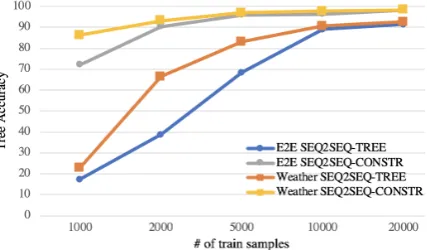
Figure 2: Performance of models on test set for varying number of samples in train set.
on the E2E dataset. One hypothesis from this and the correctness numbers is that the flat mod-els generate more generic (and therefore grammat-ical), but also incorrect, responses, compared to the tree-based models. We also note that there’s a noticeable gap in the E2E dataset between tree ac-curacy and the correctness numbers from human evaluation. We analyzed 35 examples where our tree accuracy metric disagreed with human evalu-ation, and found 22 (63%) cases where the com-positional MR was missing information in the ref-erence, seemingly due to noise in our automatic annotation process (Section3.2). We also identi-fied 6 cases (17%) of annotator confusion (for ex-ample whether between £20-30 implies the same meaning asmoderately priced), sometimes caused by noisy references that contained additional in-formation. The remaining examples all contained legitimate model errors, like content hallucination, or a wrong slot being produced despite a correct non-terminal. One future direction to get more reliable metrics would be to improve the auto-matic annotation process in Section3.2 to elimi-nate noise and flag noisy references. Further ex-perimentation is described in AppendixE.
5.4 Diversity Metrics
We report the diversity metrics used for evalu-ating E2E challenge submissions in Duˇsek et al.
(2019) (# unique tokens, # unique trigrams, Shan-non token entropy (Manning and Sch¨utze, 1999, p.61ff.), conditional bigram entropy (Manning and Sch¨utze,1999, p.63ff.)). Table8shows these num-bers, as compared against a few of the E2E partic-ipating systems, TGEN, SLUG, and ADAPT ( El-der et al.,2018). All of the models with enriched semantic representations — TOKEN, S2S-TREE, and S2S-CONSTR — show higher diver-sity than neural baselines without diverdiver-sity con-siderations. Combined with our improved BLEU scores, this seems to indicate that adding discourse relation information to input MRs can increase di-versity, without incurring losses on automatic met-rics (as is the case with the diversity-promoting ADAPT system).
5.5 Data Efficiency and Generalizability
We measured tree accuracy on the full E2E and weather test sets by varying the number of training samples for S2S-TREE and S2S-CONSTR (Fig-ure 2). S2S-CONSTR achieves more than 90% tree accuracy with just 2K samples and more than 95% with 5K samples on both datasets, suggesting that constrained decoding can help achieve supe-rior performance with much less data.
[image:8.595.77.291.228.353.2]Model Unique tokens
Unique trigrams
Shannon entropy
Cond. entropy bigrams
TGEN 83 597 5.41 1.32
SLUG 74 507 5.35 1.13
ADAPT 455 3567 6.18 2.09
S2S-TOKEN 137 1147 5.86 1.71
S2S-TREE 134 1030 5.85 1.65
[image:9.595.171.429.61.157.2]S2S-CONSTR 134 1128 5.86 1.71
Table 8: E2E dataset diversity metrics. Rows in gray correspond to metrics that we cite fromDuˇsek et al.(2019).
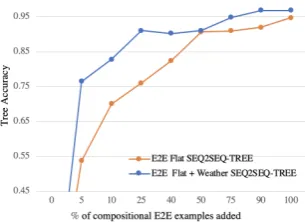
Figure 3: Performance of S2S-TREE models trained on E2E flat data, and flat E2E + full weather dataset, with a fraction of composition E2E.
with only compositional examples. Without any compositional E2E examples, both models fail to produce any valid sequences (not pictured). How-ever, when just 5% of the compositional examples are added to the training data, the E2E-WEATHER model gets a tree accuracy of 76%, while the model trained on E2E only gets 53.72%. The fi-nal E2E-WEATHERmodel also has higher overall accuracy than the E2E-only model. This shows that learned discourse relations can be leveraged for domain adaptation.
6 Related Work
Reed et al.’s (2018) approach to enriching the in-put, discussed earlier, is the most closely related work to ours. A more recent work byMoryossef et al.(2019) also focuses on exercising more con-trol over input structures through sentence plans; however, their work doesn’t touch on discourse re-lations or constrained decoding. Puduppully et al.
(2018) builds a modular end-to-end neural archi-tecture that performs content planning in addition to realization, although they focus on generating text from structured tables, and don’t consider dis-course structure.
Also related is Kiddon et al.’s (2016) neural checklist model, which tracks the coverage of an input list of ingredients when generating recipes.
Our constrained decoding approach goes beyond covering a simple list by enforcing constraints on ordering and grouping of tree structures, but theirs takes coverage into account during model train-ing. A more direct inspiration for our approach is the way coverage has been traditionally tracked in grammar-based surface realization (Shieber,1988;
Kay,1996;Carroll et al.,1999;Carroll and Oepen,
2005;Nakanishi et al.,2005;White,2006;White and Rajkumar,2009). Compared to our approach, grammar-based realizers can prevent hallucination entirely, though at the expense of developing an explicit grammar. Constrained decoding in MT (Post and Vilar, 2018, i.a.) has been used to enforce the use of specific words in the output, rather than constraints on tree structures. Also related are neural generators that take Abstract Meaning Representations (AMRs) as input ( Kon-stas et al.,2017, i.a.) rather than flat inputs; these approaches, however, do not generate trees or use constrained decoding.
7 Conclusions
We show that using rich tree-structured meaning representations can improve expressiveness and semantic correctness in generation. We also pro-pose a constrained decoding technique that lever-ages tree-structured MRs to exert precise control over the discourse structure and semantic correct-ness of the generated text. We release a challeng-ing new dataset for the weather domain and an enriched E2E dataset that include tree-structured MRs. Our experiments show that constrained de-coding, together with tree-structured MRs, can greatly improve semantic correctness as well as enhance data efficiency and generalizability.
Acknowledgments
[image:9.595.105.258.209.320.2]References
Dzmitry Bahdanau, Kyunghyun Cho, and Yoshua Ben-gio. 2014. Neural machine translation by jointly learning to align and translate. arXiv preprint arXiv:1409.0473.
Giuseppe Carenini and Johanna D. Moore. 2006. Gen-erating and evaluating evaluative arguments. Artifi-cial Intelligence, 170:925–952.
John Carroll, Ann Copestake, Dan Flickinger, and Vic-tor Pozna´nski. 1999. An efficient chart generaVic-tor for (semi-) lexicalist grammars. InProc. EWNLG-99.
John Carroll and Stefan Oepen. 2005. High efficiency realization for a wide-coverage unification grammar. InProc. IJCNLP-05.
Vera Demberg, Andi Winterboer, and Johanna D Moore. 2011. A strategy for information presenta-tion in spoken dialog systems. Computational Lin-guistics, 37(3):489–539.
Ondˇrej Duˇsek and Filip Jurcicek. 2016. Sequence-to-sequence generation for spoken dialogue via deep syntax trees and strings. InProceedings of the 54th Annual Meeting of the Association for Computa-tional Linguistics (Volume 2: Short Papers), pages 45–51. Association for Computational Linguistics.
Ondrej Duˇsek and Filip Jurcıcek. 2016. Sequence-to-sequence generation for spoken dialogue via deep syntax trees and strings. InThe 54th Annual Meet-ing of the Association for Computational LMeet-inguis- Linguis-tics, page 45.
Ondˇrej Duˇsek, Jekaterina Novikova, and Verena Rieser. 2018. Findings of the E2E NLG challenge. In Pro-ceedings of the 11th International Conference on Natural Language Generation, pages 322–328. As-sociation for Computational Linguistics.
Ondˇrej Duˇsek, Jekaterina Novikova, and Verena Rieser. 2019. Evaluating the state-of-the-art of end-to-end natural language generation: The E2E NLG Chal-lenge.arXiv preprint arXiv:1901.11528.
Henry Elder, Sebastian Gehrmann, Alexander O’Connor, and Qun Liu. 2018. E2E NLG challenge submission: Towards controllable generation of diverse natural language. InProceedings of the 11th International Conference on Natural Language Generation, pages 457–462.
Jonas Gehring, Michael Auli, David Grangier, Denis Yarats, and Yann N Dauphin. 2017. Convolutional Sequence to Sequence Learning.ArXiv e-prints.
Sepp Hochreiter and J¨urgen Schmidhuber. 1997. Long short-term memory. Neural computation, 9(8):1735–1780.
Juraj Juraska, Panagiotis Karagiannis, Kevin K. Bow-den, and Marilyn A. Walker. 2018. A deep ensemble model with slot alignment for sequence-to-sequence natural language generation. InNAACL-HLT.
Martin Kay. 1996. Chart generation. InProceedings of the 34th Annual Meeting of the Association for Computational Linguistics, pages 200–204, Santa Cruz, California, USA. Association for Computa-tional Linguistics.
Chlo´e Kiddon, Luke Zettlemoyer, and Yejin Choi. 2016. Globally coherent text generation with neu-ral checklist models. In Proceedings of the 2016 Conference on Empirical Methods in Natural Lan-guage Processing, pages 329–339. Association for Computational Linguistics.
Diederik P. Kingma and Jimmy Ba. 2015. Adam: A method for stochastic optimization. CoRR, abs/1412.6980.
Nikita Kitaev and Dan Klein. 2018. Constituency parsing with a self-attentive encoder. In Proceed-ings of the 56th Annual Meeting of the Association for Computational Linguistics (Volume 1: Long Pa-pers), Melbourne, Australia. Association for Com-putational Linguistics.
Ioannis Konstas, Srinivasan Iyer, Mark Yatskar, Yejin Choi, and Luke Zettlemoyer. 2017. Neural AMR: Sequence-to-sequence models for parsing and gen-eration. In Proceedings of the 55th Annual Meet-ing of the Association for Computational LMeet-inguis- Linguis-tics (Volume 1: Long Papers), pages 146–157, Van-couver, Canada. Association for Computational Lin-guistics.
Oliver Lemon, Johanna Moore, Mary Ellen Foster, and Michael White. 2004. Generating tailored, compar-ative descriptions in spoken dialogue. In Proc. of FLAIRS. AAAI.
Percy Liang, Michael I Jordan, and Dan Klein. 2009. Learning semantic correspondences with less super-vision. InProceedings of the Joint Conference of the 47th Annual Meeting of the ACL and the 4th Interna-tional Joint Conference on Natural Language Pro-cessing of the AFNLP: Volume 1-Volume 1, pages 91–99. Association for Computational Linguistics.
William C. Mann and Sandra A. Thompson. 1988. Rhetorical structure theory: Towards a functional theory of text organization. TEXT, 8(3):243–281.
Christopher D. Manning and Hinrich Sch¨utze. 1999. Foundations of Statistical Natural Language Pro-cessing. MIT Press, Cambridge, MA, USA.
Hongyuan Mei, Mohit Bansal, and R. Matthew Walter. 2016. What to talk about and how? selective gener-ation using lstms with coarse-to-fine alignment. In Proceedings of the 2016 Conference of the North American Chapter of the Association for Computa-tional Linguistics: Human Language Technologies, pages 720–730. Association for Computational Lin-guistics.
Amit Moryossef, Yoav Goldberg, and Ido Dagan. 2019. Step-by-step: Separating planning from realization in neural data-to-text generation. arXiv preprint arXiv:1904.03396.
Hiroko Nakanishi, Yusuke Miyao, and Jun’ichi Tsujii. 2005. Probabilistic methods for disambiguation of an HPSG-based chart generator. InProc. IWPT-05.
Jekaterina Novikova, Ondrej Dusek, Amanda Cercas Curry, and Verena Rieser. 2017. Why we need new evaluation metrics for NLG. InEMNLP.
Kishore Papineni, Salim Roukos, Todd Ward, and Wei-Jing Zhu. 2002. BLEU: a method for automatic evaluation of machine translation. InProc. ACL-02.
Jeffrey Pennington, Richard Socher, and Christopher Manning. 2014. Glove: Global vectors for word representation. InProceedings of the 2014 confer-ence on empirical methods in natural language pro-cessing (EMNLP), pages 1532–1543.
Matt Post and David Vilar. 2018. Fast lexically con-strained decoding with dynamic beam allocation for neural machine translation. InNAACL-HLT.
Ratish Puduppully, Li Dong, and Mirella Lapata. 2018. Data-to-text generation with content selection and planning. arXiv preprint arXiv:1809.00582.
Owen Rambow, Srinivas Bangalore, and Marilyn Walker. 2001. Natural language generation in dia-log systems. In Proceedings of the First Interna-tional Conference on Human Language Technology Research, HLT ’01, pages 1–4, Stroudsburg, PA, USA. Association for Computational Linguistics.
Lena Reed, Shereen Oraby, and Marilyn Walker. 2018. Can neural generators for dialogue learn sentence planning and discourse structuring? In Proceed-ings of the 11th International Conference on Natural Language Generation, pages 284–295. Association for Computational Linguistics.
Ehud Reiter. 2018. A structured review of the validity of BLEU. Computational Linguistics, 44:393–401.
Ehud Reiter and Robert Dale. 2000. Building Natural-Language Generation Systems. Cambridge Univer-sity Press.
Stuart Shieber. 1988. A uniform architecture for pars-ing and generation. InProc. COLING-88.
Charese Smiley, Elnaz Davoodi, Dezhao Song, and Frank Schilder. 2018. The E2E NLG challenge: A tale of two systems. InINLG.
Nitish Srivastava, Geoffrey Hinton, Alex Krizhevsky, Ilya Sutskever, and Ruslan Salakhutdinov. 2014. Dropout: a simple way to prevent neural networks from overfitting. The Journal of Machine Learning Research, 15(1):1929–1958.
Amanda Stent, Marilyn A. Walker, Steve Whittaker, and Preetam Maloor. 2002. User-tailored genera-tion for spoken dialogue: an experiment. In INTER-SPEECH.
Ilya Sutskever, Oriol Vinyals, and Quoc V Le. 2014. Sequence to sequence learning with neural net-works. InAdvances in neural information process-ing systems, pages 3104–3112.
Oriol Vinyals, Meire Fortunato, and Navdeep Jaitly. 2015. Pointer networks. InAdvances in Neural In-formation Processing Systems, pages 2692–2700.
Marilyn Walker, Amanda Stent, Francois Mairesse, and Rashmi Prasad. 2007. Individual and domain adap-tation in sentence planning for dialogue. Journal of Artificial Intelligence Research (JAIR), 30:413–456.
Tsung-Hsien Wen, Milica Gaˇsi´c, Nikola Mrkˇsi´c, M. Lina Rojas-Barahona, Pei-Hao Su, David Vandyke, and Steve Young. 2016. Multi-domain neural network language generation for spoken di-alogue systems. In Proceedings of the 2016 Con-ference of the North American Chapter of the Asso-ciation for Computational Linguistics: Human Lan-guage Technologies, pages 120–129. Association for Computational Linguistics.
Tsung-Hsien Wen, Milica Gasic, Nikola Mrkˇsi´c, Pei-Hao Su, David Vandyke, and Steve Young. 2015. Semantically conditioned LSTM-based natural lan-guage generation for spoken dialogue systems. In Proceedings of the 2015 Conference on Empirical Methods in Natural Language Processing, pages 1711–1721. Association for Computational Linguis-tics.
Michael White. 2006. Efficient realization of coordi-nate structures in combinatory categorial grammar. Research on Language and Computation, 4(1):39– 75.
Michael White, Robert A. J. Clark, and Johanna D. Moore. 2010. Generating tailored, comparative de-scriptions with contextually appropriate intonation. Computational Linguistics, 36(2):159–201.
Michael White and Rajakrishnan Rajkumar. 2009. Per-ceptron reranking for CCG realization. In Proceed-ings of the 2009 Conference on Empirical Methods in Natural Language Processing, pages 410–419, Singapore. Association for Computational Linguis-tics.
Sam Wiseman, Stuart Shieber, and Alexander Rush. 2017. Challenges in data-to-document generation. In Proceedings of the 2017 Conference on Empiri-cal Methods in Natural Language Processing, pages 2253–2263. Association for Computational Linguis-tics.
A Weather Forecast Generation
For every example, we extracted the date range requested by the user, and generated artificial weather forecasts for that date range. We gen-erated forecasts of different granularities (hourly or daily) depending on the date requested by the user. If the date that requested was less than 24 hours after the “reference” date in the synthetic user context, we generated hourly forecasts; oth-erwise, we generated the required number of daily forecasts. To generate forecasts, we selected rea-sonable mean, standard deviation, min, and max values for temperature and cloud coverage, and used these to sample temperatures for every point in the date range. We also selected random sun-rise and sunset times for each day present in the range. We picked values that seemed reasonable, but didn’t try too hard to get precise values, since our focus was more on using the forecasts to cre-ate complex MRs. After sampling temperatures and cloud coverage amounts for each range, we randomly chose other attributes to include, condi-tioned on the values of the temperatures and cloud coverage, like precipitation chance, wind speed summary, and other rarer conditions like fog.
B Tree-Structured Weather MR Creation
1. Errors: We addedERRORdialog acts whenever the user query contained a weather request for a date too far in the future. We also chose lo-cations to treat as “unknown” randomly, thus adding errors for locations unknown to the sys-tem. These ERROR acts are interesting be-cause they capture domain-specific information about the nature and cause of errors, and can potentially be learned across domains. Addi-tionally, including ERROR acts creates scope for interesting responses like “I’m sorry, I don’t know where that is. But right now in [user’s de-fault location], it’s sunny ...”.
2. Aggregation: We identified dates that had simi-lar weather attributes (precipitation, cloud cov-erage, etc.) and created INFORM dialog acts that expressed information regarding each date. We then grouped these acts together using a
JOINdiscourse relation.
3. Contrast: We identified attributes that were in opposition (“cloudy” vs. “sunny”) and added
a parent CONTRAST discourse relation to any such dialog acts. We also contrasted related attributes wherever possible; e.g. the cloud coverage value “sunny” can be contrasted with both “cloudy” and the precipitation type “rain”.
4. Yes/no questions: Whenever the user query was a boolean one (“Will it rain tomorrow”), we addedYESorNOdialog acts as appropriate.
5. Justifications/Recommendations: Whenever the user query mentioned an attire or activity (“Should I wear a raincoat tomorrow?”), we as-sumed that the MR should communicate a rec-ommendation as well as a justification for it (“No, you don’t need to wear one tomorrow, it looks like it’ll be sunny all day”). In these cases, we added aRECOMMENDdialog act, and an INFORM dialog act that provides the jus-tification for the recommendation. We added a parentJUSTIFYdiscourse relation to these acts, treating the recommendation as the nu-cleus and the INFORM as the satellite of the justification.
C Dataset Creation Quality
As mentioned in3, we asked annotators to provide evaluations of collected responses, and used these to filter out noisy references and annotations from our final dataset. The ratings were provided on a 1-5 scale and double annotated, and we filtered out 3,404 examples (out of a total 37,162) that had a score less than 3 on any of the four dimensions: fluency, correctness, naturalness, annotation cor-rectness.
D Data Preprocessing
Infinitely-valued arguments such as names of restaurants, dates, times, and locations such as cities, states are delexicalized (value is replaced by placeholder tokens) in both the input and output of models. This was done following the approach taken by several of the systems in the E2E chal-lenge (Duˇsek and Jurcıcek, 2016; Juraska et al.,
used to address this, though we did not explore this approach in this work.) The full list of arguments for which we performed delexicalization is:
1. Numerical arguments: temperature-related arguments, precipitation chance, day, month, year (for dates).
2. Named entities: restaurant name (E2E), land-mark (E2E), city, region, country, weekday (for dates)
E Additional Experiments
We also experimented with a reranked S2S-TREE in which the beam search candidates are reranked for tree accuracy. This yields a tree accuracy of 97.6% and 95.4% on E2E and weather.
We trained a Recurrent Neural Network Gram-mar (RNNG) to tag slots in the prediction of S2S-CONSTRin order to filter out hallucinations. The correctness on filtered test sets rose from 85.89% to 87.44% for E2E, and from 91.82% to 93.84% on weather.
F Human Evaluation of Models
When asking annotators to rate the models on correctness, we asked them to rate the response by comparing it against the reference, rather than against the MR. This adds the risk that annotators are confused by noisy references, but we found that it increased annotation speed and agreement rates significantly over evaluating against the MR directly. This is also because our MRs are tree-structured and can be hard to read. We performed double-annotation with a resolution round. Auto-matic rejection: When analyzing evaluation re-sults, we found that it was fairly easy to miss the absence of a contrast or a justification in our weather dataset, especially since our dataset is so large. As a result, annotators were marking several incorrect cases as correct. To address this issue, we automatically marked as incorrect any exam-ples where the MR had a CONTRAST but the re-sponse lacked any contrastive tokens, or where the MR has a JUSTIFY but the response lacked any clear markers of a justification. This eliminated noise from 2.8% of all responses.
G Model Training Details
We used the same seq2seq model from the S2S-FLATbaseline for our constrained decoding
H Constrained Decoding Algorithm
d e f b u i l d c o n s t r a i n t s (MR) :
# n o d e s i n MR a r e numbered f r o m 0 t o n i n o r d e r o f t h e i r # d i s c o v e r y i n d e p t h−f i r s t−s e a r c h .
# e x a m p l e , f o r MR: [ JOIN [ INFORM [A ] [ B ] ] [ INFORM [ B ] [D ] ] ] # i d s : JOIN : 0 , INFORM : 1 , A : 2 , B : 3 , INFORM : 4 , B : 5 , D : 6 f o r n o d e i n MR:
p a r e n t m a p [ n o d e . i d ] = n o d e . p a r e n t c h i l d r e n m a p [ n o d e . i d ] = n o d e . c h i l d r e n
# map f r o m non−t e r m i n a l t o a l l n o d e i d s o f t h e non−t e r m i n a l # eg : INFORM−> {1 , 4} i n c a s e o f e x a m p l e MR a b o v e v a l i d n o n t e r m i n a l n o d e s [ n o d e . n o n t e r m i n a l ] . add ( n o d e . i d ) # map f r o m n o d e i d t o n o d e s t h a t c a n c o v e r i t t h r o u g h e l l i p s i s # e x a m p l e , f o r a b o v e MR: {3 : {3 , 5}, 5 : {3 , 5}}
e l l i p s i s o p t i o n s = c o m p u t e e l l i p s i s o p t i o n s (MR) i n i t s t a t e . p a r e n t = −1
# c u r r e n t p a r e n t
i n i t s t a t e . c o v e r a g e = {} # t r a c k s n o d e i d s e n c o u n t e r e d t i l l now
# t r a c k n o d e s t h a t h a v e b e e n c o v e r e d t h r o u g h e l l i p s i s i n i t s t a t e s . e l i d e d n o d e s = {}
s t a t e s = [ i n i t s t a t e ] # l i s t o f o p e n s t a t e s
d e f c h i l d r e n c o v e r e d ( s t a t e , n o d e ) :
# r e t u r n s t r u e i f a l l n o d e s h a v e c o v e r e d e i t h e r # d i r e c t l y o r t h r o u g h e l l i p s i s
m i s s i n g c h i l d r e n = c h i l d r e n m a p [ s t a t e . p a r e n t ]− s t a t e . c o v e r a g e f o r m i s s i n g c h i l d i n m i s s i n g c h i l d r e n :
i f ( e l l i p s i s o p t i o n s [ m i s s i n g c h i l d ] − s t a t e . e l i d e d n o d e s ) i s empty : # n o d e s t h a t h a v e b e e n e l i d e d t h e m s e l v e s # can ’ t c o v e r o t h e r n o d e s t h r o u g h e l l i p s i s r e t u r n F a l s e
r e t u r n T r u e
d e f a c c e p t t o k e n ( s t a t e s , n e x t t o k e n ) :
# move s t a t e s one t i m e−s t e p f o r w a r d by a c c e p t i n g n e x t t o k e n # r e t u r n s F a l s e i f n e x t t o k e n c a n n o t be a c c e p t e d by any s t a t e i f n o t n e x t t o k e n . s t a r t s w i t h ( ” [ ” ) o r n e x t t o k e n ! = ” ] ” :
# o n l y non−t e r m i n a l t o k e n s n e e d t o be c h e c k e d r e t u r n T r u e
u p d a t e d s t a t e s = [ ] f o r s t a t e i n s t a t e s :
i f n e x t t o k e n . s t a r t s w i t h ( ” [ ” ) :
f o r c a n d i d a t e i n v a l i d n o n t e r m i n a l n o d e s [ n e x t t o k e n ] : i f c a n d i d a t e i n c h i l d r e n m a p [ s t a t e . p a r e n t ]
and c a n d i d a t e n o t i n s t a t e . c o v e r a g e : # c r e a t e a new s t a t e f o r e a c h v a l i d c a n d i d a t e n e w s t a t e = c o p y ( s t a t e )
n e w s t a t e . p a r e n t = c a n d i d a t e n e w s t a t e . c o v e r a g e . add ( c a n d i d a t e ) u p d a t e d s t a t e s . a p p e n d ( n e w s t a t e ) e l i f n e x t t o k e n == ” ] ”
and c h i l d r e n c o v e r e d ( s t a t e , s t a t e . p a r e n t ) : # a c c e p t c l o s i n g b r a c e f o r c u r r e n t n o d e and # move s t a t e s up a l e v e l i n t r e e
n e w s t a t e = c o p y ( s t a t e )
n e w s t a t e . p a r e n t = p a r e n t m a p [ s t a t e . p a r e n t ] m i s s i n g c h i l d r e n =
c h i l d r e n m a p [ s t a t e . p a r e n t ]− s t a t e . c o v e r a g e # i f we ’ r e a c c e p t i n g a c l o s i n g n o d e w i t h m i s s i n g c h i l d r e n , # t h e n a l l o f them m u s t be g e t t i n g e l i d e d
n e w s t a t e . e l i d e d n o d e s . add ( m i s s i n g c h i l d r e n ) u p d a t e d s t a t e s . a p p e n d ( u p d a t e ( n e w s t a t e , n e x t t o k e n ) ) s t a t e s = u p d a t e d s t a t e s
r e t u r n l e n ( s t a t e s )>0
d e f m a s k s c o r e ( s c o r e , s t a t e s , n e x t t o k e n ) : i f a c c e p t t o k e n ( s t a t e s , n e x t t o k e n ) :
r e t u r n s c o r e e l s e :