Proceedings of the 57th Annual Meeting of the Association for Computational Linguistics, pages 1361–1370 1361
Joint Type Inference on Entities and Relations via Graph Convolutional
Networks
Changzhi Sun1,∗, Yeyun Gong2, Yuanbin Wu1, 3, Ming Gong2, Daxing Jiang2, Man Lan1, Shiliang Sun1, and Nan Duan2
1Department of Computer Science and Technology, East China Normal University
2Microsoft Research Asia
3State Key Laboratory of Cognitive Intelligence, iFLYTEK
{changzhisun}@stu.ecnu.edu.cn {ybwu,mlan,slsun}@cs.ecnu.edu.cn {yegong, nanduan, migon, djiang}@microsoft.com
Abstract
We develop a new paradigm for the task of joint entity relation extraction. It first identi-fies entity spans, then performs a joint infer-ence on entity types and relation types. To tackle the joint type inference task, we propose a novel graph convolutional network (GCN) running on an entity-relation bipartite graph. By introducing a binary relation classification task, we are able to utilize the structure of entity-relation bipartite graph in a more effi-cient and interpretable way. Experiments on ACE05 show that our model outperforms ex-isting joint models in entity performance and is competitive with the state-of-the-art in rela-tion performance.
1 Introduction
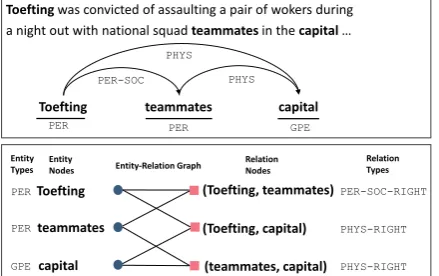
Extracting entities and relations from plain texts is an important and challenging task in natural lan-guage processing. Given a sentence, the task aims to detect text spans with specific types (entities) and semantic relations among those text spans ( re-lations). For example, in the Figure1, “Toefting” is a person entity (PER), “teammates” is a person entity (PER), and the two entities have a Person-Social relation (PER-SOC).
To tackle the task of entity relation extraction, various methods have been proposed, which can be divided into two categories: pipeline models and joint models. Pipeline models extract enti-ties and relations in two stages: entienti-ties are first extracted by an entity model, and then these ex-tracted entities are used as the inputs of a relation model. Pipeline models often ignore interactions between the two models and they suffer from error propagation. Joint models integrate information between entities and relations into a single model with the joint training, and have achieved better
∗
Work done while this author was an intern at Microsoft Research Asia.
Toeftingwas convicted of assaulting a pair of wokers during a night out with national squad teammatesin the capital…
PER PER GPE
Toefting teammates capital
PER-SOC PHYS
PHYS
Toefting
teammates
capital
(Toefting, teammates)
(Toefting, capital)
(teammates, capital)
PER
PER
GPE
PER-SOC-RIGHT
PHYS-RIGHT
PHYS-RIGHT Entity
Types Entity Nodes
Relation Nodes
[image:1.595.308.528.224.362.2]Relation Types Entity-Relation Graph
Figure 1: An example from ACE05. The first part contains annotations and the second part is the entity-relation graph of the sentence used in GCN.
results than the pipeline models. In this paper, we focus on joint models.
More and more joint methods have been ap-plied to this task. Among them,Miwa and Bansal (2016);Katiyar and Cardie(2017) identify the en-tity with a sequence labelling model, and iden-tify the relation type with a multi-class classi-fier. These joint methods do joint learning through sharing parameters and they have no explicit in-teraction in type inference. In addition, some complex joint decoding algorithms (e.g., simulta-neously decoding entities and relations in beam search) have been carefully investigated, includ-ingLi and Ji (2014); Zhang et al.(2017); Zheng et al.(2017);Wang et al.(2018). They jointly han-dle span detection and type inference to achieve more interactions.
may get a better joint extraction performance. At the same time, we observe that a joint inference on entity and relation types could be potentially bet-ter than predicting them independently. For exam-ple, in Figure1, the PER-SOCrelation suggests that the type of “Toefting” might bePER, and vice versa. Moreover thePER(“Toefting”) and the re-lationPER-SOCcould benefit from other relations such asPHYS.
In this paper, we define joint entity relation ex-traction into two sub-tasks: entity span detection and entity relation type deduction. For entity span detection, we treat it as a sequence labeling prob-lem. For joint type inference, we propose a novel and concise joint model based on graph convolu-tional networks (GCNs) (Kipf and Welling,2017). The two sub-models are trained jointly. Specif-ically, given all detected entity spans in a sen-tence, we define an entity-relation bipartite graph. For each entity span, we assign an entity node. For each entity-entity pair, we assign a relation node. Edges connect relation nodes and their en-tity nodes (last part of Figure 1). With efficient graph convolution operations, we can learn rep-resentations for entity nodes and relation nodes by recursively aggregating information from their neighborhood over the bipartite graph. It helps us to concisely capture information among entities and relations. For example, in Figure1, to predict the PER (“Toefting”), our joint model can pool the information ofPER-SOC,PHYS,PER (“team-mates”) andGPE(captital).
To further utilize the structure of the graph, we also propose assigning different weights on graph edges. In particular, we introduce a binary relation classification task, which is to determine whether the two entities form a valid relation. Different from previous GCN-based models (Shang et al., 2018; Zhang et al., 2018), the adjacency matrix of graph is based on the output of binary rela-tion classificarela-tion, which makes the proposed ad-jacency matrix more explanatory. To summarize, the main contributions of this work are1
• We present a novel and concise joint model to handle the joint type inference problem based on graph convolutional network (GCN).
• We introduce a binary relation classification task to explore the structure of entity-relation
1 Our implementation is available at https://
github.com/changzhisun/AntNRE.
bipartite graph in a more efficient and inter-pretable way.
• We show that the proposed joint model on ACE05 achieves best entity performance, and is competitive with the state-of-the-art in relation performance.
2 Background of GCN
In this section, we briefly describe graph convo-lutional networks (GCNs). Given a graph with
n nodes, the goal of GCNs is to learn structure-aware node representations on the graph which takes as inputs:
• ann×dinput node embedding matrixH, where
nis the number of nodes anddis the dimension of input node embedding;
• an n ×n matrix representation of the graph structure such as the adjacency matrixA(or some function thereof)2.
In an L-layer GCNs, every layer can be written as a non-linear function
H(l+1) =σ( ˆAH(l)W(l)) (1)
withH(0) = H, whereAˆ = D−12AD− 1 2 is the
normalized symmetric adjacency matrix andW(l)
is a parameter matrix for the l-th GCN layer. D
is the diagonal node degree matrix, whereDii =
P
jAij. σ is a non-linear activation function like
ReLU. Finally, we can obtain a node-level output
Z=H(L), which is ann×dfeature matrix.
3 Approach
We define the joint entity relation extraction task. Given a sentences = w1, . . . w|s|(wi is a word),
the task is to extract a set of entity spans E with specific types and a set of relationsR. An entity spane ∈ E is a sequence of words labeling with an entity typey(e.g., person (PER), organization (ORG)). A relationr is a quintet(e1, y1, e2, y2, l), wheree1ande2 are two entity spans with specific
typesy1andy2. lis a relation type describing the
semantic relation between two entities. (e.g., orga-nization affiliation relation (ORG-AFF)). Let Te, Tr be the set of possible entity types and relation
types respectively.
2In order to incorporate information, we add a
In this work, we decompose the joint entity re-lation extraction task into two parts, namely, en-tity span detection and enen-tity relation type de-duction. We first treat entity span detection as a sequence labelling task (Section 3.1), and then construct an entity-relation bipartite graph (Sec-tion3.2) to perform joint type inference on entity nodes and relation nodes (Section 3.3). All sub-models share parameters and are trained jointly. Different from existing joint learning algorithms (Sun et al.,2018;Zhang et al.,2017;Katiyar and Cardie, 2017;Miwa and Bansal, 2016), we pro-pose a concise joint model to perform joint type in-ference on entities and relations based on GCNs. It considers interactions among multiple entity types and relation types simultaneously in a sentence.
3.1 Entity Span Detection
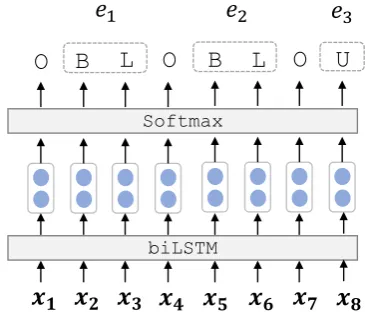
To extract entity spans from a sentence (Figure2), we adopt theBILOUsequence tagging scheme:B, I,LandOdenote the begin, inside, last and out-side of a target span,Udenotes a single word span. For example, for a person (PER) entity “Patrick McDowell”, we assign B to “Patrick” and L to “McDowell”.
Given an input sentence s, we use a bidirec-tional long short term memory (biLSTM) network (Hochreiter and Schmidhuber,1997) with param-eterθseqto incorporate information from both for-ward and backfor-ward directions ofs.
hi = biLSTM(xi;θseq), (2)
wherehi is the concatenation of a forward and a
backward LSTM’s hidden states at positioni, and
xiis the word representation ofwiwhich contains
pre-trained embeddings and character-based word representations generated by running a CNN on the character sequences ofwi. Then, we employ a
softmax output layer to predictwi’s tagˆti,
P(ˆti|s) = Softmax(Wspanhi),
whereWspanis the parameter. Given an input
sen-tencesand its gold tag sequencet =t1, . . . , t|s|, the training objective is to minimize3
Lspan =− 1 |s|
|s|
X
i=1
logP(ˆti =ti|s). (3)
3We have also tried biLSTM-CRF (Huang et al.,2015) as
an advanced sequence labelling model, but performances are nearly the same in our experiments.
biLSTM
𝒙
𝟏𝒙
𝟐𝒙
𝟑𝒙
𝟒𝒙
𝟓𝒙
𝟔𝒙
𝟕𝒙
𝟖Softmax
B
L
O
B
L
O
U
O
[image:3.595.323.506.61.217.2]𝑒
1𝑒
2𝑒
3Figure 2: The biLSTM model for entity span detection.
3.2 Entity-Relation Bipartite Graph
Given a set of detected entity spans Eˆ (obtained from the entity span tag sequenceˆt), we consider all entity span pairs in Eˆ as candidate relations 4. Then we build a heterogeneous undirected
bi-partite graph Gs which contains entity nodes and
relation nodes in a sentences. In the graph Gs,
interactions on multiple entity types and relation types can be explicitly modeled. The number of nodes n in the graph Gs is the number of entity
spans |E|ˆ plus the number of all candidate
rela-tions |E|ˆ(|E|−ˆ2 1). We have an initial input node em-bedding matrixH. For a relation r12 and its two
entitiese1, e2, we useHr12 to denote relation em-bedding ofr12, and useHe1,He2 to denote entity embedding ofe1, e2respectively.
Next, we build edges between entity nodes and relation nodes. For graph edges, we connect every relation node to its two entity nodes instead of di-rectly connecting any entity (relation) nodes. Thus we focus on the bipartite graph. The reasons are two folds. a) We do not think that all the remain-ing entities in the sentence are helpful. Relation nodes are bridges between entity nodes and vice versa. b) GCN is not suitable for fully-connected graphs because GCN reduce to rather trivial oper-ations on fully-connected graphs. It means that, for an entity nodee, the only way to observe other entities is through relations whichetakes part in. For example, given a relation noder12and its two
entity nodese1, e2, we add two edges. One is the edge betweene1 andr12, and another is the edge
4
The first entity span is always on the left side of the sec-ond entity span of each candidate relation, and we use in total 2Tr + 1relation types in order to consider both directions.
𝑒1 𝑒2 𝑒3 𝑟12 𝑟13𝑟23
GCN
Softmax
1 1 1
Softmax Softmax
. . .
Activation Function &
Dropout
GCN Layer Binary
Relation Entity
Type
Relation Type
Node Embeding Extractor Entity Span Detection
[image:4.595.83.516.59.236.2]𝑦1 𝑦2 𝑦3 𝑙1 𝑙2 𝑙3
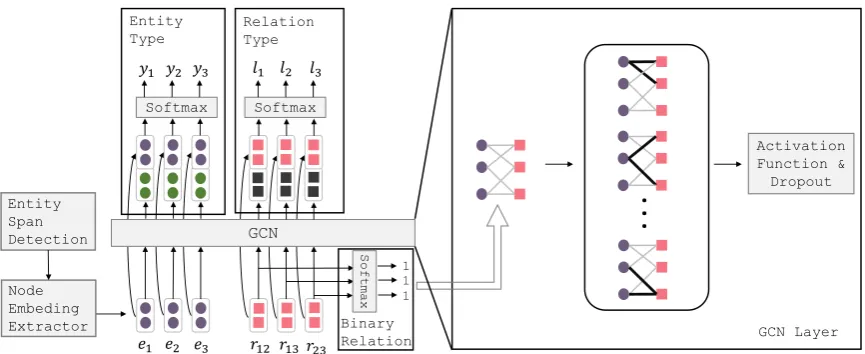
Figure 3: Our network structure for the joint entity and relation extraction based on GCN. The node embedding extractor computesHeandHr.
betweene2andr12. We refer to it asstaticgraph. In order to further utilize the structure of the graph (some kind of prior knowledge) instead of using a static graph, we also investigate the dy-namicgraph for pruning redundant edges. A key intuition is that if two entities hold a relation, we could add two edges between the relation node and two entity nodes. Conversely, if two entities have no relation, we keep two entity nodes and the rela-tion node separately. To this end, we introduce the
binary relation classificationtask. It aims to pre-dict whether a certain relation exists between an entity span pair (ignoring specific relation types). We build a binary relation model which predicts a label in{0,1} to indicate the existence of a can-didate relation based on relation node embedding. Given a relation node rij in a sentence s, to get
the posterior of the binary relation labelˆb, we ap-ply softmax layer on the relation node embedding
Hrij,
P(ˆb|rij, s) = Softmax(WbinHrij),
whereWbinis the parameter. The training
objec-tive is to minimize
Lbin=−
X
rij
logP(ˆb=b|rij, s)
# candidate relationsrij
, (4)
where true binary annotations b are transformed from the original typed relation labels. Formally, the adjacency matrixAis defined as
• ifP(ˆb = 1|rij, s)>0.5, we set the value ofA
between entity nodesei, ejand relation noderij to
1.0,
• the diagonal elements ofAare set to 1.0,
• while others are set to 0.0.
To compare withhardbinary valueA, we also try thesoftvalueAin experiments. It means that we set the value ofAbetween entity nodesei, ej
and relation node rij to the probability P(ˆb =
1|rij, s)except for the diagonal elements (they are
set to 1.0).
Here, we introduce how to compute two types of contextualized node embedding in the graphGs:
entity node embedding and relation node embed-ding.
Entity Node Embedding Given an entity span
e∈E, for each wordˆ wi ∈e, we first collectwi’s
biLSTM hidden vectorhifrom entity span model.
Then, we use a CNN (a single convolution layer with a max-pooling layer) with a multi-layer per-ceptron (MLP) on vectors{hi|wi ∈ e}to obtain
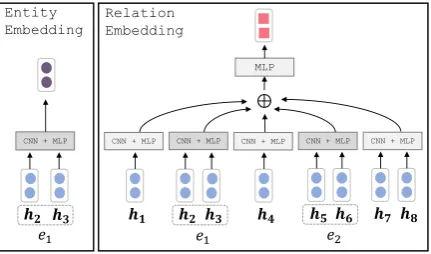
the resultingd-dimensional entity span node em-bedding He (His a matrix mentioned before in
Section2), as shown in the left part of Figure4.
Relation Node Embedding Given a candidate relation r12, we extract two types of features,
namely, features regarding words ine1, e2and fea-tures regarding contexts of the entity span pair
(e1, e2). For features on words ine1, e2, we
sim-ply use entity node embeddingHe1 andHe2. For context features of the entity span pair (e1, e2), we build three feature vectors by looking at words betweene1 ande2, words on the left of the pair
𝒉𝟐 𝒉𝟑
CNN + MLP CNN + MLP CNN + MLP CNN + MLP CNN + MLP CNN + MLP ⊕
MLP
𝒉𝟏 𝒉𝟐 𝒉𝟑 𝒉𝟒 𝒉𝟓 𝒉𝟔 𝒉𝟕 𝒉𝟖
𝑒1 𝑒2
𝑒1 Entity Embedding
Relation Embedding
Figure 4: Our node embedding extractor.
an MLP. Finally, the five feature vectors are con-catenated to a single vector. To getd-dimensional relation node embeddingHr12, we apply an MLP on the single vector, as shown in the right part of Figure4.
3.3 Joint Type Inference
After building the entity-relation bipartite graph, we feed the graph into a multi-layer GCNs to obtain the node-level output Z. For each row in Z (entity or relation node representation), it can gather and summarize information from other nodes in the graph Gs although there is no
di-rect entity-entity or relation-relation edges in the graph. Then the final node representation F of graph Gs is concatenated by the input node
em-beddingHand the node-level outputZ(H,Zand
Fare matrices).
Given an entity node ei and a relation node
rij, to predict the corresponding node types, we
pass the resulted node representation into two fully connected layer with a softmax function, respec-tively,
P(ˆy|ei, s) = Softmax(WentFei),
P(ˆl|rij, s) = Softmax(WrelFrij),
whereWent,Wrelare parameters. And the
train-ing objective is to minimize
Lent =− 1
|E|ˆ X
ei∈Eˆ
logP(ˆy=y|ei, s), (5)
Lrel=−
X
rij
logP(ˆl=l|rij, s)
# candidate relationsrij
, (6)
where the true labely, lcan be read from annota-tions, as shown in Figure3.
3.4 Training
To train the joint model, we optimize the com-bined objective function L = Lspan + Lbin +
Lent+Lrel, where the training is accomplished by the shared parameters. We employ the scheduled sampling strategy (Bengio et al.,2015) in the en-tity model similar to (Miwa and Bansal,2016). We optimize our model using Adadelta (Zeiler,2012) with gradient clipping. The network is regularized with dropout. Within a fixed number of epochs, we select the model according to the best relation performance on development sets5.
4 Experiments
We conduct experiments on ACE05 dataset, which is a standard corpus for the entity rela-tion extracrela-tion task. It includes 7 entity types and 6 relation types between entities. We use the same data split of ACE05 documents as previous work (351 training, 80 development and 80 test-ing) (Miwa and Bansal,2016).
We evaluate the performances using precision (P), recall (R) and F1 scores following (Miwa and Bansal, 2016; Sun et al., 2018). Specifically, an output entity(e, y)is correct if its typey and the region of its headeare correct, and an output rela-tionris correct if its(e1, y1, e2, y2, l)are correct ( i.e., exact match).
In this paper, the default setting “GCN” is the 1-layer GCN-based joint model with the dynamic hard adjacency matrix, which achieves the best re-lation performance on ACE05 dataset.
4.1 End-to-End Results on ACE05
First, we compare proposed models with previous work in Table1. In general, our “GCN” achieves the best entity performance 84.2 percent compar-ing with existcompar-ing joint models. For relation perfor-mance, our “GCN” significantly outperforms all joint models except for (Sun et al., 2018) which uses more complex joint decoder. Comparing with our basic neural network “NN”, our “GCN” has large improvement both on entities and relations. Those observations demonstrate the effectiveness of our “GCN” for capturing information on multi-ple entity types and relation types from a sentence.
5
[image:5.595.74.290.62.189.2]Model Entity Relation
P R F P R F
L&J (2014) 85.2 76.9 80.8 65.4 39.8 49.5
Zhang (2017) - - 83.5 - - 57.5
Sun (2018) 83.9 83.2 83.6 64.9 55.1 59.6
M&B (2016) 82.9 83.9 83.4 57.2 54.0 55.6
K&C (2017) 84.0 81.3 82.6 55.5 51.8 53.6
NN 85.7 82.1 83.9 65.6 50.7 57.2
[image:6.595.308.523.64.124.2]GCN 86.1 82.4 84.2 68.1 52.3 59.1
Table 1: Results on the ACE05 test data. Li and Ji(2014)
Zhang et al.(2017) and Sun et al.(2018) are joint decod-ing algorithms. Miwa and Bansal(2016) andKatiyar and Cardie (2017) are joint training systems without joint de-coding. “NN” is our neural network model without GCN. “GCN” is dynamic hard GCN-based neural network. We omit pipeline methods which underperform joint models (see (Li and Ji,2014) for details).
Compared to the state-of-the-art method which adopts minimum risk training (Sun et al., 2018), our “GCN” has better entity performance and comparable relation performance. Different from existing joint decoding systems, we do not use complex joint decoding algorithms such as beam search (Li and Ji, 2014), global normalization (Zhang et al., 2017) and minimum risk training (Sun et al.,2018). Our models only rely on shar-ing parameters similar to (Miwa and Bansal,2016; Katiyar and Cardie,2017). It is worth noting that the precision of our “GCN” is high compared to all the other methods. We attribute the phenomenon to the strong ability to model feature representa-tions of entity nodes and relation nodes.
Next, we evaluate our model with different set-tings. As mentioned in Section3.2, we have three types of graph: “GCN (static)”, “GCN (dynamic + hard)” and “GCN (dynamic + soft)”. The last three rows of Table3show their performances. We have three observations regarding the Table3.
1. Compared with “Sun (NN)” model which is the base neural network without minimum risk train-ing (Sun et al.,2018), our “NN” performs better 0.5 point on entities. One reason might be the en-tity type model and the relation type model share more parameters (entity CNN+MLP parameters), while “Sun (NN)” only shares biLSTM hidden states. However, our “NN” performs within 0.6 point on relations. One possible reason might be that we do not use the features of output entity type for relation type classification.
2. After introducing graph convolutional net-works, all three GCN-based models improve
per-1-layer 2-layer 3-layer
F1 of Entity Span 90.4 90.5 90.7
F1 of Binary Relation 61.5 62.9 62.8
F1 of Entity 81.6 82.1 82.2
F1 of Relation 53.8 53.5 53.6
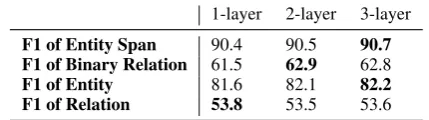
Table 2:Results on the ACE05 development set with respect to the number of GCN layers.
formances of entity and relation. Specifically, The “GCN (static)” has been slightly improved on re-lations. The “GCN (dynamic + soft)” achieves 0.7 percent improvement on relations and has the same entity performance. The “GCN (dynamic + hard)” improves the entity performance (0.4 percent) 6 and achieves large improvement (1.9 percent) in relation performance. It is competi-tive with state-of-the-art model (Sun et al.,2018). These observations show that the proposed joint model is effective for the joint type inference on entities and relations, and also show the rational-ity of the proposed dynamic graph, as expected.
3. The performances of the entity span and the binary relation are close to all proposed models. One possible reason is that there are more coarse-gained task. Effective features can be easily ex-tracted for all models. It is worth noting that the performance in binary relation is not very good. Our dynamic graph relies on binary relation de-tection task. How to improve the performance of binary relation is still a hard question. We leave it as future work.
Thirdly, we present the influences of the num-ber of GCN layers (Table2). We take the “GCN (dynamic + hard)” as a example. In general, the performances on four tasks are insensitive to the number of GCN layers7. In particular, the perfor-mances on entity span, entity and relation fluctu-ate at 1.0 points, and the binary relation fluctufluctu-ate at 1.4 points. Interestingly, we find the one layer GCN achieves best relation performance though the performances of other three tasks are not best. One possible reason is that the all models are closely related to each other. However, how they
6
In fact, the entity performance on the ACE05 test data is hard to improve from past works (Miwa and Bansal,2016;
Zhang et al.,2017;Sun et al.,2018). So it is a non-negligible improvement over existing state-of-the-art systems.
7
[image:6.595.72.297.64.170.2]Model Entity Relation Entity Span Binary Relation
P R F P R F P R F P R F
Sun (NN) (2018) 84.0 82.9 83.4 59.5 56.3 57.8 - - -
-NN 85.7 82.1 83.9 65.6 50.7 57.2 91.2 89.6 90.4 - -
-GCN (static) 85.0 82.6 83.8 66.6 51.3 57.8 90.8 90.2 90.5 - -
-GCN (dynamic + soft) 85.3 82.3 83.8 67.3 51.6 58.5 90.8 90.2 90.5 77.3 56.4 65.2
[image:7.595.83.515.64.145.2]GCN (dynamic + hard) 86.1 82.4 84.2 68.1 52.3 59.1 91.2 89.5 90.4 78.2 56.3 65.4
Table 3:Results on the ACE05 dataset in different settings.
1
(288) (163)2 (72)3 (33)4 (15)5 6) the number of relations for each sentence
50 55 60 65 70
F1 score
NN GCN(static) GCN(dynamic+soft) GCN(dynamic+hard)
Figure 5: F1 scores with respect to the number of re-lations for each sentence. The numbers in parentheses are counts of sentences in the ACE05 test set.
affect each other in this joint settings is still an open question.
Forthly, we examine the relation performance with respect to different the number of relations for each sentence (Figure5). In general, our GCN-based models almost outperform “NN” when the number of relations is larger than 2. It proves that the proposed GCN-based models are more suit-able for handle multiple relations in a sentence. We think our method will perform better on the complex multiple relations dataset which is very common in reality.
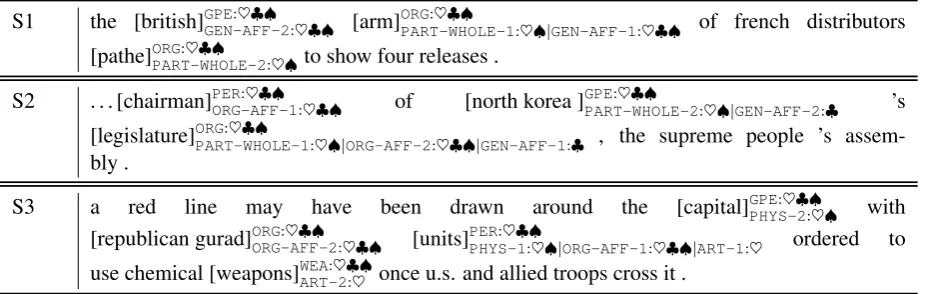
Finally, We compare the “NN” model with the “GCN” model on some concrete examples, as shown in Table 5. For S1, the “NN” wrongly identifies the relation GEN-AFF be-tween “[legislature]ORG” and “[north korea]GPE”
even though the relation ORG-AFF between “[legislature]ORG” and “[chairman]PER” is
de-tected. For S2, the “NN” does not detect PART-WHOLErelation while the “GCN” correctly find it. These two observations show that our “GCN” is good at dealing with the situation when the multiple relations share common entities, as expected. For S3, our “GCN” identifies a PHYS relation between “[units]PER” and “[captial]GPE”,
Model Relation
M&B (2016) 70.1 61.2 65.3
C&M (2018) 69.7 59.5 64.2
NN 68.5 62.8 65.5
GCN (static) 69.1 63.8 66.4
GCN (dynamic + soft) 68.7 63.4 65.9
[image:7.595.82.283.184.332.2]GCN (dynamic + hard) 68.7 65.4 67.0
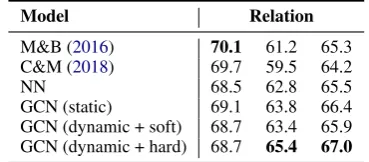
Table 4:Results on the ACE05 dataset with golden entity.
while the “NN” does not find this relation even the entities are correct. However, both models do not identify the relationARTbetween “[units]PER” and
“[weapons]WEA”. We think advanced improvement methods which use more powerful graph neural network might be helpful in this situation.
4.2 Golden Entity Results on ACE05
In order to compare with relation classification methods, we evaluate our models with golden enti-ties on ACE05 corpus in Table4. We use the same data split to compare with their model (Miwa and Bansal,2016;Christopoulou et al.,2018). We do not tune hyperparameters extensively. For exam-ple, we use the same setting in both end-to-end and golden entity rather than tune parameters on each of them. The baseline systems are (Miwa and Bansal,2016) and (Christopoulou et al.,2018).
In general, our “NN” is competitive, compar-ing to the dependency tree-based state-of-the-art model (Miwa and Bansal, 2016). It shows that our CNN-based neural networks are able to extract more powerful features to help relation extraction task. After adding GCN, our GCN-based models achieve the better performance. This indicates that the proposed models can achieve large improve-ment without any external syntactic tools8.
8For simplicity, we do not extract golden entity type
[image:7.595.323.508.186.267.2]S1 the [british]GPEGEN-AFF-2:♥♣♠ :♥♣♠ [arm]PART-WHOLE-1ORG:♥♣♠ :♥♠|GEN-AFF-1:♥♣♠ of french distributors
[pathe]ORGPART-WHOLE-2:♥♣♠ :♥♠to show four releases .
S2 . . . [chairman]PERORG-AFF-1:♥♣♠ :♥♣♠ of [north korea ]PART-WHOLE-2GPE:♥♣♠ :♥♠|GEN-AFF-2:♣ ’s
[legislature]ORGPART-WHOLE-1:♥♣♠ :♥♠|ORG-AFF-2:♥♣♠|GEN-AFF-1:♣ , the supreme people ’s assem-bly .
S3 a red line may have been drawn around the [capital]GPEPHYS-2:♥♣♠:♥♠ with [republican gurad]ORGORG-AFF-2:♥♣♠ :♥♣♠ [units]PHYS-1PER:♥♣♠:♥♠|ORG-AFF-1:♥♣♠|ART-1:♥ ordered to
use chemical [weapons]WEAART-2:♥♣♠:♥ once u.s. and allied troops cross it .
Table 5: Examples from the ACE05 dataset with label annotations from “NN” model and “GCN” model for comparison. The♥is the gold standard, and the♣,♠are the output of the “NN” ,“GCN” model respectively.
5 Related Work
There have been extensive studies for entity re-lation extraction task. Early work employs a pipeline of methods that extracts entities first, and then determines their relations (Zelenko et al., 2003; Miwa et al., 2009; Chan and Roth, 2011; Lin et al., 2016). As pipeline approaches suffer from error propagation, researchers have proposed methods for joint entity relation extraction.
Parameter sharing is a basic strategy for joint extraction. For example,Miwa and Bansal(2016) propose a neural method comprised of a sentence-level RNN for extracting entities, and a depen-dency tree-based RNN to predict relations. Their relation model takes hidden states of the entity model as features (i.e., the shared parameters). Similarly,Katiyar and Cardie(2017) use a simpli-fied relation model based on the entity RNN using the attention mechanism. These joint methods do joint learning through sharing parameters and they have no explicit interaction in type inference.
To further explore interactions between the en-tity decoder and the relation decoder, many of them focus on some joint decoding algorithms. ILP-based joint decoder (Yang and Cardie,2013), CRF-based joint decoder (Katiyar and Cardie, 2016), joint sequence labelling tag set (Zheng et al.,2017), beam search (Li and Ji,2014), global normalization (Zhang et al.,2017), and transition system (Wang et al.,2018) are investigated. Dif-ferent from models there, we propose a novel and concise joint model to handle joint type inference based on graph convolutional networks, which can capture information between multiple entity types and relation types explicitly9.
9In addition, transfer learning(Sun and Wu,2019),
multi-Recently, researches of graph neural networks (GNNs) have been receiving more and more at-tention because of the great expressive power of graphs (Cai et al., 2018; Battaglia et al., 2018; Zhou et al., 2018). Graph Convolutional Net-work (GCN) is one of the typical variants of GNN (Bruna et al., 2013;Defferrard et al.,2016;Kipf and Welling, 2017). It has been successfully ap-plied to many NLP tasks such as text classifi-cation (Yao et al., 2018), semantic role label-ing (Marcheggiani and Titov,2017), relation ex-traction (Zhang et al., 2018) machine translation (Bastings et al., 2017) and knowledge base com-pletion (Shang et al., 2018). We note that most previous applications of GCN focus on a single job, while the joint entity relation extraction con-sists of multiple sub-tasks. Investigating GCN in joint learning scenarios is the main topic of this work. A closely related work is (Christopoulou et al.,2018), which focuses on relation extraction with golden entities. Our work can be viewed as an end-to-end extension of their work.
6 Conclusion
We propose a novel and concise joint model based on GCN to perform joint type inference for entity relation extraction task. Compared with existing joint methods, it provides a new way to capture the interactions on multiple entity types and rela-tion types explicitly in a sentence. Experiments on ACE05 dataset show the effectiveness of the pro-posed method.
Acknowledgement
The authors wish to thank the reviewers for their helpful comments and suggestions. This research is (partially) supported by STCSM (18ZR1411500), NSFC(61673179) and the Foun-dation of State Key Laboratory of Cognitive Intel-ligence, iFLYTEK(COGOS-20190003). The cor-responding authors are Yuanbin Wu and Shiliang Sun.
References
Joost Bastings, Ivan Titov, Wilker Aziz, Diego Marcheggiani, and Khalil Simaan. 2017. Graph convolutional encoders for syntax-aware neural ma-chine translation. InProceedings of the 2017 Con-ference on Empirical Methods in Natural Language Processing, pages 1957–1967.
Peter W Battaglia, Jessica B Hamrick, Victor Bapst, Alvaro Sanchez-Gonzalez, Vinicius Zambaldi, Ma-teusz Malinowski, Andrea Tacchetti, David Raposo, Adam Santoro, Ryan Faulkner, et al. 2018. Rela-tional inductive biases, deep learning, and graph net-works. arXiv preprint arXiv:1806.01261.
Samy Bengio, Oriol Vinyals, Navdeep Jaitly, and Noam Shazeer. 2015. Scheduled sampling for se-quence prediction with recurrent neural networks. InAdvances in Neural Information Processing Sys-tems, pages 1171–1179.
Joan Bruna, Wojciech Zaremba, Arthur Szlam, and Yann LeCun. 2013. Spectral networks and lo-cally connected networks on graphs. arXiv preprint arXiv:1312.6203.
Hongyun Cai, Vincent W Zheng, and Kevin Chen-Chuan Chang. 2018. A comprehensive survey of graph embedding: Problems, techniques, and appli-cations. IEEE Transactions on Knowledge and Data Engineering, 30(9):1616–1637.
Yee Seng Chan and Dan Roth. 2011. Exploiting syntactico-semantic structures for relation extrac-tion. InProceedings of the 49th Annual Meeting of the Association for Computational Linguistics: Hu-man Language Technologies, pages 551–560, Port-land, Oregon, USA. Association for Computational Linguistics.
Fenia Christopoulou, Makoto Miwa, and Sophia Ana-niadou. 2018. A walk-based model on entity graphs for relation extraction. In Proceedings of the 56th Annual Meeting of the Association for Computa-tional Linguistics (Volume 2: Short Papers), pages 81–88. Association for Computational Linguistics.
Micha¨el Defferrard, Xavier Bresson, and Pierre Van-dergheynst. 2016. Convolutional neural networks on graphs with fast localized spectral filtering. In
Advances in neural information processing systems, pages 3844–3852.
Sepp Hochreiter and J¨urgen Schmidhuber. 1997. Long short-term memory. Neural Computation, 9(8):1735–1780.
Zhiheng Huang, Wei Xu, and Kai Yu. 2015. Bidi-rectional LSTM-CRF models for sequence tagging.
CoRR, abs/1508.01991.
Arzoo Katiyar and Claire Cardie. 2016. Investigating lstms for joint extraction of opinion entities and rela-tions. InProceedings of the 54th Annual Meeting of the Association for Computational Linguistics (Vol-ume 1: Long Papers), pages 919–929, Berlin, Ger-many. Association for Computational Linguistics.
Arzoo Katiyar and Claire Cardie. 2017. Going out on a limb: Joint extraction of entity mentions and relations without dependency trees. In Proceed-ings of the 55th Annual Meeting of the Association for Computational Linguistics (Volume 1: Long Pa-pers), pages 917–928, Vancouver, Canada. Associa-tion for ComputaAssocia-tional Linguistics.
Thomas N. Kipf and Max Welling. 2017. Semi-supervised classification with graph convolutional networks. InInternational Conference on Learning Representations (ICLR).
Qi Li and Heng Ji. 2014. Incremental joint extraction of entity mentions and relations. In Proc. of ACL, pages 402–412.
Yankai Lin, Shiqi Shen, Zhiyuan Liu, Huanbo Luan, and Maosong Sun. 2016. Neural relation extraction with selective attention over instances. In Proceed-ings of the 54th Annual Meeting of the Association for Computational Linguistics (Volume 1: Long Pa-pers), pages 2124–2133, Berlin, Germany. Associa-tion for ComputaAssocia-tional Linguistics.
Diego Marcheggiani and Ivan Titov. 2017. Encoding sentences with graph convolutional networks for se-mantic role labeling. In Proceedings of the 2017 Conference on Empirical Methods in Natural Lan-guage Processing, pages 1506–1515.
Makoto Miwa and Mohit Bansal. 2016.End-to-end re-lation extraction using lstms on sequences and tree structures. InProceedings of the 54th Annual Meet-ing of the Association for Computational LMeet-inguistics (Volume 1: Long Papers), pages 1105–1116, Berlin, Germany. Association for Computational Linguis-tics.
Jeffrey Pennington, Richard Socher, and Christopher Manning. 2014. Glove: Global vectors for word representation. In Proc. of EMNLP, pages 1532– 1543.
Victor Sanh, Thomas Wolf, and Sebastian Ruder. 2018. A hierarchical multi-task approach for learn-ing embeddlearn-ings from semantic tasks.arXiv preprint arXiv:1811.06031.
Chao Shang, Yun Tang, Jing Huang, Jinbo Bi, Xiaodong He, and Bowen Zhou. 2018. End-to-end structure-aware convolutional networks for knowledge base completion. arXiv preprint arXiv:1811.04441.
Changzhi Sun and Yuanbin Wu. 2019. Distantly super-vised entity relation extraction with adapted manual annotations. In Thirty-Third AAAI Conference on Artificial Intelligence.
Changzhi Sun, Yuanbin Wu, Man Lan, Shiliang Sun, Wenting Wang, Kuang-Chih Lee, and Kewen Wu. 2018. Extracting entities and relations with joint minimum risk training. InProceedings of the 2018 Conference on Empirical Methods in Natural Lan-guage Processing, pages 2256–2265. Association for Computational Linguistics.
Shaolei Wang, Yue Zhang, Wanxiang Che, and Ting Liu. 2018. Joint extraction of entities and relations based on a novel graph scheme. In IJCAI, pages 4461–4467.
Bishan Yang and Claire Cardie. 2013. Joint infer-ence for fine-grained opinion extraction. In Pro-ceedings of the 51st Annual Meeting of the Associa-tion for ComputaAssocia-tional Linguistics (Volume 1: Long Papers), volume 1, pages 1640–1649.
Liang Yao, Chengsheng Mao, and Yuan Luo. 2018. Graph convolutional networks for text classification.
arXiv preprint arXiv:1809.05679.
Matthew D Zeiler. 2012. Adadelta: an adaptive learn-ing rate method.arXiv preprint arXiv:1212.5701.
Dmitry Zelenko, Chinatsu Aone, and Anthony Richardella. 2003. Kernel methods for relation ex-traction. Journal of machine learning research, 3(Feb):1083–1106.
Meishan Zhang, Yue Zhang, and Guohong Fu. 2017.
End-to-end neural relation extraction with global op-timization. InProceedings of the 2017 Conference on Empirical Methods in Natural Language Pro-cessing, pages 1731–1741, Copenhagen, Denmark. Association for Computational Linguistics.
Yuhao Zhang, Peng Qi, and Christopher D Manning. 2018. Graph convolution over pruned dependency trees improves relation extraction. InProceedings of the 2018 Conference on Empirical Methods in Nat-ural Language Processing, pages 2205–2215.
Suncong Zheng, Feng Wang, Hongyun Bao, Yuexing Hao, Peng Zhou, and Bo Xu. 2017. Joint extraction of entities and relations based on a novel tagging scheme. In Proceedings of the 55th Annual Meet-ing of the Association for Computational LMeet-inguistics (Volume 1: Long Papers), pages 1227–1236, Van-couver, Canada. Association for Computational Lin-guistics.
Jie Zhou, Ganqu Cui, Zhengyan Zhang, Cheng Yang, Zhiyuan Liu, and Maosong Sun. 2018. Graph neu-ral networks: A review of methods and applications.