654
Know What You Don’t Know: Modeling a Pragmatic
Speaker that Refers to Objects of Unknown Categories
Sina Zarrieß
Faculty of Linguistics and Literary Studies Bielefeld University, Germany [email protected]
David Schlangen Linguistics Department University of Potsdam, Germany [email protected]
Abstract
Zero-shot learning in Language & Vision is the task of correctly labelling (ornaming) objects of novel categories. Another strand of work in L&V aims at pragmatically informative rather than “correct” object descriptions, e.g. in ref-erence games. We combine these lines of re-search and modelzero-shot reference games, where a speaker needs to successfully refer to a novel object in an image. Inspired by models of “rational speech acts”, we extend a neural generator to become a pragmatic speaker rea-soning about uncertain object categories. As a result of this reasoning, the generator pro-duces fewer nouns and names of distractor cat-egories as compared to a literal speaker. We show that this conversational strategy for deal-ing with novel objects often improves commu-nicative success, in terms of resolution accu-racy of an automatic listener.
1 Introduction
It is commonly agreed that even massive resources for language & vision (Deng et al., 2009; Chen et al.,2015;Krishna et al.,2017) will never fully cover the huge range of objects to be found “in the wild”. This motivates research in zero-shot learning (Lampert et al.,2009;Socher et al.,2013;
Hendricks et al., 2016), which aims at predicting correct labels or names for objects of novel cat-egories, typically via external lexical knowledge such as, e.g., word embeddings.
More generally, however, uncertain knowledge of the world that surrounds us, including novel ob-jects, is not only a machine learning challenge: it is simply a very common aspect of human com-munication, as speakers rarely have perfect rep-resentations of their environment. Precisely the richness of verbal interaction allows us to com-municate these uncertainties and to collaborate to-wards communicative success (Clark and Wilkes-Gibbs, 1986). Figure 1 illustrates this general
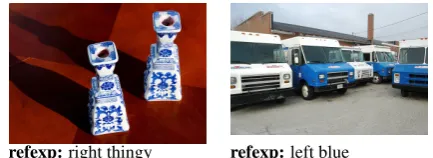
refexp:right thingy refexp:left blue
Figure 1: RefCOCO expressions referring to diffi-cult/unknown objects
point with two examples from the RefCOCO cor-pus (Yu et al.,2016), providing descriptions of vi-sual objects from an interactive reference game. Here, the use of the unspecific thingy and the omission of a noun inleft bluecan be seen as prag-matically plausible strategies that avoid confusing the listener with potentially inaccurate names for difficult-to-name objects. While there has been a lot of recent and traditional research on pragmat-ically informative object descriptions in reference games (Mao et al., 2016; Yu et al., 2017; Cohn-Gordon et al.,2018;Dale and Reiter,1995;Frank and Goodman,2012), conversational strategies for dealing with uncertainties like novel categories are largely understudied in computational pragmatics, though see, e.g., work byFang et al.(2014).
In this paper, we frame zero-shot learning as a challenge for pragmatic modeling and explore
[image:1.595.309.526.228.307.2]im-plement a Bayesian decoder reasoning about cat-egorical uncertainty and show that, solely as a re-sult of pragmatic decoding, our model produces fewer misleading object names when being uncer-tain about the category (just as the speakers did in Figure1). Furthermore, we show that this strategy often improves reference resolution accuracies of an automatic listener.
2 Background
We investigate referring expression generation (REG henceforth), where the goal is to compute an utteranceuthat identifies a target referentramong other referents R in a visual scene. Research on REG has a long tradition in natural language gen-eration (Krahmer and Van Deemter, 2012), and has recently been re-discovered in the area of Lan-guage & Vision (Mao et al.,2016;Yu et al.,2016;
Zarrieß and Schlangen,2018). These latter models for REG essentially implement variants of a stan-dard neural image captioning architecture (Vinyals et al.,2015), combining a CNN and an LSTM to generate an utterance directly from objects marked via bounding boxes in real-world images.
Our approach combines such a neural REG model with a reasoning component that is inspired by theory-driven Bayesian pragmatics and RSA (Frank and Goodman, 2012). We will briefly sketch this approach here. The starting point in RSA is a model of a “literal speaker”, S0(u|r),
which generates utterancesufor the targetr. The “pragmatic listener”L0 then assigns probabilities
to all referentsRbased on the modelS0:
L0(r|u)∝ P S0(u|r)∗P(r)
ri∈RS0(u|ri)∗P(ri)
(1)
In turn, the “pragmatic speaker” S1 reasons
about which utterance is more discriminative and will be resolved to the target by the pragmatic lis-tener:
S1(u|r)∝
L0(r|u)∗P(u) P
ui∈UL0(r|ui)∗P(ui)
(2)
(S0 and L0 are components of the recursive
rea-soning ofS1 and not in fact separate agents.)
There has been some previous work on leverag-ing RSA-like reasonleverag-ing for neural language gen-eration. For instance,Cohn-Gordon et al. (2018) implement the literal speaker as a neural caption-ing model trained on non-discriminative image de-scriptions. On top of this neural semantics, they
build a pragmatic speaker that produces more dis-criminative captions, applying equation2at each step of the inference process. They evaluate their model in a reference game where an automatic lis-tener (trained on a different portion of the image data) is used to test whether the generated caption singles out the target image among a range of dis-tractor images. A range of related articles have extended neural captioning models with decod-ing procedures geared towards vocabulary expan-sion (Anderson et al.,2017;Agrawal et al.,2018) or contextually discriminative scene descriptions (Andreas and Klein,2016;Vedantam et al.,2017). Previous work on REG commonly looks at vi-sual scenes with multiple referents of identical or similar categories. Here, speakers typically pro-duce expressions composed of a head noun, which names the category of the target, and a set of at-tributes, which distinguish the target from distrac-tor referents of the same category (Krahmer and Van Deemter,2012). Our work adds an additional dimension of uncertainty to this picture, namely a setting where the category of the target itself might not be known to the model and, hence, cannot be named with reasonable accuracy. In this set-ting, we expect that a literal speaker (e.g. a neural REG model trained for a restricted set object cate-gories) generates misleading references, e.g. con-taining incorrect head nouns, as it has no means of “knowing” which words risk being inaccurate for referring to novel objects. The following Section
3describes how we modify the RSA approach for reasoning in such a zero-shot reference game.
3 Model
Inspired by the approach in Section2, we model our pragmatic zero-shot speaker as a neural gener-ator (the literal speaker) that is decoded via a prag-matic listener. In contrast to the listener in Equa-tion (1), however, our listener possesses an addi-tional latent variableC, which reflects its beliefs about the target’s category. This hidden belief dis-tribution will, in turn, allow the pragmatic speaker to reason about how accurate the words produced by the literal speaker might be.
Our Bayesian listener will assign a probability
P(r|u) to a referent r conditioned on the utter-anceuby the (literal) speaker. To do that, it needs to calculateP(u|r), as in Equation1. While pre-vious work on RSA typically equatesP(u|r)with
prob-ability is calculated. Thus, we assume that our lis-tener has hidden beliefs about the category of the referent, that we can marginalize over as follows:
P(u|r) = X ci∈C
P(u, ci|r) = X ci∈C
P(u, ci, r) P(r)
= X
ci∈C
P(r)∗P(ci|r)∗P(u|ci, r) P(r)
∝ X
ci∈C
P(ci|r)∗P(u|ci)
(3)
As a simplification, we condition uonly onci,
instead of P(u|ci, r). This will allow us to
esti-mateP(u|ci)directly via maximum likelihood on the training data, i.e. in terms of word probabilities conditioned on categories (observed in training) . The pragmatic listener is defined as follows:
L0(r|u) = P(u|r)∗P(r) P(u)
∝ X
ci∈C
P(ci|r)∗P(u|ci)
(4)
For instance, let’s consider a game with 3 cat-egories and two words, the less specific leftwith
P(u|ci) = 12 for allci ∈ Cand the more specific
buswithP(u|c1) = 109, P(u|c2) = 101, P(u|c3) = 1
10. When the listener is uncertain and
pre-dicts P(ci|r) = 13 for all ci ∈ C, this yields
L0(r|left) = 0.5 andL0(r|bus) = 0.36,
mean-ing that the less specificleftwill be more likely re-solved to the targetr. Vice versa, when the listener is more certain, e.g. P(c1|r) = 109 , P(c2|r) =
1
10, P(c3|r) = 1
10, more specific words will be
pre-ferred:L0(r|bus) = 0.83andL0(r|left) = 0.55. The definition of the pragmatic speaker is straightforward:
S1(u|r) =S0(u|r)∗L0(r|u)α (5)
Intuitively, S1 guides its potentially
over-optimistic language model (S0) to be more
cau-tious in producing category-specific words, e.g. nouns. The idea is that the degree to which a word is category-specific and, hence, risky in a zero-shot reference game can be determined on descriptions for objects of known categories and is expressed inP(u|c). Forunknowncategories, the pragmatic speaker can deliberately avoid these
category-specific words and resort to describing other visual properties like colour or location.1
Similar to Cohn-Gordon et al. (2018), we use incremental, word-level inference to decode the pragmatic speaker model in a greedy fashion:
S1t(w|r, ut−1) =S0t(w|r, ut−1)∗L0(r|w)α+β
(6) At each time step, we generate the most likely word determined viaS0 andL0. The parameters α and β will determine the balance between the literal speaker and the listener. Whileαis simply a constant (set to 2, in our case),βis zero as long aswdoes not occur inut−1and increases when it
does occur in ut−1 (it is then set to 2). This
en-sures that there is a dynamic tradeoff between the speaker and the listener, i.e. for words that occur in previously generated utterance prefix, the lan-guage model probabilities (S0) will have
compar-itively more weight than for new words.
4 Exp. 1: Referring without naming?
Section3has introduced a model for referring ex-pression generation (REG) in a zero-shot refer-ence game. This model, and its pragmatic decod-ing component in particular, is designed to avoid words that are specific to categories when there is uncertainty about the category of a target object, in favour of words that are not specific to categories like, e.g., colour or location attributes. In the fol-lowing evaluation, we will test how this reasoning component actually affects the referring behavior of the pragmatic speaker as compared to the literal speaker, which we implement as neural supervised REG model along the lines of previous work (Mao et al.,2016;Yu et al.,2016). As object names typ-ically express category-specific information in re-ferring expressions, we focus the comparison on the nouns generated in the systems’ output.
4.1 Training
Data We conduct experiments on RefCOCO (Yu et al., 2016) referring expressions to ob-jects in MSCOCO (Lin et al., 2014) images. As is commonly done in zero-shot learning, we manually select a range of different categories as targets for our zero-shot game, cf. ( Hen-dricks et al., 2016). Out of the 90 categories
in MSCOCO, we select 6 medium-frequent cat-egories (cat,horse,cup,bottle,bus,train), that are similar to those in (Hendricks et al., 2016). For each category, we divide the training set of Ref-COCO into a new train-test split such that all im-ages with an instance of the target zero-shot cate-gory are moved to the test set.
Generation Model (S0) We implement a stan-dard CNN-LSTM model for REG, trained on pairs of image regions and referring expressions. The architecture follows the baseline version of (Yu et al.,2016). We crop images to the target region, and obtain the fc features from VGG (Simonyan and Zisserman,2014). We set the word embedding layer size to 512, and the hidden state to 1024. We optimized with ADAM, set the batch size to 32 and the learning rate to 0.0004. The number of training epochs is 5 (verified on the RefCOCO validation set).
Uncertainty Estimation Similar to previous work in zero-shot learning, we factor out the prob-lem of automatically determining the model’s cer-tainty with respect to an object’s category, cf. (Lampert et al., 2009; Socher et al., 2013): for computing L0(r|u), we set P(ci|r) to be a uni-form distribution over categories, meaning that the model is maximally uncertain about the referent’s category. We leave exploration of a more realistic uncertainty or novelty prediction to future work.
4.2 Evaluation
Measures We test to what extent our mod-els produces incorrect names for novel objects. First, for each zero-shot category, we define a set of distractor nouns (distr-noun), which cor-respond to the names of the remaining categories in MSCOCO. Any choice of noun from that set would be wrong, as the categories are pairwise dis-junct; the exploration of other nouns (e.g. thingy, animal) is left for future work. In Table 1, “% distr-noun” refers to how many expressions gener-ated for an instance of a zero-shot category con-tain such an incorrect distractor noun. Second, we count how many generated expressions do not contain any noun (no-noun) at all, according to the NLTK POS tagger.
Results Table1shows that the proportion of out-put expressions containing a distractor noun de-creasesmarkedly fromS0toS1, whereas the
pro-portion of expression without any nameincreases
Model % distr-noun % no-noun
cat S0 0.606 0.107
S1 0.484 0.193
horse S0 0.683 0.085 S1 0.572 0.30
cup S0 0.627 0.079
S1 0.332 0.172
bottle S0 0.398 0.275 S1 0.166 0.562
bus S0 0.743 0.066
S1 0.612 0.247
[image:4.595.329.500.61.230.2]train S0 0.759 0.166 S1 0.558 0.37
Table 1: Names and nouns contained in generation out-put for two speakers (S0, S1)
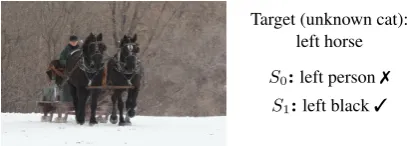
Target (unknown cat): left horse
[image:4.595.332.499.64.232.2]S0:left person7 S1:left black3
Figure 2: Qualitative Example
markedly from S0 to S1. First of all, this
sug-gests that our baseline model S0 does, in many
cases, not know what it does not know, i.e. it is not aware that it encounters a novel category and frequently generates names of known categories encountered during training. However, even in this simple model, we find a certain portion of output expressions that do not contain any name (e.g. 27% for bottle, but only 6% for bus). The results also confirm our hypothesis that the prag-matic speakerS1avoids to produce “risky” or
spe-cific words that are likely to be confused for un-certain or unknown categories. It is worth stress-ing here that this behaviour results entirely from the Bayesian reasoning thatS1 uses in decoding;
the model does not have explicit knowledge of lin-guistic categories like nouns, names or other taxo-nomic knowledge.
5 Exp. 2: Communicative success
[image:4.595.313.519.286.359.2]vocab-Zero-shot category Similar category
cat dog, cow
horse dog, cow
cup bowl, bottle, wine glass
bottle vase, wine glass
bus car, train, truck
[image:5.595.330.500.64.231.2]train car, bus, truck
Table 2: Target and distractor categories used for test-ing in Exp. 2
ulary (as shown above). We test this automati-cally using a model of a “competent” listener, that knows the respective object categories. This is supposed to approximate a conversation between a system and a human that has more elaborate knowledge of the world than the system.
The evaluation listener One pitfall of using a trained listener model (instead of a human) for task-oriented evaluation is that this model might simply make the same mistakes as the speaker model as it is trained on similar data. To avoid this circularity, Cohn-Gordon et al. (2018) train their listener on a different subset of the image data. Rather than training ondifferent data, we opt for training the listener onbetter data, as we want it to be as strict and human-like as possible. For in-stance, we do not want our listener model to re-solve an expression like the brown cat to a dog. We train Seval as a neural speaker on the entire
training set and giveLeval access to ground-truth object categories. The ground-truth categorycrof
a referent r is used to calculate P(nu|cr) where nuis the object name contained in the utteranceu.
P(nu|cr)is estimated on the entire training set.
Leval(r|u, cr) =Seval(u|r)∗P(nu|cr) (7)
P(nu|cr) will be close to zero if the utterance
contains a rare or wrong name for the categorycr, andLevalwill then assign a very low probability to
this referent. We apply this listener to all referents in the scene and take the argmax.
Test set The setTS-imagepairs each target with other (annotated!) objects in the same image, a typical set-up for reference resolution.As many images in RefCOCO only have distractors of the
same category as the target (which is not ideal for our purposes), we randomly sample an addi-tional test set calledTS-distractors, pairing
zero-Model TS-image TS-distractors
cat S0 0.516 0.343
S1 0.603 0.386
horse S0 0.644 0.096
S1 0.589 0.150
cup S0 0.721 0.483
S1 0.674 0.540
bottle S0 0.502 0.275
S1 0.517 0.306
bus S0 0.789 0.405
S1 0.759 0.361
train S0 0.658 0.202
S1 0.667 0.305
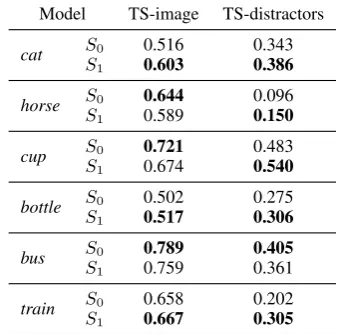
Table 3: Reference resolution accuracies obtained from listenerLevalon expressions byS0, S1
shot targets with 4 distractors of a similar cate-gory, which we defined manually, shown in Table
2. This is slightly artificial as objects are taken out of the coherent spatial context, but it helps us determining whether our model can successfully refer in a context with similar, but not identical, categories.
Results As shown in Table3, theS1 model
im-proves the resolution accuracy for all categories on TS-distractors, except forbus. On TS-image, res-olution accuracies are generally much higher and the comparison betweenS0andS1gives mixed
re-sults. We take this as positive evidence thatS1
im-proves communicative success in a relevant num-ber of cases, but it also indicates that combining this model with the more standard RSA approach could be promising. Figure2shows a qualitative example forS1 being more successful thanS0.
6 Conclusion
References
Harsh Agrawal, Karan Desai, Xinlei Chen, Rishabh Jain, Dhruv Batra, Devi Parikh, Stefan Lee, and Pe-ter Anderson. 2018. nocaps: novel object captioning at scale. arXiv preprint arXiv:1812.08658.
Peter Anderson, Basura Fernando, Mark Johnson, and Stephen Gould. 2017. Guided open vocabulary im-age captioning with constrained beam search. In Proceedings of the 2017 Conference on Empirical Methods in Natural Language Processing, pages 936–945, Copenhagen, Denmark. Association for Computational Linguistics.
Jacob Andreas and Dan Klein. 2016. Reasoning about pragmatics with neural listeners and speakers. In Proceedings of the 2016 Conference on Empirical Methods in Natural Language Processing, pages 1173–1182, Austin, Texas. Association for Compu-tational Linguistics.
Xinlei Chen, Hao Fang, Tsung-Yi Lin, Ramakr-ishna Vedantam, Saurabh Gupta, Piotr Doll´ar, and C Lawrence Zitnick. 2015. Microsoft coco captions: Data collection and evaluation server. arXiv preprint arXiv:1504.00325.
Herbert H. Clark and Deanna Wilkes-Gibbs. 1986. Re-ferring as a collaborative process. Cognition, 22:1– 39.
Reuben Cohn-Gordon, Noah Goodman, and Christo-pher Potts. 2018. Pragmatically informative image captioning with character-level inference. In Pro-ceedings of the 2018 Conference of the North Amer-ican Chapter of the Association for Computational Linguistics: Human Language Technologies, Vol-ume 2 (Short Papers), pages 439–443. Association for Computational Linguistics.
Robert Dale and Ehud Reiter. 1995. Computational interpretations of the gricean maxims in the gener-ation of referring expressions. Cognitive Science, 19(2):233–263.
J. Deng, W. Dong, R. Socher, L.-J. Li, K. Li, and L. Fei-Fei. 2009. ImageNet: A Large-Scale Hierarchical Image Database. InCVPR09.
Rui Fang, Malcolm Doering, and Joyce Y Chai. 2014. Collaborative models for referring expression gen-eration in situated dialogue. InTwenty-Eighth AAAI Conference on Artificial Intelligence.
Michael C Frank and Noah D Goodman. 2012. Pre-dicting pragmatic reasoning in language games. Sci-ence, 336(6084):998–998.
Lisa Anne Hendricks, Subhashini Venugopalan, Mar-cus Rohrbach, Raymond Mooney, Kate Saenko, and Trevor Darrell. 2016. Deep compositional cap-tioning: Describing novel object categories without paired training data. In Proceedings of the IEEE conference on computer vision and pattern recog-nition, pages 1–10.
Emiel Krahmer and Kees Van Deemter. 2012. Compu-tational generation of referring expressions: A sur-vey. Computational Linguistics, 38(1):173–218. Ranjay Krishna, Yuke Zhu, Oliver Groth, Justin
John-son, Kenji Hata, Joshua Kravitz, Stephanie Chen, Yannis Kalantidis, Li-Jia Li, David A. Shamma, Michael S. Bernstein, and Li Fei-Fei. 2017. Vi-sual genome: Connecting language and vision us-ing crowdsourced dense image annotations. Inter-national Journal of Computer Vision, 123(1):32–73.
Christoph H Lampert, Hannes Nickisch, and Stefan Harmeling. 2009. Learning to detect unseen object classes by between-class attribute transfer. InIEEE Computer Vision and Pattern Recognition, pages 951–958. IEEE.
Tsung-Yi Lin, Michael Maire, Serge Belongie, James Hays, Pietro Perona, Deva Ramanan, Piotr Doll´ar, and C.Lawrence Zitnick. 2014. Microsoft coco: Common objects in context. InComputer Vision – ECCV 2014, volume 8693, pages 740–755. Springer International Publishing.
Junhua Mao, Jonathan Huang, Alexander Toshev, Oana Camburu, Alan L. Yuille, and Kevin Murphy. 2016.
Generation and comprehension of unambiguous ob-ject descriptions. InCVPR 2016.
Karen Simonyan and Andrew Zisserman. 2014. Very deep convolutional networks for large-scale image recognition.arXiv preprint arXiv:1409.1556. Richard Socher, Milind Ganjoo, Christopher D
Man-ning, and Andrew Ng. 2013. Zero-shot learning through cross-modal transfer. In Advances in neu-ral information processing systems, pages 935–943.
Ramakrishna Vedantam, Samy Bengio, Kevin Murphy, Devi Parikh, and Gal Chechik. 2017. Context-aware captions from context-agnostic supervision. In Computer Vision and Pattern Recognition (CVPR), volume 3.
Oriol Vinyals, Alexander Toshev, Samy Bengio, and Dumitru Erhan. 2015. Show and tell: A neural im-age caption generator. InComputer Vision and Pat-tern Recognition.
Licheng Yu, Patrick Poirson, Shan Yang, Alexander C. Berg, and Tamara L. Berg. 2016. Modeling Context in Referring Expressions, pages 69–85. Springer In-ternational Publishing, Cham.
Licheng Yu, Hao Tan, Mohit Bansal, and Tamara L Berg. 2017. A joint speakerlistener-reinforcer model for referring expressions. InComputer Vision and Pattern Recognition (CVPR), volume 2.