1715
Joint Training of Candidate Extraction and Answer Selection
for Reading Comprehension
Zhen Wang Jiachen Liu Xinyan Xiao Yajuan Lyu Tian Wu Baidu Inc., Beijing, China
{wangzhen24, liujiachen, xiaoxinyan, lvyajuan, wutian}@baidu.com
Abstract
While sophisticated neural-based tech-niques have been developed in reading comprehension, most approaches model the answer in an independent manner, ig-noring its relations with other answer can-didates. This problem can be even worse in open-domain scenarios, where candi-dates from multiple passages should be combined to answer a single question. In this paper, we formulate reading com-prehension as an extract-then-select two-stage procedure. We first extract answer candidates from passages, then select the final answer by combining information from all the candidates. Furthermore, we regard candidate extraction as a latent vari-able and train the two-stage process jointly with reinforcement learning. As a result, our approach has improved the state-of-the-art performance significantly on two challenging open-domain reading compre-hension datasets. Further analysis demon-strates the effectiveness of our model com-ponents, especially the information fusion of all the candidates and the joint training of the extract-then-select procedure.
1 Introduction
Teaching machines to read and comprehend hu-man languages is a long-standing objective in nat-ural language processing. In order to evaluate this ability, reading comprehension (RC) is designed to answer questions through reading relevant pas-sages. In recent years, RC has attracted intense in-terest. Various advanced neural models have been proposed along with newly released datasets ( Her-mann et al., 2015; Rajpurkar et al., 2016; Dunn et al.,2017;Dhingra et al.,2017b;He et al.,2017).
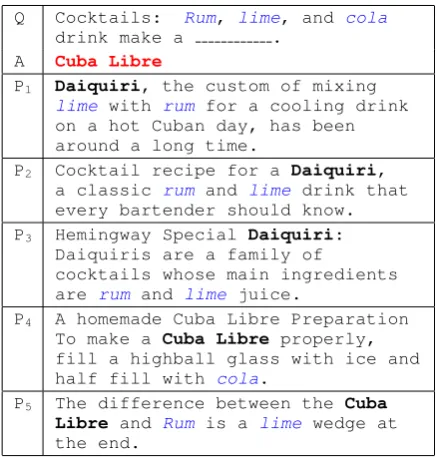
Q Cocktails: Rum, lime, and cola drink make a .
A Cuba Libre
P1 Daiquiri, the custom of mixing
lime with rum for a cooling drink on a hot Cuban day, has been around a long time.
P2 Cocktail recipe for a Daiquiri,
a classic rum and lime drink that every bartender should know. P3 Hemingway Special Daiquiri:
Daiquiris are a family of
cocktails whose main ingredients are rum and lime juice.
P4 A homemade Cuba Libre Preparation
To make a Cuba Libre properly, fill a highball glass with ice and half fill with cola.
[image:1.595.307.528.220.449.2]P5 The difference between the Cuba Libre and Rum is a lime wedge at the end.
Table 1: The answer candidates are in aboldfont. The key information is marked in italic, which should be combined from different text pieces to select the correct answer ”Cuba Libre”.
Most existing approaches mainly focus on mod-eling the interactions between questions and pas-sages (Dhingra et al., 2017a; Seo et al., 2017;
Wang et al.,2017), paying less attention to infor-mation concerning answer candidates. However, when human solve this problem, we often first read each piece of text, collect some answer candi-dates, then focus on these candidates and combine their information to select the final answer. This collect-then-select process can be more significant in open-domain scenarios, which require the com-bination of candidates from multiple passages to answer one single question. This phenomenon is illustrated by the example in Table1.
components: (1) an extraction model, which gen-erates answer candidates, (2) a selection model, which combines all these candidates and finds out the final answer. However, answer candidates to be focused on are often unobservable, as most RC datasets only provide golden answers. Therefore, we treat candidate extraction as a latent variable and train these two stages jointly with reinforce-ment learning (RL).
In conclusion, our work makes the following contributions:
1. We formulate open-domain reading compre-hension as a two-stage procedure, which first ex-tracts answer candidates and then selects the final answer. With joint training, we optimize these two correlated stages as a whole.
2. We propose a novel answer selection model, which combines the information from all the ex-tracted candidates using an attention-based corre-lation matrix. As shown in experiments, the infor-mation fusion is greatly helpful for answer selec-tion.
3. With the two-stage framework and the joint training strategy, our method significantly sur-passes the state-of-the-art performance on two challenging public RC datasets Quasar-T (Dhingra et al.,2017b) and SearchQA (Dunn et al.,2017).
2 Related Work
In recent years, reading comprehension has made remarkable progress in methodology and dataset construction. Most existing approaches mainly focus on modeling sophisticated interactions be-tween questions and passages, then use the pointer networks (Vinyals et al., 2015) to directly model the answers (Dhingra et al., 2017a; Wang and Jiang,2017;Seo et al.,2017;Wang et al.,2017). These methods prove to be effective in existing close-domain datasets (Hermann et al.,2015;Hill et al.,2015;Rajpurkar et al.,2016).
More recently, open-domain RC has attracted increasing attention (Nguyen et al., 2016; Dunn et al.,2017;Dhingra et al.,2017b;He et al.,2017) and raised new challenges for question answer-ing techniques. In these scenarios, a question is paired with multiple passages, which are often collected by exploiting unstructured documents or web data. Aforementioned approaches often rely on recurrent neural networks and sophisticated at-tentions, which are prohibitively time-consuming if passages are concatenated altogether.
There-fore, some work tried to alleviate this problem in a coarse-to-fine schema.Wang et al.(2018a) com-bined a ranker for selecting the relevant passage and a reader for producing the answer from it. However, this approach only depended on one pas-sage when producing the answer, hence put great demands on the precisions of both components. Worse still, this framework cannot handle the sit-uation where multiple passages are needed to an-swer correctly. In consideration of evidence aggre-gation,Wang et al.(2018b) proposed a re-ranking method to resolve the above issue. However, their re-ranking stage was totally isolated from the can-didate extraction procedure. Being different from the re-ranking perspective, we propose a novel se-lection model to combine the information from all the extracted candidates. Moreover, with rein-forcement learning, our candidate extraction and answer selection models can be learned in a joint manner. Trischler et al. (2016) also proposed a two-step extractor-reasoner model, which first ex-tractedKmost probable single-token answer can-didates and then compared the hypotheses with all the sentences in the passage. However, in their work, each candidate was considered isolat-edly, and their objective only took into account the ground truths compared with our RL treatment.
The training strategy employed in our paper is reinforcement learning, which is inspired by recent work exploiting it into question answer-ing problem. The above mentioned coarse-to-fine framework (Choi et al.,2017;Wang et al.,2018a) treated sentence selection as a latent variable and jointly trained the sentence selection module with the answer generation module via RL.Shen et al.
(2017) modeled the multi-hop reasoning proce-dure with a termination state to decide when it is adequate to produce an answer. RL is suitable to capture this stochastic behavior. Hu et al. (2018) merely modeled the extraction process, using F1 as rewards in addition to maximum likelihood es-timation. RL was utilized in their training process, as the F1 measure is not differentiable.
3 Two-stage RC Framework
Q P
P
P 1
2
N
. . .
C A
[image:3.595.81.273.66.167.2]Candidate Extraction Answer Selection
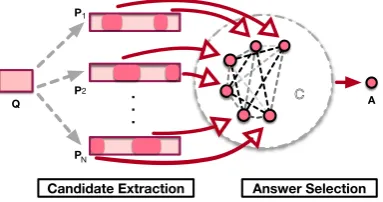
Figure 1: Two-stage RC Framework. The first part extracts candidates (denoted with circles) from all the passages. The second part establishes interac-tions among all these candidates to select the final answer. The different gray scales of dashed lines between candidates represent different intensities of interactions.
some passages in P. Our main framework
con-sists of two parts, which are: (1) extracting answer candidatesC = {C1, C2, ..., CM}from passages
Pand (2) selecting the final answerAfrom
candi-datesC. This process is illustrated in Figure1. We
design different models for each part and optimize them as a whole with joint reinforcement learning.
3.1 Candidate Extraction
We build candidate set C by independently
ex-tracting K candidates from each passage Pi ac-cording to the following distribution:
p(C|Q,P) =
N
Y
i
p({Cij}Kj=1|Q, Pi)
C=
N
[
i=1
{Cij}Kj=1
(1)
where Cij denotes the jth candidate extracted from theith passage. Kis set as a constant num-ber in our formulation. TakingK as 2 for an ex-ample, we denote each probability shown on the right side of Equation 1 through sampling without replacement:
p({Ci1, Ci2}) =p(Ci1)p(Ci2)/(1−p(Ci1))
+p(Ci1)p(Ci2)/(1−p(Ci2))
(2) where we neglectQ, Pi to abbreviate the condi-tional distributions in Equation 1.
Consequently, the basic block of our candidate extraction stage turns out to be the distribution of each candidate P(Cij|Q, Pi). In the rest of this subsection, we will elaborate on the model
archi-Attention
Start End
Question & Passage Representation Question & Passage
Interaction Candidate Scoring
Question Passage
1
xP x2 xlPP
P 1
xQ xl QQ
HQ HP H~P GP
bP eP
…
…
…
… …
[image:3.595.313.513.67.205.2]Q P
Figure 2: Candidate Extraction Model Architec-ture.
tecture concerning candidate extraction, which is displayed in Figure2.
Question & Passage Representation Firstly, we embed the questionQ={xkQ}lQ
k=1and its rele-vant passageP ={xtP}lP
t=1∈Pwith word vectors to form Q ∈ Rdw×lQ and P ∈
Rdw×lP
respec-tively, wheredwis the dimension of word embed-dings,lQandlP are the length ofQandP.
We then feedQandPto a bidirectional LSTM to form their contextual representations HQ ∈
Rdh×lQandHP ∈Rdh×lP:
HQ= BiLSTM(Q)
HP = BiLSTM(P)
(3)
Question & Passage Interaction Modeling the interactions between questions and passages is a critical step in reading comprehension. Here, we adopt the attention mechanism similar to (Lee et al., 2016) to generate question-dependent pas-sage representationHeP. AssumeHQ={hkQ}
lQ
k=1,
HP ={htP} lP
t=1, we have:
αtk=
ehkQ·h t P
PlQ
k=1e
hk Q·htP
1≤k≤lQ,1≤t≤lP
e htP =
lQ X
k=1
αtkhkQ 1≤t≤lP
e HP ={eh
t P}ltP=1
(4) After concatenating two kinds of passage rep-resentationsHP andHeP, we use another
bidirec-tional LSTM to get the final representation of ev-ery position in passagePasGP ∈Rdg×lP:
Candidate Scoring Then we use two linear transformationswb ∈ R1×dg andwe ∈ R1×dg to
calculate the begin and the end scores for each po-sition:
{btP}lQ
t=1 =bP =wbGP
{etP}lQ
t=1=eP =weGP
(6)
At last, we model the probability of every sub-span in passageP as a candidateC ={xtP}Ce
t=Cb
according to its begin and end position:
p(C|Q, P) = exp(b
Cb
P +e Ce
P )
PlP
k=1
PlP
t=kexp(bkP +etP) (7)
In this definition, the probabilities of all the valid answer candidates are already normalized.
3.2 Answer Selection
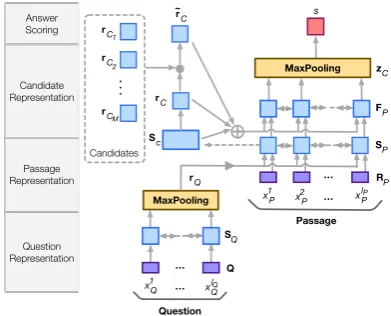
As the second part of our framework, the answer selection model finds out the most probable an-swer by calculatingp(C|Q,P,C)for each
candi-dateC ∈ C. The model architecture is illustrated in Figure3.
Notably, selection model receives candidate set
C as additional information. This more focused
information allows the model to combine evi-dences from all the candidates, which would be useful for selecting the best answer.
For ease of understanding, we briefly describe the selection stage as follows. After being ex-tracted from a single passage, a candidate borrows information from other candidates across different passages. With this global information, the pas-sage is reread to confirm the correctness of the candidate further. The following are details about the selection model.
Question Representation Questions are funda-mental for finding out the correct answer. As did for the extraction model, we embed the question
Qwith word vectors to formQ∈ Rdw×lQ. Then
we use a bidirectional LSTM to establish its con-textual representation:
Sq= BiLSTM(Q) (8)
A max-pooling operation across all the positions is followed to get the condensed vector represen-tation:
rq = MaxPooling(Sq) (9)
Question Representation
Passage Representation
Candidate Representation
Answer Scoring
Question
Passage
1
xP x2 xlPP
P
1
xQ xlQQ
SQ
SP
… …
…
… MaxPooling
rQ
. . .
MaxPooling
Sc
rC
FP rC
~
rC
rC
rC
1
2
M
zC
s
Candidates
Q
[image:4.595.312.508.65.223.2]RP
Figure 3: Answer Selection Model Architecture.
Passage Representation Assume the candidate
C is extracted from the passage P ∈ P. To be
informed ofC, we first build the representation of
P. For every word in P, three kinds of features are utilized:
• Word embedding: each word expresses its basic feature with the word vector.
• Common word: the feature has value 1 when the word occurs in the question, otherwise 0.
• Question independent representation: the condensed representationrq.
With these features, information not only inQbut also inP is considered. By concatenating them, we getrtP corresponding to every positiontin pas-sage P. Then with another bidirectional LSTM, we fuse these features to form the contextual rep-resentation ofPasSP ∈Rds×lP:
RP ={rtP} lP
t=1
SP = BiLSTM(RP)
(10)
Candidate Representation Candidates provide more focused information for answer selection. Therefore, for each candidate, we first build its in-dependent representation according to its position in the passage, then construct candidates fused representation through combination of other cor-related candidates.
Given the candidateC ={xtP}Ce
t=Cbin the
pas-sage P, we extract its corresponding span from
SP = {stP} lP
t=1 to form SC = {stP} Ce
t=Cb as its
and end positions:
rC = tanh(WbsCPb+Wes Ce
P ) (11)
whereWb ∈Rdc×ds,We ∈Rdc×ds.
To model the interactions among all the answer candidates, we calculate the correlations of the candidateC, which is assumed to be indexed by
j in C, with others {Cm}Mm=1,m6=j via attention mechanism:
Vjm=wvtanh(WcrC+WorCm) (12)
where Wc ∈ Rdc×dc, Wo ∈ Rdc×dc and wv ∈
R1×dcare linear transformations to capture the
in-tensity of each interaction.
In this way, we form acorrelation matrixV ∈
RM×M, where M is the total number of
candi-dates. With the correlation matrix, for the can-didate C, we normalize its interactions via a
sof tmaxoperation, which emphasizes the influ-ence of stronger interactions:
αm =
eVjm PM
m=1,m6=jeVjm
(13)
To take into account different influences of all the other candidates, it is sensible to generate a candidates fused representation according to the above normalized interactions:
e rC =
M
X
m=1,m6=j
αmrCm (14)
In this formulation, all the other candidates con-tribute their influences to the fused representation by their interactions withC, thus information from different passages is gathered altogether. In our experiments, this kind of information fusion is the key point for performance improvements.
Passage Advanced Representation As more focused information of the candidate C is avail-able, we are provided with a better way to confirm its correctness by rereading its corresponding pas-sageP. Specifically, we equip each positiontin
P with following advanced features:
• Passage contextual representation: the for-mer passage representationstP.
• Candidate-dependent passage representation: replace HQ with SC and HP with SP in Equation 4 to model the interactions between candidates and passages to formes
t P.
• Candidate related distance feature: the rela-tive distance to the candidateCcan be a ref-erence of the importance of each position.
• Candidate independent representation: use
rC to consider the concerned candidateC.
• Candidates fused representation: useerC to
consider all the other candidates interacting with the concerned candidateC.
With these features, we capture the information from the question, the passages and all the candi-dates. By concatenating them, we getutP in every position in the passageP. Combining these fea-tures with a bidirectional LSTM, we get:
UP ={utP} lP
t=1
FP = BiLSTM(UP)
(15)
Answer Scoring At last, the max pooling of each dimension ofFP is performed, resulting in a condensed vector representation, which contains all the concerned information in a candidate:
zC = MaxPooling(FP) (16)
The final score of this candidate as the answer is calculated via a linear transformation, which is then normalized across all the candidates:
s=wzzC
p(C|Q,P,C) = e
s
PM
k=1esk
(17)
3.3 Joint Training with RL
In our formulation, the answer candidate set in-fluences the result of answer selection to a large extent. However, with only golden answers pro-vided in the training data, it is not apparent which candidates should be considered further.
we define the reward of a candidate to reflect its accordance with the golden answer:
r(C, A) =
2 ifC==A f1(C, A) else ifC∩A6=∅
−1 else
(18) wheref1(., .) ∈ [0,1]is the function to measure word-level F1 score between two sequences. In-corporating this reward can alleviate the overstrict requirements set by traditional maximum likeli-hood estimation as well as keep consistent with our evaluation methods in experiments.
The learning objective becomes to maximize the expected reward modeled by our framework, whereθstands for all the parameters involved:
L(θ) =−EC∼P(C|Q,P)[EC∼P(C|Q,P,C)r(C, A)]
=−EC∼P(C|Q,P)[
X
C
P(C|Q,P,C)r(C, A)]
(19) Following REINFORCE algorithm, we approx-imate the gradient of the above objective with a sampled candidate set,C∼P(C|Q,P), resulting
in the following form:
∇L(θ)≈ −X
C
∇P(C|Q,P,C)r(C, A)
−∇logP(C|Q,P)[
X
C
P(C|Q,P,C)r(C, A)]
(20)
4 Experiments
4.1 Datasets
We evaluate our models on two publicly available open-domain RC datasets, which are commonly adopted in related work.
Quasar-T (Dhingra et al., 2017b) consists of 43,000 open-domain trivia questions and corresponding answers obtained from various internet sources. Each question is paired with 100 sentence-level passages retrieved from ClueWeb09 (Callan et al.,2009) based on Lucene.
SearchQA(Dunn et al.,2017) starts from exist-ing question-answer pairs, which are crawled from J!Archive, and is augmented with text snippets re-trieved by Google, resulting in more than 140,000 question-answer pairs with each pair having 49.6 snippets on average.
The detailed statistics of these two datasets is shown in Table2.
#q(train) #q(dev) #q(test) #p
Quasar-T 28,496 3,000 3,000 100
[image:6.595.315.519.62.101.2]SearchQA 99,811 13,893 27,247 50
Table 2: The statistics of our experimental datasets. #q represents the number of questions for each split of the datasets. #p is the number of passages for each question.
4.2 Model Settings
We initialize word embeddings with the 300-dimensional Glove vectors1. All the bidirectional LSTMs hold 1 layer and 100 hidden units. All the linear transformations take the size of 100 as output dimension. The common word feature and the candidate related distance feature are embed-ded with vectors of dimension 4 and 50 respec-tively. By default, we set K as 2 in Equation 1, which means each passage generates two candi-dates based on the extraction model.
For ease of training, we first initialize our mod-els by maximum likelihood estimation and fine-tune them with RL. The similar training strategy is commonly employed when RL process is involved (Ranzato et al., 2015; Li et al., 2016a;Hu et al.,
2018). To pre-train the extraction model, we only use passages containing ground truths as training data. The log likelihood of Equation 7 is taken as the training objective for each question and pas-sage pair. After pre-training the extraction model, we use it to generate two top-scoring candidates from each passage, forming the training data to pre-train our selection model, and maximize the log likelihood of the Equation 17 as our second objective. In pre-training, we use the batch size of 30 for the extraction model, 20 for the selection model and RMSProp (Tieleman and Hinton,2012) with an initial learning rate of 2e-3. In fine-tuning with RL, we use the batch size of 5 and RMSProp with an initial learning rate of 1e-4. Also, we use a dropout rate of 0.1 in each training procedure.
4.3 Experimental Results
In addition to results of previous work, we add two baselines to demonstrate the effectiveness of our framework. The first baseline only applies the extraction model to score the answers, which is aimed at explaining the importance of the se-lection model. The second one only uses the pre-trained extraction model and selection model
Quasar-T SearchQA
EM F1 EM F1
GA (Dhingra et al.,2017a) 26.4 26.4 -
-BIDAF (Seo et al.,2017) 25.9 28.5 28.6 34.6
AQA (Buck et al.,2018) - - 38.7 45.6
R3
(Wang et al.,2018a) 35.3 41.7 49.0 55.3
Re-Ranker (Wang et al.,2018b)
Strength-Based Re-Ranker (Probability) 36.1 42.4 50.4 56.5
Strength-Based Re-Ranker (Counting) 37.1 46.7 54.2 61.6
Coverage-Based Re-Raner 40.6 49.1 53.6 60.6
Full Re-Ranker 42.3 49.6 57.0 63.2
Our Methods
Extraction Model 35.4 41.6 44.7 51.2
Extraction + Selection (Isolated Training) 41.6 49.5 49.7 56.6
[image:7.595.162.437.61.245.2]Extraction + Selection (Joint Training) 45.9 53.9 58.3 64.2
Table 3: Experimental results on the test set of Quasar-T and SearchQA. Full re-ranker is the ensemble of three different re-rankers in (Wang et al.,2018b).
to illustrate the benefits from our joint training schema.
The often used evaluation metrics for extractive RC are exact match (EM) and F1 (Rajpurkar et al.,
2016). The experimental results on Quasar-T and SearchQA are shown in Table3.
As seen from the results on Quasar-T, our quite simple extraction model alone almost reaches the state-of-the-art result compared with other meth-ods without re-rankers. The combination of the extraction and selection models exceeds our ex-traction baseline by a great margin, and also sults in performance surpassing the best single re-ranker in (Wang et al.,2018b). This result illus-trates the necessity of introducing the selection model, which incorporates information from all the candidates. In the end, by joint training with RL, our method produces better performance even compared with the ensemble of three different re-rankers.
On SearchQA, we find that our extraction model alone performs not that well compared with the state-of-the-art model without re-rankers. How-ever, the improvement brought by our selection model isolatedly or jointly trained still demon-strates the importance of our two-stage frame-work. Not surprisingly, comparing the results, our isolated training strategy still lags behind the sin-gle re-ranker proposed in (Wang et al., 2018b), partly because of the deficiency with our extrac-tion model. However, uniting our extracextrac-tion and selection models with RL makes up the dispar-ity, and the performance surpasses the ensemble of three different re-rankers, let alone the result of
Quasar-T EM F1
Extraction + Selection (Joint Training) 45.9 53.9
-question representation 42.5 50.5
-question and passage common words 41.0 48.7
-candidate independent representation 44.5 53.3
-candidate related distance feature 44.7 53.0
-candidate dependent passage representation 44.4 52.3
-candidates fused representation 39.2 45.8
Table 4: Ablation results concerning the selec-tion model on the test set of Quasar-T. Obviously, candidates fused representation is the most evident feature when modeling the answer selection pro-cedure.
any single re-ranker.
4.4 Further Analysis
Effect of Features in Selection Model As the incorporation of the selection model improves the overall performance significantly, we conduct ab-lation analysis on the Quasar-T to prove the effec-tiveness of its major components. As shown in Ta-ble4, all these components modeling the selection procedure play important roles in our final archi-tecture.
Specifically, introducing the independent repre-sentation of the question and its common words with the passage seems an efficient way to sider the information of questions, which is con-sistent with previous work (Li et al.,2016b;Chen et al.,2017).
[image:7.595.308.537.304.405.2]Q Cocktails : Rum , lime , and cola drink make a .
A Cuba Libre
P1 In Nicaragua , when it is mixed using Flor de Ca a -LRB- the national brand of rum -RRB- and cola , it is called aNica Libre. P2 The drink ...DaiquiriThe custom of mixing lime with rum for a
cooling drink on a hot Cuban day has been around a long time . P3 If you only learn to make two cocktails , theManhattanshould
be one of them .
P4 DaiquiriCocktail recipe for a Daiquiri , a classic rum and lime drink that every bartender should know .
P5 Hemingway SpecialDaiquiri: Daiquiris are a family of cocktails whose main ingredients are rum and lime juice .
P6 In the Netherlands the drink is commonly calledBaco, from the two ingredients of Bacardi rum and cola .
P7 A homemade Cuba Libre Preparation To make aCuba Libre prop-erly , fill a highball glass with ice and half fill with cola . P8 BacardiCocktail Cocktail recipe for a Bacardi Cocktail , a
clas-sic cocktail of Bacardi rum , lemon or lime juice and grenadine Roy Rogers -LRB- non-alcoholic -RRB- Cocktail recipe for a Roy Rogers ,
P9 MargaritaCocktail recipe for a Margarita , a popular refreshing tequila and lime drink for summer .
[image:8.595.309.532.63.247.2]P10 The difference between theCuba Libreand Rum is a lime wedge at the end .
Table 5: An example from Quasar-T to illustrate the necessity of fused information. Candidates ex-tracted from passages are in a boldfont. To cor-rectly answer the question, information inP7 and
P10should be combined.
contributes to the final result more or less. These features include candidate-dependent passage rep-resentation, candidate independent representation and candidate related distance feature.
Most importantly, the candidates fused repre-sentation, which combines the information from all the candidates, demonstrates its indispensable role in candidate modeling, with a performance drop of nearly 8% when discarded. This phe-nomenon also verifies the necessity of our extract-then-select procedure, showing the importance of combining information scattered in different text pieces when picking out the final answer.
Example for Candidates Fused Representation
We conduct a case study to demonstrate the im-portance of candidates fused information further. In Table5, each candidate only partly matches the description of the question in its independent con-text. To correctly answer the question, informa-tion inP7andP10should be combined. In exper-iments, our selection model provides the correct answer, while the wrong candidate ”Daiquiri”, a different kind of cocktail, is selected if candidates fused representation is discarded. The attention map established when modeling the fusion of can-didates (corresponding to Equation 13) in this ex-ample is illustrated in Figure 4, in which we can see the interactions among all the candidates from
Nica Libre Daiquiri Manhattan Daiquiri Daiquiri
Baco
Cuba Libre Bacardi Margarita Cuba Libre Nica Libre
Daiquiri Manhattan Daiquiri Daiquiri Baco Cuba Libre Bacardi Margarita Cuba Libre
[image:8.595.72.290.64.277.2]0.0 0.2 0.4 0.6 0.8 1.0
Figure 4: The attention map generated when mod-eling candidates fused representations for the ex-ample in Table5.
Quasar-T EM F1
K=1 43.9 52.4
K=2 45.9 53.9
K=3 45.8 53.9
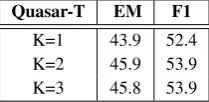
Table 6: Different number of extracted candidates results in different final performance on the test set of Quasar-T.
different passages. In this figure, it is obvious that the interaction of ”Cuba Libre” in P7 andP10 is the key point to answer the question correctly.
Effect of Candidate Number The candidate ex-traction stage takes an important role to decide what information should be focused on further. Therefore, we also test the influence of different
Kwhen extracting candidates from each passage. The results are shown in Table6. TakingK = 1
degrades the performance, which conforms to the expectation, as the correct candidates become less in this stricter situation. However, takingK = 3
can not improve the performance further. Al-though a larger K means a higher possibility to include good answers, it raises more challenges for the selection model to pick out the correct one from candidates with more varieties.
5 Conclusion
[image:8.595.364.469.317.368.2]all the candidates. Furthermore, we treat can-didate extraction as a latent variable and jointly train these two stages with RL. Experiments on public open-domain RC datasets Quasar-T and SearchQA show the necessity of introducing the selection model and the effectiveness of fusing candidates information when modeling. More-over, our joint training strategy leads to significant improvements in performance.
Acknowledgments
This work is supported by the National Basic Research Program of China (973 program, No. 2014CB340505). We thank Ying Chen and anony-mous reviewers for valuable feedback.
References
Christian Buck, Jannis Bulian, Massimiliano Cia-ramita, Andrea Gesmundo, Neil Houlsby, Wojciech Gajewski, and Wei Wang. 2018. Ask the right ques-tions: Active question reformulation with reinforce-ment learning. InICLR.
Jamie Callan, Mark Hoy, Changkuk Yoo, and Le Zhao. 2009. Clueweb09 data set.
Danqi Chen, Adam Fisch, Jason Weston, and Antoine Bordes. 2017. Reading wikipedia to answer open-domain questions. InProceedings of the 55th An-nual Meeting of the Association for Computational Linguistics. Association for Computational Linguis-tics, Vancouver, Canada, pages 1870–1879.
Eunsol Choi, Daniel Hewlett, Jakob Uszkoreit, Illia Polosukhin, Alexandre Lacoste, and Jonathan Be-rant. 2017. Coarse-to-fine question answering for long documents. InProceedings of the 55th Annual Meeting of the Association for Computational Lin-guistics. Association for Computational Linguistics, Vancouver, Canada, pages 209–220.
Bhuwan Dhingra, Hanxiao Liu, Zhilin Yang, William Cohen, and Ruslan Salakhutdinov. 2017a. Gated-attention readers for text comprehension. In Pro-ceedings of the 55th Annual Meeting of the Asso-ciation for Computational Linguistics. Association for Computational Linguistics, Vancouver, Canada, pages 1832–1846.
Bhuwan Dhingra, Kathryn Mazaitis, and William W Cohen. 2017b. Quasar: Datasets for question an-swering by search and reading. arXiv preprint arXiv:1707.03904.
Matthew Dunn, Levent Sagun, Mike Higgins, Ugur Guney, Volkan Cirik, and Kyunghyun Cho. 2017. Searchqa: A new q&a dataset augmented with context from a search engine. arXiv preprint arXiv:1704.05179.
Wei He, Kai Liu, Yajuan Lyu, Shiqi Zhao, Xinyan Xiao, Yuan Liu, Yizhong Wang, Hua Wu, Qiaoqiao She, Xuan Liu, Tian Wu, and Haifeng Wang. 2017. Dureader: a chinese machine reading comprehen-sion dataset from real-world applications. arXiv preprint arXiv:1711.05073.
Karl Moritz Hermann, Tomas Kocisky, Edward Grefenstette, Lasse Espeholt, Will Kay, Mustafa Su-leyman, and Phil Blunsom. 2015. Teaching ma-chines to read and comprehend. In Advances in Neural Information Processing Systems 28: Annual Conference on Neural Information Processing Sys-tems 2015, December 7-12, 2015, Montreal, Que-bec, Canada. pages 1693–1701.
Felix Hill, Antoine Bordes, Sumit Chopra, and Jason Weston. 2015. The goldilocks principle: Reading children’s books with explicit memory representa-tions.arXiv preprint arXiv:1511.02301.
Minghao Hu, Yuxing Peng, and Xipeng Qiu. 2018. Re-inforced mnemonic reader for machine comprehen-sion. InIJCAI.
Kenton Lee, Shimi Salant, Tom Kwiatkowski, Ankur Parikh, Dipanjan Das, and Jonathan Berant. 2016. Learning recurrent span representations for ex-tractive question answering. arXiv preprint arXiv:1611.01436.
Jiwei Li, Will Monroe, Alan Ritter, Dan Jurafsky, Michel Galley, and Jianfeng Gao. 2016a. Deep re-inforcement learning for dialogue generation. In
Proceedings of the 2016 Conference on Empirical Methods in Natural Language Processing. Associ-ation for ComputAssoci-ational Linguistics, Austin, Texas, pages 1192–1202.
Peng Li, Wei Li, Zhengyan He, Xuguang Wang, Ying Cao, Jie Zhou, and Wei Xu. 2016b. Dataset and neural recurrent sequence labeling model for open-domain factoid question answering. arXiv preprint arXiv:1607.06275.
Tri Nguyen, Mir Rosenberg, Xia Song, Jianfeng Gao, Saurabh Tiwary, Rangan Majumder, and Li Deng. 2016. MS MARCO: A human generated machine reading comprehension dataset. In Proceedings of the Workshop on Cognitive Computation: Inte-grating neural and symbolic approaches 2016 co-located with the 30th Annual Conference on Neural Information Processing Systems (NIPS 2016).
Pranav Rajpurkar, Jian Zhang, Konstantin Lopyrev, and Percy Liang. 2016. Squad: 100,000+ questions for machine comprehension of text. InProceedings of the 2016 Conference on Empirical Methods in Natu-ral Language Processing. Association for Computa-tional Linguistics, Austin, Texas, pages 2383–2392.
Minjoon Seo, Aniruddha Kembhavi, Ali Farhadi, and Hannaneh Hajishirzi. 2017. Bidirectional attention flow for machine comprehension. InICLR.
Yelong Shen, Po-Sen Huang, Jianfeng Gao, and Weizhu Chen. 2017. Reasonet: Learning to stop reading in machine comprehension. InProceedings of the 23rd ACM SIGKDD International Conference on Knowledge Discovery and Data Mining. ACM, pages 1047–1055.
Tijmen Tieleman and Geoffrey Hinton. 2012. Lecture 6.5-rmsprop: Divide the gradient by a running av-erage of its recent magnitude. COURSERA: Neural networks for machine learning4(2):26–31.
Adam Trischler, Zheng Ye, Xingdi Yuan, Philip Bach-man, Alessandro Sordoni, and Kaheer Suleman. 2016. Natural language comprehension with the epireader. In Proceedings of the 2016 Conference on Empirical Methods in Natural Language Pro-cessing. Association for Computational Linguistics, Austin, Texas, pages 128–137.
Oriol Vinyals, Meire Fortunato, and Navdeep Jaitly. 2015. Pointer networks. In Advances in Neural Information Processing Systems 28: Annual Con-ference on Neural Information Processing Systems 2015, December 7-12, 2015, Montreal, Quebec, Canada. pages 2692–2700.
Shuohang Wang and Jing Jiang. 2017. Machine com-prehension using match-lstm and answer pointer. In
ICLR.
Shuohang Wang, Mo Yu, Xiaoxiao Guo, Zhiguo Wang, Tim Klinger, Wei Zhang, Shiyu Chang, Gerald Tesauro, Bowen Zhou, and Jing Jiang. 2018a. R3: Reinforced reader-ranker for open-domain question answering. InAAAI.
Shuohang Wang, Mo Yu, Jing Jiang, Wei Zhang, Xiaoxiao Guo, Shiyu Chang, Zhiguo Wang, Tim Klinger, Gerald Tesauro, and Murray Campbell. 2018b. Evidence aggregation for answer re-ranking in open-domain question answering. InICLR.