1118
Multi-Turn Response Selection for Chatbots with Deep Attention
Matching Network
Xiangyang Zhou∗, Lu Li∗, Daxiang Dong, Yi Liu, Ying Chen, Wayne Xin Zhao†, Dianhai Yu and Hua Wu
Baidu Inc., Beijing, China
nzhouxiangyang, lilu12, dongdaxiang, liuyi05,
chenying04, v zhaoxin, yudianhai, wu hua
o
@baidu.com
Abstract
Human generates responses relying on se-mantic and functional dependencies, in-cluding coreference relation, among dia-logue elements and their context. In this paper, we investigate matching a response with its multi-turn context using depen-dency information based entirely on atten-tion. Our solution is inspired by the re-cently proposed Transformer in machine translation (Vaswani et al., 2017) and we extend the attention mechanism in two ways. First, we construct representations of text segments at different granularities solely with stacked self-attention. Second, we try to extract the truly matched seg-ment pairs with attention across the con-text and response. We jointly introduce those two kinds of attention in one uni-form neural network. Experiments on two large-scale multi-turn response selection tasks show that our proposed model sig-nificantly outperforms the state-of-the-art models.
1 Introduction
Building a chatbot that can naturally and con-sistently converse with human-beings on open-domain topics draws increasing research interests in past years. One important task in chatbots is response selection, which aims to select the best-matched response from a set of candidates given the context of a conversation. Besides playing a
critical role in retrieval-based chatbots (Ji et al.,
2014), response selection models have been used
in automatic evaluation of dialogue generation
∗
Equally contributed.
†
Work done as a visiting scholar at Baidu. Wayne Xin Zhao is an associate professor of Renmin University of China and can be reached at [email protected].
(Lowe et al.,2017) and the discriminator ofGAN -based (Generative Adversarial Networks) neural
dialogue generation (Li et al.,2017).
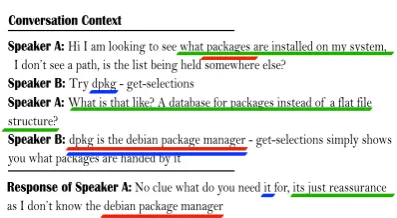
Conversation Context
Speaker A: Hi I am looking to see what packages are installed on my system, I don’t see a path, is the list being held somewhere else?
Speaker B: Try dpkg - get-selections
Speaker A: What is that like? A database for packages instead of a flat file structure?
Speaker B: dpkg is the debian package manager - get-selections simply shows you what packages are handed by it
[image:1.595.317.516.253.362.2]Response of Speaker A: No clue what do you need it for, its just reassurance as I don’t know the debian package manager
Figure 1: Example of human conversation on Ubuntu
sys-tem troubleshooting. Speaker A is seeking for a solution of package management in his/her system and speaker B recom-mend using, the debian package manager, dpkg. But speaker A does not know dpkg, and asks a backchannel-question
(Stolcke et al.,2000), i.e., “no clue what do you need it for?”,
aiming to double-check if dpkg could solve his/her problem. Text segments with underlines in the same color across con-text and response can be seen as matched pairs.
Early studies on response selection only use the last utterance in context for matching a reply,
which is referred to assingle-turn response
selec-tion(Wang et al.,2013). Recent works show that the consideration of a multi-turn context can
fa-cilitate selecting the next utterance (Zhou et al.,
2016; Wu et al., 2017). The reason why richer contextual information works is that human gen-erated responses are heavily dependent on the pre-vious dialogue segments at different granularities (words, phrases, sentences, etc), both semanti-cally and functionally, over multiple turns rather
than one turn (Lee et al., 2006;Traum and
Hee-man, 1996). Figure 1 illustrates semantic
pack-age manpack-ager”. (2) latent dependencies upon which segments are semantically/functionally related to each other. Such as the word “it” in the response, which refers to “dpkg” in the context, as well as the phrase “its just reassurance” in the response, which latently points to “what packages are in-stalled on my system”, the question that speaker A wants to double-check.
Previous studies show that capturing those matched segment pairs at different granularities across context and response is the key to
multi-turn response selection (Wu et al., 2017).
How-ever, existing models only consider the textual relevance, which suffers from matching response that latently depends on previous turns. More-over, Recurrent Neural Networks (RNN) are con-veniently used for encoding texts, which is too costly to use for capturing multi-grained
seman-tic representations (Lowe et al.,2015;Zhou et al.,
2016; Wu et al., 2017). As an alternative, we propose to match a response with multi-turn con-text using dependency information based entirely on attention mechanism. Our solution is inspired by the recently proposed Transformer in machine
translation (Vaswani et al.,2017), which addresses
the issue of sequence-to-sequence generation only using attention, and we extend the key attention mechanism of Transformer in two ways:
self-attention By making a sentence attend to
it-self, we can capture its intra word-level de-pendencies. Phrases, such as “debian pack-age manpack-ager”, can be modeled with word-level self-attention over word-embeddings, and sentence-level representations can be constructed in a similar way with phrase-level self-attention. By hierarchically stack-ing self-attention from word embeddstack-ings, we can gradually construct semantic representa-tions at different granularities.
cross-attention By making context and response
attend to each other, we can generally capture dependencies between those latently matched segment pairs, which is able to provide com-plementary information to textual relevance for matching response with multi-turn con-text.
We jointly introduce self-attention and cross-attention in one uniform neural matching network, namely the Deep Attention Matching Network
(DAM), for multi-turn response selection. In prac-tice, DAM takes each single word of an utter-ance in context or response as the centric-meaning of an abstractive semantic segment, and hierar-chically enriches its representation with stacked self-attention, gradually producing more and more sophisticated segment representations surround-ing the centric-word. Each utterance in context and response are matched based on segment pairs at different granularities, considering both textual
relevance and dependency information. In this
way, DAM generally captures matching informa-tion between the context and the response from word-level to sentence-level, important matching features are then distilled with convolution & max-pooling operations, and finally fused into one sin-gle matching score via a sinsin-gle-layer perceptron.
We test DAM on two large-scale public multi-turn response selection datasets, the Ubuntu Cor-pus v1 and Douban Conversation CorCor-pus. Exper-imental results show that our model significantly outperforms the state-of-the-art models, and the
improvement to the best baseline model onR10@1
is over 4%. What is more, DAM is expected
to be convenient to deploy in practice because most attention computation can be fully
paral-lelized (Vaswani et al.,2017). Our contributions
are two-folds: (1) we propose a new matching model for multi-turn response selection with self-attention and cross-self-attention. (2) empirical results show that our proposed model significantly out-performs the state-of-the-art baselines on public datasets, demonstrating the effectiveness of self-attention and cross-self-attention.
2 Related Work
2.1 Conversational System
To build an automatic conversational agent is a long cherished goal in Artificial Intelligence (AI) (Turing,1950). Previous researches include task-oriented dialogue system, which focuses on
com-pleting tasks in vertical domain, and chatbots,
which aims to consistently and naturally converse with human-beings on open-domain topics. Most modern chatbots are data-driven, either in a
fash-ion of informatfash-ion-retrieval (Ji et al.,2014;Banchs
and Li, 2012; Nio et al., 2014; Ameixa et al.,
2014) or sequence-generation (Ritter et al.,2011).
Input Representation Matching Aggregation Word
Embedding Representation Module
!
Word-word Matching with Cross-Attention
"#
"$ "%
Matching Score
g(c,r)
3D Matching Image Q
Ui
R Multi-grained Representations
[image:3.595.102.496.67.295.2]Mui,rself Muicross,r
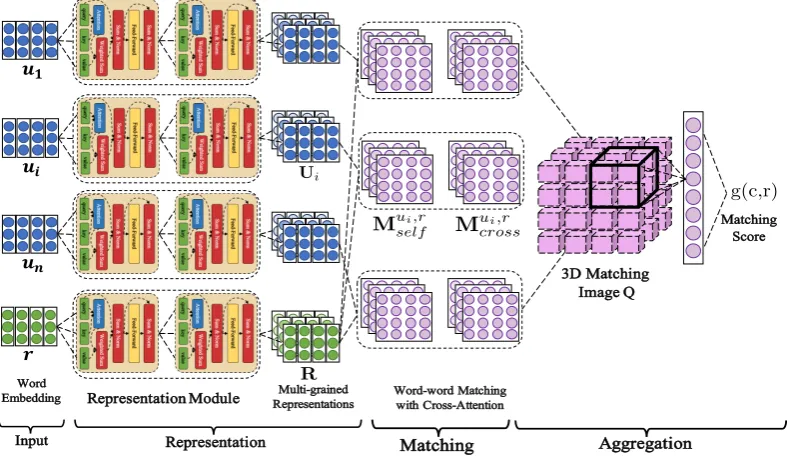
Figure 2: Overview of Deep Attention Matching Network.
candidate that best matches the current context. The generation-based models, on the other hand, learn patterns of responding from dialogues and can directly generalize new responses.
2.2 Response Selection
Researches on response selection can be generally
categorized intosingle-turnandmulti-turn. Most
early studies are single-turn that only consider the
last utterance for matching response (Wang et al.,
2013, 2015). Recent works extend it to
multi-turn conversation scenario, Lowe et al.,(2015) and
Zhou et al.,(2016) use RNN to read context and
response, use the last hidden states to represent context and response as two semantic vectors, and measure their relevance. Instead of only
consider-ing the last states of RNN, Wu et al.,(2017) take
hidden state at each time step as a text segment representation, and measure the distance between context and response via segment-segment match-ing matrixes. Nevertheless, matchmatch-ing with depen-dency information is generally ignored in previous works.
2.3 Attention
Attention has been proven to be very effective in
Natural Language Processing (NLP) (Bahdanau
et al.,2015;Yin et al.,2016;Lin et al.,2017) and
other research areas (Xu et al., 2015). Recently,
Vaswani et al.,(2017) propose a novel
sequence-to-sequence generation network, the Transformer,
which is entirely based on attention. Not only Transformer can achieve better translation results than convenient RNN-based models, but also it is very fast in training/predicting as the computation of attention can be fully parallelized. Previous works on attention mechanism show the superior ability of attention to capture semantic dependen-cies, which inspires us to improve multi-turn re-sponse selection with attention mechanism.
3 Deep Attention Matching Network
3.1 Problem Formalization
Given a dialogue data set D = {(c, r, y)Z}NZ=1,
wherec = {u0, ..., un−1} represents a
conversa-tion context with{ui}ni=0−1 as utterances andr as
a response candidate. y ∈ {0,1} is a binary
la-bel, indicating whetherr is a proper response for
c. Our goal is to learn a matching model g(c, r)
withD, which can measure the relevance between
any contextcand candidate responser.
3.2 Model Overview
Figure 2 gives an overview of DAM, which
generally follows the
representation-matching-aggregation framework to match response with
multi-turn context. For each utterance ui =
[wui,k]
nui−1
k=0 in a context and its response
candi-date r = [wr,t]tn=0r−1, where nui andnr stand for the numbers of words, DAM first looks up a shared
word embedding table and representsui andr as
[e0u
i,0, ..., e 0
ui,nui−1] and R
0 = [e0
r,0, ..., e0r,nr−1]
respectively, wheree∈Rddenotes ad-dimension
word embedding.
A representation module then starts to construct semantic representations at different granularities
for ui and r. Practically, L identical layers of
self-attention are hierarchically stacked, each lth
self-attention layer takes the output of thel−1th
layer as its input, and composites the input se-mantic vectors into more sophisticated represen-tations based on self-attention. In this way,
multi-grained representations ofui andr are gradually
constructed, denoted as [Uli]L
l=0 and [Rl]Ll=0
re-spectively.
Given [U0i, ...,ULi ] and [R0, ...,RL], utterance
ui and response r are then matched with each
other in a manner of segment-segment
similar-ity matrix. Practically, for each granularsimilar-ity l ∈
[0...L], two kinds of matching matrixes are
con-structed, i.e., the self-attention-match Mui,r,l
self and
cross-attention-matchMui,r,l
cross, measuring the rele-vance between utterance and response with textual information and dependency information respec-tively.
Those matching scores are finally merged into
a 3D matching imageQ1. Each dimension of Q
represents each utterance in context, each word
in utterance and each word in response respec-tively. Important matching information between segment pairs across multi-turn context and can-didate response is then extracted via convolution with max-pooling operations, and further fused into one matching score via a single-layer percep-tron, representing the matching degree between the response candidate and the whole context.
Specifically, we use a shared component, the Attentive Module, to implement both self-attention in representation and cross-self-attention in matching. We will discuss in detail the implemen-tation of Attentive Module and how we used it to implement both self-attention and cross-attention in following sections.
3.3 Attentive Module
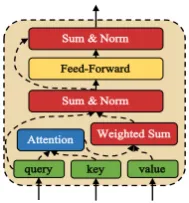
Figure 3 shows the structure of Attentive
Mod-ule, which is similar to that used in Transformer (Vaswani et al., 2017). Attentive Module has three input sentences: the query sentence, the key
sentence and the value sentence, namely Q =
[ei]in=0Q−1,K = [ei]in=0K−1,V = [ei]ni=0V−1
respec-1We refer to it asQbecause it is like a cube.
query
Attention Weighted Sum
key value
Sum & Norm
Feed-Forward
[image:4.595.367.462.61.163.2]Sum & Norm
Figure 3: Attentive Module.
tively, wherenQ, nK andnV denote the number
of words in each sentence andei stands for ad
-dimension embedding,nKis equal tonV. The
At-tentive Module first takes each word in the query sentence to attend to words in the key sentence
via Scaled Dot-Product Attention (Vaswani et al.,
2017), then applies those attention results upon the
value sentence, which is defined as:
Att(Q,K) =
sof tmax(Q[i]· K
T
√
d )
nQ−1
i=0 (1)
Vatt=Att(Q,K)· V ∈RnQ×d (2)
whereQ[i]is theithembedding in the query
sen-tence Q. Each row of Vatt, denoted as Vatt[i],
stores the fused semantic information of words in the value sentence that possibly have
dependen-cies to theith word in query sentence. For eachi,
Vatt[i]andQ[i]are then added up together,
com-positing them into a new representation that con-tains their joint meanings. A layer normalization
operation (Ba et al.,2016) is then applied, which
prevents vanishing or exploding of gradients. A
feed-forward network FFN with RELU (LeCun
et al., 2015) activation is then applied upon the normalization result, in order to further process the fused embeddings, defined as:
FFN(x) =max(0, xW1+b1)W2+b2 (3)
where,xis a 2D-tensor in the same shape of query
sentenceQandW1, b1, W2, b2 are learnt
parame-ters. This kind of activation is empirically useful in other works, and we also adapt it in our model.
The resultFFN(x)is a 2D-tensor that has the same
shape asx,FFN(x)is then residually added (He
et al.,2016) tox, and the fusion result is then nor-malized as the final outputs. We refer to the whole Attentive Module as:
As described, Attentive Module can capture de-pendencies across query sentence and key sen-tence, and further use the dependency information to composite elements in the query sentence and the value sentence into compositional representa-tions. We exploit this property of the Attentive Module to construct multi-grained semantic rep-resentations as well as match with dependency in-formation.
3.4 Representation
Given U0i orR0, the word-level embedding
rep-resentations for utteranceui or responser, DAM
takesU0i roR0 as inputs and hierarchically stacks
the Attentive Module to construct multi-grained
representations of ui and r, which is formulated
as:
Uli+1 =AttentiveModule(Uli,Uli,Uli) (5)
Rl+1=AttentiveModule(Rl,Rl,Rl) (6)
wherelranges from 0 toL−1, denoting the
dif-ferent levels of granularity. By this means, words in each utterance or response repeatedly function together to composite more and more holistic resentations, we refer to those multi-grained rep-resentations as[U0i, ...,ULi]and[R0, ...,RL] here-after.
3.5 Utterance-Response Matching
Given[Uli]L
l=0 and[Rl]Ll=0, two kinds of
segment-segment matching matrixes are constructed at each
level of granularityl, i.e., the self-attention-match
Mui,r,l
self and cross-attention-matchM
ui,r,l
cross. M ui,r,l
self is defined as:
Mui,r,l
self ={U l i[k]
T
·Rl[t]}nui×nr (7)
in which, each element in the matrix is the dot-product of Uli[k]and Rl[t], the kth embedding in
Uliand thetthembedding inRl, reflecting the
tex-tual relevance between thekth segment in u
i and
tth segment in r at thelth granularity. The
cross-attention-match matrix is based on cross-attention, which is defined as:
e
Uli=AttentiveModule(Uil,Rl,Rl) (8)
e
Rl=AttentiveModule(Rl,Uli,Uli) (9)
Mui,r,l
cross ={Ue
l i[k]
T
·Re
l
[t]}nui×nr (10)
where we use Attentive Module to make Uli and
Rl crossly attend to each other, constructing two
new representations for both of them, written as
e
UliandRe
l
respectively. BothUe
l i andRe
l
implicitly capture semantic structures that cross the utterance and response. In this way, those inter-dependent segment pairs are close to each other in represen-tations, and dot-products between those latently inter-dependent pairs could get increased, provid-ing dependency-aware matchprovid-ing information.
3.6 Aggregation
DAM finally aggregates all the segmental match-ing degrees across each utterance and response
into a 3D matching imageQ, which is defined as:
Q={Qi,k,t}n×nui×nr (11)
where each pixelQi,k,tis formulated as:
Qi,k,t =
[Mui,r,l
self [k, t]] L
l=0⊕[Mucrossi,r,l[k, t]]Ll=0
(12)
⊕is concatenation operation, and each pixel has
2(L+ 1) channels, storing the matching degrees
between one certain segment pair at different
lev-els of granularity. DAM then leverages
two-layered 3D convolution with max-pooling opera-tions to distill important matching features from the whole image. The operation of 3D convo-lution with max-pooling is the extension of typi-cal 2D convolution, whose filters and strides are
3D cubes2. We finally compute matching score
g(c, r) based on the extracted matching features
fmatch(c, r) via a single-layer perceptron, which is formulated as:
g(c, r) =σ(W3fmatch(c, r) +b3) (13)
whereW3 andb3 are learnt parameters, and σ is
sigmoid function that gives the probability ifris a
proper candidate toc. The loss function of DAM
is the negative log likelihood, defined as:
p(y|c, r) =g(c, r)y+ (1−g(c, r))(1−y) (14)
L(·) =− X
(c,r,y)∈D
log(p(y|c, r)) (15)
4 Experiment
Ubuntu Corpus Douban Conversation Corpus
R2@1 R10@1 R10@2 R10@5 MAP MRR P@1 R10@1 R10@2 R10@5
DualEncoderlstm 0.901 0.638 0.784 0.949 0.485 0.527 0.320 0.187 0.343 0.720
DualEncoderbilstm 0.895 0.630 0.780 0.944 0.479 0.514 0.313 0.184 0.330 0.716
MV-LSTM 0.906 0.653 0.804 0.946 0.498 0.538 0.348 0.202 0.351 0.710 Match-LSTM 0.904 0.653 0.799 0.944 0.500 0.537 0.345 0.202 0.348 0.720 Multiview 0.908 0.662 0.801 0.951 0.505 0.543 0.342 0.202 0.350 0.729 DL2R 0.899 0.626 0.783 0.944 0.488 0.527 0.330 0.193 0.342 0.705 SMNdynamic 0.926 0.726 0.847 0.961 0.529 0.569 0.397 0.233 0.396 0.724
DAM 0.938 0.767 0.874 0.969 0.550 0.601 0.427 0.254 0.410 0.757
DAMf irst 0.927 0.736 0.854 0.962 0.528 0.579 0.400 0.229 0.396 0.741
DAMlast 0.932 0.752 0.861 0.965 0.539 0.583 0.408 0.242 0.407 0.748
DAMself 0.931 0.741 0.859 0.964 0.527 0.574 0.382 0.221 0.403 0.750
[image:6.595.75.523.61.205.2]DAMcross 0.932 0.749 0.863 0.966 0.535 0.585 0.400 0.234 0.411 0.733
Table 1: Experimental results of DAM and other comparison approaches on Ubuntu Corpus V1 and Douban Conversation Corpus.
4.1 Dataset
We test DAM on two public multi-turn response
selection datasets, the Ubuntu Corpus V1 (Lowe
et al.,2015) and the Douban Conversation Corpus (Wu et al.,2017). The former one contains multi-turn dialogues about Ubuntu system troubleshoot-ing in English and the later one is crawled from a Chinese social networking on open-domain topics. The Ubuntu training set contains 0.5 million multi-turn contexts, and each context has one positive re-sponse that generated by human and one negative response which is randomly sampled. Both vali-dation and testing sets of Ubuntu Corpus have 50k contexts, where each context is provided with one positive response and nine negative replies. The Douban corpus is constructed in a similar way to the Ubuntu Corpus, except that its validation set contains 50k instances with 1:1 positive-negative ratios and the testing set of Douban corpus is con-sisted of 10k instances, where each context has 10 candidate responses, collected via a tiny
inverted-index system (Lucene3), and labels are manually
annotated.
4.2 Evaluation Metric
We use the same evaluation metrics as in
pre-vious works (Wu et al., 2017). Each
compari-son model is asked to select k best-matched
re-sponse from navailable candidates for the given
conversation context c, and we calculate the
re-call of the true positive replies among the k
se-lected ones as the main evaluation metric, denoted
as Rn@k =
Pk i=1yi Pn
i=1yi, where yi is the binary
la-bel for each candidate. In addition to Rn@k,
we use MAP (Mean Average Precision) (
Baeza-3https://lucenent.apache.org/
Yates et al.,1999), MRR (Mean Reciprocal Rank) (Voorhees et al.,1999), and Precision-at-oneP@1
especially for Douban corpus, following the
set-ting of previous works (Wu et al.,2017).
4.3 Comparison Methods
RNN-based models : Previous best performing
models are based on RNNs, we choose representative models as baselines,
includ-ing SMNdynamic(Wu et al., 2017),
Multi-view(Zhou et al., 2016), DualEncoderlstm
and DualEncoderbilstm (Lowe et al., 2015),
DL2R (Yan et al., 2016), Match-LSTM
(Wang and Jiang, 2017) and MV-LSTM (Pang et al., 2016), where SMNdynamic achieves the best scores against all the other published works, and we take it as our state-of-the-art baseline.
Ablation : To verify the effects of multi-grained
representation, we setup two comparison
models, i.e., DAMf irst and DAMlast, which
dispense with the multi-grained representa-tions in DAM, and use representation
re-sults from the 0th layer and Lth layer of
self-attention instead. Moreover, we setup
DAMself and DAMcross, which only use
self-attention-match or cross-attention-match respectively, in order to examine the ef-fectiveness of both self-attention-match and cross-attention-match.
4.4 Model Training
We copy the reported evaluation results of all base-lines for comparison. DAM is implemented in
tensorflow4, and the used vocabularies, word
em-4https://www.tensorflow.org. Our code and data will be
bedding sizes for Ubuntu corpus and Douban
cor-pus are all set as same as the SMN (Wu et al.,
2017). We consider at most 9 turns and 50 words
for each utterance (response) in our experiments, word embeddings are pre-trained using training
sets via word2vec (Mikolov et al., 2013),
simi-lar to previous works. We use zero-pad to
han-dle the variable-sized input and parameters inFFN
are set to 200, same as word-embedding size. We test stacking 1-7 self-attention layers, and reported our results with 5 stacks of self-attention because
it gains the best scores on validation set. The
1st convolution layer has 32 [3,3,3] filters with
[1,1,1] stride, and its max-pooling size is [3,3,3]
with [3,3,3] stride. The2ndconvolution layer has
16 [3,3,3] filters with [1,1,1] stride, and its max-pooling size is also [3,3,3] with [3,3,3] stride. We tune DAM and the other ablation models with
adam optimizer (Le et al.,2011) to minimize loss
function defined in Eq15. Learning rate is
initial-ized as 1e-3 and gradually decreased during train-ing, and the batch-size is 256. We use validation sets to select the best models and report their per-formances on test sets.
4.5 Experiment Result
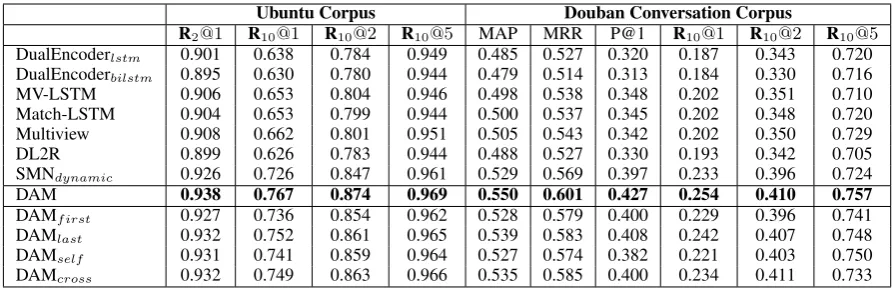
Table 1 shows the evaluation results of DAM as
well as all comparison models. As demonstrated, DAM significantly outperforms other competitors on both Ubuntu Corpus and Douban
Conversa-tion Corpus, including SMNdynamic, which is the
state-of-the-art baseline, demonstrating the supe-rior power of attention mechanism in matching re-sponse with multi-turn context. Besides, both the
performances of DAMf irstand DAMselfdecrease
a lot compared with DAM, which shows the effec-tiveness of self-attention and cross-attention. Both
DAMf irst and DAMlast underperform DAM,
which demonstrates the benefits of using
multi-grained representations. Also the absence of
self-attention-match brings down the precision, as
shown in DAMcross, exhibiting the necessity of
jointly considering textual relevance and depen-dency information in response selection.
One notable point is that, while DAMf irst is
able to achieve close performance to SMNdynamic,
it is about 2.3 times faster than SMNdynamicin our
implementation as it is very simple in
computa-tion. We believe that DAMf irst is more suitable
to the scenario that has limitations in computation time or memories but requires high precise, such
as industry application or working as an compo-nent in other neural networks like GANs.
5 Analysis
We use the Ubuntu Corpus for analyzing how self-attention and cross-self-attention work in DAM from both quantity analysis as well as visualization.
5.1 Quantity Analysis
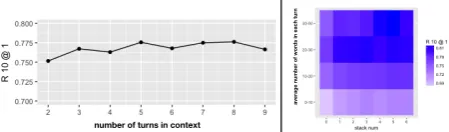
We first study how DAM performs in different ut-terance number of context. The left part in
Fig-ure 4 shows the changes of R10@1 on Ubuntu
Corpus across contexts with different number of utterance. As demonstrated, while being good at matching response with long context that has more than 4 utterances, DAM can still stably deal with short context that only has 2 turns.
average number of wor
ds in each tur
n
[image:7.595.309.534.336.402.2]number of turns in context
Figure 4: DAM’s performance on Ubuntu Corpus across
different contexts. The left part shows the performance in different utterance number of context. The right part shows performance in different average utterance text length of con-text as well as self-attention stack depth.
Moreover, the right part of Figure 4 gives the
no clue what do you need it for. its just reassurance as i dont know the debain package manager
hi i am lookingto see whatpackagesareinstalled
on my systemi.1 dont see
.1a pathis the listbeing held
some
where
else
turn 0
response
self−attention−match in stack 0
no clue what do you need it for. its just reassurance as i dont know the debain package manager
hi i am lookingto see whatpackagesareinstalled
on my systemi.1 dont see
.1a pathis the listbeing held
some
where
else
turn 0
response
self−attention−match in stack 2
no clue what do you need it for. its just reassurance as i dont know the debain package manager
hi i am lookingto see whatpackagesareinstalled
on my systemi.1 dont see
.1a pathis the listbeing held
some
where
else
turn 0
response
self−attention−match in stack 4
no clue what do you need it for. its just reassurance as i dont know the debain package manager
hi i am lookingto see whatpackagesareinstalled
on my systemi.1 dont see
.1a pathis the listbeing held
some
where
else
turn 0
response
cross−attention−match in stack 4
no clue what do you need it for its just reassurance as i dont know the debain package manager
no clue what do you need it for. its just
reassur
ance
as i dont kno
w
the
debain package manager
response
response
self−attention of response in stack 3
hii am lookingto see what packagesare installedon my systemi.1 dont see.1a pathis the list beingheld somewhereelse
hi i am lookingto see whatpackagesareinstalled
on my systemi.1 dont see
.1
apathis the list being held some where else . turn 0 tur n 0
self−attention of turn 0 in stack 3
no clue what do you need it for its just reassurance as i dont know the debain package manager
hi i am lookingto see whatpackagesareinstalled
on my systemi.1 dont see
.1
apathis the list being held some where else . turn 0 response
attention of response over turn 0 in stack 4
hii am lookingto see what packagesare installedon my systemi.1 dont see.1a pathis thelist beingheld somewhereelse
no clue what do you need it for. its just
reassur
ance
as i dont kno
w
the
debain package manager
response
tur
n 0
attention of turn 0 over response in stack 4
self-attention cross-attention no clue what do you need it for. its just reassurance as i dont know the debain package manager
hi i am
lookingto see whatpackagesareinstalledon mysystemdont apathis the listbeing held
some
where
else
turn 0
response
prior−match in stack 0
no clue what do you need it for. its just reassurance as i dont know the debain package manager
hi i am
lookingto see whatpackagesareinstalledon mysystemdont apathis the listbeing held
some
where
else
turn 0
response
prior−match in stack 2
no clue what do you need it for. its just reassurance as i dont know the debain package manager
hi i am
lookingto see whatpackagesareinstalledon mysystemdont apathis the listbeing held
some
where
else
turn 0
response
prior−match in stack 4
no clue what do you need it for. its just reassurance as i dont know the debain package manager
hi i am
lookingto see whatpackagesareinstalledon mysystemdont apathis the listbeing held
some
where
else
turn 0
response
posterior−match in stack 4
no clue what do you need it forits just reassurance asi dont knowthe debain package manager
noclue whatdo you needit for.its just
reassur ance as i dontkno w the
debainpackage manager response
response
self−attention of response in stack 3
hii am lookingto see what packagesare installedon my systemdont a pathis thelist beingheld somewhereelse
hi i am
lookingto see whatpackagesareinstalledon mysystemi.1 dont see .1a
pathis the listbeing held
some where else . turn 0 tur n 0
self−attention of turn 0 in stack 3
no clue whatdo you need it for its just reassuranceas i dont know the debain package manager
hi i am
lookingto see whatpackagesareinstalledon mysystemi.1 dont see .1a
pathis the listbeing held
some where else . turn 0 response
attention of response over turn 0 in stack 4
hii am lookingto see what packagesare installedon my systemdont a pathis thelist beingheld somewhereelse
no clue whatdo you need itfor. its just
reassur ance as i dont kno w the
debain package manager response
tur
n 0
attention of turn 0 over response in stack 4 prior-match posterior-match self-attention cross-attention no clue what do you need it for. its just reassurance as i dont know the debain package manager
hi i am
lookingto see whatpackagesareinstalledon mysystemdont apathis the listbeing held
some
where
else
turn 0
response
prior−match in stack 0
no clue what do you need it for. its just reassurance as i dont know the debain package manager
hi i am
lookingto see whatpackagesareinstalledon mysystemdont apathis the listbeing held
some
where
else
turn 0
response
prior−match in stack 2
no clue what do you need it for. its just reassurance as i dont know the debain package manager
hi i am
lookingto see whatpackagesareinstalledon mysystemdont apathis the listbeing held
some
where
else
turn 0
response
prior−match in stack 4
no clue what do you need it for. its just reassurance as i dont know the debain package manager
hi i am
lookingto see whatpackagesareinstalledon mysystemdont apathis the listbeing held
some
where
else
turn 0
response
posterior−match in stack 4
no clue what do you need it forits just reassurance asi dont knowthe debain package manager
noclue what doyou needit for. itsjust
reassur ance as i dontkno w the
debainpackage manager response
response
self−attention of response in stack 3
hii am lookingto see what packagesare installedon my systemdont a pathis thelist beingheld somewhereelse
hi i am
lookingto see whatpackagesareinstalledon mysystemi.1 dont see .1a
pathis the listbeing held
some where else . turn 0 tur n 0
self−attention of turn 0 in stack 3
no clue whatdo you need it for its just reassuranceas i dont know the debain package manager
hi i am
lookingto see whatpackagesareinstalledon mysystemi.1 dont see .1a
pathis the listbeing held
some where else . turn 0 response
attention of response over turn 0 in stack 4
hii am lookingto see what packagesare installedon my systemdont a pathis thelist beingheld somewhereelse
no clue what doyou need it for.its just
reassur ance asi dont kno w the
debain package manager response
tur
n 0
attention of turn 0 over response in stack 4 prior-match posterior-match
self-attention cross-attention
self-attention-match in stack 0 self-attention-match in stack 2 self-attention-match in stack 4 cross-attention-match in stack 4
[image:8.595.79.520.61.303.2]self-attention-match cross-attention-match
Figure 5: Visualization of self-attention-match, attention-match as well as the distribution of self-attention and cross-attention in matching response with the first utterance in Figure1. Each colored grid represents the matching degree or attention score between two words. The deeper the color is, the more important this grid is.
5.2 Visualization
We study the case in Figure1for analyzing in
de-tail how self-attention and cross-attention work. Practically, we apply a softmax operation over self-attention-match and cross-attention-match, to examine the variance of dominating matching pairs during stacking self-attention or applying
cross-attention. Figure 5 gives the visualization
results of the 0th, 2nd and 4th self-attention-match
matrixes, the 4th cross-attention-match matrix, as
well as the distribution of self-attention and
cross-attention in the4thlayer in matching response with
the first utterance (turn 0) due to space limitation.
As demonstrated, important matching pairs in
self-attention-match in stack 0 are nouns, verbs, like “package” and “packages”, those are similar in topics. However matching scores between prepo-sitions or pronouns pairs, such as “do” and “what”,
become more important inself-attention-match in
stack 4. The visualization results of self-attention show the reason why matching between preposi-tions or pronouns matters, as demonstrated, self-attention generally capture the semantic structure of “no clue what do you need package manager” for “do” in response and “what packages are in-stalled” for “what” in utterance, making segments surrounding “do” and “what” close to each other in representations, thus increases their dot-product results.
Also as shown in Figure 5,
self-attention-match and cross-attention-self-attention-match capture com-plementary information in matching utterance
with response. Words like “reassurance” and
“its” in response significantly get larger match-ing scores in cross-attention-match compared with
self-attention-match. According to the
visual-ization of cross-attention, “reassurance” generally depends on “system” “don’t” and “held” in utter-ance, which makes it close to words like “list”, “installed” or “held” of utterance. Scores of cross-attention-match trend to centralize on several seg-ments, which probably means that those segments in response generally capture structure-semantic information across utterance and response, ampli-fying their matching scores against the others.
5.3 Error Analysis
To understand the limitations of DAM and where the future improvements might lie, we analyze 100
strong bad cases from test-set that fail inR10@5.
We find two major kinds of bad cases: (1)
fuzzy-candidate, where response candidates are
basi-cally proper for the conversation context, except
for a few improper details. (2) logical-error,
where response candidates are wrong due to logi-cal mismatch, for example, given a conversation
context A: “I just want to stay at home
you.”, response candidate like “Sure, I was plan-ning to go out tomorrow.” is logically wrong be-cause it is contradictory to the first utterance of speaker A. We believe generating adversarial ex-amples, rather than randomly sampling, during training procedure may be a good idea for
address-ing both fuzzy-candidateandlogical-error, and
to capture logic-level information hidden behind conversation text is also worthy to be studied in the future.
6 Conclusion
In this paper, we investigate matching a response with its multi-turn context using dependency in-formation based entirely on attention. Our solu-tion extends the attensolu-tion mechanism of
Trans-former in two ways: (1) using stacked
self-attention to harvest multi-grained semantic repre-sentations. (2) utilizing cross-attention to match with dependency information. Empirical results on two large-scale datasets demonstrate the ef-fectiveness of self-attention and cross-attention in
multi-turn response selection. We believe that
both self-attention and cross-attention could bene-fit other research area, including spoken language understanding, dialogue state tracking or seq2seq dialogue generation. We would like to explore in depth how attention can help improve neu-ral dialogue modeling for both chatbots and task-oriented dialogue systems in our future work.
Acknowledgement
We gratefully thank the anonymous reviewers for their insightful comments. This work is supported by the National Basic Research Program of China (973 program, No. 2014CB340505).
References
David Ameixa, Luisa Coheur, Pedro Fialho, and Paulo Quaresma. 2014. Luke, i am your father: dealing with out-of-domain requests by using movies subti-tles. InInternational Conference on Intelligent Vir-tual Agents, pages 13–21. Springer.
Jimmy Lei Ba, Jamie Ryan Kiros, and Geoffrey E Hin-ton. 2016. Layer normalization. arXiv preprint arXiv:1607.06450.
Ricardo Baeza-Yates, Berthier Ribeiro-Neto, et al. 1999. Modern information retrieval, volume 463. ACM press New York.
Dzmitry Bahdanau, Kyunghyun Cho, and Yoshua Ben-gio. 2015. Neural machine translation by jointly
learning to align and translate. international con-ference on learning representations.
Rafael E Banchs and Haizhou Li. 2012. Iris: a chat-oriented dialogue system based on the vector space model. In Proceedings of the ACL 2012 System Demonstrations, pages 37–42. Association for Com-putational Linguistics.
Kaiming He, Xiangyu Zhang, Shaoqing Ren, and Jian Sun. 2016. Deep residual learning for image recog-nition. In Proceedings of the IEEE conference on computer vision and pattern recognition, pages 770– 778.
Zongcheng Ji, Zhengdong Lu, and Hang Li. 2014. An information retrieval approach to short text conver-sation. arXiv preprint arXiv:1408.6988.
Quoc V Le, Jiquan Ngiam, Adam Coates, Abhik Lahiri, Bobby Prochnow, and Andrew Y Ng. 2011. On optimization methods for deep learning. In Pro-ceedings of the 28th International Conference on In-ternational Conference on Machine Learning, pages 265–272.
Yann LeCun, Yoshua Bengio, and Geoffrey Hinton. 2015. Deep learning. Nature, 521(7553):436–444.
Alan Lee, Rashmi Prasad, Aravind Joshi, Nikhil Di-nesh, and Bonnie Webber. 2006. Complexity of de-pendencies in discourse: Are dede-pendencies in dis-course more complex than in syntax. In Proceed-ings of the 5th International Workshop on Treebanks and Linguistic Theories, Prague, Czech Republic, page 12.
Jiwei Li, Will Monroe, Tianlin Shi, Alan Ritter, and Dan Jurafsky. 2017. Adversarial learning for neural dialogue generation. InEMNLP, pages 372–381.
Zhouhan Lin, Minwei Feng, Cicero Nogueira dos San-tos, Mo Yu, Bing Xiang, Bowen Zhou, and Yoshua Bengio. 2017. A structured self-attentive sentence embedding. international conference on learning representations.
Ryan Lowe, Michael Noseworthy, Iulian V Serban, Nicolas Angelard-Gontier, Yoshua Bengio, and Joelle Pineau. 2017. Towards an automatic turing test: Learning to evaluate dialogue responses. In ACL, pages 372–381.
Ryan Lowe, Nissan Pow, Iulian Vlad Serban, and Joelle Pineau. 2015. The ubuntu dialogue corpus: A large dataset for research in unstructured multi-turn dialogue systems. annual meeting of the spe-cial interest group on discourse and dialogue, pages 285–294.
Lasguido Nio, Sakriani Sakti, Graham Neubig, Tomoki Toda, Mirna Adriani, and Satoshi Nakamura. 2014. Developing non-goal dialog system based on exam-ples of drama television. InNatural Interaction with Robots, Knowbots and Smartphones, pages 355– 361. Springer.
Liang Pang, Yanyan Lan, Jiafeng Guo, Jun Xu, Shengxian Wan, and Xueqi Cheng. 2016. Text matching as image recognition. In AAAI, pages 2793–2799.
Alan Ritter, Colin Cherry, and William B Dolan. 2011. Data-driven response generation in social media. In In Proc. EMNLP, pages 583–593. Association for Computational Linguistics.
Andreas Stolcke, Klaus Ries, Noah Coccaro, Eliza-beth Shriberg, Rebecca Bates, Daniel Jurafsky, Paul Taylor, Rachel Martin, Carol Van Ess-Dykema, and Marie Meteer. 2000. Dialogue act modeling for au-tomatic tagging and recognition of conversational speech. Computational linguistics, 26(3):339–373.
David R Traum and Peter A Heeman. 1996. Utter-ance units in spoken dialogue. In Workshop on Dialogue Processing in Spoken Language Systems, pages 125–140.
Alan M Turing. 1950. Computing machinery and in-telligence. Mind, 59(236):433–460.
Ashish Vaswani, Noam Shazeer, Niki Parmar, Jakob Uszkoreit, Llion Jones, Aidan N Gomez, Łukasz Kaiser, and Illia Polosukhin. 2017. Attention is all you need. InAdvances in Neural Information Pro-cessing Systems, pages 6000–6010.
Ellen M Voorhees et al. 1999. The trec-8 question an-swering track report. InTrec, pages 77–82.
Hao Wang, Zhengdong Lu, Hang Li, and Enhong Chen. 2013. A dataset for research on short-text conversations. InEMNLP, pages 935–945.
Mingxuan Wang, Zhengdong Lu, Hang Li, and Qun Liu. 2015. Syntax-based deep matching of short texts. International Joint Conferences on Artificial Intelligence.
Shuohang Wang and Jing Jiang. 2017. Machine com-prehension using match-lstm and answer pointer. in-ternational conference on learning representations.
Yu Wu, Wei Wu, Ming Zhou, and Zhoujun Li. 2017. Sequential match network: A new architecture for multi-turn response selection in retrieval-based chat-bots. InACL, pages 372–381.
Kelvin Xu, Jimmy Ba, Ryan Kiros, Kyunghyun Cho, Aaron Courville, Ruslan Salakhudinov, Rich Zemel, and Yoshua Bengio. 2015. Show, attend and tell: Neural image caption generation with visual at-tention. In International Conference on Machine Learning, pages 2048–2057.
Rui Yan, Yiping Song, and Hua Wu. 2016. Learning to respond with deep neural networks for retrieval-based human-computer conversation system. In Proceedings of the 39th International ACM SIGIR conference on Research and Development in Infor-mation Retrieval, pages 55–64.
Wenpeng Yin, Hinrich Sch¨utze, Bing Xiang, and Bowen Zhou. 2016. Abcnn: Attention-based convo-lutional neural network for modeling sentence pairs. Transactions of the Association of Computational Linguistics, 4(1):259–272.