485
Improving Event Coreference Resolution by Modeling Correlations
between Event Coreference Chains and Document Topic Structures
Prafulla Kumar Choubey and Ruihong Huang Department of Computer Science and Engineering
Texas A&M University
(prafulla.choubey, huangrh)@tamu.edu
Abstract
This paper proposes a novel approach for event coreference resolution that mod-els correlations between event coreference chains and document topical structures through an Integer Linear Programming formulation. We explicitly model cor-relations between the main event chains of a document with topic transition sen-tences, inter-coreference chain correla-tions, event mention distributional charac-teristics and sub-event structure, and use them with scores obtained from a local coreference relation classifier for jointly resolving multiple event chains in a doc-ument. Our experiments across KBP 2016 and 2017 datasets suggest that each of the structures contribute to improving event coreference resolution performance.
1 Introduction
Event coreference resolution aims to identify and link event mentions in a document that refer to the same real-world event, which is vital for identify-ing the skeleton of a story and text understandidentify-ing and is beneficial to numerous other NLP applica-tions such as question answering and summariza-tion. In spite of its importance, compared to con-siderable research for resolving coreferential en-tity mentions, far less attention has been devoted to event coreference resolution. Event coreference resolution thus remained a challenging task and the best performance remained low.
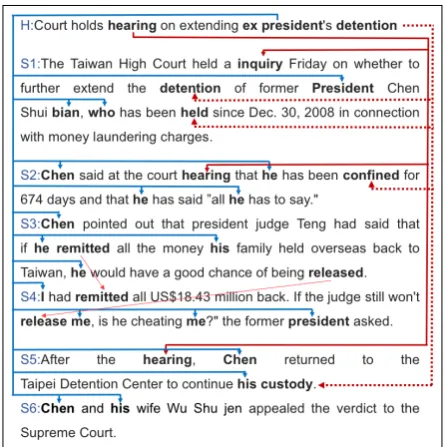
Event coreference resolution presents unique challenges. Compared to entities, coreferential event mentions are fewer in a document and much more sparsely scattered across sentences. Figure1
shows a typical news article. Here, the main en-tity, “President Chen”, appears frequently in
ev-Figure 1: An example document to illustrate the characteristics of event (red) and entity (blue) coreference chains.
[image:1.595.306.530.220.444.2]se-Dataset Type 0 1 2 3 4 >4
richERE event 11 34 20 9 7 19
entity 34 33 14 6 3 10
ACE-05 event 5 33 19 10 9 24
entity 37 28 12 7 4 13
KBP 2015 event 15 34 12 9 6 24
KBP 2016 event 8 43 15 7 6 21
[image:2.595.71.290.62.153.2]KBP 2017 event 12 49 13 7 4 15
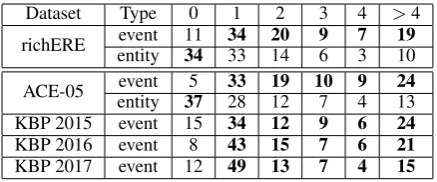
Table 1: Percentages of adjacent (event vs. entity) mention pairs based on the number of sentences between two mentions.
ries of related but different events. Essentially, (1) the same event is referred back only when a new aspect or further information of the event has to be described, and (2) repetitions of the same events are mainly used for content organization purposes and, consequently, correlate well with topic struc-tures.
Table 1 further shows the comparisons of po-sitional patterns between event coreference and entity coreference chains, based on two bench-mark datasets, ERE (Song et al.,2015) and ACE05 (Walker et al.,2006), where we paired each event (entity) mention with its nearest antecedent event (entity) mention and calculated the percentage of (event vs. entity) coreferent mention pairs based on the number of sentences between two mentions. Indeed, for entity coreference resolu-tion, centering and nearness are striking properties (Grosz et al.,1995), and the nearest antecedent of an entity mention is mostly in the same sentence or in the immediately preceding sentence ( 70%). This is especially true for nominals and pronouns, two common types of entity mentions, where the nearest preceding mention that is also compatible in basic properties (e.g., gender, person and num-ber) is likely to co-refer with the current mention. In contrast, coreferential event mentions are rarely from the same sentence ( 10%) and are often sen-tences apart. The sparse distribution of coreferent event mentions also applies to the three KBP cor-pora used in this work.
To address severe sparsity of event coreference relations in a document, we propose a holistic ap-proach to identify coreference relations between event mentions by considering their correlations with document topic structures. Our key observa-tion is that event menobserva-tions make the backbone of a document and coreferent mentions of the same event play a key role in achieving a coherent con-tent structure. For example, in figure1, the events
“hearing” and “detention” were mentioned in the headline (H), in the first sentence (S1) as a story overview, in the second sentence (S2) for transi-tioning to the body section of the story describ-ing what happened durdescrib-ing the heardescrib-ing, and then in the fifth sentence (S5) for transitioning to the end-ing section of the story describend-ing what happened after the hearing. By attaching individual event mentions to a coherent story and its topic struc-tures, our approach recognizes event coreference relations that are otherwise not easily seen due to a mismatch of two event mentions’ local contexts or long distances between event mentions.
We model several aspects of correlations be-tween event coreference chains and document level topic structures, in an Integer Linear Pro-gramming (ILP) joint inference framework. Ex-perimental results on the benchmark event coref-erence resolution dataset KBP-2016 (Ellis et al.,
2016) and KBP 2017 (Getman et al.,2017) show that the ILP system greatly improves event coref-erence resolution performance by modeling differ-ent aspects of correlations between evdiffer-ent corefer-ences and document topic structures, which out-performs the previous best system on the same dataset consistently across several event corefer-ence evaluation metrics.
2 Correlations between Event
Coreference Chains and Document Topic Structures
We model four aspects of correlations.
recover complete chains for the main events, we also encourage associating more coreferent event mentions to a chain that has a large stretch (the number of sentences between the first and the last event mention based on their textual positions).
Correlations across Semantically Associated Event Chains: semantically associated events often co-occur in the same sentence. For exam-ple, mentions of the two main events “hearing” and “detention” co-occur across the document in sentences H, S1, S2 and S5. The correlation across event chains is not specific to global main events, for example, the local events “remitted” and “re-lease” have their mentions co-occur in sentences S3 and S4 as well. In ILP, we leverage this ob-servation and encourage creating coreference links between event mentions in sentences that contain other already known coreferent event mentions.
Genre-specific Distributional Patterns: we model document level distributional patterns of coreferent event mentions that may be specific to a genre in ILP. Specifically, news article often be-gins with a summary of the overall story and then introduces the main events and their closely as-sociated events. In subsequent paragraphs, de-tailed information of events may be introduced to provide supportive evidence to the main story. Thereby, a majority of event coreference chains tend to be initiated in the early sections of the document. Event mentions in the later paragraphs may exist as coreferent mentions of an established coreference chain or as singleton event mentions which, however, are less likely to initiate a new coreference chain. Inspired by this observation, we simply modify the objective function of ILP to encourage more event coreference links in early sections of a document.
Subevents: subevents exist mainly to provide details and evidence for the parent event, there-fore, the relation between subevents and their par-ent evpar-ent prespar-ents another aspect of correlations between event relations and hierarchical document topic structures. Subevents may share the same lexical form as the parent event and cause spurious event coreference links (Araki et al., 2014). We observe that subevents referring to specific actions were seldomly referred back in a document and are often singleton events. Following the approach proposed by (Badgett and Huang,2016), we iden-tify such specific action events and improve event coreference resolution by specifying constraints in
ILP to discourage coreference links between a spe-cific action event and other event mentions.
3 Related Work
Compared to entity coreference resolution (Lee et al., 2017; Clark and Manning, 2016a,b;
Martschat and Strube, 2015; Lee et al., 2013), far less research was conducted for event coref-erence resolution. Most existing methods (Ahn,
2006; Chen et al., 2009; Cybulska and Vossen,
2015a,b) heavily rely on surface features, mainly event arguments (i.e., entities such as event par-ticipants, time, location, etc.) that were extracted from local contexts of two events, and determine that two events are coreferential if their arguments match. Often, a clustering algorithm, hierarchi-cal Bayesian (Bejan and Harabagiu,2010, 2014;
Yang et al.,2015) or spectral clustering algorithms (Chen and Ji, 2009), is applied on top of a pair-wise surface feature based classifier for inducing event clusters. However, identifying potential ar-guments, linking arguments to a proper event men-tion, and recognizing compatibilities between ar-guments are all error-prone (Lu et al.,2016). Joint event and entity coreference resolution (Lee et al.,
2012), joint inferences of event detection and event coreference resolution (Lu and Ng, 2017), and iterative information propagation (Liu et al.,
2014;Choubey and Huang,2017a) have been pro-posed to mitigate argument mismatch issues.
corefer-ences and the overall topic structures of a docu-ment, which is more likely to yield robust and gen-eralizable event coreference resolvers.
4 Modeling Event Coreference Chain -Topic Structure Correlations Using Integer Linear Programming
We model discourse level event-topic correlation structures by formulating the event coreference resolution task as an Integer Linear Programming (ILP) problem. Our baseline ILP system is de-fined over pairwise scores between event mentions obtained from a pairwise neural network-based coreference resolution classifier.
4.1 The Local Pairwise Coreference Resolution Classifier
Our local pairwise coreference classifier uses a neural network model based on features defined for an event mention pair. It includes a common layer with 347 neurons shared between two event mentions to generate embeddings corresponding to word lemmas (300) and parts-of-speech (POS) tags (47). The common layer aims to enrich event word embeddings with the POS tags using the shared weight parameters. It also includes a sec-ond layer with 380 neurons to embed suffix1 and prefix2of event words, distances (euclidean, abso-lute and cosine) between word embeddings of two event lemmas and common arguments between two event mentions. The output from the second layer is concatenated and fed into the third neu-ral layer with 10 neurons. The output embedding from the third layer is finally fed into an output layer with 1 neuron that generates a score indi-cating the confidence of assigning the given event pair to the same coreference cluster. All three lay-ers and the output layer use the sigmoid activation function.
4.2 The Basic ILP for Event Coreference Resolution
Let λrepresents the set of all event mentions in a document, Λ denotes the set of all event men-tion pairs i.e. Λ = {< i, j > | < i, j > ∈
λ× λ and i < j} and pij = pcls(coref|i, j)
represents the cost of assigning event mentions i
andj to the same coreferent cluster, we can
for-1
te, tor, or, ing, cy, id, ed, en, er, ee, pt, de, on, ion, tion, ation, ction, de, ve, ive, ce, se, ty, al, ar, ge, nd, ize, ze, it, lt
2re, in, at, tr, op
mulate the baseline objective function that min-imizes equation 1. Further we add constraints (equation2) over each triplets of mentions to en-force transitivity (Denis et al., 2007; Finkel and Manning,2008). This guarantees legal clustering by ensuring thatxij =xjk = 1impliesxik= 1.
ΘB = X
i,j∈Λ
−log(pij)xij−log(1−pij)(¬xij)
s.t. xij∈ {0,1}
(1)
¬xij+¬xjk≥ ¬xik (2)
We then add constituent objective functions and constraints to the baseline ILP formulation to in-duce correlations between coreference chains and topical structures (ΘT), discourage fragmented
chains (ΘG), encourage semantic associations among chains (ΘC), model genre-specific
distri-butional patterns (ΘD) and discourage subevents
from having coreferent mentions (ΘS). They are described in the following subsections.
4.2.1 Modeling the Correlation between Main Event Chains and Topic Transition Sentences
As shown in the example Figure 1, main events are likely to have mentions appear in topic transi-tion sentences. Therefore, We add the following objective function (equation3) to the basic objec-tive function and add the new constraint4in order to encourage coreferent event mentions to occur in topic transition sentences.
ΘT= X
m,n∈Ω
−log(smn)wmn−log(1−smn)(¬wmn)
s.t. wmn∈ {0,1}
(n−m)≥ |S|/θs
(3)
X
i0∈ξ m,j0∈ξn
xi0j0 ≥wmn (4)
Specifically, letωrepresents the set of sentences in a document andΩdenotes the set of sentence pairs i.e. Ω = {< m, n > | < m, n > ∈ ω×ω and
m < n}. Then, letsij = psim(simscore|m, n),
which represents the similarity score between sen-tences m and n and |S|equals to the number of sentences in a given document. Here, the indicator variablewmnindicates if the two sentences m and
apart, in our experiments we setθs to 5), this
ob-jective functionΘT tries to set the corresponding indicator variable wmn to 1. Then, we add
con-straint 4 to encourage coreferent event mentions to occur in topic transition sentences. Note that
ξm refers to all the event mentions in sentencem,
and xij is the indicator variable which is set to
1 if event mentions defined by indexi andj are coreferent. Thus, the above constraint ensures that two topic transition sentences contain at least one coreferent event pair.
Identifying Topic Transition Sentences Using Sentence Similarities: First, we use the unsuper-vised method based on weighted word embedding average proposed by Arora et al. (2016) to ob-tain sentence embeddings. We first compute the weighted average of words’ embeddings in a sen-tence, where the weight of a word w is given by
a/(a+p(w)). Here, p(w) represents the estimated word frequency obtained from English Wikipedia andais a small constant (1e-5). We then compute the first principal component of averaged word embeddings corresponding to sentences in a docu-ment and remove the projection on the first princi-pal component from each averaged word embed-ding for each sentence.
Then using the resulted averaged word embed-ding as the sentence embedembed-ding, we compute the similarity between two sentences as cosine simi-larity between their embeddings. We particularly choose this simple unsupervised model to reduce the reliance on any additional corpus for training a new model for calculating sentence similarities. This model was found to perform comparably to supervised RNN-LSTM based models for the se-mantic textual similarity task.
Constraints for Avoiding Fragmented Partial Event Chains: The above equations (3-4) con-sider a pair of sentences and encourage two coref-erent event mentions to appear in a pair of topic transition sentences. But the local nature of these constraints can lead to fragmented main event chains. Therefore, we further model the dis-tributional characteristics of global event chains and encourage the main event chains to have a large number of coreferential mentions and a long stretch (the number of sentences that are present in between the first and last event mention of a chain), to avoid creating partial chains. Specif-ically, we add the following objective function
(equation 5) and the new constraints (equation6
and7):
ΘG=− X
i,j∈µ
γij (5)
σij= X
k<i
¬xki∧ X
j<l
¬xjl∧xij
σij∈ {0,1}
(6)
Γi= X
k,i∈Λ
xki+ X
i,j∈Λ
xij
M(1−yij)≥(ϕ[j]−ϕ[i]).σij− d0.75 (|S|)e
γij−Γi−Γj≥M.yij
Γi,Γj, γij∈Z; Γi,Γj, γij≥0; yij∈ {0,1}
(7)
First, we define an indicator variable σij by
equation 6 3, corresponding to each event tion pair, that takes value 1 if (1) the event men-tions at indexiandjare coreferent; (2) the event mention at index i doesn’t corefer to any of the mentions preceding it; and (3) mention at indexj
doesn’t corefer to any event mention following it. Essentially, settingσij to 1 defines an event chain
that starts from the event mentioniand ends at the event mentionj.
Then with equation 7, variable σij is used to
identify main event chains as those chains which are extended to at least 75% of the document. When a chain is identified as a global chain, we encourage it to have more coreferential mentions. Here, Γi (Γj) equals the sum of indicator
vari-ablesx corresponding to event pairs that include the event mention at indexi (j) i.e. the number of mentions that are coreferent toi(j),ϕ[i](ϕ[j]) represents the sentence number of event mention
i(j), M is a large positive number andyij
repre-sents a slack variable that takes the value 0 if the event chain represented by σij is a global chain.
Givenσi,j is identified as a global chain, variable γij equals the sum of variablesΓi and Γj and is
used in the objective functionΘG(equation5) to encourage more coreferential mentions.
3
Equation6can be implemented as
np+ns≤ X
k<i
xki+ X
j<l
xjl−xij+ (np+ns+ 1).σij
X
k<i
xki+ X
j<l
xjl−xij+ (np+ns+ 1).σij≥0
wherenp, nsrepresent the number of event mentions
4.2.2 Cross-chain Inferences
As illustrated through Figure 1, semantically re-lated events tend to have their mentions co-occur within the same sentence. So, we define the ob-jective function (equation8) and constraints (9) to favor a sentence with a mention from one event chain to also contain a mention from another event chain, if the two event chains are known to have event mentions co-occur in several other sen-tences.
ΘC=− X
m,n∈Ω
Φmn (8)
Φmn= X
i∈ξm,j∈ξn
xij
|ξm|>1; |ξn|>1; Φmn∈Z; Φmn≥0
(9)
To do so, we first define a variableφmnthat equals
the number of coreferent event pairs in a sentence pair, with each sentence having more than one event mention. We then define ΘC to minimize the negative sum ofφmn. Following the previous
notations,ξmin the above equation represents the
event mentions in sentence m.
4.2.3 Modeling Segment-wise Distributional Patterns
The position of an event mention in a document has a direct influence on event coreference chains. Event mentions that occur in the first few para-graphs are more likely to initiate an event chain. On the other hand, event mentions in later parts of a document may be coreferential with a previously seen event mention but are extremely unlikely to begin a new coreference chain. This distributional association is even stronger in the journalistic style of writing. We model this through a simple objec-tive function and constraints (equation10).
ΘD=− X
i∈ξm,j∈ξn
xij+ X
k∈ξp,l∈ξq
xkl
s.t. m, n <bα|S|c;p, q >dβ|S|e
α∈[0,1];β∈[0,1]
(10)
Specifically, for the event pairs that belong to the firstα(or the lastβ) sentences in a document, we add the negative (positive) sum of their indicator variables (x) in objective functionΘD.
The equation10is meant to inhibit coreference links between event mentions that exist within the latter half of document. They do not influence the links within event chains that start early and extend till the later segments of the document.
It is also important to understand that position-based features used in entity coreference resolu-tion (Haghighi and Klein, 2007) are usually de-fined for an entity pair. However, we model the distributional patterns of an event chain in a docu-ment.
4.2.4 Restraining Subevents from Being Included in Coreference Chains
Subevents are known to be a major source of false coreference links due to their high surface similar-ity with their parent events. Therefore, we discour-age subevents from being included in coreference chains in our model and modify the global opti-mization goal by adding a new objective function (equation11).
ΘS= X
s∈S
Γs (11)
whereSrepresents the set of subevents in a docu-ment. We define the objective functionΘS as the sum of Γs, whereΓs equals the number of
men-tions that are coreferent tos. Then our goal is to minimizeΘSand restrict the subevents from being included in coreference chains.
We identify probable subevents by using sur-face syntactic cues corresponding to identifying a sequence of events in a sentence (Badgett and Huang,2016). In particular, a sequence of two or more verb event mentions in a conjunction struc-ture are extracted as subevents.
4.3 The full ILP Model and the Parameters
The equations 3-11 model correlations between non-local structures within or across event chains and document topical structures. We perform ILP inference for coreference resolution by optimizing a global objective function(Θ), defined in equation
12, that incorporates prior knowledge by means of hard or soft constraints.
Θ =κBΘB+κTΘT+κGΘG+κCΘC+κDΘD+κSΘS
(12)
Here, all theκparameters are floating point con-stants. For the sake of simplicity, we setκB and κT to 1.0 andκG =κC. Then we estimate the
pa-rametersκG(κC)andκD through 2-d grid search
in range [0, 5.0] at the interval of 0.5 on a held out training data. We found that the best performance was obtained forκC =κG = 0.5andκD = 2.5.
Since,ΘSaims to inhibit subevents from being
remained same for all the values of κS in range
[5.0,15.0]. In our final model, we keepκS= 10.0.
Also, we found that the performance is roughly in-variant to the parametersκGandκC if they are set
to values between 0.5 and 2.5.
In our experiments, we process each document to define a distinct ILP problem which is solved using the PuLP library (Mitchell et al.,2011).
5 Evaluation
5.1 Experimental Setup
We trained our ILP system on the KBP 2015 (Ellis et al., 2015) English dataset and evaluated the system on KBP 2016 and KBP 2017 English datasets4. All the KBP corpora include docu-ments from both discussion forum5 and news ar-ticles. But as the goal of this study is to lever-age discourse level topic structure in a document for improving event coreference resolution perfor-mance, we only evaluate the ILP system using reg-ular documents (news articles) in the KBP cor-pora. Specifically, we train our event extraction system and local coreference resolution classifier on 310 documents from the KBP 2015 corpus that consists of both discussion forum documents and news articles, tune the hyper-parameters cor-responding to ILP using 50 news articles6 from the KBP 2015 corpus and evaluate our system on
4The ECB+ (Cybulska and Vossen,2014) corpus is
an-other commonly used dataset for evaluating event corefer-ence resolution performance. But we determined that this corpus is not appropriate for evaluating our ILP model that explicitly focuses on using discourse level topic structures for event coreference resolution. Particularly, the ECB+ cor-pus was created to facilitate both cross-document and in-document event coreference resolution research. Thus, the documents in the corpus were grouped based on several com-mon topics and in each document, event mentions and coref-erence relations were only annotated selectively in sentences that are on a common topic. When the annotated sentences in each document are stitched together, they do not well reveal the original document structure, which makes the ECB+ cor-pus a bad choice for evaluating our approach. In addition, due to the selective annotation issue, in-document event coref-erence resolution with the ECB+ corpus is somewhat easier than with the KBP corpus, which partly explained the signif-icant differences of published in-document event coreference resolution results on the two corpora.
5Each discussion forum document consists of a series of
posts in an online discussion thread, which lacks coherent discourse structures as a regular document. Therefore, only news articles in the KBP corpora are appropriate for evaluat-ing our approach.
6
KBP 2015 dataset consists of 181 and 179 documents from discussion forum and news articles respectively. We randomly picked 50 documents from news articles for tun-ing ILP hyper-parameters and remaintun-ing 310 documents for training classifiers.
news articles from the official KBP 2016 and 2017 evaluation corpora7 respectively. For direct com-parisons, the results reported for the baselines, in-cluding the previous state-of-the-art model, were based on news articles in the test datasets as well.
We report the event coreference resolution re-sults based on the version 1.8 of the official KBP 2017 scorer. The scorer employs four coreference scoring measures, namely B3 (Bagga and Bald-win, 1998), CEAFe (Luo, 2005), MUC (Vilain
et al., 1995) and BLANC (Recasens and Hovy,
2011) and the unweighted average of their F1 scores (AV GF1).
5.2 Event Mention Identification
Lu and Ng(2017) Ours
Corpus Untyped Typed Untyped Typed KBP 2016 60.13 49.00 60.03 45.45
KBP 2017 - - 62.89 49.34
Table 2: F1 scores for event mention extraction on the KBP 2016 and 2017 corpus
We use an ensemble of multi-layer feed forward neural network classifiers to identify event men-tions (Choubey and Huang,2017b). All basic clas-sifiers are trained on features derived from the lo-cal context of words. The features include the em-bedding of word lemma, absolute difference be-tween embeddings of word and its lemma, prefix and suffix of word and pos-tag and dependency re-lation of its context words, modifiers and governor. We trained 10 classifiers on same feature sets with slightly different neural network architec-tures and different training parameters including dropout rate, optimizer, learning rate, epochs and network initialization. All the classifiers use relu, tanh and softmax activations in the input, hidden and output layers respectively. We use GloVe vec-tors (Pennington et al., 2014) for word embed-dings and one-hot vectors for pos-tag and depen-dency relations in each individual model. Pos-tagging, dependency parsing, named entity recog-nition and entity coreference resolution are per-formed using Stanford CoreNLP (Manning et al.,
2014)
Table2 shows the event mention identification results. We report the F1 score for event mention identification based on the KBP scorer, which con-siders a mention correct if its span, type and
sub-7There are 85 and 83 news articles in KBP 2016 and 2017
KBP 2016 KBP 2017
Model B3 CEAFe MUC BLANC AV G B3 CEAFe MUC BLANC AV G
Local classifier 51.47 47.96 26.29 30.82 39.13 50.24 48.47 30.81 29.94 39.87 Clustering 46.97 41.95 18.79 26.88 33.65 46.51 40.21 23.10 25.08 33.72 Basic ILP 51.44 47.77 26.65 30.95 39.19 50.4 48.49 31.33 30.58 40.2 +Topic structure 51.44 47.94 28.86 31.87 40.03 50.39 48.23 33.08 31.26 40.74 +Cross-chain 51.09 47.53 31.27 33.07 40.74 50.39 47.67 35.15 31.88 41.27 +Distribution 51.06 48.28 33.53 33.63 41.62 50.42 48.67 37.52 32.08 42.17 +Subevent 51.67 49.1 34.08 34.08 42.23 50.35 48.61 37.24 31.94 42.04
Joint learning 50.16 48.59 32.41 32.72 40.97 - - - -
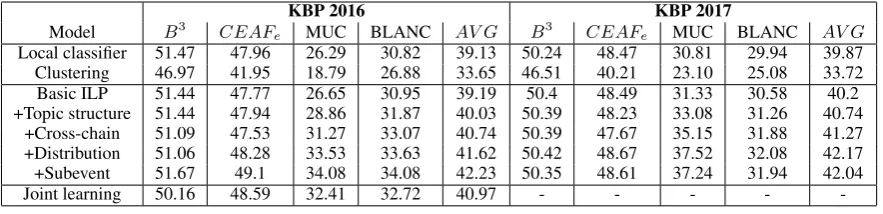
-Table 3: Results for event coreference resolution systems on the KBP 2016 and 2017 corpus.Joint learning results correspond to the actual result files evaluated in (Lu and Ng,2017). The file was obtained from the authors.
type are the same as the gold mention and assigns a partial score if span partially overlaps with the gold mention. We also report the event mention identification F1 score that only considers men-tion spans and ignores menmen-tion types. We can see that compared to the recent system by (Lu and Ng,2017) which conducts joint inferences of both event mention detection and event coreference res-olution, detecting types for event mentions is a major bottleneck to our event extraction system.
Note that the official KBP 2017 event coref-erence resolution scorer considers a mention pair coreferent if they strictly match on the event type and subtype, which has been discussed recently to be too conservative (Mitamura et al.,2017). But since improving event mention type detection is not our main goal, we therefore relax the con-straints and do not consider event mention type match while evaluating event coreference resolu-tion systems. This allows us to directly inter-pret the influences of document structures in the event coreference resolution task by overlooking any bias from upstream tasks.
5.3 Baseline Systems
We compare our document-structure guided event coreference resolution model with three baselines. Local classifier performs greedy merging of event mentions using scores predicted by the local pair-wise coreference resolution classifier. An event mention is merged to its best matching antecedent event mention if the predicted score between the two event mentions is highest and greater than 0.5. Clustering performs spectral graph clustering ( Pe-dregosa et al.,2011), which represents commonly used clustering algorithms for event coreference resolution. We used the relation between the size of event mentions and the number of coref-erence clusters in training data for pre-specifying the number of clusters. Its low performance is
par-tially accounted to the difficulty of determining the number of coreference clusters.
Joint learning uses a structured conditional ran-dom field model that operates at the document level to jointly model event mention extraction, event coreference resolution and an auxiliary task of event anaphoricity determination. This model has achieved the best event coreference resolution performance to date on the KBP 2016 corpus (Lu and Ng,2017).
5.4 Our Systems
We gradually augment the ILP baseline with ad-ditional objective functions and constraints de-scribed in sub-sections 4.2.1, 4.2.2, 4.2.3 and
4.2.4. In all the systems below, we combine ob-jective functions with their corresponding coeffi-cients (as described in sub-section4.3).
The Basic ILP System formulates event corefer-ence resolution as an ILP optimization task. It uses scores produced by the local pairwise classi-fier as weights on variables that represent ILP as-signments for event coreference relations. (Equa-tions1,2).
+Topic structure incorporates the topical structure and the characteristics of main event chains in baseline ILP system (Equations1-5).
+Cross-chain adds constraints and objective func-tion defined for cross-chain inference to the Topi-cal structure system (Equations1-8).
+Distribution further adds distributional patterns to the Cross-chain system (Equations1-10). +Subevent (Full) optimizes the objective function defined in equation12by considering all the con-straints defined in 1-11, including constraints for modeling subevent structures.
5.5 Results and Analysis
[image:8.595.79.521.62.169.2]resolu-tion approaches including the recent joint learning approach (Lu and Ng,2017) which is the best per-forming model on the KBP 2016 corpus. For both datasets, the full discourse structure augmented model achieved superior performance compared to the local classifier based system. The improve-ment is observed across all metrics with average F1 gain of 3.1 for KBP 2016 and 2.17 for KBP 2017. Most interestingly, we see over 28% im-provement in MUC F1 score which directly eval-uates the pairwise coreference link predictions. This implies that the document level structures, in-deed, helps in linking more coreferent event men-tions, which otherwise are difficult with the local classifier trained on lexical and surface features. Our ILP based system also outperforms the pre-vious best model on the KBP 2016 corpus (Lu and Ng, 2017) consistently using all the evalua-tion metrics, with an overall improvement of 1.21 based on the average F1 scores.
In Table 3, we also report the F1 scores when we increasingly add each type of structure in the ILP baseline. Among different scoring metrics, all structures positively contributed to the MUC and BLANC scores for KBP 2016 corpus. However, subevent based constraints slightly reduced the F1 scores on KBP 2017 corpus. Based on our prelim-inary analysis, this can be accounted to the simple method applied for subevent extraction. We only extracted 31 subevents in KBP 2017 corpus com-pared to 211 in KBP 2016 corpus.
5.6 Discussions on Generalizability
The correlations between event coreference chains and document topic structures are not specific to news articles and widely exist. Several main dis-tributional characteristics of coreferent event men-tions, including 1) main event coreference chains often have extended presence and have mentions scattered across segments, and 2) semantically correlated events often have their respective event mentions co-occur in a sentence, directly apply to other sources of texts such as clinical notes. But certain distributional characteristics are genre spe-cific. For instance, while it is common to observe more coreferent event mentions early on in a news article, coreference chains in a clinical note of-ten align well with pre-defined segments like the history of present illness, description of a visit and treatment plan. Thus, the objective functions and constraints defined in equations 1-8 can be
directly applied for other domains as well, while other structures like segment-wise distributional patterns may require alteration based on domain-specific knowledge.
6 Conclusions and the Future Work
We have presented an ILP based joint inference system for event coreference resolution that uti-lizes scores predicted by a pairwise event corefer-ence resolution classifier, and models several as-pects of correlations between event coreference chains and document level topic structures, includ-ing the correlation between the main event chains and topic transition sentences, interdependencies among event coreference chains, genre-specific coreferent mention distributions and subevents. We have shown that these structures are generaliz-able by conducting experiments on both the KBP 2016 and KBP 2017 datasets. Our model outper-formed the previous state-of-the-art model across all coreference scoring metrics. In the future, we will explore the use of additional discourse struc-tures that correlate highly with event coreference chains. Moreover, we will extend this work to other domains such as biomedical domains.
Acknowledgments
This work was partially supported by the National Science Foundation via NSF Award IIS-1755943. Disclaimer: the views and conclusions contained herein are those of the authors and should not be interpreted as necessarily representing the official policies or endorsements, either expressed or im-plied, of NSF or the U.S. Government.
References
David Ahn. 2006. The stages of event extraction. In Proceedings of the Workshop on Annotat-ing and ReasonAnnotat-ing About Time and Events. Association for Computational Linguistics, Stroudsburg, PA, USA, ARTE ’06, pages 1–8.
http://dl.acm.org/citation.cfm?id=1629235.1629236.
Jun Araki, Zhengzhong Liu, Eduard H Hovy, and Teruko Mitamura. 2014. Detecting subevent struc-ture for event coreference resolution. In LREC. pages 4553–4558.
Allison Badgett and Ruihong Huang. 2016. Extract-ing subevents via an effective two-phase approach. In Proceedings of the 2016 Conference on Empiri-cal Methods in Natural Language Processing. pages 906–911.
Amit Bagga and Breck Baldwin. 1998. Algorithms for scoring coreference chains. InThe first interna-tional conference on language resources and evalu-ation workshop on linguistics coreference. Granada, volume 1, pages 563–566.
Cosmin Adrian Bejan and Sanda Harabagiu. 2010. Un-supervised event coreference resolution with rich linguistic features. InProceedings of the 48th An-nual Meeting of the Association for Computational Linguistics. Association for Computational Linguis-tics, pages 1412–1422.
Cosmin Adrian Bejan and Sanda Harabagiu. 2014. Un-supervised event coreference resolution. Computa-tional Linguistics40(2):311–347.
Zheng Chen and Heng Ji. 2009. Graph-based event coreference resolution. InProceedings of the 2009 Workshop on Graph-based Methods for Natural Language Processing. Association for Computa-tional Linguistics, pages 54–57.
Zheng Chen, Heng Ji, and Robert Haralick. 2009. A pairwise event coreference model, feature impact and evaluation for event coreference resolution. In
Proceedings of the workshop on events in emerging text types. Association for Computational Linguis-tics, pages 17–22.
Prafulla Kumar Choubey and Ruihong Huang. 2017a. Event coreference resolution by iteratively unfold-ing inter-dependencies among events. In Proceed-ings of the 2017 Conference on Empirical Methods in Natural Language Processing. pages 2124–2133.
Prafulla Kumar Choubey and Ruihong Huang. 2017b. Tamu at kbp 2017: Event nugget detection and coreference resolution. InProceedings of TAC KBP 2017 Workshop, National Institute of Standards and Technology.
Prafulla Kumar Choubey, Kaushik Raju, and Ruihong Huang. 2018. Identifying the most dominant event in a news article by mining event coreference re-lations. In Proceedings of the 2018 Conference of the North American Chapter of the Association for Computational Linguistics: Human Language Tech-nologies, Volume 2 (Short Papers). volume 2, pages 340–345.
Kevin Clark and Christopher D Manning. 2016a. Deep reinforcement learning for mention-ranking coref-erence models. In Proceedings of the 2016 Con-ference on Empirical Methods in Natural Language Processing. pages 2256–2262.
Kevin Clark and Christopher D Manning. 2016b. Im-proving coreference resolution by learning entity-level distributed representations. InProceedings of
the 54th Annual Meeting of the Association for Com-putational Linguistics (Volume 1: Long Papers). volume 1, pages 643–653.
Agata Cybulska and Piek Vossen. 2014. Using a sledgehammer to crack a nut? lexical diversity and event coreference resolution. InLREC. pages 4545– 4552.
Agata Cybulska and Piek Vossen. 2015a. Translat-ing granularity of event slots into features for event coreference resolution. In Proceedings of the The 3rd Workshop on EVENTS: Definition, Detection, Coreference, and Representation. pages 1–10.
A.K. Cybulska and P.T.J.M. Vossen. 2015b. Bag of events approach to event coreference resolution. su-pervised classification of event templates. Lecture Notes in Computer Science (9042). 978-3-319-18117-2.
Pascal Denis, Jason Baldridge, et al. 2007. Joint deter-mination of anaphoricity and coreference resolution using integer programming. InHLT-NAACL. pages 236–243.
Joe Ellis, Jeremy Getman, Dana Fore, Neil Kuster, Zhiyi Song, Ann Bies, and Stephanie Strassel. 2015. Overview of linguistic resources for the tac kbp 2015 evaluations: Methodologies and results. In Proceed-ings of TAC KBP 2015 Workshop, National Institute of Standards and Technology. pages 16–17.
Joe Ellis, Jeremy Getman, Neil Kuster, Zhiyi Song, Ann Bies, and Stephanie Strassel. 2016. Overview of linguistic resources for the tac kbp 2016 evalu-ations: Methodologies and results. InProceedings of TAC KBP 2016 Workshop, National Institute of Standards and Technology.
Jenny Rose Finkel and Christopher D Manning. 2008. Enforcing transitivity in coreference resolution. In
Proceedings of the 46th Annual Meeting of the As-sociation for Computational Linguistics on Human Language Technologies: Short Papers. Association for Computational Linguistics, pages 45–48.
Jeremy Getman, Joe Ellis, Zhiyi Song, Jennifer Tracey, and Stephanie Strassel. 2017. Overview of linguistic resources for the tac kbp 2017 evaluations: Method-ologies and results. In Proceedings of TAC KBP 2017 Workshop, National Institute of Standards and Technology.
Barbara J Grosz, Scott Weinstein, and Aravind K Joshi. 1995. Centering: A framework for modeling the lo-cal coherence of discourse. Computational linguis-tics21(2):203–225.
Heeyoung Lee, Angel Chang, Yves Peirsman, Nathanael Chambers, Mihai Surdeanu, and Dan Jurafsky. 2013. Deterministic coreference resolu-tion based on entity-centric, precision-ranked rules.
Computational Linguistics39(4):885–916.
Heeyoung Lee, Marta Recasens, Angel Chang, Mihai Surdeanu, and Dan Jurafsky. 2012. Joint entity and event coreference resolution across documents. In
Proceedings of the 2012 Joint Conference on Empir-ical Methods in Natural Language Processing and Computational Natural Language Learning. Asso-ciation for Computational Linguistics, pages 489– 500.
Kenton Lee, Luheng He, Mike Lewis, and Luke Zettle-moyer. 2017. End-to-end neural coreference reso-lution. InProceedings of the 2017 Conference on Empirical Methods in Natural Language Process-ing. pages 188–197.
Zhengzhong Liu, Jun Araki, Eduard H Hovy, and Teruko Mitamura. 2014. Supervised within-document event coreference using information prop-agation. InLREC. pages 4539–4544.
Jing Lu and Vincent Ng. 2017. Joint learning for event coreference resolution. InProceedings of the 55th Annual Meeting of the Association for Compu-tational Linguistics (Volume 1: Long Papers). vol-ume 1, pages 90–101.
Jing Lu, Deepak Venugopal, Vibhav Gogate, and Vin-cent Ng. 2016. Joint inference for event corefer-ence resolution. In Proceedings of COLING 2016, the 26th International Conference on Computational Linguistics: Technical Papers. pages 3264–3275.
Xiaoqiang Luo. 2005. On coreference resolution per-formance metrics. InProceedings of the conference on human language technology and empirical meth-ods in natural language processing. Association for Computational Linguistics, pages 25–32.
Christopher D. Manning, Mihai Surdeanu, John
Bauer, Jenny Finkel, Steven J. Bethard,
and David McClosky. 2014. The Stanford
CoreNLP natural language processing toolkit. In Association for Computational Linguistics (ACL) System Demonstrations. pages 55–60.
http://www.aclweb.org/anthology/P/P14/P14-5010.
Sebastian Martschat and Michael Strube. 2015. La-tent structures for coreference resolution. Transac-tions of the Association of Computational Linguis-tics3(1):405–418.
Teruko Mitamura, Zhengzhong Liu, and Eduard Hovy. 2017. Events detection, coreference and sequenc-ing: Whats next? overview of the tac kbp 2017 event track. InProceedings of TAC KBP 2017 Workshop, National Institute of Standards and Technology.
Stuart Mitchell, Michael OSullivan, and Iain Dun-ning. 2011. Pulp: a linear programming toolkit
for python. The University of Auckland, Auck-land, New ZeaAuck-land, http://www. optimization-online. org/DB FILE/2011/09/3178. pdf .
Nafise Sadat Moosavi and Michael Strube. 2017. Lex-ical features in coreference resolution: To be used with caution. In Proceedings of the 55th Annual Meeting of the Association for Computational Lin-guistics (Volume 2: Short Papers). volume 2, pages 14–19.
F. Pedregosa, G. Varoquaux, A. Gramfort, V. Michel, B. Thirion, O. Grisel, M. Blondel, P. Pretten-hofer, R. Weiss, V. Dubourg, J. Vanderplas, A. Pas-sos, D. Cournapeau, M. Brucher, M. Perrot, and E. Duchesnay. 2011. Scikit-learn: Machine learning in Python. Journal of Machine Learning Research
12:2825–2830.
Jeffrey Pennington, Richard Socher, and Christo-pher D. Manning. 2014. Glove: Global vectors for word representation. InEmpirical Methods in Nat-ural Language Processing (EMNLP). pages 1532– 1543.http://www.aclweb.org/anthology/D14-1162.
Marta Recasens and Eduard Hovy. 2011. Blanc: Im-plementing the rand index for coreference evalu-ation. Natural Language Engineering 17(4):485– 510.
Zhiyi Song, Ann Bies, Stephanie Strassel, Tom Riese, Justin Mott, Joe Ellis, Jonathan Wright, Seth Kulick, Neville Ryant, and Xiaoyi Ma. 2015. From light to rich ere: annotation of entities, relations, and events. InProceedings of the The 3rd Workshop on EVENTS: Definition, Detection, Coreference, and Representation. pages 89–98.
Marc Vilain, John Burger, John Aberdeen, Dennis Con-nolly, and Lynette Hirschman. 1995. A model-theoretic coreference scoring scheme. In Pro-ceedings of the 6th conference on Message under-standing. Association for Computational Linguis-tics, pages 45–52.
Christopher Walker, Medero Strassel, Maeda Julie, and Kazuaki. 2006. Ace 2005 multilingual training cor-pus. InLinguistic Data Consortium, LDC Catalog No.: LDC2006T06..