Proceedings of the 56th Annual Meeting of the Association for Computational Linguistics (Long Papers), pages 1842–1852 1842
Sequence-to-sequence Models for Cache Transition Systems
Xiaochang Peng1, Linfeng Song1, Daniel Gildea1, Giorgio Satta2
1University of Rochester 2University of Padua {xpeng,lsong10,gildea}@cs.rochester.edu,
Abstract
In this paper, we present a sequence-to-sequence based approach for mapping natural language sentences to AMR se-mantic graphs. We transform the se-quence to graph mapping problem to a word sequence to transition action se-quence problem using a special transi-tion system called a cache transitransi-tion sys-tem. To address the sparsity issue of neu-ral AMR parsing, we feed feature embed-dings from the transition state to provide relevant local information for each de-coder state. We present a monotonic hard attention model for the transition frame-work to handle the strictly left-to-right alignment between each transition state and the current buffer input focus. We evaluate our neural transition model on the AMR parsing task, and our parser out-performs other sequence-to-sequence ap-proaches and achieves competitive results in comparison with the best-performing models.1
1 Introduction
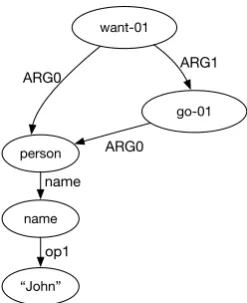
Abstract Meaning Representation (AMR) ( Ba-narescu et al., 2013) is a semantic formalism where the meaning of a sentence is encoded as a rooted, directed graph. Figure1shows an example of an AMR in which the nodes represent the AMR concepts and the edges represent the relations be-tween the concepts. AMR has been used in vari-ous applications such as text summarization (Liu et al.,2015), sentence compression (Takase et al., 2016), and event extraction (Huang et al.,2016).
1The implementation of our parser is available at https://github.com/xiaochang13/CacheTransition-Seq2seq
want-01
person
go-01 ARG0
ARG0
ARG1
name
“John” name
[image:1.595.354.478.225.377.2]op1
Figure 1: An example of AMR graph representing the meaning of: “John wants to go”
The task of AMR graph parsing is to map nat-ural language strings to AMR semantic graphs. Different parsers have been developed to tackle this problem (Flanigan et al., 2014; Wang et al., 2015b,a; Peng et al., 2015; Artzi et al., 2015; Pust et al.,2015;van Noord and Bos, 2017). On the other hand, due to the limited amount of la-beled data and the large output vocabulary, the sequence-to-sequence model has not been very successful on AMR parsing. Peng et al. (2017) propose a linearization approach that encodes la-beled graphs as sequences. To address the data sparsity issue, low-frequency entities and tokens are mapped to special categories to reduce the vo-cabulary size for the neural models.Konstas et al. (2017) use self-training on a huge amount of un-labeled text to lower the out-of-vocabulary rate. However, the final performance still falls behind the best-performing models.
of Wang and Xue (2017), which is currently the top performing system. This raises the question of whether the advantages of neural and transition-based system can be combined, as for example with the syntactic parser of Dyer et al. (2015), who use stack LSTMs to capture action history in-formation in the transition state of the transition system. Ballesteros and Al-Onaizan (2017) ap-ply stack-LSTM to transition-based AMR parsing and achieve competitive results, which shows that local transition state information is important for predicting transition actions.
Instead of linearizing the target AMR graph to a sequence structure, Buys and Blunsom (2017) propose a sequence-to-action-sequence approach where the reference AMR graph is replaced with an action derivation sequence by running a deter-ministicoraclealgorithm on the training sentence, AMR graph pairs. They use a separate alignment probability to explicitly model the hard alignment from graph nodes to sentence tokens in the buffer. Gildea et al.(2018) propose a special transition framework called a cache transition system to gen-erate the set of semantic graphs. They adapt the stack-based parsing system by adding a working set, which they refer to as a cache, to the tradi-tional stack and buffer. Peng et al. (2018) apply the cache transition system to AMR parsing and design refined action phases, each modeled with a separate feedforward neural network, to deal with some practical implementation issues.
In this paper, we propose a sequence-to-action-sequence approach for AMR parsing with cache transition systems. We want to take advantage of the sequence-to-sequence model to encode whole-sentence context information and the history ac-tion sequence, while using the transiac-tion system to constrain the possible output. The transition system can also provide better local context in-formation than the linearized graph representation, which is important for neural AMR parsing given the limited amount of data.
More specifically, we use bi-LSTM to encode two levels of input information for AMR pars-ing: word level and concept level, each refined with more general category information such as lemmatization, POS tags, and concept categories.
We also want to make better use of the complex transition system to address the data sparsity is-sue for neural AMR parsing. We extend the hard attention model ofAharoni and Goldberg (2017),
which deals with the nearly-monotonic alignment in the morphological inflection task, to the more general scenario of transition systems where the input buffer is processed from left-to-right. When we process the buffer in this ordered manner, the sequence of target transition actions are also strictly aligned left-to-right according to the in-put order. On the decoder side, we augment the prediction of output action with embedding fea-tures from the current transition state. Our exper-iments show that encoding information from the transition state significantly improves sequence-to-sequence models for AMR parsing.
2 Cache Transition Parser
We adopt the transition system of Gildea et al. (2018), which has been shown to have good cov-erage of the graphs found in AMR.
Acache transition parserconsists of a stack, a cache, and an input buffer. The stack is a sequence
σ of (integer, concept) pairs, as explained below, with the topmost element always at the rightmost position. The buffer is a sequence of ordered con-ceptsβcontaining a suffix of the input concept se-quence, with the first element to be read as a newly introduced concept/vertex of the graph. (We use the terms concept and vertex interchangeably in this paper.) Finally, the cache is a sequence of concepts η = [v1, . . . , vm]. The element at the
leftmost position is called the first element of the cache, and the element at the rightmost position is called the last element.
Operationally, the functioning of the parser can be described in terms of configurations and transi-tions. Aconfigurationof our parser has the form:
C= (σ, η, β, Gp)
where σ, η and β are as described above, and
Gp is the partial graph that has been built so
far. The initial configuration of the parser is ([],[$, . . . ,$],[c1, . . . , cn],∅), meaning that the
stack cache buffer edges actions taken [] [$, $, $] [Per, want-01, go-01] ∅ —
[1, $] [$, $, Per] [want-01, go-01] ∅ Shift;PushIndex(1)
[image:3.595.76.520.61.205.2][1, $] [$, $, Per] [want-01, go-01] ∅ Arc(1, -, NULL);Arc(2, -, NULL) [1, $, 1, $] [$, Per, want-01] [go-01] ∅ Shift;PushIndex(1)
[1, $, 1, $] [$, Per, want-01] [go-01] E1 Arc(1, -, NULL);Arc(2, L, ARG0)
[1, $, 1, $, 1, $] [Per, want-01, go-01] [] E1 Shift;PushIndex(1)
[1, $, 1, $, 1, $] [Per, want-01, go-01] [] E2 Arc(1, L, ARG0);Arc(2, R, ARG1)
[1, $, 1, $] [$, Per, want-01 ] [] E2 Pop
[1, $] [$, $, Per] [] E2 Pop
[] [$, $, $] [] E2 Pop
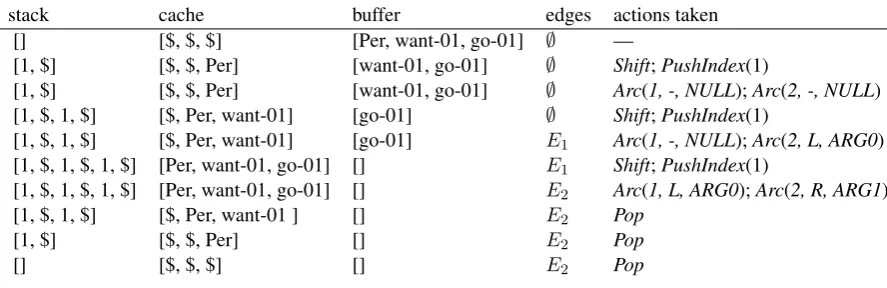
Figure 2: Example run of the cache transition system constructing the graph for the sentence “John wants to go” with cache size of 3. The left four columns show the parser configura-tions after taking the acconfigura-tions shown in the last column. E1 = {(Per,want-01,L-ARG0)}, E2 =
{(Per,want-01,L-ARG0),(Per,go-01,L-ARG0),(want-01,go-01,R-ARG1)}.
In the first step, which is called concept iden-tification, we map the input sentence w1:n0 =
w1, . . . , wn0 to a sequence of concepts c1:n =
c1, . . . , cn. We decouple the problem of concept
identification from the transition system and ini-tialize the buffer with a recognized concept se-quence from another classifier, which we will in-troduce later. As the sequence-to-sequence model uses all possible output actions as the target vo-cabulary, this can significantly reduce the target vocabulary size. Thetransitionsof the parser are specified as follows.
1. Poppops a pair(i, v) from the stack, where the integerirecords the position in the cache that it originally came from. We place con-ceptvin positioniin the cache, shifting the remainder of the cache one position to the right, and discarding the last element in the cache.
2. Shiftsignals that we will start processing the next input concept, which will become a new vertex in the output graph.
3. PushIndex(i)shifts the next input concept out of the buffer and moves it into the last posi-tion of the cache. We also take out the con-cept vi appearing at position i in the cache
and push it onto the stackσ, along with the integerirecording its original position in the cache.2
2
Our transition design is different fromPeng et al.(2018) in two ways: the PushIndex phase is initiated before making all the arc decisions; the newly introduced concept is placed at the last cache position instead of the leftmost buffer posi-tion, which essentially increases the cache size by 1.
4. Arc(i, d, l)builds an arc with directiondand label l between the rightmost concept and thei-th concept in the cache. The labellis NULLif no arc is made and we use the action NOARCin this case. Otherwise we decom-pose the arc decision into two actionsARC and d-l. We consider all arc decisions be-tween the rightmost cache concept and each of the other concepts in the cache. We can consider this phase as first making a binary decision whether there is an arc, and then pre-dicting the label in case there is one, between each concept pair.
Given the sentence “John wants to go” and the recognized concept sequence “Per want-01 go-01” (person name categoryPerfor “John”), our cache transition parser can construct the AMR graph shown in Figure1using the run shown in Figure2 with cache size of 3.
2.1 Oracle Extraction Algorithm
We use the following oracle algorithm (Nivre, 2008) to derive the sequence of actions that leads to the gold AMR graph for a cache transition parser with cache sizem. The correctness of the oracle is shown byGildea et al.(2018).
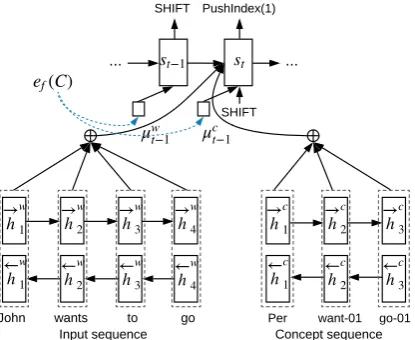
Figure 3: Sequence-to-sequence model with soft attention, encoding a word sequence and concept sequence separately by two BiLSTM encoders.
EGto decide which transition to take next, or else to decide that it should fail. This decision is based on the mutually exclusive rules listed below.
1. ShiftOrPop phase: the oracle chooses transi-tionPop, in case there is no edge (vm, v) in
EGsuch that vertexvis inS, or chooses tran-sitionShiftand proceeds to the next phase.
2. PushIndex phase: in this phase, the oracle first chooses a positioni(as explained below) in the cache to place the candidate concept and removes the vertex at this position and places its index, vertex pair onto the stack. The oracle chooses transition PushIndex(i) and proceeds to the next phase.
3. ArcBinary, ArcLabel phases: between the rightmost cache concept and each concept in the cache, we make a binary decision about whether there is an arc between them. If there is an arc, the oracle chooses its direction and label. After arc decisions tom−1cache con-cepts are made, we jump to the next step.
4. If the stack and buffer are both empty, and the cache is in the initial state, the oracle fin-ishes with success, otherwise we proceed to the first step.
We use the equation below to choose the cache concept to take out in the stepPushIndex(i). For
j ∈ [|β|], we writeβj to denote thej-th vertex in
β. We choose a vertexvi∗ inηsuch that:
i∗ = argmax
i∈[m]
[image:4.595.78.286.63.233.2]min {j | (vi, βj)∈EG}
Figure 4: Sequence-to-sequence model with monotonic hard attention. Different colors show the changes of hard attention focus.
In words,vi∗ is the concept from the cache whose closest neighbor in the bufferβis furthest forward inβ. We move out of the cache vertexvi∗and push it onto the stack, for later processing.
For each training example (x1:n, g), the tran-sition system generates the output AMR graph g
from the input sequencex1:nthrough an oracle se-quence a1:q ∈ Σ∗a, where Σa is the union of all possible actions. We model the probability of the output with the action sequence:
P(a1:q|x1:n) = q
t=1
P(at|a1, . . . , at−1, x1:n;θ)
which we estimate using a sequence-to-sequence model, as we will describe in the next section.
3 Soft vs Hard Attention for Sequence-to-action-sequence
Shown in Figure 3, our sequence-to-sequence model takes a word sequencew1:n and its mapped concept sequencec1:nas the input, and the action sequencea1:q as the output. It uses two BiLSTM encoders, each encoding an input sequence. As the two encoders have the same structure, we only introduce the encoder for the word sequence in de-tail below.
3.1 BiLSTM Encoder
Given an input word sequencew1:n, we use a bidi-rectional LSTM to encode it. At each stepj, the current hidden states←−hw
j and −→hwj are generated from the previous hidden states←h−w
j+1 and
− →
and the representation vectorxj of the current
in-put wordwj:
←−
hwj =LSTM(←−hwj+1, xj)
− →
hwj =LSTM(−→hwj−1, xj)
The representation vectorxj is the concatenation
of the embeddings of its word, lemma, and POS tag, respectively. Then the hidden states of both directions are concatenated as the final hidden state for wordwj:
hwj = [←−hwj;−→hwj ]
Similarly, for the concept sequence, the final hidden state for conceptcj is:
hcj = [←−hcj;−→hcj]
3.2 LSTM Decoder with Soft Attention
We use an attention-based LSTM decoder ( Bah-danau et al., 2014) with two attention memories
HwandHc, whereHw is the concatenation of the
state vectors of all input words, and Hc for input
concepts correspondingly:
Hw= [hw1;h2w;. . .;hwn0] (1)
Hc= [hc1;h2c;. . .;hcn] (2)
The decoder yields an action sequence
a1, a2, . . . , aq as the output by calculating a
se-quence of hidden states s1, s2. . . , sq recurrently.
While generating the t-th output action, the decoder considers three factors: (1) the previous hidden state of the LSTM model st−1; (2) the
embedding of the previous generated actionet−1;
and (3) the previous context vectors for words
µwt−1 and concepts µct−1, which are calculated
usingHw andHc, respectively. Whent = 1, we
initialize µ0 as a zero vector, and set e0 to the
embedding of the start token “hsi”. The hidden states0is initialized as:
s0 =Wd[
←−
hw1;−→hwn;←h−c1;−→hcn] +bd,
whereWdandbdare model parameters.
For each time-stept, the decoder feeds the con-catenation of the embedding of previous action
et−1 and the previous context vectors for words µwt−1 and conceptsµct−1 into the LSTM model to update its hidden state.
st=LSTM(st−1,[et−1;µwt−1;µct−1]) (3)
Then the attention probabilities for the word se-quence and the concept sese-quence are calculated similarly. Take the word sequence as an example,
αwt,i onhwi ∈Hw for time-steptis calculated as:
t,i =vcTtanh(Whhwi +Wsst+bc)
αwt,i = exp(t,i) PN
j=1exp(t,j)
Wh,Ws,vcandbcare model parameters. The new
context vectorµwt = Pn
i=1αwt,ihwi . The
calcula-tion ofµct follows the same procedure, but with a different set of model parameters.
The output probability distribution over all ac-tions at the current state is calculated by:
PΣa =softmax(Va[st;µ w
t;µct] +ba), (4)
whereVaandbaare learnable parameters, and the
number of rows inVarepresents the number of all
actions. The symbolΣais the set of all actions.
3.3 Monotonic Hard Attention for Transition Systems
When we process each buffer input, the next few transition actions are closely related to this input position. The buffer maintains the order informa-tion of the input sequence and is processed strictly left-to-right, which essentially encodes a mono-tone alignment between the transition action se-quence and the input sese-quence.
As we have generated a concept sequence from the input word sequence, we maintain two hard attention pointers,lw andlc, to model monotonic
attention to word and concept sequences respec-tively. The update to the decoder state now relies on a single position of each input sequence in con-trast to Equation3:
st=LSTM(st−1,[et−1;hwlw;h c
lc]) (5) Control Mechanism. Both pointers are initial-ized as 0 and advanced to the next position deter-ministically. We move the concept attention focus
lcto the next position after arc decisions to all the
otherm−1 cache concepts are made. We move the word attention focuslw to its aligned position
3.4 Transition State Features for Decoder
Another difference of our model with Buys and Blunsom (2017) is that we extract features from the current transition state configurationCt:
ef(Ct) = [ef1(Ct);ef2(Ct);· · ·;efl(Ct)]
where lis the number of features extracted from
Ctandefk(Ct) (k = 1, . . . , l)represents the
em-bedding for thek-th feature, which is learned dur-ing traindur-ing. These feature embedddur-ings are con-catenated asef(Ct), and fed as additional input to
the decoder. For the soft attention decoder:
st=LSTM(st−1,[et−1;µwt−1;µct−1;ef(Ct)])
and for the hard attention decoder:
st=LSTM(st−1,[et−1;hwlw;h c
lc;ef(Ct)])
We use the following features in our experiments:
1. Phase type: indicator features showing which phase the next transition is.
2. ShiftOrPop features: token features3 for the rightmost cache concept and the leftmost buffer concept. Number of dependencies to words on the right, and the top three depen-dency labels for them.
3. ArcBinary or ArcLabel features: token fea-tures for the rightmost concept and the cur-rent cache concept it makes arc decisions to. Word, concept and dependency distance be-tween the two concepts. The labels for the two most recent outgoing arcs for these two concepts and their first incoming arc and the number of incoming arcs. Dependency label between the two positions if there is a depen-dency arc between them.
4. PushIndex features: token features for the leftmost buffer concept and all the concepts in the cache.
The phase type features are deterministic from the last action output. For example, if the last action output is Shift, the current phase type would be PushIndex. We only extract corresponding fea-tures for this phase and fill all the other feature types with-NULL-as placeholders. The features for other phases are similar.
3Concept, concept category at the specified position in
concept sequence. And the word, lemma, POS tag at the aligned input position.
4 AMR Parsing
4.1 Training and Decoding
We train our models using the cross-entropy loss, over each oracle action sequencea∗1, . . . , a∗q:
L=−
q
X
t=1
logP(a∗t|a∗1, . . . , a∗t−1, X;θ), (6)
where X represents the input word and concept sequences, andθis the model parameters. Adam (Kingma and Ba, 2014) with a learning rate of 0.001 is used as the optimizer, and the model that yields the best performance on the dev set is se-lected to evaluate on the test set. Dropout with rate 0.3 is used during training. Beam search with a beam size of 10 is used for decoding. Both train-ing and decodtrain-ing use a Tesla K20X GPU.
Hidden state sizes for both encoder and decoder are set to 100. The word embeddings are ini-tialized from Glove pretrained word embeddings (Pennington et al.,2014) on Common Crawl, and are not updated during training. The embeddings for POS tags and features are randomly initialized, with the sizes of 20 and 50, respectively.
4.2 Preprocessing and Postprocessing
As the AMR data is very sparse, we collapse some subgraphs or spans into categories based on the alignment. We define some special cate-gories such as named entities (NE), dates (DATE), single rooted subgraphs involving multiple con-cepts (MULT)4, numbers (NUMBER) and phrases (PHRASE). The phrases are extracted based on the multiple-to-one alignment in the training data. One example phrase ismore thanwhich aligns to a single conceptmore-than. We first collapse spans and subgraphs into these categories based on the alignment from the JAMR aligner (Flanigan et al., 2014), which greedily aligns a span of words to AMR subgraphs using a set of heuristics. This cat-egorization procedure enables the parser to capture mappings from continuous spans on the sentence side to connected subgraphs on the AMR side.
We use the semi-Markov model fromFlanigan et al.(2016) as the concept identifier, which jointly segments the sentence into a sequence of spans and maps each span to a subgraph. During decod-ing, our output has categories, and we need to map
4For example, verbalization of “teacher” as “(person
ShiftOrPop PushIndex ArcBinary ArcLabel Peng et al.(2018) 0.87 0.87 0.83 0.81
Soft+feats 0.93 0.84 0.91 0.75 Hard+feats 0.94 0.85 0.93 0.77
Table 1: Performance breakdown of each transi-tion phase.
each category to the corresponding AMR concept or subgraph. We save a tableQwhich shows the original subgraph each category is collapsed from, and map each category to its original subgraph representation. We also use heuristic rules to gen-erate the target-side AMR subgraph representation forNE,DATE, andNUMBERbased on the source side tokens.
5 Experiments
We evaluate our system on the released dataset (LDC2015E86) for SemEval 2016 task 8 on mean-ing representation parsmean-ing (May, 2016). The dataset contains 16,833 training, 1,368 develop-ment, and 1,371 test sentences which mainly cover domains like newswire, discussion forum, etc. All parsing results are measured by Smatch (version 2.0.2) (Cai and Knight,2013).
5.1 Experiment Settings
We categorize the training data using the auto-matic alignment and dump a template for date en-tities and frequent phrases from the multiple to one alignment. We also generate an alignment table from tokens or phrases to their candidate target-side subgraphs. For the dev and test data, we first extract the named entities using the Illinois Named Entity Tagger (Ratinov and Roth, 2009) and ex-tract date entities by matching spans with the date template. We further categorize the dataset with the categories we have defined. After categoriza-tion, we use Stanford CoreNLP (Manning et al., 2014) to get the POS tags and dependencies of the categorized dataset. We run the oracle algorithm separately for training and dev data (with align-ment) to get the statistics of individual phases. We use a cache size of 5 in our experiments.
5.2 Results
Individual Phase Accuracy We first evaluate the prediction accuracy of individual phases on the dev oracle data assuming gold prediction history. The four transition phasesShiftOrPop,PushIndex, ArcBinary, andArcLabelaccount for 25%, 12.5%,
50.1%, and 12.4% of the total transition actions respectively. Table 1 shows the phase-wise ac-curacy of our sequence-to-sequence model. Peng et al. (2018) use a separate feedforward network to predict each phase independently. We use the same alignment from the SemEval dataset as in Peng et al. (2018) to avoid differences resulting from the aligner. Soft+feats shows the perfor-mance of our sequence-to-sequence model with soft attention and transition state features, while Hard+feats is using hard attention. We can see that the hard attention model outperforms the soft attention model in all phases, which shows that the single-pointer attention finds more relevant in-formation than the soft attention on the relatively small dataset. The sequence-to-sequence mod-els perform better than the feedforward model of Peng et al. (2018) on ShiftOrPop andArcBinary, which shows that the whole-sentence context in-formation is important for the prediction of these two phases. On the other hand, the sequence-to-sequence models perform worse than the feedfor-ward models on PushIndex and ArcLabel. One possible reason is that the model tries to optimize the overall accuracy, while these two phases ac-count for fewer than 25% of the total transition actions and might be less attended to during the update.
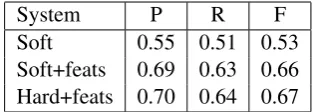
Impact of Different Components Table 2 shows the impact of different components for the sequence-to-sequence model. We can see that the transition state features play a very important role for predicting the correct transition action. This is because different transition phases have very different prediction behaviors and need different types of local information for the prediction. Rely-ing on the sequence-to-sequence model alone does not perform well in disambiguating these choices, while the transition state can enforce direct con-straints. We can also see that while the hard at-tention only attends to one position of the input, it performs slightly better than the soft attention model, while the time complexity is lower.
[image:7.595.75.291.64.104.2]System P R F
Soft 0.55 0.51 0.53
[image:8.595.312.520.60.132.2]Soft+feats 0.69 0.63 0.66 Hard+feats 0.70 0.64 0.67
Table 2: Impact of various components for the sequence-to-sequence model (dev).
Cache Size P R F
4 0.69 0.63 0.66
5 0.70 0.64 0.67
[image:8.595.102.259.62.118.2]6 0.69 0.64 0.66
Table 3: Impact of cache size for the sequence-to-sequence model, hard attention (dev).
the hard attention model performs best with cache size 5. The soft attention model also achieves best performance with the same cache size.
Comparison with other Parsers Table4shows the comparison with other AMR parsers. The first three systems are some competitive neural models. We can see that our parser significantly outper-forms the sequence-to-action-sequence model of Buys and Blunsom(2017). Konstas et al. (2017) use a linearization approach that linearizes the AMR graph to a sequence structure and use self-training on 20M unlabeled Gigaword sentences. Our model achieves better results without using additional unlabeled data, which shows that rele-vant information from the transition system is very useful for the prediction. Our model also outper-forms the stack-LSTM model by Ballesteros and Al-Onaizan(2017), while their model is evaluated on the previous release of LDC2014T12.
System P R F
Buys and Blunsom(2017) – – 0.60
Konstas et al.(2017) 0.60 0.65 0.62
Ballesteros and Al-Onaizan(2017)* – – 0.64
Damonte et al.(2017) – – 0.64
Peng et al.(2018) 0.69 0.59 0.64
Wang et al.(2015b) 0.64 0.62 0.63
Wang et al.(2015a) 0.70 0.63 0.66
Flanigan et al.(2016) 0.70 0.65 0.67
Wang and Xue(2017) 0.72 0.65 0.68 Ours soft attention 0.68 0.63 0.65 Ours hard attention 0.69 0.64 0.66
Table 4: Comparison to other AMR parsers. *Model has been trained on the previous release of the corpus (LDC2014T12).
System P R F
Peng et al.(2018) 0.44 0.28 0.34 Damonte et al.(2017) – – 0.41
JAMR 0.47 0.38 0.42
Ours 0.58 0.34 0.43
Table 5: Reentrancy statistics.
We also show the performance of some of the best-performing models. While our hard attention achieves slightly lower performance in compari-son withWang et al.(2015a) andWang and Xue (2017), it is worth noting that their approaches of using WordNet, semantic role labels and word cluster features are complimentary to ours. The alignment from the aligner and the concept iden-tification identifier also play an important role for improving the performance.Wang and Xue(2017) propose to improve AMR parsing by improving the alignment and concept identification, which can also be combined with our system to im-prove the performance of a sequence-to-sequence model.
Dealing with Reentrancy Reentrancy is an im-portant characteristic of AMR, and we evaluate the Smatch score only on the reentrant edges fol-lowing Damonte et al.(2017). From Table 5we can see that our hard attention model significantly outperforms the feedforward model ofPeng et al. (2018) in predicting reentrancies. This is because predicting reentrancy is directly related to the Ar-cBinaryphase of the cache transition system since it decides to make multiple arc decisions to the same vertex, and we can see from Table 1 that the hard attention model has significantly better prediction accuracy in this phase. We also com-pare the reentrancy results of our transition system with two other systems,Damonte et al.(2017) and JAMR, where these statistics are available. From Table5, we can see that our cache transition sys-tem slightly outperforms these two syssys-tems in pre-dicting reentrancies.
[image:8.595.106.259.169.228.2] [image:8.595.74.289.574.717.2]i - desire-01 live-01 any city ARG0 ARG0
polarity ARG1
location
$ $ i - desire-01
polarity ARG0
$ i - desire-01 live-01
ARG1 ARG0 Our hard attention output:
Sentence: I have no desire to live in any city .
Cache arc decisions creating the reentrancy
(cache size of 5): JAMR output:
Peng et al. (2018) output:
mod
i - desire-01 live-01 any city
polarity ARG1
location mod
i - desire-01 live-01 any city
ARG0 polarity
ARG1
[image:9.595.110.490.96.358.2]location mod
Figure 5: An example showing how our system predicts the correct reentrancy.
andlive-01toi. This error is because their feed-forward ArcBinary classifier does not model long-term dependency and usually prefers making arcs between words that are close and not if they are distant. Our classifier, which encodes both word and concept sequence information, can accurately predict the reentrancy through the two arc deci-sions shown in Figure5. Whendesire-01and live-01are shifted into the cache respectively, the tran-sition system makes a left-going arc from each of them to the same concepti, thus creating the reen-trancy as desired.
6 Conclusion
In this paper, we have presented a sequence-to-action-sequence approach for cache transition sys-tems and applied it to AMR parsing. To address the data sparsity issue for neural AMR parsing, we show that the transition state features are very helpful in constraining the possible output and im-proving the performance of sequence-to-sequence models. We also show that the monotonic hard at-tention model can be generalized to the transition-based framework and outperforms the soft atten-tion model when limited data is available. While
we are focused on AMR parsing in this paper, in future work our cache transition system and the presented sequence-to-sequence models can be potentially applied to other semantic graph parsing tasks (Oepen et al.,2015;Du et al.,2015;Zhang et al.,2016;Cao et al.,2017).
Acknowledgments
We gratefully acknowledge the assistance of Hao Zhang from Google, New York for the monotonic hard attention idea and the helpful comments and suggestions.
References
Roee Aharoni and Yoav Goldberg. 2017. Morphologi-cal inflection generation with hard monotonic atten-tion. InProceedings of the 55th Annual Meeting of the Association for Computational Linguistics (Vol-ume 1: Long Papers), pages 2004–2015, Vancouver, Canada. Association for Computational Linguistics.
Dzmitry Bahdanau, Kyunghyun Cho, and Yoshua Ben-gio. 2014. Neural machine translation by jointly learning to align and translate. arXiv preprint arXiv:1409.0473.
Miguel Ballesteros and Yaser Al-Onaizan. 2017. AMR parsing using stack-LSTMs. InProceedings of the 2017 Conference on Empirical Methods in Natural Language Processing, pages 1269–1275.
Laura Banarescu, Claire Bonial, Shu Cai, Madalina Georgescu, Kira Griffitt, Ulf Hermjakob, Kevin Knight, Philipp Koehn, Martha Palmer, and Nathan Schneider. 2013. Abstract meaning representation for sembanking. InProceedings of the 7th Linguis-tic Annotation Workshop and Interoperability with Discourse, pages 178–186, Sofia, Bulgaria.
Jan Buys and Phil Blunsom. 2017. Robust incremen-tal neural semantic graph parsing. InProceedings of the 55th Annual Meeting of the Association for Com-putational Linguistics (Volume 1: Long Papers), volume 1, pages 1215–1226.
Shu Cai and Kevin Knight. 2013. Smatch: an evalua-tion metric for semantic feature structures. In Pro-ceedings of the 51st Annual Meeting of the Associa-tion for ComputaAssocia-tional Linguistics (ACL-13), pages 748–752.
Junjie Cao, Sheng Huang, Weiwei Sun, and Xiao-jun Wan. 2017. Parsing to 1-endpoint-crossing, pagenumber-2 graphs. InProceedings of the 55th Annual Meeting of the Association for Computa-tional Linguistics (Volume 1: Long Papers), vol-ume 1, pages 2110–2120.
Marco Damonte, Shay B Cohen, and Giorgio Satta. 2017. An incremental parser for abstract meaning representation. InProceedings of the 15th Confer-ence of the European Chapter of the Association for Computational Linguistics: Volume 1, Long Papers, volume 1, pages 536–546.
Yantao Du, Fan Zhang, Xun Zhang, Weiwei Sun, and Xiaojun Wan. 2015. Peking: Building semantic de-pendency graphs with a hybrid parser. In Proceed-ings of the 9th International Workshop on Semantic Evaluation (SemEval 2015), pages 927–931.
Chris Dyer, Miguel Ballesteros, Wang Ling, Austin Matthews, and Noah A Smith. 2015. Transition-based dependency parsing with stack long short-term memory. In Proceedings of the 53rd Annual Meeting of the Association for Computational Lin-guistics and the 7th International Joint Conference on Natural Language Processing (Volume 1: Long Papers), volume 1, pages 334–343.
Jeffrey Flanigan, Chris Dyer, Noah A Smith, and Jaime Carbonell. 2016. CMU at SemEval-2016 task 8: Graph-based AMR parsing with infinite ramp loss. InProceedings of the 10th International Workshop on Semantic Evaluation (SemEval-2016), pages 1202–1206.
Jeffrey Flanigan, Sam Thomson, Jaime Carbonell, Chris Dyer, and Noah A. Smith. 2014. A discrim-inative graph-based parser for the abstract mean-ing representation. InProceedings of the 52nd An-nual Meeting of the Association for Computational Linguistics (ACL-14), pages 1426–1436, Baltimore, Maryland.
Daniel Gildea, Giorgio Satta, and Xiaochang Peng. 2018. Cache transition systems for graph parsing.
Computational Linguistics, 44(1):85–118.
Lifu Huang, Taylor Cassidy, Xiaocheng Feng, Heng Ji, Clare R Voss, Jiawei Han, and Avirup Sil. 2016. Liberal event extraction and event schema induction. InProceedings of the 54th Annual Meeting of the As-sociation for Computational Linguistics (Volume 1: Long Papers), volume 1, pages 258–268.
Diederik P Kingma and Jimmy Ba. 2014. Adam: A method for stochastic optimization. arXiv preprint arXiv:1412.6980.
Ioannis Konstas, Srinivasan Iyer, Mark Yatskar, Yejin Choi, and Luke Zettlemoyer. 2017. Neural AMR: Sequence-to-sequence models for parsing and gen-eration. In Proceedings of the 55th Annual Meet-ing of the Association for Computational LMeet-inguis- Linguis-tics (Volume 1: Long Papers), pages 146–157, Van-couver, Canada. Association for Computational Lin-guistics.
Fei Liu, Jeffrey Flanigan, Sam Thomson, Norman Sadeh, and Noah A Smith. 2015. Toward abstrac-tive summarization using semantic representations. InProceedings of the 2015 Conference of the North American Chapter of the Association for Computa-tional Linguistics: Human Language Technologies, pages 1077–1086.
Christopher D Manning, Mihai Surdeanu, John Bauer, Jenny Rose Finkel, Steven Bethard, and David Mc-Closky. 2014. The Stanford CoreNLP natural lan-guage processing toolkit. In ACL (System Demon-strations), pages 55–60.
Jonathan May. 2016. SemEval-2016 task 8: Mean-ing representation parsMean-ing. In Proceedings of the 10th International Workshop on Semantic Evalua-tion (SemEval-2016), pages 1063–1073, San Diego, California.
Joakim Nivre. 2008. Algorithms for deterministic in-cremental dependency parsing. Computational Lin-guistics, 34(4):513–553.
Rik van Noord and Johan Bos. 2017. Neural seman-tic parsing by character-based translation: Experi-ments with abstract meaning representations. arXiv preprint arXiv:1705.09980.
task 18: Broad-coverage semantic dependency pars-ing. InProceedings of the 9th International Work-shop on Semantic Evaluation (SemEval 2015), pages 915–926, Denver, Colorado.
Xiaochang Peng, Daniel Gildea, and Giorgio Satta. 2018. AMR parsing with cache transition systems. InProceedings of the National Conference on Arti-ficial Intelligence (AAAI-18).
Xiaochang Peng, Linfeng Song, and Daniel Gildea. 2015.A synchronous hyperedge replacement gram-mar based approach for AMR parsing. In Proceed-ings of the Nineteenth Conference on Computational Natural Language Learning (CoNLL-15), pages 32– 41, Beijing, China.
Xiaochang Peng, Chuan Wang, Daniel Gildea, and Ni-anwen Xue. 2017. Addressing the data sparsity is-sue in neural AMR parsing. In Proceedings of the European Chapter of the ACL (EACL-17).
Jeffrey Pennington, Richard Socher, and Christopher Manning. 2014. Glove: Global vectors for word representation. In Proceedings of the 2014 Con-ference on Empirical Methods in Natural Language Processing (EMNLP), pages 1532–1543, Doha, Qatar.
Michael Pust, Ulf Hermjakob, Kevin Knight, Daniel Marcu, and Jonathan May. 2015. Parsing English into abstract meaning representation using syntax-based machine translation. In Proceedings of the 2015 Conference on Empirical Methods in Natu-ral Language Processing, pages 1143–1154, Lis-bon, Portugal. Association for Computational Lin-guistics.
Lev Ratinov and Dan Roth. 2009. Design chal-lenges and misconceptions in named entity recog-nition. In Proceedings of the Thirteenth Confer-ence on Computational Natural Language Learning (CoNLL-2009), pages 147–155, Boulder, Colorado. Association for Computational Linguistics.
Sho Takase, Jun Suzuki, Naoaki Okazaki, Tsutomu Hirao, and Masaaki Nagata. 2016. Neural head-line generation on abstract meaning representation. In Proceedings of the 2016 Conference on Empiri-cal Methods in Natural Language Processing, pages 1054–1059.
Chuan Wang and Nianwen Xue. 2017. Getting the most out of AMR parsing. In Proceedings of the 2017 Conference on Empirical Methods in Natural Language Processing, pages 1257–1268.
Chuan Wang, Nianwen Xue, and Sameer Pradhan. 2015a. Boosting transition-based AMR parsing with refined actions and auxiliary analyzers. In Pro-ceedings of the 53rd Annual Meeting of the Associa-tion for ComputaAssocia-tional Linguistics (ACL-15), pages 857–862, Beijing, China.
Chuan Wang, Nianwen Xue, and Sameer Pradhan. 2015b. A transition-based algorithm for AMR pars-ing. In Proceedings of the 2015 Meeting of the North American chapter of the Association for Com-putational Linguistics (NAACL-15), pages 366–375, Denver, Colorado.