Proceedings of the 55th Annual Meeting of the Association for Computational Linguistics-System Demonstrations, pages 97–102 Vancouver, Canada, July 30 - August 4, 2017. c2017 Association for Computational Linguistics
Proceedings of the 55th Annual Meeting of the Association for Computational Linguistics-System Demonstrations, pages 97–102 Vancouver, Canada, July 30 - August 4, 2017. c2017 Association for Computational Linguistics
SuperAgent: A Customer Service Chatbot for E-commerce Websites
Lei Cui∗,Shaohan Huang∗,Furu Wei,Chuanqi Tan,Chaoqun Duan, andMing Zhou
Microsoft Research Asia
{lecu,shaohanh,fuwei,v-chutan,v-chadu,mingzhou}@microsoft.com
Abstract
Conventional customer service chatbots are usually based on human dialogue, yet significant issues in terms of data scale and privacy. In this paper, we present SuperA-gent, a customer service chatbot that lever-ages largscale and publicly available e-commerce data. Distinct from existing counterparts, SuperAgent takes advantage of data from in-page product descriptions as well as user-generated content from e-commerce websites, which is more prac-tical and cost-effective when answering repetitive questions, freeing up human support staff to answer much higher value questions. We demonstrate SuperAgent as an add-on extension to mainstream web browsers and show its usefulness to user’s online shopping experience.
1 Introduction
Customer service plays an important role in an or-ganization’s ability to generate income and rev-enue. It is often the most resource-intensive de-partment within a company, consuming billions of dollars a year to change the entire percep-tion customers hold. Support staff spend a lot of time answering questions via telephone or mes-saging applications to make sure are customers satisfied with their business. This traditional cus-tomer service has two problems: First, staff usu-ally receive repetitive questions asked by a vari-ety of customers, which can be cost-effectively answered by machines. Second, it is difficult to support 7×24 services, especially for most
non-global businesses. Therefore, chatbots can be a great way to supplement customer service offer-ings since they are more economical and
indefati-∗
The first two authors contribute equally to this work.
gable, and free up support staff to answer much higher value queries.
Recently, virtual assistants for customer service have become more and more popular with cus-tomer oriented businesses. Most of them are built from human conversations in the past, which is straightforward but faced with problems of data scale and privacy. Most of the time, customers need to wait online to get a support staff person’s answer, which is less effective and difficult to scale up. Meanwhile, customers may have privacy con-cerns about the conversations, hence conversations with customers cannot be easily leveraged to train a chatbot. It is essential to find large-scale and publicly available customer service data sources on which to build such assistants.
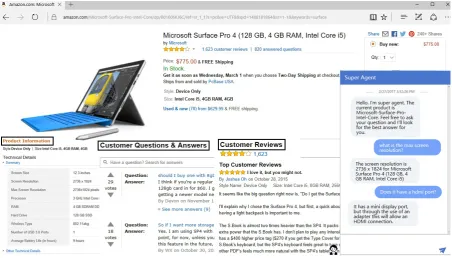
In this paper, we demonstrate SuperAgent, a powerful customer service chatbot leveraging large-scale and publicly available e-commerce data. Nowadays, large e-commerce websites con-tain a great deal of in-page product descriptions as well as user-generated content, such as Ama-zon.com, Ebay.com, and JD.com. Figure1shows a product page from Amazon.com, which contains detailed Product Information (PI), a set of exist-ing customer Questions & Answers (QA), as well as sufficient Customer Reviews (CR). This crowd-sourcing style of data provides appropriate infor-mation to feed into chat engines, accompanying human support staff to deliver better customer ser-vice experience when online shopping.
We define the problem as follows: given a spe-cific product page and a customer question, Super-Agent selects the best answer from existing data sources within the page (PI+QA+CR). If it can-not find the answer, it indicates that no replies will be generated. Specifically, we decompose the chat engine into three sub-engines: 1) a fact question answering engine for PI; 2) an FAQ search engine for QA; 3) an opinion mining & text question
Figure 1: An example of a product page from Amazon.com, including product information, customer Q&A, and reviews. SuperAgent is an add-on extension located at the bottom right corner.
swering engine for CR. In addition, we also add a chit-chat engine as the back-fill to make conversa-tions as smooth as possible. To improve the overall online shopping experience, we demonstrate Su-perAgent as an add-on extension to mainstream web browsers such as Microsoft Edge and Google Chrome, where the conversation UI is shown at the bottom right corner, as shown in Figure1.
Compared to conventional customer service chatbots, SuperAgent has several promising ad-vantages:
1. SuperAgent can easily leverage crowd-sourcing styles, as well as large-scale and publicly available e-commerce data,
2. SuperAgent contains a set of state-of-the-art NLP and machine learning techniques, in-cluding fact QA, FAQ search, opinion min-ing, text QA, and chit-chat conversation. 3. SuperAgent is integrated into e-commerce
websites as an add-on extension, which can directly improve customer’s online shopping experience.
The rest of the paper is organized as follows: The system details are described in Section 2. The usability analysis is presented in Section 3. Sec-tion 4 introduces some related work. SecSec-tion 5 concludes the paper and suggests future directions.
2 System Details
2.1 Overview
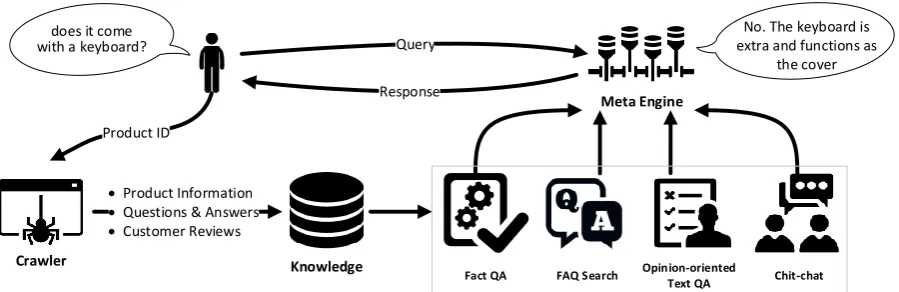
Figure 2 shows the system overview of SuperA-gent. As the figure shows, when the product page is first visited, SuperAgent crawls the html in-formation and scrape PI+QA+CR data from the webpage. The advantage of this design pattern is that we do not need to deploy web crawlers for the websites. Instead, when users visit the page, SuperAgent will be notified since the add-on ex-tension is associated with each webpage. There-fore, SuperAgent brings very few additional web loads to the host websites. Besides, this architec-ture makes data updates very easy to implement, where frequently-visited pages get updated fre-quently and vice versa. After that, given an input query from a customer, different engines are pro-cessed in parallel. If one of the answers from the first three engines has high confidence, the chat-bot returns with the answer as the response. Oth-erwise, the chit-chat engine will generate a reply from the predefined permitted response sets. Next, we introduce these engines in detail.
2.2 Fact QA for Product Information
Product ID
Knowledge
Product Information
Questions & Answers
Customer Reviews
Fact QA FAQ Search Opinion-oriented Text QA Chit-chat Crawler
Meta Engine Query
Response does it come
with a keyboard?
No. The keyboard is extra and functions as
[image:3.595.76.526.64.210.2]the cover
Figure 2: The system overview of SuperAgent
format of knowledge triples h#, attribute name, attribute valuei, where # represents the product
name in our scenario. We focus on simple fact inquiry in this paper. As a result, the task is trans-formed to matching the question to the attribute names in the product information. This is achieved with a deep learning based matching framework. Specifically, the input question is matched with ev-ery attribute name using the DSSM model (Huang et al., 2013). We select the top-ranked attribute name which passes a predefined threshold as the result from attribute matching. The corresponding attribute value is further used to generate the re-sponse sentences with predefined templates. The engine’s output is shown as follows:
Q: What’s the CPU?
A: The processor is 3 GHz Intel Core i5
for Microsoft Surface Pro 4 (128 GB, 4 GB RAM, Intel Core i5)
Q: What is the pre-installed operating
system?
A: The operating system is Windows
10 Pro for Microsoft Surface Pro 4 (128 GB, 4 GB RAM, Intel Core i5)
2.3 FAQ Search for Customer QA Pairs
The FAQ search engine is defined as follows: given a set of QA pairs P = {qi, ai}ni=1 and a customer’s questionq, we find the most similarqj inP and return the correspondingaj as the reply. For example, given two QA pairs:
Q: does it come with a keyboard
A: No. The keyboard is extra and
func-tions as the cover
Q: does it come with the pen
A: yes it does
Then, if the user asks “does it have a keyboard”, the question “does it come with a keyboard” will be matched and the answer should be “No. The keyboard is extra and functions as the cover”. Therefore, the question ranking problem is essen-tial for an FAQ search engine.
Formally, given two questions q and q0, the question ranker will learn a mapping function f
wheref(q, q0) → [0,1], sof is actually a
seman-tic similarity metric between two questions, in-dicating whether they convey the same meaning. We train a regression forest model (Meinshausen,
2006) and use the following features: monolingual word aligner (Sultan et al., 2014), DSSM model (Huang et al., 2013), word embedding composi-tion (max, sum, idf-sum) with GloVe ( Penning-ton et al., 2014), n-gram overlap, subsequence matching, PairingWords (Han et al., 2013), word mover’s distance (Kusner et al.,2015).
The model is evaluated on the dataset for SemEval-2016 Task 1. The mean accuracy (Pear-son Correlation) of our model on five datasets (0.78455) significantly outperforms the 1st place team (0.77807)1. Specifically, the accuracy on the
question-to-question dataset is 0.75773, surpass-ing the 1st place team (0.68705) by a large mar-gin. This confirms the effectiveness of our model on the FAQ search task.
2.4 Opinion-Oriented Text QA for Reviews
Customer reviews provide rich information for different aspects of the product from users’
per-1http://alt.qcri.org/semeval2016/
spective. They are very important resources for answering opinion-oriented questions. To this end, we first split the review text into sentences and run opinion mining modules to extract the as-pects and corresponding opinions. We then use the text question answering module to generate re-sponses (i.e. review sentences).
For opinion mining, we use a hybrid approach (Qiu et al., 2011) to extract the aspects from re-view sentences. We also run the sentiment clas-sifier (Tang et al.,2014) to determine the polarity (i.e. positive, negative, and neutral) of the sen-tence regarding the specific aspect mentioned. The aspects and polarity are indexed together with key-words using the Lucene toolkit2.
For text QA, given an input query, it outputs the answer based on the following three steps:
• Candidate retrieval, which searches the query by Lucene to get candidate sentences. • Candidate ranking, which ranks all
candi-date sentences with a regression based rank-ing framework.
• Candidate triggering, which decides whether it is confident enough to output the candidate. Specifically, for candidate retrieval, we use the default ranker in Lucene to retrieve the top 20 can-didate sentences. For cancan-didate ranking, we build a regression based framework to rank all candidate sentences based on features designed at differ-ent levels of granularity. Our feature set consists of WordCnt, translation model, type matching, WordNet, and two neural network based methods BiCNN (Yu et al.,2014) and MatchLSTM (Wang and Jiang, 2016). We conduct experiments on the WikiQA (Yang et al., 2015) dataset. The re-sults show that we achieve state-of-the-art rere-sults with 0.7164 in terms of MAP and 0.7332 in terms of MRR. For candidate triggering, as the ranking model outputs a regression score for each candi-date sentence, we only output the candicandi-date sen-tence whose score is higher than the threshold se-lected on the development set. The engine’s output examples are shown as follows:
Q: what do you think of the battery life
of surface pro 4?
R: I’ve been getting˜7-9 hours of bat-tery life on the SP4 which is more than enough to get me through a school day. 2http://lucene.apache.org
Q: Is the screen size of surface pro 4 appropriate for reading?
R: The screen is not too small like the
iPad, neither is it bulky like a laptop.
2.5 Chit-chat Conversation Modeling
The chit-chat engine is mainly designed to reply to greeting queries such as “hello“ and “thank you”, as well as queries that cannot be answered by the previous three engines, such as “you are so cute”. However, general chit-chat engines tend to be topic-deviated so that the replies may be ir-relevant. To avoid such deviations, we follow the smart reply approach for email reply suggestions (Kannan et al.,2016) to predefine a permitted re-sponse set. Formally, the chit-chat model is an attention-based LSTM seq2seq model (Bahdanau et al., 2014) trained on twitter conversation data (˜43 million query-reply pairs). We select the 5 million most frequent non-duplicate short replies (less than 15 words) as the permitted response set, most of which are greetings and common replies. The end-to-end perplexity of the seq2seq model is 16.9, which is similar toKannan et al.’s result. The engine’s output is very topic-coherent, which is shown as follows:
Q: hello
R: hey how are you?
Q: thank you
R: you’re very welcome sir
Q: you are so cute
R: u r more
2.6 Meta Engine
For each query, SuperAgent will call the above-mentioned sub-engines in parallel. The meta en-gine is then used to merge and prioritize the results from the different engines. We use a simple strat-egy to implement the meta engine, which prefers results from the engines in order of fact QA, FAQ search, text QA and chit-chat engine according to tunable threshold.
3 Usability Analysis
need to know what other people feel after the pur-chase. In addition, customers are also interested in the answers to similar questions that other peo-ple have. We randomly select 670 product pages from Amazon.com and get a total of 29,471 cus-tomer QA pairs, almost 44 pairs per product on av-erage. We also get 72,402 customer reviews, about 108 reviews per product on average. The number is much higher for a popular product, making it difficult for users to read all of them. For exam-ple, in Figure1, there are more than 800 QA pairs existing within the page, which is impossible to go through by customers. Besides, there are also more than 1,200 high quality customer reviews in the page of Figure1, which is overwhelming for users to read. Therefore, it is crucial to integrate these data into a unified knowledge base and pro-vide easy access to all customers.
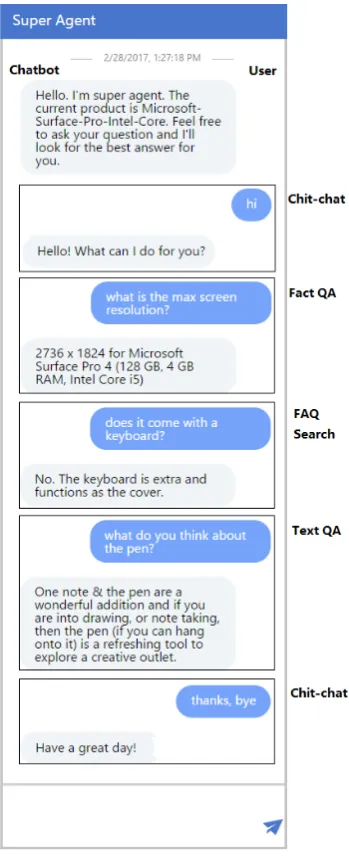
Figure 3shows a typical scenario when a tomer asks SuperAgent for help. When the cus-tomer opens up the chat window within web browsers, SuperAgent first detects which product is being visited. SuperAgent then makes a self-introduction and confirms that the customer is vis-iting the product. Subsequently, customers may greet SuperAgent or ask specific questions. As Figure3shows, SuperAgent is able to answer fact questions using in-page product information, con-duct an FAQ search from customer QA pairs, get text QA answers from customer reviews, and fi-nally greet customers using the chit-chat engine. The dialogs are coordinated by the meta engine so that different queries go to corresponding en-gines respectively. Since e-commerce websites get updated frequently and fresh user-generated con-tent emerges continuously, SuperAgent also up-dates the data and models periodically according to the frequency of customers’ visits.
4 Related Work
[image:5.595.327.502.61.494.2]Customer service chatbots can be roughly catego-rized into two types: first-party and third-party. First-party chatbots refer to conversation engines developed by large enterprises for their own busi-ness to improve customer service quality and re-duce overall customer service budget. This of-ten happens in consumer-driven industries such as banking, telecoms, and e-commerce. One exam-ple is the recently launched chatbot Erica from Bank of America, which helps customers with banking-related problems. Another example is the
Figure 3: A case study of SuperAgent
AT&T support chatbot that helps people answer FAQs related to different business questions.
Third-party chatbots refer to open source build-ing blocks that help developers to build their con-versation engines, such as Microsoft Bot Frame-work3, Facebook Messenger4, Google Assistant5,
and Amazon Lex6. These chatbot makers build
and connect intelligent conversation engines to in-teract with customers naturally wherever they are. In addition, they are highly customizable in terms of real scenarios with third-party data.
It is worth mentioning that we position Super-Agent as a third-party chatbot because it utilizes
publicly available third-party data. Moreover, it improves the overall online shopping experience for various products in an e-commerce website.
5 Conclusion and Future Work
We have developed SuperAgent, a customer ser-vice chatbot for e-commerce websites. Com-pared to conventional customer service chatbots, SuperAgent takes advantage of large-scale, pub-licly available, and crowd-sourced customer data. In addition, SuperAgent leverages state-of-the-art NLP and machine learning techniques, including fact QA, FAQ search, opinion-oriented text QA, as well as chit-chat conversation modeling. Usabil-ity analysis shows that SuperAgent has improved the end-to-end user experience in terms of online shopping. It is more convenient for customer’s in-formation acquisition especially when a product page contains too much user-generated content.
In the future, we will focus on two main prob-lems. First, we need to integrate a customer’s query intent detection module, so that we can bet-ter leverage individual engines. Second, we will have a deeper delve on multi-turn queries, where context modeling will be further investigated.
References
Dzmitry Bahdanau, Kyunghyun Cho, and Yoshua Bengio. 2014. Neural machine translation by jointly learning to align and translate. CoRR abs/1409.0473. http://arxiv.org/abs/1409.0473. Lushan Han, Abhay L. Kashyap, Tim Finin,
James Mayfield, and Jonathan Weese. 2013. Umbc ebiquity-core: Semantic textual similar-ity systems. In Second Joint Conference on Lexical and Computational Semantics (*SEM), Volume 1: Proceedings of the Main Confer-ence and the Shared Task: Semantic Textual Similarity. Association for Computational Lin-guistics, Atlanta, Georgia, USA, pages 44–52. http://www.aclweb.org/anthology/S13-1005. Po-Sen Huang, Xiaodong He, Jianfeng Gao, Li Deng,
Alex Acero, and Larry Heck. 2013. Learning deep structured semantic models for web search using clickthrough data. In Proceedings of the 22Nd ACM International Conference on Infor-mation & Knowledge Management. ACM, New York, NY, USA, CIKM ’13, pages 2333–2338. https://doi.org/10.1145/2505515.2505665.
Anjuli Kannan, Karol Kurach, Sujith Ravi, To-bias Kaufman, Balint Miklos, Greg Corrado, Andrew Tomkins, Laszlo Lukacs, Marina Ganea, Peter Young, and Vivek Ramavaj-jala. 2016. Smart reply: Automated response
suggestion for email. In Proceedings of the
ACM SIGKDD Conference on Knowledge
Discovery and Data Mining (KDD) (2016).. http://www.kdd.org/kdd2016/papers/files/Paper 1069.pdf. Matt J. Kusner, Yu Sun, Nicholas I. Kolkin, and
Kilian Q. Weinberger. 2015. From word em-beddings to document distances. In Proceedings of the 32Nd International Conference on International Conference on Machine Learning -Volume 37. JMLR.org, ICML’15, pages 957–966. http://dl.acm.org/citation.cfm?id=3045118.3045221. Nicolai Meinshausen. 2006. Quantile
regres-sion forests. J. Mach. Learn. Res. 7:983–999. http://dl.acm.org/citation.cfm?id=1248547.1248582.
Jeffrey Pennington, Richard Socher, and Christo-pher D. Manning. 2014. Glove: Global vectors for word representation. InEmpirical Methods in Nat-ural Language Processing (EMNLP). pages 1532– 1543.http://www.aclweb.org/anthology/D14-1162.
Guang Qiu, Bing Liu, Jiajun Bu, and Chun Chen. 2011. Opinion word expansion and target extrac-tion through double propagaextrac-tion. Comput. Linguist. 37(1):9–27. https://doi.org/10.1162/coli a 00034. Md Sultan, Steven Bethard, and Tamara
Sum-ner. 2014. Back to basics for monolingual alignment: Exploiting word similarity and con-textual evidence. Transactions of the Associ-ation for ComputAssoci-ational Linguistics 2:219–230. https://transacl.org/ojs/index.php/tacl/article/view/292. Duyu Tang, Furu Wei, Nan Yang, Ming Zhou, Ting
Liu, and Bing Qin. 2014. Learning sentiment-specific word embedding for twitter sentiment clas-sification. InProceedings of the 52nd Annual Meet-ing of the Association for Computational LMeet-inguis- Linguis-tics (Volume 1: Long Papers). Association for Com-putational Linguistics, Baltimore, Maryland, pages 1555–1565. http://www.aclweb.org/anthology/P14-1146.
Shuohang Wang and Jing Jiang. 2016. Learning natu-ral language inference with LSTM. InNAACL HLT 2016, The 2016 Conference of the North American Chapter of the Association for Computational Lin-guistics: Human Language Technologies, San Diego California, USA, June 12-17, 2016.
Yi Yang, Wen-tau Yih, and Christopher Meek. 2015. Wikiqa: A challenge dataset for open-domain question answering. In Proceedings of the 2015 Conference on Empirical Meth-ods in Natural Language Processing. Association for Computational Linguistics, pages 2013–2018. https://doi.org/10.18653/v1/D15-1237.