Proceedings of the 55th Annual Meeting of the Association for Computational Linguistics, pages 1799–1809 Vancouver, Canada, July 30 - August 4, 2017. c2017 Association for Computational Linguistics Proceedings of the 55th Annual Meeting of the Association for Computational Linguistics, pages 1799–1809
Vancouver, Canada, July 30 - August 4, 2017. c2017 Association for Computational Linguistics
Topical Coherence in LDA-based Models through Induced Segmentation
Hesam Amoualian
Univ. Grenoble Alps, CNRS, Grenoble INP - LIG [email protected]
Wei Lu
Singapore University of Technology and Design [email protected]
Eric Gaussier
Univ. Grenoble Alps, CNRS, Grenoble INP - LIG [email protected]
Georgios Balikas
Univ. Grenoble Alps, CNRS, Grenoble INP - LIG [email protected]
Massih-Reza Amini
Univ. Grenoble Alps, CNRS, Grenoble INP - LIG [email protected]
Marianne Clausel
Univ. Grenoble Alps, CNRS, Grenoble INP - LJK [email protected]
Abstract
This paper presents anLDA-based model
that generates topically coherent segments within documents by jointly segmenting documents and assigning topics to their words. The coherence between topics is ensured through a copula, binding the top-ics associated to the words of a segment. In addition, this model relies on both doc-ument and segment specific topic distribu-tions so as to capture fine grained differ-ences in topic assignments. We show that the proposed model naturally encompasses other state-of-the-artLDA-based models de-signed for similar tasks. Furthermore, our experiments, conducted on six different publicly available datasets, show the effec-tiveness of our model in terms of perplexity, Normalized Pointwise Mutual Information, which captures the coherence between the generated topics, and the Micro F1 measure for text classification.
1 Introduction
Since the seminal works ofHofmann(1999) and
Blei et al.(2003), there have been several develop-ments in probabilistic topic models. Many exten-sions have indeed been proposed for different ap-plications, including ad-hoc information retrieval (Wei and Croft, 2006), clustering search results (Zeng et al.,2004) and driving faceted browsing (Mimno and McCallum,2007). In most of these studies, the initial exchangeability assumptions of
PLSA and LDA, stipulating that words within a
document are interdependent, has led to incoherent topic assignments within semantically meaningful text units, even though the importance of having topically coherent phrases is generally admitted (Griffiths et al., 2005). More recently, (Balikas et al.,2016b) has shown that binding topics, so as to obtain more coherent topic assignments, within such text segments as noun phrases improves the performance (e.g.in terms of perplexity) ofLDA -based models. The question nevertheless remains as to which segmentation one should rely on.
Furthermore, text segments can refer to topics that are barely present in other parts of the
doc-ument. For example, the segment “the Kurdish
regional capital” in the sentence1 “A thousand protesters took to the main street in Erbil, the Kur-dish regional capital, to condemn a new law requir-ing all public demonstrations to have government permits.” refers to geography in a document that is mainly devoted to politics. Relying on a single topic distribution, as done in most previous studies including (Balikas et al.,2016b), may prevent one from capturing those segment specific topics.
In this paper, we propose a novel LDA-based
model that automatically segments documents into topically coherent sequences of words. The
coher-ence between topics is ensured throughcopulas
(Elidan,2013) that bind the topics associated to the words of a segment. In addition, this model relies on both document and segment specific topic
distri-1This sentence is taken from New York Times news (NYT)
collection described in Section4.
butions so as to capture fine grained differences in topic assignments. A simple switching mechanism is used to select the appropriate distribution (doc-ument or segment specific) for assigning a topic to a word. We show that this model naturally
en-compasses other state-of-the-artLDA-based models
proposed to accomplish the same task, and that it outperforms these models over six publicly avail-able collections in terms of perplexity, Normalized Pointwise Mutual Information (NPMI), a measure used to assess the coherence of topics with docu-ments, and the Micro F1-measure in a text classifi-cation context.
2 Related work
Probabilistic Latent Semantic Analysis (PLSA)
proposed by (Hofmann, 1999) is the first
proba-bilistic model that explains the generation of co-occurrence data using latent random topics and, the EM algorithm for parameter estimation. The model was found more flexible and scalable than the La-tent Semantic Analysis (Deerwester et al.,1990), which is based on the singular value
decomposi-tion of the document-term matrix, howeverPLSA
is not a generative model as parameter estimation should be performed at each addition of new
doc-uments. To overcome this drawback, Blei et al.
(2003) proposed the Latent Dirichlet Allocation
(LDA) by assuming that the latent topics are ran-dom variables sampled from a Dirichlet distribu-tion and that the generated words, occurring in a document, are exchangeable. The interdependence assumption allows the parameter estimation and
the inference of theLDAmodel to be carried out
efficiently, but it is not realistic in the sense that topics assigned to similar words of a text span are generally incoherent.
Different studies, presented in the following sec-tions, attempted to remedy this problem and they can be grouped in two broad families depending on whether they make use of external knowledge-based tools or not in order to exhibit text structure for word-topic assignment.
2.1 Knowledge-based topic assignments
The main assumption behind these models are that text-spans such as sentences, phrases or segments are related in their content. Therefore, the inte-gration of these dependent structures can help to discover coherent latent topics for words. Different
attempts to combineLDA-based models with
sta-tistical tools to discover document structures have been successfully proposed, such as the study of
Griffiths et al. (2005) who investigated the effect of combining a Hidden Markov Model with LDA to capture long and short distance dependencies.
Similarly, (Boyd-Graber and Blei,2008;Balikas
et al.,2016a,b) integrated text structure exhibited by a parser or a chunker in their topic models. In this line, Du et al. (2013) following (Du et al.,
2010) presented a hierarchical Bayesian model for
unsupervised topic segmentation. This model in-tegrates a boundary sampling method used in a
Bayesian segmentation model introduced byPurver
et al.(2006) to the topic model. For inference, a non-parametric Markov Chain inference is used that splits and merges the segments while a Pitman-Yor process (Teh,2006) binds the topics. Recently,
Tamura and Sumita(2016) extended this idea to the bilingual setting. They assume that documents con-sist of segments and the topic distribution of each segment is generated using a Pitman-Yor process (Teh,2006).
Though, the topic assignments follow the struc-ture of the text; these models suffer from the bias of statistical or linguistic tools they rely on. To overpass this limitation, other systems integrated automatically the extraction of text structure, in the form of phrases, in their process.
2.2 Knowledge-free topic assignments
This type of models extract text-spans using n
-gram counts and word collections and use bi-grams to integrate the order of words as well as to capture the topical content of a phrase (Lau et al.,2013). In (Wang et al.,2007), depending on the topic a particular bigram can be either considered as a
sin-gle token or as two unigrams. Further,Wang et al.
(2009) merged topic models with a unigram model
over sentences that assigns topics to the sentences instead of the words.
α
θd
z1 zn
w1 wn
φ β λ
|S|
D
K
. . . . . .
(a)copLDA
α
θd
z1 zn
w1 wn
S
|Sd|
φ β λ
|S|
D
K
. . . . . .
(b)segLDAcopp=0
α
θd
fn
θd,s,n
p
θs
zn
wn
S
|Sd|
φ β
|S|
D
K (c)segLDAcopλ=0
α
θd
f1 fn
θd,s,1 θd,s,n
p
θs
z1 zn
w1 wn
S
|Sd|
φ β λ
|S|
D
K
. . . . . . . . . . . .
[image:3.595.79.525.60.310.2](d)segLDAcop
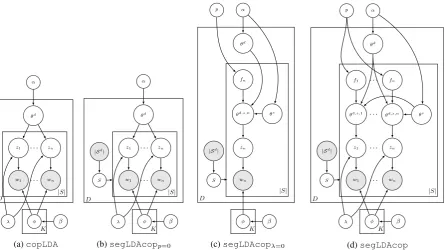
Figure 1: Graphical model for Copula LDA (copLDA), extension of Copula LDA with segmentation
(segLDAcopp=0), LDA with segmentation and topic shift (segLDAcopλ=0) and complete model (segLDAcop).
3 Joint latent model for topics and segments
We define here asegmentas a topically coherent
sequence of contiguous words. By topically coher-ent, we mean that, even though words in a segment can be associated to different topics, these topics are usually related. This view is in line with the one expressed in (Balikas et al.,2016b), in which
a latent topic model, referred to ascopLDAin the
remainder, includes a binding mechanism between topics within coherent text spans, defined in their study as noun phrases (NPs). The relation between topics is captured through a copula that provides a joint probability for all the topics used in a seg-ment. That is, to generate words in a segment, one first jointly generates all the word specific topics
z via a copula, and then generates each word in
the segment from its word specific topic and the word-topic distributionφ. Figure1(a) illustrates
this.
Copulas are particularly useful when mod-eling dependencies between random variables, as the joint cumulative distribution function
(CDF) FX1,···,Xn of any random vector X =
(X1,· · · , Xn) can be written as a function of its
marginals, according to Sklar’s Theorem (Nelsen,
2006):
FX1,···,Xn(x1,· · ·, xp) =C(FX1(x1),· · ·, FXn(xn))
whereCis a copula. For latent topic models, as
discussed in (Amoualian et al.,2016), Frank’s cop-ula is particcop-ularly interesting as (a) it is invariant by permutations and associative, as are the words and topicszin each segment due to the exchangeability assumption, and (b) it relies on a single parameter
(denoted λhere) that controls the strength of
de-pendence between the variables and is thus easy to implement. In Frank’s copula, when the parameter
λapproaches0, the variables are independent of
each other, whereas whenλapproaches+∞, the
variables take the same value. For further details on copulas, we refer the reader to (Nelsen,2006).
One important problem, however, withcopLDA
is its reliance on a predefined segmentation. Al-though the information brought by the segmenta-tion based on NPs helps to improve topic assign-ment, it may not be flexible enough to capture all the possible segments of a text. It is easy to correct this problem by considering all possible segmen-tations of a document and by choosing the most appropriate one at the same time that topics are assigned to words. This is illustrated in Figure1(b),
where a segmentationS is chosen from the setSd
of possible segmentations for a documentd, and
where each segment inSare generated in turn. We
refer to the associated model assegLDAcopp=0
for reasons that will become clear later.
segLDAcopp=0) is that the topics used in each segment come from the same document specific topic distribution θd. This entails that, in these
models, one cannot differentiate the main topics of a document from potential segment specific topics that can explain some parts of it. Indeed, some text segments can refer to topics that are barely present in other parts of the document; relying on a single topic distribution may prevent one from capturing those segment specific topics.
It is possible to overcome this difficulty by gen-erating a segment specific topic distribution as il-lustrated in Figure1(c) (this model is referred to assegLDAcopλ=0, again for reasons that will be-come clear later). However, as some words in a segment can be associated to the general topics of a document, we introduce a mechanism to choose, for each word in a segment, a topic either from the segment specific topic distributionθsor from
the document specific topic distributionθd (this
mechanism is similar to the one used for routes and levels in (Paul and Girju,2010)). The choice between them is based on the Bernoulli variablef,
as explained in the generative story given below. The above developments can be combined in a single, complete model, illustrated in Figure1(d) and detailed below. We will simply refer to this
model assegLDAcop.
3.1 Complete generative model
As in standard LDA based models, with V
de-noting the size of the vocabulary of the
collec-tion and K the number of latent topics, β and
φk,1 ≤ k ≤ K, areV dimensional vectors, α
andθ(i.e., θd, θs, θd,s,n) areK dimensional
vec-tors, whereaszntakes value in{1,· · · , K}. Lower
indices are used to denote coordinates of the above
vectors. Lastly,Dir denotes the Dirichlet
distri-bution,Catthe categorical distribution (which is
a multinomial distribution with one draw) and we omit, as is usual, the generation of the length of
the document. The complete modelsegLDAcop
is then based on the following generative process:
1. Generate, for each topick,1 ≤ k ≤ K, a
distribution over the words:φk∼Dir(β);
2. For each documentd,1≤d≤D:
(a) Choose a document specific topic distribu-tion: θd∼Dir(α);
(b) Choose a segmentationSof the document
uniformly from the set of all possible
segmentationsSd:P(S) = 1
|Sd|;
(c) For each segmentsinS:
(i) Choose a segment specific topic
distri-bution:θs∼Dir(α);
(ii) For each positionnins, choosefn ∼
Ber(p)and set:
θd,s,n =
θs iff n= 1
θd otherwise
(iii) Choose topics Zs = {z
1, . . . , zn}
from Frank’s copula with parameter
λand marginalsCat(θd,s,n);
(iv) For each positionnins, choose word wn:wn∼Cat(φzn).
As on can note, the generative process relies on a segmentation uniformly chosen from the set of pos-sible segmentations (step2.b) to generate related topics within each segment (Frank’s copula in step
2.c.(iii)), the distribution underlying each word spe-cific topicznbeing either specific to the segment or
general to the document (steps2.c.(i)and2.c.(ii)).
The other steps are similar to the standard LDA
steps.
As in almost all previous studies onLDA,αand
βare considered fixed and symmetric, each
coor-dinate of the vector being equal:α1 =· · ·=αK.
The hyperparametersp(∈[0,1]) of the Bernoulli
distribution andλ(∈[0,+∞]) of Frank’s copula
re-spectively regulate the choice between the segment specific and the document specific topic distribu-tions and the strength of the dependence between topics in a segment. As for the other hyperparame-ters, we consider them fixed here (the values for all hyperparameters are given in Section4).
As mentioned before, all the models presented
in Figure 1 are special cases of the complete
model segLDAcop: hence segLDAcopλ=0 is
obtained by dropping the topic dependencies,
which amounts to settingλ to (a value close to)
0,segLDAcopp=0is obtained by relying only on the topic distribution obtained for the document, which amounts to settingpto0, and the previously
introducedcopLDAmodel is obtained by setting
pto0, and fixing the segmentation.
3.2 Inference with Gibbs sampling
The parameters of the complete model can be di-rectly estimated through Gibbs sampling. The
Gibbs updates for the parametersφandθare the
2003). The parametersfn are directly estimated
through:fn∼Ber(p). Lastly, for the variablesz,
we follow the same strategy as the one described in (Balikas et al.,2016b) and based on (Amoualian et al.,2016), leading to:
P(Zs
|Z−s, W,Θ,Φ, λ) =p(Zs
|Θ, λ)Y
n
φzn
wn
where W denotes the document collection, and
Θ and Φ the sets of allθ and φk,1 ≤ k ≤ K,
vectors.p(Zs|Θ, λ)is obtained by Frank’s copula
with parameterλand marginalsCat(θd,s,n). As is
standard in topic models, the notation−smeans
excluding the information froms.
From the above equation, one can formulate an acceptance/rejection algorithm based on the follow-ing steps: (a) sampleZsfrom p(Zs|Θ, λ)using
Frank’s copula, and (b) accept the sample with probabilityQnφzn
wn, wherenruns over all the
po-sitions in segments.
3.3 Efficient segmentation
As topics may change from one sentence to another, we assume here that segments cannot overlap sen-tence boundaries. The different segmentations of a document are thus based on its sentence
segmen-tations. In the remainder, we useLto denote the
maximum length of a segment andg(M;L)to
de-note the number of segmentations in a sentence
of lengthM, each segment comprising at mostL
words.
Generating all possible segmentations of a sen-tence and then selecting one at random is not an efficient process as the number of segments rapidly grows with the length of the sentence. In practice, however, one can define an efficient segmentation on the basis of the following proposition, the proof
of which is given in AppendixA:
Proposition 3.1. Let lsi be the random variable
associated to the length of the segment starting at positioniin a sentence of lengthM (positions
go from1toM andlsi takes value in{1,· · · , L}).
ThenP(lsi =l) := g(gM(M+1+1−i−−il;L);)L) defines a proba-bility distribution overls
i.
Furthermore, the following process is equivalent to choosing sentence segmentations uniformly from the set of possible segmentations.
From pos. 1, repeat till end of sentence: (a) Generate segment length acc. to P; (b) Add segment to current segmentation; (c) Move to position after the segment.
In practice, we thus replace steps 2.b and2.c
of the generative story by a loop over all sen-tences, and in each sentence use the process de-scribed in Prop,3.1. Furthermore, as described in
Appendix A, the values ofg needed to compute
P(lsi = l) can be efficiently computed by
recur-rence.
4 Experiments
We conducted a number of experiments aimed at studying the impact of simultaneously segment-ing and assignsegment-ing topics to words within segments
using the proposedsegLDAcopmodel.
Datasets:We considered six publicly available datasets derived from Pubmed2(Tsatsaronis et al., 2015), Wikipedia (Partalas et al.,2015), Reuters3
and New York Times (NYT)4 (Yao et al.,2016).
The first two collections were considered in (
Ba-likas et al.,2016a), we followed their setup by con-sidering 3 subsets of Wikipedia with different num-ber of classes (namely, Wiki0, Wiki1 and Wiki2). The Reuters dataset comes from Reuters-21578, Distribution 1.0 as investigated in (Bird et al.,2009) and the NYT dataset is collected from full text of New York Times global news, from January 1st to December 31st, 2011.
These collections were processed following (Blei et al.,2003) by removing a standard list of 50 stop words, lemmatizing, lowercasing and keeping only words made of letters. To deal with relatively homogeneous collections, we also removed doc-uments that are too long. The statistics of these datasets, as well as the admissible maximal length for documents, in terms of the number of words they contain, can be found in Table1.
Settings: We compared our mod-els (segLDAcopp=0, segLDAcopλ=0, segLDAcop) with three models, namely
the standard LDA model, and two previously
introduced models aiming at binding topics within segments:
1. LDA: Standard Latent Dirichlet Allocation im-plemented using collapsed Gibbs sampling in-ference (Griffiths and Steyvers,2004)5. Note
2https://github.com/balikasg/
topicModelling/tree/master/data
3https://archive.ics.uci.edu/
ml/datasets/Reuters-21578+Text+ Categorization+Collection
4https://github.com/yao8839836/COT/
tree/master/data
Wiki0 Wiki1 Wiki2 # words 32,354 70,954 103,308
–vocabulary size 7,853 12,689 14,715
# docs 1,014 2,138 3,152
–maximal length 100 100 100
# labels 17 42 53
Pubmed Reuters NYT # words 104,683 192,562 237,046
–vocabulary size 12,779 10,479 17,773
# docs 2,059 6,708 2,564
–maximal length 75 50 200
# labels 50 83
-Table 1: Dataset statistics.
that there are neither segmentation nor topic binding mechanisms in this model;
2. senLDA: Sentence LDA, introduced in ( Ba-likas et al., 2016a), which forces all words within a sentence to be assigned to the same topic. The segments considered thus corre-spond to sentences, and the binding between topics within segments is maximal as all word specific topics are equal;
3. copLDA: Copula LDA, introduced in ( Ba-likas et al.,2016b) already discussed before, which relies on two types of segments, namely
NPs (extracted with thenltk.chunk
pack-age (Bird et al.,2009)) and single words. In addition, a copula is also used to bind topics within NPs, from the document specific topic distribution.
Both senLDA and copLDA implementations,
can be found in https://github.com/
balikasg/topicModelling.
In all modelsαandβplay a symmetric role and
are respectively fixed to1/K, following (Asuncion
et al., 2009). For copula based models, λis set
to 5, following (Balikas et al.,2016b). As already discussed,pis set to0for segLDAcopp=0; it is set to0.5forsegLDAcopso as not to privilegea priorione topic distribution (document or segment specific) over the other. For sampling from Frank’s
copula, we relied on the R copula package (Hofert
and Maechler,2011)6. We choseL(the maximum
length of a segment) using line search forL∈[2,5]
and usedL= 3in all our experiments. Finally, to
illustrate the behaviors of the different models with different number of topics, we present here the
results obtained withK = 20andK= 100.
We now compare the different models along three main dimensions: perplexity, use of topic
6Our complete code will be available for research
pur-poses.
representations for classification and topic coher-ence.
4.1 Perplexity
We first randomly split here all the collections, us-ing 75% of them for trainus-ing, and 25% for testus-ing. In order to see how well the models fit the data and following (Blei et al.,2003), we first evaluated the methods in terms of perplexity defined as:
P erplexity= exp −
P
d∈D
P
w∈dlog
PK
k=1θdkφkw
P
d∈D|d|
! ,
wheredis a test document from the test setD, and
|d|is the total number of words ind, andKis the
total number of topics. The lower the perplexity is, the better the model fits the test data. Table2shows
perplexities of different methods forK = 20and
K = 100topics.
50 100 150 200 250 300 350
1,400 1,600 1,800 2,000 2,200
Iterations
Perple
xity
NYT
LDA senLDA copLDA segLDAcopp=0
segLDAcopλ=0
[image:6.595.80.284.61.189.2]segLDAcop
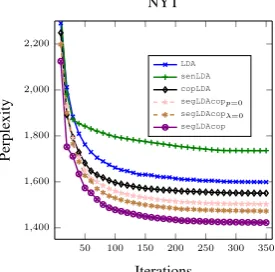
Figure 2: Perplexity with respect to training itera-tion on NYT collecitera-tion (20 topics).
From Table2, it comes out that the best perform-ing model in terms of perplexity over all datasets
and for different number of topics issegLDAcop.
Further,segLDAcopλ=0, that uses both document
and segment specific topic distributions, performs
better thansegLDAcopp=0, which in turn
outper-formscopLDA, bringing evidence that using all
possible segmentations rather than only NPs unit extracted using a chunker yields a more flexible and natural topic assignment.
[image:6.595.345.483.359.495.2]Models 20Wiki0100 20Wiki1100 20Wiki2100 20Pubmed100 20Reuters100 20NYT100 LDA 853.7 370.9 1144.6 541.1 1225.2 570.6 1267.8 628.7 210.6 118.8 1600.1 1172.1
senLDA 958.4 420.5 1236.7 675.3 1253.1 625.2 1346.3 674.3 254.3 173.6 1735.9 1215.3
copLDA 753.1 264.3 954.1 411.5 1028.6 420.6 1031.5 483.2 206.3 101.3 1551.5 1063.2
segLDAcopp=0 670.2 235.4 904.2 382.4 975.7 409.2 985.5 459.3 194.2 96.7 1504.2 1033.2
segLDAcopλ=0 655.1 222.1 890.3 370.2 949.2 404.3 971.3 451.2 190.1 91.3 1474.6 1014.3
[image:7.595.82.521.62.145.2]segLDAcop 621.2 213.5 861.2 358.6 934.7 394.4 960.4 442.1 182.1 87.5 1424.2 992.3
Table 2: Perplexity with respect to different number of topics (20 and 100).
Models 20Wiki0100 20Wiki1100 20Wiki2100 20Pubmed100 20Reuters100 LDA 55.3 63.5 42.4 51.4 41.2 48.7 54.1 63.5 75.5 82.7
senLDA 41.4 53.2 33.5 44.5 36.4 40.9 50.2 62.5 69.4 74.2
copLDA 51.2 62.7 43.4 52.1 40.8 46.5 53.5 63.1 75.2 81.5
segLDAcopp=0 59.1 64.2 44.8 51.2 42.3 50.1 55.4 63.1 76.8 82.5
segLDAcopλ=0 61.1 67.4 46.5 53.8 44.1 52.2 57.1 65.2 79.6 84.4
segLDAcop 62.3 68.4 48.4 55.2 44.8 53.5 59.3 66.5 80.2 85.1
Table 3: MiF score (percent) with respect to different number of topics (20 and 100).
4.2 Topical induced representation for classification
Some studies compare topic models using extrin-sic tasks such as document classification. In this case, it is possible to reduce the dimensionality of the representation space by using the induced topics (Blei et al.,2003). In this study, we first ran-domly splitted the datasets, except NYT that does not contain class information, into training (75%) and test (25%) sets. We then applied SVMs with a linear kernel; the value of the hyperparameter
Cwas found by cross-validation over the training
set{0.01,0.1,1,10,100}. For datasets where cer-tain documents have more than one label (Pubmed, Reuters), we used the one-versus-all approach for performing multi-label classification.
In Table3, we report the Micro F1 (MiF) score of different models on the test sets. Again, the best
re-sults are obtained withsegLDAcop, followed by
segLDAcopλ=0. This shows the importance of re-lying on both document and segment specific topic distributions. As conjectured before, our model is able to captures fine grained topic assignments within documents. In addition, all models
rely-ing on an inferred segmentation (segLDAcopp=0,
segLDAcopλ=0, segLDAcop) outperform the models relying on fixed segmentations (sentences or NPs). This shows the importance of being able to discover flexible segmentations for assigning topics within documents.
4.3 Topic coherence
Another common way to evaluate topic models is by examining how coherent the produced topics
are. Doing this manually is a time consuming pro-cess and cannot scale. To overcome this limitation the task of automatically evaluating the coherence of topics produced by topic models received a lot of attention (Mimno et al.,2011). It has been found that scoring the topics using co-occurrence mea-sures, such as the pointwise mutual information (PMI) between the top-words of a topic, correlates well with human judgments (Newman et al.,2010). For this purpose an external, large corpus is used as a meta-document where the PMI scores of pairs of words are estimated using a sliding window. As dis-cussed above, calculating the co-occurrence mea-sures requires selecting the top-N words of a topic
and performing the manual or automatic evaluation.
Hence,Nis a hyper-parameter to be chosen and its
value can impact the results. Very recently,Lau and Baldwin(2016) showed thatN actually impacts
the quality of the obtained results and, in particu-lar, the correlation with human judgments. In their work, they found that aggregating the topic coher-ence scores over several topic cardinalities leads to a substantially more stable and robust evaluation.
Following the findings of Lau and Baldwin
(2016) and using (Newman et al., 2010)’s
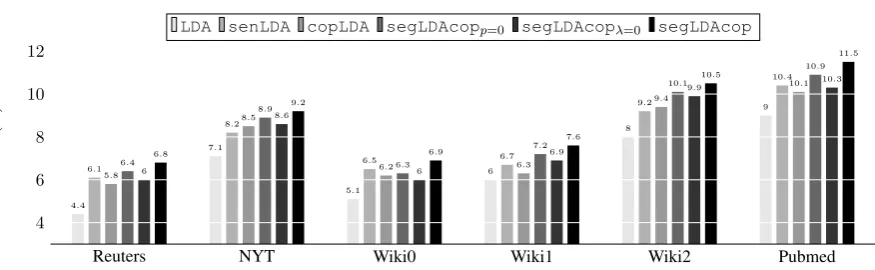
equa-tion, we present in Figure3 the topic coherence
scores as measured by the Normalized Pointwise Mutual Information (NPMI) . Their values are in [-1,1], where in the limit of -1 two wordsw1andw2 never occur together, while in the limit of +1 they always occur together (complete co-occurrence). For the reported scores, we aggregate the topic co-herence scores over three different topic
Wiki0 Wiki1 Wiki2 Pubmed
Reuters NYT
4 6 8 10 12
5.1
6
8
9
4.4
7.1
6.5 6.7
9.2
10.4
6.1
8.2
6.2 6.3
9.4
10.1
5.8
8.5
6.3
7.2
10.1
10.9
6.4
8.9
6
6.9
9.9 10.3
6
8.6
6.9
7.6
10.5
11.5
6.8
9.2
NPMI
(%)
[image:8.595.83.521.56.191.2]LDA senLDA copLDA segLDAcopp=0 segLDAcopλ=0 segLDAcop
Figure 3: Topic coherence (NPMI) score with respect to 100 of topics.
uses copulas and segmentation together, shows the best score for the given reference meta-data (Wikipedia) in all of the datasets. It should be
noted that segLDAcopλ=0 which has not
cop-ula binder inside the model has less improvement
against the segLDAcopp=0 which has the
cop-ula. This means using copula has more effect on the topic coherence than only the segment-specific topic distribution.
4.4 Visualization
In order to illustrate the results obtained by
segLDAcop, we display in Figure4 the top 10
most probable words over 5 topics (K = 20) for
the Reuters dataset, for both segLDAcop and
LDA. In segLDAcop, topic 1, the top-ranked words are mostly relevant to the topic “date” (e.g.,
Topic1 march, fell, rose, january, rise,year, fall, february, pct, week fell, mln, year, january, dlrs,rise, rose, pct, billion, february
Topic2 currency, bank, pct, cut, rate,day, prime, exchange, interest, national
billion, prime, day, rate, dlrs, pct, reserve, federal, fed, bank
Topic3 term, agreement, acquire, buy,sell, unit, acquisition, corp, company, sale
term, dlrs, buy, company, sell, unit, corp, acquisition, sale, mln
Topic4 approved, american, common,split, merger, company, board, stock, share, shareholder
acquire, mln, company, com-mon, stock, shareholder, share, corp, merger, dlrs
Topic5 tokyo, life, intent, letter, buy,insurance, yen, japan, dealer, dollar
central, european, japan, yen, ec, dollar, bank, rate, dealer, market
Figure 4: Top-10 words ofsegLDAcop(left) vs
LDA(right) for the Reuters (5 out of 20 topics).
Ralph Borsodi wasan economics theorist andpractical experimenter
interested in waysof living
Figure 5: Topic assignments with segmentation
boundaries usingsegLDAcop. Colors are topics
(examples from Wiki0 including stopwords with 20 topics).
march, january, year, fall, february, week).
How-ever, a similar topic learned by LDA appears to
involve less such words (year, january, february), indicating a less coherent topic.
Figure5illustrates another aspect of our model, namely the possibility to detect topically coherent segments. In particular, as one can note, the sen-tence is segmented in six parts by our model, the
first one is a NP,Ralph Borsodiwhere one single
topic is assigned to both words. We observe a sim-ilar coherence in topic assignments on other NPs and segments, in which a single topic is used for the words involved. The data-driven approach we have adopted here can discover such fine grained differences, something the approaches based on fixed segmentations (either based on sentences or NPs), are less likely to achieve.
5 Discussion
In this paper, we have introduced anLDA-based
[image:8.595.78.284.494.623.2]binding mechanism to produce topically coherent segments.
As regards complexity, it is true that more com-plex models, as the one we are considering, are more prone to underfitting (when data is scarce) and overfitting than simpler models. This said, the experimental results on perplexity (in which the word-topic distributions are fixed) and on classi-fication (based on the topical induced representa-tions) suggest that our model neither underfits nor overfits compared to simpler models. We believe that this is due to the fact that the main additional parameters in our model (the segment specific topic distribution) do not really add complexity as they are drawn from the same distribution as the stan-dard document specific topics. Furthermore, the
parameterspandfare simple parameters to choose
between these two distributions.
The comparison with other segmentation meth-ods is also an important point. While state-of-the-art supervised segmentation models can be used
before applying the LDA model, we note such a
pipeline approach comes with several limitations. The approach requires external annotated data to train the segmentation models, where certain do-main and language specific information need to be captured. By contrast, our unsupervised approach learns both segmentations and topics jointly in a domain and language independent manner. Fur-thermore, existing supervised segmentation models are largely designed for a very different purpose with strong linguistic motivations, which may not align well with our main goal in this paper which is improving topic coherence in topic modeling. Sim-ilarly, unsupervised approaches, used for example in the TDT (Topic Detection and Tracking) cam-paigns or more recently inDu et al.(2013), usually consider coarse-grained topics, that can encom-pass several sentences. In contrast, our approach aims at identifying fine-grained topics associated with coherent segments that do not overlap sen-tence boundaries. These considerations, explain the choice of the baselines retained: they are based on segments of different granularities (words, NPs, sentences) that do not overlap sentence boundaries. In the future, we plan on relying on other infer-ence approaches, based for example on variational Bayes known to yield better estimates for perplex-ity (Asuncion et al.,2009); it is however not certain that the gain in perplexity one can expect from the use of variational Bayes approaches will
nec-essarily result in a gain in, say, topic coherence. Indeed, the impact of the inference approach on the different usages of latent topic models for text collections remains to be better understood.
Acknowledgments
We would like to thank the reviewers for their help-ful comments. Most of this work was done when Hesam Amoualian was visiting Singapore Univer-sity of Technology and Design. This work is sup-ported by MOE Tier 1 grant SUTDT12015008, also partly supported by the LabEx PERSYVAL-Lab ANR-11-LABX-0025.
References
Hesam Amoualian, Marianne Clausel, Eric Gaussier, and Massih-Reza Amini. 2016. Streaming-lda: A copula-based approach to modeling topic de-pendencies in document streams. In Proceed-ings of the 22nd International Conference on Knowledge Discovery and Data Mining. ACM, New York, NY, USA, SIGKDD, pages 695–704.
https://doi.org/10.1145/2939672.2939781.
Arthur Asuncion, Max Welling, Padhraic Smyth,
and Yee Whye Teh. 2009. On smoothing
and inference for topic models. In Proceed-ings of the 25th Conference on Uncertainty in Artificial Intelligence. AUAI Press, Arling-ton, Virginia, United States, UAI, pages 27–34.
http://dl.acm.org/citation.cfm?id=1795114.1795118. Georgios Balikas, Massih-Reza Amini, and Marianne
Clausel. 2016a. On a topic model for sentences. In
Proceedings of the 39th International Conference on Research and Development in Information Retrieval. ACM, New York, NY, USA, SIGIR, pages 921–924.
https://doi.org/10.1145/2911451.2914714.
Georgios Balikas, Hesam Amoualian, Marianne Clausel, Eric Gaussier, and Massih R Amini. 2016b.
Modeling topic dependencies in semantically coher-ent text spans with copulas. In Proceedings of the 26th International Conference on Computational Linguistics: Technical Papers. The COLING 2016 Organizing Committee, Osaka, Japan, COLING, pages 1767–1776. http://aclweb.org/anthology/C16-1166.
Steven Bird, Ewan Klein, and Edward Loper. 2009. Natural Language Processing with Python. O’Reilly, Beijing.http://www.nltk.org/book/. David M. Blei, Andrew Y. Ng, and Michael I.
Jordan. 2003. Latent dirichlet allocation.
Journal of Machine Learning 3:993–1022.
http://dl.acm.org/citation.cfm?id=944919.944937. Jordan Boyd-Graber and David Blei. 2008.
21st International Conference on Neural In-formation Processing Systems. Curran As-sociates Inc., USA, NIPS, pages 185–192.
http://dl.acm.org/citation.cfm?id=2981780.2981804. Scott Deerwester, Susan T. Dumais, George W. Furnas, Thomas K. Landauer, and Richard Harshman. 1990. Indexing by latent se-mantic analysis. Journal of the American Society for Information Science 41(6):391– 407. http://dx.doi.org/10.1002/(SICI)1097-4571(199009)41:6<391::AID-ASI1>3.0.CO;2-9.
Lan Du, Wray Buntine, and Huidong Jin.
2010. A Segmented Topic Model Based
on the Two-parameter Poisson-Dirichlet Pro-cess. Journal of Machine learning 81(1):5–19.
https://doi.org/10.1007/s10994-010-5197-4.
Lan Du, Wray Buntine, and Mark Johnson. 2013.
Topic Segmentation with a Structured Topic Model.
In Proceedings of The Annual Conference of the North American Chapter of the Association for Com-putational Linguistics, Human Language Technolo-gies. HLT-NAACL, pages 190–200. http://dblp.uni-trier.de/db/conf/naacl/naacl2013.html/DuBJ13. Gal Elidan. 2013. Copulas in Machine Learning,
Springer Berlin Heidelberg, Berlin, Heidelberg, pages 39–60. https://doi.org/10.1007/978-3-642-35407-6_3.
Thomas L. Griffiths and Mark Steyvers. 2004. Find-ing scientific topics. Journal of the National Academy of Sciences 101(suppl 1):5228–5235.
https://doi.org/10.1073/pnas.0307752101.
Thomas L Griffiths, Mark Steyvers, David M Blei, and Joshua B Tenenbaum. 2005. Integrating topics and syntax. In L. K. Saul, Y. Weiss, and L. Bottou, editors, Advances in the Inter-national Conference on Neural Information Pro-cessing Systems. MIT Press, NIPS, pages 537– 544. http://papers.nips.cc/paper/2587-integrating-topics-and-syntax.pdf.
Marius Hofert and Martin Maechler. 2011. Nested Archimedean Copulas Meet R: The nacopula Pack-age. Journal of Statistical Software 39(i09):–.
https://doi.org/http://hdl.handle.net/10.
Thomas Hofmann. 1999. Probabilistic latent se-mantic indexing. In Proceedings of the 22Nd Annual International Conference on Research and Development in Information Retrieval. ACM, New York, NY, USA, SIGIR, pages 50–57.
https://doi.org/10.1145/312624.312649.
Jey Han Lau and Timothy Baldwin. 2016. The sensitivity of topic coherence evaluation to topic cardinality. In Proceedings of The Annual Con-ference of the North American Chapter of the Association for Computational Linguistics, Hu-man Language Technologies, San Diego California, USA, June 12-17, 2016. NAACL, pages 483–487.
http://aclweb.org/anthology/N/N16/N16-1057.pdf.
Jey Han Lau, Timothy Baldwin, and David Newman. 2013. On collocations and topic models. Journal of ACM Trans. Speech Lang. Process. 10(3):10:1– 10:14.https://doi.org/10.1145/2483969.2483972.
David Mimno and Andrew McCallum. 2007. Orga-nizing the oca: Learning faceted subjects from a library of digital books. In Proceedings of the 7th Joint Conference on Digital Libraries. ACM, New York, NY, USA, JCDL ’07, pages 376–385.
https://doi.org/10.1145/1255175.1255249.
David Mimno, Hanna M. Wallach, Edmund Tal-ley, Miriam Leenders, and Andrew McCallum. 2011. Optimizing semantic coherence in topic models. In Proceedings of the Conference on Empirical Methods in Natural Language Process-ing. Association for Computational Linguistics, Stroudsburg, PA, USA, EMNLP, pages 262–272.
http://dl.acm.org/citation.cfm?id=2145432.2145462.
Roger B. Nelsen. 2006. An Introduction to Cop-ulas (Springer Series in Statistics). Springer-Verlag New York, Inc., Secaucus, NJ, USA.
http://www.springer.com/gp/book/9780387286594.
David Newman, Jey Han Lau, Karl Grieser, and Timothy Baldwin. 2010. Automatic evalua-tion of topic coherence. In Proceedings of The Annual Conference of the North Ameri-can Chapter of the Association for Computa-tional Linguistics, Human Language Technolo-gies. Association for Computational Linguistics, Stroudsburg, PA, USA, NAACL, pages 100–108.
http://dl.acm.org/citation.cfm?id=1857999.1858011.
Ioannis Partalas, Aris Kosmopoulos, Nicolas Bask-iotis, et al. 2015. LSHTC: A Benchmark for Large-Scale Text Classification. Journal of CoRR
abs/1503.08581.http://arxiv.org/abs/1503.08581.
Michael Paul and Roxana Girju. 2010. A two-dimensional topic-aspect model for discov-ering multi-faceted topics. In Proceedings of the 24th Conference on Artificial Intelli-gence. AAAI Press, AAAI, pages 545–550.
http://dl.acm.org/citation.cfm?id=2898607.2898695.
Matthew Purver, Thomas L Griffiths, Konrad P. Körd-ing, and Joshua B. Tenenbaum. 2006. Unsuper-vised topic modelling for multi-party spoken dis-course. In Proceedings of the 21st International Conference on Computational Linguistics and the 44th Annual Meeting of the Association for Compu-tational Linguistics. Association for Computational Linguistics, Stroudsburg, PA, USA, ACL, pages 17– 24.https://doi.org/10.3115/1220175.1220178.
Akihiro Tamura and Eiichiro Sumita. 2016. Bilin-gual segmented topic model. In Proceed-ings of the 54th Annual Meeting of the As-sociation for Computational Linguistics. ACL.
Yee Whye Teh. 2006. A hierarchical bayesian lan-guage model based on pitman-yor processes. In
Proceedings of the 21st International Conference on Computational Linguistics and the 44th An-nual Meeting of the Association for Computational Linguistics. Association for Computational Linguis-tics, Stroudsburg, PA, USA, ACL, pages 985–992.
https://doi.org/10.3115/1220175.1220299.
George Tsatsaronis, Georgios Balikas, Prodro-mos Malakasiotis, et al. 2015. An overview of the BIOASQ large-scale biomedical seman-tic indexing and question answering competi-tion. Journal of BMC Bioinformatics 16(1):138.
https://doi.org/10.1186/s12859-015-0564-6.
Dingding Wang, Shenghuo Zhu, Tao Li, and Yi-hong Gong. 2009. Multi-document summa-rization using sentence-based topic models. In Proceedings of the Conference on Associ-ation for ComputAssoci-ational Linguistics. Associ-ation for ComputAssoci-ational Linguistics, Strouds-burg, PA, USA, ACL-IJCNLP, pages 297–300.
http://dl.acm.org/citation.cfm?id=1667583.1667675.
Xuerui Wang, Andrew McCallum, and Xing Wei. 2007. Topical n-grams: Phrase and topic discov-ery, with an application to information retrieval. In Proceedings of the 7th International Confer-ence on Data Mining. IEEE Computer Society, Washington, DC, USA, ICDM, pages 697–702.
https://doi.org/10.1109/ICDM.2007.86.
Xing Wei and W. Bruce Croft. 2006. Lda-based doc-ument models for ad-hoc retrieval. InProceedings of the 29th Annual International Conference on Re-search and Development in Information Retrieval. ACM, New York, NY, USA, SIGIR, pages 178–185.
https://doi.org/10.1145/1148170.1148204.
Liang Yao, Yin Zhang, Baogang Wei, Lei Li, Fei Wu, Peng Zhang, and Yali Bian. 2016. Con-cept over time: the combination of probabilistic topic model with wikipedia knowledge. Journal of Expert Systems with Applications 60:27 – 38.
https://doi.org/10.1016/j.eswa.2016.04.014.
Hua-Jun Zeng, Qi-Cai He, Zheng Chen, Wei-Ying Ma, and Jinwen Ma. 2004. Learning to clus-ter web search results. In Proceedings of the 27th Annual International Conference on Research and Development in Information Retrieval. ACM, New York, NY, USA, SIGIR, pages 210–217.
https://doi.org/10.1145/1008992.1009030.
A Efficient segmentation
Let us recall the property presented before:
Proposition A.1. Let ls
i be the random variable
associated to the length of the segment starting at positioniin a sentence of lengthM (positions
go from1toM andls
i takes value in{1,· · · , L}).
ThenP(lsi =l) := g(gM(M+1+1−i−−il;L);)L) defines a proba-bility distribution overls
i.
Furthermore, the following process is equivalent to choosing sentence segmentations uniformly from the set of possible segmentations.
From pos. 1, repeat till end of sentence: (a) Generate segment length acc. to P; (b) Add segment to current segmentation; (c) Move to position after the segment.
ProofAny segmentation of the sentence of length
M starts with either a segment of length1, a
seg-ment of length2, · · ·, or a segment of length L.
Thus,g(M;L)can be defined through the
follow-ing recurrence relation:
g(M;L) =
L
X
l=1
g(M−l;L) (1)
together with the initial values
g(1;L), g(2;L),· · ·, g(L;L), which can be
computed offline (for example, forL= 3, one has:
g(1; 3) = 1, g(2; 3) = 2, g(3; 3) = 4). Note that
g(1;L) = 1for allL.
Thus:
L
X
l=1
P(lis=l) =
L
X
l=1
g(M+ 1−i−l);L)
g(M + 1−i;L) = 1
due to the recurrence relation ong. This proves the
first part of the proposition.
Using the process described above where seg-ments are generated one after another according to P, for a segmentation S, comprising |S|
seg-ments, let us denote byl1, l2,· · · , l|S|the lengths of each segment and byi1, i2,· · · , i|S|the starting positions of each segment (withi1= 1). One has, as segments are independent of each other:
P(S) =
|S|
Y
j=1
P(lsij =lj) =
|S|
Y
j=1
g(M+ 1−(ij+lj);L)
g(M+ 1−ij;L)
=g(M−l1;L) g(M;L)
g(M−l1−l2;L) g(M−l1;L) · · ·
= 1
g(M;L)
asg(1;L) = 1. This concludes the proof of the
proposition. 2
Furthermore, as one can note from Eq.1, the
various elements needed to computeP(lsi =l)can
be efficiently computed, the time complexity being equal toO(M). In addition, as the number of
dif-ferent sentence lengths is limited, one can store the
values ofgto reuse them during the segmentation