Max-Margin Tensor Neural Network for Chinese Word Segmentation
Wenzhe Pei Tao Ge Baobao Chang∗
Key Laboratory of Computational Linguistics, Ministry of Education School of Electronics Engineering and Computer Science, Peking University
Beijing, P.R.China, 100871
{peiwenzhe,getao,chbb}@pku.edu.cn
Abstract
Recently, neural network models for nat-ural language processing tasks have been increasingly focused on for their ability to alleviate the burden of manual feature engineering. In this paper, we propose a novel neural network model for Chinese word segmentation called Max-Margin Tensor Neural Network (MMTNN). By exploiting tag embeddings and tensor-based transformation, MMTNN has the ability to model complicated interactions between tags and context characters. Fur-thermore, a new tensor factorization ap-proach is proposed to speed up the model and avoid overfitting. Experiments on the benchmark dataset show that our model achieves better performances than previ-ous neural network models and that our model can achieve a competitive perfor-mance with minimal feature engineering. Despite Chinese word segmentation being a specific case, MMTNN can be easily generalized and applied to other sequence labeling tasks.
1 Introduction
Unlike English and other western languages, Chi-nese do not delimit words by white-space. There-fore, word segmentation is a preliminary and im-portant pre-process for Chinese language process-ing. Most previous systems address this problem by treating this task as a sequence labeling prob-lem where each character is assigned a tag indi-cating its position in the word. These systems are effective because researchers can incorporate a large body of handcrafted features into the models. However, the ability of these models is restricted
∗Corresponding author
by the design of features and the number of fea-tures could be so large that the result models are too large for practical use and prone to overfit on training corpus.
Recently, neural network models have been in-creasingly focused on for their ability to mini-mize the effort in feature engineering. Collobert et al. (2011) developed the SENNA system that ap-proaches or surpasses the state-of-the-art systems on a variety of sequence labeling tasks for English. Zheng et al. (2013) applied the architecture of Collobert et al. (2011) to Chinese word segmenta-tion and POS tagging and proposed a perceptron-style algorithm to speed up the training process with negligible loss in performance.
Workable as previous neural network models seem, a limitation of them to be pointed out is that the tag-tag interaction, tag-character inter-action and character-character interinter-action are not well modeled. In conventional feature-based lin-ear (log-linlin-ear) models, these interactions are ex-plicitly modeled as features. Take phrase “打篮
球(play basketball)” as an example, assuming we are labeling characterC0=“篮”, possible features could be:
f1=
(
1 C−1=“打” andC1=“球” andy0=“B” 0 else
f2 =
(
1 C0=“篮” andy0=“B” andy−1=“S” 0 else
To capture more interactions, researchers have de-signed a large number of features based on linguis-tic intuition and statislinguis-tical information. In previ-ous neural network models, however, hardly can such interactional effects be fully captured rely-ing only on the simple transition score and the sin-gle non-linear transformation (See section 2). In order to address this problem, we propose a new model called Max-Margin Tensor Neural Network (MMTNN) that explicitly models the interactions
between tags and context characters by exploiting tag embeddings and tensor-based transformation. Moreover, we propose a tensor factorization ap-proach that effectively improves the model effi-ciency and prevents from overfitting. We evalu-ate the performance of Chinese word segmentation on the PKU and MSRA benchmark datasets in the second International Chinese Word Segmentation Bakeoff (Emerson, 2005) which are commonly used for evaluation of Chinese word segmentation. Experiment results show that our model outper-forms other neural network models.
Although we focus on the question that how far we can go without using feature engineering in this paper, the study of deep learning for NLP tasks is still a new area in which it is currently challenging to surpass the state-of-the-art with-out additional features. Following Mansur et al. (2013), we wonder how well our model can per-form with minimal feature engineering. There-fore, we integrate additional simple character bi-gram features into our model and the result shows that our model can achieve a competitive perfor-mance that other systems hardly achieve unless they use more complex task-specific features.
The main contributions of our work are as fol-lows:
• We propose a Max-Margin Tensor Neu-ral Network for Chinese word segmentation without feature engineering. The test re-sults on the benchmark dataset show that our model outperforms previous neural network models.
• We propose a new tensor factorization ap-proach that models each tensor slice as the product of two low-rank matrices. Not only does this approach improve the efficiency of our model but also it avoids the risk of over-fitting.
• Compared with previous works that use a large number of handcrafted features, our model can achieve a competitive perfor-mance with minimal feature engineering. • Despite Chinese word segmentation being a
[image:2.595.307.518.64.243.2]specific case, our approach can be easily gen-eralized to other sequence labeling tasks. The remaining part of this paper is organized as follows. Section 2 describes the details of con-ventional neural network architecture. Section 3
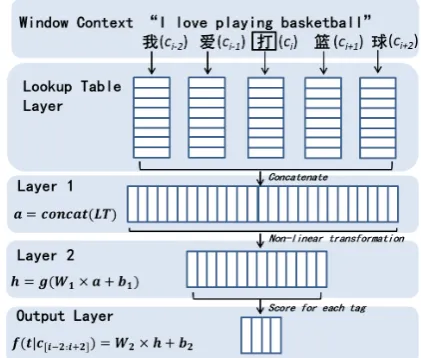
Figure 1: Conventional Neural Network
describes the details of our model. Experiment re-sults are reported in Section 4. Section 5 reviews the related work. The conclusions are given in Section 6.
2 Conventional Neural Network 2.1 Lookup Table
The idea of distributed representation for symbolic data is one of the most important reasons why the neural network works. It was proposed by Hin-ton (1986) and has been a research hot spot for more than twenty years (Bengio et al., 2003; Col-lobert et al., 2011; Schwenk et al., 2012; Mikolov et al., 2013a). Formally, in the Chinese word seg-mentation task, we have a character dictionaryD
of size|D|. Unless otherwise specified, the char-acter dictionary is extracted from the training set and unknown characters are mapped to a special symbol that is not used elsewhere. Each character
c∈Dis represented as a real-valued vector (char-acter embedding)Embed(c) ∈Rdwheredis the dimensionality of the vector space. The charac-ter embeddings are then stacked into a embedding matrixM ∈ Rd×|D|. For a characterc ∈ Dthat
has an associated indexk, the corresponding char-acter embeddingEmbed(c) ∈ Rdis retrieved by the Lookup Table layer as shown in Figure 1:
Embed(c) =Mek (1)
character is achieved by table lookup operation ac-cording to their indices. The embedding matrix
M is initialized with small random numbers and trained by back-propagation. We will analyze in more detail about the effect of character embed-dings in Section 4.
2.2 Tag Scoring
The most common tagging approach is the win-dow approach. The winwin-dow approach assumes that the tag of a character largely depends on its neighboring characters. Given an input sentence
c[1:n], a window of sizewslides over the sentence from character c1 to cn. We set w = 5 in all experiments. As shown in Figure 1, at position
ci,1 ≤ i≤ n, the context characters are fed into the Lookup Table layer. The characters exceeding the sentence boundaries are mapped to one of two special symbols, namely “start” and “end” sym-bols. The character embeddings extracted by the Lookup Table layer are then concatenated into a single vector a ∈ RH1, where H1 = w ·d is
the size of Layer 1. Then ais fed into the next layer which performs linear transformation fol-lowed by an element-wise activation function g
such astanh, which is used in our experiments:
h=g(W1a+b1) (2)
whereW1∈RH2×H1,b1∈RH2×1,h∈RH2. H2 is a hyper-parameter which is the number of hid-den units in Layer 2. Given a set of tagsT of size |T|, a similar linear transformation is performed except that no non-linear function is followed:
f(t|c[i−2:i+2]) =W2h+b2 (3)
where W2 ∈ R|T|×H2, b2 ∈ R|T|×1.
f(t|c[i−2:i+2]) ∈ R|T|is the score vector for each possible tag. In Chinese word segmentation, the most prevalent tag setT is BMES tag set, which uses 4 tags to carry word boundary information. It uses B, M, E and S to denote the Beginning, the Middle, the End of a word and a Single character forming a word respectively. We use this tag set in our method.
2.3 Model Training and Inference
Despite sharing commonalities mentioned above, previous work models the segmentation task dif-ferently and therefore uses different training and inference procedure. Mansur et al. (2013) mod-eled Chinese word segmentation as a series of
classification task at each position of the sentence in which the tag score is transformed into proba-bility using softmax function:
p(ti|c[i−2:i+2]) = Pexp(f(ti|c[i−2:i+2])) t0exp(f(t0|c[i−2:i+2]))
The model is then trained in MLE-style which maximizes the log-likelihood of the tagged data. Obviously, it is a local model which cannot cap-ture the dependency between tags and does not support to infer the tag sequence globally.
To model the tag dependency, previous neural network models (Collobert et al., 2011; Zheng et al., 2013) introduce a transition score Aij for jumping from tag i ∈ T to tag j ∈ T. For a input sentencec[1:n] with a tag sequence t[1:n], a sentence-level score is then given by the sum of transition and network scores:
s(c[1:n], t[1:n], θ) =Xn i=1
(Ati−1ti+fθ(ti|c[i−2:i+2]))
(4) where fθ(ti|c[i−2:i+2]) indicates the score output for tagti at thei-th character by the network with parameters θ = (M, A, W1, b1, W2, b2). Given the sentence-level score, Zheng et al. (2013) proposed a perceptron-style training algorithm in-spired by the work of Collins (2002). Compared with Mansur et al. (2013), their model is a global one where the training and inference is performed at sentence-level.
Workable as these methods seem, one of the limitations of them is that the tag-tag interaction and the neural network are modeled seperately. The simple tag-tag transition neglects the impact of context characters and thus limits the ability to capture flexible interactions between tags and context characters. Moreover, the simple non-linear transformation in equation (2) is also poor to model the complex interactional effects in Chi-nese word segmentation.
3 Max-Margin Tensor Neural Network 3.1 Tag Embedding
Figure 2: Max-Margin Tensor Neural Network
of the vector space (same with character embed-dings). Then the tag embeddingEmbed(t) ∈Rd for tagt∈T with indexkcan be retrieved by the lookup operation:
Embed(t) =Lek (5)
where ek ∈ R|T|×1 is a binary vector which is zero in all positions except atk-th index. The tag embeddings start from a random initialization and can be automatically trained by back-propagation. Figure 2 shows the new Lookup Table layer with tag embeddings. Assuming we are at thei-th char-acter of a sentence, besides the charchar-acter embed-dings, the tag embeddings of the previous tags are also considered1. For a fast tag inference, only the previous tag ti−1 is used in our model even though a longer history of tags can be considered. The concatenation operation in Layer 1 then con-catenates the character embeddings and tag em-bedding together into a long vectora. In this way, the tag representation can be directly incorporated in the neural network so that the tag-tag interac-tion and tag-character interacinterac-tion can be explicitly modeled in deeper layers (See Section 3.2). More-over, the transition score in equation (4) is not necessary in our model, because, by incorporating tag embedding into the neural network, the effect of tag-tag interaction and tag-character interaction are covered uniformly in one same model. Now
1We also tried the architecture in which the tag embedding of current tag is also considered, but this did not bring much improvement and runs slower
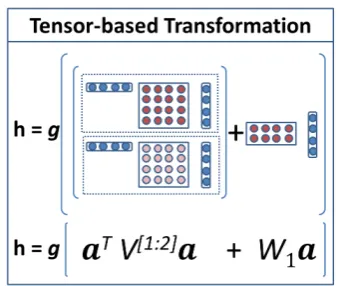
Figure 3: The tensor-based transformation in Layer 2. ais the input from Layer 1. V is the tensor parameter. Each dashed box represents one of the H2-many tensor slices, which defines the bilinear form on vectora.
equation (4) can be rewritten as follows:
s(c[1:n], t[1:n], θ) = n
X
i=1
fθ(ti|c[i−2:i+2], ti−1) (6) wherefθ(ti|c[i−2:i+2], ti−1)is the score output for tagtiat thei-th character by the network with pa-rametersθ. Like Collobert et al. (2011) and Zheng et al. (2013), our model is also trained at sentence-level and carries out inference globally.
3.2 Tensor Neural Network
A tensor is a geometric object that describes rela-tions between vectors, scalars, and other tensors. It can be represented as a multi-dimensional array of numerical values. An advantage of the tensor is that it can explicitly model multiple interactions in data. As a result, tensor-based model have been widely used in a variety of tasks (Salakhutdinov et al., 2007; Krizhevsky et al., 2010; Socher et al., 2013b).
In Chinese word segmentation, a proper model-ing of the tag-tag interaction, tag-character inter-action and character-character interinter-action is very important. In linear models, these kinds of inter-actions are usually modeled as features. In con-ventional neural network models, however, the in-put embeddings only implicitly interact through the non-linear function which can hardly model the complexity of the interactions. Given the ad-vantage of tensors, we apply a tensor-based trans-formation to the input vector. Formally, we use a 3-way tensor V[1:H2] ∈ RH2×H1×H1 to directly
[image:4.595.76.291.63.229.2]Layer 2 andH1 = (w+ 1)·dis the size of con-catenated vectorain Layer 1 as shown in Figure 2. Figure 3 gives an example of the tensor-based transformation2. The output of a tensor product is a vectorz ∈ RH2 where each dimensionzi is the
result of the bilinear form defined by each tensor sliceV[i]∈RH1×H1:
z=aTV[1:H2]a;z
i =aTV[i]a=
X
j,k
Vjk[i]ajak
(7) Since vector a is the concatenation of character embeddings and the tag embedding, equation (7) can be written in the following form:
zi =
X
p,q
X
j,k
V(p,q,j,k)[i] Ej[p]Ek[q]
whereEj[p]is thej-th element of thep-th embed-ding in Lookup Table layer andV(p,q,j,k)[i] is the cor-responding coefficient for Ej[p] and Ek[q] in V[i]. As we can see, in each tensor slice i, the em-beddings are explicitly related in a bilinear form which captures the interactions between charac-ters and tags. The multiplicative operations be-tween tag embeddings and character embeddings can somehow be seen as “feature combination”, which are hand-designed in feature-based models. Our model learns the information automatically and encodes them in tensor parameters and em-beddings. Intuitively, we can interpret each slice of the tensor as capturing a specific type of tag-character interaction and tag-character-tag-character inter-action.
Combining the tensor product with linear trans-formation, the tensor-based transformation in Layer 2 is defined as:
h=g(aTV[1:H2]a+W
1a+b1) (8) where W1 ∈ RH2×H1, b1 ∈ RH2×1, h ∈ RH2. In fact, equation (2) used in previous work is a special case of equation (8) whenV is set to 0. 3.3 Tensor Factorization
Despite tensor-based transformation being effec-tive for capturing the interactions, introducing tensor-based transformation into neural network models to solve sequence labeling task is time pro-hibitive since the tensor product operation drasti-cally slows down the model. Without consider-ing matrix optimization algorithms, the complex-ity of the non-linear transformation in equation (2)
[image:5.595.326.503.65.201.2]2The bias term is omitted in Figure 3 for simplicity
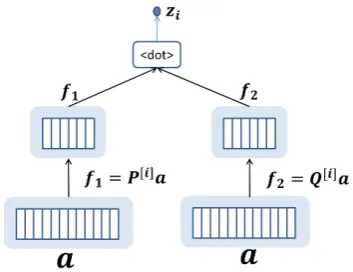
Figure 4: Tensor product with tensor factorization
isO(H1H2) while the tensor operation complex-ity in equation (8) isO(H2
1H2). The tensor-based transformation isH1 times slower. Moreover, the additional tensor could bring millions of param-eters to the model which makes the model suf-fer from the risk of overfitting. To remedy this, we propose a tensor factorization approach that factorizes each tensor slice as the product of two low-rank matrices. Formally, each tensor slice
V[i] ∈ RH1×H1 is factorized into two low rank
matrixP[i]∈RH1×randQ[i]∈Rr×H1:
V[i]=P[i]Q[i],1≤i≤H
2 (9)
wherer H1 is the number of factors. Substi-tuting equation (9) into equation (8), we get the factorized tensor function:
h=g(aTP[1:H2]Q[1:H2]a+W
1a+b1) (10)
Figure 4 illustrates the operation in each slice of the factorized tensor. First, vector ais projected into twor-dimension vectorsf1 andf2. Then the outputzi for each tensor sliceiis the dot-product of f1 and f2. The complexity of the tensor op-eration is nowO(rH1H2). As long as r is small enough, the factorized tensor operation would be much faster than the un-factorized one and the number of free parameters would also be much smaller, which prevent the model from overfitting. 3.4 Max-Margin Training
a given sentence xi and the correct tag sequence for xi is yi. The parameters of our model are
θ ={W1, b1, W2, b2, M, L, P[1:H2], Q[1:H2]}. We first define a structured margin loss 4(yi,yˆ) for predicting a tag sequenceyˆfor a given correct tag sequenceyi:
4(yi,yˆ) = n
X
j
κ1{yi,j 6= ˆyj} (11)
wherenis the length of sentencexiandκis a dis-count parameter. The loss is proportional to the number of characters with an incorrect tag in the proposed tag sequence, which increases the more incorrect the proposed tag sequence is. For a given training instance(xi, yi), we search for the tag se-quence with the highest score:
y∗ = arg max ˆ
y∈Y(x) s(xi,y, θˆ ) (12)
where the tag sequence is found and scored by the Tensor Neural Network via the functionsin equa-tion (6). The object of Max-Margin training is that the highest scoring tag sequence is the correct one:
y∗=yiand its score will be larger up to a margin
to other possible tag sequencesyˆ∈Y(xi):
s(x, yi, θ)≥s(x,y, θˆ ) +4(yi,yˆ)
This leads to the regularized objective function for
mtraining examples:
J(θ) = m1 m
X
i=1
li(θ) +λ2||θ||2
li(θ) = max ˆ
y∈Y(xi)(s(xi,y, θˆ ) +4(yi,yˆ))
−s(xi, yi, θ)) (13)
By minimizing this object, the score of the correct tag sequenceyiis increased and score of the high-est scoring incorrect tag sequenceyˆis decreased.
The objective function is not differentiable due to the hinge loss. We use a generalization of gra-dient descent called subgragra-dient method (Ratliff et al., 2007) which computes a gradient-like direc-tion. The subgradient of equation (13) is:
∂J ∂θ =
1
m
X
i
(∂s(xi,∂θyˆmax, θ)−∂s(x∂θi, yi, θ))+λθ
where yˆmax is the tag sequence with the highest score in equation (13). Following Socher et al. (2013a), we use the diagonal variant of AdaGrad
PKU MSRA
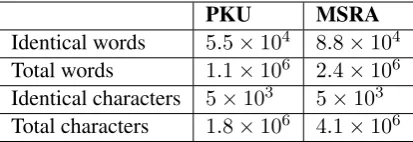
[image:6.595.313.520.62.133.2]Identical words 5.5×10⁴ 8.8×10⁴ Total words 1.1×10⁶ 2.4×10⁶ Identical characters 5×10³ 5×10³ Total characters 1.8×10⁶ 4.1×10⁶ Table 1: Details of the PKU and MSRA datasets
Window size w= 5
Character(tag) embedding size d= 25 Hidden unit number H2= 50 Number of factors r= 10 Initial learning rate α= 0.2 Margin loss discount κ= 0.2 Regularization λ= 10−4
Table 2: Hyperparameters of our model
(Duchi et al., 2011) with minibatchs to minimize the objective. The parameter update for thei-th parameterθt,iat time steptis as follows:
θt,i=θt−1,i−qPtα τ=1g2τ,i
gt,i (14)
whereαis the initial learning rate andgτ ∈ R|θi| is the subgradient at time stepτ for parameterθi. 4 Experiment
4.1 Data and Model Selection
We use the PKU and MSRA data provided by the second International Chinese Word Segmentation Bakeoff (Emerson, 2005) to test our model. They are commonly used by previous state-of-the-art models and neural network models. Details of the data are listed in Table 1. For evaluation, we use the standard bake-off scoring program to calculate precision, recall, F1-score and out-of-vocabulary (OOV) word recall.
in-P R F OOV CRF 87.8 85.7 86.7 57.1 NN 92.4 92.2 92.3 60.0 NN+Tag Embed 93.0 92.7 92.9 61.0 MMTNN 93.7 93.4 93.5 64.2 Table 3: Test results with different configurations. NN stands for the conventional neural network. NN+Tag Embed stands for the neural network with tag embeddings.
creases drastically when the number of factors is larger than 10. We hypothesize that larger factor size results in too many parameters to train and hence perform worse. The final hyperparameters of our model are set as in Table 2.
4.2 Experiment Results
We first perform a close test3 on the PKU dataset to show the effect of different model configura-tions. We also compare our model with the CRF model (Lafferty et al., 2001), which is a widely used log-linear model for Chinese word segmen-tation. The input feature to the CRF model is sim-ply the context characters (unigram feature) with-out any additional feature engineering. We use an open source toolkitCRF++4 to train the CRF model. All the neural networks are trained us-ing the Max-Margin approach described in Sec-tion 3.4. Table 3 summarizes the test results. As we can see, by using Tag embedding, the F-score is improved by +0.6% and OOV recall is improved by +1.0%, which shows that tag embed-dings succeed in modeling the tag-tag interaction and tag-character interaction. Model performance is further boosted after using tensor-based trans-formation. The F-score is improved by +0.6% while OOV recall is improved by +3.2%, which denotes that tensor-based transformation captures more interactional information than simple non-linear transformation.
Another important result in Table 3 is that our neural network models perform much better than CRF-based model when only unigram features are used. Compared with CRF, there are two differ-ences in neural network models. First, the discrete feature vector is replaced with dense character em-beddings. Second, the non-linear transformation 3No other material or knowledge except the training data is allowed
4http://crfpp.googlecode.com/svn/
trunk/doc/index.html?source=navbar
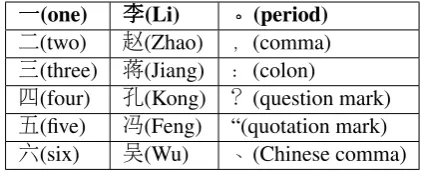
一一一(one) 李李李(Li) 。。。(period) 二(two) 赵(Zhao) ,(comma) 三(three) 蒋(Jiang) :(colon)
[image:7.595.310.522.62.148.2]四(four) 孔(Kong) ?(question mark) 五(five) 冯(Feng) “(quotation mark) 六(six) 吴(Wu) 、(Chinese comma)
Table 4: Examples of character embeddings
is used to discover higher level representation. In fact, CRF can be regarded as a special neural net-work without non-linear function (Wang and Man-ning, 2013). Wang and Manning (2013) conduct an empirical study on the effect of non-linearity and the results suggest that non-linear models are highly effective only when distributed representa-tion is used. To explain why distributed represen-tation captures more information than discrete fea-tures, we show in Table 4 the effect of character embeddings which are obtained from the lookup table of MMTNN after training. The first row lists three characters we are interested in. In each col-umn, we list the top 5 characters that are near-est (measured by Euclidean distance) to the cor-responding character in the first row according to their embeddings. As we can see, characters in the first column are all Chinese number characters and characters in the second column and the third column are all Chinese family names and Chinese punctuations respectively. Therefore, compared with discrete feature representations, distributed representation can capture the syntactic and se-mantic similarity between characters. As a re-sult, the model can still perform well even if some words do not appear in the training cases.
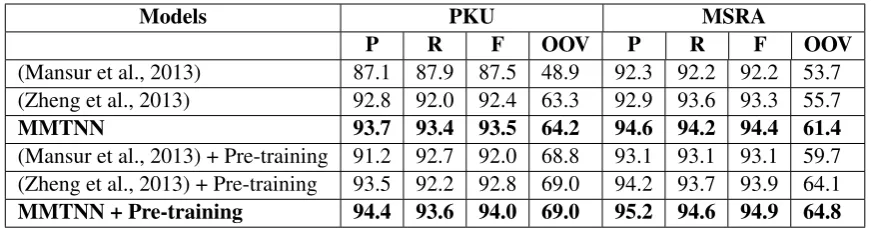
We further compare our model with previous neural network models on both PKU and MSRA datasets. Since Zheng et al. (2013) did not report the results on the these datasets, we re-implemented their model and tested it on the test data. The results are listed in the first three rows of Table 5, which shows that our model achieved higher F-score than the previous neural network models.
4.3 Unsupervised Pre-training
Models PKU MSRA
P R F OOV P R F OOV
(Mansur et al., 2013) 87.1 87.9 87.5 48.9 92.3 92.2 92.2 53.7 (Zheng et al., 2013) 92.8 92.0 92.4 63.3 92.9 93.6 93.3 55.7
MMTNN 93.7 93.4 93.5 64.2 94.6 94.2 94.4 61.4
(Mansur et al., 2013) + Pre-training 91.2 92.7 92.0 68.8 93.1 93.1 93.1 59.7 (Zheng et al., 2013) + Pre-training 93.5 92.2 92.8 69.0 94.2 93.7 93.9 64.1 MMTNN + Pre-training 94.4 93.6 94.0 69.0 95.2 94.6 94.9 64.8
Table 5: Comparison with previous neural network models
(Mansur et al., 2013; Zheng et al., 2013). Mikolov et al. (2013b) show that pre-trained embeddings can capture interesting semantic and syntactic in-formation such asking−man+woman≈queen
on English data. There are several ways to learn the embeddings on unlabeled data. Mansur et al. (2013) used the model proposed by Bengio et al. (2003) which learns the embeddings based on neu-ral language model. Zheng et al. (2013) followed the model proposed by Collobert et al. (2008). They constructed a neural network that outputs high scores for windows that occur in the cor-pus and low scores for windows where one char-acter is replaced by a random one. Mikolov et al. (2013a) proposed a faster skip-gram model
word2vec5 which tries to maximize classification
of a word based on another word in the same sen-tence. In this paper, we useword2vecbecause pre-liminary experiments did not show differences be-tween performances of these models butword2vec
is much faster to train. We pre-train the embed-dings on the Chinese Giga-word corpus (Graff and Chen, 2005). As shown in Table 5 (last three rows), both the F-score and OOV recall of our model boost by using pre-training. Our model still outperforms other models after pre-training.
4.4 Minimal Feature Engineering
Although we focus on the question that how far we can go without using feature engineering in this paper, the study of deep learning for NLP tasks is still a new area in which it is currently chal-lenging to surpass the state-of-the-art without ad-ditional features. To incorporate features into the neural network, Mansur et al. (2013) proposed the feature-based neural network where each con-text feature is represented as feature embeddings. The idea of feature embeddings is similar to that of character embeddings described in section 2.1.
5https://code.google.com/p/word2vec/
Model PKU MSRA
Best05(Chen et al., 2005) 95.0 96.0 Best05(Tseng et al., 2005) 95.0 96.4 (Zhang et al., 2006) 95.1 97.1 (Zhang and Clark, 2007) 94.5 97.2 (Sun et al., 2009) 95.2 97.3 (Sun et al., 2012) 95.4 97.4 (Zhang et al., 2013) 96.1 97.4
MMTNN 94.0 94.9
[image:8.595.81.517.61.176.2]MMTNN + bigram 95.2 97.2 Table 6: Comparison with state-of-the-art systems
Formally, we assume the extracted features form a feature dictionaryDf. Then each featuref ∈Df is represented by ad-dimensional vector which is called feature embedding. Following their idea, we try to find out how well our model can perform with minimal feature engineering.
from 94.0% to 95.2% on PKU dataset and from 94.9% to 97.2% on MSRA dataset. It is a com-petitive result given that our model only use sim-ple bigram features while other models use more complex features. For example, Sun et al. (2012) uses additional word-based features. Zhang et al. (2013) uses eight types of features such as Mu-tual Information and Accessor Variety and they extract dynamic statistical features from both an in-domain corpus and an out-of-domain corpus us-ing co-trainus-ing. Since feature engineerus-ing is not the main focus of this paper, we did not experi-ment with more features.
5 Related Work
Chinese word segmentation has been studied with considerable efforts in the NLP community. The most popular approach treats word segmentation as a sequence labeling problem which was first proposed in Xue (2003). Most previous systems address this task by using linear statistical mod-els with carefully designed features such as bi-gram features, punctuation information (Li and Sun, 2009) and statistical information (Sun and Xu, 2011). Recently, researchers have tended to explore new approaches for word segmentation which circumvent the feature engineering by au-tomatically learning features with neural network models (Mansur et al., 2013; Zheng et al., 2013). Our study is consistent with this line of research, however, our model explicitly models the intertions between tags and context characters and ac-cordingly captures more semantic information.
Tensor-based transformation was also used in other neural network models for its ability to cap-ture multiple interactions in data. For example, Socher et al. (2013b) exploited tensor-based func-tion in the task of Sentiment Analysis to cap-ture more semantic information from constituents. However, given the small size of their tensor ma-trix, they do not have the problem of high time cost and overfitting problem as we faced in mod-eling a sequence labmod-eling task like Chinese word segmentation. That’s why we propose to decrease computational cost and avoid overfitting with ten-sor factorization.
Various tensor factorization (decomposition) methods have been proposed recently for tensor-based dimension reduction (Cohen et al., 2013; Van de Cruys et al., 2013; Chang et al., 2013). For example, Chang et al. (2013) proposed the
Multi-Relational Latent Semantic Analysis. Sim-ilar to LSA, a low rank approximation of the ten-sor is derived using a tenten-sor decomposition ap-proch. Similar ideas were also used for collab-orative filtering (Salakhutdinov et al., 2007) and object recognition (Ranzato et al., 2010). Our ten-sor factorization is related to these work but uses a different tensor factorization approach. By in-troducing tensor factorization into the neural net-work model for sequence labeling tasks, the model training and inference are speeded up and overfit-ting is prevented.
6 Conclusion
In this paper, we propose a new model called Max-Margin Tensor Neural Network that explicitly models the interactions between tags and context characters. Moreover, we propose a tensor fac-torization approach that effectively improves the model efficiency and avoids the risk of overfitting. Experiments on the benchmark datasets show that our model achieve better results than previous neu-ral network models and that our model can achieve a competitive result with minimal feature engi-neering. In the future, we plan to further extend our model and apply it to other structure predic-tion problems.
Acknowledgments
This work is supported by National Natural Science Foundation of China under Grant No. 61273318 and National Key Basic Research Pro-gram of China 2014CB340504.
References
Yoshua Bengio, R´ejean Ducharme, Pascal Vincent, and Christian Jauvin. 2003. A neural probabilistic lan-guage model. Journal of Machine Learning Re-search, 3:1137–1155.
Kai-Wei Chang, Wen-tau Yih, and Christopher Meek. 2013. Multi-relational latent semantic analysis. In
Proceedings of the 2013 Conference on Empirical Methods in Natural Language Processing, pages 1602–1612, Seattle, Washington, USA, October. Association for Computational Linguistics.
Shay B Cohen, Giorgio Satta, and Michael Collins. 2013. Approximate pcfg parsing using tensor de-composition. InProceedings of NAACL-HLT, pages 487–496.
Michael Collins. 2002. Discriminative training meth-ods for hidden markov models: Theory and exper-iments with perceptron algorithms. InProceedings of the ACL-02 conference on Empirical methods in natural language processing-Volume 10, pages 1–8. Association for Computational Linguistics.
Ronan Collobert and Jason Weston. 2008. A unified architecture for natural language processing: Deep neural networks with multitask learning. In Pro-ceedings of the 25th international conference on Machine learning, pages 160–167. ACM.
Ronan Collobert, Jason Weston, L´eon Bottou, Michael Karlen, Koray Kavukcuoglu, and Pavel Kuksa. 2011. Natural language processing (almost) from scratch. The Journal of Machine Learning Re-search, 12:2493–2537.
John Duchi, Elad Hazan, and Yoram Singer. 2011. Adaptive subgradient methods for online learning and stochastic optimization. The Journal of Ma-chine Learning Research, 999999:2121–2159.
Thomas Emerson. 2005. The second international chi-nese word segmentation bakeoff. InProceedings of the Fourth SIGHAN Workshop on Chinese Language Processing, volume 133.
David Graff and Ke Chen. 2005. Chinese gigaword.
LDC Catalog No.: LDC2003T09, ISBN, 1:58563– 230.
Geoffrey E Hinton. 1986. Learning distributed repre-sentations of concepts. InProceedings of the eighth annual conference of the cognitive science society, pages 1–12. Amherst, MA.
Alex Krizhevsky, Geoffrey E Hinton, et al. 2010. Fac-tored 3-way restricted boltzmann machines for mod-eling natural images. In International Conference on Artificial Intelligence and Statistics, pages 621– 628.
John Lafferty, Andrew McCallum, and Fernando CN Pereira. 2001. Conditional random fields: Prob-abilistic models for segmenting and labeling se-quence data.
Zhongguo Li and Maosong Sun. 2009. Punctuation as implicit annotations for chinese word segmentation.
Computational Linguistics, 35(4):505–512.
Mairgup Mansur, Wenzhe Pei, and Baobao Chang. 2013. Feature-based neural language model and chinese word segmentation. In Proceedings of the Sixth International Joint Conference on Natural Language Processing.
Tomas Mikolov, Kai Chen, Greg Corrado, and Jef-frey Dean. 2013a. Efficient estimation of word representations in vector space. arXiv preprint arXiv:1301.3781.
Tomas Mikolov, Wen-tau Yih, and Geoffrey Zweig. 2013b. Linguistic regularities in continuous space word representations. In Proceedings of NAACL-HLT, pages 746–751.
Marc’Aurelio Ranzato, Alex Krizhevsky, and Geof-frey E Hinton. 2010. Factored 3-way restricted boltzmann machines for modeling natural images. Nathan D Ratliff, J Andrew Bagnell, and Martin A
Zinkevich. 2007. (online) subgradient methods for structured prediction.
Ruslan Salakhutdinov, Andriy Mnih, and Geoffrey Hinton. 2007. Restricted boltzmann machines for collaborative filtering. InProceedings of the 24th in-ternational conference on Machine learning, pages 791–798. ACM.
Holger Schwenk, Anthony Rousseau, and Mohammed Attik. 2012. Large, pruned or continuous space language models on a gpu for statistical machine translation. InProceedings of the NAACL-HLT 2012 Workshop: Will We Ever Really Replace the N-gram Model? On the Future of Language Modeling for HLT, pages 11–19. Association for Computational Linguistics.
Richard Socher, John Bauer, Christopher D Manning, and Andrew Y Ng. 2013a. Parsing with composi-tional vector grammars. InAnnual Meeting of the Association for Computational Linguistics (ACL). Richard Socher, Alex Perelygin, Jean Y Wu, Jason
Chuang, Christopher D Manning, Andrew Y Ng, and Christopher Potts. 2013b. Recursive deep mod-els for semantic compositionality over a sentiment treebank. EMNLP.
Weiwei Sun and Jia Xu. 2011. Enhancing chinese word segmentation using unlabeled data. In Pro-ceedings of the Conference on Empirical Methods in Natural Language Processing, pages 970–979. As-sociation for Computational Linguistics.
Xu Sun, Yaozhong Zhang, Takuya Matsuzaki, Yoshi-masa Tsuruoka, and Jun’ichi Tsujii. 2009. A dis-criminative latent variable chinese segmenter with hybrid word/character information. InProceedings of Human Language Technologies: The 2009 An-nual Conference of the North American Chapter of the Association for Computational Linguistics, pages 56–64. Association for Computational Lin-guistics.
Korea, July. Association for Computational Linguis-tics.
Ben Taskar, Vassil Chatalbashev, Daphne Koller, and Carlos Guestrin. 2005. Learning structured predic-tion models: A large margin approach. In Proceed-ings of the 22nd international conference on Ma-chine learning, pages 896–903. ACM.
Huihsin Tseng, Pichuan Chang, Galen Andrew, Daniel Jurafsky, and Christopher Manning. 2005. A condi-tional random field word segmenter for sighan bake-off 2005. In Proceedings of the Fourth SIGHAN Workshop on Chinese Language Processing, volume 171.
Tim Van de Cruys, Thierry Poibeau, and Anna Ko-rhonen. 2013. A tensor-based factorization model of semantic compositionality. In Proceedings of NAACL-HLT, pages 1142–1151.
Mengqiu Wang and Christopher D Manning. 2013. Effect of non-linear deep architecture in sequence labeling. InProceedings of the Sixth International Joint Conference on Natural Language Processing. Nianwen Xue. 2003. Chinese word segmentation as
character tagging. Computational Linguistics and Chinese Language Processing, 8(1):29–48.
Yue Zhang and Stephen Clark. 2007. Chinese seg-mentation with a word-based perceptron algorithm.
InANNUAL MEETING-ASSOCIATION FOR
COM-PUTATIONAL LINGUISTICS, volume 45, page 840. Ruiqiang Zhang, Genichiro Kikui, and Eiichiro Sumita. 2006. Subword-based tagging by condi-tional random fields for chinese word segmentation. In Proceedings of the Human Language Technol-ogy Conference of the NAACL, Companion Volume: Short Papers, pages 193–196. Association for Com-putational Linguistics.